False Flags?
Semiotic Operations and Assemblages of (Neo) Fascist Propaganda and Protest
Tom Holert
Abstract
Prologue: Bad Object
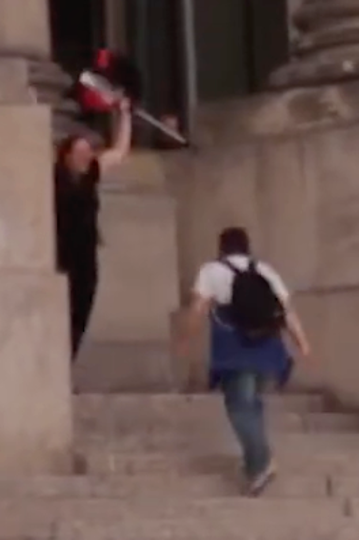
1 | August 29, 2020, the first demonstrator entering the stair landing of the Reichstag building. Enlarged detail from screenshot. YouTube, The Honest Club.
On the steps leading to the main entrance of the Reichstag building in Berlin, the seat of the German Bundestag, a female figure waves what appears to be a crumpled Reichsflagge, a German Empire’s flag (evidenced by its black, white, and red colors) attached to a small white staff with her left hand. The image is an enlarged detail from a screenshot of a video taken on the evening of August 29, 2020, during a turbulent gathering of around 400 demonstrators on the Reichstag steps, culminating in what infamously entered the historical archive as the “Sturm auf den Reichstag” (“Storming of the Reichstag”). In many ways, this figure serves as a kind of secret protagonist of this text and the research that underlies it. Her blurred, anonymous presence represents a sense of rage directed against a state’s political establishment, with the express desire to enter the Reichstag that she and her fellow demonstrators identified as, in the heat of that moment, the building of the people, the Volk.
By equipping and extending herself with a specific, and, moreover, controversial flag, presumably to underscore her rage, the figure embedded herself in an event which was cluttered with flags– and not only Reichsflaggen – as seen in various visual documents of the event. The demonstration at the Reichstag building took place alongside a larger demonstration protesting measures related to the coronavirus. It was a diverse, motley crowd, comprising QAnon supporters, so-called Reich citizens, and various fringe critics of pandemic policy. A majority of those gathered in front of the building were right-wing extremists, many of whom made their ideological positions graphically clear through the display of various flags, visible to the numerous cameras operating on site. While it would be worth discussing further the extent to which these flag wavers were fascists in any theoretically and historically meaningful sense, it can be easily observed that they displayed convictions that tapped into a growing mood of stark opposition to most features of liberal democracies.
In many ways, the flag flying in front of the Reichstag building on August 29, 2020, may reinforce the prejudice that the flag itself is an essentially problematic, if not outright ‘bad object’ in the psychoanalytic sense. My own interest in this object of contestation, identification, and embodiment originates in a deep unease with what any nation-state flag represents and potentially entails in terms of affect and potential violence. The origin of the flag as a banner or standard in the military and on the battlefield renders any critique of its eventual weaponization tautological. With some exceptions, such as truce or rainbow flags, where flags fly, the violence of war and colonialism, exclusion and oppression, are not far away. In whatever ways they may have used in painting, photography, or film to depict or to represent politically progressive intentions and perspectives, this intrinsically violent iconographic legacy, which extends to contemporary art and its adaptations of the flag as motif and material (e.g. Fleckner 2011), cannot be obscured. Attempts to frame a flag as a unifying or harmonizing symbol of democracy, patriotism, or overcoming of tyranny must reckon with the fact that flags are historically embedded within nationalism, chauvinism, and conquest. As one pioneering researcher on the semiotics of the flag formulated in 1973, “in order to impress other nation-states with its military potential, the nation-state must somehow harness each successive generation of its nationals to this collective objective of military readiness” (Weitman 1973, 361). Just as the topic of this “Engramma” issue, “Political iconology of far right-wing culture”, does not necessarily promise optimistic, life-affirming research, so too may inquiry into the political performativity of the flag in past and present “image space” prove disturbing.
Flying/Dying: The Totemist Telos of the Flag
While the second part of this text focuses upon the semiotics, iconology, and performativity of the flags displayed on August 29, 2020, I will begin by outlining the concept of the flag as totem, before examining the functions of flags in historical fascism to clarify the genealogy of the crumpled Reich flag. The pairing of flags and fascism seems to be an obvious connection. And yet, apart from some exceptions referring to historical fascism in Germany and Italy, there is surprisingly little interesting research on flags in contemporary right-wing extremist, authoritarian, and fascist movements, societies, and systems. This relative lack of inspiring work on the flag/fascism complex can be explained, at least in part, by the fact that isolating flags from the symbolic and ritual apparatus of political movements and state structures yields little in terms of historical and iconological insights. Here, I tend to agree with Carolyn Marvin and David W. Ingle, authors of 1999 Blood Sacrifice and the Nation. Totem Rituals and the American Flag, that it is likely “that scholars have not expected to find interesting patterns in such data (i.e. representative data from the field of practices relating to displays of flags and other national symbols). If everyone knows what the flag means and how it is displayed, there is little for scholars to say” (Marvin, Ingle 1999, 317). It does not seem effective to focus primarily or exclusively upon the flag as a designed and symbolic object, rather than upon the performative, rhetorical, and embodied aspects of the use and display of flags in image spaces of “banal nationalism” (Billig 1995) and blatant propaganda. National flags are flown in front yards in many countries, most notoriously in the United States. They are deployed in the PR strategies of major global sporting events and their brand-related displays of national pride. They fly at military parades and as manifestations of white supremacy and xenophobic attitudes, both offline and online. Such featuring in complex, intermedial, semio-praxeological assemblages, demands that the analysis of flags gives attention to the material, political, and social dimensions of semiosis, areas where semiotic research on flags has rarely gone, despite some attempts in this direction (e.g. Firth 1973, 328-367; Weitman 1973; Cerulo 1993, Reichl 2004; Leone 2021). If semiotics, according to Umberto Eco’s jocular definition, is the “discipline studying everything which can be used in order to lie” (Eco 1976, 7), then a semiotic approach to flags seems particularly appropriate in the context of right-wing extremist and fascist politics, even if this truism applies to all politics.
For some years now, historians Philippe Lagadec and Laurent Le Gall have been working with the concept of “vexillary regime” (régime vexillaire), defined as, “a set of devices and practices adopted by a group, and by extension a society, which induce representations, sensibilities, and imaginaries, thereby conforming, through more or less implicit rules of conduct, an order of discourse and ways of talking about flags and making them speak” (Lagadec, Le Gall 2023, 9). Lagadec and Le Gall further expand upon the performative functionality of the flag, which they conceive of as “a latent resource, […] a materially tangible surface that allows [political/social actors] to project themselves into relationships, sometimes paradoxical, with more or less elementary forms of collectivity […]” (Lagadec, Le Gall 2023, 13).
The phrase “elementary forms” of course evokes Émile Durkheim’s The Elementary Forms of Religious Life, in which the sociologist and ethnologist dedicated few, but pertinent, paragraphs to the issue of totemist emblems and flags. Durkheim attended to the “contagious” relationships between things, feelings, and symbols – the close, mental connection between “the idea of the thing and the idea of its symbol” which enables the phenomenon that “the feelings evoked by one spread contagiously to the other” (Durkheim [1912] 1995, 221). Durkheim, anticipating gestalt psychology as much as communications theory, seemed aware that “this contagion […] is much more complete and more pronounced whenever the symbol is something simple, well defined, and easily imagined” (Durkheim [1912] 1995, 221). For him, the reality of the symbol supersedes and dominates the emotional involvement over any reality it may symbolize, thus granting a peculiar agency to the flag or banner to evoke the animistic collapsing of dualisms such as signifier/signified or subject/object, endowing the flag with the status of a living being. As stated, for example, in U.S. Code Title 36, § 176 (“Respect for flag”), “The flag represents a living country and is itself considered a living thing”.
Intimacy and identity are rooted in symbolic relationships, on the ideational level of the sign, they may therefore be called ‘idealistic’ in a very specific sense. Durkheim could thus not be more explicit in the years of heightened nationalist chauvinism and warmongering in the run-up to the First World War, when he states, specifically in relation to the flag:
It is the symbol that is loved, feared, and respected. It is to the symbol that one is grateful. And it is to the symbol that one sacrifices oneself. The soldier who dies for his flag dies for his country, but the idea of the flag is actually in the foreground of his consciousness. Indeed, the flag sometimes causes action directly. Although the country will not be lost if a solitary flag remains in the hands of the enemy or won if it is regained, the soldier is killed retaking it. He forgets that the flag is only a symbol that has no value in itself but only brings to mind the reality it represents. The flag itself is treated as if it was that reality (Durkheim [1912] 1995, 221-222).
One who believes in the totemist power of the flag is framed as oblivious to the flag’s semiotic functioning. For Durkheim, the veneration and martyrdom exercised in the face of the flag is thus a testament to a momentary suspension of enlightened, secular reasoning, a reminder of modernity’s disenchantment.
Carolyn Marvin and David W. Ingle expand upon Durkheim’s (and only a few others’) anthropological approach to flags, underscoring the crucial dimensions of violence and martyrdom with regard to the semiotics of the flag as totem. They argue that these dimensions indeed add to the flag’s power to promote national solidarity through individual and group acts of “willing sacrifice” (Marvin, Ingle 1999, 73-78; see also Shanafelt 2009, 13-14). Seen along these lines, the flag’s violent teleology is embodied in the image of the blood flag, or the Blutsfahne, so dear to fervent nationalists and National Socialists.
Marvin and Ingle’s sociological semiotics have a lot to offer a post-Durkheimian understanding of flags that exceeds better-known musings on flags’ power and poetry, such as Elias Canetti’s maxim, “Flags are wind made visible” from his 1960 Crowds and Power (Canetti [1960] 1963, 86). For Hilmar Hoffmann, who prefaced his 1988 study on Nazi propaganda with a chapter on the symbolism of flags, Canetti’s oft-quoted aphorism at the end of a section not on politics or nationalism, but on wind, summed up “the nature of flags in terms of two basic characteristics: their exposed position, visible from great distances, as they wave in the breeze above people’s heads; and the relationship between the material from which they are made – cloth or, in the case of weather vanes, metal – and their immateriality, i.e., their suitability for expressing abstract ideas, their symbolic function” (Hoffmann [1988] 1996, 1). Perhaps, though, as Hoffmann pointed out, Canetti is essentially connecting the numinous-magical aspect with the imperialistic-military function of the flag when he writes that flags “are like bits cut from clouds, nearer and more varied in color, tethered and given permanent shape. In their movement they are truly arresting. Nations use them to mark the air above them as their own, as though the wind could be partitioned” (Canetti [1960] 1963, 86). The “truly arresting” supernatural powers of flags contribute to their totemist appeal. Moved by the wind, they divide the sky and define territorial boundaries—or, at least, that is their impact upon those who believe in them.
The distinctive nature of flags as informative signs and emotionally charged symbols is a key feature of any discussion about them, but this semiotic dimension should, as Lagadec and Le Gall suggest, “be linked to other forms of mobilization and other political mechanisms (demonstrations, strikes, etc.) within which it nestles and which operate as possible reverberations, thereby influencing the meanings that actors attach to it” (Lagadec, Le Gall 2023, 17). Here, they helpfully understand the flag – following Michael Billig’s notion of “banal nationalism” in which the symbols of the nation pass largely unnoticed, in other words, as naturalised – “as a resource that can be used by the state to mobilize on behalf of the nation or to justify discourses that advocate unity around the emblem – and what it is supposed to represent” (Lagadec, Le Gall 2023, 17). Further on, it will be discussed how the “resource” of the flag is tapped not only by states, but also by organizations and movements that oppose the state and statehood, in reference either to past states or rebellious counter-nations.
Filling the Frame: Performing the Swastika
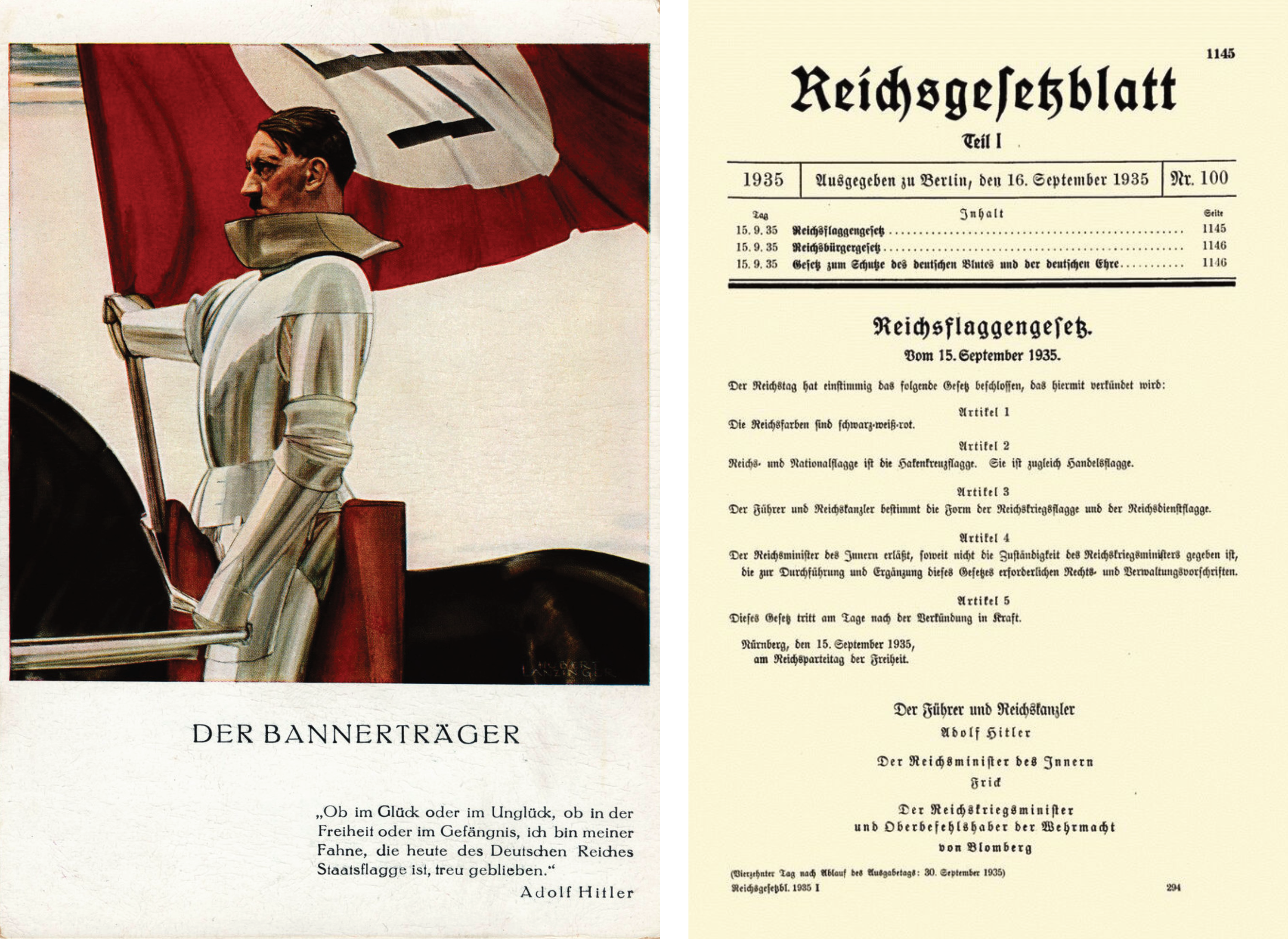
2 | Hubert Lanzinger, Der Bannerträger (“The Standard Bearer”), 1937, post card version by Heinrich Hoffmann, 1938, Washington, DC, United States Army Center of Military History.
3 | Reichsflaggengesetz (“Empire’s Flag Law”), September 15, 1935, Reichsgesetzblatt 100 (1935).
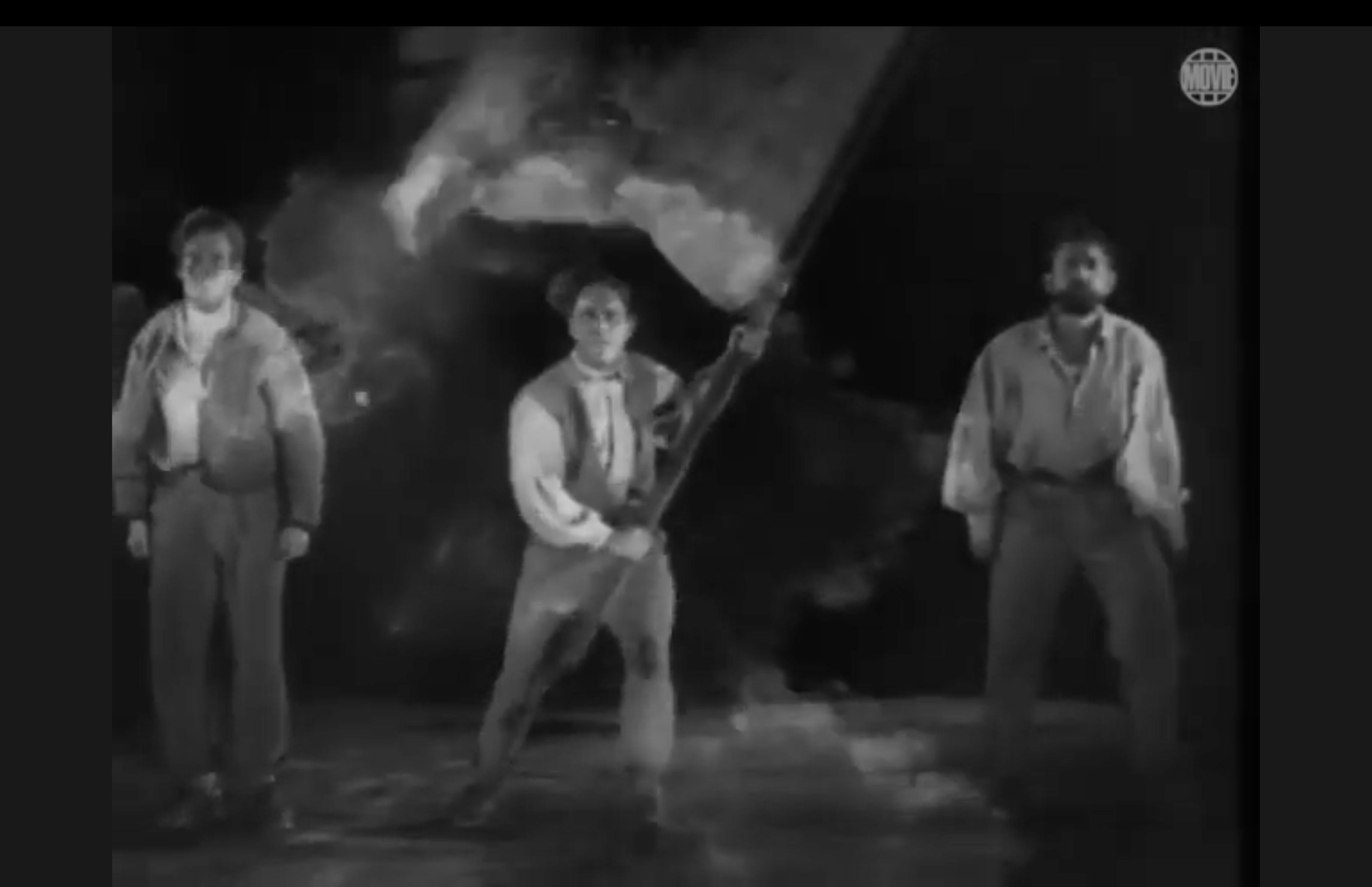
4 | Final minutes of Der Rebell [The Rebel], Luis Trenker, 1932 (click to watch).
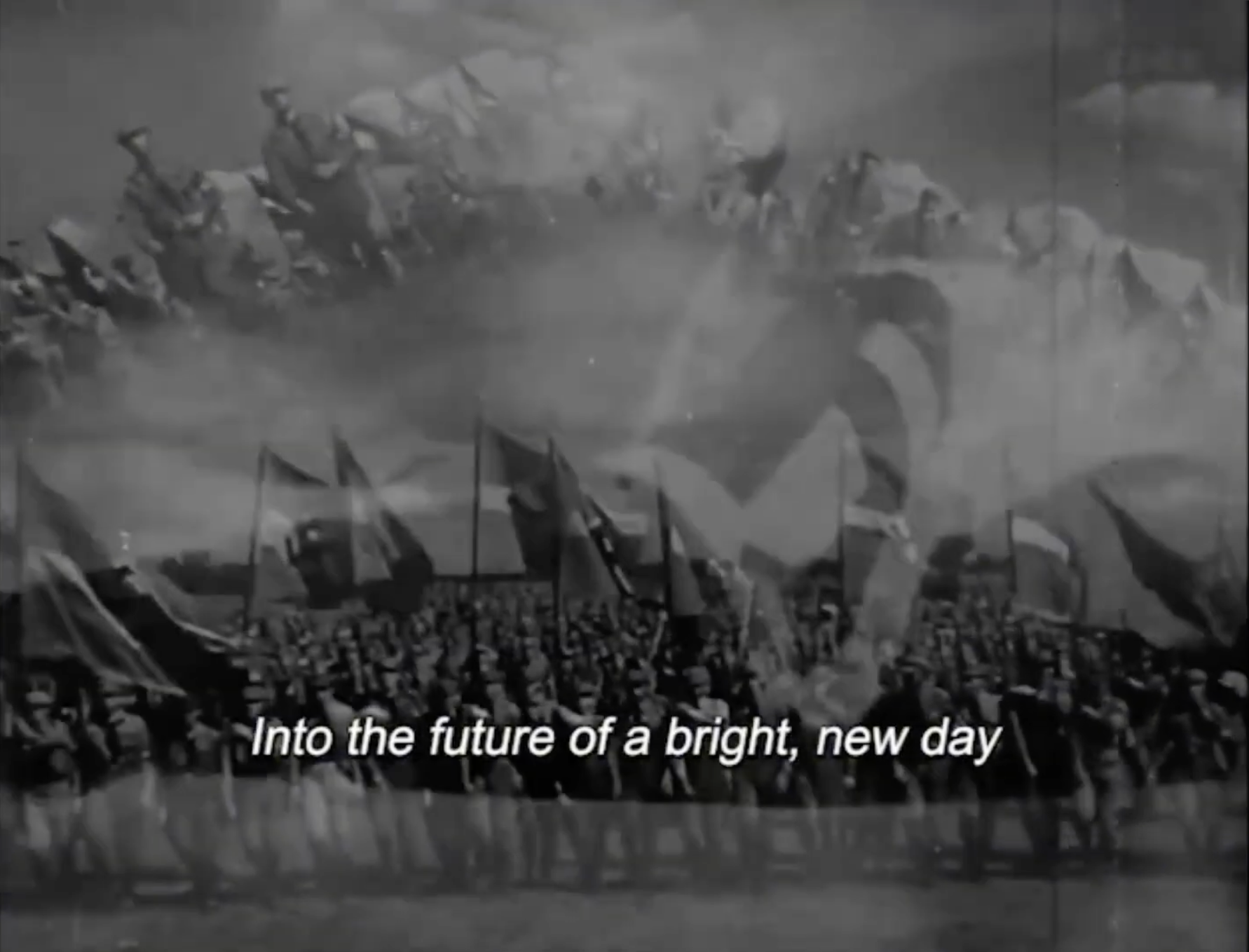
5 | Final minutes of Hitlerjunge Quex [Hitler Youth Quex], Hans Steinhoff, 1933 (click to watch).
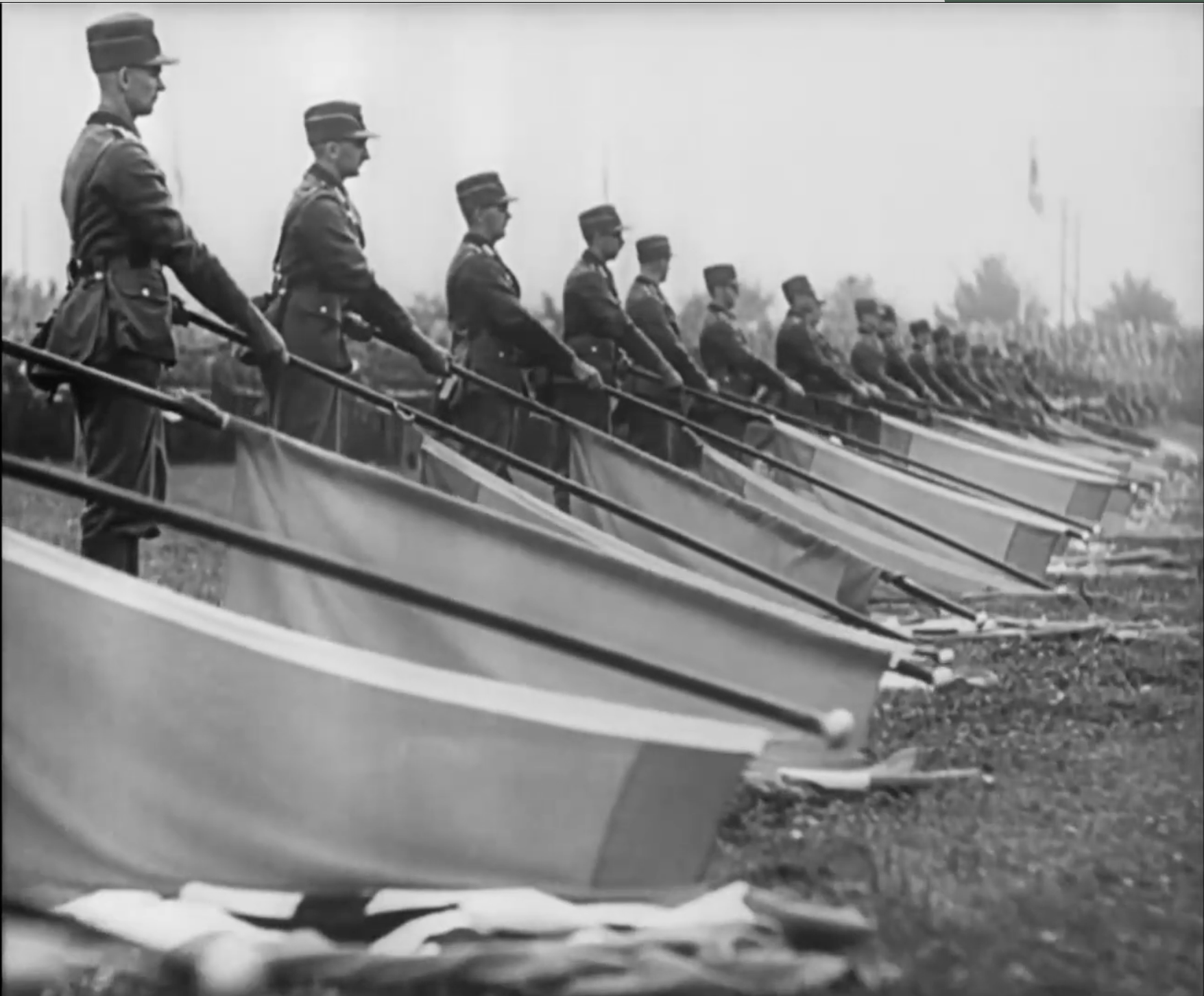
6 | Excerpt from Triumph des Willens [Triumph of the Will], Leni Riefenstahl, 1934 (the video excerpt could not be uploaded due to You Tube policy restrictions).
Historical fascism, like most nation states in the interwar period, sought to establish a highly visible and affectively charged bond between citizens and the state. Under Nazism, this relationship was framed as the organic unity of the Volksgenossen and the party. Those responsible for designing this particular “vexillary regime” understood the new popular sciences of PR, branding, and logo design, introduced in the 1920s and 1930s by right-wing designer Hans Domizlaff (Friebe 2007). They emphasized the flag in Nazi propaganda, education, urban design, and festivals.
Malcolm Quinn, author of Swastika. Constructing the Symbol, compares the Nazi swastika and the corporate logo on the assumption that both, in their own way, transcend or overturn existing exchange relationships and value systems. He writes, “What the logo now establishes as a ‘free gift’ and supplement to commodity laws of value, the Nazi swastika instituted as an injunction and a law in its own right, in the form of a ‘national awakening’ in which the individual subject was returned to himself as a member of the Aryan aristocracy” (Quinn 1994, 126). The quasi-legal power of the swastika symbol on flags, posters, badges, etc. contributed semiotically to the stigmatization and negation of Jews and other groups, who, according to the Nazi racial ideology enshrined in the Nuremberg Laws, were considered unworthy of life and rights.
Yet, the images created in the process of imposing the law-like character of the Hakenkreuz were always intended to demonstrate that the swastika flag was both autonomous and embedded, seemingly doing its sign work on its own, while at the same time integrated into rituals, architectural structures, films, or a mass stagings [Fig. 2]. In the visual, literary, and musical propaganda culture of the Nazis, the cult surrounding the flag played a prominent role in the ideological indoctrination of young people. The flag was introduced as a sacred object directly linked to the figure of Hitler, and as the bearer of his personalized swastika banner, which became the flag of the German nation/empire in order to defeat death and be led into the fascist future. The two verses and the chorus of the so-called Flag Song of the Hitler Youth, the lyrics of which were written by Reich Youth Leader, Baldur von Schirach, signal aggressive combativeness, devotion to the flag, loyalty to the Führer, and contempt for death: “Our flag flutters ahead of us! We march into the future, man for man! We march for Hitler through night and hardship, with the flag of youth, for freedom and bread! Our flag flutters ahead of us! Our flag is the new era! And the flag leads us into eternity! Yes, the flag is more than death!”.
Hitler claimed to have invented the swastika logo himself in 1920, although the final design is attributed to Friedrich Krohn, a dentist and member of the völkisch Thule-Gesellschaft. Krohn claimed to have been asked at the “Gründungsversammlung” of the NSDAP on February 24, 1920, to draw the sign (Goodrich-Clarke 2004, 151; Hartmann et al. 2016, 1248, fn. 85, 1250, fn. 93; Witamwas 2016, 43). That said, Hitler associated the swastika and the swastika flag with a call for modernization. As he wrote in Mein Kampf, “[We see] in the swastika the mission of struggle for the victory Aryan man, and, by the same token, the victory of the idea of creative work which as such always has been and always will be anti-Semitic” (translation quoted from Kasher 1992, 50). For Steven Kasher, Hitler’s “idea of creative work” refers, “to the notion of an aestheticization of labor and social relations that would negate class conflicts and unite the Volk”. The swastika was the symbol of a militant process, Hitler’s Kampf, aiming at “a totalized society rigidly stratified along sexual, racial, and class lines. It stood for a program of aggressive racial, sexual, and cultural purification, a struggle toward a single transcendent culture” (translation quoted from Kasher 1992, 50).
The significance of the swastika flag to Hitler was made evident on September 15, 1935, when he convened a special session of the Reichstag in Nuremberg to announce, among other infamous “Nuremberg Laws”, two laws concerning flag protocol [Fig. 3]. The swastika flag was declared the sole state flag of Germany, and Jews were prohibited from flying the German national flag. Furthermore, it was decreed that, “The Führer and Reich Chancellor determine the form of the Reich war flag and the Reich service flag”. Hitler’s anecdotal authorship of the flag was thus made into a law.
The question of how to deal with Bismarck’s imperial black, white, and red flag was long settled by the time the Reich Flag Law of 1935 was enacted. The black, red and gold German flag of the Weimar Republic had been replaced by a provisional black, white, and red flag after Paul von Hindenburg issued his provisional flag decree of 12 March 1933, ending the so-called flag dispute (Flaggenstreit) that had lasted for almost the entire duration of the Weimar Republic. As “sacred and dear” as the black, white, and red flag under which he had fought in the First World War had been to Hitler – its colors “uniquely beautiful in their youthful freshness” – he did not want this flag to be understood as a “symbol for a future struggle”. Therefore, he pressured Hindenburg to stipulate in 1933 that, “until the final regulation of the ‘Reich colors’, the black, white, and red flag and the swastika flag are to be hoisted together”. The traditional symbol stood for “the glorious past of the German Reich”, the new one, for the “mighty rebirth of the German nation”. “Together”, Hindenburg wrote, “They embody the power of the state and the inner bonds [linking] all the national forces of the German people” (Hindenburg, 12 March 1933, quoted from Hoffmann [1988] 1996, 17).
In popular media, Nazi propaganda developed a specific tropology and rhetoricity that prepared the ground for the swastika flag to become the ultimate, universal variant of its kind. Siegfried Kracauer, in his From Caligari to Hitler, traces one of those trajectories, suggesting a sequence beginning with the flag as a symbol of anti-French, tribalist resistance and heroic sacrifice for the nation (Tyrol) in Luis Trenker’s 1932 movie Der Rebell (The Rebel), to Hans Steinhoff’s Hitlerjunge Quex (Hitler Youth Quex) the following year, both treating the flag as a metaphysical medium to conquer death through martyrdom [Fig. 4]. “Through similar images”, Kracauer argues, “both the Trenker film and the Nazi film point at the imminent triumph of national rebellions – a coincidence which strikingly confirms the identical nature of the rebellions themselves”. Regarding The Rebel, he emphasized the manipulative cinematography of the flag, underscoring its connection to the cult of martyrdom (“apotheosis of rebellious ardor”). He writes:
There is pictorial evidence that the Trenker film was nothing but a thinly masked pro-Nazi film. Photographed by Sepp Allgeier, it introduced symbols which were to play a prominent part on the early Hitler screen. To enhance national passion, elaborate use is made of close-ups of flags, a device common with the Nazis. In the visionary concluding sequence, the resurrected student, who along with two other rebel leaders has been executed by the French, moves onwards, a flag in his hands (Kracauer [1947] 2004, 262).
Kracauer then drew a direct line from the ending of The Rebel to that of Hitler Youth Quex, writing, “In the film’s finale, the militant Hitler boy Heini, surnamed Quex, distributes leaflets in one of Berlin’s proletarian quarters and there is stabbed by a communist [Fig. 5]. Abandoned, he lies on a dark street” (Kracauer [1947] 2004, 262). He continued with a quote from a 1943 study drafted by Gregory Bateson on, “the cultural and thematic analysis of fictional films”, which attended to Hitler Youth Quex as its key example (Bateson 1943, 76): “The Nazis come and find Heini dying. His last words are, ‘Our flag billows before…’ The soundtrack takes up the Youth Song and the flag appears on the screen, giving place to marching columns of Hitler Youth” (Kracauer [1947] 2004, 262, and Bateson 1943, 76; for the context see Ponten 2020).
Bateson’s reading of the performance of flags in Hitler Youth Quex also serves as a commentary both upon Canetti’s proverbial “Flags are wind made visible”, and upon Kracauer’s focus on the close-ups of flags in Nazi films. Bateson writes:
In translating the “Nazi Youth Song”, the word flattern has been rendered as “billow”. The dictionary meaning of this word is “flutter”, and the German word is certainly sometimes used in this sense (e.g. in referring to birds). A small experiment shows, however, that Americans, when asked to visualize a flag fluttering, usually see a small flag moving rapidly or a large flag rather far away, whereas the image called up in Germans by the words Fahne and flattern is of a large flag close up. In Nazi films, the flags are usually photographed to fill the frame, so that the emphasis falls not to the changing outline of the flag, but rather on the wave motion in the middle of the fabric. This billowing motion is clearly intended to have a fascination similar to that of waves in water (Bateson 1943, 54, n. 6).
Amplifying the “fascination” of the Nazi flag by attending to its kineticism and thus filming it in a particular kind of motion, rendered effective by flooding the image with the moving fabric, was a formal strategy deployed in many instances, and probably most systematically by Leni Riefenstahl. For Kracauer, as for many others, the films of Riefenstahl, and especially Triumph des Willens (Triumph of the Will), which monumentalized the 1934 Reich’s Party Convention (Reichsparteitag) in Nuremberg, epitomize the centering of Nazi propaganda on the image of swastika flags. Bateson would have found in them plenty of evidence for his thesis of the billowing effect of the close-ups on flags in film. In Triumph of the Will, Kracauer saw “an ocean of flags and people artistically arranged. Souls were thoroughly manipulated so as to create the impression that the heart mediated between brain and hand”. To quote once again from Malcolm Quinn’s study on the swastika:
Kracauer’s analysis […] offered a model for the Nazi colonisation of the visual field […] Kracauer suggests that Nazi film motifs and cinematography conspire to demonstrate cartographically a total victory over spaces and surfaces. This is the colonisation of space undertaken by the swastika as the symbol of the new regime, and the corrosion of materiality and ontology which it initiates is manifest in Riefenstahl’s film (Quinn 1994, 123-124).
A short excerpt from Triumph of the Will may illustrate the points on the overwhelming diagrammatical force of the swastika in fascist image space made by Kracauer and Quinn. Futhermore, it incorporates additional aspects, particularly regarding Riefenstahl’s and the organizers of the Reich’s Party Convention’s cinematic and choreographed strategy of overwriting not only space but history with the totemist emblem of the swastika. In the flag ceremony of the Reich Labor Service (Reichsarbeitsdienst), stages of German military history are retraced through a sequence of the ritualistic lowering of large swastika flags onto the Nuremberg Rally’s grounds, thereby treating the swastika as the super-symbol of this history [Fig. 6].
Threat to Public Order? The Legal Coding of Right Wing Flag Culture
Displaying and wearing the swastika has been prohibited in Germany, Austria, and other countries since the end of World War II. The Criminal Code of the Federal Republic of Germany, which regulates the “distribution of propaganda materials from unconstitutional and terrorist organizations” (§ 86), makes exceptions only in cases of “civic education, the prevention of unconstitutional activities, art or science, research or teaching, reporting on current events or history, or similar purposes” (paragraph 4). There are plenty of reasons for this ban, including the identification of the Führer and the flag, the cult of sacrifice associated with the flag, and the role that swastika flags played in the propaganda assemblages of the NSDAP and the National Socialist state. Since 1945 it has not been possible to stage such assemblages in the manner known from the historical record. In the present, however, there are new, differently motivated, coordinated, and choreographed manifestations of flags—in extreme cases, with the intention to substitute, displace, or camouflage the swastika. Mirroring, or rather, diffracting, the theater of official politics, for example, during state visits or military parades, a new typology of mass protests increasingly engendering images of flag display has evolved in the first decades of the twenty-first century, either in an attempt to enforce democratic conditions within a national framework, or, in the opposite case, to manifest and mediatize anti-democratic attitudes.
This revival of flags varies according to national context at unofficial events, at which political convictions are expressed and performed. Such variation depends upon the degree to which states culturally encourage or legally regulate the display of flags, particularly those whose political symbolism is deemed problematic or prohibited from the state’s perspective. The psychological, anthropological, propagandistic, or historical-political dimensions of flag use and veneration are always supplemented by legal provisions. The state claims exclusive rights to determine how and when ‘its’ flag is displayed, hoisted, waved, etc. These protocols and criminal regulations, mostly codified with reference to constitutional law, tend to trigger semiotic reactions and strategies from those who question the state’s monopoly on the interpretation of official symbolism. Arguably, the legally mandated absence of the swastika acts as a regulatory mechanism that ensures a level of creativity and performativity in the design, selection, and use of symbols deployed to criticize the so-called “freiheitliche demokratische Grundordnung” (“free democratic constitutional order”) and its state representatives in the contemporary mediascape.
In the late afternoon of August 29, 2020, about 2000 demonstrators gathered at Platz der Republik in front of the Reichstag building in Berlin. It was a loose group that had broken away from the main demonstration of around 38,000 protesters against coronavirus measures gathered at the Brandenburg Gate, Friedrichstraße, and Straße des 17. Juni, near the parliamentary complex. At around 7 p.m. some protesters – among them, the figure waving the small imperial war flag presented at the beginning of this essay – broke through police barriers and climbed the stairs of the Reichstag building, followed by around 300 others, to perform what they themselves had announced on social media and elsewhere as a “Sturm auf den Reichstag” (“storming of the Reichstag”), a formulation quickly adopted by politicians across the spectrum and by journalists and pundits in the mainstream media.
As part of a short documentary streamed on the website of the German weekly, “Die Zeit”, in 2023, a police officer who now enjoys the reputation of “hero of the Reichstag”, and had been for years one of the most interviewed persons present at the scene, recounted the events of August 29, 2020 as follows:
For me, it was an adrenaline rush. For me, it was a classic attack on German democracy. My name is Karsten Bonack. On August 29, 2020, I was deployed to the Reichstag. When we arrived at the operations room, my platoon was assigned to protect a rally directly below the steps of the Reichstag building. Several hundred people were at the site, and speeches were being made. […] What irritated me a little at that point was that various people turned up with different flags in their hands—Russian flags, upside-down German flags, Reich war flags, rainbow flags… (Sturm auf den Reichstag: “Ein Angriff auf die Demokratie”, “Die Zeit”, 28 August 2023)
The officer’s initial irritation about the presence of a multiplicity of flags whose public and mediatized display at the time were not punishable under German law, such as the Reich flag and the flag of the Federal Republic shown upside down, is worth mentioning. It bespeaks the practice of policing symbols and signs in public space, and the persecution of those deploying these symbols and signs, especially those that are deemed in conflict with the Constitution and the legal interests of public order or peace.
These statements by a German police officer, who by default represents the executive branch responsible for upholding and enforcing laws, already emphasize, if indirectly, the significance of the legal framework around the practices and uses of flags. This legal dimension is crucial in the discussion of the performative, symbolic strategies of the far right, because it is intended to guarantee and secure historical and ideological distance from the Nazis’ use of the swastika flag. Approached from the iconological angle given by the concept of “vexillary regimes”, proposed by Lagadec and Le Gall, a large part of the appeal for members of far-right organizations of displaying Reichsflaggen and the like is their contested, problematic legal status, the anticonstitutional provocations they signal and entail, and the racist, anti-Semitic, or political violence they potentially imply.
The dissemination of propaganda and the use of symbols of unconstitutional organizations are punishable by law (Criminal Code § 86). This also includes symbols, “which, according to their content, are intended to continue the efforts of a former National Socialist organization”. Symbols are defined as, “flags, badges, uniform items, slogans, and forms of greeting”. Thus, displaying the Hitler salute and using the swastika are punishable offences. But even the traditional Reich war flag which used to fly over some allotment gardens, mostly in West Germany, has brought politicians onto the scene since the 1990s, as it was increasingly being used by right-wing extremists. The flag was not banned, but its display was forbidden, but, even then, only under certain conditions. Bavaria, for example, refused to take action against the flag’s display.
In the wording of the Verfassungsschutz (the “Federal Office for the Protection of the Constitution”), because the flag provides a “crystallization point” for criminal acts, such as displaying the Hitler salute, singing Nazi songs, or expressing insults or incitements of hatred, the police must also confiscate the flag. As for the Imperial War Flag, displaying it (except for the Reichskriegsflagge used by the National Socialists from 1935 to 1945) does not constitute an offense under the Criminal Code or the Administrative Offenses Act, even while it “can be seized under general police and public order law if this is the necessary, appropriate, and proportionate measure in specific individual cases to avert specific dangers to public safety and order. This is the case, for example, if the flag is the focal point of a specific imminent danger and this danger can be averted by confiscating it” (Bundesamt für Verfassungsschutz 2022, 53-54). Hence, on August 29, 2020, “the display and use of both the Reich flag and the Reich war flag was not prohibited”. As one commentator argued, however, confiscation or seizure of these flags may have been considered under police and public order law (Müller 2020). Apparently, such measures were not carried out, as the police seemed either to have been overwhelmed by the situation or legally unprepared to do so.
In the aftermath of the events, however, legal restrictions regarding the display of black, white, and red flags were tightened by decrees issued by the Ministries of the Interior of the federal states over the course of 2021 and 2022. Using the same text blocks, these decrees stated that, in spite of the Reich and Reich war flags not being prohibited under the Criminal Law:
When used in public, [these flags may] constitute a lasting impairment of the conditions for orderly civic and human coexistence and thus pose a threat to public order. […] This threat to public order always exists when, viewed as a whole, provocative and aggressive circumstances accompany the display of the flags, which are likely to impair the orderly civic coexistence of citizens and create a climate of violent demonstration and potential readiness to use violence (Brandenburg, Ministry of the Interior 2021).
In this context, it becomes necessary to assess the existence of a provocative and intimidating effect based on the overall circumstances of the individual incident. In particular, the decree elaborates, the slogan and the context in which the flags are displayed and used must be considered. Thus, “a threat to public order” in connection with the display of a non-prohibited Reich or Reich war flag may exist—according to these post-Sturm-auf-den-Reichstag regulations, in particular when a Reich flag is hoisted or used at a location or on a date with historical symbolic significance, when the display of the flag is accompanied by that of signs and symbols related to National Socialism, the chanting of xenophobic, anti-foreigner, or otherwise intimidating slogans or song lyrics, as well as intimidating effects due to threatening behavior produced by paramilitary-style gatherings or marches, for example, in combination with drums, torches, uniforms, marching in formation or the existence of the appearance of an association with Nazi flag marches (Brandenburg, Ministry of the Interior 2021).
Despite these decrees, however, the authorities’ powers of enforcement and sanctions remain limited (fines of €1,000 are mentioned) and are, above all, at the discretion of the regulatory and police authorities on site, who must assess whether “there is a concrete threat to public order”, based upon documented facts collected “by means of photos and video recordings, insofar as this is legally permissible”. In the event of specific danger, the confiscation of flags is possible under certain conditions – regarding “the use of Reich (war) flags in connection with assemblies, a quota system for flags should be considered as a less severe measure” (Brandenburg, Ministry of the Interior 2021).
A balancing act between conflicting legal interests is evident in every line of this code. The protection of public order versus the right to assembly, and the prevention of violent behavior in public spaces, including that expressed through symbols and their use, versus the preservation of the right to freedom of expression, are two primary tensions. Flags as components of entire arrays of official and informal, legal and illegal political signs, rituals, and symbols, are thus not only a semiotic fact, but also a constitutional and, arguably, social one. What is more, the decrees are clearly informed and influenced by intelligence gathering on the performativity and aesthetics of right-wing extremist, fascist organizations and subcultures, and their navigation of the boundaries of the sayable and the showable. Considering the strategic use of symbolic dates and anniversaries to hoist the Reichsflagge or a variant of it, the staging of processions and marches in which flags are a constitutive element, the legislator knows, or pretends to know, that the provocativeness of specific flags is amplified by their integration into various contexts, displays, rallies, social media stories, and memes.
Interferences: Disturbing the Official Flag Protocol
One of the countless photographs and videoclips produced on August 29, 2020, shows a situation far more akin to a somewhat hurried walk to the German parliament building stairs than a dramatic storming of those steps [Fig. 7]. Close to the camera is a man wearing a Reichsflagge around his neck with which he or some other has inscribed (by hand) “Peace treaty” (Friedensvertrag) on the white stripe. To the left of him, another man sports a sleeveless shirt the back of which features a printed variation of the well-known Antifa logo with the overlapping black and red flags, but this time in gold. The text written on the logo is barely legible, it is nonetheless fair to say without any hint of overstatement that appropriation and intended mockery are expressed.
During the afternoon, coinciding with the main demonstration, a small audience had attended an event organized and registered by Rüdiger Hoffmann, a notorious right-wing activist and self-acclaimed Reichsbürger, to take place in front of the Reichstag building. In the audience, a person wearing a Reichsflagge around his neck, while waving another Empire’s flag on a pole can be seen [Fig. 8]. These people and a large proportion of those who, from about 5 p.m. onwards of that day, had made their way to the Reichstag, are adherents of the heterogeneous scene involving the so-called “Reich Citizens” (Reichsbürger) movement consisting of several anti-constitutional revisionist groups and individuals in Germany and elsewhere who reject the legitimacy of the Federal Republic of Germany, in favor of the German Reich which they believe was not succeeded by the Federal Republic under the principle of state succession. Instead, they hold that the Reich continues to exist in its pre-World War II or pre-World War I borders, and its legitimate government is one or another of the Reichsbürger organizations.
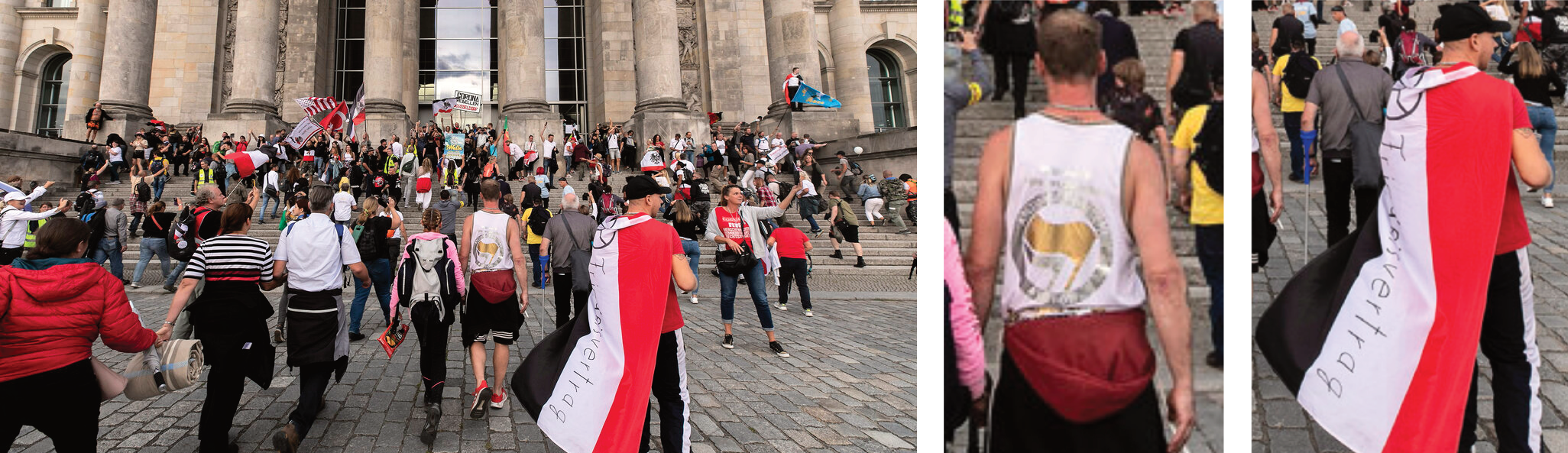
7 | August 29, 2020, “Sturm auf den Reichstag”, Berlin, at around 7 pm. Photographer: Fritz Engel/Zenit
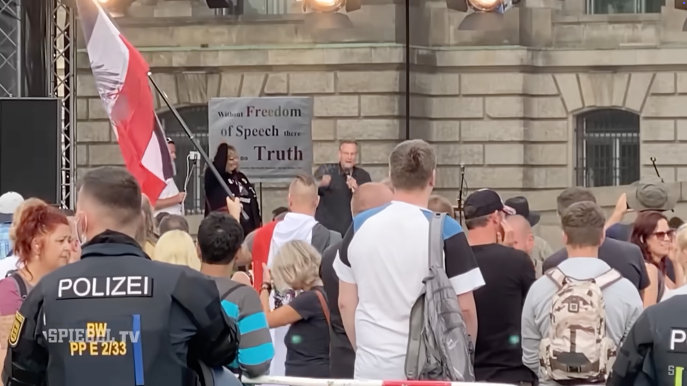
8 | Imperial flags in the audience of a speech of right-wing activist and Reichsbürger Rüdiger Hoffmann delivered from a stage in front of the Reichstag building, August 29, 2020.
Some members of Hoffmann’s audience had broken a few police barriers on the Platz der Republik (the lawn area in front of the parliament) that had been erected to keep the main demonstration participants from entering the ascent to the Reichstag building. By means of their Empire’s flags’ display they signaled affinity with the Reichsbürger movement. These flag bearers were joined by other members of assorted fringe groups. Some of those waiting to get closer to the Reichstag wore yellow vests in reminiscence of the French gilets jaunes, though primarily they were followers of QAnon, the conspiracy who, like others, spread rumors throughout the afternoon that Donald Trump was in town and would be waiting for them to negotiate peace.
A photograph taken shortly before the so-called storming of the Reichstag, reveals five flags identifiable in the crowd—three Empire’s flags, a Russian flag and a flag of the United States [Fig.9]. In the image they are framed by three German flags hoisted on two flagpoles placed to the left and the right of the stairs and one of the flagpoles on the roof of the Southwest tower of the Reichstag building. The photo thus also documents how the various flags displayed by the demonstrators interfered with the official display of the German flag. The latter is organized according to the government’s flagging decree which stipulates that the official buildings of the highest federal authorities, as well as buildings housing offices of such authorities, should be flagged every day, including: one federal flag and one European flag (each 3m x 5m) in front of the east and west entrances to the Reichstag building, one federal flag (5m x 7m) on each of the three towers of the Reichstag building, one European flag (5m x 7m) on one tower of the Reichstag building, and a flag of unity (6m x 10m) on the Platz der Republik in front of the Reichstag building (Beflaggung beim Deutschen Bundestag).
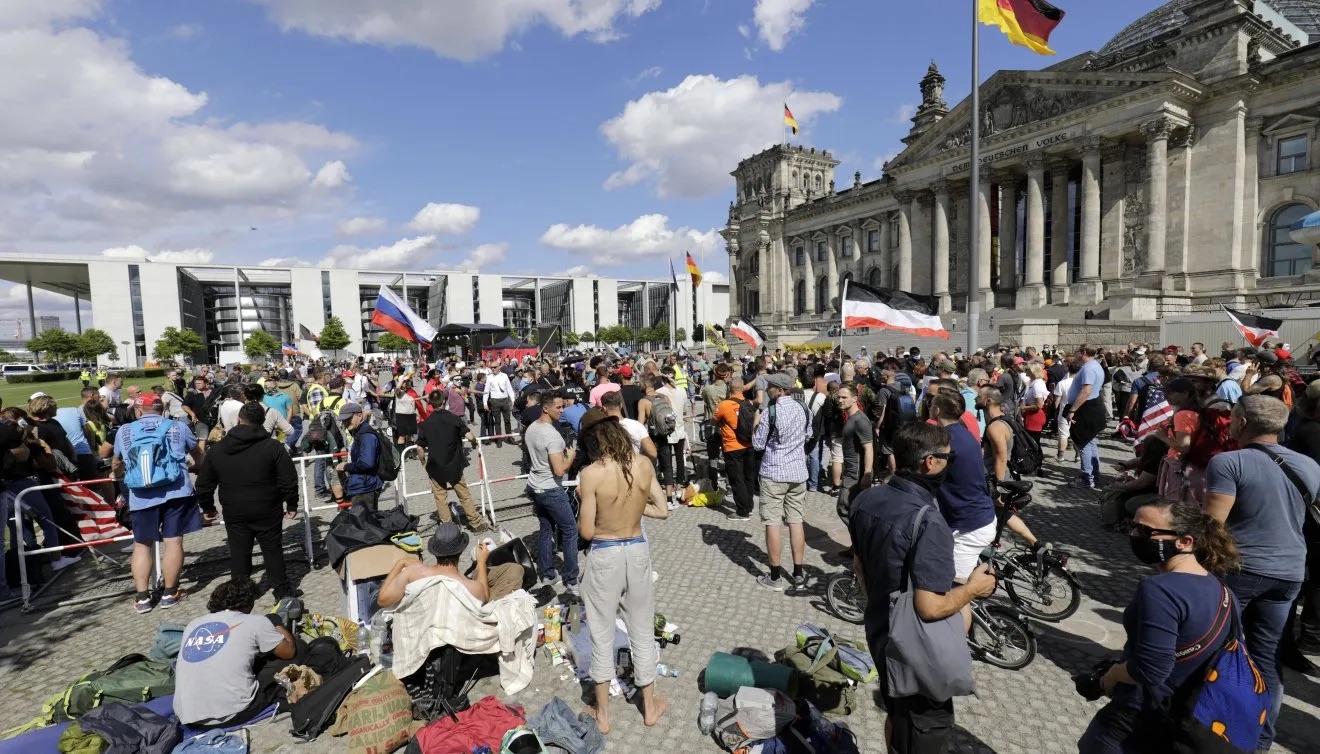
9 | August 29, 2020, early evening, gathering in front of the German parliament in advance of the “Storming of the Reichstag”. Imago Images/Future Images.
The Flag of Unity is a national monument to reunification that stands on Platz der Republik in Berlin in front of the west entrance to the Reichstag building, a few meters from the southern end of the lower staircase. The oversized German flag was first raised on October 2, 1990, as part of the celebrations marking German reunification. The raising of the flag was deliberately timed to coincide with the coming into effect of reunification at midnight and to accompany it, along with fireworks and the playing of the national anthem. Measuring six by ten meters, the flag of unity is the largest official flag of the Federal Republic of Germany.
One of the most official and widely publicized photographs of this event, kept in the Federal Archives, also shows a hand holding/waving a small Reich War Flag, the war flag of the armed forces of the German Empire until 1921, including versions derived from it in the Weimar Republic and the flags used during the Nazi era. This tiny flare-up of nationalist, even right-wing extremist sentiment in the foreground of the image indicated how the reunification could also be viewed in continuity with the nationalist and expansionist politics of the Reich, here to be understood as affirmative rather than critical. The small, handheld version of the Reichskriegsflagge certainly wasn’t the only one during that night in Berlin, as two other photos made elsewhere in Berlin on the night of October 2/3, 1990, suggest. One, also kept by the Bundesarchiv, shows a crowd of mostly men waving predominantly black, red, and gold German flags, while photographer Peer Grimm pointed his camera at a large black, white, and red Reichskriegsflagge with the Iron Cross, but in a fantasy design that the person waving it had apparently created himself without a correct historical model. The other photo, by Jochen Eckel, features a mustached man, holding the Reichskriegsflagge (in the design used between 1903 and 1921) above his head with one arm, while raising the other for the Nazi salute and sporting a small black, red and gold German flag, which he has pinned to the chest of his jacket [Figs. 10, 11, 12] .
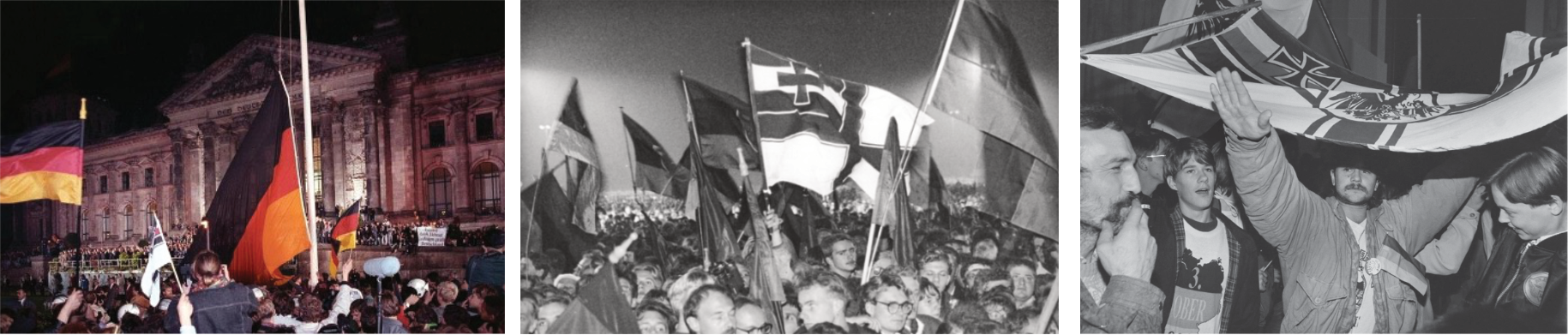
10 | Hoisting of the Flag of Unity (Einheitsflagge) at midnight of October 2/3, 1990. Photographer: Peer Grimm. Bundesarchiv.
11 | Self-made Reichskriegsflagge amid a crowd in Berlin during the reunification ceremonies in the night of October 2/3, 1990. Photographer: Peer Grimm. Bundesarchiv.
12 | A man displaying a Reichskriegsflagge and a Nazi salute in the vicinity of Brandenburg Gate, Berlin, 2/3 October, 1990. Photographer: Jochen Eckel/Imago.
In all three instances, there was (and still would be) no criminal offense under German federal law because, despite the well-documented connection between the Reichskriegsflagge and the self-promotion of the right-wing extremist and neo-Nazi scene, displaying this flag falls under the constitutional right to freedom of expression. This exemption from punishment does not, of course, alter the functions displaying this flag serves – as a symbol of recognition within the far-right movement and as a provocation toward the democratic majority population and the executive and judicial branches of government.
Almost 30 years later, the first handful of demonstrators rushed up the stairs, soon to joined by around 300 more, some of whom had broken through the next line of police barriers. Those who brought flags (some of which displayed upside down, likely as a sign of protest) were flying them on their way up or started to wave them as soon as they had reached the top of the stairs [Fig. 13]. Considered that a “Sturm auf den Reichstag” had been discussed and announced in several right wing Telegram chats in the days leading to August 29, and that on the same day some of those who delivered speeches from the Reichsbürger stage encouraged the audience to enter the building, it took surprisingly long until the first police officers arrived at the scene, enough time for the gathering of a considerable crowd on the parliament’s stairs in order to create an image of proto-revolutionary upheaval, complete with numerous of those either posed dressed in the flag or waving flags on poles. This process created the sight of a certain variety of flags – a vista clearly orchestrated for the many handheld cameras and the several tv camera teams on site.
Whether this was a staged event involving so many flags may or may not invite comparisons with Leni Riefenstahl’s staging of flags and people for the camera – that is for us to decide [Fig. 14]. In any case, the action on August 29, 2020, was quite obviously an allusion to the “Storming of the Reichstag”, organized and staged in November 2017 by theater director and provocateur Milo Rau (itself reminiscent of the storming of the Winter Palace in Petrograd in November 1917 or rather the “mass action” directed by Nikolai Evreinov on the third anniversary of the revolution in 1920). The second, more immediate precedent of the August 29 events, however, were protests such as the one taking place outside and inside of the State Capitol in Lansing, Michigan, on April 15, 2020, organized in part by far right groups and extremist Trump supporters but also mobilizing others who were, for a variety of (mainly economic) reasons, dissatisfied and concerned with the Covid related lockdowns and other measures [Fig. 15]. Here too, numerous flags were present on the scene, and not only the US flag, anticipating the “vexillary” character of many of the photographs and videos taken at the riots at the Capitol in Washington on January 6, 2021.
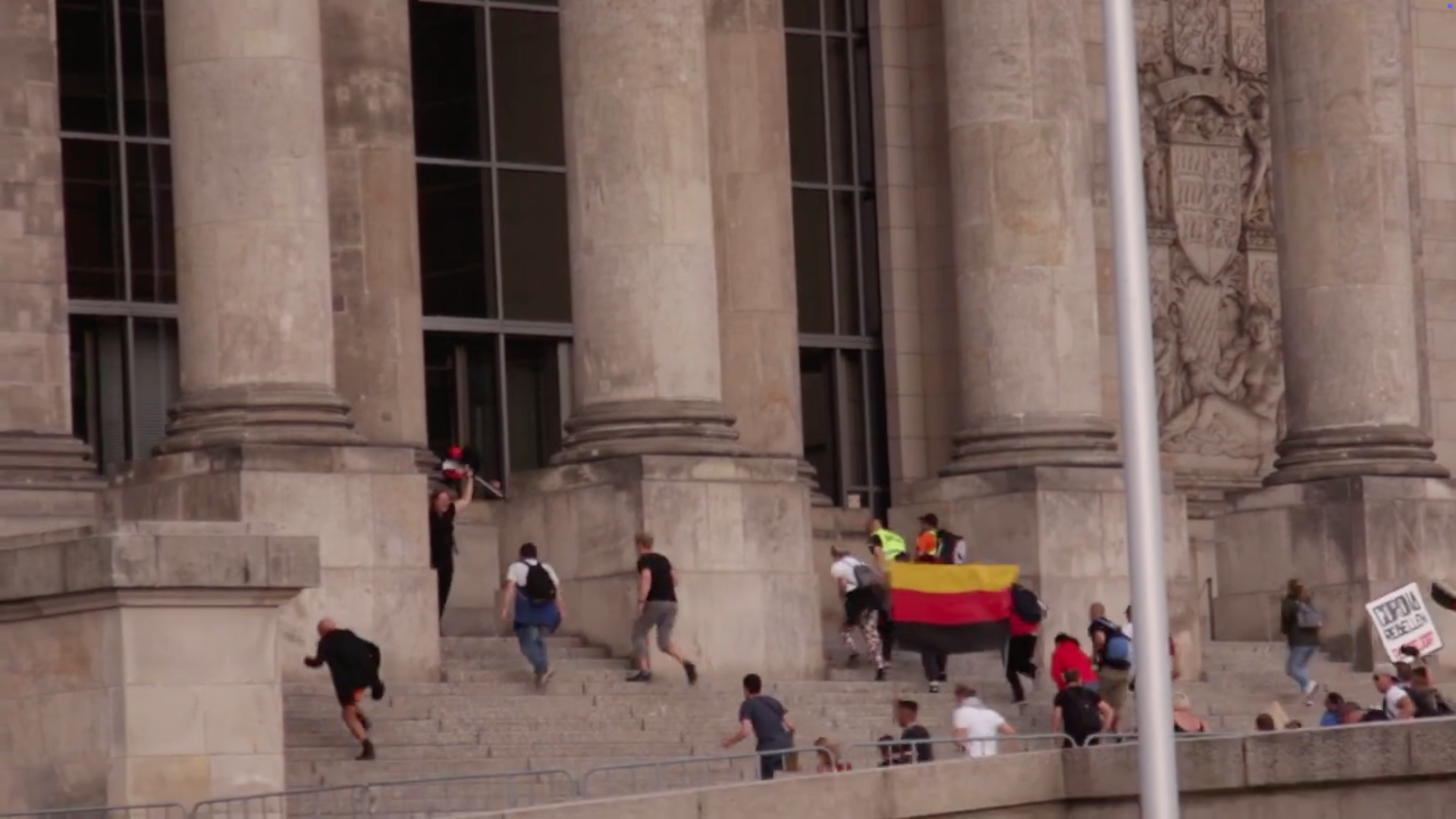
13 | August 29, 2020, the first demonstrators entering the stairs of the Reichstag building, screenshot. YouTube, The Honest Club.
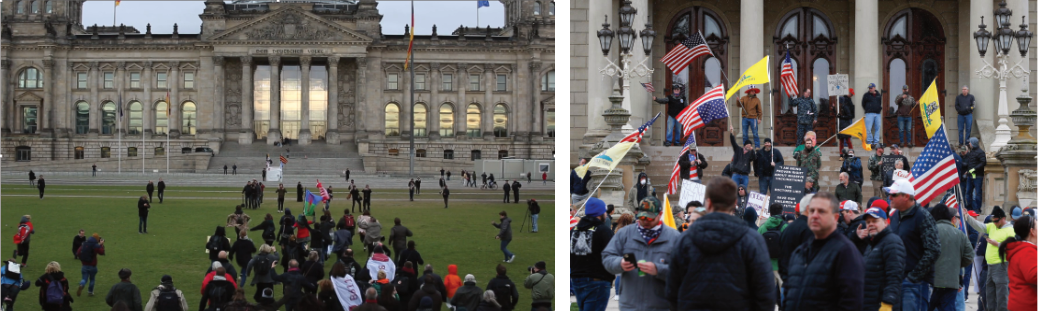
14 | “Sturm auf den Reichstag”, reenactment, organized by Milo Rau/IIPM (Institute of Political Murder), during the “Generally Assembly”, Berlin, November 7, 2017. YouTube, Schaubühne Berlin.
15 | Protesters in Lansing, Michigan, rallying at the state capitol against their state’s business lockdown, April 15, 2020. Photographer: Paul Sancya/AP.
Leaving aside the specifics of jurisdiction and right-wing symbolism regarding Reich flags for now, what else can be said about the August 29, 2020, events in terms of flag use and display? It is worth mentioning that the police officer in the video cited earlier consistently used the colloquial term Fahne when he should have said Flagge, following a common, but at the same time hardly observed, distinction. There is no exact equivalent in English for the distinction between Fahne and Flagge in German. Fahne would probably be closest to ‘banner’, (battle) standard or field sign. The term is thus linked to totemist, tribal and military uses of textile objects that signify a nation’s, a family’s, a guild’s or a corporation’s identity and pride. Not incidentally, the pseudo-scientific discipline of flags and banners called vexillology derives its name from the Latin vexillum and thus refers to the military tradition of the flag, which historically precedes that of the flags of nation states and other state entities.
Attending to the semantic slippages in the usage of Flagge and Fahne in German could prove helpful in approaching the events of August 29, 2020. For, arguably, the Reichsbürger and Querdenker protestors climbing the stairs of the Reichstag building, carrying and waving their respective flags, intentionally or unintentionally referred to the etymology of Fahne rather than Flagge, for they imagine themselves to be caught in an act of (para-)military conquest and battle, interpellated by the projects and ideologies symbolized by the flags, at times clinging to these pieces of textile as quasi-sacred objects requiring protection and display to a public eye that they are certain will be antagonized and provoked by such visual demonstration. The anthropological and sociological underpinnings of such performances of flags, the Durkheimian “contagion” of the flag carriers and the crowd by its presence is difficult to test or measure and would probably need specific analytical and methodological tools to be applied to properly assessing the motivations and tactics of the motley assembly of protestors on that day.
That said, the events on the stairs of the Reichstag produced images in the German media that where bound to astonish and outrage the political class. Any assessment of the behavior of the protesters, with and without flags, on August 29, 2020, should take into account: political and media reactions; the questions of why the police were so ill-prepared and why Reich citizen Rüdiger Hoffmann was allowed to set up his stage (not for the first time) directly in front of the Reichstag steps; and what impact the images and comments on the “Storming of the Reichstag” had upon public opinion regarding critical opposition to the coronavirus measures taken by federal and state governments. One of the voices that is generally and officially accepted is that of the ‘alternative’ journalist, Aya Velásquez, an early and outspoken critic of coronavirus governance. Two years after the events, having reviewed a wide range of sources and media reports, she questioned the prevailing narrative about the ‘storming’ that threatened democracy, criticized the devaluation of the widespread and often successful form of protest involving the occupation of parliament buildings or their steps, pointed to gaps and contradictions in the statements of police and politicians, and even put forward a suspicion of a ‘psy op’ involving the Verfassungsschutz, police, politicians, and the media. One does not have to agree with Velásquez (Velásquez 2022) on all points, but her doubts about the prevailing narratives and frames seem legitimate, considering the comprehensive media archive of the event, including the attempt by a team of reporters of the German weekly, “Die Zeit”, to reconstruct the events three years after the fact, without presenting any substantial correction to the official narrative (Artun et al. 2023).
From today’s perspective, it seems impossible to view August 29, 2020, independently of the January 6, 2021, storming of the Capitol in Washington, DC. The images of the violent mob outside, but above all inside, the building where the two chambers of the United States Parliament meet, and where the Senate and the House of Representatives were supposed to formally confirm Joe Biden’s 2020 presidential victory, have been burned into historical memory and have overshadowed other stormings of parliaments in 2020 and 2021 [Figs. 16, 17]. The significance and function of flags during the storming of the Capitol, strongly tangible in the photographs and videos taken on that day, is the subject for a separate essay. But, to say the least, the use of flags there shares a striking heterogeneity with that of the Berlin ‘storming’, as if the spectrum of protesters wanted to assure their own internal diversity of concerns, ideological origins, and identifications through the use of flags.
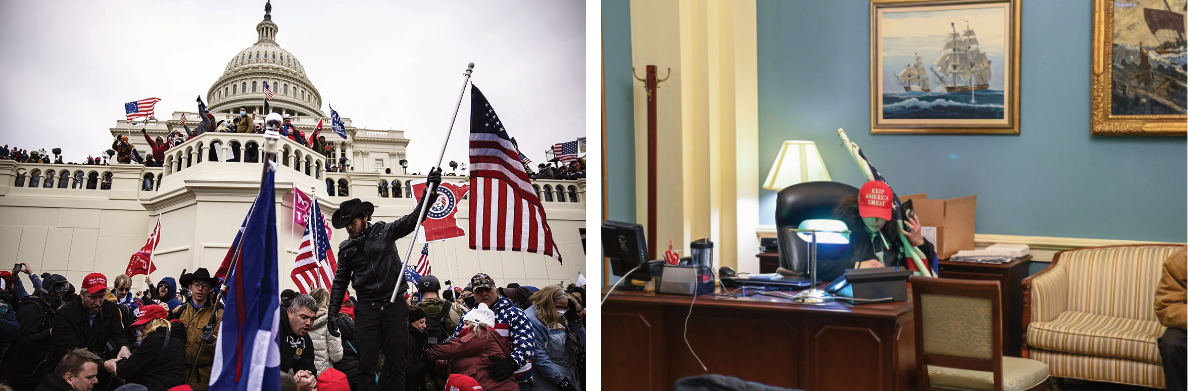
16 | Protesters at the U.S. Capitol in Washington, DC, during the January 6, 2021 riots. Photographer: Samuel Corum/Getty Images.
17 | A protestor with a rolled-up US flag sits at a desk of a delegate’s office after invading the U.S. Capitol building on January 6, 2021. Photographer: Saul Loeb / AFP via Getty Images.
As indicated at the beginning of this essay, viewing the video footage of the first protestors passing the barriers in front of the Reichstag and climbing the stairs to the main entrance, I followed the path of the figure in the middle who was carrying something resembling a bundled black, white, and red-colored Reichsflagge, the controversial and near-illegal symbol of the German empire, associated with the far right. Once she reached the platform on the top of the stairs, she waved the as yet not fully unfolded flag affixed to a short pole, while other flag carriers – one displaying an upside-down German flag on a pole, another two holding the flag in their hands, and another wearing a Reichsflagge as a cape around his neck – followed suit. It was the beginning of a robust, right-wing happening on the Reichstag’s stairs that was badly managed, if at all, generating the many images found by many to be shocking proof of imminent danger to democracy. The question remains as to what extent this spectacle can be counted within the rubric of flag activity that Carolyn Marvin and David Ingle have deemed ‘popular’ (in contradistinction to totemist and affiliative), defining it as, “the disorganized, creative flag-waving substratum of the people, a fertile body of social matter and energy to be harnessed for totem sacrifice or affiliative competition” (Marvin, Ingle 1999, 319).
The AfD (Alternative for Germany) benefited enormously between 2020 and 2022 from the coronavirus policies of the German government and media. They have adopted the position of several alternative media outlets that the “Storming of the Reichstag” was a conspiracy theory designed to produce images of Reich flags that could be used to delegitimize critics of coronavirus measures. The AfD has its own flag mission, and fills its stages and studios with the German flag, following with the deliberate ‘flag mania’ of its political counterparts in France, Italy, and the United States [Fig. 18]. In all contemporary instances, the legitimate, officially sanctioned flag is treated in such a way as to imply distance from the unrestrained, extreme right and its penchant for the Reich flag and Reich war flag. The flag policy and decorum of the far right is thusly supposed to remain distinguishable from the totemic and riotous flag performances of the streets and assemblies. The common tactic of ‘colonizing’ symbolic and visual spaces with flags, however, remains beyond such a division.
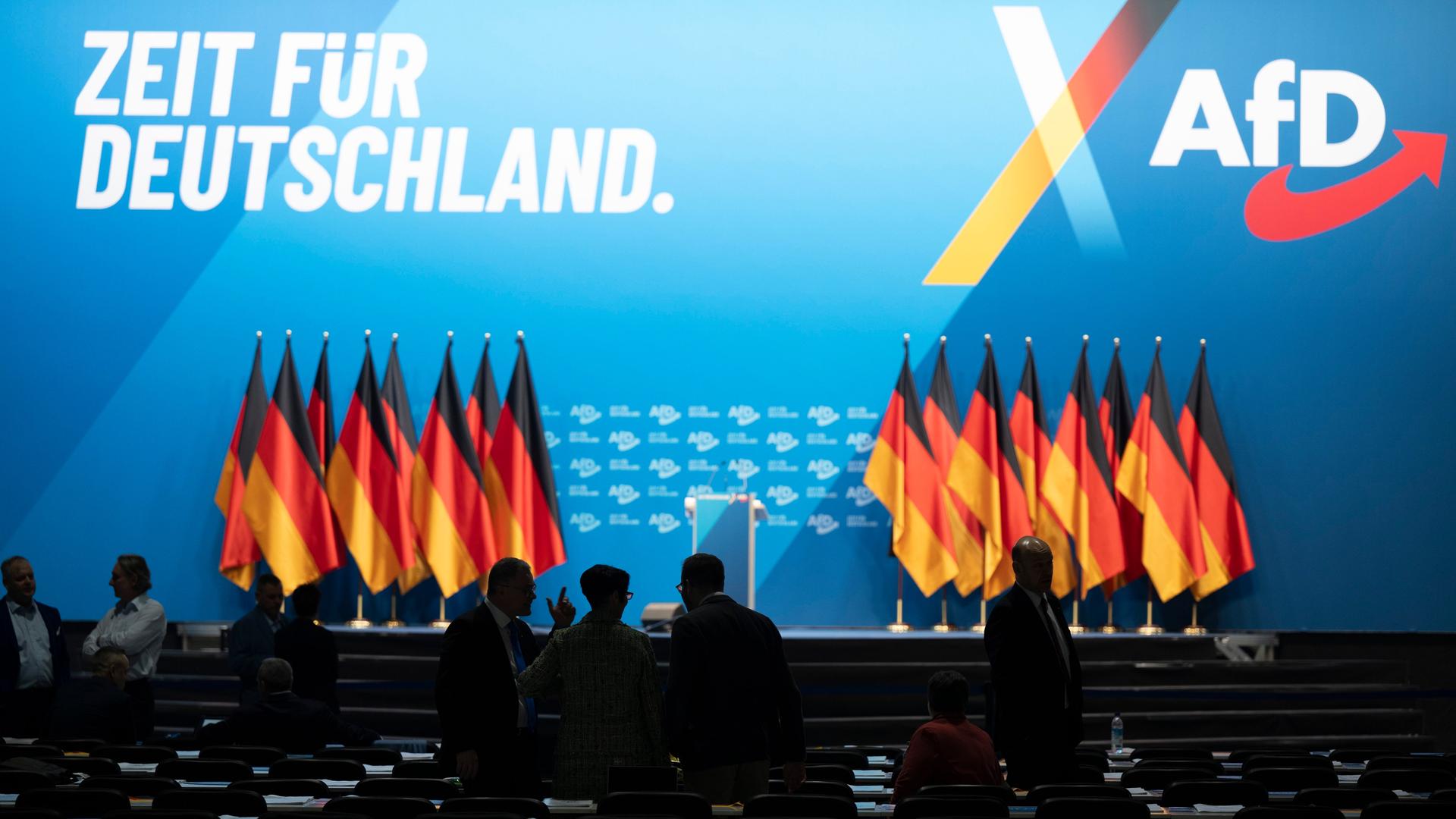
18 | German flags on the stage of a AfD federal party conference, Riesa (Saxonia), January 11, 2025. Photographer: Sebastian Kahnert / picture alliance / dpa.
Bibliography
Sources
- Brandenburg, Ministry of the Interior 2021
Brandenburg, Ministry of the Interior, Erlass des Ministeriums des Innern und für Kommunales zum Umgang mit dem öffentlichen Zeigen von Reichs(kriegs)flaggen, “Amtsblatt für Brandenburg” 32, 29, July 28, 2021, 622-623. - Bundesamt für Verfassungsschutz 2022
Bundesamt für Verfassungsschutz, Rechtsextremismus: Symbole, Zeichen und verbotene Organisationen, Cologne 2022.
Bibliographical references
- Artun et al. 2023
L. Artun et al., Warum haben Sie mitgemacht?, “Die Zeit” August 23, 2023. - Bateson 1943
G. Bateson, Cultural and Thematic Analysis of Fictional Films, “Transactions of the New York Academy of Sciences” (1943), 72-78. - Bateson 1980
G. Bateson, An Analysis of the Nazi Film “Hitlerjunge Quex”, “Studies in Visual Communication” 6 (1980), 20-55. - Behrenbeck 1996
S. Behrenbeck, Der Kult um die toten Helden. Nationalsozialistische Mythen, Riten und Symbole, 1923-1945, Vierow near Greifswald 1996. - Billig 1995
M. Billig, Banal Nationalism, London 1995. - Canetti [1960] 1963
E. Canetti, Crowds and Power [Masse und Macht, Hamburg 1960], transl. C. Stewart, New York 1963. - Cerulo 1993
K.A. Cerulo, Symbols and the World System: National Anthems and Flags, “Sociological Forum” 8 (1993), 243-271. - Durkheim [1912] 1995
E. Durkheim, The Elementary Forms of Religious Life [Formes élémentaires de la vie religieuse, Paris 1912], edited by K.E. Fields, New York 1995. - Eco 1976
U. Eco, A Theory of Semiotics, Bloomington/London 1976. - Firth 1973
R. Firth, Symbols, Public and Private, London 1973. - Fleckner 2011
U. Fleckner, Flagge, in U. Fleckner, M. Warnke, H. Ziegler (Hrsg.), Politische Ikonographie. Ein Handbuch, vol. 1, Munich 2011, 324-330. - Friebe 2007
H. Friebe, Branding Germany: Hans Domizlaff ’s Markentechnik and Its Ideological Impact, in P.E. Swett, J. Wiesen, J.R. Zatlin (eds.), Selling Modernity. Advertising in Twentieth-Century Germany, Durham/London, 78-101. - Goodrich-Clarke 2004
N. Goodrich-Clarke, The Occult Roots of Nazism. Secret Aryan Cults and their Influence on Nazi Ideology, London 2004. - Hoffmann [1988] 1996
H. Hoffmann, The Triumph of Propaganda. Film and National Socialism, 1933-1945 [“Und die Fahne führt uns in die Ewigkeit”. Propaganda im NS-Film, Frankfurt 1988], transl. by J.A. Broadwin, V.R. Berghahn, Princeton/Oxford 1996. - Kasher 1992
S. Kasher, The Art of Hitler, “October” 59 (Winter 1992), 48-85. - Kracauer [1947] 2004
S. Kracauer, From Caligari to Hitler. A Psychological History of the German Film [1947], revised and expanded edition by L. Quaresima, Princeton/Oxford 2004. - Lagadec/Le Gall 2023
P. Lagadec, L. Le Gall, Ces drapeaux que l’on regarde, ou pas. Esquisse d’une réflexion sur le dévoilement politique, “Revue d’histoire” 157 (2023), 3-18. - Leone 2021
M. Leone, The Semiotics of Flags, in A. Wagner, S. Marusek (eds.), Flags, Color, and the Legal Narrative. Public Memory, Identity, and Critique, Cham 2021, 53-63. - Marvin, Ingle 1999
C. Marvin, D.W. Ingle, Blood Sacrifice and the Nation. Totem Rituals and the American Flag, Cambridge 1999. - Müller 2020
R. Müller, Schwarz Weiß Rot, “Frankfurter Allgemeine Zeitung”, September 2, 2020. - Ponten 2020
F. Ponten, Tremor, Tick, and Trance: Siegfried Kracauer and Gregory Bateson in the Film Library of the Museum of Modern Art, “New German Critique” 47 (2020), 141-172. - Quinn 1994
M. Quinn, Swastika. Constructing the Symbol, London/New York 1994. - Reichl 2004
S. Reichl, Flying the Flag: The Intricate Semiotics of National Identity, “European Journal of English Studies” 8 (2004), 205-217. - Shanafelt 2008
R. Shanafelt, The Nature of Flag Power. How Flags Entail Dominance, Subordination, and Social Solidarity, “Politics and the Life Sciences” 27 (2009), 13-27. - Velásquez 2022
A. Velásquez, Der Sturm auf den Reichstag. Chronik einer Psy-Op: Wie Verfassungsschutz, Berliner Behörden und Medien den “Angriff auf die Demokratie” inszenierten, website Aya Velázquez, December 27, 2022. - Weitman 1973
S.R. Weitman, National Flags: a Sociological Overview, “Semiotica” 8 (1973), 328-367. - Witamwas 2016
B. Witamwas, Geklebte NS-Propaganda. Verführung und Manipulation durch das Plakat, Berlin/Boston 2016.
Abstract
National flags have played significant roles in the political and media image production of historical fascism. The current recirculation and updating of this archive of semiotic demagoguery, which has always been kept open, proves difficult to understand and cumbersome to regulate. Taking its cue from a notorious event in Berlin during the first Covid summer, the so-called “storming of the Reichstag” on August 29, 2020, this essay discusses: aspects of existing socio-anthropological studies on the totemic dimensions and death cult activated in Nazi iconology; how this iconological heritage lives on in contemporary manifestations of right-wing extremist and neo-fascist protests (directed against buildings and flag protocols embodying the self-understanding of liberal democracies); and attempts to legally regulate the semiotic maneuvers of the right performed by the use of controversial flags.
keywords | Reichsflagge; Reichsbürger; Alternative für Deutschland (AfD); Vexillary regimes.
questo numero di Engramma è a invito: la revisione dei saggi è stata affidata al comitato editoriale e all'international advisory board della rivista
Per citare questo articolo / To cite this article: T. Holert, False Flags? Semiotic Operations and Assemblages of (Neo) Fascist Propaganda and Protest, “La Rivista di Engramma” n. 233 (aprile 2026).