Downloading Martyrs
Turkey’s Commemoration Campaign for the Failed Coup Attempt of July 15, 2016
Elif Akyüz
Abstract
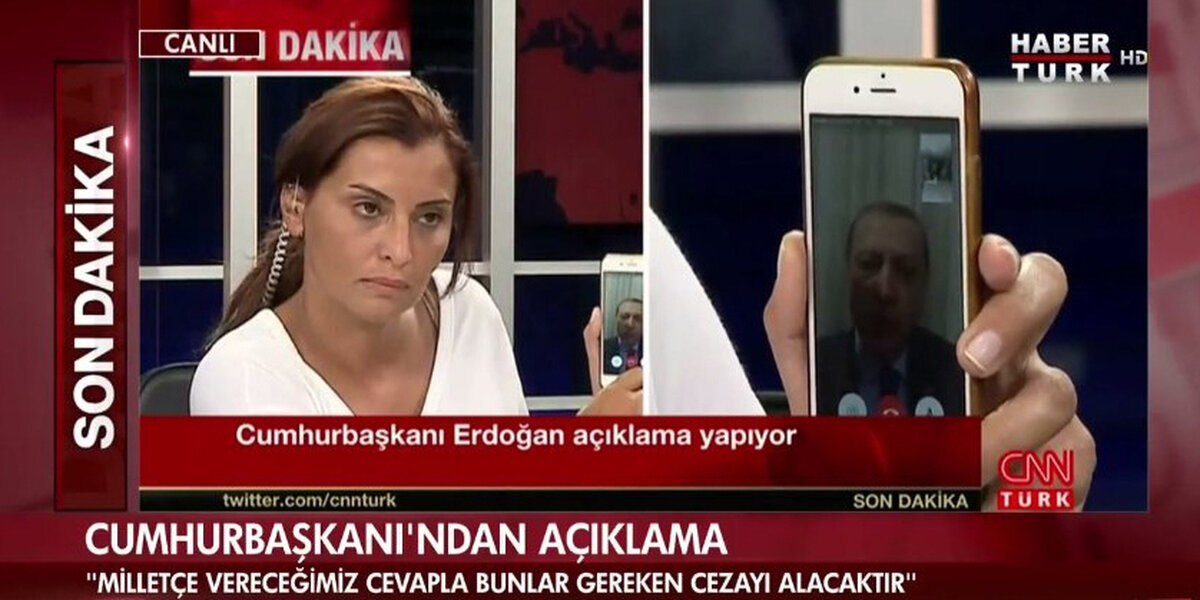
1 | News Anchor Hande Fırat on the night of 15 July 2016, talking to President Recep Tayyip Erdoğan via Face Time during a Live Broadcast on CNN Türk. Photo: DPA/CNN Türk.
Early in the 2010s, digital media technologies and platforms fueled by user-generated content were widely regarded as instruments of political emancipation. In activist movements that peaked around that time, they were heralded as an intrinsic tool of societies poised to free themselves from the clutches of authoritarian power. What began in Tunisia in December 2010 was a wave of far-reaching uprisings and activist movements that swept rapidly across North African countries and soon spread to the Arabian Peninsula. The protests were collectively labeled as the “Arab Spring”. This terminology evoked associations with former historical episodes in Europe like the “Springtime of the Peoples” (1848) or the “Prague Spring” (1968), where progressive social movements were violently suppressed. Events in several countries appeared to validate the notion that platforms such as social media and file-sharing networks could circumvent censorship and state control to accelerate grassroots communication on an unprecedented scale. Popular watchwords like “Facebook Revolution” and “Twitter Activism” captured a widespread assumption: the internet’s structural features, such as its ability to decentralize information flows, allow free access and encourage peer-to-peer distribution, were understood as inherently democratizing (Tufekci 2017). This techno-political optimism was not just a reaction to the recent events but was rooted in one of the internet’s own founding myths. Already in Tim Berners-Lee’s 1989 proposal for a new communication infrastructure at CERN in Geneva, the structure that would soon become the ‘World Wide Web’ was imagined as a decentralized system designed to resist hierarchical control and to facilitate the exchange of knowledge (Berners-Lee 2008).
What began as a technological design principle, increasingly turned into the subject of interpretations that centered around an emancipatory promise. In fact, the internet seemed to be the realization of a claim that the German writer Bertolt Brecht had articulated in his democratic media-theoretical observations on the radio as early as the 1930s. In his writings, he called for the transformation of a distribution apparatus (that the radio clearly was) into a two-way communication apparatus in which every user could act as a sender as well as receiver of information (Brecht [1932] 1967, 129). This demand, central to what became known as Brecht’s Radiotheorie, remained utopian for the medium of the radio, as its broadcast structure precluded reciprocal communication. This seemed finally technically enabled by the ‘WWW’, which marked one of the twentieth century’s most significant media technological democratization processes.
Yet the techno-optimistic moment of the uprisings that forced political leaders in Tunisia, Egypt and beyond into resignation proved short-lived. Within a few years, authoritarian regimes began deploying the same structural features that once enabled a wave of emancipatory activism (Howard, Hussain 2013, 69). Unlike traditional propaganda, which was structured around explicit ideological doctrines and promoted a sanctioned worldview, often suppressing political pluralism, contemporary authoritarian regimes increasingly appropriate the visual languages of grassroots culture and adopt the aesthetics and dissemination mechanisms of democratic protest (Bogerts 2017). This article examines this phenomenon through a striking case study: the Turkish government’s commemoration campaign following the failed coup attempt of 2016.
On the first anniversary of Turkey’s failed 15 July 2016 coup attempt President Recep Tayyip Erdoğan’s government released a series of sixteen poster designs commemorating the events of the night, when parts of the Turkish Military aimed to overthrow the president and his administration. Titled 15 Temmuz Destanı (“The 15 July Epic”), these images combined an abundance of what appeared to be snapshots of diverse provenance: several street scenes, a deployment of video game aesthetics, and motifs that were reminiscent of revolutionary iconography, sometimes even of propaganda posters of Soviet origin. The combination of those hybrid visual elements was the very material that supported a heroic narrative of what had happened on Turkish streets during the said military operation. Crucially, the posters were distributed not only through traditional channels, such as large-format billboards in urban spaces, but also as free downloads available on a website for anyone inside and outside the country. This distribution strategy relied on the internet’s viral dynamics and encouraged users to share the poster designs via social media and thereby simulated circulation practices that had characterized the so-called Arab Spring and Turkey’s own Gezi Park protests of 2013, but which served entirely different ends: the stabilization of an official historical interpretation under authoritarian control. This article analyzes the July 15 commemoration campaign across three successive media formations. The first part examines President Erdoğan’s FaceTime appearance during the night of the attempted coup in 2016 as a moment of a televised authoritative imperative. In the second part it turns to the 2017 poster campaign, which constituted the central visual program of the commemoration targeting the political narrative of state martyrdom. Central to the campaign is its appropriation of first-person shooter aesthetics, its use of photomontages, and its invocation of documentary authenticity. Finally, the article analyzes the July 15 Memorial Museum in Istanbul, opened in 2019 as the architectural consolidation of this visual regime. As a whole, the campaign appeared like a carefully orchestrated transmedia evolution that was initiated with an ephemeral digital moment and reached its peak with the opening of the physical monument of the museum providing architectural permanence for the campaign’s imagery in material space.
For an iconological perspective, the July 15 poster campaign and the opening of the Istanbul museum stand as paradigmatic cases of how contemporary authoritarian regimes appropriate the visual and distributional logics of democratic activist movements, the rhetorics of post-colonial discourse and that of counter-monumentalism. On closer examination, it becomes evident that digital image production enables not the replacement of propaganda but its transformation from top-down messaging to simulated grassroots communication in state-controlled narratives. The emerging commemorative practice adapts the iconographical and discursive visual vocabulary of democratic dissent for authoritarian consolidation.
I. The President as Deus Ex Machina: The July 15 Coup Attempt and Its Immediate Medialization
In the late hours of 15 July 2016, reaching into the following day, one of the most significant events in Turkey’s recent history ran its course. Parts of the military attempted to overthrow the government of President Recep Tayyip Erdoğan. In fact, this was not the first military coup in the country’s history. Since the founding of the republic in 1923, the armed forces had repeatedly intervened in politics, most notably in 1960, 1971, and 1980, as well as with the so-called “postmodern coup” of 1997. However, a significant difference between the events of that momentous night in 2016 and the earlier coups was the decisive role that the contemporary media environment played. Soldiers blocked bridges with tanks, occupied key infrastructural sites, and entered the broadcasting center of the state television station TRT. While fighter jets were sighted over Ankara and shots could be heard in the streets of Istanbul, events played out almost in real time on television screens. Government reports drew a concerning balance sheet. Approximately 250 people died in the streets of the metropolises and thousands were injured. The Turkish government held supporters of the Gülen movement accountable for the deadly incidents. Existing since the late 1960s, this social network and religious circle was orbiting around the ideas of the Islamic preacher Fetullah Gülen, who had been living in exile in the United States since 1999. Gülen, who had maintained close ties with the Erdoğan government until their public break in 2013, denied all involvement in the coup attempt. Since 2015, the Turkish state has labeled the movement under the acronym FETÖ (Fetullahçı Terör Örgütü, “Fetullahist Terrorist Organization”), a classification that was contested massively by the movement itself, and, ultimately, led to the decline of its influence. In the coup’s aftermath, tens of thousands of alleged Gülen supporters and political opponents of Erdoğan were arrested, dismissed from public positions, or had their passports revoked.
The president’s improvised television appearance became the iconic moment of that night. Shortly after midnight and a few hours into the anti-governmental military operation, he was connected to a special broadcast on the pro-government channel CNN Türk via Apple FaceTime. From the display of news anchor Hande Fırat’s private mobile phone, he appealed to the citizens of the Turkish cities of Istanbul and Ankara, encouraging them to take to the streets and to confront the putschists [Fig. 1]. At the time of the video call, Erdoğan was at a hotel on the Turkish Aegean coast and was transported to Istanbul by helicopter just minutes before the putschists arrived at the holiday resort in the course of an armored operation to arrest him. Screenshots of the broadcast capture a striking visual layering that metaphorically recalls the deus ex machina of ancient Greek theatre—the divine intervention lowered onto stage by theatrical machinery to resolve an otherwise insoluble crisis. Here, however, the intervention came literally through the machine: Fırat’s concentrated, troubled expression as she holds her phone toward the studio cameras, the president’s face compressed on the small rectangular screen of the white-framed mobile phone, surrounded by multiple scrolling news banners that frame and contextualize the emergency. This unusual form of layering multiple screens, modes of address and the stacking of visual information, by assembling “on the screen ribbons of text, photographs, graphics, and uneven audio […] (as was the case during the Persian Gulf War)” (Bolter, Grusin 1999, 8f.), created a ‘hypermediacy’ that proved crucial not only to understanding the broadcast’s iconographic urgency but, arguably, also to the course of the events. With its poor video quality, providing pixelated images to the audience through an unsteadily held mobile device, and occasional audio disruptions, the broadcast paradoxically enhanced rather than diminished the broadcast’s authenticity, while activating visual codes associated with citizen journalism and grassroots documentation rather than official state communication.
This unusual form of address, broadcast by the television station through a private communication device, created a paradoxical but highly effective visual situation: the call to defend democracy appeared in a format that combined the privacy of a personal video call and the poor, partially disrupted image and sound quality of the medium, with the authority of state power. This uncommon mode of direct presidential address recalled the communications strategies that defined the ‘Arab Spring’ uprisings. Most notably, Egyptian activist and later Sakharov Prize winner Asmaa Mahfouz’s January 2011 video blog, filmed on a personal camera and uploaded to Facebook, directly addressed the audience with much quoted daring phrases like “If you think yourself a man, come with me on January 25”, catalyzing the mass mobilization that filled Cairo’s Tahrir Square in early 2011 (Mahfouz’s original vlog has been reuploaded with English subtitles to YouTube). Mahfouz’s amateur video that showed her seated in front of a simple white background was credited with sparking the Egyptian revolution. While this video represented grassroots activism bypassing state media infrastructure through user generated content, Erdoğan’s FaceTime call, on the contrary, seemed to appropriate this aesthetic of intimate, peer-to-peer communication while broadcasting through a top-down channel. The president, set against the white curtains of a hotel suite rather than the representational environment of an official government facility, further emphasized the improvised, non-institutional character of the broadcast. In this speech, the president addressed two audiences simultaneously. By threatening the coup plotters with severe judicial consequences while mobilizing civilians to march in protest, the address became more than the mere case study of objective reporting on an internal power struggle. Through this visual arrangement, it was staged as a spontaneous moment of popular self-assertion, denigrating the rebellious threat and transforming citizens into active protagonists of national defense, defending nothing less than democracy and freedom. And indeed, the televised appeal led to massive involvement of civilians who, as it was officially reported, confronted the putschists and ultimately made a decisive contribution to the failure of the attempted coup d’état.
II. Heroes and Martyrs: A Poster Campaign for the Anniversary of the Failed Coup Attempt
One year after the events of 15 July 2016, sixteen graphic designs, each bearing the logo of President Recep Tayyip Erdoğan’s administration, were commissioned and employed revolutionary iconography, as well as the digital aesthetics of popular imagery and video games. For instance, the complete poster series is embedded within a digital memorial platform. The government operated website presents biographical narratives of the 251 individuals killed during the coup attempt in heroic martyrological language, alongside downloadable commemorative materials including the poster designs, social media graphics, and other resources that reinforce the official narrative. The posters were distributed as free digital downloads and as large-format posters displayed in the urban spaces of Turkish metropolises. As they manifested a techno-aesthetic appearance, the posters condensed the dramatic events that unfolded on the streets of Istanbul and Ankara into visual forms designed to resonate with contemporary protest imagery and infrastructure as well as media consumption habits.
When examining series as a whole, the posters can be categorized into two distinct formal-aesthetic groups based on their modes of address. The first group consists of images that adopt visual perspectives familiar to users of contemporary digital culture. One of the most prominent characteristics of the designs is their use of computer game aesthetics, both in content and form. By showing scenes in which beholders find themselves confronted with war related imagery—shooting soldiers, chaotic situations, or blurred images resembling amateur footage from zones of conflict—they create a sense of imminent threat. These designs employ the first-person perspective known from first-person shooter games to create not only an iconography of proximity, urgency, and menace but also transport the sense of agency and participation, as the beholder is positioned as an active participant in the scene.
The second group of motifs consists of collages that draw from photographic materials of diverse origin. Interestingly, most of the poster motifs are not self-referential, but draw their content from photographs formerly posted either on social media accounts by amateurs, predominantly on Twitter, or they recontextualize canonical icons of war photography. Using established iconographies of affective modes such as mourning or regret, the designs are utilizing them to serve the political narrative central to the campaign. In the poster series, the photographs are graphically reworked or embedded within a visual idiom that recalls historical revolutionary iconography rather than documentary reporting. It is remarkable that some of individuals whose private photos were alienated from their original contexts later publicly stated that their images had been used without consent. These collages therefore perform a Janus-faced operation: the depiction of private or amateur content functions as an event testimony, while the integration into the poster’s informational context utilizes it for a historicizing interpretive framework. Crucially, these two levels work in productive tension, as the privacy or spontaneity of the private photograph or the integration of iconic material subsequently authenticates the martyrological symbolism that is a central part of the campaign’s narrative.
III. Creating an Ambivalent Iconography: The First-Person Shooter Perspective as Design Principle
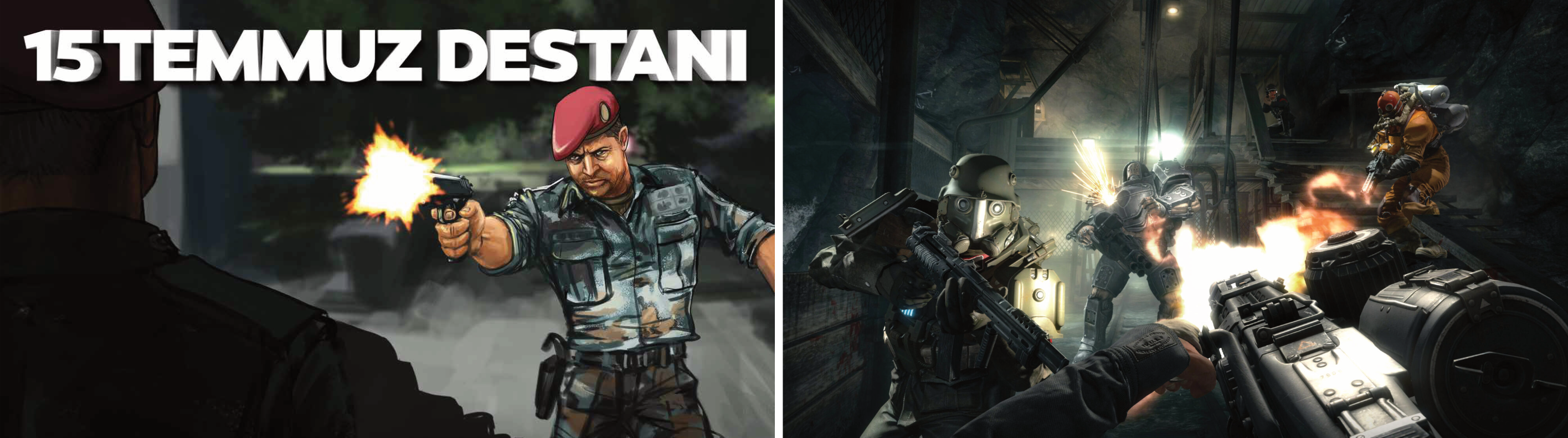
2 | Presidency of the Republic of Turkey, 15 Temmuz Destanı. Series of 16 poster designs, 2017.
3 | Wolfenstein 3D: The Old Blood, 2015, Gamestill. Foto: Zsolt Wilhelm.
One poster exemplifies the first of these two formal-aesthetic groups [Fig. 2]. The composition shows an armed soldier in military tactical gear. The depicted figure of this scene, wearing a camouflage vest and a red beret, is identifiable as military personnel even without specific knowledge of Turkish Armed Forces uniforms. The soldier is positioned in the foreground, his weapon raised and aimed directly toward the beholder as the muzzle flash erupts in bright yellow-orange. His facial expression, rendered in a stylized, almost comic-book-like aesthetic, combines determination and aggression. Behind him, the background dissolves into reduced resolution, refusing any specific identification of location and context, while the visible blurred greens and grays suggest an outdoor environment. Unlike all other posters in this series, this example does not identify a specific location, underscoring the emblematic character of this design. The degraded background, which appears to simulate the depth-of-field blur familiar from first-person shooter video games, throws the hyper-rendered soldier into sharp relief. In the left foreground, the composition features another dark silhouetted figure, functioning as repoussoir. This shadowed form, also appearing to wear military gear, frames the central soldier and functions as an identification figure, positioning the beholder to share this figure’s perspective, looking directly into the gun barrel. While in nineteenth-century landscape painting this compositional strategy functioned primarily to generate spatial depth and to guide the viewer’s gaze into picturesque distance, here the repoussoir positions the beholder directly in the line of fire. However, the visual indeterminacy surrounding both figures creates an ambiguity, resulting in compositional contradictions: the central soldier could either represent a putschist threat (positioning the shooting figure as perpetrator) or a loyal military ally (positioning the soldier as heroic defender).
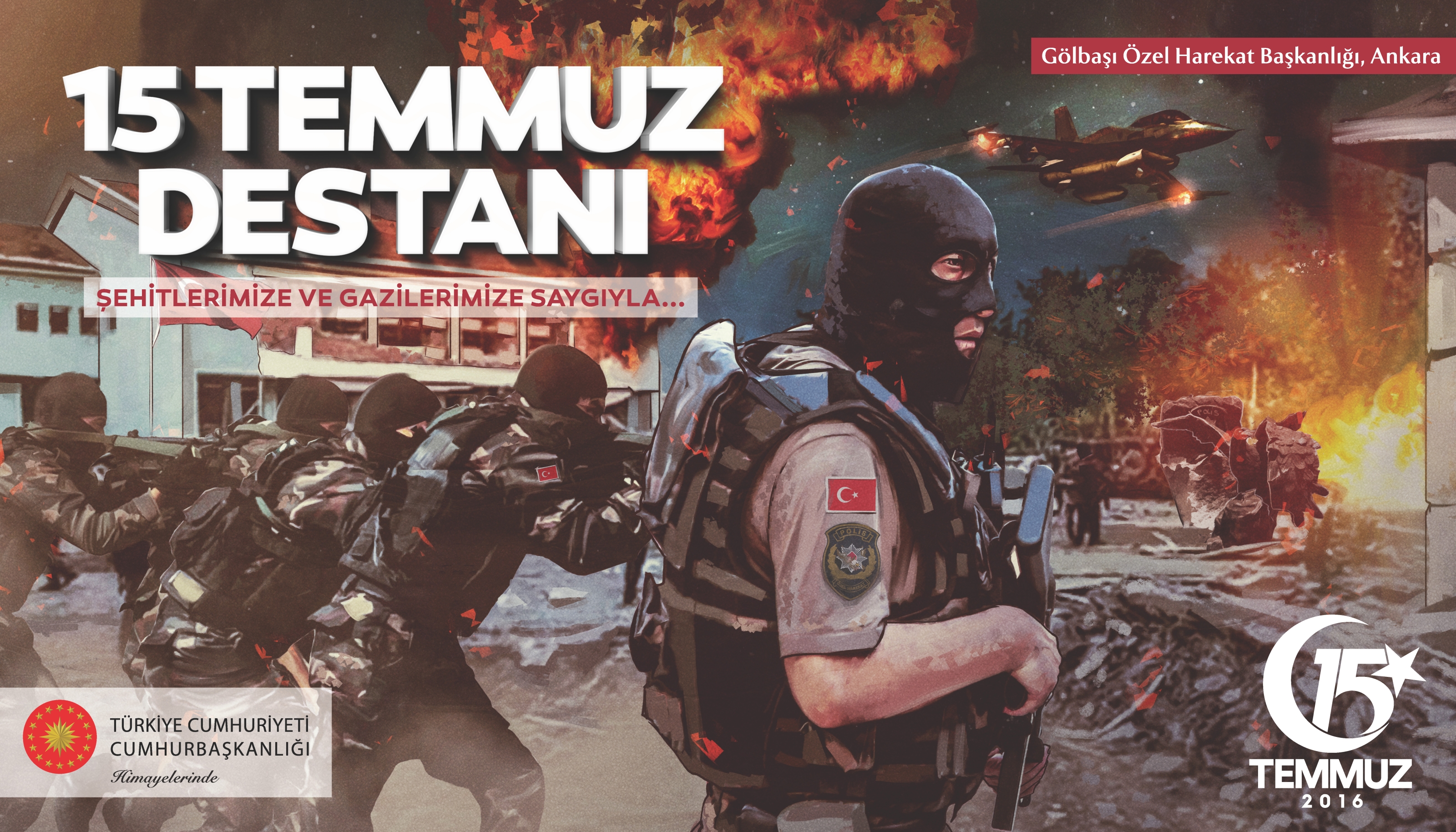
4 | Presidency of the Republic of Turkey, 15 Temmuz Destanı, Gölbaşı Özel Harekat Başkanlığı, Ankara. Poster design, 2017.
Upon examining the records of 15 July, it becomes clear though that the central soldier is modeled after one of the loyal soldiers, Ömer Halisdemir, who died on that night upon being ordered to neutralize one of the plotters of the coup. Although this scene is officially narrated as heroic defense that changed the course of events, the visual composition remains ambiguous with the repoussoir making the beholder the target of the shooting by placing him in the soldier’s line of fire. This visual convention was established in video games since the early 1990s (notably Wolfenstein 3D, 1992, or later editions like Wolfenstein: The Old Blood, 2015) [Fig. 3] and generates another layer of spatial ambiguity (Birken 2022, 19): are beholders invited to identify with the armed soldier as a defender of the nation, or are they positioned as potential targets of state violence enacted in the name of security? The poster’s iconographic structure refuses to resolve this question. A second example [Fig. 4] positions a soldier in tactical gear as the dominant foreground figure, his back turned to the beholder while facing a chaotic street scene engulfed in flames and smoke. The composition is identified by the location marker “Gölbaşı Özel Harekat Başkanlığı, Ankara” (“Gölbaşı Special Operations Department, Ankara”) in the upper right corner. Here too, the iconographic significance of the figures remains unclear. The visual grammar maintains indeterminacy in defining heroes and villains and allows the image to function simultaneously as protection narrative and a threat display at the same time.
The repeated caption of these design “15 Temmuz Destanı” (“15 July Epic”), clarifies not only the historical reference point, frankly mythicizing the events, but also sets the interpretive framework through which beholders are meant to understand what they see. The phrase “Şehitlerimize ve Gazilerimize Saygımızla” (“With Respect to Our Martyrs and Veterans”) frames the image as an act of warfare against the nation-state and through the theological-political category of şehit (martyr), a term which presupposes righteous sacrifice for the nation and, crucially, positions those who died as religious martyrs. Recent scholarship has identified a revival of martyrological discourse in contemporary politics. For example, both Sigrid Weigel and Baldessare Scolari observe that the martyr figure, a category derived from religious or revolutionary contexts, is being politicized through media reproduction following events like 9/11, the attacks on the Paris headquarters of “Charlie Hebdo”, or the Arab Spring, to transform casualties into symbols of national legitimacy (Weigel 2007; Scolari 2017). In his paper on emergence of national state martyrs in modernity, Baldessare Scolari points out that the discursive invocation of this category functions to “Sacralize the victim, making it a symbolic body of the religious and/or political community, even where the victim refuses this categorization” and also marks a “Concealment strategy through which the sovereign state not only hides its power to decide on ‘bare life’ […], but in fact even transforms it […] into a symbol of and for the nation-state” (Scolari 2017, 25-26). By sacralizing the deaths of hundreds of Turkish citizens, the poster campaign performatively mythicizes the events into an epic and establishes the narrative of national sacrifice. This produces a binary commemorative logic that erases the boundary between passive victim and active combatant, subsuming both into the unified category of martyrdom. The putschists by contrast—even though the posters do not clearly mark any of the depicted figures as such—remain excluded from this category of political sacrifice, and were referred to in official sources as hain (traitor).
The posters’ refusal to visually resolve the identity of uniformed figures serves a specific ideological function. By maintaining this indeterminacy, the designs avoid iconographically representing any Turkish soldier as perpetrator of violence against civilians. The putschists, though rhetorically condemned and excluded from martyrological commemoration, remain unmarked in the visual composition of the posters. This allows to denounce individual traitors through text and official discourse while preserving the military institution’s visual and therefore actual legitimacy. In the above-mentioned designs no uniformed figure is depicted explicitly as villain. The distinction between loyal defender and Gülenist infiltrator remains a matter of invisible political allegiance, thereby protecting the military as institution from visual indictment even as specific officers faced condemnation.
IV. Adapting the Pathos of Grief and Defeat: Heroic Photomontages
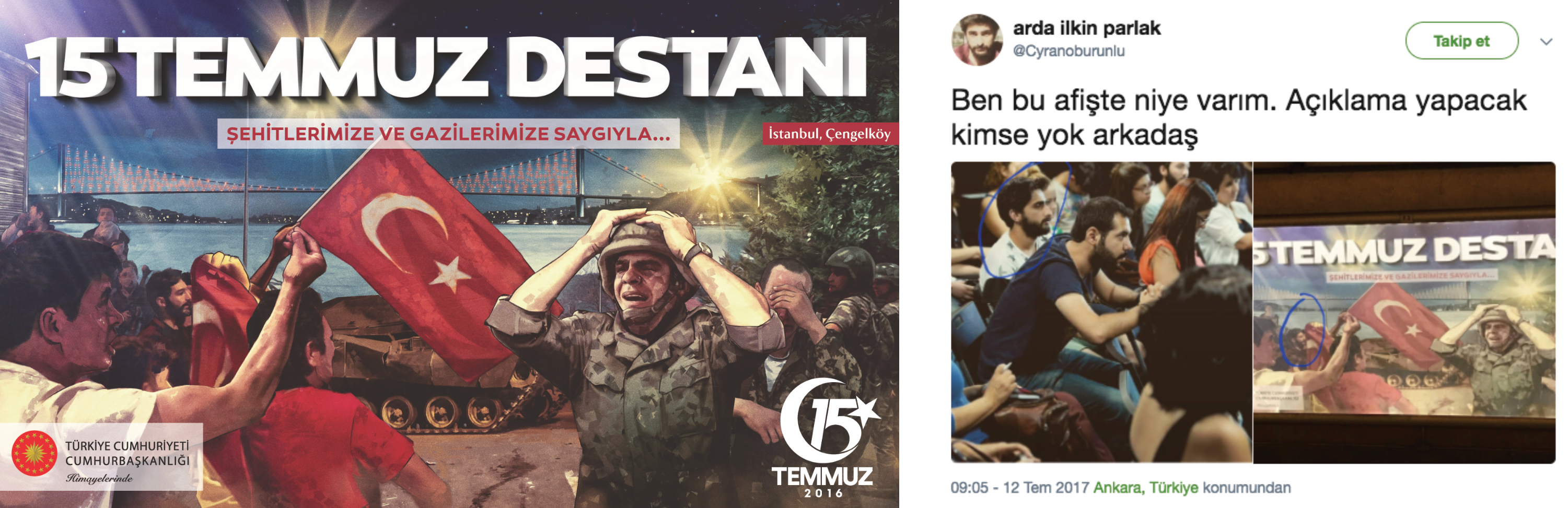
5 | Presidency of the Republic of Turkey, 15 Temmuz Destanı, İstanbul, Çengelköy. Poster design, 2017.
6 | Twitter post by a Turkish citizen, Arda Ilkin Parlak, who identified himself on one of the poster designs shortly after they were published. Screenshot, 12 July 2017.
The second formal-aesthetic group within the poster series operates through the technique of the photomontage rather than hyper-stylized illustration. Yet unlike the first group’s frank use of illustration, these designs simulate documentary authenticity through photographic elements whose sources remain deliberately obscure. Rather than drawing exclusively (or even primarily) on images from 15 July itself, the posters assemble figures and scenes from diverse, often unrelated sources into compositions that appear to document the coup attempt. This collage method leaves the provenance of the images opaque. Although, at first sight, the motifs seem to form an organic visual entity, closer examination reveals that in many cases it remains unclear where the photographs originate, whether they depict the events being commemorated, or even whether they come from Turkish sources at all. One example from the series proves insightful when trying to understand how—in Warburgian terms—Pathosformeln, as recurring gestural modes of depiction that carry emotional intensity across visual culture, function as a central strategy of the designs, and how their operation through affective mobilization is an inherent part of the posters’ commemorative logic.
The composition identified as “İstanbul, Çengelköy” [Fig. 5] shows what appears to be a nighttime scene at one of the bridges linking the continents of Europe and Asia—specifically the Boğaziçi Köprüsü (“Bosporus Bridge”), which after July 15 underwent a much-discussed renaming to 15 Temmuz Şehitler Köprüsü (“15 July Martyrs Bridge”) and which, in fact, served as one of the main sites during the coup attempt. In the center of the composition, a man holds a large Turkish flag, the red fabric billowing across the frame in such a way that it partially reveals a military tank positioned in the middle ground. Behind them, the bridge itself stretches across the strait, its suspension cables illuminated in red lights that visually echo the colors of the Turkish flag while simultaneously constructing a visual link between two distinct iconographic motifs. Dark stains that suggest blood cover portions of the partially revealed asphalt before the tank. On the left side of the composition, a group of civilians is depicted with their arms raised, hands gesturing and mouths open as if shouting toward the military presence. Their gestures address a group of men to the right-hand side and in the background, who appear to be soldiers dressed in tactical uniform. The men’s face expressions display what could be understood as a visual catalogue of negative affective reactions: the central soldier has his hands clasped together on top of his helmet in a gesture suggesting frustration, regret, or perhaps capitulation; another figure appears to hide his face behind his hand, a motion signaling what might be discomfort or embarrassment. These gestures, symbolizing regret, defeat, and shame, suggest that the soldiers depicted here are positioned as the vanquished rather than the victors.
Yet the poster’s documentary appearance, which recalls the events of that night through the naming of specific places and the depiction of what appear to be actual sites, in fact conceals a systematic process of fabrication. A bearded man, visible in profile among the civilians on the left side later, identified himself publicly on Twitter, stating that his photograph had been taken from an entirely different context and had been inserted into this poster, as he emphasized, without his permission. This man, Arda İlkin Parlak, spotted his own photograph on one of the designs when he encountered the prominently advertised series on the government-launched webpage where the posters were made available for download and sharing as part of the commemoration campaign. He posted what amounted to a side-by-side comparison image on his personal Twitter account on 17 July 2017 [Fig. 6]: on the left, a photograph showing him seated among a group of people; on the right, the official poster with a blue circle marking his face among the crowd of civilians confronting the military. A caption accompanies the image: “Ben bu afişte niye varım? Açıklama yapacak kimse yok arkadaş” (“Why am I in this poster? There is no one to explain, my friend”). The striking analogy of the juxtaposition revealed that his image had been extracted from an unrelated context and digitally inserted among the civilians at Çengelköy, thereby transforming him into an involuntary participant in the heroic campaign.
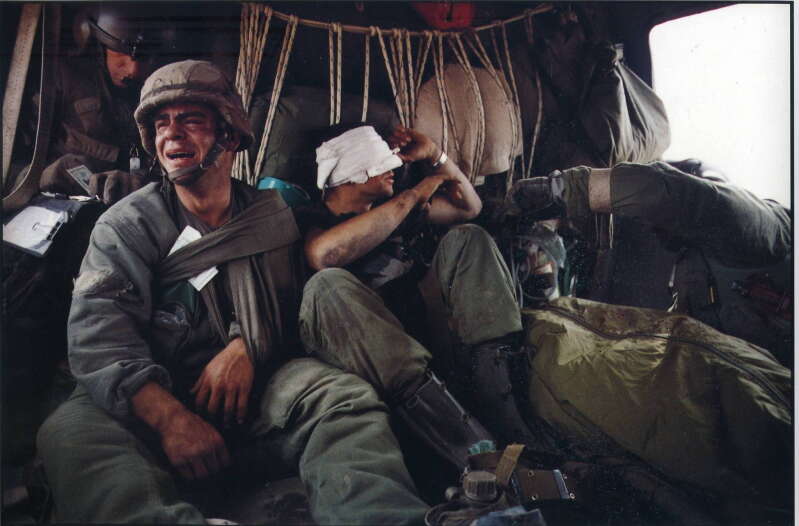
7 | D. Turnley, American Soldier Grieving for Comrade, Persian Gulf War, 1991. © David Turnley / CORBIS.
Another striking case of decontextualization involves the central soldier with hands clasped on his head—a figure that proves to be not from July 15, not from Turkey, and, remarkably, not even from the same decade. The soldier’s facial expression was copied directly from David Turnley’s Pulitzer Prize-winning 1991 Gulf War photograph showing U.S. Army Specialist Ken Kozakiewicz grieving in a helicopter beside the body bag of his comrade, Staff Sergeant Andy Alaniz, who had been killed in Iraq by friendly fire [Fig. 7]. In Turnley’s original photograph – which was published widely in international media – the gesture unmistakably signifies the overwhelming grief of a soldier confronted with the death of a comrade in war, captured in a posture of what can only be understood as overwhelming anguish. The photograph became iconic because it humanized military violence and foregrounded psychological cost rather than strategic triumph (Chouliaraki 2013, 329). In the July 15 poster, however, this same figure’s facial expression was extracted entirely from its original context and reinterpreted within an almost encyclopedic variety of negative affective reactions that mark the depicted soldiers as defeated putschists. The gesture of hands clasped on head becomes in the Turkish poster a sign of regret, shame, or perhaps capitulation following the coup’s failure. Other soldiers visible in the background reinforce this reading: one figure appears to hide his face behind his hand, another displays what seems to be a posture of dejection. The accumulated gestures – defeat, regret, shame – code these figures as the coup’s failed perpetrators confronting their political failure, effectively transforming Turnley’s documentation of grief into a Pathosformel of vanquished rebellion.
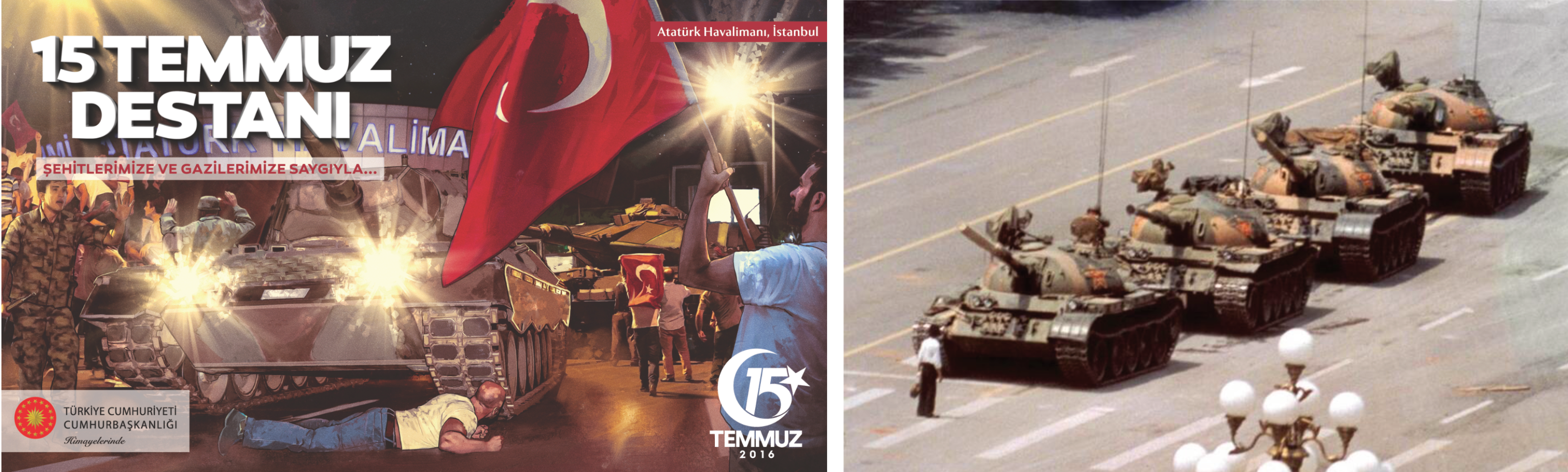
8 | Presidency of the Republic of Turkey, 15 Temmuz Destanı, Atatürk Havalimanı, İstanbul. Poster design, 2017.
9 | J. Wildener, “Tank Man” stops the advance of Tanks in Tiananmen Square on 5 June 1989, Beijing.
A similar logic of iconographic inversion operates in the poster situated at “Atatürk Havalimanı, İstanbul” [Fig. 8]. The composition centers on a figure lying prostrate before the treads of an advancing tank, his body positioned horizontally against the asphalt while civilians with raised flags surge forward in the background. The visual configuration unmistakably evokes the iconic 1989 photograph of the so-called Tank Man at Tiananmen Square in Beijing [Fig. 9], in which a lone protester stood upright before the column of military vehicles in what became a global symbol of individual defiance against state violence and was distributed as an internet meme for different bottom-up narratives ever since (Schankweiler 2021, 130; Shifman 2014, 10). Yet the July 15 poster inverts the context of this Pathosformel. Where Tank Man’s vertical posture signified resistance and civil disobedience, the prone figure in the poster suggests a more exaggerated sacrificial submission for the sake of patriotism, and recasts the tank as threat to the state and the civilian body as object to the heroic mystification of a nationalist political statement. The massive Turkish flag, a central motif in the scene, completes the transformation and binds the individual body to the national collective, converts into the general heroic narrative of the commemorative campaign by using an icon of democratic resistance as a formula of authoritarian ‘martyrdom’.
Across all sixteen designs, the Turkish flag serves not just as a marker of national identification but also as a revolutionary insignia in the tradition that Uwe Fleckner has traced through nineteenth-century political iconography in Europe. In Eugène Delacroix’s La Liberté guidant le peuple (1830), the Tricolore becomes what Fleckner calls the “blue-white-red heroine” of the scene, positioned at the compositional apex where it unifies all directional impulses and carries the image’s affective charge (Fleckner 2011, 326). The July 15 posters deploy the Turkish flag in much the same manner. In most of the designs, billowing red fabric with the white crescent dominates the visual field, structuring scenes of confrontation and serving as the focal point around which collective action acquires nationalistic legibility. Beholders are invited to interpret the lively folds as an “equivalent of politically inspired agitation” (Fleckner 2011, 326) and, in doing so, are drawn to the repository of their musée imaginaire, to the mental repository of images through which viewers recognize and interpret visual forms across historical contexts (see also Diers 1997, 41). In the Turkish examples, the iconographic role of the flag remains comparable to revolutionary iconography at the level of form across all analyzed cases, even though its political orientation shifts toward the commemoration and legitimation of a state-controlled narrative rather than revolutionary uprising.
V. Promising Documentary Authenticity: The Aesthetics of Citizen Journalism
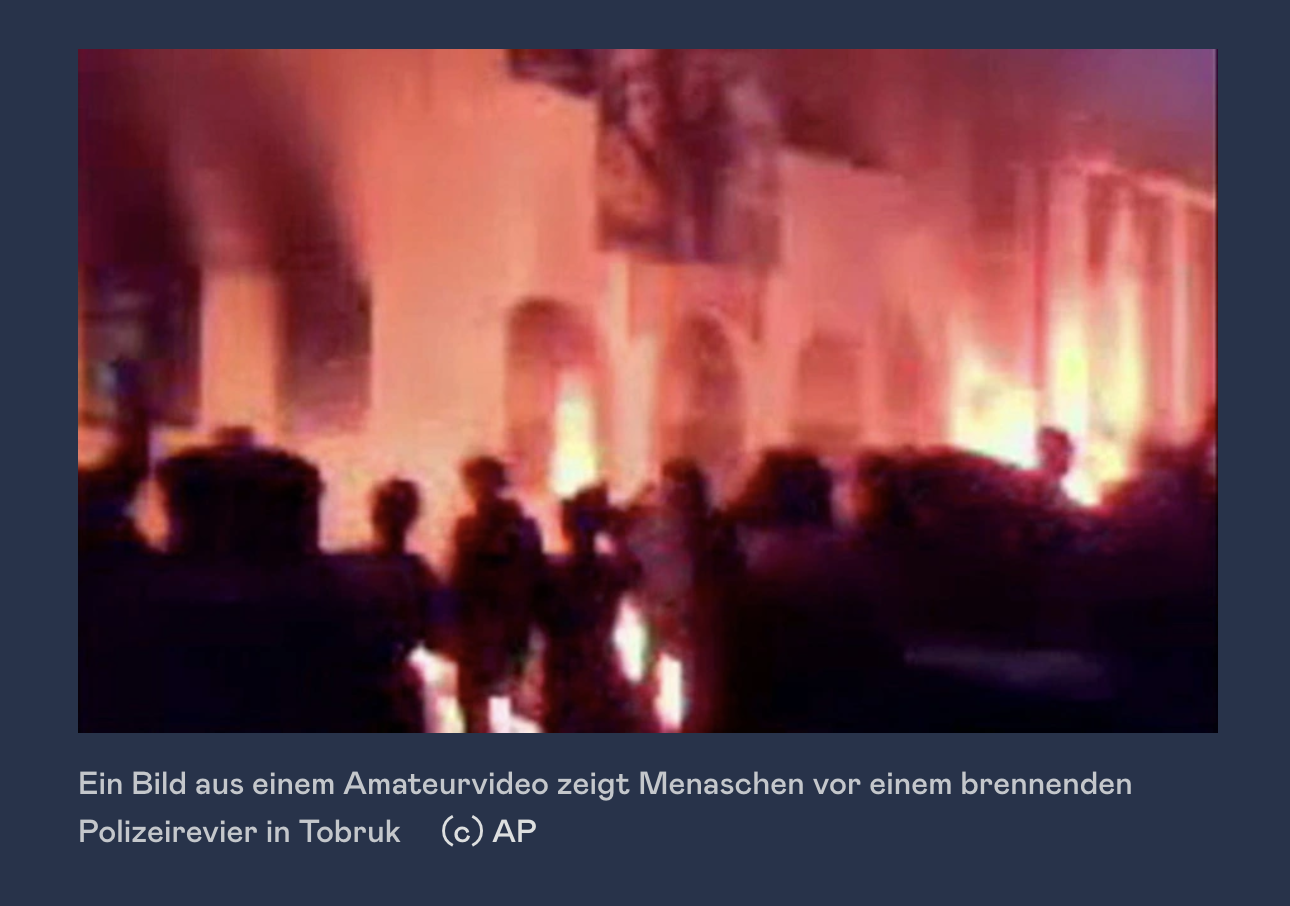
10 | Newspaper article illustrated by amateur photograph to accompany article titled “Demonstranten stürmen Parlament in Lybien”, 2 July 2022, screenshot.
Another important characteristic of these posters is the blurred quality in the depicted scenes. Media artist Hito Steyerl describes, with reference to the first days of the U.S. invasion of Iraq in 2003, that shaky, low-resolution cell phone photos by no means fulfill the documentary promise that major news broadcasters attribute to them when they use images and videos from amateurs on social networks to illustrate their media reports. The images broadcast on CNN during this the military invasion of Iraq often appeared like “green-gray color surfaces” that moved “like military camouflage” across the screen, which made the images appear like abstract compositions whose similarity to what they claimed to show could only be guessed (Steyerl [2008] 2020, 101-103). Despite their low informational content, these images served as markers of authenticity and were used in reporting both as immediate testimony and as visual substitute for what was actually unshowable, namely immediate military operations. This visual logic extends far beyond the Iraq War context. A striking example appeared in an article by Austrian daily newspaper “Die Presse” [Fig. 10]. In its coverage of the 2011 Libyan uprising, in which the video still of an amateur video was used for illustration, silhouetted figures appear before a burning building in Tobruk, how the caption informs the reader. Yet the photograph itself reveals almost nothing beyond orange flames and black silhouettes. The architectural structure remains unidentifiable, just as the anthropomorphic figures are rendered as pure shadows. This pattern of degraded-yet-authenticated imagery recurs throughout coverage of contemporary conflicts and uprisings, from Syria to Ukraine to Hong Kong, establishing this ‘poor image’ aesthetics as the dominant visual grammar of citizen journalism in the digital age (Schankweiler 2021, 93; see also: Andén-Papadopoulos 2014).
The July 15 posters do not quite embrace this aesthetic. They are, after all, professionally designed illustrations rather than compressed video stills. Yet they strategically appropriate its formal language and affective charge: while protest images from the Arab Spring and other revolts were mostly amateurish, blurred, and symbolic, the Turkish government posters adapt this aesthetic to transfer it into a controlled heroic iconography. The aesthetics of these posters thus work simultaneously as artefacts, familiar to the beholder’s eye, as they connect to popular digital visual languages, and authoritative, because they mobilize these for a state-orchestrated heroic narrative. The posters’ deployment of the concept of the poor image aesthetics reveals a sophisticated understanding of contemporary visual authentication.
VI. Iconographies of Heroism and Victimhood: The July 15 Museum in Istanbul as Culmination
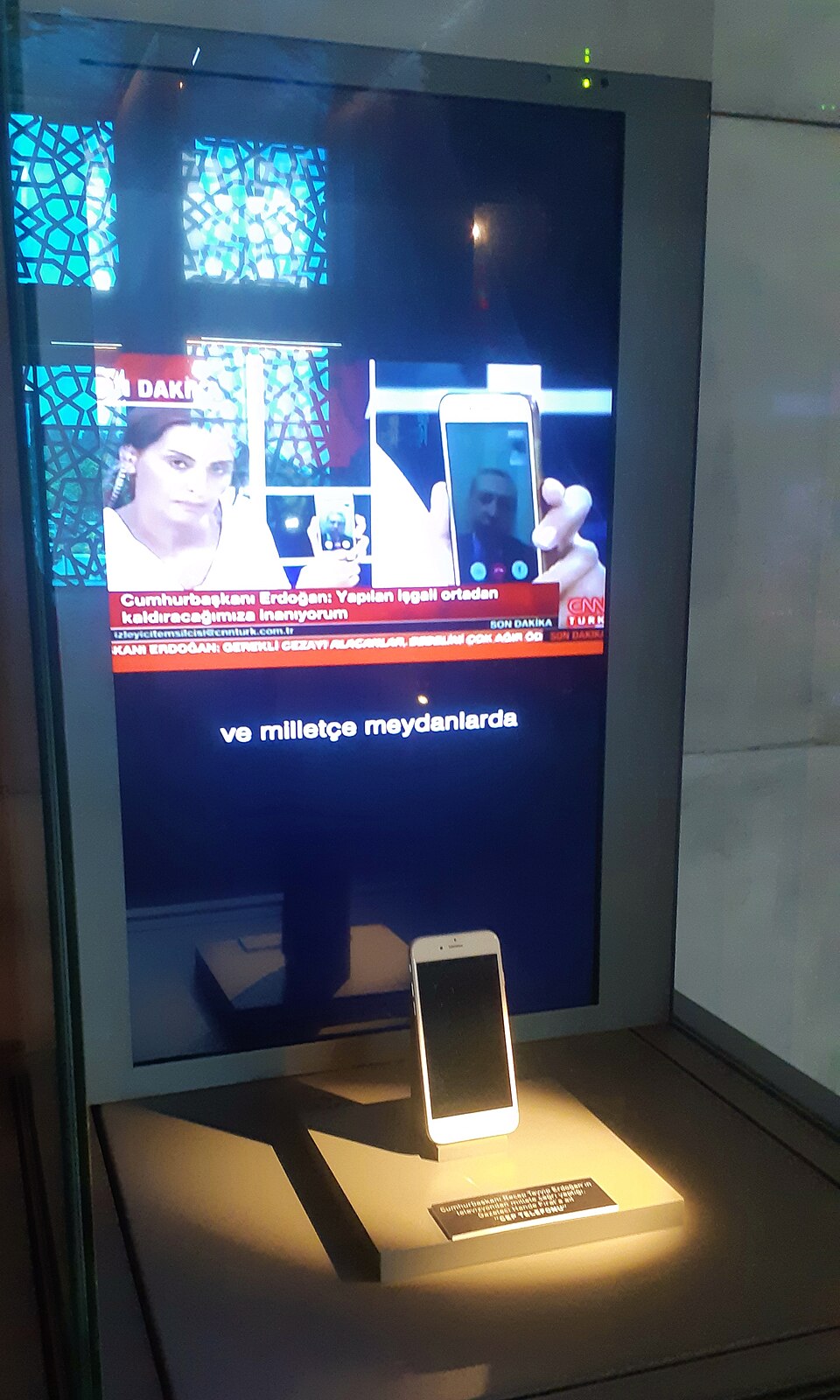
11 | Museum Display with the Mobile Phone of News Anchor Hande Fırat at the 15 July Memorial Museum, Istanbul, photo taken by the author.
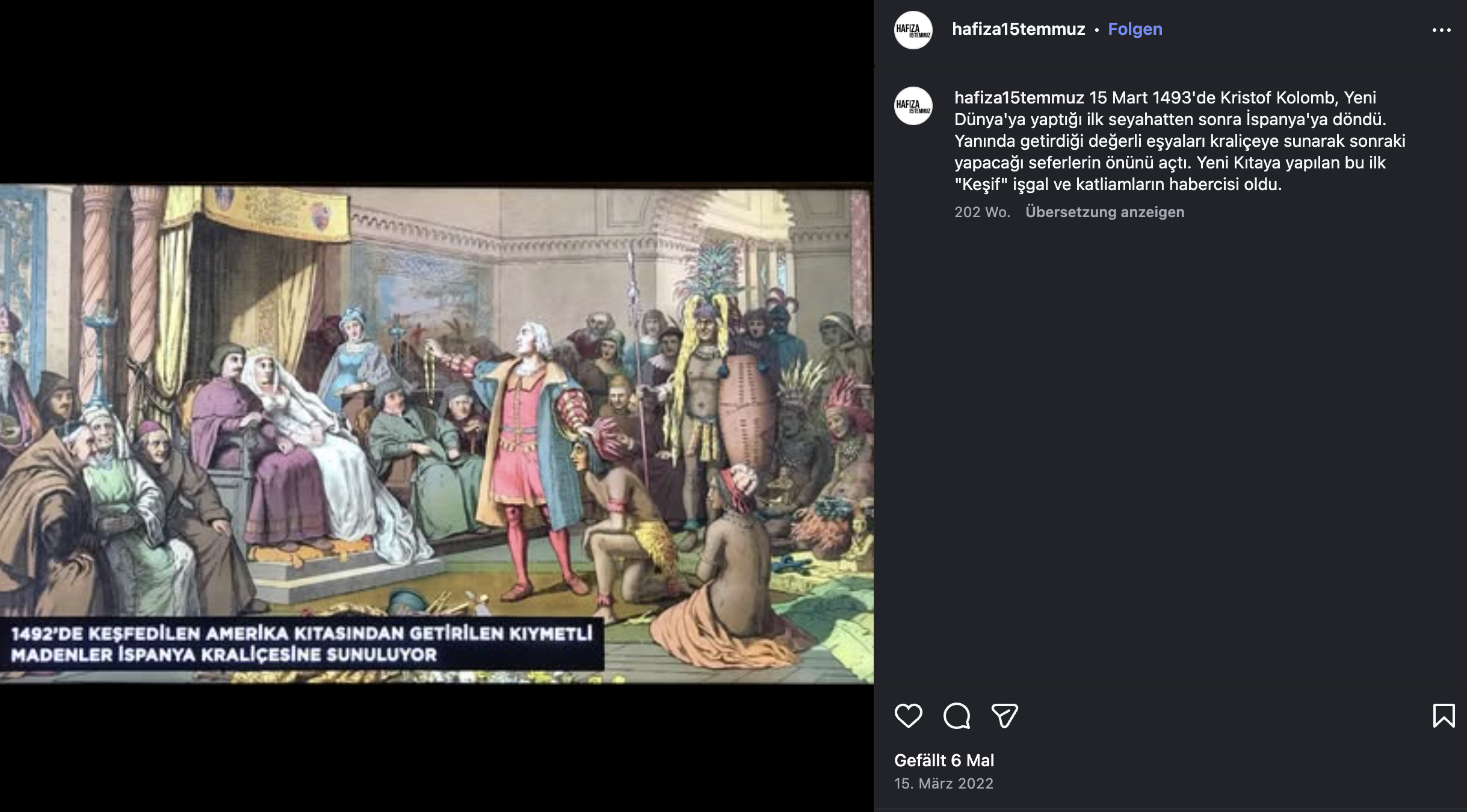
12 | Instagram post on the account of the 15 July Memorial Museum, Istanbul, 15 March 2022, screenshot.
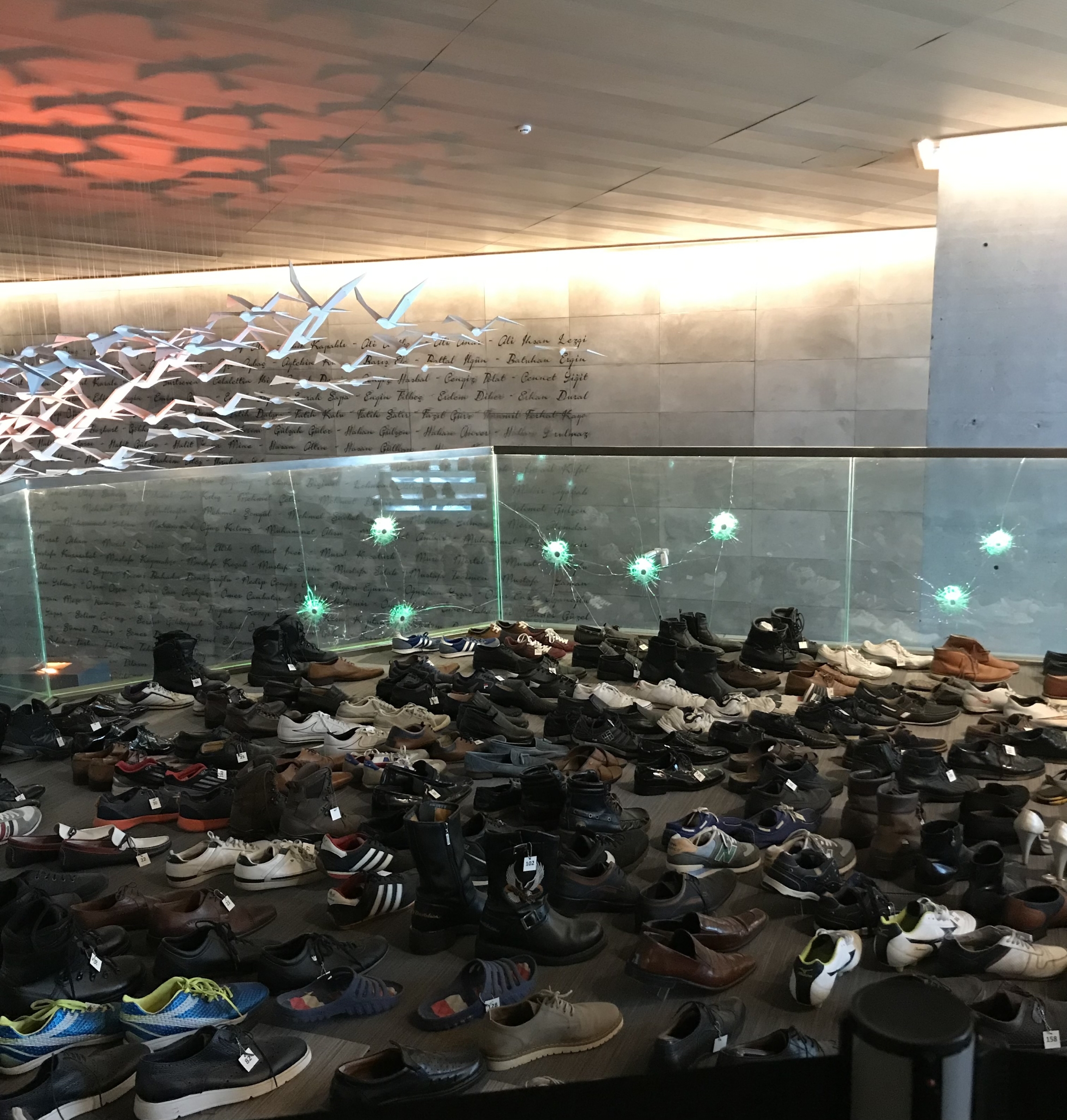
13 | Museum Installation titled Şehitlerimizin Ayakkabıları (“Our Martyrs’ Shoes”), 15 July Memorial Museum, Istanbul, photo taken by the author.
Three years after the attempted coup, objects central to the construction of its enduring heroic narrative, which was promoted through the widely disseminated poster campaign still accessible today, were installed in a newly built museum situated at the foot of the renamed 15 July Martyrs Bridge on the Asian shore of the Bosporus. Given the revealing name Hafıza 15 Temmuz Müzesi (“Memory 15 July Museum”), on its website, the institution positions itself not only as a memorial to the coup attempt, but also prominently as a site addressing the much broader discourse of “Coups, colonies, and colonialism” in Turkey and the world. This rhetorical move exemplifies what Turkish scholars have identified as an emerging trend in Turkey and other parts of the world where “Anti- and post-colonial critiques are deployed in service of authoritarian regimes” (Çapan, Zarakol 2017, 194).
The museum concept for the Istanbul project was first articulated at a planning workshop held on 14 January 2017, organized by the newly founded 15 July Association in coordination with the Ministry of Culture and Tourism and the Istanbul Metropolitan Municipality. Culture and Tourism Minister Nabi Avcı framed the institution as both physical and digital from its inception, stating that it would integrate new communication technologies to enable content distribution “Without time and space restrictions” (The speech is available on the webpage of the Turkish Ministry of Culture and Tourism). Accordingly, the downloadable poster campaign, launched six months later, was in fact part of a coordinated transmedia strategy conceived at the museum’s earliest planning stages. Avcı additionally stressed that the museum would address “the prehistory of the coup tradition” explicitly including the 27 May 1960 military coup in this genealogy of recurring attacks on the nation. The museum opened on 12 July 2019 under the curatorial direction of architect Hilmi Şenalp, who had previously designed several state-commissioned projects, with President Erdoğan in attendance.
While the first section of the museum addresses the events by exhibiting artefacts from the night itself like the mobile phone from which news anchor Hande Fırat received the president’s call on the night of the attempted coup, displayed alongside a screen showing the original broadcast [Fig. 11], a car crushed by a military tank or different personal effects invoking the presence of the people who took to the street, a second section aims to contextualize the events by linking them to atrocities of the colonial period. With this secondary narrative that was not yet present in the poster campaign launched two years earlier, the coup was framed not just as a domestic political conflict but as foreign infiltration of imperialist forces orchestrated by the Gülen movement from its base in the United States. To mark early stages of colonialism as relevant to the trajectory of the events leading to what had happened in 2016, the museum uses multiple in- and ex-situ media platforms. For example, on the museum’s Instagram account there are several images that are also displayed on screens in the museum. One of those references is a post that can also be seen on a multimedia exhibition display on the site. The image shows a late nineteenth century color lithograph by American artist Victor A. Searles depicting Columbus at the royal court of Spain in Barcelona presenting precious goods and treasures to Ferdinand II of Aragón and his wife, Queen Isabella I, on 15 March 1493 [Fig. 12]. The Instagram post not only shows the color lithograph, but also contextualizes the image in a post-colonial reading. The caption states as follows:
15 Mart 1493’de Kristof Kolomb, Yeni Dünya’ya yaptığı ilk seyahatten sonra İspanya’ya döndü. Yanında getirdiği değerli eşyaları kraliçeye sunarak sonraki yapacağı seferlerin önünü açtı. Yeni Kıtaya yapılan bu ilk “Keşif” işgal ve katliamların habercisi oldu.
[On March 15, 1493, Christopher Columbus returned to Spain after his first voyage to the New World. He presented the valuable items he brought back to the queen, paving the way for his subsequent voyages. This first “discovery” of the New World heralded the coming of occupation and massacres].
This postcolonial framing is not only surprising given that by 1493 Istanbul had already been taken as the imperial capital of the Ottoman Empire for forty years and therefore possessed its own expanding territory and imperial history, but also because it establishes a crucial framework. By positioning July 15 museologically within a global narrative of resistance to foreign intervention and marginalization, the museum adapts the visual and rhetorical language of anti-colonial struggle and, more generally, that of victimhood. Furthermore, this adaption extends beyond narrative content to encompass formal strategies as well. In official sources, the museum positions itself explicitly as a counter-monumental site and strikingly adopts design principles developed in contexts of democratic memorialization, particularly post World War II memory culture. The blending of two seemingly contradictory, even paradoxical narrative lines, that include the concepts of heroism and victimhood, finds its synthesis in the concept of the martyr, which allows both readings to coexist without resolution. The museum bases its concept on a universal repertoire of colonial violence, linking disparate historical episodes into a narrative of Western imperialism.
In an adjacent gallery, visitors encounter a concrete-walled installation where dozens of shoes—sneakers, dress shoes, plastic slippers, house shoes, sandals, work boots—lie draped across the floor in apparent forward movement, while additional pairs ascend a wall display, arranged on the steps of a staircase apparently leading to heaven [Fig. 13]. Above, a poetic inscription in metal lettering accompanies the capital letters of the label “Şehitlerimizin Ayakkabıları” (“Our Martyrs’ Shoes”) and reinforces this reading, while a glass barrier bearing what appear to be bullet-holes separates neighboring spaces from the accumulated footwear.
The memorial complex comprises multiple integrated elements: a museum building housing exhibitions and artifacts, a domed outdoor mausoleum with a strong religious connotation (Şehitler Makamı) inscribed with 251 names, a memorial forest (Hatıra Ormanı) of 251 trees for each person reported killed, and a mescid (“prayer room”). What proves analytically significant is the complex’s deployment of visual and spatial strategies derived from internationally recognized non-heroic commemorative forms, directly from post-1980s European counter-memorial discourse developed in response to the so-called memory boom and the prevailing skepticism toward heroic forms of commemoration (see Young 1992). Counter-memorial forms emerged from the premise that after genocidal violence, memory could no longer rely on affirmative, heroic representation but had to register absence, doubt, and the refusal of triumphalist narratives (Widrich 2020, 57). Turkey’s monumental discourse, by contrast, developed from a very different political setting: The Ottoman Empire as an Islamic empire maintained no figurative public monument culture comparable to nineteenth-century European statuary; monumental commemoration entered the region as a state-driven Republican project institutionalizing what art historian Aylin Tekiner describes as the sacralization and eternalization of the state through representation (Tekiner 2010, 32; see also: Doğramcı 2004, 97-98). Although today there is indeed counter-monumental practice among Turkish contemporary artists, no epistemic break comparable to Europe’s “memory boom” disrupted the heroic commemorative logic established during the early years of the republic with Mustafa Kemal Atatürk.
The shoe display exemplifies this disjunction: personal effects functioning as metonymic traces of absent bodies, the scattered arrangement suggesting interrupted lives, all following visual grammar developed to resist spectacle, heroization, and the sacralization of violence. The trope of the victims’ shoes was historically stabilized within Holocaust museum practices as a specific form of commemoration. Beginning with early exhibitions at Auschwitz-Birkenau after 1947 and reinforced through subsequent displays, photographs, and educational media that circulated internationally, shoes were gradually transformed from mundane personal objects into globally legible metonyms of absence, loss, and mass death (David 2024, 66). Commemoration sites in New York, Jerusalem and Budapest developed this visual language as a particular way of representing the unpresentable scale of the atrocities, using everyday objects as substitutes for absent bodies and endowing them with a fixed moral and emotional grammar. This form of commemorative practice, developed and established within museum contexts, was only later adapted by protest movements as a symbol for very different political purposes (David 2024, 69). An academic study, republished by the Presidential Communications Directorate in 2022 provides insight into how the government aimed to conceptualize these visual practices. Authored by Rabia Zamur Tuncer and titled15 Temmuz Darbe Girişimi ve Toplumsal Belleğin Hafıza Mekanları (“The Coup Attempt of 15 July and Memory Spaces of Social Memory”), the study analyzes the museum concept and mobilizes canonical Western memory theory of the twentieth century, from Maurice Halbwachs and Pierre Nora to Jan Assmann, and explicitly references different definitions of counter-monuments, among them one that identifies displays of Holocaust victims’ shoes as a paradigmatic anti-heroic, counter-monumental (karşı anıt) memorial form (Tuncer 2022, 172). Without explicitly ascribing counter-monumental status to the 15 July Museum, the study attempts to determine through quantitative methods whether the museum (among other significant places for the commemoration of 15 July) has successfully achieved the status of a lieu de mémoire. Tuncer’s own quantitative findings reveal that the respondents expressed anxiety about the ubiquitous use of the term ‘martyr’ and perceive name changes as part of a “perception creation process” (algı oluşturma) (Tuncer 2022, 302). While not addressing the contradiction between the museum’s actual heroic form and the theory of the counter-monument, the study simultaneously employs the category of ‘martyr’ throughout the analysis, which itself is a theological-political term that presupposes sacrificial legitimacy and forecloses the skepticism definitive of counter-memorial practice.
This reversal can be understood through political theorist Baldassare Scolari's analysis of modern state martyrologies. Scolari’s primary concern is with linguistic performance and how martyrological rhetoric underwent secularization from theological to political spheres of meaning while retaining what he calls, drawing on a term coined by Giorgio Agamben, its “signature”. Signatures, in this framework, are signs transposed from one semantic field to another while preserving residual force from their earlier context (Scolari 2017, 8). Scolari demonstrates that martyrological language activates associations with absolute victimhood and moral incontestability in order to transform political violence into sacred history. His central intervention is the concept of the “state martyr”. Unlike martyrs of resistance movements who challenge sovereign authority, state martyrs legitimate existing power. While Scolari analyzes primarily discursive practices, for example political speeches, media representations, commemorative rhetoric, his framework proves equally applicable to material commemoration (Scolari 2017, 9). The shoes, trees, and inscribed names function as visual signatures in his sense: they activate associations developed in different contexts of memory culture without explicit reference, lending borrowed moral authority to an entirely different political project. The combination of established memorial forms with Islamic devotional architecture produces a “translational memorial”, addressing diverse and potentially international audiences through globally legible iconographies of victimhood while grounding domestic reception in the frameworks of Islamic martyrisms in order to reproduce the heroic narrative central to the commemoration of 15 July 2016.
VII. Conclusion: Authoritarian Afterlives of Protest Aesthetics
With rising authoritarian conservatism and regimes worldwide increasingly finding more far-reaching ways to present political narratives and ideologies, it becomes ever more important to understand how new media comes into play within these processes. Turkey’s July 15 commemoration campaign offers a paradigmatic case of how the state adapts different democratic visual forms, like popular media and consumption habits, or citizen journalism, counter-monumental theory and forms, as well as post-colonial discourse. The Turkish campaign evolved through three stages utilizing the full spectrum of contemporary media communication both in content and form: President Erdoğan’s FaceTime call broadcast on television the night of the events, the downloadable poster series launched for the first anniversary, and the museum opening in Istanbul and Ankara in 2019. This trajectory transformed a contested national event into sacred history through distinct formal languages calibrated for different audiences: younger groups through digital media, older demographics through posters and television.
The museum, inaugurated three years later deployed markedly different formal vocabulary, combining postcolonial framing with the appropriation of counter-memorial aesthetics developed in European memory culture. This turn acquires significance within Turkey’s commemorative landscape. Ottoman-Islamic restriction to figurative representation meant no monument culture comparable to European statuary until the founding of the republic; republican monumentalization institutionalized the sacralization of state representation, without the impacts of the epistemic break that Europe’s post-Holocaust memory boom introduced. With the 15 July 2016 commemorative campaign, the Turkish government under Erdoğan faced a specific challenge: how can a heroic epic, an official interpretation of the failed coup attempt, be visually remembered and disseminated while addressing a broad audience familiar with Western aesthetic principles? The existing solution produced a paradox where anti-heroic aesthetics serve the heroic narrative, while the ideological content remains consistent across all three stages through the martyrological narrative. The museum reinforces this reading through architectural elements while framing the coup through postcolonial rhetoric resulting in a hybrid and highly ambivalent concept of a “translational memorial”, borrowing European memory culture’s moral authority for international audiences while grounding domestic reception in Islamic devotional frameworks through a domed mausoleum, prayer room, and a metonymic shoe-display suggesting ascension.
Ten years ago, in 2016, Turkey’s case appeared like an exceptional context where authoritarian commemorative strategies seemed like an isolated aberration. In contemporary political culture with its rising authoritarianism, these patterns have become symptomatic of broader tendencies. The Turkish case illuminates this pattern, demonstrating how regimes strategically adapt multiple historical and contemporary formal vocabularies while maintaining an ideological content and inverting democratic as well as counter-hegemonic languages to foreclose the very contestation these forms were designed to enable.
Bibliographical references
- Andén-Papadopoulos 2014
K. Andén-Papadopoulos, Citizen Camera-Witnessing: Embodied Political Dissent in the Age of ‘Mediated Mass Self-Communication’, “New Media & Society” 16, 5 (2014), 753-769. - Berners-Lee 2008
T. Berners-Lee, Tim Berners-Lee announced the creation of the World Wide Web Foundation, World Wide Web Foundation. - Birken 2022
J. Birken, Videospiele, Berlin 2022. - Brecht [1932] 1967
B. Brecht, Der Rundfunk als Kommunikationsapparat. Rede über die Funktion des Rundfunks, in Id. Schriften zur Literatur und Kunst, vol. 1, hrsg. von W. Hecht et al., Frankfurt am Main 1967, 138-147. - Bogerts 2017
L. Bogerts, Ästhetik als Widerstand. Ambivalenzen von Kunst und Aktivismus, “Peripherie” 37, 145 (Marz 2017), 7-28. - Bolter, Grusin 1999
J.D. Bolter, R. Grusin, Remediation. Understanding New Media, Cambridge (MA) 1999. - Çapan, Zarakol 2017
Z.G. Çapan, A. Zarakol, Postcolonial colonialism? The case of Turkey, in C. Epstein (ed.), Against International Relations Norms. Postcolonial Perspectives, London 2017, 193-211. - Chouliaraki 2013
L. Chouliaraki, The Humanity of War: Iconic Photojournalism of the Battlefield, 1914-2012, “Visual Communication”, 12, 3 (2013), 315-340. - David 2024
L. David, The Victims’ Shoe Trope and Emerging solidarity in Political Protest, “Nations and Nationalism” 31 (2025), 68-78. - Diers 1997
M. Diers, Schlagbilder. Zur politischen Ikonographie der Gegenwart, Frankfurt am Main 1997. - Doğramacı 2004
B. Doğramacı, Im Dienste Atatürks. Deutschsprachige Architekten und Bildhauer in der Türkei, in M.Warnke (Hrsg.), Politische Kunst. Gebärden und Gebaren, Berlin 2004, 97-120. - Fleckner 2011
U. Fleckner, Flagge, in U. Fleckner, M. Warnke and H. Ziegler (eds.), Politische Ikonographie. Ein Handbuch, vol. 1, Berlin 2011, 324-330. - Howard, Hussain 2013
P.N. Howard, M.M. Hussain, Democracy’s Fourth Wave? Digital Media and the Arab Spring, Oxford 2013. - Schankweiler 2021
K. Schankweiler, Bildproteste, in A. Kohout, W. Ullrich, Digitale Bildkulturen. Bildproteste, Screenshots, Hassbilder, Netzfeminismus und Selfies, Bonn 2021, 85-156. - Scolari 2017
B. Scolari, State Martyrs: Aesthetics and Performativity of a Contemporary Political Discourse, “Journal of Religion in Europe”, 10 (2017), 71-106. - Shifman 2014
L. Shifman, Meme. Kunst, Kultur und Politik im digitalen Zeitalter, Berlin 2014. - Steyerl [2008] 2020
H. Steyerl, Die dokumentarische Unschärferelation. Was ist Dokumentarismus?, in I. Busch, U. Fleckner, J. Waldmann (Hrsg.), Nähe auf Distanz. Eigendynamik und mobilisierende Kraft politischer Bilder im Internet, Berlin 2020, 101-111. - Tekiner 2010
A. Tekiner, Atatürk Statues: Cult, Aesthetic, and Politics, Istanbul 2010. - Tufekci 2017
Z. Tufekci, Twitter and Tear Gas. The Power and Fragility of Networked Protest, New Haven 2017. - Tuncer 2022
R.Z. Tuncer, 15 Temmuz Darbe Girişimi ve Toplumsal Belleğin Hafıza Mekanları, Istanbul 2022. - Weigel 2007
S. Weigel, Schauplätze, Figuren, Umformungen. Zu Kontinuitäten und Unterscheidungen von Märtyrerkulten, in Ead. (Hrsg.), Märtyrer-Porträts: Von Opfertod, Blutzeugen und heiligen Kriegern, Munich 2007, 11-37. - Widrich 2020
M. Widrich, After the Counter-monument. Commemoration in the Expanded Field, in S. Chattopadhyay, J. White (eds.), The Routledge Companion to Critical Approaches to Contemporary Architecture, New York 2020, 57-67. - Young 1992
J.E. Young, The counter-monument. Memory Against Itself in Germany Today, “Critical Inquiry” 18 (1992), 267-296.
Abstract
Elif Akyüz’s article analyzes how contemporary authoritarian regimes appropriate the visual languages and media practices originally associated with democratic activism. Focusing on the Turkish government’s commemoration campaign following the failed coup attempt of 15 July 2016, it examines how protest aesthetics, citizen journalism, and counter-memorial strategies are reconfigured within a state-controlled narrative. The study traces the campaign across three successive media formations: President Recep Tayyip Erdoğan’s FaceTime appearance during the night of the coup attempt, the downloadable poster series released for the first anniversary in 2017, and the July 15 Memorial Museum in Istanbul opened in 2019. Through iconological analysis, the article demonstrates how the campaign mobilizes visual vocabularies such as first-person shooter imagery, photomontage, Pathosformeln of revolutionary iconography, and the aesthetics of the “poor image” associated with citizen journalism. These forms are combined with martyrological rhetoric and with memorial strategies derived from European counter-monument discourse. The result is a hybrid commemorative regime that transforms a contested political event into sacred national history while simulating grassroots communication. The Turkish case illustrates a broader tendency in contemporary political culture in which authoritarian regimes adapt and invert democratic visual languages in order to stabilize official narratives and foreclose political contestation.
keywords | July 15 Coup Attempt; State martyr; Hafıza 15 Temmuz Müzesi; Counter-Monument.
questo numero di Engramma è a invito: la revisione dei saggi è stata affidata al comitato editoriale e all'international advisory board della rivista
Per citare questo articolo / To cite this article: E. Akyüz, Downloading Martyrs. Turkey’s Commemoration Campaign for the Failed Coup Attempt of July 15, 2016, “La Rivista di Engramma” n. 233 (aprile 2026).