Surface Derangement
Preliminary Notes for an Inquiry into Trumpian Imagery
Luka Arsenjuk, Mauro Resmini
Abstract
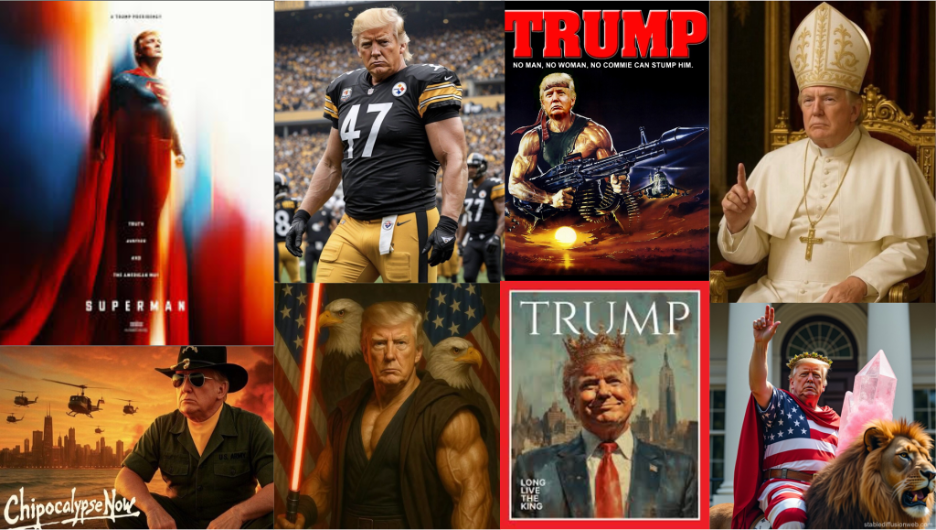
…C’est dans les symptômes de l’Amérique que se déchiffrent au mieux les symptômes dans la culture, le malaise mondial dans la civilisation.
(Gérard Wajcman)
Trumpism: Political Disarticulation and Spectacle
“Trumpism” is at this point in time best understood as a coalition composed of the various segments of the American Right, among which the following are the most important ones: MAGA (Make America Great Again movement), which brings together the “American gentry” (Wyman 2021; Cooper 2022), the disgruntled petty bourgeoisie, and a portion of the downwardly mobile working class population; the Christian nationalist Right, whose long-term aim is to reverse the liberal progress of the last hundred-and-fifty years (Greenhouse 2023); the explicitly Alt Right, Far Right, neo-Nazi and fascist groups, which seem to appeal in particular to the disaffected young men (Bouie 2025; Parker, Sherer, Miroff 2026); the leftovers of the imperial Neoconservative Right which used to dominate the Republican Party, but whose project for “The New American Century” has now been pared down to a set of more limited adventures within an increasingly hemispheric rather than a global horizon (Singh 2026); the techno-anarchist and monarchist Silicon Valley oligarchs in search of the political form that might enable them to evade the constraints of the bourgeois state and help cement the economic dominance they have established in the recent couple of decades (Slobodian 2025a; Slobodian 2025b, Slobodian 2025c; Glickmann 2025a; Glickmann 2025b); the private equity industry, whose asset-stripping methods represent finance capital’s cutting-edge response to the crisis of industrial profitability and the persistent malaise of secular stagnation; and finally, MAHA (or Make America Healthy Again), a “diagonalist” formation which emerged out of the shock of the COVID-19 pandemic, and which centers its conspiracist and eugenicist energies on the distrust of science, public health institutions, and vaccine provision (Callison, Slobodian 2021; Gaffney, Himmelstein, Woolhandler 2025). This is a diverse set, and while each of these groups may possess a project more or less coherent on its own individual terms, it is also the case that these different strands of the American Right are to a large extent mutually incompatible and do not share an overall political vision. They would not be able to construct an alliance by themselves, let alone achieve the popular support necessary to seize state power.
The singular feature of Donald Trump as a figure is that he has been able to function as a point of shared articulation for these diverse reactionary formations. Crucially, he has done so not by providing them with some overall political idea under which they could integrate into a larger coherent political project, but rather by standing for an absolute willingness to give up on the coherence of politics as such. The Trump-figure, we may say, is where politics loses coherence as politics, yet it is precisely for this reason that the American Right is able to cohere around it into something like a coalition. Trumpism in that sense names a situation in which the disarticulation of politics comes to serve as the very ground of political articulation. That the Trump-figure functions in this way is confirmed by the fact that he typically appears as an essentially sub-political figure: most commonly as a sort of a mob boss, a paternalistic head of a familial crime enterprise, or indeed as an idiosyncratic real-estate developer and speculator, in whose hands the art of politics is reduced to a form of naked deal-making (the “art of the deal”). But again, it is precisely this failure to exceed the level of the sub-political, the failure to ascend to some proper form of political figuration, that makes it possible for the Trump-figure to serve as a point of articulation in today’s politics.
How does Trumpism concretely manage to hold together these disparate strands? It is possible to recognize in this situation, in which disarticulation functions as the condition of political totalization, the old logic of the spectacle. The Trump-figure has managed to connect the otherwise incompatible formations of American reaction precisely because it has been able to shift the terrain away from politics and to rigorously submit any political project with which it comes into contact to the demands of the spectacular image (or, if one prefers, the demands of the media attention economy). Trumpism, after all, appears on the surface of things as a remarkable accumulation and proliferation of images. It manifests itself as a veritable iconorrhea: a flood of images that make a constant claim on people’s attention; and it does so precisely because it is the logic of the spectacular image that in Trumpism has to do the work abandoned by more distinctly political forms of relation.
The standard formula for understanding Trumpism as politics-become-spectacle still has to be Walter Benjamin’s description of historical fascism as “aestheticization of politics”. Putting things in these terms should, however, also lead us to try to measure the distance between Trumpism and the older, twentieth-century forms of political reaction. In the case of Benjamin’s critical concept of the “aestheticization of politics”, the term “aestheticization” stood for a sort of alienation or perversion of something that could still be thought of as a properly historical mode of politics. “Aestheticization of politics” named a process whereby the fascism of the twentieth century mimicked the politics of revolutionary modernity even as it was in the process of dismantling it. For this reason, the fascist aesthetic perversion of modern politics remained recognizable as politics. And in turn, this remainder of politics under the disguise of fascist aestheticization – put simply, the fact that fascism still represented an attempt “to organize the newly proletarianized masses” or to “give them expression” (Benjamin [1936] 2006, 120-122) – was able to serve as the very terrain on which Benjamin could wager a reversal: the communist (re)politicization of aesthetics, which is to say the (re)discovery of aesthetics and art as sites of historico-political intervention.
The reactionary formation of Trumpism does not belong to the sequence of historical fascism in the sense outlined above and confronts us with a very different situation. Insofar as we can continue to speak of a certain “aestheticization” in relation to Trumpism, it seems clear that what is being “aestheticized” in this case is not some recognizable historical form of politics. Trumpian images may contain plenty of mimicking, but one would be hard-pressed to find in them some kind of consistent attempt at appropriation of politics proper, let alone of modern revolutionary politics. Trumpian “aestheticization” is not “of” politics, in the sense that no recognizable form of politics seems to precede it, logically, as its substantial source. And if one can still think of “aestheticization” as a perversion of something, one must in the case of Trumpism be able to think this moment of perversion as coming first, arriving as logically prior, and itself putting into place the semblance of the very thing (“politics”) from which it is supposed to deviate (Baudrillard’s “precession of simulacra”). Or to put it differently, if Trumpian “aestheticization” appears to us as a flood of images, a kind of spectacular iconorrhea, it is also the case that it is no longer possible to grasp this proliferation of Trumpian icons as alienation or perversion of some prior or more fundamental political logos. The situation of Trumpism is rather one in which the flow of images (the moment of spectacle, of “aestheticization”) breaks decisively from any anchoring in the discursive articulation of politics. There is no political form or deeper political meaning here that could continue to serve as the object of “aestheticization” or as the terrain upon which the perversion of spectacle is performed.
On this particular point, we may pause for a bit and draw a comparison with the work of the Italian philologist and mythology scholar Furio Jesi. In his book Cultura di destra (“Right-wing Culture”), first published in 1979, Jesi describes a crucial element in reactionary ideologies: a set of clichés, commonplaces, and stereotypes (including notions such as Homeland, Heritage, Family, etc.) that does not rely on any concrete discursive articulation. Borrowing an expression from Oswald Spengler, Jesi calls them “ideas without words”, or we could say, ideas without logos. These are notions that seemingly transcend any pre-existing form of politics, come into being in a void, and as such become spiritualized, infused with metaphysical value. The hollowing out of any conceptual, historical, or cultural reference that accompanies the deployment of these ideas produces an effect of artificial transparency, a sort of semiotic flatness, which expresses itself in the sense that these ideas “go without saying”. Jesi famously referred to such mental content as “pappa omogeneizzata” – mush, baby food: undifferentiated, tasteless, and easy to digest (see Jesi [1979] 2025, in particular Il linguaggio delle idee senza parole, 111-232, where Jesi uses the formula “pappa omogeneizzata”). While Jesi’s analysis can primarily be situated in the context of print and literary culture, it strikes us as potentially useful to think of the status of Trumpian imagery – particularly the ever-greater pervasiveness in it of AI-generated images or the so-called AI slop – as performing an additional twist in Jesi’s formulation. What we encounter in Trumpian imagery, which it would not be wrong to describe as a kind of homogenized baby food, is a certain fantasy that “ideas without words” may be directly visualized, that the image may be turned into a vehicle for establishing a seemingly unmediated circuit between some generic bit of meaning and its visual manifestation. This type of fantasy tends to reduce the function of the image, which after all possesses a certain discursivity of its own and often presents an obstacle rather than easy access to meaning, to the status of the visual or perhaps even the pornographic. So that we may add to Jesi’s “ideas without words” the notion of “visuality without images” as another important aspect of contemporary rightwing culture: a proliferation of visual content that in reality shuns the (discursive) function of the image. And just as Jesi allows us to recognize in the rightwing logorrhea a fair amount of logophobia (a loquaciousness that seeks at all cost to avoid the effects and consequences of discursive articulation), we may observe how the iconorrhetic flow of Trumpian spectacle might in fact be underpinned by a massive strain of iconophobia, a profound anxiety about what images might do if one fails to harness them to the task of visual saturation.
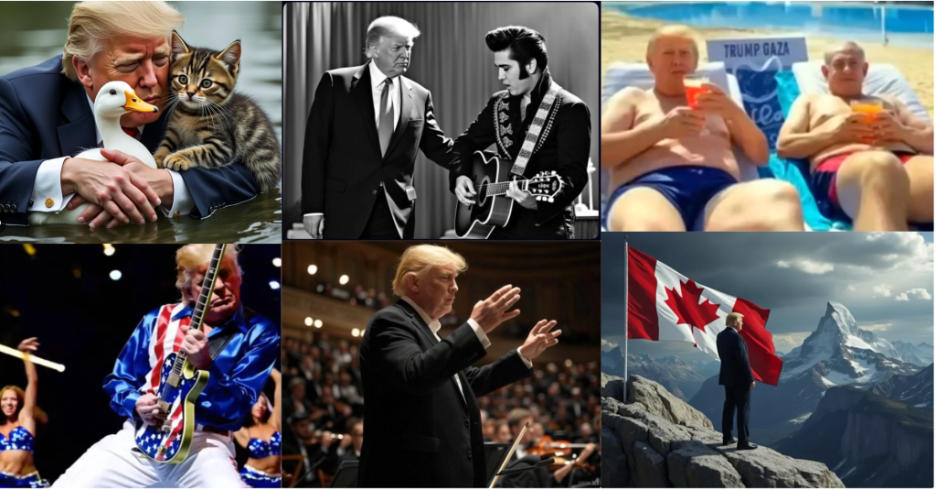
The sense of aestheticization’s precession is further reaffirmed in the present context by the increasing reliance on AI-generated imagery in Trumpian image production. This is the case not only because AI image generation proceeds from large data sets that contain vast quantities of already existing images, and that what we therefore encounter with it are “images from images” (Somaini 2023). The loss of discursive anchoring is intensified also by the fact that AI-generated “images from images” are likely to become the largest part of the dataset or the archive on which the present and future AI models will be trained, so that AI images will increasingly be produced from “images from images”, and then future images will be produced from “images from “images from images” and so on…. Alongside the effect of potentially indefinite forward regress created by this type of recursive image generation, there is also the fact that the functioning of the deep neural networks in AI image-generating models is a kind of “black box” and at present exceeds our ability to understand or discursively grasp it in human terms. Our attempt to make it produce an image depends on a machine learning process, during which we feed an AI model with data (a large set of images) and answers (textual descriptions or tags associated with these images). The learning process of an AI model consists in the model’s extraction of the rules or a statistical structure from this input. It is this ability to infer the rules that then makes it possible for the AI model to automate the task we wish it to perform: that is, to generate a new image (for a useful introduction to AI-based machine learning, see Chollet 2021). What is crucial, however, is that the configuration of statistical parameters the AI model arrives at during the training process remains obscure to us and is, if we may improperly anthropomorphize for a moment, “known” only to the AI model. We do not know how, according to what “rules”, what distribution of statistical weights, the AI model generated the image we prompted it to produce, which means that the image generated with the help of AI must always strike us at some level as irreducibly accidental. But it is precisely in this fundamental obscurity of its discursive condition that the process of AI-based image generation finds a kind of structural affinity with Trumpism and its iconorrhetic excess – an affinity, we may add, that has become strikingly clear in the explosion of AI-generated imagery during Trump’s second presidential term (for more on this question, see Meyer 2026).
Image and Crisis
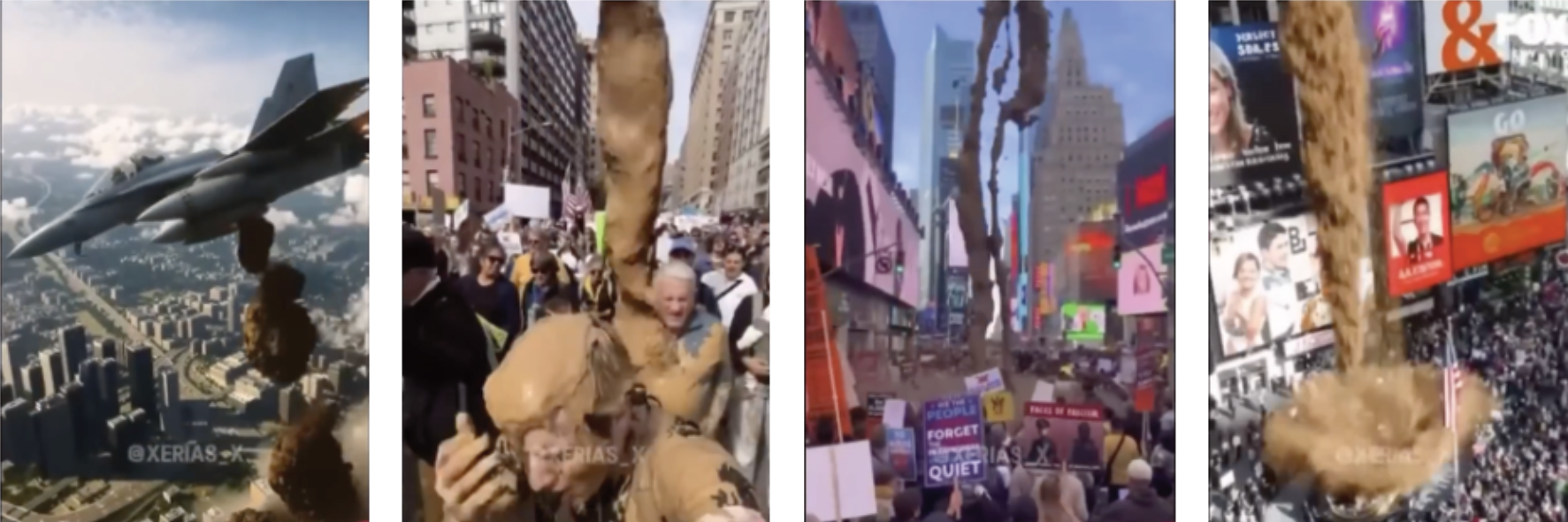
The primacy of “aestheticization” over politics, the existence of the iconorrhetic flood ungrounded in political logos, triggers as a response the desire for deep, hermeneutic interpretation capable of moving behind or beyond the delirious flux of Trumpian images in order to nevertheless identify their true political or discursive meaning. Such desire to interpretatively arrest the Trumpian flux either takes the form of ideologico-political analysis (i.e., identifying Trumpism with fascism, or with the good old American racism and white supremacy, or with some new underlying development, such as “neo-royalism”, for which see Goddard, Newman 2025) or seeks to unravel a set of deeper historical causes, as is for instance the case with the Marxist reading of Trumpism as a manifestation of the long economic downturn and the subsequent emergence of a new regime of accumulation called “political capitalism” (Riley, Brenner 2022; see also Riley, Brenner 2025). While we do not wish to suggest that these types of interpretations are wrong – on the contrary, they manage to illuminate Trumpism in important ways – from the perspective of someone interested in Trumpian imagery, their hermeneutic reach for the deeper meaning of Trumpism misses what is in some sense Trumpism’s truly enigmatic part: namely, its appearance. Why must the deeper political or historical meaning which we are able to identify as essential to Trumpism appear in this particular way? Why, for instance, must “fascism”, if that’s what we grasp as the underlying reality of Trumpism, assume on the surface of things precisely this form of visual delirium and derangement? Rather than simply follow the hermeneutic interpretative imperative – “Do not get taken by the surface delirium of Trumpian spectacle, focus on the deeper meaning these images seek to distract you from!” – it seems to us that it is just as important to trace the phenomenon of Trumpism along the opposite path as well, which is to say, to grasp it along the way on which the “deeper” meaning of the phenomenon comes to assume the specific surface appearance of Trumpism itself. What requires explanation is not merely the underlying meaning of Trumpism, but also – and perhaps especially – its genuinely confounding mode of appearance, its superficial manifestation. It is the form in which things appear that contains the secret of Trumpism’s historical novelty, perhaps even its historical singularity. Paying attention to the surface form, we rush to add, does not invalidate the deeper interpretation, but it might help provide us with a more concrete, as well as usefully estranged, sense of how these histories may be informed by a critical and historical ontology of the present.
With respect to this question of what is new and singular about Trumpism, we may continue to draw a sharp distinction between the critical theories of twentieth-century historical fascism and the theoretical resources that may be needed in our present moment (in this, we take inspiration from Toscano 2023). To be made intelligible, the historical fascism that emerged during the inter-war years of the previous century required theorizations of historical time that were profoundly dialectical. In perhaps the most famous elaboration, Ernst Bloch in his Heritage of Our Times made sense of the historical crisis that helped produce fascism by introducing the concept of the “contemporaneity of the non-contemporaneous”, thereby linking the phenomenon of fascism to the force of dialectical contradictions within historical time itself. Contemporaneity of the non-contemporaneous referred in Bloch’s usage to the coexistence of heterogeneous times within the time of the present. Above all, the concept named the fact of unfinished capitalist modernization: the persistence of real remnants of the past (peasant, premodern and pre-capitalist forms of life) that continued to assert themselves and exercise a strong subjective pull in the lives of the large part of the population. Historical fascism, which drew on this temporal tension within the present, within modernity that was not yet fully itself, thus mobilized a genuine dialectical (and negative) moment at work in historical time, which it then diverted toward its reactionary ends, its nostalgic longing for the past and the violent fantasies in which it imagined the purging of the very element of heterogeneity from which it drew its initial appeal.
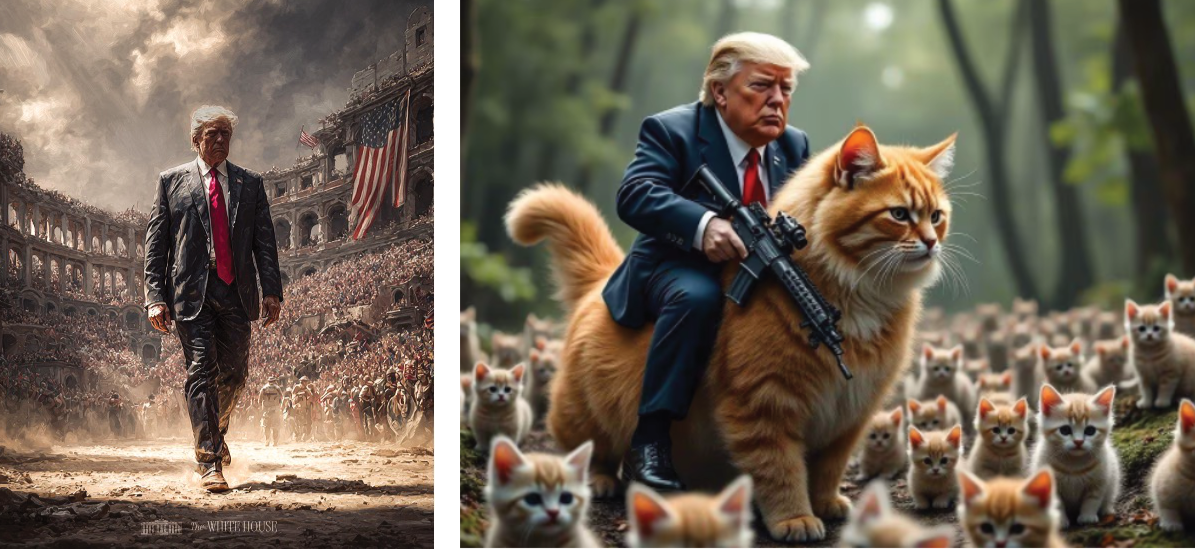
The status of the image, as it was critically elaborated in the situation of twentieth-century historical fascism, similarly relied on this dialectical coexistence of heterogeneous temporalities, for which the radical tension between the past and the present served as a kind of matrix. In Bloch – but also in Benjamin, and in a yet different way in the work of Aby Warburg – the image was grasped as a dialectical (or, in the case of Warburg, perhaps more as a tragic) configuration of incompatible times. The strength of the image was identified with its unique capacity to bring together, make con-temporaneous, times that lacked any shared measure. This incommensurability, the essential division of time, for which the temporalization of the image was nevertheless seen as providing a dialectical measure, expressed itself in the fact that the image appeared as something punctual, a sudden crystallization of a crisis. One can see this dynamic captured in Bloch’s concepts of “montage” and “abrupt mediation”, Benjamin’s concept of the “critical moment” and his idea of the image as “dialectics at a standstill”, as well as in Warburg’s interest in the Pathosformeln that inscribe the trace of suffering and disrupt the classical composure of pictorial form.
However, unlike the thinkers of the interwar period, we find ourselves in a situation of completed modernization. Over the course of the twentieth century, capitalism became global and has, through an imposition of a planetary present, snuffed out the remnants of any genuinely historical past. The kind of heterogeneity of time that constituted the historical dialectic of the early twentieth century no longer obtains. In distinguishing the situation of incomplete modernization from that of completed modernization, we borrow from Fredric Jameson’s distinction between the historical situations of modernism and postmodernism. In his A Singular Modernity (Jameson 2012), Jameson writes:
What we call artistic or aesthetic ‘modernism’ essentially corresponds to a situation of incomplete modernization. It is a situation [characterized by] the astonishingly belated survival of modernity’s feudal context in some European countries up to the very end of World War II: and by the same token, modernity’s emergence in limited commodification. The new bourgeoisies of the properly capitalist era […] are still relatively small segments of the overall and still predominantly peasant population. […] This makes for a world that is still organized around two distinct temporalities: that of the new industrial big city and that of the peasant countryside. And I will remark in passing that one of the great themes which has conventionally been identified as a dominant in literary modernism – namely temporality itself […] – is very precisely the mode in which this transitional economic structure of incomplete capitalism can be registered and identified as such (Jameson 2012, 141–142).
Consequently, the situation of postmodernism can then famously be described in the following way: “Postmodernism is what you have when the modernization process is complete and nature is gone for good” (Jameson 1991, IX).
Yet we would be mistaken to think that this completion of the modernizing process signals the disappearance of all non-contemporaneity or temporal heterogeneity as such. It is rather the case that what disappears with it are the distinct forms of historical non-contemporaneity, which have been replaced by the properly capitalist forms of temporal dislocation. Though often regarded as a homogenizing force, capital in its envelopment of the planet does not rely primarily on its ability to make time homogenous, but rather on the ceaseless exploitation of temporal differences, which it in turn (re)produces through its movement. There exist, in other words, forms of non-contemporaneity that are distinctly capitalist or immanent to capital. A central example: surplus-value, around which the entire movement of capital revolves, is produced in the sphere of production (through capital’s consumption of labor-power), but it is only realized in the sphere of circulation (through the exchange of commodities, where it comes into existence as profit), which is to say that surplus-value is necessarily, structurally non-contemporaneous with itself. This type of non-contemporaneity can hardly be considered historical, since it does not consist of two distinct and heterogeneous times (past and present), but is rather internal to a single moment (the emergence of surplus-value) in the capitalist structure. Or put differently, temporal fracture in capitalism does not point to the incommensurability between two historical temporalities, but rather inheres in the temporalization of a single phenomenon which is incommensurable in relation to itself (i.e., surplus-value is the lack of common measure constitutive of capital as value in motion). In this sense, it is perhaps more appropriate to speak of this phenomenon as one of temporal discontinuity rather than non-contemporaneity, reserving the latter term for those situations in which temporal heterogeneity assumes one of its distinctly historical forms.
Capitalist discontinuity does not require the invention of contemporaneity as the form to mediate the temporal incommensurabilities that capital seeks to exploit. Contemporaneity, understood as a possibility of synthesis (or totalization) in the face of temporal difference, is essentially a historical problem and in that sense implies a collective human subject as an agent capable of becoming con-temporary, of carrying out the work of synthesis and conquering the time of the present by mastering the heterogeneous temporal impulses that traverse it. In place of human history as the production of contemporaneity, capital, on the contrary, requires only continuity or the assurance of the continuous operation of its circuits across the discontinuities and interruptions which provide the movement of value with its own dynamism (see, in particular, Chapter 4, “The Three Figures of the Circuit”, in Marx, Engels [1885] 1997). The formula of the problem proper to the movement of capital can therefore more correctly be stated as that of the continuity of the discontinuous, and can as such be seen as fundamentally different from the historical problematic of temporal synthesis signaled by the Blochian concept of the contemporaneity of the non-contemporaneous.
That the process of modernization has been completed, that capitalism has entrenched itself as a truly global world-system, could therefore also be expressed by saying that continuity has replaced contemporaneity as the dominant manner in which the problem of temporal difference, the fact that time is not one with itself, registers today. With this, the meaning of temporal difference has itself shifted: the latter can no longer be felt and experienced as non-contemporaneity (an encounter of the present with an irreducible past) and instead assumes the guise of the seemingly more sterile experience of discontinuity.

This shift may also be observed in the changed status of the image. No longer the privileged site for the dialectical articulation of heterogeneous temporalities, as it might have been the case in the twentieth century, the image has become a vehicle for the construction of an order of continuity, in which the previously temporally heterogeneous elements are translated into a set of discontinuities and then made to assume a form of simultaneous coexistence. Consider for instance the following AI-generated image, posted on the official X account of the US Department of Homeland Security, in which the silhouette of a cowboy is placed against a rugged Western background, and a B–2 strategic bomber flies in the sky above it.
The caption (“We’ll have our home again”, a popular white supremacist slogan) announces the sanctioned reading of the image: a vague but unmistakably white American heritage is somehow under threat, and must be defended with all the power afforded by American technological superiority. It is clear that this is not a montage between elements we are meant to experience as non-contemporaneous. There are no intimations of (temporal) incommensurability, nor does the image suggest some sort of intense contrast between the cowboy and the bomber. The frictionless juxtaposition between the two elements which underpins the propagandistic message of the image is hardly the crystallization of a divided historical time; rather, the image imposes a spatial continuity – the backdrop of the Western landscape as the ‘home’ the caption refers to – between the discontinuous elements.
If we wish to follow the example of the critical theories of the twentieth-century historical fascism and read such an image, in which the aspect of space predominates over any inscription of temporal contradiction, as an index of a crisis, we must then also observe that the crisis itself thereby no longer appears as strictly speaking historical – as a dialectical crystallization of temporal tensions that traverse the present and await the work of synthesis – but has come to assume a different form. How might one characterize this “non-historical” form of crisis? The French psychoanalyst Gérard Wajcman has recently suggested that we now live in a period in which the very sense of crisis – which, again, has typically been understood as a sudden moment of interruption or reversal that punctuates, and thus separates, two periods of calmness – has become inseparable from the logic of seriality. So that in place of the sequence “calm–crisis–calm”, we seem to find ourselves in the sequence “crisis–crisis–crisis”. To put it in our terms, the crisis appears today in the form of a continuous discontinuity, a critical interruption that perpetuates itself, recurs indefinitely, without interruption:
This corrupts the very meaning of crisis, which presupposes a breach in the timeline, a critical moment of vacillation, an unbalanced suspension between a former state that has been broken and a future that has not yet come to pass. Today’s crisis exists without rupture; it unfolds along a continuous critical ridge. An uninterrupted crisis, in which we ought to see the emergence of a hypercrisis. Finally, I find myself thinking that what we have called hyper-modernity is, in truth, the era of perpetuated hypercrisis (Wajcman 2018, 23).
“A Disassembly Workshop”: Trumpism, Seriality, and Myth
What Wajcman calls “hypercrisis” is the form of the appearance of crisis in the capitalist system as such: multiple, cyclical, repetitive, and inscribed into the normal functioning of the system itself. Another way of formulating Wajcman’s thesis would be to say that in the moment of completed capitalist modernization, crisis and normalcy assume a relationship homologous to that of the two sides of a Moebius strip: the difference between crisis and normalcy is only legible if they are considered parts of the same, continuous movement, just as their unity is only graspable if we are able to see them as two distinct sides of the process. Crisis and normalcy may thus be considered as distinct moments, yet they are also practically indiscernible, and it is this strange articulation which renders the particular modality of serial crisis characteristic of the contemporary capitalist world-system.
This form of the appearance of crisis offers another way to measure the gap that separates the historical time of unfinished modernization and our present time of completed modernization. In the former, the dialectical regime of contemporaneity of the non-contemporaneous allows crisis to materialize itself as also dialectical – in Benjamin’s terms, a moment of catastrophe that illuminates the historical conditions that brought it into existence (Benjamin [1927-1940] [1982] 1999, 462). Indeed, it is precisely in the moment of crisis that the question of the emergence of the non-contemporaneous – and of its reactionary or emancipatory uses – poses itself: it is the “moment of danger”, as Benjamin calls it, in which the past becomes susceptible to political appropriation and weaponization (Benjamin [1955] 1968, 255). In times of unfinished modernization, then, crisis presents itself as apokalypsis, bringing with itself the intertwined augurs of catastrophe and revelation.
No such meaningful encounter with crisis obtains in the context of completed modernization. Here, crisis assumes the more mundane traits of a feature of the capitalist system itself – a state of emergency that appears at once temporary and continuous, seemingly indiscernible from the one that preceded it and the one that will surely succeed it. As the Moebius strip of crisis-as-normality and normality-as-crisis, hypercrisis names a situation in which the political and aesthetic problem posed by the contemporaneity of the non-contemporaneous gives way to the experience of an intermittent but seemingly infinite bout with trauma, whereby our ability to make sense of dramatic upheavals is hindered by the chaotic and relentless way in which they manifest themselves to us – or, in the Lacanian terms Wajcman uses, the symbolic finds itself unable to weave the traumatic real back into the fabric of collective experience. Crucially, this failure of the symbolic has itself become serialized: no longer a singular disruptive event around which some kind of narrative could still be articulated (as in the case of modernism), but a chain of repeated, multiple breakdowns that hardly registers as an event at all. The cultural form of the series and its seemingly irresistible popularity in recent times, Wajcman argues, are to be read as both the form that best captures this new regime of experience and one of the foremost symptoms of this inability to re-inscribe the trauma of crisis into our apprehension of the world.
While Wajcman writes his theorization with television series in mind, we believe it is possible to extend his arguments beyond any medium specificity and toward a formal theory of media seriality. From our point of view, series names in the most general sense a form that describes with a certain degree of coherence the visible surface of a phenomenon while also making it possible to grasp the absence or the falling apart of form as such. It is precisely in this tension that the most consequential stakes of seriality are played out: the inner limitation of the series (namely, its inability to attain complete coherence) is also what makes it a revealing aesthetic symptom of our times of hypercrisis. Itself a form-in-crisis, seriality also appears as the form of uninterrupted crisis: a sprawling, haphazard attempt at articulating a narrative that would bestow a coherent meaning onto recurrent encounters with trauma and assimilate them into the frame of collective experience but ultimately fails to do so, endlessly flirting as it does with narrative disintegration.
As much a descriptor for uninterrupted crisis as the form of an inability to fully narrativize it, seriality is one of the ways in which the aestheticization of politics appears in conditions of completed modernity. Its defining features of open-endedness and a-hierarchical organization, along with its symptomatic ability to index a novel situation in which crisis has itself become serial, seem particularly useful for shedding some light on the enigma we formulated earlier, namely, the reason why the essence of Trumpism – its deeper political or historical meaning – appears in this particular way. That the spectacle of Trumpism might carry a special relationship to seriality suggests itself as a justifiable hypothesis already due to the fact that the Trump-figure must itself be understood as a serial construction, produced over several decades through tabloid seriality, the televisual seriality of reality TV, and more recently, the seriality of social media and the internet, which in Trump’s case function as an extension and intensification of televisual seriality.
It is perhaps not surprising that Wajcman would look primarily at America (through American television series) as the stage where seriality attains its most precise and sophisticated articulation. “The series”, he quips, “is a disassembly workshop [atelier de démontage] of an America that is already misfit and rather deranged” (Wajcman 2018, 15). The terms Wajcman uses to describe contemporary America (“misfit” and “désaxée” in the original) evoke the situation of a country off-kilter, unable to find a steady alignment, a stable horizon that would provide some orientation for coherent political action. This discombobulation is a result of a slew of transformations in the global order that have taken place in the last thirty years or so: globalization, the rise of China and an increasingly multipolar international order, the war on terror and its failures, mass migration, financial crises and market instability, increasing inequality and social disintegration, ecological disaster, etc. It is clear enough that this is no longer mid-twentieth-century America relying on classical Hollywood and its genre system to establish the mythical narrative of a country “in the process of building itself” (Wajcman 2018, 15). In many ways, the “disassembly workshop” of the series fulfills the very opposite task: as an attempt to narrativize the thirty-year long crisis of the Pax Americana, it returns to us the deconstructed image of an America in crisis, fractured and erratic, in which traumas no longer register as traumas and crisis does not carry any promise of greater historical understanding. Seriality, then, responds to this new form of crisis by adapting its narrative logic to it, while at the same time ratifying the inadequacy of more classical forms of narrativization to capture the present moment.
With Trumpian seriality, however, it is not a simple case of one form of narrative superseding another, obsolete one. In a remarkable twist, Trumpian serialized imagery attempts to salvage and re-incorporate classical forms of narrativization. In Trumpism, in other words, the disassembly workshop of the series doesn’t just deal in spare parts: against its avowed capabilities, it is also tasked with a tentative project of retrofitting. While a vast swath of Trumpian AI-slop fulfills the all-consuming task of trolling whoever dares to oppose the regime, there is another strand of content that functions according to a different, more ambitious mythologizing logic. It is rather obvious, at least in intent, that some part of the Trumpian content-generation frenzy confusedly aims for a revival of a certain American mythology. In pictures and videos mostly posted by the Department of Homeland Security’s official X account, frontier lore and Civil War imagery intersect with pop-culture icons of various “golden ages”: the Fifties, the Eighties, the Nineties (the exclusion of antagonistic moments in which historicity reappears – the Thirties, the Forties, the Sixties and, the Seventies – is as conspicuous as its motivations are transparent). Wajcman, however, is categorical: due to its fragmented and dispersed form, the series is entirely hostile to myth (Wajcman 2018, 15). The disassembly workshop of the series can process the undoing of an America désaxée, but cannot be effectively enlisted in the myth-building effort of a faltering empire. This is one of the contradictions at the heart of Trumpian imagery: the deployment of the series-form to carry out a task – rebuild a mythology – that it is structurally incapable of performing.
A closer look at Trumpian imagery, particularly the serial flux of frontier-themed art, reveals the inner incongruence of the notion of serialized myth-building. In this situation of general visual equivalence based in the continuity imposed on the discontinuous, there is no meaningful difference between, say, the John Gast painting American Progress (1872) and the AI-generated picture of alligators with ICE hats lined up outside a penitentiary.

The inclusion of the painting into the series makes it aesthetically, if not factually, as much AI-slop as the alligator picture. It must be said that this ‘slopification’ of painting also reveals, conversely, the extent to which some paintings already display features that we would associate with AI aesthetics: a certain glossy smoothness, an obtuse, propagandistic obviousness, and so forth. The mythologizing intention of the Gast painting, however crude, would seem to set it apart from the puerile celebration of Alligator Alcatraz (the infamous South Florida immigration detention facility), but is in fact neutralized under conditions of seriality, as is that of the myriad frontier-themed images that populate the Trumpian iconosphere, where inaccurate citations from Tombstone (“Are you gonna cowboy up or just stay there and bleed?”) line up alongside bottles of Coca-Cola and a Ford Bronco, AI renditions of medieval knights (“The enemies are at the gates”), and freeze frames from The Lord of the Rings trilogy (“There won’t be a shire, Pippin”).

The general impression one receives from this serial onslaught of images is certainly not that of the genuine mythology of a new founding, the pioneering of a new iteration of America. What is offered is, far more modestly, the tatters of a narrative of restoration: the white supremacist fantasy of returning America to its glorious past by violently reasserting and patrolling an impassable dividing line between those who are included in the national community and those who are not. A useful framework for better understanding this form of nostalgic longing is the historical distinction Wajcman makes between a world governed by a now-faded logic of limits, where borders are enforced and the enemy can always be identified as external; and a logic of the decay of limits that characterizes contemporary societies in a globalized world, porous societies that struggle to draw a proper distinction between interior and exterior and therefore exist in a state of constant panic aroused by the well-worn phantom of the ‘enemy within.’ In such societies we reach a paradoxical state of proliferation of borders whose effects have become tragically apparent in the recent occupation of a number of American cities (most notably Washington, DC and the Twin Cities) by federal immigration agents dispatched by the Department of Homeland Security: “to defend society against its enemies is to defend it against its own members… to defend society means to defend it against itself” (Wajcman 2018, 32).
One aspect that perhaps Wajcman does not emphasize enough is the phantasmatic quality of the former, limit-asserting logic. His thesis, in other words, should not simply be read as an account of two distinct phases in history succeeding one another. Rather, it is the case that the historical situation of globalization and its logic of limitlessness has given rise to a countervailing desire for clearer lines of demarcation between inside and outside, which in turn takes the form of a call for the restoration of a state of affairs that, in some sense, never existed in the first place – a time of sealed borders that is imagined as precedent but is in fact conceptually consequent. Indeed, the idea of an impassable border in modern times has never been more than a reassuring fiction, and no one has handled this fantasy more deftly – or has profited more extensively off of it – than Trumpism. Of course, the serial recurrence of the figure of the border in Trumpian imagery is, in some ways, the sign of a failure of that fantasy: as we have seen, the serialized narrativization of the current situation of hypercrisis can only occur in the move away from classical, mythical narrative forms, and no deployment, however obsessive, of a rag-tag border-themed iconography with its corollaries of spectacularization and cruelty can constitute an exception to this incompatibility of series and myth: there is no genuinely mythical narrative of a reconquest of the homeland to be had here. This is not, however, simply a failure of fantasy; we are dealing here also and at the same time with a fantasy of failure. The border must never be completely secure, lest its political value wane. It must remain porous, so as to act as a catalyst for anxieties and reactionary sentiments: a fantasy of endless alertness justifying the Sisyphean work of fending off a siege.
There is, however, a certain ambivalence in the visual form that this fantasy assumes. By and large, the most copious reservoir of material for the border-series in Trumpian propaganda is frontier-related. At some level, this should come as no surprise. The frontier is, after all, the great founding narrative of America, and any attempt at mythbuilding in myth-averse conditions of seriality is bound to look for inspiration there. Secondly, the frontier and the border both qualify on the face of it as lines of separation, albeit of a radically different kind. While the frontier can also function nominally and ideologically as a border in American mythology (between, say, the ‘garden’ of white civilization and the ‘wilderness’ of Native American territories), its defining trait is that it advances, and with that westward advancement comes a promise of abundance and prosperity for the citizens of a newborn nation (and genocide and deracination for everyone else). There is a clear-cut vitalism associated with the frontier: if it is a line of demarcation, it is one whose worth and appeal reside in its impermanence and dynamism, as it is pushed further toward the Pacific against external foes by the providential design that the aforementioned Gast painting so clumsily captures. The border, particularly in its contemporary proliferating iteration, responds to rather different criteria, as the ICE alligators AI-slop adumbrates: a frozen, defensive posture guarding an immobile line – a wall – designed to interrupt movement altogether and reaffirm an irrevocable separation between the inside and the outside.
The shift from the frontier to the border as the dominant ideological figure through which America represents itself to itself tracks along the historico-political transformations of the country through the twentieth century and, more specifically, indexes the changing role that promises of abundance and fears of scarcity play in policy-making. It is perhaps useful to remember that the myth of the frontier encountered its first moment of exhaustion with the New Deal. Reckoning with the historical closing of the frontier forty years earlier and the end of the promise of endless expansion, the so-called Left Turnerists in the Roosevelt administration called for strong federal intervention and redistribution of wealth as the solutions for a new reality of finite resources. With FDR, the frontier was seen “less as mythology and more as pathology, a social disorder manifested in an insistence on national uniqueness”, as Greg Grandin puts it (Grandin 2019, 176). The nominally universalist project of the New Deal, based on government support and oversight, remained active after the Second World War, but changed its complexion in the context of the boom of postwar productivity. During the rise of the liberal world order based on a vision of endless growth, the economic upswing offered the promise of a new abundance, and with the expansion of foreign capitalist markets, the myth of the frontier was once again open for business. But the New Deal idea of scarcity hardly disappeared from the political debate. A new racist worldview began to grow in the belly of the new liberalism. Assuming a complete rejection of New Deal universalism, the proponents of the so-called ‘race realism’ called for resources to be hoarded and protected from immigrants. The new defining figure of this worldview was no longer the frontier, but the border. As Grandin has argued, this shift eventually came to define one of the crucial aspects of Trumpism:
It was the focus on the border and all that went with it – labeling Mexicans rapists, calling migrants snakes and animals, stirring up anger at undocumented residents, proposing to end birthright citizenship, and unleashing ICE agents to raid deep into the country, to stalk schools and hospitals, to split families and spread grief – that provided Trumpism its most compelling through-line message: The world’s horizon is not limitless; not all can share in its wealth; and the nation’s policies should reflect that reality (Grandin 2019, 8).
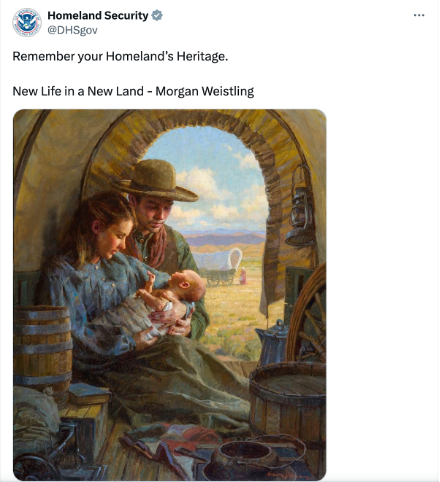
It is no wonder, then, that the deployment of frontier imagery to build a mythology around this vision would reveal a certain internal incoherence. The vitalism inscribed into the westward expansion and the promise of bountiful life it carried can hardly harmonize with the reactive and defensive ambition to hoard resources beyond guarded walls. This is evident also in some of the choices DHS makes in their perusal of frontier-themed art. Consider for instance this painting by Morgan Weistling where the horizon (and the expansionist promise it carries) all but disappears in favor of a celebration of the nuclear family of settlers inside the confined space of a wagon.
To use a Lacanian term, the mythology of the frontier and the fantasy of the border configure two opposite relationships to enjoyment: a future-oriented vision of prosperity contingent upon territorial enlargement, on one hand; and on the other, a violent reaction to scarcity aimed at recouping resources we feel entitled to from those who are unjustly enjoying their benefits. The sleight of hand of this resentful fantasy is that of implicitly casting the rancorous one as a victim in need of reparation from these thieves of enjoyment. It is not surprising that this aspect would remain somewhat hidden in favor of more triumphant themes (in right-wing dogma victimhood equals weakness), but it is clear that the animating spirit of this imagery is that of righting a perceived injustice.
The figure of the border and its attendant fantasy of resentment are both, in some way, underpinned by a general idea of limitation that we could summarily formulate as follows: the finitude of resources requires a partitioning of space enforced by state violence so as to secure the exploitation of said resources for the exclusive benefit of a particular racialized group of people. One of the basic exhortations of Trumpism, especially in the face of the most outlandish exploits of the administration, is that we must “be realistic”: we must fortify America’s existing limits (which, in Trumpism, take on an increasingly hemispheric scope) as well as force our competitors to accept the same conception of the limit. This zero-sum statecraft exercise which elevates the ‘limit’ to the level of both cause and effect of a changing post-globalized world finds a perhaps marginal but no less arresting moment of contradiction in the Trumpian visual field, whose conditions of existence we have tried to chart in this essay. “Limitlessness”, writes Wajcman, “is at the heart of the series” (Wajcman 2018, 30). This sprawling, fragmented form is intrinsically indefinite, based as it is in the infinite recurrence of the elements that constitute it. The series, in other words, knows no limits. The serial form of appearance of the border in the Trumpian imagery thus contradicts the stated political content of the border-figure itself. What we are contending with is the paradox of a fantasy of a sovereign, world-building practice of limit affirmation (the proliferation of borders) that expresses itself through limitlessness, that is, through the infinite recurrence of a form that abhors limitation absolutely.
Bibliographical references
- Benjamin [1927-1940] [1982] 1999
W. Benjamin, The Arcades Project [Das Passagen-Werk, Hrsg. von H. Tiedemann, Frankfurt am Main [1927-1940] 1982], trans. H. Eiland, K. McLaughlin, Cambridge (MA) 1999. - Benjamin [1936] 2006
W. Benjamin, The Work of Art in the Age of Its Reproducibility [L’œuvre d’art à l’époque de sa reproduction mécanisée, “Zeitschrift für Sozialforschung” V, 1 (1936), 40-68] in Id., Selected Writings, Volume 3, 1935-1938, edited by H. Eiland, M.W. Jennings, trans. E. Jephcott, H. Eiland, et al., Cambridge (MA) 2006. - Benjamin [1955] 1968
W. Benjamin, Illuminations [Schriften, Hrsg. von T.W. Adorno, G. Adorno, Frankfurt am Main 1955], edited by H. Arendt, trans. H. Zohn, New York 1968. - Bouie 2025
J. Bouie, JD Vance is Idling at the Edges of American Politics, “The New York Times” 15 November 2025. - Callison, Slobodian 2021
W. Callison, Q. Slobodian, Coronapolitics from the Reichstag to the Capitol, “Boston Review” 12 January 2021. - Chollet 2021
F. Chollet, Deep Learning With Python: Second Edition, Shelter Island (NY) 2021, 1-25. - Cooper 2022
M. Cooper, Family Capitalism and the Small Business Insurrection, “Dissent” (Winter 2022). - Gaffney, Himmelstein, Woolhandler 2025
A. Gaffney, D.U. Himmelstein, S. Woolhandler, The Dismantling of American Healthcare, “The New York Review” 8 July 2025. - Glickmann 2025a
S. Glickmann, The War Over Defense Tech, “The New York Review” 4 October 2025. - Glickmann 2025b
S. Glickmann, Runaway Short-Termism. A conversation with Susannah Glickman and Nic Johnson, “The New York Review” 21 November 2025. - Greenhouse 2023
L. Greenhouse, Victimhood and Vengeance, “The New York Review” 9 February 2023. - Goddard, Newman 2025
S.E. Goddard, A. Newman, Further Back to the Future: Neo-Royalism, the Trump Administration, and the Emerging International Order, “International Organization” 79, 1 (December 2025), 12-25. - Grandin 2019
G. Grandin, The End of the Myth: From the Frontier to the Border Wall in the Mind of America, New York 2019. - Jameson 1991
F. Jameson, Postmodernism, or, The Cultural Logic of Late Capitalism, Durham 1991. - Jameson 2012
F. Jameson, A Singular Modernity, London 2012. - Jesi [1979] 2025
F. Jesi, Cultura di destra. Con tre inediti e un’intervista, a cura di A. Cavalletti, Milano 2025. - Luce 2026
E. Luce, America’s Barbarians Inside the Gates, “Financial Times” 20 January 2026. - Meyer 2026
R. Meyer, Generative KI und die Ästhetik des Digitalen Faschismus, YouTube. - Marx, Engels [1885] 1997
K. Marx, F. Engels, Capital, Volume II [Das Kapital. Kritik der politischen Ökonomie, Bd. II, Hrsg. von F. Engels, Hamburg 1885], in Iid., Collected Works, vol. 36, London 1997. - Parker, Sherer, Miroff 2026
A. Parker, M. Sherer, N. Miroff, The Wrath of Stephen Miller, “The Atlantic” 7 January 2026. - Riley, Brenner 2022
D. Riley, R. Brenner, Seven Theses on American Politics, “New Left Review” 138 (November-December 2022), 5-27. - Riley, Brenner 2025
D. Riley, R. Brenner, The Long Economic Downturn and Its Political Results, “New Left Review” 155 (September-October 2025), 25-70. - Singh 2026
N.P. Singh, Homeland Empire, “Equator” 14 January 2026. - Slobodian 2025a
Q. Slobodian, The tech bros have front-row seats at Trump’s inauguration, but what they want goes way beyond that, “The Guardian” 18 January 2025). - Slobodian 2025b
Q. Slobodian, Elon Musk’s hostile takeover, “The New Statesman” 15 January 2025. - Slobodian 2025c
Q. Slobodian, Speedup the Breakdown, “The New York Review” 15 February 2025. - Somaini 2023
A. Somaini, Algorithmic Image: Artificial Intelligence and Visual Culture, “Grey Room” 93 (Fall, 2023), 74-155. - Toscano 2023
A. Toscano, Late Fascism: Race, Capitalism and the Politics of Crisis, London 2023. - Wajcman 2018
G. Wajcman, Les séries, le monde, la crise, les femmes, Paris 2018. - Wolf 2026
M. Wolf, Trump is Erasing the Global Economic Order, “Financial Times” 20 January 2026. - Wyman 2021
P. Wyman, American Gentry, “The Atlantic” 23 September 2021.
Abstract
Arsenjuk and Resmini’s contribution examines Trumpian imagery as the visual form of a politically disarticulated reactionary coalition. It argues that Trumpism achieves unity through spectacle: a proliferating and serial image regime that compensates for the loss of political articulation. Drawing on Benjamin, Jesi, Jameson, and Wajcman, the essay shows how contemporary Trumpian visual culture, especially in its AI-generated forms, is structured by seriality, discontinuity, and hypercrisis rather than by the dialectical temporality of historical fascism. Trumpian imagery thus appears as an unstable attempt to produce myth under conditions that render myth impossible. The article proposes seriality as a key category for understanding the historical specificity of Trumpist spectacle.
keywords | Donald Trump; Walter Benjamin; Trumpism; Furio Jesi; Hypercrisis.
questo numero di Engramma è a invito: la revisione dei saggi è stata affidata al comitato editoriale e all'international advisory board della rivista
Per citare questo articolo / To cite this article: L. Arsenjuk, M. Resmini, Surface Derangement: Preliminary Notes for an Inquiry into Trumpian Imagery, “La Rivista di Engramma” n. 233 (aprile 2026).