The Masculine Aesthetics of Matteo Salvini and Jair Bolsonaro
Analysing Far Right Virilities in Digital Spaces
Erica Capecchi
Abstract
Introduction
This article analyses the masculine aesthetics of Italian and Brazilian Far Right leaders Matteo Salvini and Jair Bolsonaro, exploring the performative dimension of their virile self-representation online. It advances a multimodal aesthetic analysis that centres visual and iconographic investigations of digital contents, supported by critical discourse, social semiotic, and historiographic methods. Far from providing an exhaustive account of how male identity is shaped in the online representation and discourse of the two leaders, the analysis draws on selected examples from Salvini and Bolsonaro’s social media profiles and online news reports related to specific events and debates. This paper dissects some of the essential aspects informing the construction of a masculine aesthetics that cements the public perception of the two leaders around imaginaries of male dominance and patriarchal hegemony. It contributes to advance critical understanding of the ways the public image of Matteo Salvini and Jair Bolsonaro has been shaped through aesthetic strategies that, capitalising on the possibilities provided by the digital medium, consolidate their representation as strongmen in the public imaginary.
Despite the attention that the global rise of Far Right movements between the 2010s and 2020s has gauged among scholars, there is still a dearth of research engaged with the aesthetic dimension of far-right representation and discourse online. Consistent progress has been made in unravelling several aspects at the heart of Far Right politics including economic, religious, and cultural processes. Nevertheless, as Craig (2022) notes, less critical attention has been paid to how political consciousness and partisanship are shaped through aesthetic forms that imbue those politics with meaning and potentiality. Furthermore, current research seems to miss the potential of developing interdisciplinary approaches to examine the interplay of visual, textual, and discursive elements for the manufacturing of online narratives capable to legitimise far-right politics and ideologies in public debates.
In this context, few studies explored the parallels emerging from the multifaceted self-representation of far-right leaders online. Even less research has investigated the connections between personalities such as Salvini and Bolsonaro (Demuru and Sedda 2020; Adinolfi and Goulart da Silva 2024). Recent scholarship focused especially on the figure of US President-elect Donald Trump (Kellner 2017; Nai et al. 2019; James 2021; Di Silvestro 2023; Bourne 2025), framing him as the main reference for comparisons around public identity, personality, and representation of far-right leader, while overlooking other possibilities. This is testified, for example, by the appellative given to Bolsonaro as the ‘Trump of the Tropics’, a definition that can be limiting because it relegates Bolsonaro in a position of subordination to Trump, stripping him of agency and specificity.
Investigating the virile performances that inform Salvini and Bolsonaro’s online self-representation, this article suggests the existence of parallels and connections in the construction of their public persona, which boasts a masculine aesthetics that blends models of strong and authoritative leadership with imaginaries of ordinariness and imperfection. As Mazzoni and Mincigrucci (2023) observe, these leaders managed to overcome what Kane and Patapan (2012) defined as the “paradox of the democratic leader” by exploiting logics of celebrity politics and influencer culture to develop self-branding strategies online that foster their appreciation and popularity among the citizenship. Merging the characteristics of super and everyday celebrity politicians identified by Wood, Corbett, and Flinders (2016), both Salvini and Bolsonaro show a type of double-faced masculinity that is at the same time tough, exceptional, and unique, as well as human, fragile, and overall ‘normal’.
This attitude is generally inscribed in the realm of a ‘populist’ politics and ideology that, in the past years, a broad range of research (Swank, Betz 2003; Alvares, Dahlgren 2016; Engesser et al. 2017; Wodak et al. 2013; Wodak 2019; Rodrik 2021) has juxtaposed especially with far-right movements due to the negative characteristics assigned to this concept, frequently associated with authoritarian tendencies, anti-elitism, and exclusionary ideas sustained by irrationality, and oversimplification. Drawing on Laclau’s (2018) perspective, my analysis diverges from these interpretations by framing populism as an articulatory practice with its own logic and rationality. Populism is therefore considered here as a political discourse (Mudde 2004) and performative act (Cover 2020) capable to interpret complex social realities and shape political consciousness and identities around the pastoral figure of the leader, who oversees the unity of the group that they embody and represent. In this context, the group is defined by ‘the people’ understood as a qualitative concept. As Umberto Eco reminds in his analysis of Ur-Fascism (1995), in Far Right discourse, ‘the people’ is conceived as a homogeneous and monolithic entity enmeshed with the image of the authoritative leader. Building on this concept of populism, the argument highlights how the virile performances enacted by Salvini and Bolsonaro online foster the construction of a shared identity and sense of belonging to the same community group by boasting feelings of ethno-nationalistic unity through camaraderie, brotherhood, and male dominance.
Considering the specificities of the Italian and Brazilian socio-cultural landscape after the electoral victories of Salvini and Bolsonaro in 2018, this article unpacks the specific strategies employed by the two leaders to shape public perceptions around their masculine body and role as political leads, outlining shared patterns and key differences. The investigation considers three main themes: the link with football popular culture, the rehabilitation of the memory of both countries’ authoritarian pasts through praise of the military, and the fetishisation of phallic dominance and violence through the public exhibition of weaponry. The imaginaries awakened by these themes converge in the ‘captain’ character impersonated by both leaders, which is crucial for the enactment of their virile performances and the construction of their public identity.
The People’s Captains
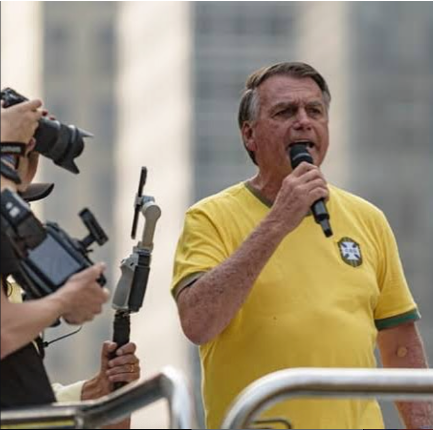
1 | Jair Bolsonaro wearing the Brazilian national football team shirt while giving a speech from a stage set in the Avenida Paulista, São Paulo, 19 February 2025. Instagram.
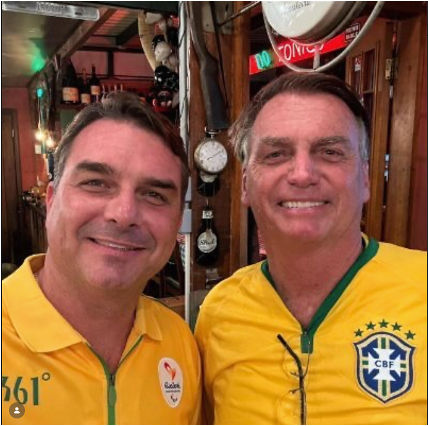
2 | Jair Bolsonaro with his son Flávio, both wearing shirts that feature the yellow and green colours of the Brazilian flag. Instagram.
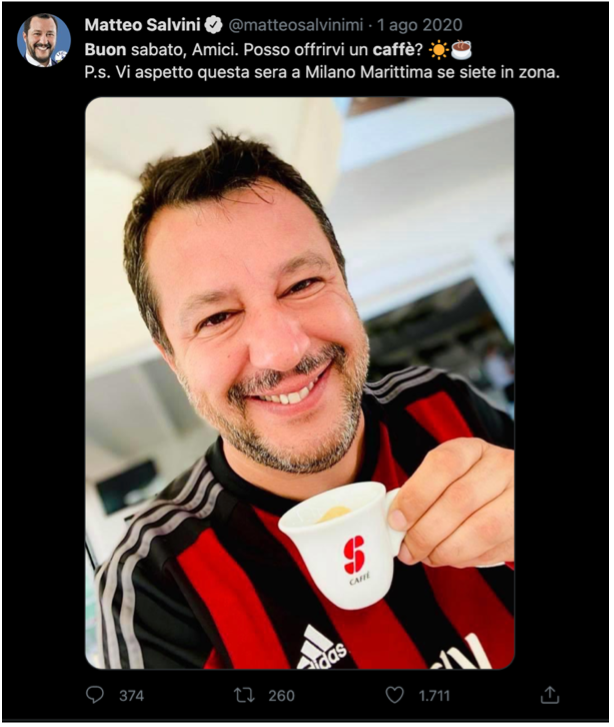
3 | Matteo Salvini wearing a Milan AC shirt gives the good morning to his ‘Friends’ with a cup of espresso, 1 August 2020. X.
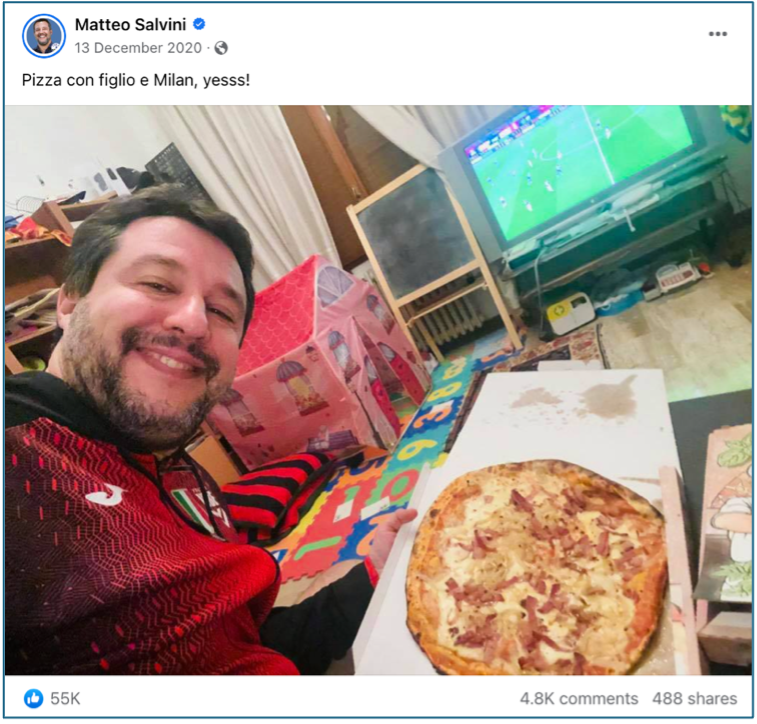
4 | Matteo Salvini showing a takeaway pizza with a football game streaming in the background, 13 December 2020. Facebook.
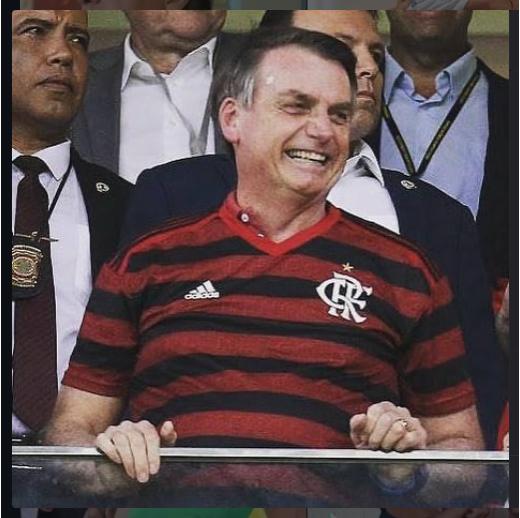
5 | Jair Bolsonaro at the stadium wearing the shirt of the football team Flamengo from Rio de Janeiro, 19 October 2022. Instagram.
One of the main parallels that stands out from the construction of the public image and identity of both Matteo Salvini and Jair Bolsonaro is the aesthetics of the invincible leader exemplified by the Captain figure (Capitão in Portuguese and Capitano in Italian). Although the origins of this character and the iconography associated with it presents contextual differences, its meaning and goal in terms of manufacturing a specific masculine aesthetics imbued with machismo (“Machismo is characterised by a ‘warrior ideology’ that influences the socialisation and enculturation of males and sustains the organisation of humankind in gender hierarchies of superior male and inferior female social categories” Mosher 1991, 199) present cross-overs that align to a political and ideological agenda shared within a global Far Right network.
In the case of Bolsonaro, the appellative Capitão draws direct connections with the military past of the leader (Adinolfi, Goulart da Silva 2024; Turner 2024; Piazza, Landy 2024) referring to his career in the Brazilian Paratrooper Forces. It is not difficult to imagine why this appellative has been chosen to define the leader’s public representation. By referring to a military vocabulary, the imaginary of the Captain contributed to build a stronger sense of male leadership around Bolsonaro, one rooted in the manufacturing of a sense of masculine identity imbued with socio-cultural constructs of strength and dominance as 'natural' traits of masculinity. Furthermore, framed within a military perspective, the captain figure awakens an idea of camaraderie and brotherhood that foster feelings of belonging to the same community group enhanced by the male bond established between the leader and his supporters.
A similar aesthetics can be found in the role of Capitano attributed to Matteo Salvini. In the case of Salvini, however, the use of this appellative refers more to a maritime vocabulary and imaginary that draws on the anti-immigration and exclusionary ideologies promoted by the leader. Salvini has indeed shaped most of his electoral campaigning and political activity around a “closed-port policy” (Aru 2023) to prevent the arrival of Black-African immigrants in Italy countries fleeing wars, poverty, and dreadful living conditions through the Mediterranean Sea route. Slogans such as “chiudiamo i porti” (“close the ports”) and “a casa” (“go home”) have been among Salvini’s most successful lines during the campaign for the 2018 Italian general elections, when he promised naval blockades and the use of force to stop, arrest, and deport immigrants deemed ‘illegal’ back to Africa.
Before delving into the analysis of the military and maritime imaginaries evoked by this appellative, however, it is important to note another central aspect of the Captain aesthetics that draws on national-popular culture. The use of the term carries in both Salvini and Bolsonaro’s examples a strong populist appeal in manufacturing perceptions of the leaders as popular idols and, at the same time, ordinary men, fostering their representation as embodiment of the voice of the people. This aesthetics has been extremely useful in depicting the two leaders as outsiders positioned against the establishment, a message conveyed through the adoption of informal and transgressive attitudes including the use of anti-elitist language and the exhibition of their bodies in anti-conformist outfits, settings, and postures (Demuru, Sedda 2020).
One of the central elements capable to blend the aesthetics of the popular icon and ordinary man draws on references to football culture, which remains as a highly male-dominated environment, affected by stark gender inequalities in Europe and worldwide (Culvin, Bowes 2023; Yiapanas 2025). Therefore, the role of the captain in football contexts is still anchored to an idea of masculine leadership, one capable of cheering up and mobilise the support of male audiences. The conflation of this aesthetics with the figure of the political leader creates a powerful imaginary wherein the role of the captain in representing the team is extended by association to the leader as representative of the people as one, united, entity.
Both Bolsonaro and Salvini have been particularly able to exploit the aesthetics of football captain for their electoral and self-representation goals. Their social media profiles frequently feature the leaders showing off shirts of either their favourite football clubs or their countries’ national teams. In the case of Bolsonaro, the appropriation of the national Brazilian football shirt has become a signature of his propaganda, transforming it into a symbol of nationalistic pride juxtaposed with ‘Bolsonarismo’. Figures 1 and 2 show two examples, among the many available on his social media profiles, of the use of this symbolism by Bolsonaro. Figure 1 portrays the leader during a public rally organised in São Paulo to gather support for his cause to obtain the amnesty in relation to the events of the attempted coup of 8 January 2023, for which he was later investigated and condemned to 27 years of detention. The sentence was enforced by the Supremo Tribunal Federal, after an investigation that ended in September 2025 found Bolsonaro guilty of orchestrating the coup plot aimed at keeping him in power despite the victory of his left-wing opponent Luiz Inácio Lula da Silva at the 2022 general elections (Armstrong 2025).
The photo portrays the leader showing a tense facial expression while holding a microphone and delivering a public speech from a stage set up in the Avenida Paulista, one of the most popular locations used for his rallies in the heart of São Paulo. Bolsonaro is wearing a traditional yellow and green shirt of the Brazilian football team with the official logo of the Confederação Brasileira de Futebol (CBF) on the chest. On the left side of the photo, cameras and microphones are recording the speech, a visual element that contributes to amplifying the authority and the importance attributed to the moment. The focus on Bolsonaro and the cameras on the side standing out from a blurred background enhances the leader’s perception as a team captain, or even a coach, captured while delivering a motivational speech to his teammates, personified by supporters. Further reinforcing this imaginary, this setting awakens also visual memories of post-game interviews and press conferences delivered either by the team captain or coach as representatives of the team.
The Brazilian national shirt shows up also in Figure 2, which features a selfie of Jair Bolsonaro with his older son Flávio. The setting here has completely changed compared to that of Figure 1 and conveys a different message to the leader’s audience. Standing in an informal environment, likely a bar or a club given the bottles visible in the background and the decorations hanging from the wooden wall, the leader and his son show a relaxed and smiling expression to the camera, suggesting an intimate moment. This is further confirmed by Bolsonaro’s caption comment wishing happy birthday to his son. While Bolsonaro is showing off the national Brazilian shirt, recognisable for its traditional colours and the CBF symbol on the chest, Flávio does not seem to wear a football jersey like his father.
Nevertheless, the shirt worn by Flávio matches that of his father in evoking nationalistic feelings through sport-related references, as suggested by the yellow and green colours and details such as what seems to be a participant number at the top left of his chest, and the logo of the Rio de Janeiro 2016 Olympics on the top right.
The visual resonance created by the Brazilian national colours worn by the two serve multiple goals. The most direct consists of amplifying the nationalism boasted by Bolsonaro as a sense of belonging to one community of like-minded people gathered around the figure of the leader-captain. Nevertheless, the matching shirts contribute to enhance another powerful element which is the father-son bond. The relationship between Bolsonaro and his son Flávio performed here also works, in fact, to foster a sense of masculine brotherhood and camaraderie through parental bonding. The apparent spontaneity staged by this selfie gives the idea of a tender father-son moment that Bolsonaro decided to share with his audience. Virtually extending the emotional bond performed by the two, this strategy creates an illusion of exclusivity among Bolsonaro’s supporters for becoming part of his family by being allowed to actively participate in Flávio’s birthday celebrations.
A similar use of football iconography to foster male leadership based on a sense of shared sense of brotherhood and father-son bonding also emerges in Salvini’s online self-representation. Football seems to be the main sports reference used by both Bolsonaro and Salvini for the construction of their masculine aesthetics, likely because in Brazil as much as in Italy, this sport is deeply connected with both countries’ popular culture and representative of male identity and bonding. References to football emerge frequently on Salvini’s social media profiles, with a particular focus on his favourite team, the Milan AC (Milan Football Association). Compared to Bolsonaro indeed, who appropriated the Brazilian national team shirt as a symbol of his nationalistic politics and ideology, Salvini uses football references more to convey a type of masculinity that fosters the image of man of the people and create the illusion of the leader being alike his followers: an ordinary man who enjoys going to the stadium, commenting on his favourite team’s performance online, and share this passion with his son. Therefore, while still drawing connections with the captain figure, mentions to football in Salvini’s case present a softer type of masculinity that prioritizes his portrayal as a leader close to the people. Figures 3 and 4 provide insightful examples of this representations.
Figure 3 shows a selfie shared by Salvini on his X account on 1 August 2020, in which he is portrayed while smiling at the camera and holding a cup of espresso in a setting that looks like a patio of a café. In this photo he is wearing a Milan AC shirt and his look, featuring messy hair and swollen eyes, suggests that he recently woke up. This photo reproduces a series of stereotypical imageries of Italian popular culture in which Salvini’s followers can easily identify. First, the cup of coffee in the foreground indicates that the leader shares the habit of enjoying espresso for breakfast like many Italians. This is further confirmed by the time of the tweet, 8:47 am. Furthermore, details such as the setting of the café paired with the date of the post, Saturday 1 August 2020, refers to the habit of having breakfast out, which is an activity shared among many Italians, especially on weekends and vacations. It is worth reminding here that August is indeed the month in which most Italians, especially working and middle-class, go on leave.
These elements add another layer to the aesthetics of the ordinary man impersonated by Salvini, which is further enhanced here by the selfie’s location, Milano Marittima, as specified by the comment caption. Milano Marittima is indeed a popular summer holiday destination on the shores of the region of Emilia Romagna facing the Adriatic Sea. Especially in August, the town becomes crowded with young vacationers and families, Italian and foreigners, too. By showing himself in a very informal look and situation, Salvini strengthens an idea of intimacy with his supporters who, as seen in the case of Bolsonaro in Figure 2, might feel like they are allowed to peak and participate in the private life of the leader. Furthermore, given the appeal that football holds primarily among Italy’s male population, by wearing the Milan AC shirt Salvini is addressing especially his male audience, potentially attracting the attention of other Milan supporters and opponents, too.
The comment caption of the post shows the ways text and semantics are used to consolidate the type of aesthetics analysed above in the audience’s imaginary: “Happy Saturday, friends. Can I offer you a coffee? ☀️☕️ P.S. I’ll see you this evening in Milano Marittima if you’re around”.
By addressing his followers as “Friends” (amici), the leader reinforces the sense of bonding and belonging to the same community group emphasised by the visual. It is not by chance that the word “Friends” is capitalised according to a strategy to heighten and validate the importance of the community gathered around the leader, to which he is wishing a good Saturday and virtually offering a coffee. As seen with Bolsonaro, Salvini capitalizes on the participatory and performative culture promoted by social media platforms along with logics of celebrity-politics and online influencer communication. The virtual gesture of the leader offering a coffee to his supporters is visually conveyed and materialized through the act of raising the cup to his public and further reiterated through the cup of coffee emoji paired to the sun emoji (which implies a good day ahead) in his comment.
The aesthetics of the ordinary football-passionate man embodied by Salvini returns in his online communication boasting idealised imaginaries of fatherhood, as also seen in Bolsonaro’s case. Figure 4 provides a meaningful example of this added element. The selfie embedded in this Facebook post shows the leader in an ordinary domestic context, likely the living room of his house (or flat, it is not due to know). Three main elements stand out from this visual composition: the pizza in a carton box, the toys scattered in the living room, and the TV streaming a football game in the background. As seen for the selfie of Figure 3, here Salvini plays around stereotypical imaginary of Italian popular culture by showing a take-away pizza which evokes a humble and spontaneous dinner plan. It is not clear if in this photo he is wearing official merchandise of his favourite football club, the logo partially visible on the top right of Salvini’s chest seems to read “Lube”, which suggests that the jumper might refer to the homonymous professional male volleyball club based in the city of Trento. The red and black colours of his jumper, however, match those of Milan AC which is enough to contextualise his portrait in a football scenery. Furthermore, the detail of the Italian tricolour patch on the top right of his chest reinforces the sense of Italian-ness that this scene aims to awaken in nationalistic and community-building terms. The connection to football is also reiterated by the red and black striped pillow visible in the background, to the left.
Notably, the angle of the selfie creates a perspective according to which the edge of the pillow aligns with both the inclination of Salvini’s head and the edges of the pizza carton to draw an imaginary trajectory that leads to the TV screen. The TV streaming the football game is therefore the focal point of this visual, which refers to an exclusive father-son night about to take place. This is confirmed by the post’s comment caption where Salvini is cheerfully saying that he is going to have pizza and watch Milan’s game with his son. The aesthetics of male bonding through fatherhood fostered by Salvini enhances his masculine performance, adding a strong emotional dimension to it. The father-son relationship staged by this scene is further emphasised by the presence of perceived girl-like toys in the background, and especially the pink house to the left, which serves to remind the public of Salvini’s young daughter. At the same time, this setting also serves to tone down the male-dominated atmosphere of the scene by portraying the leader as loving father of (also) a young girl.
The emphasis on fatherhood is crucial for the construction of Salvini’s masculine aesthetics as it provides an alternative image of the leader, one that is modern and apparently distant from those patriarchal schemes that he is used to promote in his propaganda, especially around heteronormative family rhetoric and gender norms. This is especially true given that he had his children from two different partners, both whom he separated. Therefore, through contents like these he conveys the image of a modern and caring single father which has a dual impact. First, the imaginary of the single father aims to awake a subtle sense of male victimhood capable to resonate with wider segments of both the Italian male and female electorate. Male supporters sharing similar life and romantic experiences might identify in the scenery created by Salvini while, on the other hand, portions of the female audience might be able to empathize with the leader from a perspective shaped by a conservative mentality that still frames women as primary caregivers. These two perspectives converge by shaping a perception according to which, by stepping in the role of primary caregiver, socially and culturally built around the maternal figure, Salvini (and by association all men who identify in this situation) is seen as making a great effort by doing something interpretable as special or unusual for a man in a patriarchal society. In this sense, the leader manages to intercept and interpret the feelings shared by a part of the male population that might struggle to retain a sense of dominance due to the advancement of gender equality norms that liberate women, or at least partially, from the expectations dictated by ‘traditional’ social and cultural infrastructures.
Salvini uses frequently the imaginary of ordinary man and single father in his aestheticized propaganda online. Conversely to Bolsonaro, who rarely shows or talks about his young daughter in his communication, Salvini has frequently exploited the image of his young girl more than that of his son, to encourage emotional responses from his followers (and he has been often criticized in the Italian debate for the opportunistic use of his daughter’s image on social media). Nevertheless, for both leaders, references to football remain evocative of an exclusive masculine realm. While Bolsonaro has especially exploited and appropriated the symbolism of the national Brazilian team to boost his nationalistic ideology and self-representation as popular idol, Salvini uses football references more to manufacture the image of the leader who is also an ordinary man. However, even in Bolsonaro’s case is possible to encounter photos of the leader wearing the shirts of his favourite team(s) in a variety of occasions. Therefore, in this sense, both leaders share the imaginary of the ‘man of the people’ while at the same time locating themselves above the people by acting as their representatives in the role of ‘captains’. The captain aesthetics, however, is not confined to the football context but has multiple levels of representation and interpretation. The next section explores the way masculine aesthetics and performances of the people’s captains are imbued with references to military culture and memory of both countries’ authoritarian pasts.
Military Aesthetics and Dictatorship Nostalgia
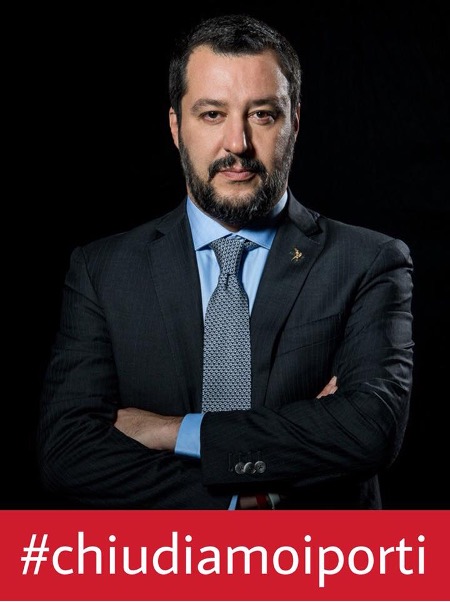
6 | Matteo Salvini in a propaganda image promoting “closed-ports” policy. Facebook.
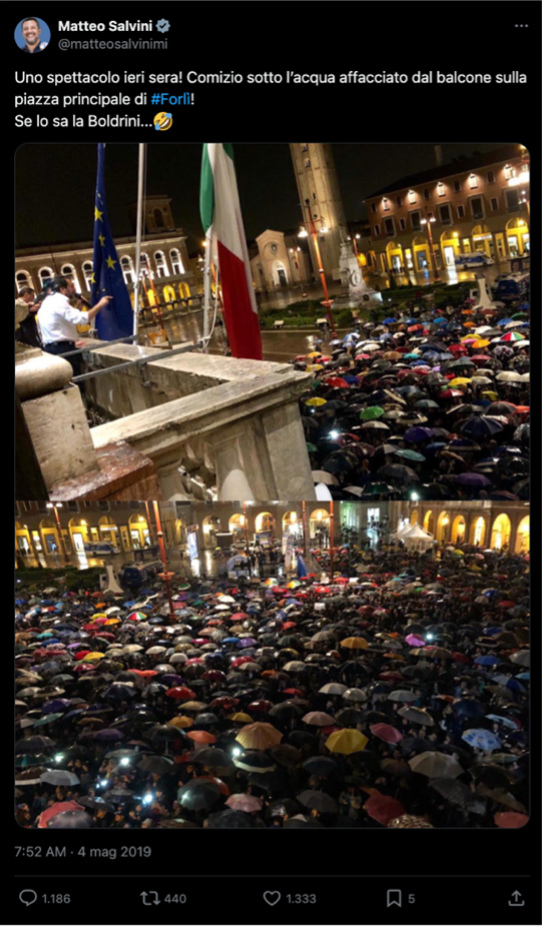
7 | Footage of Matteo Salvini greeting his supporters from the balcony of Palazzo Saffi in the town of Forlì, 4 May 2019. X.
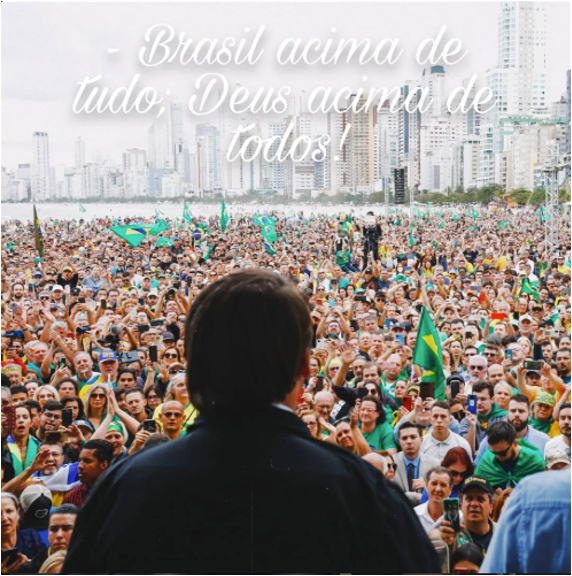
8 | Jair Bolsonaro from the stage of a rally during the Marcha para Jesus in Balnéario Camburiú, in the state of Santa Catarina, 25 June 2022. Instagram.
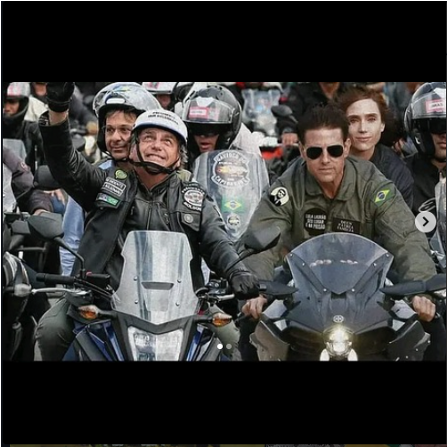
9 | Photomontage of Jair Bolsonaro with US actor Tom Cruise during a motociata promoting enrolment in the Brazilian Airforce, 16 June 2022. Instagram.
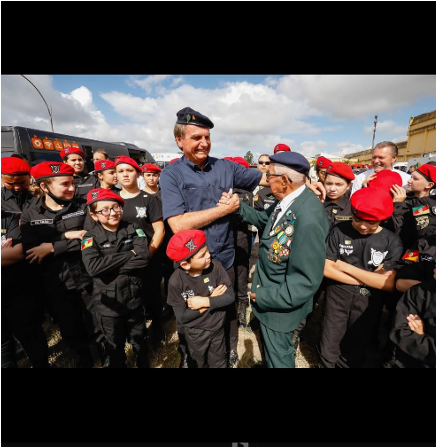
10 | Jair Bolsonaro greeting WWII Tenant veteran João Pereira da Silva surrounded by pupils of an alleged military school, presumably in the state of Rio Grande do Sul, 8 April 2022. Instagram.
Beyond football, the Captain character impersonated by both Salvini and Bolsonaro works to build an imaginary of male leadership and camaraderie which draws consistently on idealisations of military culture and militarization of society. In the case of Salvini and the Italian context, the imaginary of the Captain figure in military terms draws on hierarchical aesthetic codes embedded in the visual memory of the Duce Benito Mussolini and the Fascist regime (1922-1943). The appellative Duce, which comes from the Latin ducere (to conduct), can be seen as a powerful tool used by the regime’s propaganda machine to foster both a sense of fear and fascination around the virile and authoritarian dominance exerted by Mussolini’s figure on the Italian people (see, for example, Falasca-Zamponi 1997; Gundle et al. 2015; Sontag 1975). It contributed to reframe his role and public image as a dictator within a more appealing imagery, drawing on aesthetics and myths of the Roman Empire appropriated by the regime’s propaganda (see on this Gentile 1990; Mosse 1996; Nelis 2007, Nelis 2013).
The parallel with Fascist aesthetics and Mussolini’s myth emerged in various occasions in the public representation of Matteo Salvini since the period of his rise in popularity, from 2018 onwards. The examples of figures 5 and 6 show how the Captain imaginary constructed around Salvini has deliberately played with memories of Mussolini’s aesthetics and portraits. Figure 5 is particularly interesting inasmuch it blends Salvini’s Captain aesthetics and rhetoric with Mussolini’s traditional iconography. This portrait was shared on the Facebook and Twitter channels of the leader during the campaigning period for Italy’s 2018 general elections round. At that time, Salvini was aggressively pushing his anti-immigrant propaganda in the public debate using the slogan “close the ports” (“chiudiamo i porti”), which reads as a hashtag at the bottom of the photo in Figure 6.
Differently from the football references analysed earlier, here Salvini’s masculine aesthetics is performed through a sense of austerity which is expressed through the tight pose and severe facial expression of Salvini staring at his viewers. References to Mussolini and Fascist aesthetics emerge in various elements of the visual composition. Among this, the intense colour black of the background and Salvini’s blouse. In Italy, the use of black clothing in political contexts can be sensitive insofar as it may evoke Fascism and especially memories of camicie nere, the squads of violent fascist thugs that the regime was sending to patrol the street, intimidate citizens, as well as beat, torture, and kill political opponents. For this reason, in Italy it is very uncommon to see bold uses of this colour in mainstream propaganda, except for deliberately neo-fascist groups. Therefore, the stylistic choice made in this portrait cannot be interpreted as casual and suggests the intention to draw a clear reference to Fascist memory. Furthermore, the tight pose of Salvini with crossed arms traces another direct connection with representations of the Duce.
Similarly to the use of the black background and clothing, the crossed arms pose is rare to encounter in Italian electoral posters due to the visual parallels with Mussolini’s portraits. As Cheles (2023) reminds, since the post-war period Italian politicians have usually avoided to be represented in such a posture due to risks of awakening imaginaries connected to the regime’s aesthetics. This taboo, however, was already crossed by those mainstream politicians who, before Salvini, have strategically adopted this imagery in an effort to rehabilitate both the image of Mussolini and the regime’s ideological and cultural legacy (Cheles 2023).
In his online communication, Salvini made more allusions to Fascism, and especially to Mussolini, by exploiting other visual memories of the Fascist era imprinted in Italians’ collective imaginary. Figure 7 brings another example of this tendency. It consists of a collage shared by Salvini on his X account in 2019, after a rally held in the town of Forlì, in the Emilia Romagna region. The image at the top is particularly important because it shows the leader in a peculiar situation, greeting a crowd of supporters from the balcony of the town hall building, Palazzo Saffi. The choice of this setting is significant because it is the same balcony from which Mussolini gave his first speeches as leader of the Partito Nazionale Fascista, before the establishment of the regime in 1922. In general, the balcony has a powerful symbolic meaning tied to male dominance as has historically served to establish and reinforce power hierarchies by affirming the role of the leader in positions of moral, social, and spiritual superiority.
When planning the setting of this public appearance, Salvini and his entourage were certainly aware of the historical, symbolic, and aesthetic parallel that this image would have awakened. This is confirmed by Salvini himself, who in his comment caption makes irony around this aspect by mentioning Laura Boldrini and implying that she will get mad after knowing that he gave a rally from this specific location. At the time of this post Boldrini was a prominent politician of the Partito Democratico and president of the Deputies House. On many occasions, Boldrini positioned as an anti-fascist, publicly denouncing Salvini’s Far Right politics and ideologies. For this reason, she became a target of Salvini’s online misogynistic comments and shaming campaigns.
Through the use of this iconic setting, the photo at the top traces another clear and intentional connection with the Duce’s iconography by mimicking the perspective through which Mussolini was used to be photographed and filmed, using a side angle capable to capture both him and the crowd below. The memory of fascist rallies is further reiterated by the bottom image, which reproduces the perception of what the regime’s propaganda used to address as folle oceaniche (literally translatable as ‘ocean-like crowds’) to enhance the idea of people’s enthusiastic participation. The clear reference to the folle oceaniche in Salvini’s post strengthens the parallel with Fascist imaginary and enhances perceptions around the leader’s popular authority and leadership by equating it to Mussolini’s.
Emphasis on the imaginary of the folle oceaniche seems another trait shared by Salvini and Bolsonaro’s aesthetics, as Figure 8 shows. The photo, taken from the stage of a rally attended by Bolsonaro during the Marcha para Jesus, in Balnéario Camboriú, in the southern Brazilian state of Santa Catarina, provides a suggestive representation of a highly participated and crowded event. The visual of the people stocked up in front of the stage where Bolsonaro is standing, conveys a strong sense of unity around the leader who is captured in the foreground while giving his shoulders to the camera. This viewpoint is frequently reproduced in the photos documenting Bolsonaro’s public rallies, and it is not rare to find it also in Salvini’s online footage. Providing the perspective of the leader, it invites viewers to identify with him and share the emotions elicited by that specific moment, standing on stage and looking at the cheering crowd. Furthermore, this perspective amplifies the perception of people’s participation to the event, suggesting that a vast number of Brazilians stands united with their leader. These feelings are boasted by the presence of numerous Brazilian flags and Brazilian football shirts standing out from the crowd, which help fostering a sense of identity and belonging in an ethno-nationalistic meaning.
Another important detail in the photo of Figure 8 is the slogan “Brasil Acima de Tudo, Deus Acima de Todos” (“Brazil above everything, God above everyone”) which characterized Bolsonaro’s propaganda since the electoral campaigning for his first presidential mandate in 2018. This slogan is peculiar inasmuch the line ‘Brasil Acima de Tudo’ draws on the motto of the Brazilian Paratroopers, the army force in which Bolsonaro served as Captain. By recycling this motto, the leader consolidates his image as army Captain in the public perception asserts his masculine leadership through the lens of military culture. Furthermore, the slogan’s first line creates another subtle connection with the memory of the Nazi regime by linking to the motto “Deutschland, Deutschland Über Alles” (“Germany, Germany Above All”). Despite this phrase being part of the German national anthem before and after the rise and fall of Nazism, it was instrumentalized by the Nazi regime to emphasise the supremacist and Imperialistic goals of the German State. These references should not be underestimated nor interpreted as casual and disconnected but rather seen as the expression of a precise ideology and vision of society which conflates male domination with military aesthetics and authoritarian tendencies. Finally, the mention of God in Bolsonaro’s slogan dialogues particularly well with the most religious and conservative segments of his electorate, providing a sense of sacred validation to Bolsonaro’s figure as a leader as well as to his vision and politics.
The appeal to God emerges again in Bolsonaro’s frequent use of the popular fascist slogan “Dio, patria e famiglia” (“God, homeland, and family”) which conflates religion, the state, and patriarchal norms and is frequently adopted by Far Right activists in Italy and globally. The use of slogans mindful of both Fascist and Nazi ideology in Bolsonaro’s performative repertoire further validates the parallels with Salvini’s aesthetics and propaganda strategies, especially in terms of nostalgic remarks to a golden authoritarian age. This is expressed by Bolsonaro on his social media pages through imageries that show the leader wearing military uniforms or surrounded by militaries in solemn occasions. Besides evoking parallels with his past serving in the army, this type of aesthetics also draws on the memory of Brazil’s military dictatorship (1964-1982) as part of a strategy that, similarly to what seen with Salvini’s example, seeks to rehabilitate that period of the country’s history in the public debate, about which Bolsonaro has publicly denied crimes and atrocities: this included statements in which he denied the regime’s crimes addressing the dictatorship as a “20 years period of order and progress” (Human Rights Watch), and defining the coup’s anniversary “liberation day” (Braga 2021). Figures 9 and 10 show how this aesthetics unfolds in Bolsonaro’s online communication.
Figure 9 refers to an Instagram post shared on Bolsonaro’s profile on 26 June 2022 to promote and encourage enrolment in the Brazilian Airforce. This post is significant because it combines three key elements of Bolsonaro’s propaganda which inform his masculine aesthetics and virile performances. Here, the Far Right leader is portrayed riding a motorbike at the forefront of a crowded group of bikers following him. This is a peculiar imagery of Bolsonaro’s aesthetics. The leader is known for his passion for motorbikes, and, on his Instagram page, one can frequently encounter posts featuring footage of motociatas (motorbike tours) that he used to organise in different cities of Brazil as part of his campaigning and self-promotion strategy.
Videos and images of motociatas generally respond to the same scheme that features Bolsonaro leading a large group of bikers around the hosting cities, cheered up by supporters watching the show from the sides of the street. Among manifold occasions in which Bolsonaro has been represented among the people, these events have a particular aesthetic appeal which is made of two main elements: the first one concerns imaginaries of bikers linked to a Hollywood-type of masculine aesthetics, reminiscent of the films of James Dean and Marlon Brando, in which the main character, usually dressed in black leather, is portrayed as a fearless and mysterious seductor. The second element consists of enhancing the representation of Bolsonaro as ‘man of the people’ through his physical presence among ordinary citizens.
Adding up to these two crucial components of Bolsonaro’s motociatas iconography, there is a peculiar element that stands out from this image which consists of the photomontage of the actor Tom Cruise riding a motorbike next to Bolsonaro. This photomontage draws on a frame from the second Top Gun film (2022) in which Tom Cruise rides a black motorbike with the actress Jennifer Connelly on the backseat. Notably, the military-green uniform worn by the actor has been enriched here with context-specific symbols referring to Bolsonaro and Brazilian identity. On the uniform’s sleeves it is possible to spot the Brazilian flag (right) and a patch with Bolsonaro’s portrait (left), while on the chest there are two other patches, one of which reads the Fascist slogan “Deus, Patria e Familia” (“God, Homeland, and Family”) while the other one, on the left, results unreadable. This choice shows an effort to repurpose and exploit Top Gun’s masculine imaginary for electoral purposes, conveying the message that being a (male) Bolsonaro supporter and sharing his values and ideas grants popularity and celebrity.
Another level of analysis of this post, which further enhances the virile performance enacted by Bolsonaro, unfolds in the message promoting the enrolment of Brazilian citizens in the Airforce. After clarifying that Tom Cruise is a photomontage, Bolsonaro praises the Airforce and writes: “Real-life Top Guns of our glorious Brazilian Airforce led by the Brigadier Baptista Júnior, always ready to protect our airspace and our Brazil. Join the [Brazilian Airforce]”.
The reference to Top Gun therefore has a layered meaning that converges in the conflation of Bolsonaro’s self-representation with a type of masculinity imbued with Hollywood and military aesthetics as a determinant of popularity and a higher social status. The message conveyed by this post defines virile men as leaders who ride motorbikes, join the army, and embrace values rooted in Christian and ethno-nationalistic identity. These values are summarised here by the patches with the slogan “Deus, Patria e Familia”, the Brazilian flag, and the portrait of Bolsonaro placed on Tom Cruise’s uniform. In this way, Captain Bolsonaro reiterates his role as representative of the Brazilian people and protector of the country’s perceived foundational values. Next to the explicit reference to God in the slogan mentioned above, the religious tie is further reinforced by Bolsonaro’s gesture of looking and pointing at the sky, which returns frequently in his public appearances and representations. In this post, however, the gesture also serves to strengthen his praise of the Airforce.
Figure 10 features another post shared by Bolsonaro on 8 April 2022 on his Instagram profile, and it is particularly interesting for its glorification of the military during an event in the state of Rio Grande do Sul (RS) when the leader awarded the honours to Tenant João Pereira da Silva, a late WWII highly decorated veteran of the Força Expedicionaria Brasileira (Portal Uai 2022). In the centre of the image, a smiling Bolsonaro is portrayed while shaking hands with Pereira. The two are surrounded by children in uniforms, plausibly pupils of a military school in the state of Rio Grande do Sul, as suggested by the green, red, and yellow striped flag visible on some children’s sleeves.
This image creates a highly emotional connection between past and present by juxtaposing the elderly veteran with the future generation of army servants. The cheerful expression of the children helps to promote military education as enjoyable and fun, but also respectable and prestigious, as exemplified by highly decorated veterans such as Pereira. The message conveyed by the visual is further reinforced by Bolsonaro’s comment to the post:
Those who forget their past are condemned to have no future. Our eternal homage to the heroes of Brazil. May the honour and love for the homeland forever inspire future generations! 🇧🇷
The main role of this caption is to enhance the idealised scene staged in the photo by materialising feelings of nostalgia and imaginaries of heroism around perceptions of the army through celebrations of valorous WWII veterans. Nevertheless, by looking carefully at Bolsonaro’s semantics, it is possible to notice a lack of specificity that makes the message deliberately vague and ambiguous. The accent posed on the importance of remembering the past and commemorating the ‘heroes of Brazil’ is a rhetorical exercise that, given its intentional lack of specificity, honours all militaries as heroes, without making distinctions with the violence and the repression perpetrated by the armed forces during the dictatorship period (1964-1982). Therefore, by generalising the celebration of the military, Bolsonaro is implicitly commemorating the memory of the dictatorship, too, and legitimising ideas of male dominance through brutal force and violence which characterised the regime period.
Bolsonaro’s glorification of the armed forces also legitimises a specific choice to reinstate the military at the centre of Brazil’s democracy and society (Hunter, Vega 2022), one of the focal points of his electoral program based on a patriarchal, white supremacist, and queerphobic project (Dalmaso-Junquera, Gomes de Lima 2024) which granted him support and consensus from the backbone of the country’s elite (Winter 2020). Boasting excessive admiration for the military and the police is another element that draws significant parallels between the masculine aesthetics informing the online propaganda of Bolsonaro and Salvini, becoming a sort of electoral brand (Turner 2024) that transcends national borders. This linkage unfolds in online contents that portray the leaders wearing law-enforcement clothes while chatting, smiling, or even joking with officers in convivial situations, usually accompanied by comment-captions that celebrate their bravery and thank them for looking after citizens and keeping them safe.
As Mazzoni and Mincigrucci (2023) note, this aesthetics conveys very specific messages to manufacture consensus around policy agendas based on law-and-order rhetoric that prioritise both State’s and leaders’ personal commitment to security. The emphasis around the good heart of police and military officers serves to enhance a sense of trust which encourages those deemed as honest and hard-working citizens to accept State force and surveillance in the name of a fallacious idea of protection. This dynamic draws on an ‘us vs. them’ populist-type of discourse that divides society between in-groups and out-groups. The in-group is depicted as a blameless and morally good native community (Hameleers, Schmuck 2017), defined by civilized and respectable identity rooted in a white, Western, and Christian background. Constructed around deeply antagonistic views, the out-group instead is made by morally evil individuals (Hameleers, Schmuck 2017) indicated as enemies and outsiders, who are therefore excluded due to perceived negative qualities that naturally estrange them from the in-group.
Despite significant social and historical differences, the discourse of Bolsonaro and Salvini around the definition of the out-group converges in specific hostility and racism towards Black and Brown individuals, who are generally blamed for the country’s social and economic grievances. In fact, while Salvini focuses on Black-African and Muslim people, and especially immigrants and refugees, Bolsonaro and his collaborators often frame the problem of organised crime in Brazil as inherent of marginalised and impoverished communities, and especially those living in favelas disseminated across the country.
In a scenario where the out-group is systematically criminalised and dehumanized, both leaders portray themselves as the only ones capable of rescuing their countries from imminent decay. This discourse is imbued with an apocalyptic aesthetics that provides both Captains with a redemptive and messianic role (Messias or Messiah is also Bolsonaro’s second name) that contributes to manufacture moral justification for the enforcement of exclusionary and autocratic policies advocated by the leaders. The imaginary of masculine force and dominance associated with the idea of protecting the nation and its civilisation returns in messages that fetishise a righteous use of violence through displays of phallic fantasies of strength and aggression represented through public exhibition of weapons. This aesthetics defines the last meaningful cross-over analysed by this paper around the masculine aesthetics and virile performances enacted online by both Salvini and Bolsonaro, as discussed in the next section.
Fetishization of Phallic Dominance and Violence
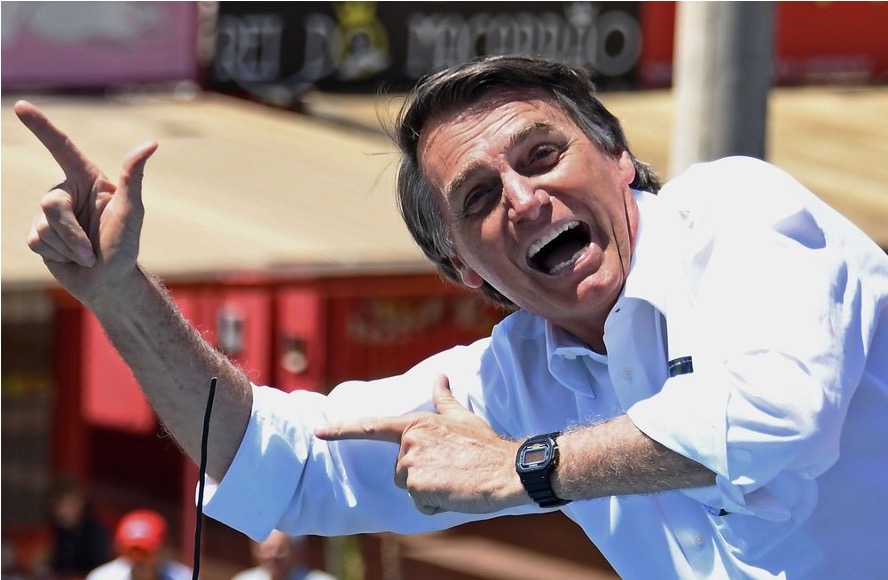
11 | Bolsonaro doing the ‘arms up’ gesture during an electoral motorcade in the suburbs of Brasília on 5 September 2018. “The Intercept”.
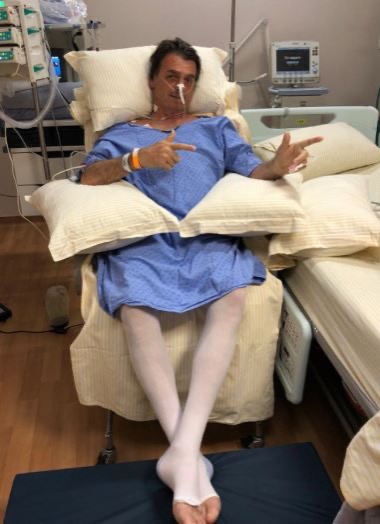
12 | Bolsonaro in a post shared on X by his son Eduardo doing the ‘arms up’ gesture from a hospital room where he was recovering from a stabbing attack suffered during a rally in Rio de Janeiro. X.
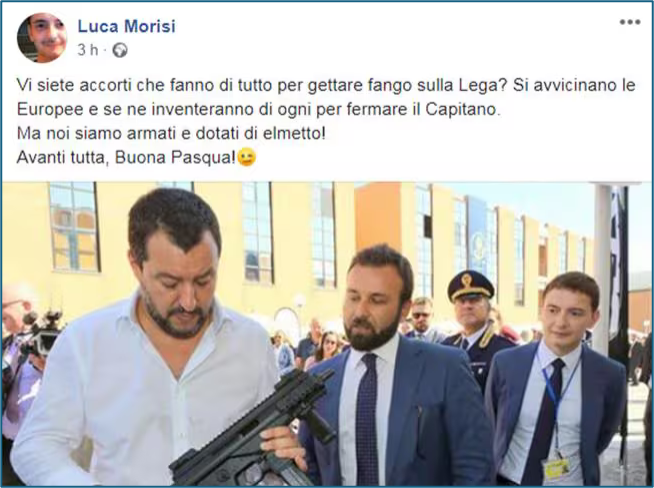
13 | Matteo Salvini carefully holding and showing an automatic rifle in a post shared on Facebook by Luca Morisi related to the 2019 European election campaign.
Both Salvini and Bolsonaro disseminate a type of discourse that emphasises self-defence to legitimise policies around the liberalisation of arms detention and the use of State force, which they advocate through their online propaganda. The idea of defending the nation and its identity at all costs is part of that same law-and-order rhetoric seen earlier that justifies the criminalisation and the exclusion of individuals and communities estranged from what is perceived as the ‘legitimate’ in-group community. The ‘us vs. them’ rhetoric underpinning this discourse draws on a specific type of affective politics of fear (Ahmed 2014) that exacerbates feelings of enmity to materialize scenarios of an imminent and visceral life-threat which creates a sense of urgency to act against perceived enemies. This is something that Umberto Eco (1995) highlighted very well in his analysis of how fascist mentality and tendencies are re-adapted and re-interpreted by Far Right movements in the present day. Visually, the urgency to act in defence of the in-group community and the nation stressed by Far Right leaders unfolds in performances that fetishise male strength and violence through the public exhibition of weapons and references to destructive acts aimed at assert dominance including shooting, demolition, and eradication. Bolsonaro made of this symbolism his signature by adopting gestures from military culture which reinforce his representation as strongman and army Captain in the public imaginary as showed by the example of Figure 12.
The image shows Bolsonaro doing an ‘arms up’ gesture after a rally in São Francisco do Sul, in the state of Santa Catarina, in February 2021. In this occasion, the former president stated that the people of Brazil where thrilled by the announcement of four new decrees proposed by his cabinet that would have made the acquisition and detention of guns more easily available (Phillips 2021). Besides supporting and promoting the liberalisation of arms, however, the ‘arms up’ gesture has become an inherent part of his masculine visual and symbolic repertoire since his rise as a political leader and presidential candidate.
It is notable, in this context, the way he displayed this gesture after an attack in which he was stabbed during a rally in Rio de Janeiro, in September 2018, as Figure 12 shows. From the hospital chair in which he is sitting in this post, which was shared on X by his son Eduardo, Bolsonaro’s performance portrays two faces of his masculine character. On the one hand, he shows the arms up gesture to reassure his supporters about his toughness, framing himself as an invincible leader, or a superhero, who does not give up even in the most difficult of circumstances. Interestingly, this gesture was displayed before Bolsonaro by late Italian right-wing prime minister Silvio Berlusconi. During a joint press conference with Russian president Vladimir Putin in 2008, the Italian leader directed the automatic rifle gesture towards a female journalist who asked Putin some uncomfortable questions around alleged scandals concerning his marital and romantic private life (Piscioneri 2008). Berlusconi became famous worldwide for his transgressive and inconvenient attitudes rooted in machismo and male dominant aesthetics. Scholars such as Foot (2016) have noted how Berlusconi can be rightfully considered the predecessor and symbolic mentor of political personalities like Donald Trump, and possibly other Far Right leaders like Bolsonaro, more than Mussolini and other authoritarian figures of the past. Furthermore, in this context, the gesture also evokes ideas of retaliation and punishment. On the other hand, however, he also shows his human dimension by letting his followers seeing the fragile side of an ordinary man recovering from a life-threatening attack. This aspect contributes to frame the leader in a context of victimhood that fosters a sense of empathy and compassion among his supporters.
Imaginaries around phallic fantasies of male domination are also evoked by Salvini, who made multiple public appearances showing off rifles. Figure 13 provides a meaningful example, among the many. This post was shared on X by Salvini’s former spin doctor Luca Morisi, the manager of the leader’s communication strategies and propaganda, who contributed to amplify exponentially the visibility and popularity of Salvini using social media platforms. It refers to an event in April 2019, a time in which Salvini was at the peak of his popularity and likeability in national polls and was campaigning for the elections for the European Parliament that were going to take place in May. The image captures Salvini while attentively checking an automatic rifle, probably introduced by the person standing next to him.
Morisi’s comment caption adds multiple levels of interpretation to this image, making it sound and look like a threat towards opponents and perceived enemies of both the leader and his party: “Have you noticed that they do everything to defame the League? The European [elections] are getting closer, and they will invent anything to stop the Captain! We, however, are armed and have helmets! Full speed ahead, happy Easter! 😉”.
Like Bolsonaro in the example of Figure 12, this post boasts a victimising rhetoric that depicts Salvini as a leader persecuted by his left-wing adversaries. Morisi’s comment is pre-emptively warning Salvini’s supporters of the strategies that the leader’s enemies will implement to defame the party and prevent the Captain from succeeding in the upcoming European elections. However, Morisi adds that [they] are armed and have helmets, awakening a warfare scenery in which Salvini’s community is addressed as an army ready to fight in defence of their leader. This imaginary is further reinforced by the emphasis to Salvini’s role as Captain, which enhances the sense of authoritative male leadership built around the leader’s image. Paired with the photo embedded in the post, Morisi’s comment conveys a powerful message that implicitly exhorts and legitimates violence against anyone committed to stop the Captain from taking power. Furthermore, the absence of women in the foreground scene strengthens the idea of male primacy expressed by the performance enacted by Salvini carefully holding the automatic rifle, which cements the fetishisation of phallic dominance in the public imaginary.
Fantasies of phallic dominance that permeate the masculine performances of leaders such as Salvini and Bolsonaro, often translate into openly sexist and misogynistic attitudes that legitimise gender discrimination and abuse in the public discourse. Both leaders have repeatedly resorted to sexually-based insults and humiliation rooted in rape culture, especially when addressing political female opponents. Aimed at re-affirming male hegemony, this attitude is exemplified particularly well by a comment that Bolsonaro expressed in 2022 during the celebrations of Brazil’s independence day, at the end of a parade that featured pompous displays of military strength and the celebration of farming culture rooted in expropriation and displacement of natives’ land. In that occasion, Bolsonaro addressed the crowd from the presidential stage starting a chant that repeated “imbrochável”, a term with a strong phallic and sexual meaning as “un-screwable” or “inflexible” (CNN Brasil 2022). The video of this episode is particularly suggestive as it represents a moment of entertainment that shows Bolsonaro’s wife smiling at his husband’s performance and the crowd chanting with him in what becomes collective trivialization of machoism and male supremacist ideology.
It was not the first time that Bolsonaro expressed publicly this concept. In March 2021, in response to a nationwide protest that was about to take place against his detrimental management of the COVID-19 pandemic in Brazil, he held up a sign reading “immorivel, imbrochável, e incomivel” which translates as “invincible, inflexible, and indigestible” (Royster 2021). This type of speech embedded in imaginaries of sexual dominance, sublimates the overt exhibition of virile strength performed by the leader, materializing an aesthetics capable to shape political consciousness around the exaltation of patriarchal hegemony as an inherent social and cultural asset.
Conclusion
This paper investigated the masculine aesthetics informing the online performances of Italy’s Far Right leader Matteo Salvini and Brazil’s Jair Bolsonaro. While a lot of research and public commentaries have drawn parallels and comparisons based on the example provided by US President-elect Donald Trump, a very limited number of studies outlined the connections between Salvini and Bolsonaro which, I argue, make an interesting case deserving more attention from researchers engaged with multi-disciplinary perspectives. The analysis examined selected examples from the social media profiles of the two leaders and online news media related to specific public events and interventions. Based on a multimodal aesthetic analysis method, the discussion highlighted significant parallels in the construction of the public image and identity of the two leaders. Looking at the interplay between image, text, and discourse facilitated by the communication logics of social media platforms, the analysis dissected central elements of Salvini and Bolsonaro’s online representation, which reinforce ideas of leadership rooted in patriarchal imaginaries of male dominance and strength.
Despite context-specific differences determined by the history, culture, and socio-political background of Italy and Brazil, the investigation shed light on common aesthetic patterns that emerge from the virile performances enacted by the two leaders for their propaganda online. One of the most outstanding parallels highlighted by the analysis consisted of the role as captains built around Salvini and Bolsonaro’s public personas which, despite drawing on different references, the military past of Bolsonaro and the closed-ports policy advocated by Salvini, takes similar directions in defining a type of male identity based on the idealisation of force, authority, and dominance as inherent expressions of virility.
The choice of the appellative Captain (Capitão in Portuguese and Capitano in Italian) to designate the leaders is peculiar of an intention to consolidate their leadership and pastoral role as representatives of the voice and will of the people. The Captain theme returns in visual and symbolic representations of Salvini and Bolsonaro, drawing on multidirectional references that oscillate between apparently innocuous football imaginaries, idealisations of military culture, memories and nostalgia of the authoritarian pasts of both countries, and of male dominance through the fetishisation of phallic violence. Modelled around accepted socio-cultural standards of heteronormative masculinity, the investigation showed how the Captain figure takes multiple forms depending on the message to convey in specific circumstances. In this context, Salvini and Bolsonaro’s masculine performances frame them either as ordinary men, football icons, loving fathers, or strong and invincible leaders.
The masculine imaginaries underpinning the self-representation of the two leaders foster identification with their (male) followers, enhancing feelings of male bonding that reinforce the idea of belonging to the same in-group community in an ethno-nationalistic sense. A strong ethno-nationalism emerges indeed from the appropriation of the traditional green and yellow Brazilian football shirt, which became a primary ideological and cultural symbol associated with Bolsonarismo, and contributed to cement the myth of Bolsonaro as the people’s captain to the eyes of his supporters.
The investigation undertaken in section two demonstrated how Salvini’s performative masculinity awakens fascist memory to assert his male authority, particularly through the visual imaginary of the Duce Benito Mussolini, by staging visual representations that consolidate the hegemonic and hierarchical relationship between the people and the leader. Visual and textual references to Italian fascism were also outlined in Bolsonaro’s online representation, including the use of slogans such as Deus, Patria e Familia (God, Homeland, and Family) and the iconography of the folle oceaniche (literally ocean-like crowds). The visual motif of the folle oceaniche reminds imageries of mass participation to Fascist and Nazi rallies mixed with pop-cultural aesthetics and celebrity culture, as seen in the case of the photomontage of Tom Cruise riding a motorbike next to Bolsonaro.
Finally, the last section has further elaborated on the military and authoritarian aesthetics promoted by the two leaders, showing how this converges into a fetishisation of phallic dominance through public exhibition of arms and display of hand gestures referred to the act of shooting with a rifle. This tendency responds to a law-and-order rhetoric that manufactures warfare imaginaries to mobilise electoral support around policies of self-defence through the liberalisation of acquisition and detention of weapons, as well as legitimise uses of State force and violence. At the same time, however, it is also expression of an aesthetics designed to cement in the public imaginary an idea of masculinity that asserts its identity through virile force and substantiates in representations of male power rooted in fantasies of sexual domination.
Bibliographical references
- Adinolfi, Goulart da Silva 2024
G. Adinolfi, M. Goulart da Silva, The Populist Challenge to the Liberal Democratic Regime in Italy and Brazil: Jair Bolsonaro and Matteo Salvini, “Sociologia, Problemas e Práticas” 105 (2024). - Ahmed 2014
S. Ahmed, The Cultural Politics of Emotions, 2nd ed., Edinburgh 2014. - Alvares, Dahlgren 2016
C. Alvares, P. Dahlgren, Populism, Extremism, and Media: Mapping an Uncertain Terrain, “European Journal of Communication” 31,1 (2016), 46-57. - Armstrong 2025
K. Armstrong, Bolsonaro Ordered to Start Serving 27-Year Prison Sentence for Brazil Coup Plot, “BBC” 26 November 2025. - Aru 2023
S. Aru, Battleship at the Port of Europe’: Italy’s Closed-Port Policy and Its Legitimizing Narratives, “Political Geography” 104 (2023). - Ben-Ghiat 2020
R. Ben-Ghiat, Strongmen: Mussolini to the Present, New York 2020. - Bello 2024-2025
L. Bello, 2022 Census: 16.4 Million Persons in Brazil Lived in Favelas and Urban Communities, “Agência IBGE Noticias” 8 November 2024; updated 7 January 2025. - Bourne 2025
P.A. Bourne, Perceptions of Leadership: A Qualitative Exploration of Donald Trump’s Leadership Style and Influence, “Journal of Global Political Studies” 1,1 (2025), 53-67. - Braga 2021
C. Braga, Bolsonaro and the Brazilian Military Dictatorship: A History of Anti-Democratic Attacks, “Columbia Political Review” 17 March 2021. - Cheles 2023
L. Cheles, Iconografia della Destra: La Propaganda Figurativa da Almirante a Meloni, Roma 2023. - Cover 2020
R. Cover, Vulnerability and the Discourse of ‘Forgotten People’: Populism, Population and Cultural Change, “Continuum” 34,5 (2020), 749-762. - Craig 2022
K. Craig, The Aesthetic Politics of Far Right Movements, “PoLAR” 30 August 2022. - Culvin, Bowes 2023
A. Culvin, A. Bowes, Women’s Football in a Global, Professional Era, Leeds 2023. - Dalmaso-Junqueira, Gomes de Lima 2024
B. Dalmaso-Junqueira, I. Gomes de Lima, Civic-Military Schools in Brazil: Feminist Lenses to Uncover a Patriarchal, White Supremacist, and Queerphobic Project, “On_Education” 20 October 2024. - Demuru, Sedda 2020
P. Demuru, F. Sedda, Il Corpo Socialista, “Actes Semiotiques” 123 (2020). - Di Silvestro 2023
E. Di Silvestro, A comparative study of Donald J. Trump and Matteo Salvini’s populist strategies in the representation of immigrants and refugees on Twitter, in M. Deckert, P. Pezick, R. Zago (eds.), Language, expressivity, and cognition, London 2023, 85-109. - Eco 1995
U. Eco, Ur-Fascism, “The New York Review of Books” 22 June 1995. - Engesser et al. 2017
S. Engesser, N. Ernst, F. Esser, F. Büchel, Populism and Social Media: How Politicians Spread a Fragmented Ideology, “Information, Communication & Society” 20, 8 (2017), 1109-1112. - Falasca-Zamponi 1997
S. Falasca-Zamponi, The Fascist Spectacle: The Aesthetics of Power in Mussolini’s Italy, Berkeley/Los Angeles/London 1997. - Foot 2016
J. Foot, We Have Seen Trump Before – His Name Was Silvio Berlusconi, “The Guardian” 20 October 2016. - Gentile 1990
E. Gentile, Fascism as Political Religion, “Journal of Contemporary History” 25,2/3 (1990), 229-251. - Giuffrida 2022
A. Giuffrida, Footballers in Italian Women’s Top Division Finally Turn Professional, “The Guardian” 27 April 2022. - Gundle, Pieri, Duggan 2015
S. Gundle, G. Pieri, and C. Duggan (eds.), The Cult of the Duce: Mussolini and the Italians, Manchester 2015. - Hameleers, Schmuck 2017
M. Hameleers, D. Schmuck, It’s Us Against Them: A Comparative Experiment of the Effects of Populist Messages on Social Media, “Information, Communication & Society” 20,9 (2017), 1425-1444. - Hunter, Vega 2022
W. Hunter, D. Vega, Populism and the Military: Symbiosis and Tension in Bolsonaro’s Brazil, “Democratization” 29,2 (2022). - James 2021
T.S. James, The Effects of Donald Trump, “Policy Studies” 42, 5-6, 755-769 (2021). - Kane, Patapan 2012
J. Kane, H. Patapan, The Democratic Leader: How Democracy Defines, Empowers, and Limits Its Leaders, Oxford 2012. - Kellner 2017
D. Kellner, Brexit Plus, Whitelash, and the Ascendency of Donald J. Trump, “Cultural Politics” 13,2 (2017), 135-149. - Laclau 2018
E. Laclau, On Populist Reason, London 2018. - Mazzoni, Mincigrucci 2023
M. Mazzoni, R. Mincigrucci, When Visual Communication Fosters Leaders’ Exceptional and Ordinary Image: The Salvini Case, in D. Lilliker, A. Veneti (eds.), Research Handbook on Visual Politics, Cheltenham/Northampton (MA) 2023, 215-227. - Mosher 1991
D.L. Mosher, Macho Men, Machismo, and Sexuality, “Annual Review of Sex Research” 2,1 (1991), 199-247. - Mosse 1996
G.L. Mosse, Fascist Aesthetics and Society: Some Considerations, “Journal of Contemporary History” 31,2 (1996), 245-252. - Mudde 2004
C. Mudde, The Populist Zeitgeist, “Government and Opposition” 39,4 (2004), 541-563. - Nai et al.
A. Nai, F. Martínez í Coma, J. Maier, Donald Trump, Populism, and the Age of Extremes: Comparing the Personality Traits and Campaigning Styles of Trump and Other Leaders Worldwide, “Presidential Studies Quarterly” 49 (2019), 609-643. - Nelis 2007
J. Nelis, Constructing Fascist Identity: Benito Mussolini and the Myth of “Romanità”, “Classical World” 100,4 (2007), 391-415. - Nelis 2013
J. Nelis, The Myth of Romanità, Antichistica and Aesthetics in Light of the Fascist Sacralization of Politics, and Modernism, “Mediterraneo Antico” 16,1 (2013), 259-274. - Phillips 2021
T. Phillips, Anger as Bolsonaro Moves To Make Guns Easier to Access: A Threat to Democracy, “The Guardian” 15 February 2021. - Piazza, Landy 2024
K. Piazza, J. Landy, Captain Mayor and Sergeant Councilman? An Assessment of the Reach of Military Politicization in Brazilian Politics, “Armed Forces and Society” 51,4 (2024). - Piscioneri 2008
F. Piscioneri, Berlusconi Returns To World Stage With Putin’s Visit, “Reuters” 18 April 2008. - Rodrik 2021
D. Rodrik, Why Does Globalization Fuel Populism? Economics, Culture, and the Rise of Right-Wing Populism, “Annual Review Economics” 13 (2021), 133-170. - Royster 2021
M. Royster, Opinion: “Invincible, Inflexible, and Indigestible” – Brazil’s President as Macho Man, “The Rio Times” 31 May 2021. - Sontag [1975] 1980
S. Sontag, Fascinating Fascism [“The New York Review of Books” 6 February 1975, 73-108], in Ead., Under the Sign of Saturn, New York 1980, 73-105. - Swank, Betz 2003
D. Swank, H.-G. Betz, Globalization, the Welfare State and Right-Wing Populism in Western Europe, “Socio-Economic Review” 1,2 (2003), 215-245. - Winter 2020
B. Winter, Messiah Complex: How Brazil Made Bolsonaro, “Foreign Affairs” 99, 119 (2020). - Wodak, Mral, Khosravinik 2013
R. Wodak, B. Mral, M. KhosraviNik (eds.), Right-wing populism in Europe: Politics and discourse, London/New York 2013. - Wood, Corbett, Flinders 2016
M. Wood, J. Corbett, M. Flinders, Just Like Us: Everyday Celebrity Politicians and the Pursuit of Popularity in an Age of Anti-Politics, “The British Journal of Politics and International Relations” 18,3 (2016), 581-598. - Yiapanas 2025
G. Yiapanas, Addressing Gender Inequalities in European Football: Key Dimensions and Strategies, “Insight – Sports Science” 7,1 (2025), 711.
Abstract
This article analyses the masculine aesthetics of Italian and Brazilian far-right leaders Matteo Salvini and Jair Bolsonaro, exploring the performative dimension of their virile self-representation online. It advances a multimodal aesthetic analysis that centres visual and iconographic investigations of digital contents, supported by critical discourse, social semiotic, and historiographic methods. The investigation examines how the image of the two leaders has been shaped through specific aesthetic strategies to consolidate their representation as strongmen in public perception. Central to this construction is the figure of the captain (capitão/capitano), an aesthetic that blends representations of authority with imageries of ordinariness and imperfection, exploiting the logics of celebrity politics and online influencer culture. Building on selected examples drawn from the social media profiles of Salvini and Bolsonaro from the period of their respective electoral victories in 2018, the analysis dissects three central themes enabling parallels between Italian and Brazilian far-right politics and discourse: the link with football popular culture, the praise of the military, the rehabilitation of the memory of both countries’ authoritarian pasts, and the fetishisation of phallic dominance and violence through the public exhibition of weaponry. This article demonstrates how the virile performances of the two leaders foster a shared identity and a sense of belonging in an ethno-nationalistic sense, cementing perceptions of male dominance and patriarchal hegemony. Ultimately, it underscores the centrality of visual and historiographic investigations to better understand the social and cultural conditions that fostered the rise of far-right politics in positions of global power.
keywords | Far Right politics; masculine aesthetics; Matteo Salvini; Jair Bolsonaro; digital propaganda.
questo numero di Engramma è a invito: la revisione dei saggi è stata affidata al comitato editoriale e all'international advisory board della rivista
Per citare questo articolo / To cite this article: E. Capecchi, The Masculine Aesthetics of Matteo Salvini and Jair Bolsonaro. Analysing Far Right Virilities in Digital Spaces, “La Rivista di Engramma” n. 233 (aprile 2026).