The Visual Politics of ‘Danishness’ and the Mainstreaming of Xenophobia in Danish Party Politics
Mikkel Bolt Rasmussen
Abstract
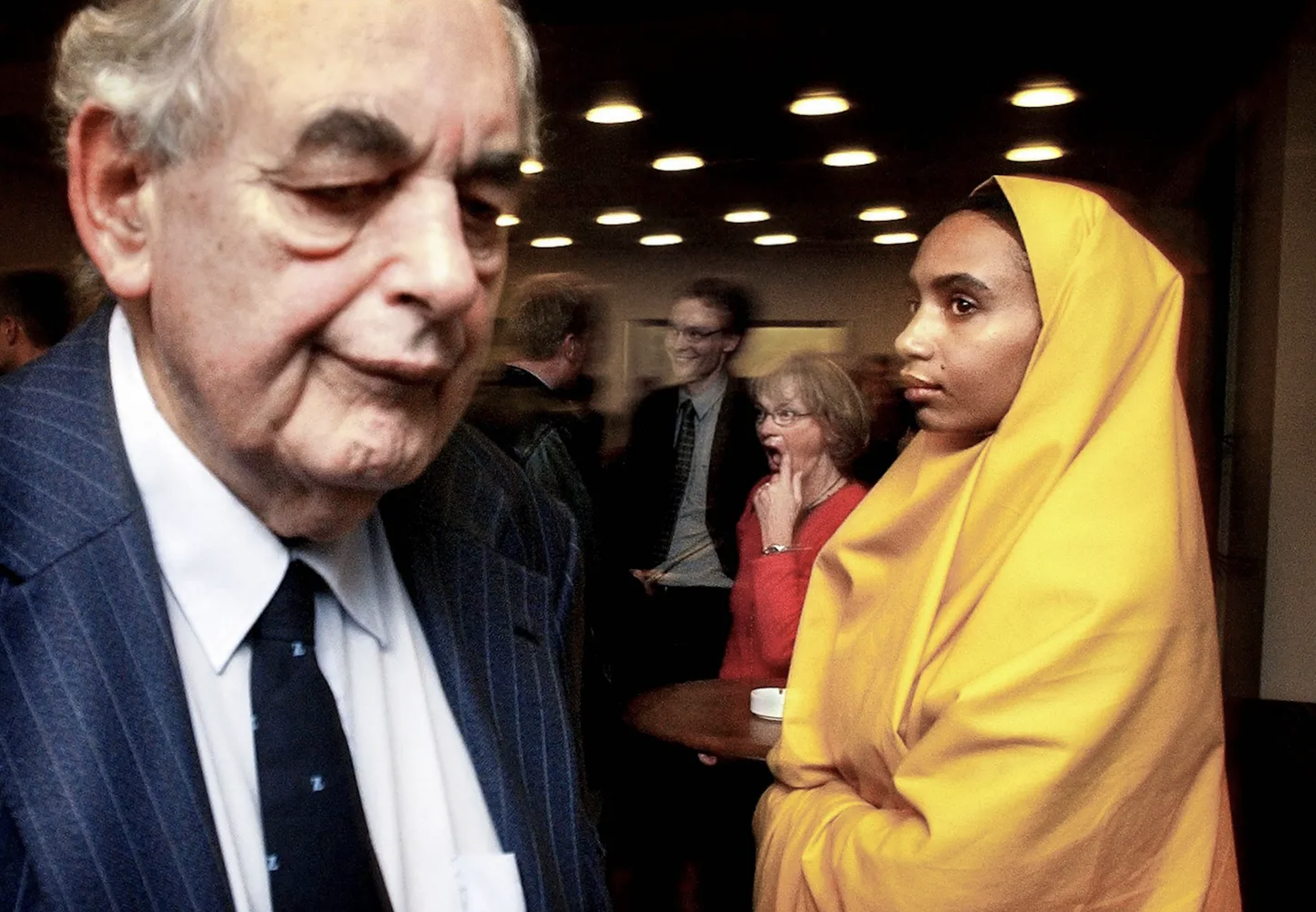
1 | Spacecampaign: “Valgaften foran Christiansborg”, 2001, performance.
In recent years, Denmark has become something of a reference point in attempts to introduce harsher asylum and immigration policies across Europe. Both the German Chancellor, Friedrich Merz, and the UK Prime Minister, Keir Starmer, have spoken admiringly of the tough migration policies implemented by the Danish government led by the Social Democratic Mette Frederiksen and previous Right-wing governments. In a joint written opinion piece in “The Guardian” in December 2025, Starmer and Frederiksen write: “Denmark has led the way here, with tough but fair reforms which have delivered results. Last year, the number of people being granted asylum in Denmark was the lowest in 40 years. […] That’s what people want their governments to do—maintain control over who comes and who stays, and do it on our terms” (Starmer, Frederiksen 2025). Denmark has become something of a leader in matters of immigration and refugee politics transcending the left-right political divide in Europe. Friedrich Merz praised Denmark, saying that what it “has achieved in recent years is truly exemplary”, and that, thanks to Danish initiatives, Europe “is moving towards new and stricter asylum rules” (Liboreiro 2025).
It is not only centre-left or centre-right politicians who take inspiration from Denmark. Since gaining power in late 2022, Italian prime minister Giorgia Meloni, leader of the Brothers of Italy, has continuously sought inspiration in Denmark’s immigration policies in an attempt to curb the number of migrants and refugees arriving in Italy. The interest is mutual: the Danish Social Democrat has been eager to join forces with the far-right Italian prime minister. In May 2025 Meloni and the Danish Prime Minister, Mette Frederiksen, published a joint letter, co-signed by seven other EU countries, calling for reform of the European Court of Human Rights. “We should have more room nationally to decide on when to expel criminal foreign nationals”, the letter stated. The two prime ministers wrote that the European Court has stretched the European Convention beyond its original intent, especially in matters concerning migration. The letter paints a picture of migrants flooding Europe’s borders and portrays them as a threat to European values and national communities. Meloni and Frederiksen activate colonial stereotypes such as primitive/civilised, lazy/productive and criminal/law-abiding (Hall 1997, 247-248). According to Meloni and Frederiksen, migrants and refugees have “chosen not to integrate, isolating themselves in parallel societies and distancing themselves from our fundamental values of equality, democracy and freedom”. Furthermore, when European societies have welcomed migrants, they have “chosen to commit crimes”. Therefore, Frederiksen and Meloni argue that it is necessary to relax rules and regulations to allow countries to expel “criminal foreign nationals” and “keep track of […] criminal foreigners who cannot be deported”. The letter portrays concerned national leaders dedicated to the welfare of their citizens trying to combat criminal foreigners protected by an autonomous court that is unable to understand the situation. While it is understandable for the court to refer to the horrors of the World Wars and international rules, this is a new situation that requires a new strategy. “The safety and stability of our own societies should have the highest priority”.
The letter is an example of the “political demonology” (Rogin 1987) that has been prevalent in Danish politics for over two decades. Not only are migrants and refugees presented as foreigners, they are also presented as a problem that threatens to undermine Danish society and an imagined idea of Danishness. In April 2024, Frederik Vad, a member of the Danish Parliament for the Social Democrats, warned against seemingly well-integrated migrants who could be destroying Danish society. Many migrants and ethnic minority citizens have jobs and go to work like the rest of us, but can we be sure that they are not using their “positions to undermine Danish society from within?”, Vad asked from the podium in the Danish Parliament (Vad 2024).
Denmark is one of the wealthiest countries in the EU and has one of the lowest migrant populations. Nonetheless, it has played a leading role in the xenophobic and Islamophobic backlash that has emerged since the end of the last century. Although Denmark, like most Western European countries has undergone a process of intense neoliberal globalisation involving state cutbacks, pension reductions and financial liberalisation since the 1980s, the xenophobia has a clear superstructural dimension. Given the small number of refugees and migrants, the relatively stable class relations, and the complete absence of any opposition to capitalist hegemony, the intense focus on Danishness and the fear of national decline is clearly more ‘cultural’ than ‘material’. As Wilhelm Reich pointed out when attempting to explain the emergence of German fascism and its ability to mobilise German workers against their own interests, it is necessary to supplement the analysis of capital and labour with an “account of what happens ‘in people’s heads’” (Reich 1971, 5). The point being that fascism offers its followers something, namely pleasure, the pleasure of aggression and meanness.
In this article I will analyse how this came about, focusing on the role of Dansk Folkeparti (Danish People’s Party) and how its Islamophobic rhetoric became mainstream in Danish politics, culminating in a situation where a Danish Social Democratic prime minister is seen as the natural ally of far-right parties across Europe. First, I will address the core terminological issue of whether the new far-right should be understood as an example of populism or fascism. Then, I will provide an overview of the Danish People’s Party’s history, and how its racist rhetoric was adopted by the political mainstream in the country. Finally, I will analyse the way the party visualises Danishness.
Right-wing populism or (post-)fascism?
When analysing the Danish People’s Party and its image politics, it has become commonplace to categorise the party as an example of right-wing populism. Indeed, the party aligns closely with Cas Mudde’s influential description of the ‘populist radical right’ characterised by a strong emphasis on “nativism [and] authoritarianism” coupled with “welfare chauvinism” (Mudde 2017, 4). When the Danish People’s Party first appeared on the political scene, it adopted a strongly populist rhetoric, arguing that the political elite had allowed migrants to come to Denmark contrary to the wishes of the population. Throughout nativism has been at the core of the party’s ideology; Denmark is conceptualised as a tightly knit national group that needs protection. Nationalism and xenophobia are combined in the belief that the nation-state is naturally reserved for members of the native group. Non-native elements are considered a “threat to the homogenous nation-state” (Mudde 2017, 4). From the outset, the party has also emphasised the importance of law and order. More police are needed, and a tough stance on crime is important, especially regarding the ‘many criminal migrants’ that the party frequently invokes. Other political parties have failed to do so and seem intent on letting the national community slowly disintegrate, the populist line goes.
Mudde’s description is insightful, and applying the term “right-populist” to the Danish People’s Party and similar parties has provided valuable analysis (Awad et al. 2022; Jensen 2009; Jordan 2024; Siim et al. 2016). However, as Eric Fassin and Enzo Traverso have argued, the term ‘populism’ tends to normalise far-right politics by focusing on how populist parties communicate (Fassin 2017, 21-22; Traverso 2019, 20-22). Furthermore, it implicitly privileges the political centre as a natural point of orientation, portraying left- and right-populism as political extremes that are somehow alike. As John Bellamy Foster argues, the notion of ‘populism’ normalises democracy and privileges the centre, hiding the seesaw that enables democracy to adopt fascist forms of power in times of crisis (Bellamy Foster 2017, 57-88).
The Danish People’s Party is rarely analysed as a fascist party. Even critical analyses of the party’s virulent ultra-nationalism tend to avoid labelling the party as such. This is partly due to the difficulty of using the term ‘fascist’ as a political description today, as it invokes the worst episode in human history. However, it is also because there is a desire to focus on the novelty of parties like the Danish People’s Party, which are therefore most often described as right-wing populist. Right-wing populism is considered a contemporary political formation, whereas fascism is viewed as an outdated historical phenomenon that cannot return. As Geoff Eley, Alberto Toscano and I have argued, however, this use of the term ‘fascism’ is based on a reductive, Eurocentric understanding of the phenomenon, limiting it to the two interwar political regimes of Italian fascism and German Nazism (Bolt Rasmussen 2021, 1-11; Eley 2020, 284-285; Toscano 2024, 1-4).
As demonstrated by generations of anticolonial and Black radical thinkers and activists, as well as the first generation of Frankfurt School scholars, fascism cannot be viewed as a historical exception and something that belongs to the 1920s and 1930s. Rather, it should be understood as a constant possibility within modern capitalist society. As Étienne Balibar explains, the racist violence of fascism “is anchored in [the] material structures (including psychical and sociopolitical structures)” of national identity. In crisis situations this racism is acted out “on a scale which runs from mere words to ‘individual’ violence and from this to the organized movement whose ultimate objectives are an institutionalization of exclusion and discrimination” (Balibar 1991, 219).
Fascism is less a specific political regime than a way of treating internal enemies by placing them in situations of extreme state terror or state-sanctioned violence. As George Jackson asks: “Fascism for whom?” (Jackson 1990, 118-119). Modern liberal democracies may appear to be societies characterised by rules and norms, but for enslaved, racialised or colonized people, they have historically been characterised by forms of racist state terror. As Jackson writes (from a prison cell), white citizens in the US in the late 1960s were unaware of fascism as they went about their daily lives of work, family and leisure. For Black militants like Jackson, however, racism and fascism were a daily reality. Jackson himself spent his entire adult life in prisons, having been given an indeterminate prison sentence of one year to life in 1961 for the unarmed robbery of $70 from a gas station, before being killed by a prison guard at San Quentin in 1971. From this perspective, fascism has never really gone away. This does not mean that history is repeating itself and that regimes embracing the term ‘fascist’ in the interwar period are making a comeback. Rather, we should free the term from the stranglehold of the 1930s and understand fascism as a broader concept. This is why Aimé Césaire was so puzzled by the European exceptionalisation of fascist state violence, stressing the connection between the unspeakable violence of colonialism and the horrors of National Socialism. Europeans had inflicted barbarism on non-European peoples in the colonies for a long time. 1930s European fascism was a boomerang effect of this violence (Césaire [1955] 2000, 36).
In the case of Denmark, it is important to emphasize the fact that Denmark remains a colonial power that has gone to great length to keep Kalaallit Nunaat (the territory known as Greenland) as a territory under Danish rule (Hermann 2021). Colonial practices included the forced sterilisation of Greenlandic women during the 1960s and 1970s, when Danish doctors under the direction of government officials placed intrauterine devices in thousands of Inuit girls and women in most cases without consent. The racist migration laws clearly echo the policies Inuit people indigenous to Kalaallit Nunaat have been subjected to by the Danish state. As Christina Petterson has argued, the Danish state’s colonial violence has been erased by a discourse on Danish colonial exceptionalism according to which Denmark is in fact not a colonial power and Kalaallit Nunaat not a colony (Petterson 2012, 29-31).
Adopting an expanded understanding of fascism, we can say that the Danish People’s Party embodies a kind of post-fascist ideology. This ideology does not subscribe to all the features of interwar fascism; most notably, it does not have the anti-democratic dimension that characterised both Italian fascism and German Nazism. Similarly, it lacks the organisational structure that characterised the ultra-nationalist movements in the interwar period. However, the party clearly exhibits features that align strikingly with fascism. Not least among these is an extreme form of nationalism coupled with what often appears to be an outright hatred of socially constructed others, primarily people from Muslim countries. This fear legitimises state violence towards people deemed intent on destroying the national community. Like most other post-fascist parties, from Rassemblement National to Alternative für Deutschland, the Danish People’s Party directly attacks the demands for social justice – in terms of equality, representation and recognition – that have been advanced by generations of Marxist and feminist militants, as well as anti-, post- and decolonial movements. Post-fascism is not a mere repetition of inter-war fascism, but a continuation of much of the same programme with local specifics. And both inter-war fascism and contemporary racialised control can be traced back to colonial hierarchies of value.
Nationalism and xenophobia remain the key features of the party’s politics. If you visit the party’s homepage in late 2025, you will see a text superimposed on a slideshow of images depicting some of Denmark’s most iconic landmarks, natural landscapes and historical sites, ranging from the castle Kronborg and the coast of Jutland to the royal ship Dannebrog (incidentally, also the name of the Danish flag). The text reads: “We are fighting for a country. A people. For the future of us all. Since 1995, the Danish People’s Party has stood up for Denmark and the Danish people, and we are the only party that puts the Danish people first. Not foreigners, not the EU, not the experts – the Danish people!”. This is a fairly exemplary tale of a party fighting for the people: the nation as a spiritual entity. This phenomenon, the nation as a mystical community, differs from the state apparatus and the bodies that are endowed with Danish citizenship. Much of the party’s rhetoric strives to distinguish this mystical, truer Denmark from the existing state and (some of) the bodies currently inhabiting it.
The Danish People’s Party
The history of the mainstreaming of xenophobia in Denmark is closely linked to the emergence of electoral success of the Danish People’s Party (see Meret 2010, 95-144; see also Trads 2002). The party was established in 1995 as a splinter group from the anti-establishment Progress Party, a party that was established by the scandal riven and rather grotesque lawyer Mogens Glistrup in 1972 on an anti-tax, ultra-libertarian and xenophobic platform. Glistrup became a household name in Denmark in 1971, when he claimed on live national television that he was not paying taxes, in an act of defiance similar to that of Danish resistance fighters during the German occupation in World War Two. Glistrup was eventually sentenced to three years in prison for tax evasion. In keeping with Glistrup’s impulsive and somewhat chaotic approach, The Progress Party was a loosely organised party, characterised by frequent splits and internal schisms. Throughout the 1980s, the Progress Party was the only party in the Danish parliament with an explicitly xenophobic stance. At that time migration was primarily seen as a labour market issue (Padovan-Özdemir, Øland 2022, 51-56). The Danish People’s Party was established in 1995 by four former parliamentary members of Glistrup’s party. Led by Pia Kjærsgaard—a former home care service worker who had initially stood in for Glistrup while he was in prison – the new party sought to distance itself from the chaos of the Progress Party. To this end, it repeatedly expelled candidates and members to avoid the appearance of being a group of village idiots or political extremists. In the early years of its existence, the party expelled a long list of members for using nazi terminology or referring to historical fascism. The party leadership was adamant about distinguishing between an ultra-nationalist stance and fascism as a historical excess. This strategy of deliberate contradictoriness where it distances itself against what it calls fascism all the while engaging in extremely racist rhetorics demanding stronger walls to protect the nation-state proved extremely successful and after a few years the party had acquired a remarkable political respectability in Danish politics.
In the 1998 election, the party campaigned for tougher migration policies and received over 7% of the votes. Unlike its predecessor, the Progress Party, the new party was keen to collaborate with other right-wing parties. Initially, most other parties shunned the party, regarding it as an offshoot of the Progress Party. However, the party gained ground with the help of a series of racist newspaper articles in Danish right-wing tabloids and papers about cheating Muslim migrants. Migration went from being an issue of labour market politics to being a social problem to finally being an external threat to national unity.
In 1999, the then Social Democrat prime minister, Poul Nyrup Rasmussen, unsuccessfully attempted to insist on a crucial difference between the Danish People’s Party and the other parties in the Danish parliament, stating that the party would never be considered respectable. However, spurred on by the tabloid campaign against migrants, the competition for the racist votes was already in full swing, with the Social Democrats under Nyrup Rasmussen participating wholeheartedly. As early as 1997, Nyrup Rasmussen had appointed Thorkild Simonson, then mayor of Aarhus, as Minister of the Interior. Simonson’s explicit mission was to tighten the asylum system, including cutting benefits to asylum seekers, restricting family reunification and shortening the duration of residence permits (for a useful analysis of how the Social Democrats quickly adopted elements of the Danish People’s Party’s xenophobic policy proposals, see Engelbreth Larsen 2001, 150-197). These changes resulted in criticism from the UNHCR, who stated that the reduced integration benefits violated Article 23 of the Refugee Convention. The Un body also questioned the legislation’s rules on restricting the free allocation of housing for refugees. The Social Democrats’ introduction of these changes effectively opened the door for the Danish People’s Party, which continued to press for further restrictions.
In the November 2001 election, shortly after 9/11 and the launch of the so-called ‘War on Terror’ (where Denmark participated in the invasion of Afghanistan and later Iraq as part of the so-called ‘coalition of the willing’), the Danish People’s Party gained 12% of the votes cast, becoming the third-largest party in the Danish parliament. 9/11 was used to further mobilise anti-Muslim sentiment, and ‘the clash of civilisation’ discourse of academics such as Samuel Huntington, who lent legitimacy to Islamophobic rhetoric in most national public spheres and further accelerated what Wendy Brown has called “fantasies of containment” (Brown 2010, 117-119). The optimistic discourse surrounding globalization in the 1990s took on a new, sinister tone, and the world became sharpy divided into two opposing groups: the free, democratic world and backward-looking Islamists locked in a deadly fight. This worldview aligned perfectly with the ideology of the Danish People’s Party, which, since its inception, has maintained that Denmark and the West was being undermined by the influx of migrants from Muslim countries who cannot assimilate into Danish society.
The 2001 election led to the formation of a right-wing government led by Anders Fogh Rasmussen and supported by the Danish People’s Party, which had become a key player in Danish politics. The party supplied the necessary votes for the new government. This further legitimised the party and its far-right, ultra-nationalist stance. The party skilfully managed to support the neoliberal agenda of the Fogh Rasmussen government, approving all annual budget negotiations, while pressing for tightener asylum and migration policies. The Danish People’s Party presented its support for the new government as a system change, in which a left-wing political and intellectual elite was challenged by a popular revolt embodied by the party. According to this narrative, the intellectual elite had become enamoured with the idea of multiculturalism, therefore losing any understanding of what the party referred to as ‘Danishness’: This framing was so effective that influential local center-left intellectuals such as the editor of the daily Information Rune Lykkeberg adopted it and used it an analysis of modern Danish political history (Lykkeberg 2008).
For a number of years, the Danish People’s Party acted as a loyal supporting cast for the right-wing government of Anders Fogh Rasmussen, voting in favour of a series of neoliberal reforms, but getting a select number of small welfare adjustments in favour of senior citizens, as well as high-profile tightening of asylum rules, each year. While the party had initially been on the fringes of Danish politics, the party was now close to power and well respected. Most parties, with the exception of the Red Green Alliance, were in favour of tight asylum rules and competed with each other to be the most rhetorically harsh against particular racialised groups of citizens and migrants.
In the 2005, 2007 and 2011 elections, the party enjoyed fairly stable voter support, winning 24, 25 and 22 of the 189 seats in the Danish parliament, respectively. In the 2015 election, the party became the largest right-wing party in the Danish parliament, winning 37 seats and 21,1% of the vote. However, it did not form a government, instead remaining a loyal supporter of a minority right-wing government. However, under the leadership of Kristian Thulesen Dahl, who sought to present the party as respectable and willing to enter government at some stage, toning down the Islamophobic and xenophobic rhetoric, the party however lost support during the following local elections.
Following the emergence of a series of new far-right parties combining a more explicit neoliberal profile with a strong emphasis on xenophobia, the Danish People’s Party quickly dropped in the opinion polls. In the 2019 election, it lost more than half of its parliamentary seats. At this point, most local political commentators concluded that the party had become redundant due to its own success. Over the course of 20 years, the entire political spectrum had moved dramatically to the right on matters of asylum and migration policies, making it difficult to distinguish between centre-left and a far-right positions.
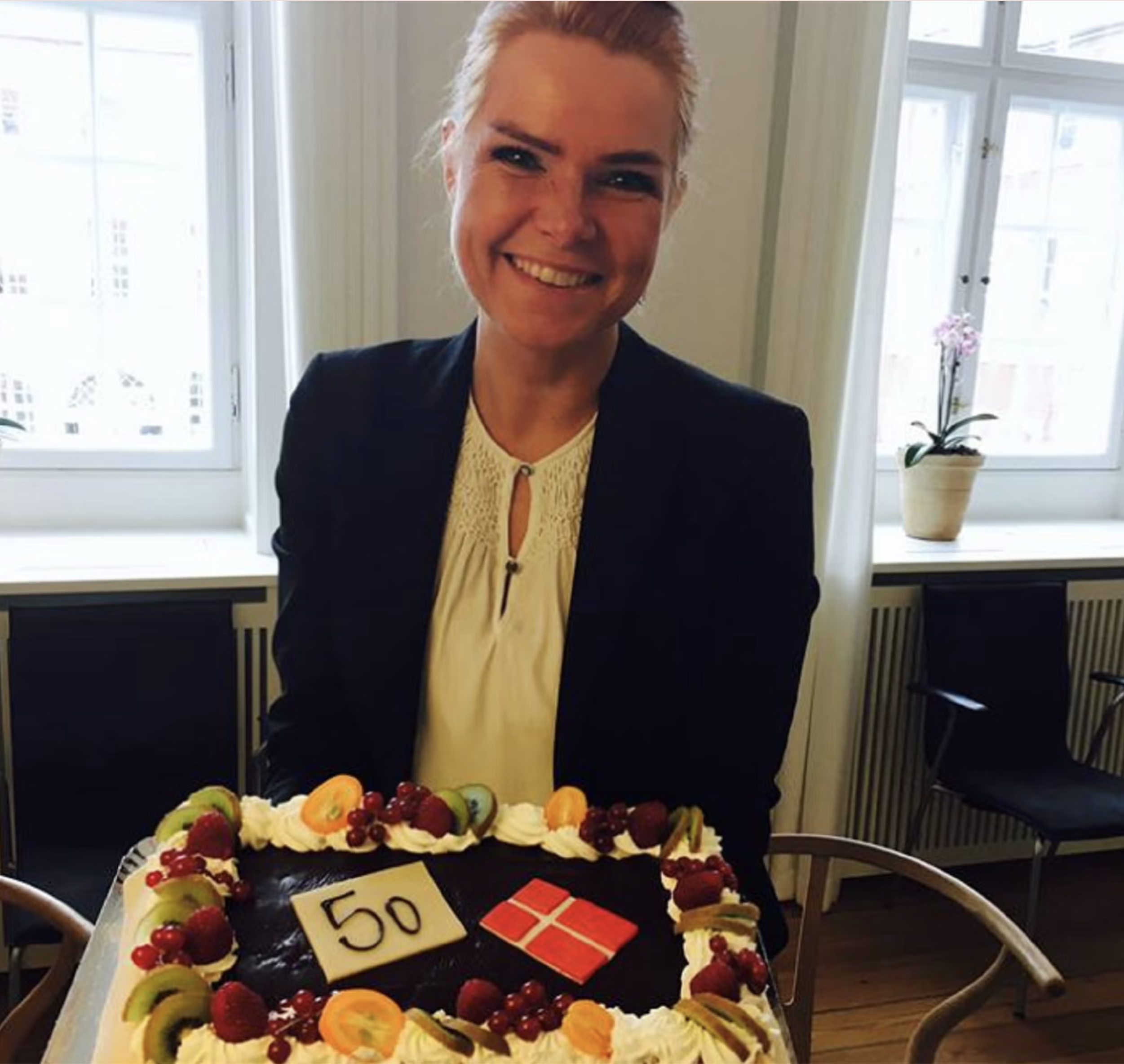
2 | Minister of Immigration, Inger Støjberg, posted a photo of herself on Facebook with a cake in celebration of passing the 50th law cracking down on migration to Denmark, 2017.
The Danish People’s Party’s aggressive Islamophobic discourse had at this point more or less whole-heartedly been appropriated not only by other right-wing parties, but also by centre-right, centre-left and even left-wing parties. Notably, several parties from both the centre-right and the centre-left ran campaigns that stigmatised and mocked migrants, as well as Danish citizens with a mixed background or whose parents were migrants to Denmark. Throughout the noughties and 2010s, racist and xenophobic campaigns were the norm in Danish politics. In 2015, the Social Democratic Party, led by Helle Thorning-Schmidt, launched a campaign called “Det Danmark du kender” (“The Denmark you know”), featuring a series of posters. One of those posters showed a smiling Thorning-Schmidt standing in front of an out-of-focus old building, accompanied by the text: “If you come to Denmark, you have to work”. The point is that even refugees escaping civil wars or climate disasters should not expect an easy time once they arrive in Denmark. Another poster from the same campaign, featuring the same photo of the Social Democratic leader, read: “Stricter asylum rules and more demands on immigrants”. In 2017, Inger Støjberg, the Danish Minister of Migration at the time and a member of the governing right-wing party Venstre, posted a photo of herself on Facebook with a traditional Danish Othello cake bearing the number of 50 in chocolate, to celebrate the fact that she had managed to tighten the asylum law 50 times in her capacity as minister [Fig. 2]. Such visual representations of official state xenophobia accompanied the material transformation of Danish immigration law, which included continuous cuts to benefits, postponement of the right to family reunification and tightening of border control. The previous year, Støjberg introduced a series of amendments to the Danish Aliens Act, including the so-called jewellery law, which allows Danish authorities to seize cash and valuables from asylum seekers to fund their maintenance, with the explicit goal of making Denmark less attractive to asylum seekers.
Using the terminology of Walter Benjamin and Susan Buck-Morss, this can be described as an extended process of “anesthetisation” (Buck-Morss 1992, 6), whereby Danish voters are become accustomed to viewing socially constructed ‘others’ as having little to no value; as being less than human; as being unworthy of Danish citizenship; and as being legitimate objects of ridicule, mockery, imprisonment, misery and exclusion. New emotional registers and new conditions of conscience are being produced (for an analysis of how ordinary Germans in the 1930s were prepared for state terror and wartime atrocities through the dissemination of racial concepts by legal discourse, pedagogical incitement and media representations – including magazines, exhibitions and humour – see Koonz 2003). As Koonz demonstrates, the state terror of the Nazi regime was less the result of the instilling of a specific Nazi conscience than the eradication of a universal humanist conscience, which enabled a “loose consensus” about “ethnic organism” (Koonz 2003, 10). The Danish People’s Party, the Social Democrats and all the other parties have participated in a decades-long training exercise in numbness, which visually culminated in 2017 when a photographer from the newspaper Information took a picture of a middle-aged Danish man spitting at Syrian refugees from a highway bridge. This is a modern-day version of the sense-dead subject, Benjamin observed in German fascism (Bolt Rasmussen 2026). Feeling just a little bit better by spitting on the ‘other’. This was the pleasure of aggression and violence that Reich sought to analyse in The Mass Psychology of Fascism. Fascism simplifies and concretises complex political-economic process by targeting and lashing out at socially constructed ‘others’. It enables people to be vicious towards those they perceive as vulnerable.
Since the early noughties, Denmark has seen a steady shift towards increasingly stringent asylum laws, regardless of which government has been in power. These measures have not only affected asylum laws, but also other areas enabling external and internal racialised control and urban racial exclusion. In 2018, the so-called ‘ghetto’ or ‘parallel societies law’ came into effect, enabling the state to demolish apartment blocks in areas where at least half of the residents have a ‘non-Western’ background. The designation of an area as a ‘ghetto’ enables higher penalties for crimes and the collective punishment of entire families through eviction if one of their members commits a criminal act. In 2021, the Social Democratic-led government passed a law allowing refugees arriving in Denmark to be moved to asylum centres in partner countries, such as Rwanda. This proposal was strongly criticised by the European Commission. The government also considered detaining asylum seekers on a remote island which previously housed a laboratory for contagious diseases (for an encompassing analysis of the Lindholm project and the way it exemplifies Danish asylum policy, see Björgvinsson 2025). In 2023, Denmark revoked residency permits for Syrian refugees, declaring some parts of the war-torn country safe for return, but then backtracked in the face of international backlash.
Following the near collapse of the Danish People’s Party after the last election in 2022, the party has returned to its increasingly extreme xenophobic position under its new leader, Morten Messerschmidt, with a focus on remigration. In a recent interview with the right-wing paper Weekendavisen, Messerschmidt explained that between 50,000 and 100,000 people should be deported, and those who are unwilling to leave should be imprisoned (Messerschmidt 2025, 5). These prisons would be tougher than normal Danish prisons. It is necessary to be much tougher, Messerschmidt explained. This includes revising the entire citizenship acquisition process, which has already undergone dramatic changes in recent years. According to Messerschmidt, the 25,000-plus people who have acquired Danish citizenship in the last eight years must reapply under new, tougher conditions, including having a conversation with members of the Danish parliament about whether they are “truly Danish in their hearts”. If you are a practising Muslim, this will be taken into account during the assessment process. The same applies to utterances against the State of Israel: “Whether it’s a hundred thousand or ten thousand, people who have been convicted of crimes and people who cannot support themselves and live off public funds, should not be here” (Messerschmidt 2025, 5). As Mikkel Bjørn, one of the other leading figures in the party, has explained: “It must be made virtually impossible to live an Islamic life in Denmark” (Bjørn 2024, 20). The party’s youth wing has also toughened its rhetoric and recently distributed thousands of fake one-way airline tickets with the text “from Denmark to the Middle East” in primary schools during mock elections, where children are introduced to political parties. When asked about the matter, the Social Democratic Minister of Education, Mattias Tesfaye, said he found the stunt acceptable as part of the political education of schoolchildren. The new, even harsher discourse has had an immediate effect on opinion polls, with the party once again becoming the largest right-wing party, forcing the Social Democrats and most other parliamentary parties in the parliament to follow suit.
The Danish Social Democrats’ attempt to render the stance of the Danish People’s Party indistinguishable from their own can be analysed as an instance of “fascisation” (Palheta, Bantigny 2021, 55-79). This is the process whereby traditional parties implement post-fascist demands to prevent post-fascist parties from gaining ground. This process involves a dual rise in racism and an authoritarian hardening of the state. As Ludivine Bantigny and Ugo Palheta argue, this process occurs as part of a “radicalisation of whole sections of the ruling class, out of fear that the political situation is escaping them”, in tandem with the “social entrenchment of fascist […] ideas and affects” (Palheta, Bantigny 2021, 58). In other words, the fight against fascism cannot be limited to combatting the explicitly fascist parties; it must also address how the ruling class enables fascist sentiments to become official state policy in times of economic crisis (Hall 1988). The problem lies in the combination of political democracy and ultra-nationalism into what the Danish historian Carsten Juhl has termed “a national democratic authenticity totalitarianism” (Juhl 2002, 20). A contemporary antifascist perspective must combine critique of post-fascist parties with an analysis of political democracy within the nation state. We should abandon the idea that fascism and democracy are necessarily opposed to each other. Amadeo Bordiga analysed this as far back as 1923: “Fascism incorporates the counterrevolutionary struggle of all allied bourgeois forces, and for this reason is not necessarily bound to destroy democratic institutions” (Bordiga[1922] 2020, 168).
The Visual Politics of Danishness
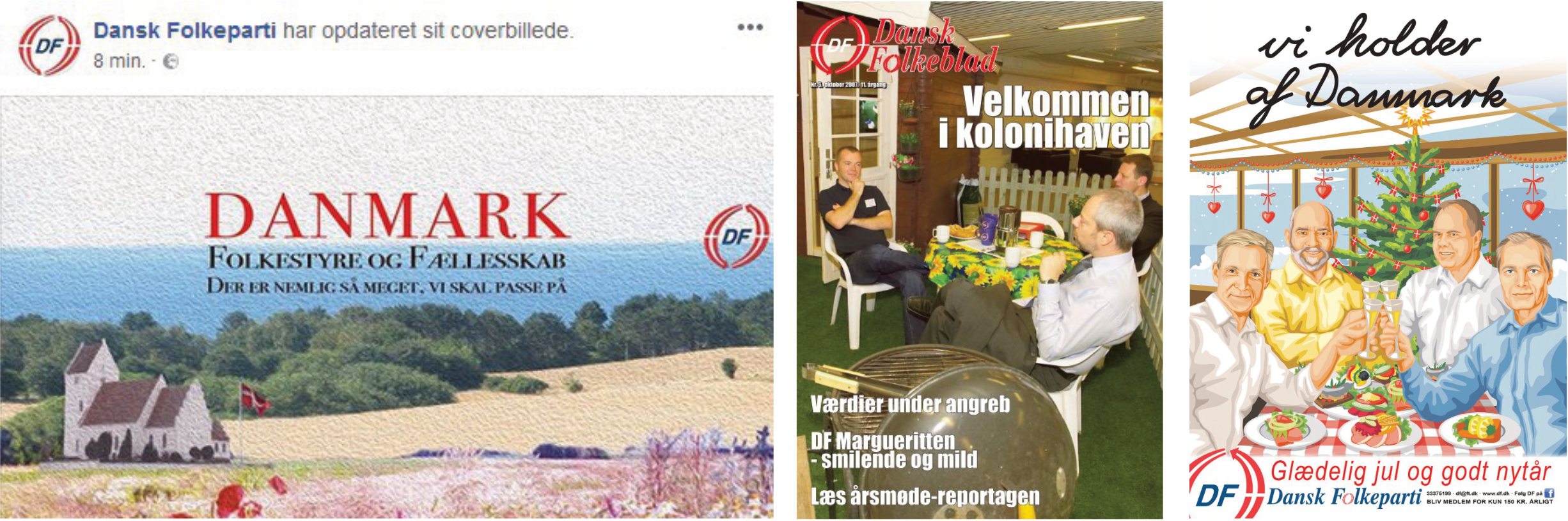
3 | Danish People’s Party cover image on Facebook, 2018: “Denmark, democracy and community. There’s so much we need to take care of”.
4 | Danish People’s Party, cover of “Dansk Folkeblad”, October, 2007, showing the allotment house built at the annual party conference.
5 | Danish People’s Party, poster, 2018: “We care for Denmark. Merry Christmas and a Happy New Year!”.
Throughout its existence the Danish People’s party has referred to Danishness in its slogans, campaigns and speeches [Fig. 3]. The party’s name says it all: This is the party for Danish people; those who are Danish and belong to the Danish people. Not necessarily everybody in Denmark or with Danish citizenship. The name thus effectively distinguishes between Denmark as a political and legal entity, and Danishness as a cultural and spiritual community – a more ancestral Denmark that requires protection.
As with most ultra-nationalist parties and groups, the nature of the national element is difficult to define. Unlike parties that signal the political direction they want society to take—be it a socialist or a conservative, for example – the Danish People’s Party is dedicated to making Denmark more Danish. The question, of course, is what ‘Danish’ means. In a statement on Danish culture on the party’s homepage, the party explains: “Denmark is a very small area in terms of language and culture. But it is ours, and it is precious and unique. Our cultural policy must therefore have one clear goal: to preserve and strengthen Danish culture and language. Our history, language, beliefs and traditions are our shared identity. They bind us together across generations and social divides and form the foundation for the valuable trust on which our society and public life are built”. Aside from language, it is difficult to define more concretely what Danishness amounts to for the Danish People’s Party. There is a clear tautological dimension at play, whereby Danishness is something one is simply by being Danish (Jøker Bjerre 2009, 16-17).
A group of Danish priests played a central role in formulating the party’s ultra-nationalism in the 1990 and early noughts. Led by Søren Krarup, editor of the nationalist Lutheran journal “Tidehverv”, these priests promoted an idea of Christian and intransigent nationalism. Already in the mid-1980s, Krarup and other Tidehverv priests campaigned against “Muslim immigration” to Denmark. According to Krarup he was engaged in a resistance fight similar to that of the Danish resistance fighters in World War Two, when Denmark was occupied by Nazi Germany. Therefore, he argued, any comparison of “Tidehverv” and fascism was completely off the table.
The Danishness of the Danish People’s Party is akin to Furio Jesi’s visual clichés, which can be moulded and shaped in the most expedient way. In the vocabulary of Jesi, Danishness is an example of “ideas without words”, i.e. abstractions that have been used so much that they have almost lost their meaning (Jesi 2011, 24). Danishness is a formula that does not need to be understood; everyone knows what it means. If you do not, then you are not Danish. It is that simple. The fascist myth is insidious because it is easy; you nod or agree even without really thinking about it. You cannot really dispute the myth of Danishness and end up going along with it, accepting it as reality. This is what Jesi warned about.
‘Danish’ is an amalgamation of values, traditions and customs that Danish citizens embody by being Danish (danskhed). By being Danish, Danish citizens conform to this idea of Danishness according to the national democratic tradition about ‘danskhed’. There’s an obvious auto-erotic dimension here. In this case, however, the myth is particularly banal, lacking any kind of transcendence that was historically, and is perhaps still today, present in other forms of European fascism and post-fascism. Danishness is a flat and particularly empty idea, that cannot easily be defined. But that is its strength. There is an obvious reactionary dimension to the ultra-nationalism of the Danish People’s Party. Its project is to secure Danishness, i.e. how Danish citizens are Danish. This way of life must be protected against any threats, whether internal or external, be it migrants, the EU, or US popular culture, including left-wing culture as wokeism and cancel culture.
The party logo features two Danish flags wrapped around the party’s abbreviation. The Danish flag features prominently in most of the party’s campaigns. It is always present at party conferences and is frequently used in photos or posters. Often the flag is superimposed on a map of Denmark, or children are wrapped in the Danish flag. Most often with texts creating an opposition between external threats and Denmark.
The party has often invoked a particular, retro-idea of Danish post-war culture. This post-war culture was actively engaged in an producing an image of a previous, harmonious national community – an agrarian romanticised version of Denmark. This took place, not least, in the film adaptations of Morten Korch’s agrarian romantic novels, in which national identity was rooted in the soil and the age-old, inherited peasant farm (Marklund 2014; Troelsen 1980).
In posters and speeches, scenes of Danish country life, a village church surrounded by green fields or a farmer on his tractor and his wife busy cooking in the kitchen or the nuclear family united in the garden, eating and drinking, are presented as examples of an ideal way of life [Fig. 3]. At a party meeting in 2007, an allotment house, which is typically associated with the post-war era when working-class families gained access to higher wages and purchased small plots of land on the outskirts of the cities, was constructed inside the convention centre where the party meeting was held [Fig. 4]. In 2018, the party ran a campaign with a series of posters featuring four leading members of the party, Kristian Thulesen Dahl, Søren Espersen, Peter Skaarup and Martin Henriksen, depicted as friendly, slightly caricatured cartoon faces painted in light pastel colours. With their painting-after-photography style, the campaign posters are reminiscent of a mixture of Jehovah’s Witnesses and socialist realism. The faces of the four politicians are completely smooth, while the background has a slightly bumpy appearance, like a fresco or crumpled tin foil. On all the posters, they stand alone or together with their mouths closed, saying things like: “There is so much we need to protect” or “You always know what we stand for”. There is an implicit understanding in these statements, just as there is in many of Donald Trump’s slogans. In one of the posters, the four politicians were depicted sitting in front of a Christmas tree adorned with miniature Danish flags, in an allotment or summerhouse, about to enjoy a traditional, meat-centric Danish Christmas meal, complete with a red-and-white checked tablecloth [Fig. 5].
The idea that Denmark is under threat and needs to be protected has been a constant refrain. The description on the current leader of the party, Morten Messerschmidt’s, Instagram simply says “Politician” and “Denmark back!”. Since the mid-1990s, most of the party’s slogans have emphasised this rhetoric. In 2019, the party launched a campaign under the slogan “Give us Denmark back”. Most of these campaigns invoke a vague notion of a rapidly disappearing past that needs to be secured. The kitschy visual style of the campaigns is slightly tongue-in-cheek, enabling the party to make an explicit reference to an imagined, cosy past while also being xenophobic. The party has continued to supplement the images and posters depicting an idealised rural lifestyle with anti-refugee representations. Maps of Denmark are combined with warning or demand texts: “We must help our own people before immigrants” and “There has to be a border”, where the limit is understood in both a concrete sense, as strict border control, and in the sense of a limit to the number of migrants in Denmark.
Michael Rogin defines political demonology as “the creation of monsters […] by the inflation, stigmatization and dehumanization of political foes” (Rogin 1987, XIII). The focus of his analysis is the United States, and how the white ruling class has continually invoked and actively produced dangerous ‘others’ from native ‘Indians’ to ‘Red’ communists—who must be kept at bay to keep the nation safe. In the Danish context, since the mid-1990s, the monster has principally been people from Muslim countries in North Africa and the Middle East. Rogin describes the demonisation process as characterized by a “misplaced concreteness”, whereby the countersubversive sees monsters everywhere and nowhere at all. To give form to the anxieties and fears that are part of political demonology, the countersubversive constantly mixes reality and fantasy. The monstrous ‘other’ thus takes on the form of an uncanny double that is independent and in formation. “The alien comes to birth as the American’s dark double, the imaginary twin who sustains his (or her) brother’s identity” (Rogin 1987, 284). Rogin discusses how Ronald Reagan referred to communism and communists as both specific individuals and nowhere to be seen, both an actual presence and an invisible threat. In the case of the Danish People’s Party, they have not only repeatedly inflated numbers—for example, in December 2025, Morten Messerschmidt claimed that there were more than 15,000 foreigners sentenced to deportation living in Denmark, whereas all accounts suggest the figure is no higher than 1,500 – but they have also created the fear they invoke. During the 2011 election, Alex Ahrendtsen made and circulated a video titled “A Day in the Ghetto”, in which he walked around in Vollsmose in Odense. Suddenly an elderly white woman was robbed and beaten by a man with darker skin in the background. This scene was staged by Ahrendtsen. It worked, however, and Ahrendtsen was subsequently elected to the Danish parliament.
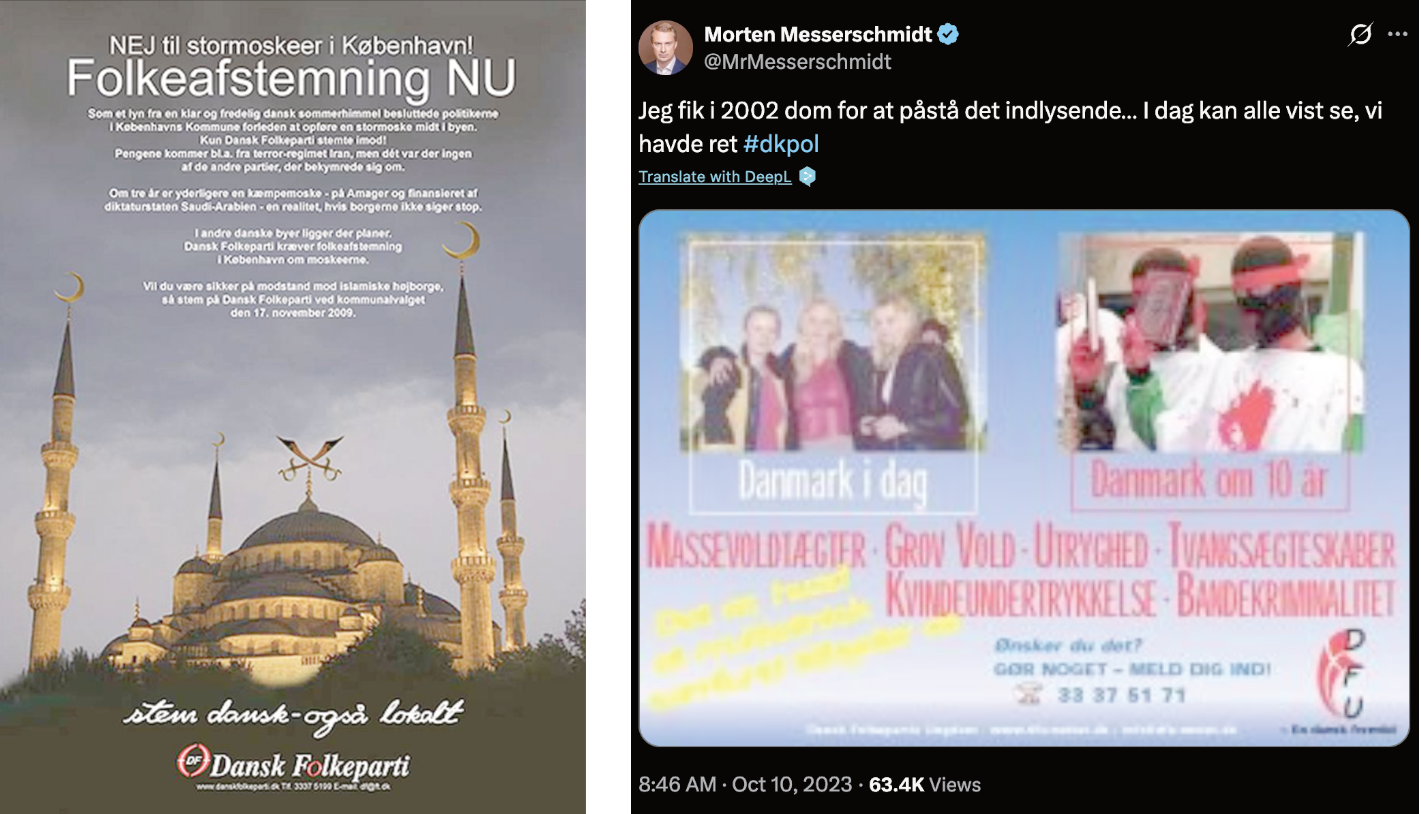
6 | Danish People’s Party, poster, 2009: “No to mosques in Danish cities”.
7 | X post by Morten Messerschmidt, the leader of the Danish People’s Party in 2023, reposting a poster from 2001 juxtaposing young blond women and hooded, bloodstained men holding the Koran. “In 2001 I was sentenced for stating the obvious… Today everybody can most likely see we were right”.
Most of the Danish People’s Party’s posters allude to an unseen threat that it is difficult to identify, which makes it all the more important to stand firm. Other posters focus on representing the socially constructed other or attempting to make it visible. The hijab and the burka have been constant references to un-Danishness. According to the Danish People’s Party, you cannot wear a hijab and be Danish, it’s that simple. A 2001 poster shows the face of a burka-clad women facing the viewer, accompanied by large yellow text on a blue background: “Your Denmark: Is this what you wish for?” with a list of consequences between the question and the answer. “A multiethnic society with: Gang rapes, serious violence, insecurity, forced marriages, gang crime”. Another poster from 2008 features a burka-clad female judge holding a gavel, with the words “So ruled the judge” at the top. Beneath the photo was a short text with the heading “Submission”, which explained that the Danish parliament, as well as the courts, were planning to accept the hijab (The term “submission” was a reference to the Islamophobic 2004-film by the far-right Dutch film maker Theo van Gogh, written by Ayaan Hirsi Ali, Van Gogh was stabbed and killed by Mohammed Bouyeri in November 2004). The fact that the woman in the picture was wearing a burka, not a hijab, and that only three people in Denmark at the time regularly wore burkas, according to the social authorities, was beside the point. The following year, the party ran a campaign against a mosque in Copenhagen in all the large newspapers and tabloids, using a manipulated photo of the 16-century Blue Mosque in Istanbul, in which the crescent moon had been replaced by two scimitars [Fig. 6].
In 2001, four male members of the party’s youth wing, including Morten Messerschmidt, who is now the party leader, were convicted of racism for a poster published in a youth magazine with a print run of 45,000 copies [Fig. 7]. The poster juxtaposed two photos, one labelled “Denmark now “and the other “Denmark in ten years”. “Now” showed three young blonde women in short tops, while “the future” showed three hooded, bloodstained men holding the Koran, accompanied by the text “Mass rapes. Serious violence. Insecurity. Forced marriages. Oppression of women. Gang crime. These are the things a multi-ethnic society offers us”. This was an example of what we with Dagmar Herzog can called “Islamophobic pornography” where racism is mixed with titillating incitement (Herzog 2025, 9-17). DF-voters get to look at good-looking semi-naked young women and feel morally superior to migrants from Muslim countries. In October of 2024, Messerschmidt decided to republish the poster on Facebook and X with the comment: “In 2002, I was convicted for stating the obvious… Today, everyone can see that we were right”.
Antifascism Today
In his 1998 book The Unveiling of National Icons, the late Marxist art historian Albert Boime proposed an act of “patriotic iconoclasm”, pointing to Jasper Johns’ and Faith Ringgold’s reinterpretations of the Stars and Stripes. However, I believe that we are now in a situation where this is no longer possible; it has become extremely difficult to envisage a progressive détournement of nationalist symbols (in the West). There are several examples of such iconoclastic gestures in Denmark during the emergence of the Danish People’s Party, including when Lars von Trier made a short video in 2006 in response to the Minister of Culture’s creation of a national cultural canon listing the most significant Danish art works. In the video, von Trier cuts up the Danish flag, removing the white cross, and then proceeds to raise the resulting all-red flag to the tune of “The Internationale”. Von Trier was reported to the police, but no charges were brought against him. Another important attempt at challenging the mainstreaming of racist sentiments was Ellen Nyman’s 2001-“Space Campaign” project where the Danish artist and actor Nyman dressed in a yellow tablecloth from IKEA would appear as an African refugee at political events. One action took place at the entrance of the Danish Parliament where Nyman confronted the then leader of the Danish People’s Party Pia Kjærsgaard singing the Danish national anthem [Fig. 1]. While it may still be necessary to deconstruct and repurpose national symbols, we must also consider other modes of opposition. In light of the emergence of a new kind of fascism, it may be time to return to an earlier iconoclastic and anti-nationalist stance, similar to that of the inter-war Zimmerwald Left, which sought to formulate a staunchly internationalist perspective refusing to engage with parliamentary democracy (Chuzeville 2024). The Gaza encampment movement, which sprang up on campuses across the world in late 2023 and early 2024 in protest against the genocide of Palestinians in Gaza by the Israeli state, could be an early indication of such internationalism, or at least a necessary anti-imperialist stepping stone towards it. Obviously, we are very far from the kind of international solidarity that existed in the interwar period. The language of revolutionary internationalism did not survive the horrors of the 20th century and the neoliberal onslaught on the idea of a revolutionary change. However, Gaza has become a prism through which numerous injustices and forms of domination can be seen. Despite heavy repression and accusations of antisemitism, millions of people around the world have spoken out against the violence in Gaza, holding demonstrations, occupying campuses and blocking ports. The atrocities in Gaza have become a symbol of hundreds of years of colonisation, not only of Palestine, but of many other places too. As Nasser Abourahme eloquently put it, the synchronised, real-time witnessing of the so-called ‘war in Gaza’ is like “a condensed restaging of every colonial war in history, bearing every hallmark: the pummelling of dispossessed and besieged people by an overwhelming military power in the name of self-defence and ‘Western civilisation and values’; the demonology and language of savagery, zoology and bestiality; the devaluation of life in racial taxonomies that actively produce disposability as the condition of value everywhere; the presentism and the refusal of any claims of a historical past or historical injustice” (Abourahme 2024, 19). In the face of the near-total Western support for Israel – Denmark being among the staunchest supporters of Israel’s “right to self-defence” – Palestinian liberation is once again emerging as a common cause. This is not yet an established historical consciousness, but rather a sense of historical necessity. Perhaps we are witnessing the beginning of an alternative to the accelerated process of fascisation we see taking place in country after country.
Bibliographical references
- Abourahme 2024
N. Abourahme, In Tune with Their Time, “Radical Philosophy” 216 (2024), 13-20. - Awad et al. 2022
S. Awad, N. Doerr, A. Nissen, Far-Right Boundary Construction Towards the ‘Other’: Visual Communication of Danish People’s Party on Social Media, “The British Journal of Sociology” 73, 5 (2022), 985-1005. - Balibar [1985] 1991
É. Balibar, Racism and Crisis [1985], trans. C. Turner, in É. Balibar, I. Wallerstein, Race, Nation, Class: Ambiguos Identities, London 1991. - Bellamy Foster 2017
J. Bellamy Foster, Trump in the White House: Tragedy and Farce, New York 2017. - Benjamin [1936] 2006
W. Benjamin, The Work of Art in the Age of Its Reproducibility [L’œuvre d’art à l’époque de sa reproduction mécanisée, “Zeitschrift für Sozialforschung” V, 1 (1936), 40-68] in Id., Selected Writings, Volume 3, 1935-1938, edited by H.Eiland, M.W. Jennings, trans. E. Jephcott, H. Eiland, et. al., Cambridge (MA) 2006. - Bjørn 2024
M. Bjørn, interview by T. Holm, C. Jessen, Mikkel Bjørn vil gøre det ‘tæt på umuligt’ at leve et islamistisk liv I Danmark, “Berlingske” 15 September 2024, 20-21. - Boime 1988
A. Boime, The Unveiling of National Icons: A Plea for Patriotic Iconoclasm in a Nationalist Era, Cambridge 1998. - Bolt Rasmussen 2011
M. Bolt Rasmussen, On the Turn Towards Liberal State Racism, “e-flux journal” 22. - Bolt Rasmussen 2021
M. Bolt Rasmussen, Late Capitalist Fascism, Cambridge 2021. - Bolt Rasmussen 2026
M. Bolt Rasmussen, L’estetica politica del fascismo tardo-capitalistico, trans. A. Martinengo, “Almanacco di Filosofia e Politica” 7 (2026), 117-132. - Bordiga [1922] 2020
A. Bordiga, Report to the Fourth Congress of the Communist International, trans. G. Donis, in The Science and Passion of Communism: Selected Writings of Amadeo Bordiga (1912-1965), Leiden/Boston 2020, 157-176. - Brown 2010
W. Brown, Walled States, Waning Sovereignty, New York 2010. - Buck-Morss 1992
S. Buck-Morss, Aesthetics and Anaesthetics: Walter Benjamin’s Artwork Essay Reconsidered, “October” 62 (1992), 3-41. - Césaire [1955] 2000
A. Césaire, Discourse on Colonialism [Discours sur le colonialisme, Paris 1955], trans. J. Pinkham, New York 2000. - Chuzeville 2024
J. Chuzeville, Zimmerwald 1915. L’internationalisme contre la Première Guerre Mondiale, Toulose, 2024. - Eley 2020
G. Eley, Conclusion, in G. Eley, J.A. Thomas (eds.), Visualizing Fascim, Durham 2020, 284-291. - Engelbreth Larsen 2001
R. Engelbreth Larsen, Det nye højre i Danmark, København 2001. - Fassin 2017
É. Fassin, Populisme. Le grand ressentiment, Paris 2017. - Hall 1988
S. Hall, The Hard Road to Renewal: Thatcherism and the Crisis of the Left, London 1988. - Hall 2013
S. Hall, The Spectacle of the Other, in S. Hall, J. Evans, S. Nixon (eds.), Representation, London 2013, 215-287. - Hermann 2021
A.K. Hermann, Imperiets børn. Da Danmark vildledte FN og Grønland for at beholde sin sidste koloni, København 2021. - Herzog 2025
D. Herzog, The New Fascist Body, Berlin 2025. - Jackson 1990
G. Jackson, Blood in my Eye, Baltimore 1990. - Jensen 2009
A. Jensen (ed.), Stuerent? Dansk Folkeparti, populisme antimuslimsk retorik og offermytologi, København 2009. - Jesi [1979] 2025
F. Jesi, Cultura di destra. Con tre inediti e un’intervista, a cura di A. Cavalletti, Milano 2025. - Jordan 2024
J. Jordan, The Strategic Ambiguity of the Radical Right: A Study of the Danish People’s Party, “Party Politics” 30,1 (2024), 139-150. - Juhl 2002
C. Juhl, To stikord m.m. til det abjekte Danmark, “Mutant” 1 (2002), 20-27. - Jøker Bjerre 2009
H. Jøker Bjerre, Vanens magt, in A. Jensen (ed.), Stuerent? Dansk Folkeparti, populisme antimuslimsk retorik og offermytologi, København 2009, 15-34. - Koonz 2005
J. Koonz, The Nazi Conscience, Cambridge (MA) 2005. - Liboreiro 2025
J. Liboreiro, Denmark takes over EU presidency in stormy times. Here’s what to expect, “euro news” 1 June 2025. - Lykkeberg 2008
R. Lykkeberg, Kampen om sandhederne, København 2008. - Marklund 2014
A. Marklund, Danskhetens landskap. Landskap, återuppbygnad och national identitet I dansk efterkrigsfilm, “Scandia” 80,1 (2014), 39-69. - Meret 2010
S. Meret, The Danish People’s Party, the Italian Northern League and the Austrian Freedom Party in a Comparative Perspective: Party Ideology and Electoral Support, PhD thesis, Aalborg University 2010. - Messerschmidt 2025
M. Messerschmidt (interview by C. Bennike), Den store udvisning, “Weekendavisen”, 31 October 2025, 5. - Mudde 2017
C. Mudde, Introduction to the Populist Radical Right, in C. Mudde (ed.), The populist Radical Right, London 2017, 1-10. - Padovan-Özdemir, Øland 2022
M. Padovan-Özdemir, T. Øland, Racism in Danish Welfare Work with Refugees: Troubled by Difference, Docility, and Dignity, London 2022. - Palheta, Bantigny 2021
U. Palheta, L. Bantigny, Face à la menace fasciste, Paris 2021. - Petterson 2012
C. Petterson, Colonialism, Racism, and Exceptionalism, in K. Loftsdóttir, L. Jensen (eds.), Whiteness and Postcolonialism in the Nordic Region: Exceptionalism, Migrant Others, and National Identities, London 2012, 29-42. - Reich [1934] 1970
W. Reich, What is Class Consciousness? [E. Parell [W.Reich], Was ist Klassenbewusstsein? Ein Beitrag zur Neuformierung der Arbeiterbewegung, Kopenhagen/Prag/Zürich 1934], New York 1971. - Rogin 1987
M. Rogin, Ronald Reagan, the Movie and Other Episodes of Political Demonology, Berkeley 1987. - Starmer, Frederiksen 2025
K. Starmer, M. Frederiksen, We Must Protect Our Borders to Protect Our Democracies, “The Guardian” 9 December 2025. - Siim et al. 2016
B. Siim, S. Meret, Right Wing Populism in Denmark: People, Nation and Welfare in the Construction of the ‘Other’, in G. Lazaridis, G. Campani, A. Benveniste (eds.), The Rise of the Far Right in Europe: Populist Shifts and ‘Othering’, London 2016, 109-137. - Toscano 2024
A. Toscano, Late Fascism: Race, Capitalism and the Politics of Crisis, London/New York, 2024. - Trads 2002
D. Trads, Danskerne først! En historie om Dansk Folkeparti, København 2002. - Traverso 2019
E. Traverso, The New Faces of Fascism: Populism and the Far Right, London/New York 2019. - Troelsen 1980
A. Troelsen, Det var så dejligt ude på landet…, in Id. (ed.), Levende billeder af Danmark, København 1980, 235-266. - Vad 2024
F. Vad, Tale i forbindelse med forespørgsel nr. 12 i Folketingssalen, 5 Apri, 2024.
Abstract
Bolt Rasmussen’s article examines the mainstreaming of xenophobia and Islamophobia in Danish party politics over the past three decades, focusing on the Danish People's Party (Dansk Folkeparti) as the primary vehicle through which far-right nativist ideology entered the political mainstream. Rejecting the dominant framing of the party as a case of right-wing populism, the author argues for an expanded concept of (post-)fascism – drawing on anticolonial thought, the Frankfurt School, and thinkers such as Aimé Césaire, George Jackson, and Wilhelm Reich – to account for the continuum between colonial violence and contemporary racialised state control.
keywords | Danishness; Dansk Folkeparti; Danish People’s party.
questo numero di Engramma è a invito: la revisione dei saggi è stata affidata al comitato editoriale e all'international advisory board della rivista
Per citare questo articolo / To cite this article: M. Bolt Rasmussen, The Visual Politics of ‘Danishness’ and the Mainstreaming of Xenophobia in Danish Party Politics, “La Rivista di Engramma” n. 233 (aprile 2026).