The Aesthetics of Technofascism
From Apocalypse to Milk and Mar-a-Lago-Makeovers
Kathrin Rottmann, Friederike Sigler
Abstract

1 | Cybertruck in charred landscape, screenshot from the German website of tesla.com.
On 19 August 2025, American tech billionaire Peter Thiel delivered four lectures at a two-day workshop held at the Faculty of Catholic Theology at the University of Innsbruck in Austria. According to press reports, around twenty theologians attended, including Thiel’s entourage, a personal assistant, and two religion scholars (Kilian 2025). Among them was Alan Fimister, a British theologian and an “influential advocate of neo-integralism”, a movement that strives for a kind of Catholic theocracy to which the US Vice President, J.D. Vance, also has ties (Kilian 2025). The organiser of the Tyrolean lectures was Professor Emeritus Wolfgang Palaver, a theologian who met Thiel in the 1990s while conducting research at Stanford University’s Centre for International Security and Arms Control. There, they encountered René Girard and discovered their shared fascination with the French literary scholar, cultural scientist and philosopher. Today, Girard is regarded as a “visionary of Silicon Valley and the anti-democratic right in the USA” (Bernard 2025), and Palaver is researching his work at the University of Innsbruck (Palaver, 2008; Girard, Palaver 2010).
The subject of Thiel’s Innsbruck lectures was his crude theory about the Antichrist, inspired by the work of Girard. The Austrian newspaper “Der Standard” (hlk 2025) summarised Thiel’s claims, which he had previously set out in detail for a semi-public audience, in a way that is understandable even to those unfamiliar with the Bible:
They can be summarised as meaning that ‘the Antichrist’ will exploit an impending Armageddon or, more generally, an impending catastrophe to seize power and establish a ‘one-world government’. This one-world government will push for regulation and high taxes in the name of security—that is ‘sacrificing’ the ‘freedom’ of businesses—in order to avert catastrophe. However, allying oneself with the Antichrist is not the solution—instead, one must pursue an absolutely opposite, ultra-libertarian course.
According to Thiel, Antichrists can be identified as climate crisis activists, such as Greta Thunberg, who demand strategies to combat the crisis. They can also be supranational institutions, such as the United Nations, which was established in 1945 in response to fascism.
In light of Thiel’s broader comments and actions—including his investments in eugenics research centered on white embryos, his involvement in Palantir (a company whose software, Palantir Gotham, has access to the data records of billions of people and influences criminalisation decision-making processes by providing services to the authorities), and his financing of J.D. Vance’s election campaign—the term ‘ultra-libertarian’ seems insufficient, if not downright euphemistic, as a description of his political strategy. Instead, Thiel’s entrepreneurial approach, combined with his Antichrist theory, results in the extremist practices of an orthodox fanatic who aims to abolish liberal democracies in favour of individual-centred power, while enforcing the hegemony of ‘healthy’, Western, white populations. And he is not alone in this. In their publication, which they define as a “political treatise” providing instructions for action, Alex Karp and Nicholas W. Zaminska (Karp, Zaminska 2025, XV) put forward arguments similar to those of Thiel. According to their book’s title, “The engineering elite of Silicon Valley” must take responsibility “in the defence of the nation and the articulation of a national project” by “business leaders […] [determining] the relationship between the technology sector and the state” for The Technological Republic to come (Karp, Zaminska 2025, XIV-XV). For this reason, the political practices of Thiel and his ‘tech bros’, including his Palantir-partner Karp, Elon Musk, Jeff Bezos as well as Mark Zuckerberg, have long been described as technofascist.
The term characterises the expansion of digital technologies and infrastructures for entrepreneurial, political and fascist purposes in capitalist industrialised countries that define themselves as democracies, such as the United States. Drawing on Janis A. Mimura’s analysis of Japanese “reform bureaucrats”—prominent advocates of “techno-fascism” who sought to realise their vision of a “managerial state” and a “controlled economy” in pre-war Japan—we define techno-fascism as a form of fascism in which political power is seized by the economically powerful in an illiberal manner, with democratic structures being employed solely for technocratic administration (Mimura 2017). While in 1930s Japan it was industrialised capital that held power, today it is the owners of new technologies such as AI or Palantir.
For Thiel, technological expansion can only succeed if political systems such as democracies adopt a purely technocratic approach, with the real political power residing with capital and its holders. Weakening democracies politically would also prevent Antichrists such as the climate movement or the UN from gaining or retaining power. Additionally, Karp, Thiel’s Palantir partner, has repeatedly emphasised that both are committed to using technology to make the US military the most powerful in the world. A cursory analysis of US politics reveals that these examples for technofascist strategies are already being implemented, if only in part. This involves the violation of international law through illegal bombing and kidnapping in order to gain access to Venezuelan oil reserves. And it also involves the financial backing of the election of Vice President J.D. Vance, a former venture capital lawyer in Silicon Valley, by Thiel.
The concept of technofascism has been the subject of scientific study from various perspectives. These include the infrastructures of state power (Möllers 2025), Silicon Valley imperialism (McElroy 2024), authoritarianism (Coeckelbergh 2026) and the extent to which digital technologies and infrastructures such as AI, surveillance and social media (Zuboff 2019; Schaake 2024) are used today to control information, people and their emotions (Strick 2021; Fielitz, Marcks 2020). This practice has historical parallels in the utilisation of analogue administrative apparatus and mass media by historical fascism. However, an investigation of its aesthetic figurations, which do not necessarily resemble those of historical fascism, is still lacking. The present paper aims to provide an art-historical analysis of this specific phenomenon. It is based on two assumptions. According to Alberto Toscano’s definition, we argue that “late fascism” manifests repeatedly in novel forms “as a dynamic that precedes its naming” and “like other political phenomena, [it] varies according to its socioeconomic context” (Toscano 2023, XI). Secondly, we assume that these pre- or proto-fascist dynamics are particularly evident in aesthetics because politics can be pursued here independently of concrete political theory and beyond the sphere of state political power. To demonstrate this, we will explore the aesthetics of technofascism. First, we will examine the military armour of the Cybertruck and its potential for combatting the apocalypse. Next, we will use female figures to analyse the politics of retro dreams and the naturalness of raw milk in twentyfirst-century industrial society, starting with the Mar-A-Lago face and the tradwife. Finally, on a fictional walk through Innsbruck, we will ask whether the aesthetics of technofascism encompass more than just ‘doom trucks’, fillers, and raw milk shots.
Riding the Apocalypse. Electric Cars for Katechons

2 | Technofascist Fusion: Humvee, Cybertruck on Mars and Delorean Time Machine, collage by the authors.
On Tesla’s German company website, the Cybertruck—unveiled by company founder Elon Musk in 2019—is not presented as a means of transport that allows buyers to get from A to B quickly and easily. Nor is it presented as particularly sustainable, despite its electric drive. Instead, most of the images and videos show the pickup truck off-road, with no roads in sight [Fig. 1]. It is pictured in barren wastelands under threatening clouds, surrounded by black rubble, as if everything had burned down. It kicks up red, dusty earth as if driving across Mars. It races through the surf along the coast or crosses rivers, seemingly far from civilisation, as if there were no roads or other people left. However, the Cybertruck is not designed for experiencing nature, despite the website providing an image of a family camping, but rather for times of disaster. In fact, user experiences and practical tests have proven that it is not built for this purpose at all. Yet, the design of this high-powered steel wedge on wheels promises survival, as the car’s immense size and load capacity give it the appearance of a vehicle from a 1970s vision of the future that predicts disaster. Its contours and materials suggest movement is a fight for survival, with its polished stainless steel and sharp edges as if cutting through the air and every obstacle. Its rough shape [Fig. 2] is reminiscent of a crude combination of a Humvee (the US military’s off-road High Mobility Multipurpose Wheeled Vehicle), a stealth aircraft, the DeLorean time machine from Back to the Future, and the Lotus sports car driven by James Bond, but on a monumental scale: it is almost two metres high and weighs three tonnes. “This thing radiates dystopia, war zone, combat vehicle”, says Paul Snyder, a professor of transport design at the College for Creative Studies in Detroit (Anonymous, 2019). In addition to fast-charging stations and cinema-quality screens, it promises occupants protection from light ammunition in the form of a steel and bulletproof glass body, as well as a “bioweapon defence mode” that filters the air to hospital-grade quality.
Musk is not selling Cybertruck drivers protection from disaster with this moving steel wedge; rather, he is selling them technology for the apocalypse. “Sometimes you get these late-civilization vibes [that the] apocalypse could come along at any moment”, he explains: “Here at Tesla, we have the best in apocalypse technology” (Lawrence 2025). In Christianity, the apocalypse signifies both the end of the world and its subsequent transformation. In contrast, “Doomsday preppers” (Lawrence 2025) spend their time preparing for ‘the day after’ (to use TV film’s term), even if they can only afford a truck and not a luxury underground bunker (Rushkoff 2025, 25-38). Such preparation is hardly necessary, however, as everything will be better and newly created afterwards. The Cybertruck is therefore designed for a different version of the apocalypse. “Tesla’s apocalypse machine” (Lawrence 2025) is destined for the end-time events that Thiel conjures up. Central to Thiel’s “apocalyptic crypto-theology” and his conception of the apocalypse is his adoption of Carl Schmitt’s interpretation of the “katechon” (Baab 2026).
According to Christian beliefs about the end times, the katechon delays the appearance of the Antichrist, without whom salvation cannot follow. For Christians, the figure of the katechon thus provides an explanation as to why the apocalypse, the creation of a new earth and a new heaven, the return of Christ, and the peaceful existence of all the redeemed have not yet come to pass after some 2000 years. The political theorist Carl Schmitt defines “all significant concepts of the modern theory of the state” as “secularised theological concepts” (Schmitt [1922] 1985, 36) and has used the term katechon in his publications since the era of National Socialism (Grossheutschi 1996, 57). Initially, he defined it similarly, as a “retarder and delayer”, identifying it with “‘old’ or at least anachronistic empires or states” (Grossheutschi 1996, 62-63). However, he later characterised the figure positively as a “historical force”—in the sense of an “honorary title” (Grossheutschi 1996, 90, 105). Thiel referred to this interpretation in autumn 2025 in San Francisco at the Commonwealth Club in his private lecture series, the dress rehearsal for which took place in Innsbruck, “The Antichrist: A Four-Part Lecture Series” (Bhuiyan, Kerr, Robins-Early, 2025). The series was organised and sponsored by ACTS 17 Collective (ACTS stands for “Acknowledging Christ Within Technology and Society”), a Christian network of tech investors whose aim is to minister “to elites” rather than the poor (Tiku, Dwoskin & De Vynck 2025). Thiel identifies both the katechon and the Antichrist threat of a “one-world state” (threatening only to the super-rich as there would no longer be any tax havens) as originating from the USA: “The katechon is tied in with empire and politics. If the antichrist is going to take over the world, you need something very powerful to stop it” (Bhuiyan, Kerr, Robins-Early 2025). Theologian Florian Baab (2026) analyses who Thiel specifically identifies with this term katechon in his “identitarian pseudo-theology”:
The Katechon represents the process of technological progress. Therefore, tech nerds are the ones holding back the impending apocalypse, the opponents of the Antichrist. This explains the sense of pathos surrounding the idea of delaying the Parousia [the Second Coming of Christ] at all costs, which is considered a core Christian task. This is where the dark intersection between this reactionary Silicon Valley ideology and the Trumpist movement lies. […] And who is this Antichrist? There is a broad consensus that it is ‘woke ideologies’ and transnational alliances such as the European Union and NATO. According to Thiel and others, these would ultimately bring about a bureaucratically overburdened, innovation-hostile, and politically paralysed world government.
Thiel envisages an apocalypse that replaces the Christian belief in a happy ending with a permanent state of threat. By doing so, he adopts a key strategy of the New Right: using invented grand narratives to create threats in order to present the implementation of right-wing and fascist policies as a form of salvation (Schilk 2024). Specifically, Thiel’s techno-fascist argument aims to completely deregulate tech industries, allowing them to use AI, surveillance software, and ‘the most powerful military in the world’ to stop the supposed Antichrist.

3 | Casspir, “the father of all MRAPs” (Mine-Resistant Ambush Protected), photograph from reddit.com “r/Military Porn”.
By defining the unspecified catastrophe as an apocalypse, Musk—whom Thiel has explicitly praised in his lectures—has placed the Cybertruck within the framework of technofascist theorizing and has provided Thiel’s audience with a car for the end times that references the tech industry in its name. In addition, its technofascist aesthetic is linked to narratives of white supremacy and apartheid. The Cybertruck’s sharp edges and straight surfaces are often described as minimalist, as if this meant reducing to the essentials. However, anthropologist Vivian Chenxue Lu and historian Nana Osei-Opare argue that the car’s shape and dimensions resemble the Casspir [Fig. 3], a huge mine-protected wheeled armoured vehicle with a V-shaped hull for troop transport. Photographs of the Casspir are shared on the online discussion forum Reddit under the hashtag “Military Porn” but this military retro-dream is racist. The Casspir was designed, produced and deployed especially in the townships of South Africa, where Musk was born and raised, and where Thiel attended school. The armoured vehicle was used “to patrol and terrorise Black African communities” and has therefore been an “iconic global symbol of apartheid oppression” since the 1990s (Lu, Osei-Opare 2025). Due to its similarity in size and design to the Casspir, the Cybertruck “blurs the boundaries between the battlefield and the public street” (Lu, Osei-Opare 2025). Furthermore, it defines the street—or the charred landscape of rubble—as a racist battlefield, thereby exposing the politics underlying the design, production and use of the Cybertruck.
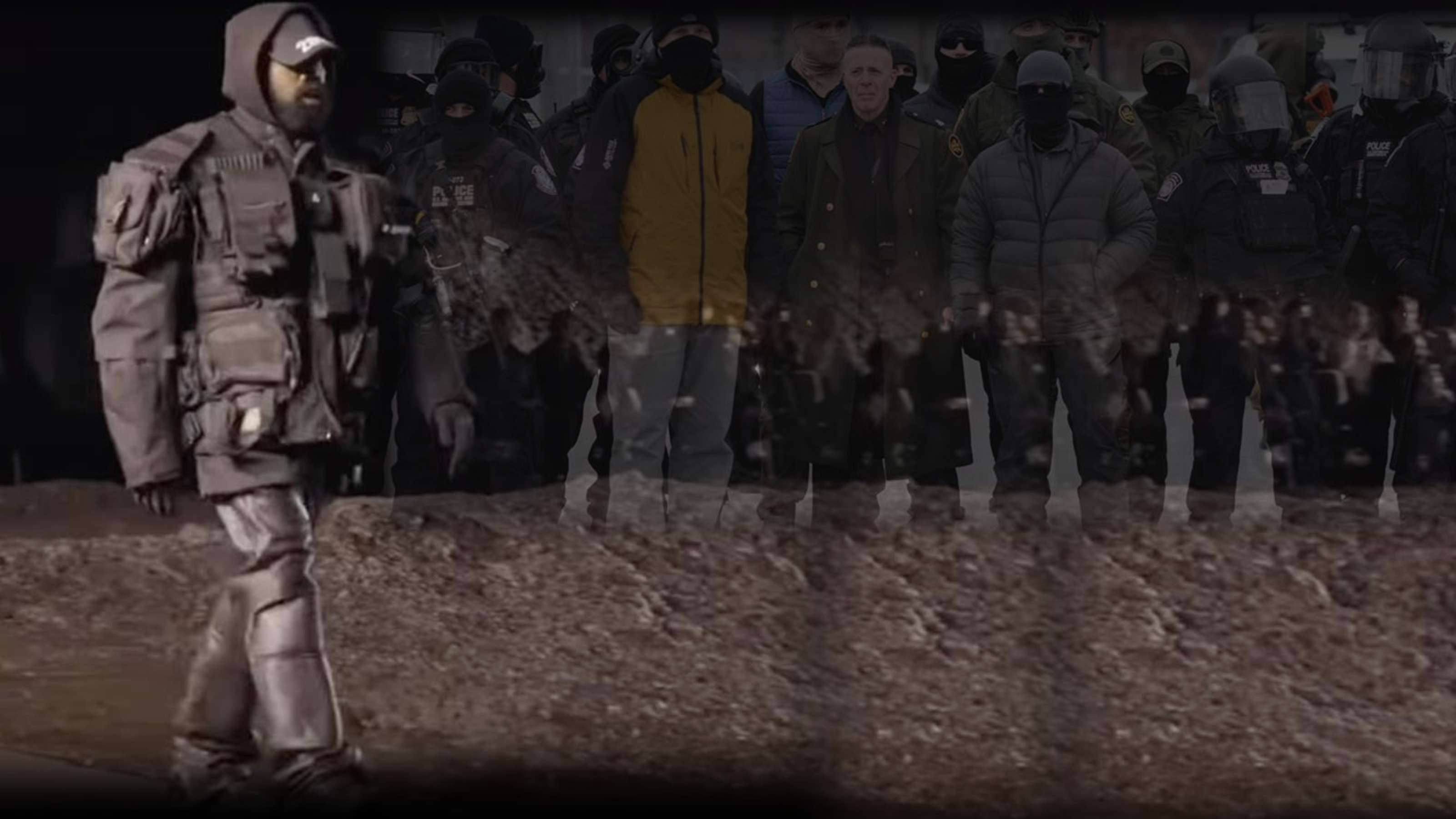
4 | Technofascist Fusion: catwalk wasteland for Balenciaga’s 2023 summer fashion collection, designed by Santiago Sierra, Kanye West on the runway in a military-style survival outfit and ICE agents during Donald Trump’s second term in office. Collage by the authors.
This military porn and doomsday aesthetic is already evident in many other areas. Examples include the perverse bunker architecture designed for the super-rich, which is intended to ensure their survival underground in the event of an apocalypse. These bunkers feature luxury spas and other amenities and are guarded by ex-military personnel to prevent others from seeking shelter there. This aesthetic also resonates in the catwalk wasteland designed by artist Santiago Sierra for the presentation of Balenciaga’s 2023 summer fashion collection. The parallels are unmistakable, especially when Kanye West—who has long trivialised fascism and the Holocaust through his fascist fantasies and Hitler songs—struts across the runway in his hip military-style survival outfit, as if he has just emerged from his bunker security shift. From today’s perspective, this was frighteningly prescient. The outfits worn by ICE agents during Donald Trump’s second term in office are virtually identical. With their bulletproof vests, black sunglasses and balaclavas or scarves wrapped around their faces, they resemble the models on the Balenciaga catwalk [Fig. 4]. However, the aesthetics of contemporary US-American fascism are not limited to haute couture looks. Gregory Bovino, the now-resigned head of Border Control, stands out from the DIY style of his agents. For photo shoots and public appearances, he wears a uniform-like, long-cut coat with extremely straight shoulders, a Sam Browne belt, gold buttons and badges, and with his undercut and martial appearance, he looks as if he came straight out of Nazi Germany of the 1930s and 1940s. However, this discrepancy does not show that “the new US totalitarianism has not yet found its own style” (Frank 2026), but rather that historical and contemporary elements come together here and, precisely in their mixture, reveal a great deal about the new face of fascism.
This aesthetic embodies specific gender politics. What is particularly striking about these apocalyptic aesthetic examples is that they are genuinely masculine. No matter how many Kim Kardashians drive the Cybertruck, it remains the car for the techno-fascist man of the future. While figures such as Mark Zuckerberg once exemplified the entrepreneurial spirit of the ‘new men’ who opposed patriarchy and advocated equality in the workplace and at home, today’s techno-fascist ‘broligarchs’ are characterised by a “re-masculinisation” or “re-sovereignisation” of the strong man (Forster 2006). These authoritarian and toxic forms of masculinity have always been present in neoliberalism and Silicon Valley, as argued by Becca Lewis (2025). Their shift to the right and their alliance with the established political right has now resulted in a new masculinity based on authoritarian, supremacist ideas centred around the sale and consumption of fossil fuels. Their vehicle is the “complex of masculinity and cars”, which appears to be an inevitable part of the art and cultural history of the Global North (Kunze 2022, 24). Political scientist Cara Daggett has highlighted that the US right wing, whom Donald Trump successfully appealed to in his first election campaign, has strong economic links to the fossil fuel industry. Trump promised to reinstate the ‘good old days’, when working in the fossil fuel industry provided prosperity and enabled the traditional male breadwinner model. These reactionary politics have given rise to a new form of petro-masculinity, manifested in the denial of climate change and the fetishisation of combustion engines within right-wing movements worldwide. Although it is powered by an electric motor and therefore seems to represent less of a petroleum culture and petro-masculinity, and more of what Daggett calls eco-modernism, the Cybertruck fits into these new models of masculinity and its resovereignisation—due to its aesthetics. Daggett argues that the Cybertruck in particular surpasses the aesthetics inherent in SUV design, with its ground clearance (without off-road capability), elevated seating position, robust, voluminous body, pronounced fenders and striking front end—only better and more extreme: “The Cybertruck is hyped as not just a permissible replacement for the traditional pick-up truck, but as far superior in terms of hardness, toughness, and power” (Daggett 2022).
During its presentation in 2019, the vehicle was smashed with a hammer and shot at with bullets to demonstrate that the metal of the militarised Cybertruck is very hard. The Cybertruck thus literally becomes the car-version of Klaus Theweleit’s Körperpanzer (“body armour”). Theweleit, a cultural scientist, analyses these psychoanalytically based notions of fascist masculinity, which are directed against anything associated with femininity. He uses the example of the soldierly man in the literature of the German Freikorps after the First World War and finds similar notions in National Socialism (Theweleit 1987). In today’s technofascist condition, the Cybertruck embodies and extends a technofascist masculinity characterised by the same criteria, but which uses armouring, alongside psychotechnique, drills and violent technologies. The fact that it has an electric motor does not contradict petro-masculinity. As Daggett argues, Musk’s handling of critical minerals and rare earths, which he needs for electric motor production, and of space is just as imperialistic and exploitative as the coal democracies’ appropriation of raw materials. Ultimately, the Cybertruck is not about combatting the climate crisis through sustainable energy production; it is about completely exploiting the world (and space) through continuously evolving technologies. Therefore, it is also not contradictory for Trump supporters and ‘Rolling Coal’ to modify their diesel engines to emit high levels of exhaust fumes and form a cross-front with Cybertruck drivers. Instead, it is this supposed incompatibility and asynchrony that characterise the aesthetics of technofascism today.
Milking the völkisch Future: Retro-Dreams from the Scratch
Aesthetics of a seemingly contradictory nature are also evident in the images of women in technofascism. Consequently, right-wing women who endorse and perpetuate the contemporary fascist movement find themselves presented with a range of aesthetic options. In German-speaking countries, right-wing femininity has been represented in public in recent years primarily by “three positions that are equally permeated by feudal, bourgeois and colonial attitudes”, as argued by art historian and artist Ruby Sircar, “The princess, vassal or damsel, and [the] representative of the people” (2021, 163-164). A prime example of this is Brittany Sellner, née Pettibone, an American white nationalist who presents herself on social media as an ‘immaculate bride’ but spreads racist conspiracy theories; the publicist Ellen Kositza, who appears in home stories about herself and her husband, the publisher and right-wing activist Götz Kubitschek, as a knight’s wife on their shared estate; and Caroline Sommerfeld-Lethen, who uses intellectual work and gardening projects to convey right-wing ideologies to the bourgeois middle class (Sircar 2021, 164-165, 167). In the United States, there are currently two other significant aesthetic trends that are defining gender relations in the context of technofascism. These are the ‘Mar-a-Lago face’ and the ‘trad wife’.
The Mar-a-Lago look is intended to convey “emphasized femininity” (Mühl, Paul 2026) and to openly display that expensive surgical procedures have been performed, preferably in the beauty clinics near Trump’s private residence, which have now specialised in this aesthetic. The procedures engender a similarity between faces that is independent of biological kinship. The aesthetic can be defined by the combination of static facial expressions, accentuated cheekbones, pronounced jawlines, the extensive use of fillers, a narrow nose, visibly taut skin, and penetrating eyes framed by raised eyebrows, set against wavy, motionless hair. In addition to numerous influencers, Melania Trump, Lara Trump and Kristi Noem are cited as prime examples of this look in research. The latter is the former Minister of Homeland Security and has a particular penchant for martial displays. For rough field appointments, she has adopted an ensemble that evokes a Lara Croft Mar-a-Lago look, characterised by a baseball cap adorned with Homeland Security print, a form-fitting white shirt, relaxed trousers in an army-inspired style, and lace-up boots. In this manner, she has herself been photographed in front of open prison cells in El Salvador and deported Venezuelan inmates, as if she had personally captured them. The latter are presented as if they were no more than animals, a category for which the minister is known to have no sympathy, since she cold-bloodedly shot her own dog when it no longer suited her.
Therefore, the Mar-a-Lago face is, firstly, an aesthetic that marks belonging and submission. The facial transformation, essentially a transfer “from digital to physical filter” (Künne 2025), is, as argued by art historian Anne Higonnet, tantamount to a declaration of political loyalty: “a sign of physical submission to Donald Trump, a statement of fealty to him and the idea that the surface of a policy is the only thing that matters. […] In a way, these women are performing a key part of Donald Trump’s whole political persona” (Oh 2025). This phenomenon is also evident among men, as it is associated with the capacity to wield political influence. Secondly, the Mar-a-Lago face represents a policy that views the actions of the US government impassively and without any form of empathy—indeed, it actively pursues, contributes to and trivialises this very policy. The use of Botox and fillers constitutes a pivotal element in the process of “saving face”, that is to say, the suppression of facial expressions, affects, affection and moral principles, even in the face of extreme violence. Concurrently, women such as 28-year-old Press Secretary Karoline Leavitt, with her blonde curls and appeal to an iconography of innocence, convey a perfidious and cold-blooded trivialisation and normalisation of the fascist policies she justifies on a daily basis, as if it were the most normal thing in the world. For these reasons, the Mar-a-Lago face is the face of the technofascist Trump administration. It stoically confronts brutality, racism and daily violence as if empathy were indeed a “fundamental weakness of Western civilisation”, as Elon Musk explained in a three-hour podcast with Joe Rogan, the voice of hypermasculinity, in 2025. For the technofascist aesthetic, this anti-empathy prosthesis deliberately equips the supposedly more emotional female politicians with facial armour.
It is evident that this visual association also manifests class and race, as its characteristics are perceived in the USA as the epitome of a Caucasian appearance (Alonso 2025). The Mar-a-Lago face is genuinely white and thus evokes both National Socialist ‘racial thinking’ and the ideology of white supremacy established in the United States. This aesthetic is not confined to faces; it also encompasses bodies that are notably slim, toned, sculpted and ‘healthy’. Noem’s complete mastery of this style for example is evident in figure-hugging clothing, especially dresses, that act as an extension of the Mar-a-Lago face and its white ‘healthy’ body and, because their aim is to emphasise the body’s shapes, make the white healthy body as visible as possible. Incidentally, right-wing circles regard the Caucasian appearance as a product of white genetics. Now, technofascism embraces technological mastery to redefine it. This reinvention of the Caucasian look is based on the concept of artificial naturalness and does not hide the fact that it is technologically produced. Parallels with National Socialism become apparent; a movement that promoted a genocidal racial ideology based on a white, blonde aesthetic. As not all German National Socialists were born with blonde hair, they quickly resorted to using hair bleach to achieve the desired Nordic look (Spiekermann 2021). Similarly, white fascist racial ideology is conceptualised as a technological and ‘produced’ construct today.
This also applies to the figure of the Trad Wife, although her aesthetic is characterised less by surgery than by performance. The Trad Wife is a digital and political phenomenon. The movement, whose formation is measured in follower numbers and likes rather than in demonstration participants on the streets, has its genuine place in social media and, consequently, in the tools, instruments and platforms of technofascism. The term ‘Trad Wife’, which has been circulating since the 2010s and has been widely established as a hashtag on social media since the 2020s, is associated with images that largely show “highly curated versions of domestic life, showcasing elaborate home-cooked meals, vintage-inspired fashion, and idyllic family scenes” (Tamara 2025, 1386)—all of which is still defined in capitalist industrial societies as care work and thus as women’s work.
While the gendered division of labour depicted in such images was defined as, and criticised for, being unequal and exploitative in feminist debates, particularly during the second wave of the women’s movement, Trad Wives present the decision to engage in full-time care work as a form of emancipatory self-determination. What is strategically ignored here is that this decision is made under post-feminist conditions. In contrast to the 1950s, which US Trad Wives fantasise about as a better retro future in the same nostalgic manner as petromasculinity, most women from the middle class upwards can now decide whether or not to combine care work and wage work. Given that this is the result of the second wave of the women’s movement, which fought for these opportunities, scholars such as Angela McRobbie refer to it as post-feminism (McRobbie 2004). Consequently, Trad Wives are not subject to the same care work obligations as in the 1950s; rather, they elect to engage in such activities within a framework shaped by the accomplishments of the feminist movement. Their basis, therefore, is “the toxic use of feminist tools and […] the utilisation of hard-won freedoms” (Sircar 2021, 161).
In the post-feminist era, these spaces of hard-won freedom also include the possibility of explicitly performing care work for the internet, i.e. playing a role geared towards the camera and, more specifically, towards the public and the pursuit of financial gain. Trad Wives do not seek to depict authentic domestic labour; rather, they employ the medium of the internet to represent women’s care work, thereby rendering the gender division of labour and the underlying gender relations more relatable. Consequently, the ideological tenets of the Trad Wives movement can be characterised as fundamentally anti-feminist (Leidig 2023, 96). But the movement cannot be reduced to a binding political programme, a theoretical framework or a shared aesthetic. In addition, the vast majority of Trad Wives do not publicly profess allegiance to any party or political movement. The theoretical vagueness of the movement, in conjunction with its ideological overlaps with the gender concepts of religious fundamentalism, political conservatism and the global New Right (Lewandowsky 2025), under the conditions of post-feminism and digitality, engenders compatibility with technofascism, which performs the “simultaneity of progress and regression” in its aesthetics (Amlinger, Nachtwey 2025, 33).
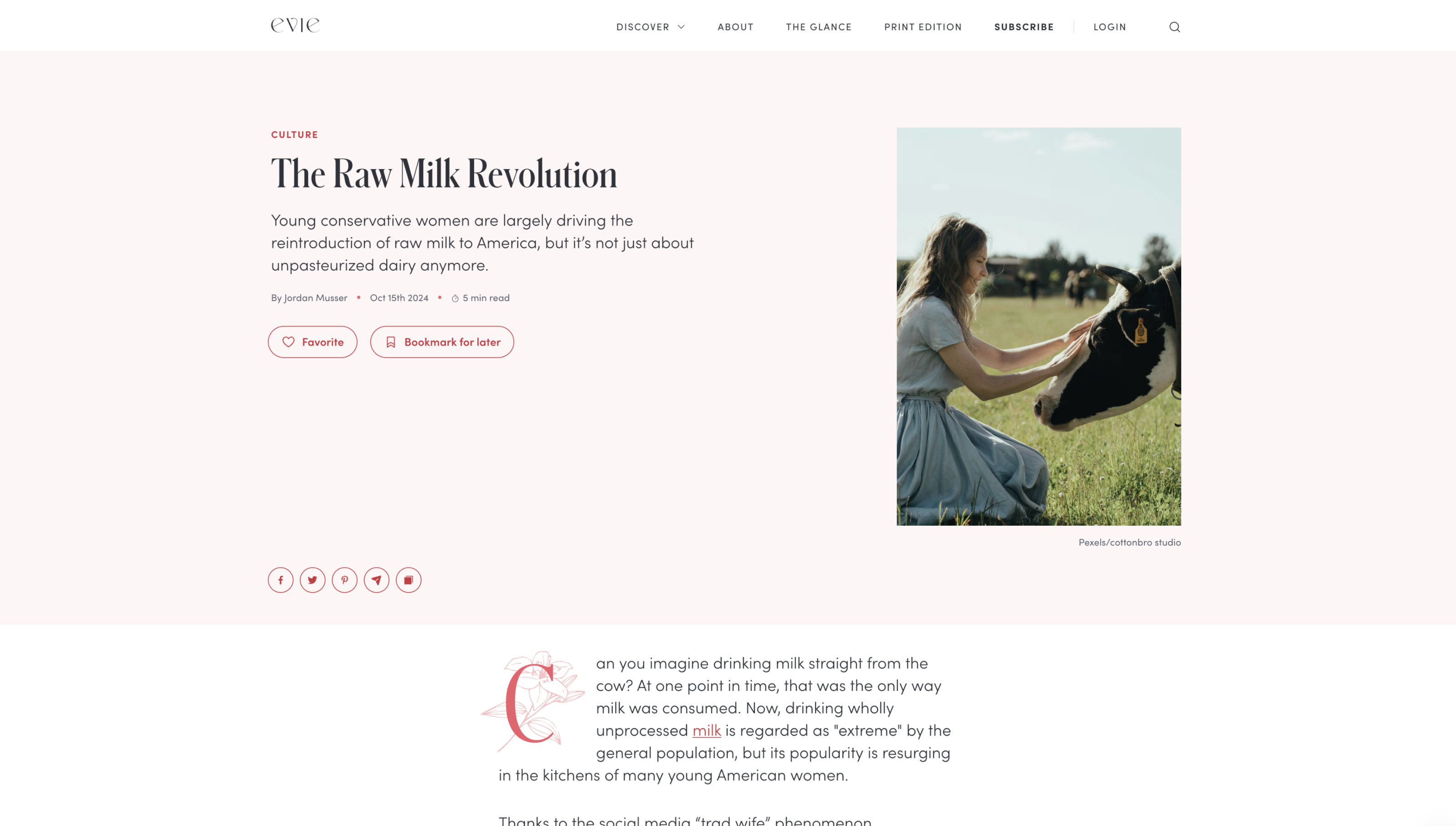
5 | Jordan Musser, The Raw Milk Revolution, 15 October 2024, screenshot from “Evie” magazine.
A central characteristic of the images shared and disseminated in the context of the Trad Wives movement is their supposed anachronism—not only with regard to long-outdated gender stereotypes. In October 2024, “Evie” magazine published an article on its website about raw milk, illustrated with a photo of a woman and a cow. The online magazine, which is published in print once a year but updated several times a day online, is a kind of “Cosmopolitan” for conservative, preferably white American women, according to its imagery. The photo accompanying the article on raw milk shows the cow and the woman facing each other in profile, bathed in bright sunshine, on a lush green pasture dotted with wildflowers and herbs. The woman is kneeling in the grass, her hair is loose and slightly wavy and tousled by the wind, yet glistening in the sun. Its lack of artificiality, conveyed not as unkempt, but as natural, contrasts with the stiff MAGA concrete waves. The woman also wears a simple, modest cotton dress in a light beige or blue tone that reaches below the knees, has modest sleeves like a T-shirt, and is tied at the waist with a simple fabric belt that gathers the wide flared skirt. The black and white cow standing opposite her is marked as a farm animal. It wears an ear tag and collar and lowers its head so far that the woman can place her hands on its forehead, as if the two—despite the exploitation of one by the other—were sharing an intimate moment bathed in golden light, overexposed because it is so beautiful against the backdrop of the website’s delicate pink layout.
The woman in the raw milk article can only be understood as a female farmer, despite the fact that no farmer with such hair would go milking, the vast majority of “Evie” readers are likely not farmers, and industrial dairy farming today relies on different production conditions. This retro dream is part of the magazine’s agenda, which frames its content with images of a fictional white present and future. The magazine uses images of white women to report on “lost feminine skills”—milk “from the scratch”, as German-American Nara Smith sells her cooking videos. Other “Evie” articles provide insights into the life of the Trad Wife influencer from Ballerina Farm and the New American Dream, appeal to married couples with explicit tips on sex practices, spread falsehoods about porn consumption (Watching Porn Is Literally Making You Gay) and place information about Gen Z’s new faith (God Is Back) alongside anti-abortion confessions such as: I Used To Be Pro-Choice. Here’s What Changed My Mind. Furthermore, they attribute all honours and achievements to white men (In Defence of White Men), who have been unjustly criticised so much in recent years, as the founders of institutions, nations, culture, peace, security, prosperity, civilisation and technology. Articles like these show that new right-wing women and the figure of the Trad Wife not only propagate a new image of women, but also advocate a masculinity linked to this image of women, reviving the classic heteronormative breadwinner model, according to which the man rakes in the money so that the woman is a full-time care worker—looking after children and cows or reading recommendations for underwear and nail designs.
What is striking about articles such as the propaganda for raw milk and the glorification of reactionary gender models is a peculiar anachronism that is particularly evident when embedded in contemporary digital technologies. In his study of painting in German fascism, art historian Bertold Hinz identified such an anachronism as characteristic of National Socialist art, which, for example, depicted numerous farmers working the fields by hand with ploughs, despite the fact that this type of agricultural work was already obsolete at the time:
The temporal discrepancy between painting and reality that characterizes all National Socialist art lies at the very heart of this painting. This dual temporal perspective tries to convince the observer that work and the conditions in which it is performed—the conditions under which the worker lives—are permanent and unchanging, that progress has no place in the social conditions of work, that no improvement in the means of production is possible, and that the worker can produce more only by working longer, not differently (Hinz 1979, 115).
The right-wing conservative women’s magazine shows a similar discrepancy. It appears as an online medium with all the links and networks in social media, is therefore based on IT technologies and ties in with the digital internet phenomenon of the Trad Wife. At the same time, it uses images to present a pre-industrial, comprehensively idealised way of working for women in the household, in which care work is not visible as work, but as love in complete affirmation and acceptance of the role of the Trad Wife. In terms of content, the magazine thus continues a policy that conservative activist and publicist Phyllis Schlafly, who has been campaigning against the Equal Rights Amendment since the 1970s, has been promoting for decades: “Marriage and motherhood give a woman a new identity and the opportunity for all-round fulfilment as a woman” (Schlafly 2003, 196). “Evie” magazine is an exemplar of this policy, employing a glossy magazine aesthetic to disseminate its message beyond the confines of conventional political discourse.
In addition, the white dairy farmer featured in “Evie” magazine evokes a nationalistic retro dream: raw milk. For decades, raw milk was consumed only in hippie communes or far away from dairies. Now, however, it is part of the “Make America Healthy Again” (MAHA) programme. The current U.S. Secretary of Health and Human Services, Robert F. Kennedy Jr., is pursuing MAHA alongside the rejection of vaccinations, the promotion of a supposed natural lifestyle, and the consumption of state-subsidised full-fat milk (@SecKennedy 2026). Notably, he also claims to drink raw milk, which of course has long been the product of large dairies as well. But MAHA is not actually about pasteurisation. For technofascists, milk is “white power milk” (Stănescu 2018). The retro dream that is supposed to come true with milk consumption is ethnonationalist and völkisch, in the sense that ideas of purity and naturalness are connected to blood and race. Since the late 2010s, white supremacists have claimed that the ability to digest milk in adulthood is proof of their genetic superiority, which they attribute to their Northern European origins (Freeman 2013, 1263). Milk consumption is the epitome of their “colonial dream of racial purity” because milk itself seems to contain whiteness as “iconic imagery” (Stănescu 2018, 119). The reference to European ancestry, underpinned by milk consumption, corresponds to the fundamental redefinition of US national identity that J. D. Vance has been defining in his speeches since 2024 in terms of a völkisch understanding of the state based on ancestry, not birthright and belief in the rights enshrined in the US Constitution (Beck 2025). The technofascist future belongs to milk drinkers.
Beyond cars and milk: Technofascism and its hidden aesthetics
As the examples show, technofascist aesthetics are polyphonic. They produce new things like the Cybertruck, which operates simultaneously with ‘old’ (military) notions of masculinity and, as an electric car with its harsh aesthetics, has to outdo the petromasculine SUVs because it does not have a combustion engine, even though both are equally guilty of extractivist overexploitation of resources. The central importance of technology, a characteristic of historical fascism, should not be understood as a contradiction to references to older ideas of masculinity and the division of labour. The example of the Mar-a-Lago face and the Trad Wives perhaps shows even more clearly how retro fantasies and new technologies mix: the hyper-digitised Trad Wife as a pure social media phenomenon and the attempt to generate a white racial aesthetic with surgery, synthetic substances—and milk consumption. However, amidst these pronounced aesthetic choices lies an additional, yet often overlooked, consideration of which Thiel himself is the best example. So let’s go back to Innsbruck, Austria, in August 2025.
Not much is known about the tech fascist’s stay. If Thiel had opted to take a short stroll through the city during his visit to Tyrol, he would not necessarily have stood out from other people, because, like many other tech fascists, he does not have a particularly striking sense of style (Gaugele, Held 2021). He certainly differs from those who once considered themselves liberal, such as Alex Karp with his shaggy hair, mountaineering boots and yoga look, or Mark Zuckerberg, who recently mutated from nerd to wannabe martial artist with gold chains. In contrast to them, he represents the classic, conservative American look with chinos, an open suit shirt or polo shirt and an unobtrusive hairstyle, the kind of look that is also worn in Austria and comes across as sheer understatement in relation to his political agenda. He therefore does not represent a change in style, nor does he represent a new style, but rather a shift in the content and political significance of an existing aesthetic or, to put it another way, an aesthetic that takes on a correspondingly changed meaning under the changed conditions of the present.
In times of technofascism, conservative Stanford chic does not contrast with fascist politics. Instead, it is its infrastructures that are shifting to the right, thereby helping to shape the public image of technofascism while simultaneously trivialising it. Had Thiel taken a walk through Innsbruck, it is likely that he would not have been recognised, let alone identified as an extremist technofascist. One would not have categorised him as such based on his clothing, nor if he had philosophised about how the view of the Alps reminded him of his beloved Lord of the Rings, from which he borrowed the title for his surveillance software Palantir and which has been relevant literary and political reference for the Italian right since the mid-1970s, for example. And one would not have guessed that his investments in embryo research as part of his postnatal stance, or in J.D. Vance, who is already translating this into politics, show clear parallels to Austrian’s most famous fascist. In contrast to the assertions of the majority of theories of fascist aesthetics, such as those presented by Susan Sontag in her 1974 article “Fascinating Fascism”, fascism does not exclusively manifest aesthetically in mass movements, neoclassicism or scenarios of subjugation.
Furthermore, it does not necessarily express itself in a newly invented aesthetic, as was the case with Italian Futurism. As the German version of fascism has demonstrated, instead, it seems to favour working with existing materials and concepts. For example, nineteenth century genre painting was revived in National Socialist art and integrated with set pieces that aligned with the prevailing political agenda. The examples selected, which are by no means exhaustive, demonstrate that the aesthetics of techno-fascism bear a striking resemblance to the agendas of historical references. These aesthetics are neither homogeneous nor hermetic; they are not designed and implemented in a centralised manner. Instead, they draw on existing, inconspicuous, or sometimes, outdated aesthetics, carrying them into a new technological age. These aesthetics are modified and thus given new meanings and roles through technologisation and the technofascist context. Rather than engendering an original aesthetic, technofascism combines and transforms existing aesthetics, transferring them into the technological era and altering their meanings and associations. Consequently, the technofascist aesthetic does not immediately capture the observer's attention. Instead, it has been in existence for a considerable amount of time, and, akin to its associated policies, it has been implemented with minimal scrutiny.
Bibliographical references
- Alonso 2025
M. Alonso, The Popularity of the “Mar-a-Lago face” Soars in Trump’s Inner Circle, “El País” 24 febrero 2025. - Amlinger, Nachtwey 2025
C. Amlinger, O. Nachtwey, Zerstörungslust. Elemente des demokratischen Faschismus, Berlin 2025. - Anonymous 2019
Professor: Tesla Cybertruck ist kein guter Start in die Roboter-Zukunft, “Teslamag.de” 11 Dezember 2019. - Baab 2026
F. Baab, Peter Thiel und die Apokalypse. Oder: Ideologiekritik als Aufgabe der Theologie, “feinschwarz.net” 2 Januar 2026. - Beck 2025
A. Beck, Die völkische Ideologie des JD Vance, “Humanistischer Pressedienst” 4 August 2025. - Bernard 2025
A. Bernard, Vater der Gewalt. Stichwortgeber für JD Vance und Peter Thiel, “Spiegel online” 3 August 2025. - Bhuiyan, Kerr, Robins-Early 2025
J. Bhuiyan, D. Kerr, N. Robins-Early, Inside Tech Billionaire Peter Thiel’s off-the-record lectures about the Antichrist, “The Guardian” 10 October 2025. - Coeckelbergh 2026
M. Coeckelbergh, Technofascism. AI, Big Tech, and the New Authoritarianism, “AI & Society” 25 January 2026, 1-14. - Daggett 2022
C. Daggett, Green-ing masculinity? Ecomodernism and electric trucks, “Autonomy Institute” 12 January 2022. - Fielitz, Marcks 2020
M. Fielitz, H. Marcks, Digitaler Faschismus. Die sozialen Medien als Motor des Rechtsextremismus, Berlin 2020. - Forster 2006
E. Forster, Männliche Resouveränisierungen, “Feministische Studien” 2 (2006), 193-207. - Freeman 2013
A. Freeman, The Unbearable Whiteness of Milk. Food Oppression and the USDA, “UC Irvine Law Review” 3 (2013), 1251-1279. - Gaugele, Held 2021
E. Gaugele, S. Held (Hrsg.), Rechte Angriffe – toxische Effekte. Umformierungen extrem rechter in Mode, Feminismus und Popkultur, Bielefeld 2021. - Girard, Palaver 2010
R. Girard, W. Palaver, Gewalt und Religion. Gespräche mit Wolfgang Palaver, Berlin 2010. - Grossheutschi 1996
F. Grossheutschi, Carl Schmitt und die Lehre vom Katechon, Berlin 1996. - Hinz 1979
B. Hinz, Art in the Third Reich, New York 1979. - hlk 2025
Peter Thiel hält nun Vorträge über den Antichrist, der die Menschheit durch Regulierung verblende, “Der Standard” 23 September 2025. - Karp, Zaminska 2025
A.C. Karp, N.W. Zaminska, The Technological Republic. Hard Power, Soft Belief and the Future of the West, London 2025. - Kilian 2025
- Kra 2019
C. Kra, Tesla’s Cybertruck. Hässlich in die Zukunft, “stern.de” 22 November 2019. - Künne 2025
C. Künne, “Mar-a-Lago Face”. Die politische Ästhetik der visuellen Konformität, “docma.info” 5 Mai 2025. - Kunze 2022
C. Kunze, Deutschland als Autobahn. Eine Kulturgeschichte von Männlichkeit, Moderne und Nationalismus, Bielefeld 2022. - Lawrence 2025
A. Lawrence, The Cybertruck was supposed to be apocalypse-proof. Can it even survive a trip to the grocery store, “The Guardian” 15 May 2025. - Leidig 2023
E. Leidig, The Women of the Far Right. Social Media Influencers and Online Radicalization, New York 2023. - Lewandowsky 2025
M. Lewandowsky, Die globale Rechte. Geschichte, Erfolgsbedingungen, Auswirkungen, München 2025. - Lu, Osei-Opare 2025
V.C. Lu, N. Osei-Opare, Elon Musk Wanted the Cybertruck to Look like “the Future”. But It Reminds Us of One Particular Past, “Slate.com” 15 March 2025. - McElroy 2024
E. McElroy, Silicon Valley Imperialism. Techno Fantasies and Frictions in Postsocialist Times, Durham 2024. - McRobbie 2004
A. McRobbie, Post-Feminism and Popular Culture, “Feminist Media Studies” 2 (2004), 255-264. - Mimura 2017
J.A. Mimura, Planning for Empire. Reform Bureaucrats and the Japanese Wartime State, Cornell 2017. - Möllers 2025
N. Möllers, We have Never Not Been Fascist. Infrastructures of State Violence as Technofascist Laboratories, “Dialogues on Digital Society” 3 (2025), 252-255. - Oh 2025
I. Oh, In Your Face. The Brutal Aesthetics of MAGA, “Mother Jones” 17 March 2025. - Palaver 2008
W. Palaver, René Girards mimetische Theorie im Kontext kulturtheoretischer und gesellschaftspolitischer Fragen, Wien 2008. - Rushkoff 2025
D. Rushkoff, Survival of the Richest. Warum wir vor den Tech-Milliardären noch nicht einmal auf dem Mars sicher sind, Berlin 2025. - Schilk 2024
F. Schilk, Die Erzählgemeinschaften der Neuen Rechten. Zur politischen Soziologie konservativer Krisennarrative, Bielefeld 2024. - Schlafly 2003
P. Schlafly, Feminist Fantasies, Dallas 2003. - Schaake 2024
M. Schaake, The Tech Coup. How to Save Democracy from Silicon Valley, Princeton/Oxford 2024. - Schmitt [1922] 1985
C. Schmitt, Political Theology. Four Chapters on the Concept of Sovereignty [Politische Theologie. Vier Kapitel zur Lehre von der Souveränität, Munich/Leipzig 1922], trans. G. Schwab, Cambridge (MA)/London 1985. - Sircar 2021
R. Sircar, Röcke übers Knie, Häubchen ins Haar. Zur Bauchlandung des rechten Feminismus, in E. Gaugele, S. Held (Hrsg.), Rechte Angriffe – toxische Effekte. Umformierungen extrem rechter in Mode, Feminismus und Popkultur, Bielefeld 2021, 159-175. - Spiekermann 2021
U. Spiekermann, Blondinen zur Zeit des Nationalsozialismus – Das Haarfärbeshampoo Nurblond, “uwe-spiekermann.com” 15 Februar 2021. - Stănescu 2018
V. Stănescu, “White Power Milk”. Milk, Dietary Racism, and the “Alt-Right”, “Animal Studies Journal” 2 (2018), 103-128. - Strick 2021
S. Strick, Rechte Gefühle. Affekte und Strategien des digitalen Faschismus, Bielefeld 2021. - Tamara 2025
M.C. Tamara, Trad Wives, in The Sage International Encyclopedia of Politics and Gender, 4, edited by L.K. Roberts, Thousand Oaks 2025, 1385-1392. - Theweleit [1977-1978] 1987
K. Theweleit, Male Fantasies [Männerphantasien, Frankfurt am Main/Basel 1977-1978], trans. S. Conway, E. Carter, C. Turner, Minneapolis 1987. - Tiku, Dwoskin, De Vynck 2025
N. Tiku, E. Dwoskin, G. De Vynck, Inside Billionaire Peter Thiel’s Private Lectures: Warnings of ,the Antichrist‘ and U.S. Destruction, “The Washington Post” 10 October 2025. - Toscano 2023
A. Toscano, Late Fascism, London/Brooklyn 2023. - Zuboff 2019
S. Zuboff, The Age of Surveillance Capitalism. The Fight for a Human Future at the New Frontier of Power, New York 2019.
Abstract
The contribution offers an art-historical analysis of the aesthetics of technofascism in the contemporary United States, arguing that the political practices of figures such as Peter Thiel, Elon Musk, and their Silicon Valley allies constitute a novel form of fascism in which economic power seizes political control through illiberal means. Drawing on three interconnected case studies, the paper examines the militarised design of the Tesla Cybertruck as an embodiment of apocalyptic technofascist masculinity and white supremacist visual codes; the "Mar-a-Lago face" as a surgical and political aesthetic of racial whiteness, anti-empathy, and submission; and the Trad Wife phenomenon as a hyper-digitised performance of retro gender ideology and völkisch naturalism.
keywords | Peter Thiel; Elon Musk; Mar-a-Lago; Tesla; Evie Magazine; Trad Wife.
questo numero di Engramma è a invito: la revisione dei saggi è stata affidata al comitato editoriale e all'international advisory board della rivista
Per citare questo articolo / To cite this article: K. Rottmann, F. Sigler, The Aesthetics of Technofascism. From Apocalypse to Milk and Mar-a-Lago-Makeovers, “La Rivista di Engramma” n. 233 (aprile 2026).