Capitalism had no other choice than that which it has excellently made with fascism up until now;
yet it would certainly prefer old liberalism to romantic “anti-capitalism” (without which business could admittedly no longer be done in Germany).
The blood myth […] is not the most desirable servant of capitalist reason.
(Ernst Bloch, 1929)
The crowd symbol of the Germans was the army. But the army was more than just the army; it was the marching forest […].
The parallel rigidity of the upright trees and their density and number fill the heart of the German with a deep and mysterious delight.
To this day he loves to go deep into the forest where his forefathers lived; he feels at one with the trees.
(Elias Canetti, 1960)
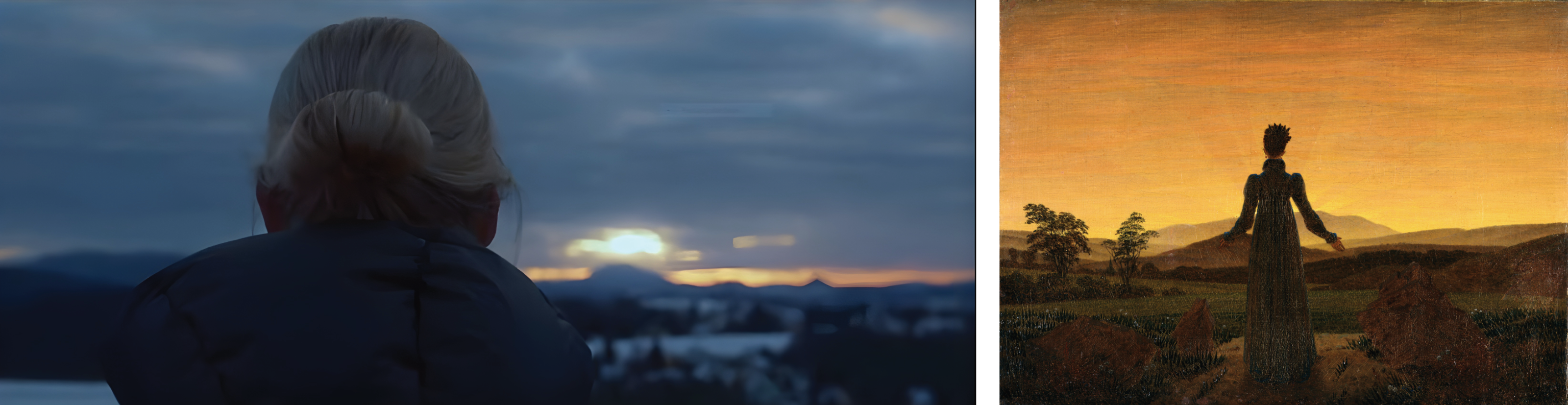
1 | Video posted by alice.weidel Instagram account on 26 January 2025, frame 00’ 14’’.
2 | Caspar David Friedrich, Woman before the Setting Sun, oil on canvas, ca. 1818, Berlin, Staatliche Museen, Nationalgalerie.
In the national elections of February, 2025, the Alternative for Germany (AfD) secured its highest share of the vote, 20.8%, since its founding in 2013. The party initially emerged as a conservative force, critical of Angela Merkel’s management of the Eurozone crisis. It was only after the so-called “migration crisis” of 2014-2015 and the party’s convention in Essen, at which the founding leader, Bernd Lucke, was ousted, that the AfD began to take on the characteristic blend of nativism and neoliberalism for which it is known for today. With the deterioration of the country’s economy, exacerbated by international sanctions limiting the manufacturing sector’s access to Russian gas, the AfD gained further consensus by stylising itself as the defender of “national interest” and by promising a reliable energy supply based upon fossil fuels and nuclear power. The party’s electoral base has only continued to grow, particularly amongst young voters and in former East Germany, where recession and unemployment has been especially severe.
The AfD incorporates disparate far-right currents, at least two of which have achieved national prominence. First, it includes factions often described as völkisch, a word that is notoriously untranslatable and here means chauvinistic, socially conservative, eager to revive “Germanic” traditions and critical of American cultural colonisation. Second, are AfD’s neoliberal elements, epitomised by the party’s 2025 candidate for Chancellor, Alice Weidel. Weidel joined the AfD in 2013 and was elected to its federal executive committee less than two years later. By 2017, she stood out as one of the party’s leading Bundestag candidates. A former Goldman Sachs analyst, Weidel holds a doctorate in economics and speaks Mandarin. Her extremely rapid rise within the party, however, cannot be explained solely by her competences and connections. Weidel’s public profile corresponds with a trend that, as Luciano Cheles noted, is also reflected by Rassemblement National and Fratelli d’Italia – the prominence of relatively young, blonde women as conservative leaders (Cheles 2023, 153). Without reducing their leadership to an aesthetic strategy, this choice nonetheless signals an attempt to undermine the stereotype of far-right parties as hinged upon patriarchal, warrior-like masculinity. Weidel’s case, takes this further. She is openly gay and lives with her Sri Lankan-born partner.
The AfD’s campaigns, by now, based heavily in social media, are orchestrated to generate controversy (Fielitz, et al. 2024). From Björn Höcke’s electoral tour on a Simson motorcycle, a cultural icon of the former GDR, to scandalous images of things such as fake “remigration” flight tickets or parents protecting their children with Hitler salutes, the party has adopted a formula of political communication, marked by “provocation, calculated ambivalence and denial” (Wodak 2021, 20). Through deliberate scandalisation and “ready deniability in case of critical rebuke”, the AfD influence the political agenda (Herzog 2025, 9). For the 2017 elections, the party’s campaign was managed by an American firm, Harris Media. But for the 2025 campaign, the AfD issued no official statements regarding its communications agencies (Doerr 2021; Schicha 2019; Feng 2023). Nonetheless, Alexander “Malenki” Kleine, a former activist of the Identitarian Movement and managing director of Tannwald Media UG, has been linked to the AfD’s 2025 election campaign, particularly its AI-generated graphics. Commentators have also highlighted overlaps between Tannwald Media and the Instagram troll account wilhelm_kachel, whose neo-völkisch memes occasionally bear similarities to the AfD’s official posts (Ayyadi 2024).
For the 2025 general elections, Weidel introduced herself in a 52-second, untitled short film that circulated widely across the party’s social media channels. Its authors have not been disclosed. Months after its release, the video remained pinned to the party’s Instagram account, casting it as a quasi-programmatic manifesto. This article concentrates upon this short film, unpacking its meanings from an art-historical perspective, combining political iconology in the tradition of Martin Warnke with Marxist ideology critique. Here, “ideology” designates a set of transfigurations of the economic determinations that stabilise social forms. It denotes the discursive formations through which the ruling classes seek to displace and to justify social contradictions, while preserving, for themselves and for society at large, a reassuring semblance of coherence.
Enlisting Caspar David Friederich
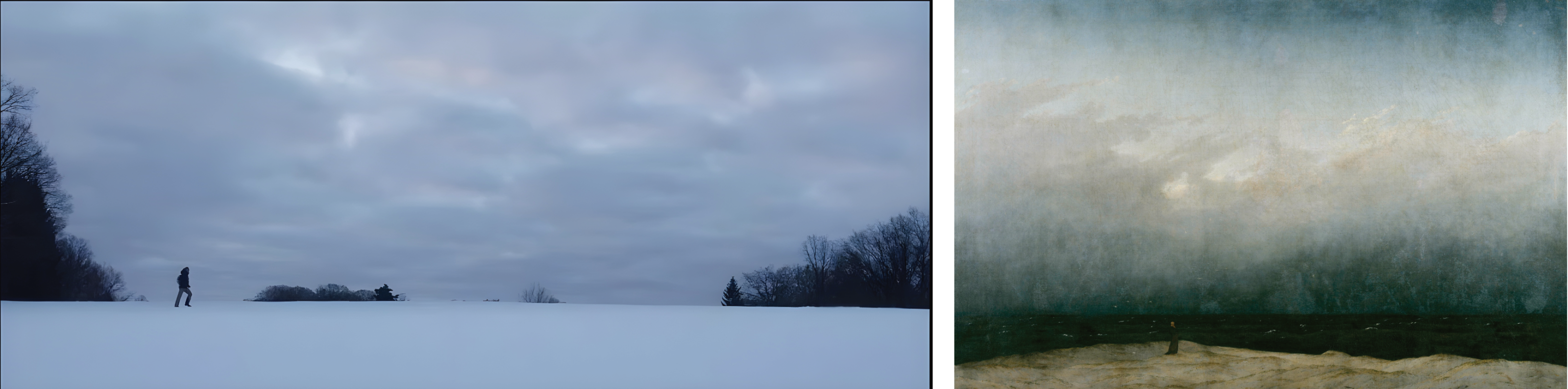
3 | Video posted by alice.weidel Instagram account on 26 January 2025, frame 00’ 17’’.
4 | Caspar David Friedrich, Monk by the Sea, oil on canvas, 1808-1810, Berlin, Staatliche Museen, Alte Nationalgalerie.
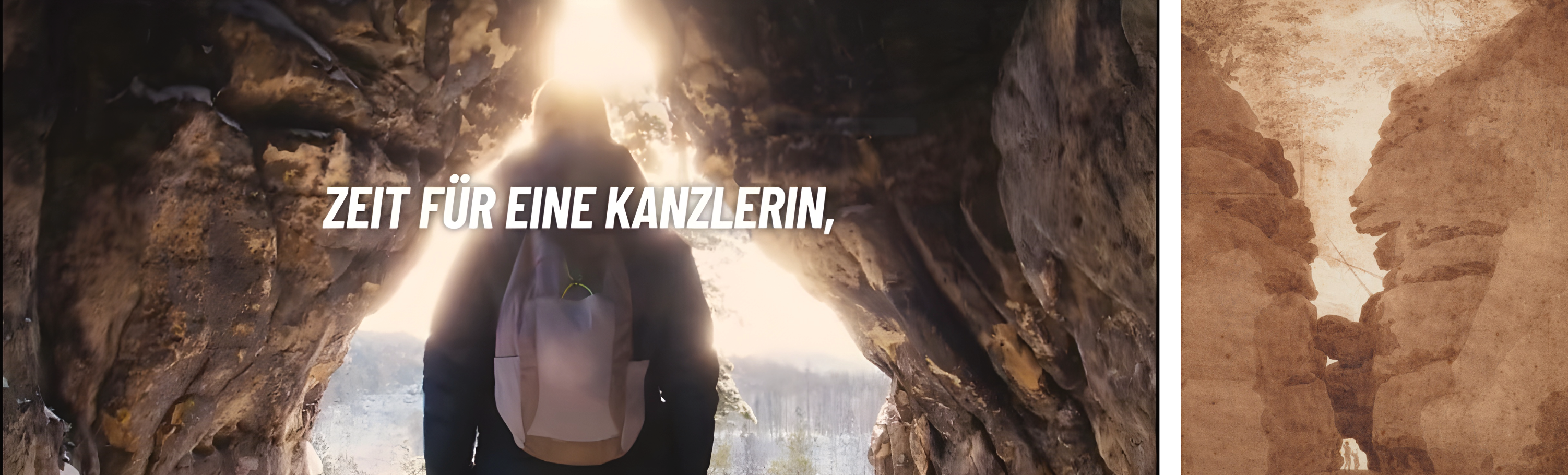
5 | Video posted by alice.weidel Instagram account on 26 January 2025, frame 00’ 17’’.
6 | Caspar David Friedrich, Rock Gate in Uttewalde Gorge, oil on canvas, ca. 1820-1823, Leipzig, Museum der bildenden Künste.
Constructed in the style of a film trailer, the video begins with inserts of Weidel dressed in hiking gear and a blue scarf, the AfD’s official colour. There are intermittent cuts to details from a mountainous landscape: fir trees, glittering snow, a babbling brook, etc. The soundtrack blends dramatic music with natural sounds. Melting stalactites of ice intimate the first stirrings of thaw, an allusion to the timing of the 2025 elections. Suddenly, the screen turns black and the music stops. Out of this darkness, Weidel’s voice breaks the silence. Her disembodied speech pronounces the official oath recited by German Chancellors upon assuming office: “I swear that I will dedicate my efforts to the welfare of the German people, promote their welfare, protect them from harm, uphold and defend the Basic Law and the laws of the Federation, perform my duties conscientiously and do justice to all. So help me God”. The oath implicitly responds to those who accuse the party of being unconstitutional (verfassungswidrig), while simultaneously introducing a religious dimension. Since 1998, the reference to God has indeed been omitted from the official oath, with successive Chancellors opting for a secularised version. In the final sequence, Weidel stands in a grotto and looks out over a sunlit forest, as two sentences of text overlay her shoulders, one after the other. The first reads, “Time for a chancellor who remembers the oath”; the second, “Time for Germany”. The second sentence is accompanied by the AfD’s logo, superimposed onto Weidel’s backpack.
Weidel’s video contains no crowds, flags, microphones. Yet, politics appear in the form of references to Caspar David Friedrich, whose 250th anniversary was being commemorated with exhibitions throughout Germany at the time of the video’s release. Allusions to his paintings saturate the video, such as Woman before the Setting Sun [Figg. 1, 2], Monk by the Sea [Figg. 3, 4], and Rock Gate in Uttewalde Gorge [Figg. 5, 6].
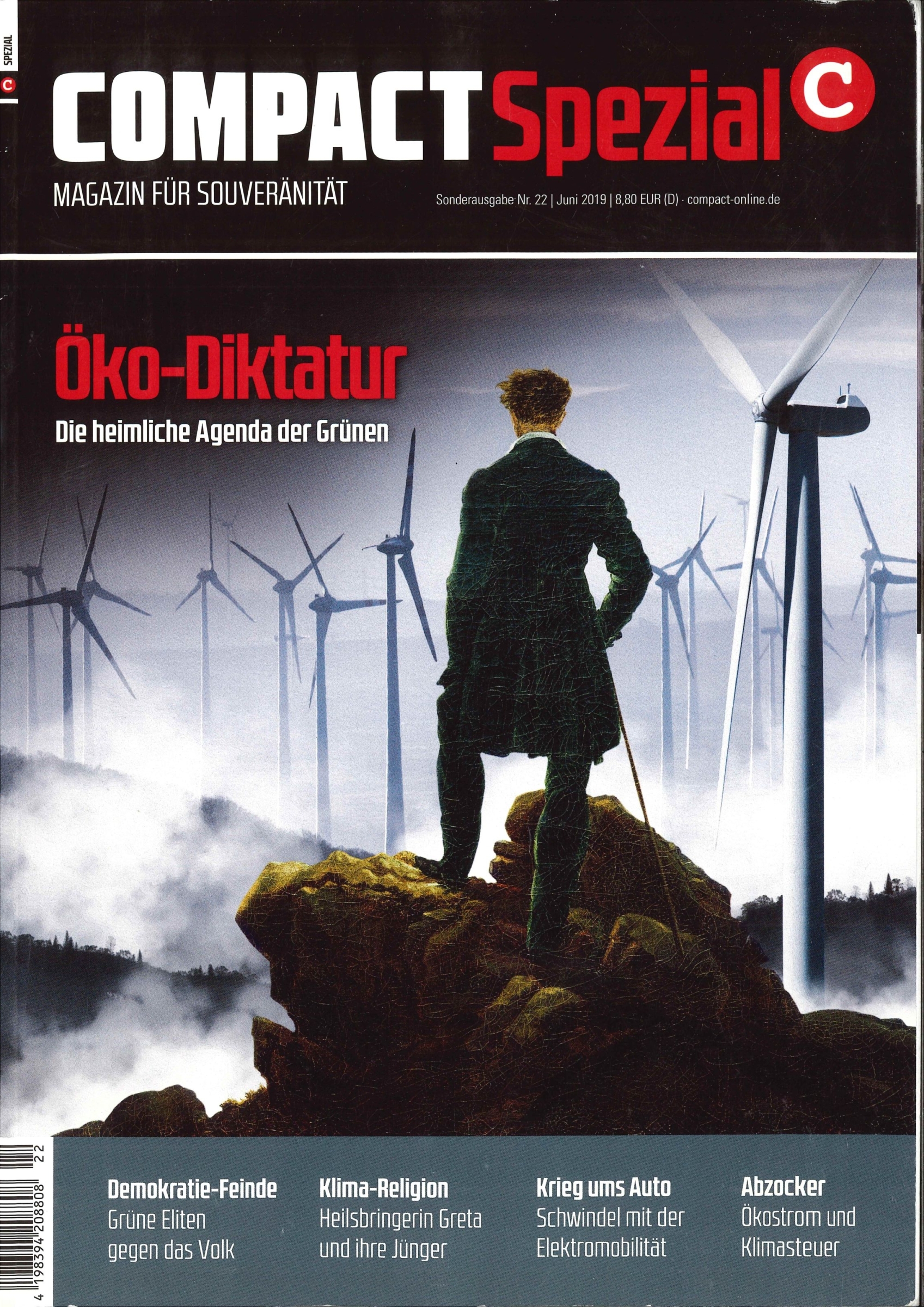
7 | “Compact” special issue 22, June 2019.
8 | Video posted by afdnrw’s Instagram account on 26 January 2025, frame 00’ 6’’.
Broader political motifs used by Friedrich, such as the foggy forest to the snows that often cover his landscapes, are also quoted in the video. Between 1806 and 1815, the blanket of snow coded the experience of French domination (Warren 2017; Hermand 2011, 14-34). The video also appropriates one of the painter’s key conceits, the “spatial barrier”, in which the landscape is mediated through back-turned figures who both obstruct and beckon the viewer’s gaze. Weidel is indeed depicted almost exclusively from behind, serving as a surrogate with whom the viewer can identify, but also follow. From another of Weidel’s Instagram posts, we learn that the filming took place in Saxon Switzerland, one of Friedrich’s favoured landscapes (posted on Instagram by alice.weidel on 13 January 2025). That Friedrich’s imagery, including the iconic Wanderer above the Sea of Fog, is perceptible to a broad, far-right audience as a subtext of the video is indirectly corroborated by “Compact”, a magazine that forms part of the AfD’s media ecosystem. In 2019, “Compact”’s cover [Fig. 7] quoted the figure seen from behind in Wanderer above the Sea of Fog, superimposed onto a forest of wind turbines.
A brief analysis of the twentieth-century German reception of Friedrich offers a lens to examine the politics of the AfD’s video. After attracting considerable attention between 1808 and 1820, Friedrich’s work was neglected for decades until its rediscovery in 1906 (Hinrichs 2009). On the eve of the First World War, Friedrich’s production was frequently interpreted as a “Nordic” and patriotic. The former term, “Nordic”, was associated with Friedrich during his lifetime, but it lacked nationalist overtones and instead indicated that he consciously favoured the landscapes of Northern Europe over those of the Grand Tour, the customary rite of passage for artists. Following the dissolution of the Holy Roman Empire by Napoleon in 1806, and especially during the Wars of Liberation (1813-1815), Friedrich’s landscapes took on anti-French undertones, often couched in allusive imagery to circumvent censorship. Anti-French sentiment was conveyed through references to “anti-Latin” Germanness, such as tombs of ancient Germanic tribes, Gothic architecture, traditional costumes, and, in a more pointed way, Arminius, whom Friederich celebrated in The Tombs of the Old Heroes.
Arminius was the chieftain who defeated the Romans in the Battle of the Teutoburg Forest and was mythologised as a national hero in the nineteenth century. Likewise, the motif of the impenetrable forest functioned as a symbol of emergent German identity, as in Chasseur in the Forest, in which a lone French soldier hesitates at the threshold of the woods as a raven sitting on a stump foretells his fate. As art historian William S. Heckscher observed in the late 1930s, this enacted myth of ancient Germans as “Noble Savages” became foundational for modern German identity*.
The association of the forest with Germanness partly originated in Tacitus’s Germania (c. 98 CE), which describes the land’s primeval biome and the resilience of its inhabitants. Tacitus, who, incidentally, never went east of the Rhein (Zechner 2016), set the “Germani” in opposition to the Romans, portraying them as unsullied by luxury and devoted to martial traditions. Their freedom, according to Tacitus, manifested itself in the political and military sphere. Deliberations were conducted by assemblies of free warriors, and leaders secured their loyalty by the force of personal value (Dörner 1996).
The Nazis admired the “Nordic” atmospheres of Friedrich’s paintings. Yet, they misrepresented his sylvan landscapes as sinister “ethnoscapes”. This term describes the projection of nativist fantasies onto the landscape, in this case, an intimate kinship between Aryan blood and the German soil (Smith 1999). Nazi art historians viewed Friederich’s paintings as instantiating “blood and soil” culture (Eberlein 1939). Popularised by Walther Darré, Reich Minister of Food and Agriculture, this ideology postulated an ancestral tie between racial purity and the German homeland, one that provided a mythic justification for expansionist policies in Eastern Europe (Gies 2019; Brüggemeier et al. 2005). The anti-aristocratic and democratic elements inherent to Friedrich’s nationalism were largely ignored in the 1930s. With the regime of censorship marking the 1820s “Persecutions of demagogues”, a campaign of repression targeting liberal intellectuals across the German Confederation commenced. It then became evident that the anti-Napoleonic struggles had primarily strengthened the princes’ power. The traditional German garments worn by some figures in Friedrich’s paintings can indeed be read less as a proto-racial symbol of the “Blood and soil” mystique and more in a liberal-democratic key, given that such attire had been banned because of its associations with opposition to princely authority (Hermand 2011, 14-34).
Following World War II, exegeses of Friedrich’s work in West Germany emphasised its pietistic roots (Börsch-Supan [1973] 1974). The GDR, by contrast, sought to promote a progressive reading, not least because a portion of his works were held in East German museums (Hinz 1974). In the 1970s, a new generation of art historians turned to Marxism in their analyses of Friedrich. They suggested that the fraught legacy of his work offered a mirror to German history, from the dawn of national identity to the capitalist culture of West Germany, which by then had appropriated Friedrich’s paintings to market exotic travels or modern cars (Hoffmann 1974).
Friedrich’s reception until the 1970s, followed by studies by Johannes Grave, Joseph Leo Koerner and Nina Amstutz, provide insights for interpreting the AfD’s enlistment of his oeuvre. They note that the master trope of Friedrich’s art, the landscape observed by Rückenfiguren (figures seen from behind and connotated as contemporaneous with the viewer) perform several key functions (Sugiyama 2009). Firstly, Friedrich’s Rückenfiguren invited the early-nineteenth-century bourgeois public to project itself into the scene, allowing for a mode of absorption that did not exist within eighteenth-century pastoral landscapes, which were embedded in biblical or classical narratives. Secondly, this strong sense of immersion was mitigated by the perception of nature from a distance. For all Friedrich’s debt to Rousseau’s Reveries of a Solitary Walker, his works complicate the ideal of communion with nature by maintaining a spatial barrier between the figure and the landscape (Hoffmann 1974).
Friedrich’s majestic vistas resonate with Kant’s conception of the sublime, not merely as experiences of awe or disorientation, but as moments in which the subject becomes aware of its supersensible vocation (Clewis 2001). The viewers of Friedrich’s paintings, like the bourgeois figures depicted within them, can be understood as experiencing themselves as free, rational agents whose ultimate essence lies beyond the domain of sensibility. Thirdly, Friedrich’s oeuvre envisions art as a tool to invoke a “Community of feeling” or Gefühlsgemeinschaft, a notion that has been used to characterise the AfD as a party that furnishes its electorate with affective home and empowering forms of identification (Spissinger 2024; Amstutz 2015, 449). Friedrich’s often solitary figures invite a sense of fraternity by suggesting shared acts of perception and, thusly, an affective community. Despite this pronounced intersubjectivity, however, the artist confines the beholders of his paintings to the role of a “secondary spectator” observing the observer (Grave 2023). Fourthly, Friedrich subjectivises nature. Instead of a rational, connective middle ground between his wanderers and the deep background, ambiguous, atmospheric light and colour dissolve the horizon. The landscape is thus a visual phenomenon, rather than a spatial one, manifesting as an internal and indistinct picture in the mind. His works indeed exemplify a form of Erlebniskunst, an “art of lived experience”, in which the landscape fuses outer scene and inner vision, becoming, in a sense, a self-portrait of the artist (Koerner 1990).
These unresolved tensions between affective, national community and artistic individuality converge in the expanse of trees unfolding before Weidel, framed as one of Friedrich’s Rückenfiguren. Her sublime encounter with nature, in which the viewer vicariously shares, has little, however, to do with the Kantian “revelation” of moral freedom granted to the bourgeois subject. Cast in the mould of the Romantic genius-artist, the video enacts the motif of “politician as artist”, explored by Marin Warnke, who demonstrated the widespread use of this metaphor, by which the state was a work of art, and the people were a pliant matter to be shaped (Warnke 2007). In this video, Weidel’s inner vision appears to witness the epiphany of the German woods qua Volk. According to Georg Mosse’s analyses of pre-Nazi right-wing culture, Volk should be understood as, “The union of a group of people with a transcendental ‘essence’ […] fused to man’s innermost nature and represent[ing] […] the source of his creativity, his depth of feelings, his individuality, and his unity with other members of the Volk” (Mosse 1964, 4). The omniscient perspective offered by drone photography suggests power and oversight rather than the inner exile exalted by the far-right intellectual Ernst Jünger in The Forest Passage (1951), which features on wilhelm_kachels stickers. The landscape before Weidel’s eyes, at once material and fantasised, delineates an ethnoscape projecting identity symbols onto the woods. It evokes the idea of “eternal forest” (Dauerwald), which embodies a silviculture, first adopted in the 1920s, as much as it is an analogy to connote the German Volk as perpetually comprised of native species (Imort 2005).
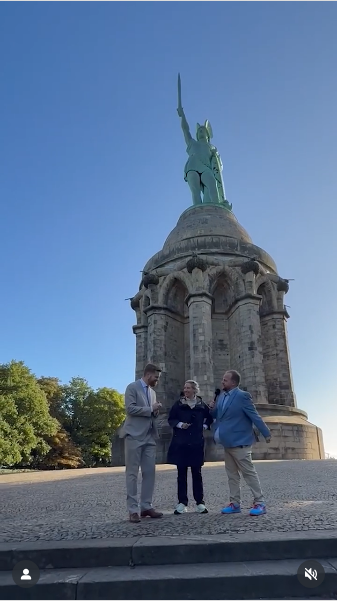
“Compact”, briefly banned as a “right-wing extremist publication” in 2024, also praises the German forest along similar lines. Friedrich’s “sacred groves” are described as “mysterious and legendary”, emblematic of a tradition immortalised “by countless German writers, poets, and artists” (Elsässer 2021). “Compact” also drew attention to another topos of völkisch culture that is routinely invoked alongside that of the German forest, the myth of Arminius’ victory. The magazine heralds the story of Germanic tribes ambushing Roman legions by concealing themselves in the woods as “The most important day in our history” (Pföhringer 2023). Indeed, in a 2025 Instagram video, Weidel was interviewed standing before the 1875 monument to Arminius [Fig. 8].
Recasting Tacitus’s notion of libertas in an anti-statist, economically libertarian register, which, incidentally, echoes the Nazis’ celebration of “decentralisation” as an expression of German “essence” (Chapoutot [2020] 2023), “Compact” argued that the defining trait of autochthonous populations lay in their “will to freedom […]. Unlike […] the Romans, the Germanic tribes knew neither a state, nor codified legislation, nor bureaucracy” (Pföhringer 2023). In her book Widerworte, Weidel avoided references to Germanic figures, situating her thought according to political and economic liberalism, from Locke and von Mises to one of neoliberalism’s putative fathers, Friedrich von Hayek (Weidel 2019). Taken together, Weidel’s pantheon of references and “Compact”’s portrayal of Germanic tribes introduce an additional semantic layer to the AfD’s campaign video. The romantic landscape stands out as a hybrid of Nordic mythology and neoliberal anti-statism. In this synthesis, the AfD transforms Friedrich’s motifs into a distinctly neoliberal idiom, intertwining völkisch myths of Ur-Germanic prehistory with the Lockean ideal of possessive individualism, articulating both within an anti-welfare discourse (Macpherson 1962).
Weidel admits, however, to the ideological underpinnings of this view of nature in a passage describing left-wing ecology as an “ersatz religion”. She reveals indirectly that the iconography of the video embodies a compensatory fantasy. In Widerworte, she writes:
The longing for a return to a pure, unspoiled nature, together with the rhapsodic idealisation of the forest and of life outdoors, has been a persistent motif in the national self-understanding of the Germans since Romanticism, at the latest. […] Above all, in times of political impotence, the turn towards nature has experienced a marked resurgence. Such was the case around 1800, at the birth of Romanticism, when the country was fragmented and subject to the foreign domination of Napoleonic rule (Weidel 2019, 29).
This quote suggests that there is more to the video than escapist fantasies. While the reception of Friedrich’s painting and the semantics of the German forest helped explain some of its historical references, the AfD’s instrumentalising of “unspoiled nature” must be examined further.
Cyclical Temporality, Völkisch Ecology and Political Theology

9 | Image posted by Fabian-Jank-afd Instagram account on 7 January 2025. The text reads “Make environmental activists right wing again”.
10 | Image posted by afd.bund Instagram account on 15 January 2025. The text reads “Merz opposes reliable nuclear power. It’s time for affordable energy with the AfD. It’s time for Germany”.
11 | Carl Theodor Protzen, RAB-Baustelle. Lahnbrücke (“Motorway construction site: Lahn Bridge”), 1938, oil on canvas, 83 × 130 cm, München, Städtische Galerie im Lenbachhaus und Kunstbau.
12 | Image published by chrupallatino Instagram account on 1 November 2023.
13 | Poster for the municipal elections in Hesse, 25 April 1948.
The polemical register of Widerworte locates the “good old days” in the era of the Deutsche Mark, prior to the adoption of the single European currency (Weidel 2019, 84-85). This nostalgia, however, is absent from the video. The thaw that heralds the return of Spring suggests the advent of a new era. The final motto, “Time for a chancellor who remembers her oath—time for Germany”, and teaser-like structure of the video builds anticipation for this new phase. The concept of renewal is presented as the fulfilment of a destiny rather than the outcome of an election. Just as Spring is bound to return, the AfD is destined to lead Germany out of a political Ice Age. This cyclical understanding of time, in which the ascent of the leader mirrors climatic rhythms, participates in what Bernhard Forchtner and Christoffer Kølvraa term the “Primordial imaginary world” of the contemporary far-right, which they explored in a study of narrative fiction. They write, “Temporal vistas are typically […] ‘trans-millennial’” and can take “meta-subjects” as their protagonists (Kølvraa, Forchtner 2024, 55). This temporal mode punctuates German far-right thought. It is the same temporality embraced by the Nazi regime, advocating a break with the modern experience of time as a relentless repetition of the new, and tending to collapse past, present, and future into a transhistorical continuum premised upon the idea of racial destiny (Clark 2019). Figures loosely associated with Traditionalism, a philosophical current that has become central to today’s far right, also valorise cyclical conceptions of the passage of time that stand in contrast to progressive narratives underlying “modernity” and the Judeo-Christian experience of time (Eliade [1949] 1954; Sedgwick 2023; Teitelbaum 2020).
Attuned to the cosmic rhythms of celestial rotation, the temporality evoked by the video severs nature from climate and the anthropogenic forces that shape its transformation. The winters of Saxon Switzerland are, however, no longer those of Friedrich’s time. They bring far fewer frost days and increasingly prolonged dry spells. Focusing upon an ahistorical “nature” allows for a synthesis between the primordial imaginary of far-right fiction and a fixation upon the “eternal now” typical of post-Cold-War temporal regimes, which are characterised, according to François Hartog, by musealisation of the past, anxieties about the future and modes of governance grounded in crisis management (Hartog [2003] 2015). Ultimately, the AfD instantiates a crucial aspect of what situationists called spectacle. Under the guise of celebrating nature’s “rebirth”, the video elides the political dimension of snowy winters, invoking the image of the thaw only to more effectively freeze the historicity of climate. Guy Debord writes, “The spectacle, being the reigning social organisation of a paralysed history, of a paralysed memory, of an abandonment of any history founded in historical time, is in effect a false consciousness of time” (Debord [1967] 1995, 114).
Koerner argues that Friedrich’s approach to landscape at once affirms and denies the immanence of God in nature (Koerner 1990). Along similar lines, the AfD’s video reveals a “false consciousness of time” through the invocation of transhistorical subjects, like divinities, and Weidel’s oath hits on a politico-theological register that has largely fallen out of use. As Carl Schmitt, the jurist and political theorist who briefly aligned with National Socialism, famously argued, modern state theory largely rests upon secularised theological concepts (Schmitt [1922] 2005). In the video, the appeal to divine assistance is an invocation of Europe’s Christian roots. This is nothing new for far-right movements. Aby Warburg had already noted the sacral legitimation of fascism in his 1929 analysis of the iconography surrounding the Lateran Pacts. He observed that Mussolini embraced a “Thoroughly medieval, absolutist, Catholic theory of the state [Gewalttheorie]” (Warburg’s letter to Alfred Doren, 15 March 1926, in GS Briefe, 646). Critical of the Church’s occasional promotion of compassion for migrants, the AfD treats religion mostly as an element of identity rather than devotion (Cremer 2023). At the same time, it also references medieval motifs. In the video, the leader’s divine sanction is reinforced by the final image, which frames Weidel as a quasi-sacred figure, enshrined in, and organically bound to, the grotto. She is encircled by a vulval outline often employed in sacred architecture and iconography known as a mandorla. The motif bears a twofold signification. On the one hand, the vulva-like shape evokes birth; on the other, it can be seen as the intersection of two circles, symbolising the conjunction of two realms, the material and the spiritual. For this reason, the mandorla traditionally frames holy or anointed personages such as Christ, the Madonna, or sovereigns who claim to rule “by the grace of God”.
Weidel emerges from the grotto as an authoritative, guardian figure associated with Cybele, a deity venerated by the Romans from c. 200 BCE onward. A goddess of fertility, her sanctuaries were at times situated in caves. Such an analogy might appear arbitrary, were it not for the fact that Alessandro Giuli, the current Minister of culture in the far-right Italian government, published a volume devoted to Cybele (Giuli 2018). Whether intended or not, however, the AfD’s allusions should not be overestimated. The AfD also drew upon more mainstream references in order to address a broader audience, not necessarily familiar with Friedrich’s paintings or the iconography of Cybele. The party logo, conspicuously akin to Nike’s swoosh, appears even closer to the brand’s iconography when, in the video’s final shot, it is superimposed onto Weidel’s backpack. Similarly, while there are discernible echoes of those “tales of longing for high places”, typical of the Bergfilm genre that made Leni Riefenstahl famous, Weidel’s video resonates more closely with hiking clips posted on social media by countless amateurs (Sontag, 1980, 86). Through invocations of fertility goddesses, pantheistic visions of forests, cosmic temporalities and a supposed a-historicity of climate dynamics, the video’s iconography implicitly posits a divide between a local, pure, “natural” environment and global climate change—a dichotomy that underpins the ideology of far-right ecology. Unpacking the complexity of far-right ecological imaginaries in Germany will be helpful before returning, in the conclusion, to the political and affective reasons that pushed the party to produce campaign videos of this kind.
Concern for the natural environment has been a persistent feature of the German far-right since the beginning of the twentieth century, from the Heimatschutzbewegung (homeland protection movement) after World War I, to the Nazis’ biodynamic farming, to postwar organisations such as the World Federation for the Protection of Life (particularly under Werner Georg Haverbeck) and the political discourse of Herbert Gruhl (Biehl and P. Staudenmaier 2011; Uekötter 2006; Olsen 1999). These movements and figures combined holistic conceptions of the “fatherland” as an interdependent and self-contained organism, with a quasi-religious cult of nature understood as the cosmic unity of living beings. Factions within the AfD embrace this perspective, as suggested by an AI-generated image posted on Instagram in 2025 [Fig. 9]. Created by the same designers responsible for the wilhelm_kachel web project, the image depicts an anthropomorphic bear in a forest, imbued with the naïve clarity of a children’s book. The slight tilt of the all-caps, sans serif slogan in white lettering on a blue background adds a juvenile dynamism. The phrase, “Make environmental activists right wing again”, is written in Denglish (the hybrid of German and English typical of youth vernacular) and clearly borrows the format of Trump’s MAGA slogan. The animal’s pose allegorises nature, asserting and saluting its right-wing essence. As some comments to the post note, however, the bear’s upward-pointing finger recalls a conventional, celebratory gesture signifying the oneness and sovereignty of God in Islamic iconography. These images have probably found their way into the databases used to train artificial intelligence, which by now occasionally lends far-right imagery an involuntary incongruity.
Much like other far-right political forces, the AfD has advanced climate-obstructive policies (Malm, Zetkin Collective 2021). At the same time, it would be a mistake to dismiss the party’s arguments as politically-motivated fabrications. The AfD’s articulated ecological perspective hinges upon a perceived disjunction between the local and the global, between Heimat (home or homeland) as a site of belonging and rootedness, and the abstract, planetary scale of climate governance. Drawing upon the analysis of magazines associated with the AfD and the German far right more generally, Bernhard Forchtner and Özgür Özvatan have revealed the tension between these two spatial imaginaries (Forchtner, Özvatan 2019). The global, they argue, is construed as homogenous and deprived of inherent value. It is viewed as a domain in which human beings are interchangeable units. Institutions combating climate change are portrayed by these magazines as emanating from cosmopolitan liberalism with agendas that run contrary to national industrial priorities. Conversely, a rooted ecology, oriented towards the specificity of place and tradition is promoted, and cast as natural rather than political. Within this perspective, an element such the forest can embody the historical continuity of a cultural identity. Human beings, flora and fauna are construed as parts of a unified habitat, virtually beyond the Christian dualism of natural and supernatural (White 1967). While this approach superficially resembles non-anthropocentric ontologies, it differs fundamentally in that it re-naturalises cultural identity, rather than destabilising it. Simply put, the AfD extends the concept of environment to include its inhabitants. The protection of the former thus implicitly values the protection of the latter because of this essential bond within an exclusionary, when not outright xenophobic, logic of belonging. Migrants are, therefore, represented as forms of contamination or destabilising agents that threaten the equilibrium of a timeless order. Likewise, the visual analogy between wind turbines and minarets may operate at a subconscious level, contributing to the transformation of the former into one of the AfD’s chief targets (Malm, Zetkin Collective 2021, 88). This ecological imaginary at times incorporates a critique of capitalism by acknowledging anthropogenic climate change. It conceives of capital, however, in a particular way, as symptomatic of a broader moral malaise induced by technological modernity, rather than as a systemic totality driven by a “mute compulsion” towards perpetual growth. Environmental remedies thus come in the form of moral appeals to restore the harmonious exchange between humanity and nature, a line of argument which occasionally converges with leftist ecological thought. A widespread tendency amongst contemporary artists, for example, as Linn Burchert observes, is the call for a re-enchantment of the world and endorsement anti-consumerist lifestyles as antidotes to capital’s expansion (Burchert 2024).
Olsen and Forchtner conduct a detailed analysis of the visual materials used by Die Kehre, a magazine whose title refers to Martin Heidegger’s critique of instrumental rationality (Forchtner, Olsen 2024). Key figures associated with Die Kehre are Benedikt Kaiser and Götz Kubitschek, intellectuals of the German New Right close to the völkisch wing of the AfD. According to Olsen and Forchtner, images published by the magazine articulate two distinct “chronotopes”, configurations of time and space that generate subjectivity through affect and other means. Echoing the analyses of the four far-right magazines discussed earlier, they define the “Promethean chronotope” as characterised by relentless acceleration and growth. Time is future-oriented, space is abstract and the human subject is unanchored, propelled by a belief in progressive technological mastery. In contrast, the “Idyllic chronotope” envisions a temporality of slowness, in which space is imbued with tradition, limits are embraced as sources of moral balance and the subject appears self-restrained and rooted in a landscape, untouched by, for instance, wind turbines, which are perceived as aesthetically disrupting (Schneider, forthcoming).
Both Promethean and Idyllic chronotopes exist within the AfD’s visual repertoire. In an effort to discredit wind turbines on economic grounds and advocate a return to nuclear energy, for instance, the party has posted images on Instagram of nuclear power plants nestled in green plains, overlaid by an oversized portrait of Friederich Merz, the CDU leader and current chancellor, in a greyscale that likens him to a rain cloud and presents him as an obstacle to energy sovereignty [Fig. 10]. This image makes apparent a dilemma confronted by the AfD, which is analogous to that faced by the National Socialists during the construction of the regime’s motorway network. Several paintings commissioned by the Nazi regime exemplify an ideological effort to reconcile the pastoral, romantic ideals of Germany with the technological sublime of modern infrastructure, an enterprise that entailed extensive destruction of forested areas, yet was aesthetically redeemed through scenes of industrial grandeur [Fig. 11].
Another attempt to merge the Promethean and Idyllic chronotopes was instantiated in a series of AI-generated images posted by the social media accounts of party leader Tino Chrupalla in 2023 and 2024 [Fig. 12]. A nuclear family is viewed from behind, advancing on a dirt path towards an operating factory surrounded by the low roofs of a modest village, hemmed in by a small mountain range in the distant background. The Promethean imaginary of heavy industry is pastoralised through a verdant clearing. The scene operates simultaneously as a geographical territory and as a temporal projection into the future, embracing a motif of “wellbeing” (Wohlstand). The image can be defined as “chronotopic” insofar as it seeks to inscribe a political subject within a specific space-time nexus. It evokes a utopia that both inheres within the subjects in the foreground and lies within reach before them.
The motif invites identification while serving a predominantly didactic function. This gratifying fantasy of harmony also defines and characterises the objects and limits of desire, functioning, as Slavoj Žižek argues, as a property of ideology (Žižek 1997). In the late 1940s, Christian Democratic campaigns mobilised the same chronotopic motif with a poster that harkens back to Friedrich’s Woman before the Setting Sun [Fig. 13]. A chromatic progression on each side of the image—from the black of the war years to the colours of the German flag—frames the centre of the composition and functions as a temporal marker, setting the stage for the fantasised return of Germans to the territories east of the Oder-Neiße line (now within Poland). The party devised this image to fuse rural bliss with a deferred sense of personal fulfilment. The CDU’s logo is transformed into a sun embracing the word Du (“you”), while a widow and her children, emerging from the rubble of war, receive the promise of collective, if parochial, plenitude. The italic font of the phrase, “Dein Recht durch [die CDU]” (“your right through the CDU”) further individualises the address, appealing to the voter in an almost intimate manner. In the AfD’s post, the figures are an AI-generated, white, heterosexual nuclear family with two children, visualising the fiction of a standard German family that contradicts contemporary demographic realities. This generic visual characterisation is impersonal and temporally structured by a recursive nostalgia in which the future is envisioned as the revival of an idealised version of the 1960s and 1970s. Within the affective economy of these images, longing functions as a political technology, suturing nostalgia for a promethean idea of growth anchored in fossil energy to a dream of idyllic family life.
Friedrich’s Bastard
14 | Post published by wilhelm_kachel Instagram account on 11 January 2025.
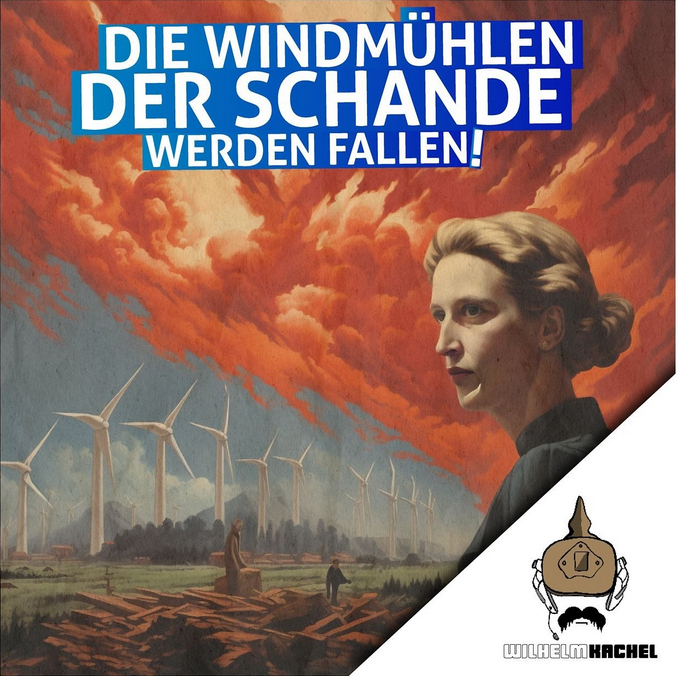
A few days before the release of the AfD’s campaign video, wilhelm_kachel posted an AI-generated image on Instagram echoing Weidel’s commitment to tearing down the “Wind turbines of shame” [Fig. 14]. The logo, a kind of Reich-era soldier with a spiked helmet and a modern headset, is in the lower-right corner. Towering above it, a portrait bust resembling Weidel, composed in the latent space of AI, appears against a fiery sky. Her gaze, carved in deep shadow and poised in impassive restraint, recalls the psychological distance of 1920s Neue Sachlichkeit painting. In the background, atmospheric mountains rise, as if awaiting the punitive blaze that will level the windmills that separate them from the forest and hamlet in the middle ground. Felled timber occupying the foreground suggests that the turbines are themselves the cause of despoilation. Two small figures roam over the pile, mirroring the chronotopic motif described above. Yet the space-time configuration of this image departs from historical time, intimating catastrophic destruction, or an apocalypse, in the biblical sense of revelation. Neither an instance of what Cara Dagget called “petro-masculinity” nor the nurturing Cybele of the campaign video, here Weidel’s AI-generated doppelgänger appears as a looming, divine figure of Old Testament wrath (Daggett 2018).
In a text dedicated to Marina Vishmidt, Daniel Spaulding underscores the importance of continuing to engage with bourgeois art, even though the ethos of the class that once produced and admired it has long changed. He writes, “We have to look at bourgeois paintings […] in ways that the bourgeoisie itself no longer can: maybe […] to preserve an archive of ways of feeling and seeing that don’t fit into the present world. And also to keep vivid the fact that even oppression was once different” (Spaulding 2025, 53). Through a strategic resignification of bourgeois painting, in particular of the politically laden reception of Friedrich’s oeuvre, the AfD’s 2025 campaign constructed “ways of feeling and seeing” that shape the world the party seeks to bring into being. What emerges in the video is a calculated synthesis of heterogeneous imaginaries in a nuclear-energy-friendly, neoliberal rearticulation of Friedrich’s Nordic landscapes. At one level, the video’s iconography pays homage to the party’s völkisch wing, an intention confirmed by Weidel’s quotation of Johann Gottlieb Fichte’s Addresses to the German Nation (1808) in the runup to the 2025 elections (Maitra 2025). On another, recourse to this visual rhetoric betrays the inability of leaders steeped in neoliberal or ordoliberal economic doctrines to affectively mobilise potent imagery emanating from their cultural background. The repertoire on which they draw remains fundamentally alien to the intellectual universe of Mises or Hayek.
As Quinn Slobodian and Melinda Cooper have demonstrated, the contemporary far right has sought to forge an alliance between its libertarian currents and the hierarchical and racialised imaginaries long cherished by social conservatives. Their search for ideological convergence has crystallised, for instance, around the icon of the (white) “Traditional family”, whose elevation functions within a broader project to reallocate the responsibilities of social reproduction from the welfare state to the family, seen as a privatised apparatus of wealth transfer and affective labour (Slobodian 2025; Cooper 2017). If such neoliberal formations can be described as, in Slobodian’s words, “Hayek’s bastards”, then the AfD’s video may perhaps be seen as “Friedrich’s bastard”, the illegitimate progeny of the religious and nationalist German bourgeoisie who rediscovered Friederich at the beginning of the twentieth century.
*In the archive of William S. Heckscher, which is held at the Warburg Haus in Hamburg, two texts, probably dating from the late 1930s and respectively titled Tacitus, Shakespear and the Nazis and, The Noble Savage: Case History and Therapy, elaborate on the Nazi cult of Tacitus’ Germania. I wish to thank Karen Michel for pointing this out.
Bibliography
Sources
- GS Briefe
A. Warburg, Briefe, hrsg. von M. Diers, S. Haug mit T. Helbig, Berlin 2021.
Bibliographical references
- Amstutz 2015
N. Amstutz, Caspar David Friedrich and the Aesthetics of Community, “Studies in Romanticism” 54, 4 (Winter 2015), 447-475. - Ayyadi 2024
K. Ayyadi, Tannwald Media: AfD setzt im Wahlkampf auf künstliche Intelligenz, “Belltower News” 18 December 2024. - Biehl, Staudenmaier 2011
J. Biehl, P. Staudenmaier, Ecofascism Refvisited. Lessons from the German Experience, Porsgrunn 2011. - Bloch 1991
E. Bloch, Heritage of our Time [Erbschaft dieser Zeit, Zurich 1935], trans. N. Plaice, S. Plaice, London 1991. - Brüggemeier, et al. 2005
F.-J. Brüggemeier, M. Cioc, T. Zeller (eds.), How Green Were the Nazis? Nature, Environment, and Nation in the Third Reich, Athens (OH) 2005. - Burchert 2024
L. Burchert, Kunst und Klimapolitik, “Kunstchronik. Monatsschrift für Kunstwissenschaft – Museumswesen und Denkmalpflege” 77, 8 (August 2024), 584-589. - Börsch-Supan [1973] 1974
H. Börsch-Supan, Caspar David Friedrich [Caspar David Friedrich, Munich 1973], New York 1974. - Canetti [1960] 1962
E. Canetti, Crowds and Power [Masse und Macht, Hamburg 1960], trans. C. Stewart, New York 1962. - Chapoutot [2020] 2023
J. Chapoutot, Free to Obey: How the Nazis Invented Modern Management [Libres d’obéir : le management, du nazisme à aujourd’hui, Paris 2020], trans. Steven Rendall, New York 2023. - Cheles 2023
L. Cheles, L’iconografia della destra. Da Mussolini a Berlusconi, Roma 2023. - Clark 2019
C. Clark, Time and Power: Visions of History in German Politics, from the Thirty Years’ War to the Third Reich, Princeton (NJ) 2019. - Clewis 2009
R.R. Clewis, The Kantian Sublime and the Revelation of Freedom, Cambridge 2009. - Cooper 2017
M. Cooper, Family Values. Between Neoliberalism and the New Social Conservatism, New York 2017. - Cremer 2023
T. Cremer, The Godless Crusade. Religion, Populism and Right-Wing Identity Politics in the West, Cambridge 2023. - Daggett 2018
C. Daggett, Petro-Masculinity. Fossil Fuels and Authoritarian Desire, “Millennium. Journal of International Studies” 47,1 (2018), 25-44. - Doerr 2021
N. Doerr, The Visual Politics of the Alternative for Germany (AfD). Anti-Islam, Ethno-Nationalism, and Gendered Images, “Social Sciences” 10 (2021), 1-16. - Dörner 1996
A. Dörner, Politischer Mythos. Eine Einführung, Hamburg 1996. - Eberlein 1939
K.K. Eberlein, Caspar David Friedrich. Der Landschaftsmaler. Ein Volksbuch deutscher Kunst, Munich 1939. - Eliade [1949] 1954
M. Eliade, The Myth of the Eternal Return. Cosmos and History [Le Mythe de l’éternel retour. Archétypes et répétition, Paris 1949], trans. W.R. Trask, Princeton (NJ) 1954. - Elsässer 2021
J. Elsässer, Im heiligen Hain der Götter. Die Deutschen und ihr Wald, “COMPACT-Online”, 13 January 2021. - Feng 2023
Y. Feng, Bildstrategien der AfD. Die Visualisierung der rechtspopulistischen Ideologie, Wiesbaden 2023. - Fielitz, et al. 2024
M. Fielitz, H. Sick, M. Schmidt, C. Donner, Social-Media-Partei AfD? Digitale Landtagswahlkämpfe im Vergleich, Frankfurt am Main 2024. - Forchtner, Olsen 2024
B. Forchtner, J. Olsen, Against the promethean: Energy throughput and the far-right politics of degrowth, “Environment and Planning E: Nature and Space” 7,5 (2024), 2078-2096. - Forchtner, Özvatan 2019
B. Forchtner, Ö. Özvatan, Beyond the ‘German Forest’. Environmental communication by the far right in Germany, in B. Forchtner (ed.), The Far Right and the Environment: Politics, Discourse and Communication, London 2019, 216-236. - Gies 2019
H. Gies, Richard Walther Darré. Der „Reichsbauernführer“, die nationalsozialistische „Blut und Boden“ – Ideologie und Hitlers Machteroberung, Paderborn/Munich/Vienna/Zurich 2019. - Giuli 2018
A. Giuli, Venne la Magna Madre. I riti, il culto e l’azione di Cibele Romana, Rome 2018. - Grave 2023
J. Grave, Caspar David Friedrich, Munich/London/New York 2023. - Hartog 2003
F. Hartog, Regimes of Historicity. Presentism and Experiences of Time [Régimes d’historicité. Présentisme et expériences du temps, Paris 2003], trans. S. Brown, New York 2015. - Hermand 1994
J. Hermand, Politische Denkbilder. Essays zur Literatur, Kunst und Musik, Cologne/Weimar/Vienna 1994. - Herzog 2025
D. Herzog, The New Fascist Body, London/New York 2025. - Hinrichs 2009
N. Hinrichs, Caspar David Friedrich. Ein Künstler des Nordens, Hamburg 2009. - Hinz 1974
S. Hinz (Hrsg.), Caspar David Friedrich in Briefen und Bekenntnissen, Berlin 1974. - Hofmann 1974
W. Hofmann (Hrsg.), Caspar David Friedrich und die deutsche Nachwelt. Aspekte zum Verhältnis von Mensch und Natur in der bürgerlichen Gesellschaft, Frankfurt am Main 1974. - Koerner 1990
J.L. Koerner, Caspar David Friedrich and the Subject of Landscape, New Haven/London 1990. - Kølvraa, Forchtner 2024
C. L. Kølvraa, B. Forchtner, Imagining Alternative Worlds. Far-Right Fiction and the Power of Cultural Imaginaries, London/New York 2024. - Imort 2005
M. Imort, Eternal Forest—Eternal Volk: The Rhetoric and Reality of National Socialist Forest Policy, in F.-J. Brüggemeier, M. Cioc, T. Zeller (eds.), How Green Were the Nazis? Nature, Environment, and Nation in the Third Reich, Athens (OH) 2005, 43-72. - Macpherson 1962
C.B. Macpherson, The Political Theory of Possessive Individualism. Hobbes to Locke, Oxford 1962. - Maitra 2025
S. Maitra, “Slaves Don’t Fight”: AfD’s Weidel Speaks Exclusively to The American Conservative, “The American Conservative” 6 January 2025. - Malm, The Zetkin Collective 2021
A. Malm, The Zetkin Collective, White Skin, Black Fuel: On the Danger of Fossil Fascism, London 2021. - Mosse 1964
G.L. Mosse, The Crisis of German Ideology. Intellectual Origins of the Third Reich, New York 1964. - Olsen 1999
J. Olsen, Nature and Nationalism. Right-Wing Ecology and the Politics of Identity in Contemporary Germany, Houndmills/Basingstoke 1999. - Pföhringer 2023
D. Pföhringer, Hermannsschlacht: Der wichtigste Tag unserer Geschichte, “COMPACT-Online”, 26 November 2023. - Schicha 2017
C. Schicha (Hrsg.), Wahlwerbespots zur Bundestagswahl 2017. Analysen und Anschlussdiskurse über parteipolitische Kurzfilme in Deutschland, Wiesbaden 2019. - Schmitt 2005
C. Schmitt, Political Theology. Four Chapters on the Concept of Sovereignty [Politische Theologie. Vier Kapitel zur Lehre von der Souveränität, München/Leipzig 1922], trans. G. Schwab, Chicago/London 2005. - Schneider forthcoming
B. Schneider, Technolandschaften: Moderne Mensch-Natur-Verhältnisse im Anthropozän, Berlin, forthcoming. - Sedgwick 2023
M. Sedgwick, Traditionalism: The Radical Project for Restoring Sacred Order, London/New York 2023. - Smith 1999
A.D. Smith, Myths and Memories of the Nation, Oxford 1999. - Sontag 1980
S. Sontag, Fascinating Fascism, New York 1980. - Spaulding 2025
D. Spaulding, Total art and mimetic subsumption: Thoughts after Marina Vishmidt, “Radical Philosophy” 218 (Spring 2025), 53-57. - Spissinger 2024
F. Spissinger, Die Gefühlsgemeinschaft der AfD: Narrative, Praktiken und Räume zum Wohlfühlen, Opladen/Berlin/Toronto, 2024. - Slobodian 2025
Q. Slobodian, Hayek’s Bastards: Race, Gold, IQ, and the Capitalism of the Far Right, New York 2025. - Sugiyama 2009
A. Sugiyama, Wanderer unter dem Regenbogen – Die Rückenfigur Caspar David Friedrichs, PhD dissertation, Freie Universität Berlin, 2009. - Teitelbaum 2020
B.R. Teitelbaum, War for Eternity: The Return of Traditionalism and the Rise of the Populist Right, London 2020. - Uekötter 2006
F. Uekötter, The Green and the Brown. A History of Conservation in Nazi Germany, Cambridge 2006. - Warnke 2007
M. Warnke, Könige als Künstler, Munich 2007. - Warren 2017
R. Warren, Caspar David Friedrich, Ancient Rome and the Freiheitskrieg, “Open Cultural Studies” 1 (2017), 66-74. - Weidel 2019
A. Weidel, Widerworte. Gedanken über Deutschland, Kulmbach 2019. - White 1967
L. White, The Historical Roots of Our Ecologic Crisis, “Science” 155,3767 (1967), 1203-1207. - Wodak 2021
R. Wodak, The Politics of Fear. The Shameless Normalisation of Far-Right Discourse, London 2021. - Zechner 2016
I. Zechner, Der deutsche Wald. Mythen, Kult, und Politik, Vienna/Cologne/Weimar 2016. - Žižek 1997
S. Žižek, The Plague of Fantasies, London 1997.
Abstract
Jacopo Galimberti’s article examines the AfD’s 2025 campaign imagery through a close reading of a short promotional film featuring Alice Weidel. Combining political iconology and Marxist ideology critique, Galimberti argues that the video appropriates the visual legacy of Caspar David Friedrich in order to articulate a hybrid ideological formation, where völkisch mythology, neoliberal anti-statism, political theology, and far-right ecological imaginaries converge. By staging Weidel within a Romantic landscape coded through motifs of forest, seasonal renewal, and sublime contemplation, the film transforms bourgeois-national imagery into a contemporary affective device of identification, rootedness, and exclusion. The article shows how this visual strategy naturalises nationalist politics, obscures the historical dimensions of climate and capitalism, and helps explain the AfD’s attempt to reconcile neoliberal leadership with ethnonationalist fantasy.
keywords | AfD; Alice Weidel; Caspar David Friedrich; völkisch Culture; German New Right.
questo numero di Engramma è a invito: la revisione dei saggi è stata affidata al comitato editoriale e all'international advisory board della rivista
Per citare questo articolo / To cite this article: J. Galimberti, A Neoliberal Caspar David Friederich. The AfD’s Ethnoscape, “La Rivista di Engramma” n. 233 (aprile 2026).