A Magical Aid to Experience
Warburg’s Use of Film as an Object of Political Iconology
Thomas Helbig
Abstract
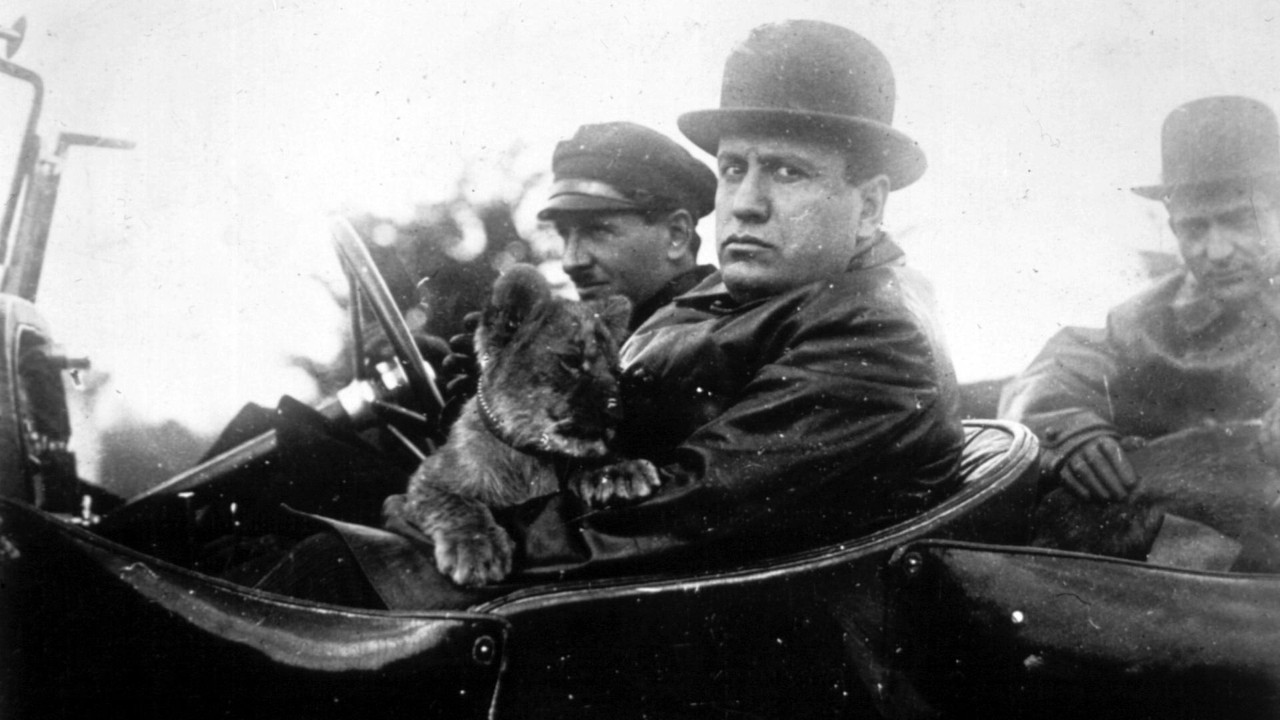
1 | Mussolini with his lioness Italia, 1924.
Preliminary remarks
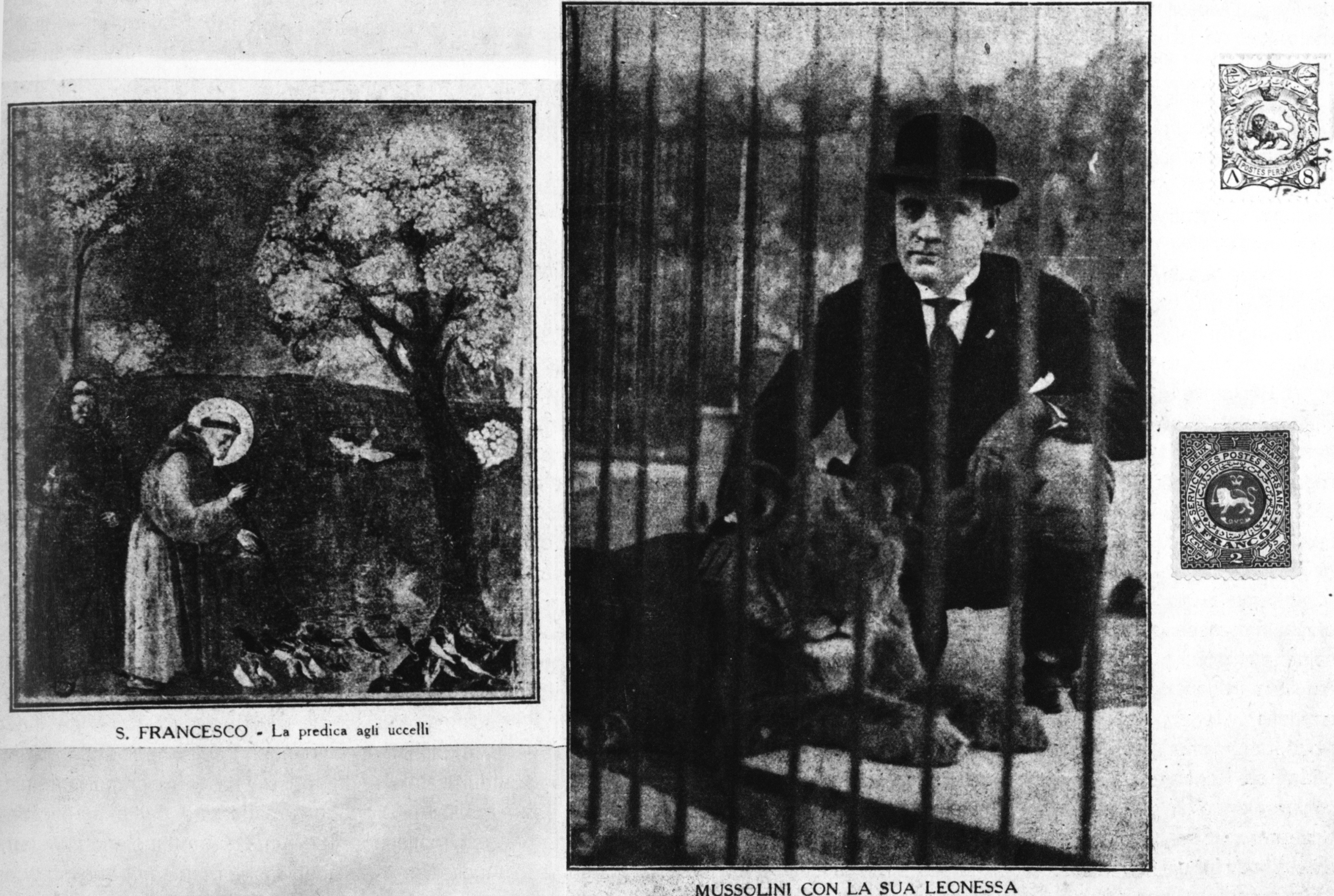
2 | Warburg’s picture panel, presumably for the lecture on 16 July 1927, with a reproduction of Giotto’s fresco, St. Francis Preaching to the Birds (c. 1296-1299, Assisi, San Francesco), and a photograph of Mussolini and the lioness (1927), to the right of which are two Persian stamps with lion-motif coats of arms (GS Ausstellungen, 137; GS Atlas, XVI).
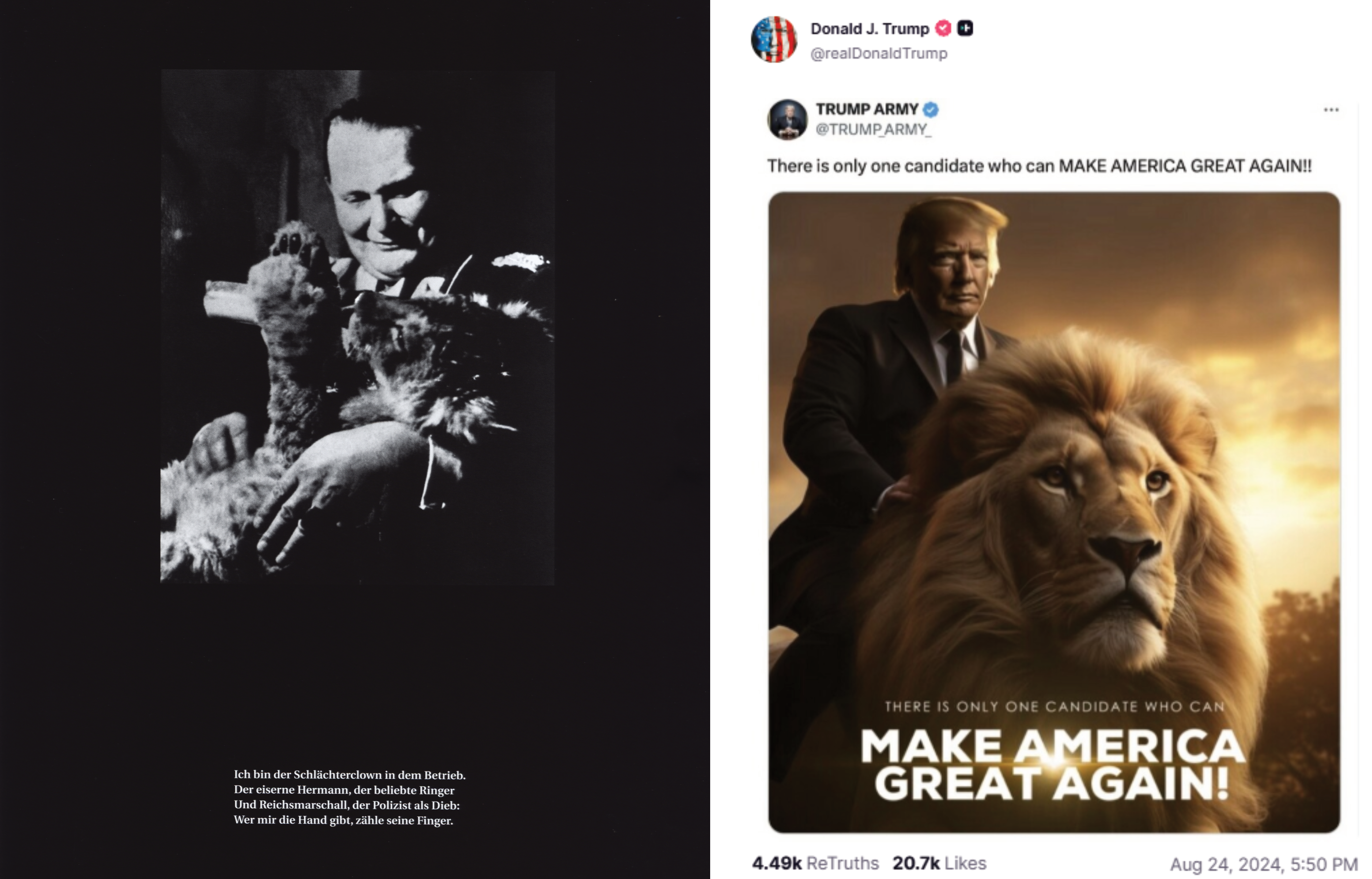
3 | Bertolt Brecht, Kriegsfibel, 1955: “Ich bin der Schlächterclown in dem Betrieb. Der eiserne Hermann, der beliebte Ringer. Und Reichsmarschall, der Polizist als Dieb: Wer mir die Hand gibt, zähle seine Finger [I am the butcher clown in the business. Iron Hermann, the popular wrestler. And Reich Marshal, the policeman as thief: whoever shakes my hand should count their fingers]” (Brecht 2008, 72).
4 | Donald Trump’s post on Truth, 24 August 2024.
It is surely no coincidence that modern mass media imagery appears only on the first and last panels, with a few minor exceptions, of Warburg’s Mnemosyne Atlas. Due to his unexpected death in 1929, however, this project remained unfinished. It therefore remains unknown whether Warburg, who called himself “Bildhistoriker, kein Kunsthistoriker” (“an image historian, rather than an art historian”: Warburg’s diary entry of 12 February 1917, quoted in Diers 1991, 230, fn. 142), would later have added more examples of modern media to his Atlas.
But we do know one thing for certain. Warburg claimed that one of the essential functions of the “Kulturwissenschaftliche Bibliothek Warburg” (KBW) was to engage with technological and media discourses of its time from a visual, art-historical perspective. The inclusion of advertisements, photographs, and newspaper clippings with reports on modern disasters and atrocities, as well as technical innovations such as aviation and pictorial telegraphy, in the first and last panels of the Mnemosyne Atlas could be understood as an attempt to actualize this aim.
Warburg’s demonstrated sensitivity to propaganda likewise supports this conjecture. He had documented and analyzed signs of anti-Semitism, racism, and fascism, including Italian fascism, at an early stage in his career. On 16 July 1927, Warburg gave a lecture on Die Funktion der sozialen Mneme als Bewahrerin der antikisierenden Dynamo-Engramme der Gebärdensprache (The Function of Social Mneme as Preserver of the Antiquising Dynamo Engrams of Sign Language), accompanied by a Bilderreihe (“series of images”) on “Weltanschauung im Lichtbild” (“Worldview in Photography”: GS Ausstellungen, 135-140). In this talk, he traced the symbols of Italian fascism under Benito Mussolini to a series of ancient motifs. Jost Philipp Klenner, in an article entitled Mussolini und der Löwe (Klenner 2007a), traces Warburg’s argument linking Mussolini’s preference for presenting himself with his lioness Italia with a long history of the iconography of power.
This symbolism is reiterated, for example in a similar photograph of Hermann Göring and a lion, which was used by Bertolt Brecht in his Kriegsfibel (1955), and extends as far as an AI-generated post by Donald Trump in the present day.
Warburg’s relationship with cinema and film has been discussed by many. Peter J. Schwartz recently presented a critical review of the research literature, calling some widely held theses into question (Schwartz 2020). Although Warburg cannot be described as a true cineaste, a number of his connections with the new medium can nevertheless be identified. The question to be debated is to what extent film influenced Warburg’s scholarly work. The inclusion of a film screening in the KBW’s lecture program is a clear starting point to address this inquiry. On 17 March 1928, Czech ethnologist František Pospíšil gave a lecture entitled Urantike Tänze im heutigen Baskenlande (Ancient dances in today’s Basque Country), which included the screening of films. A film projector was set up especially for this purpose in the KBW reading room. The lecture took half an hour, while the screening lasted an hour (GS Briefe, II, 529; see also Pospisil, Warburg [1926-1929] 2003; McEwan 2008). Warburg, a scholar who had devoted his life to the study of bewegtes Beiwerk (“moving accessories”) such as clothing and hair in antiquity and the Renaissance, must have been thrilled that film provided a means of capturing “social expressive movements” in images. In his letter to Wolfgang Stammler on 2 April 1928, Warburg summarized the lecture as follows:
Ich hege für Dr. Pospisil aufrichtige Bewunderung: Denn mag auch das Hackmesser der Zeit stellenweise schädlich dareinfahren, so muss die Kulturwissenschaftliche Forschung doch Ihre Freude daran haben, dass unter Einsatz äusserster Energie und überragender Intelligenz, soziale Ausdrucksbewegungen im Bilde gerettet werden, die zur Psychologie des europäischen Festwesens einzig wertvolle, und leider im Absterben begriffene Prozesse in der Erinnerung lebendig erhalten.
[I have sincere admiration for Dr. Pospíšil. Although time’s chopper may sporadically cause damage by its intrusion, still cultural studies must delight in the fact that socially expressive movements are being salvaged in images that preserve moribund processes of unique importance to the psychological understanding of European festivals] (GS Briefe, I, 704).
1929
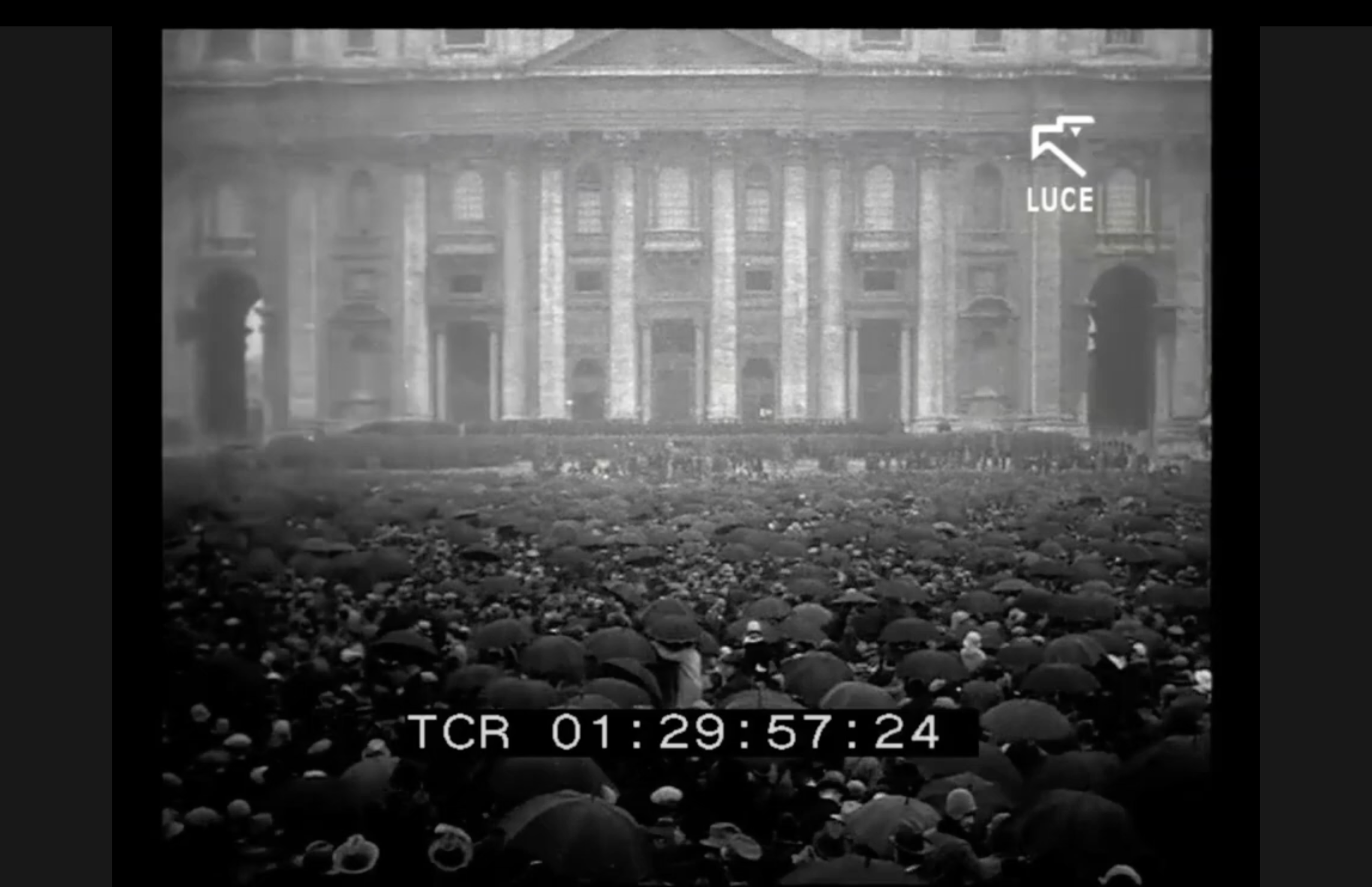
5 | La conciliazione fra l’Italia e il Vaticano, 1929, LUCE; montage of selected scenes by the author (click to watch).
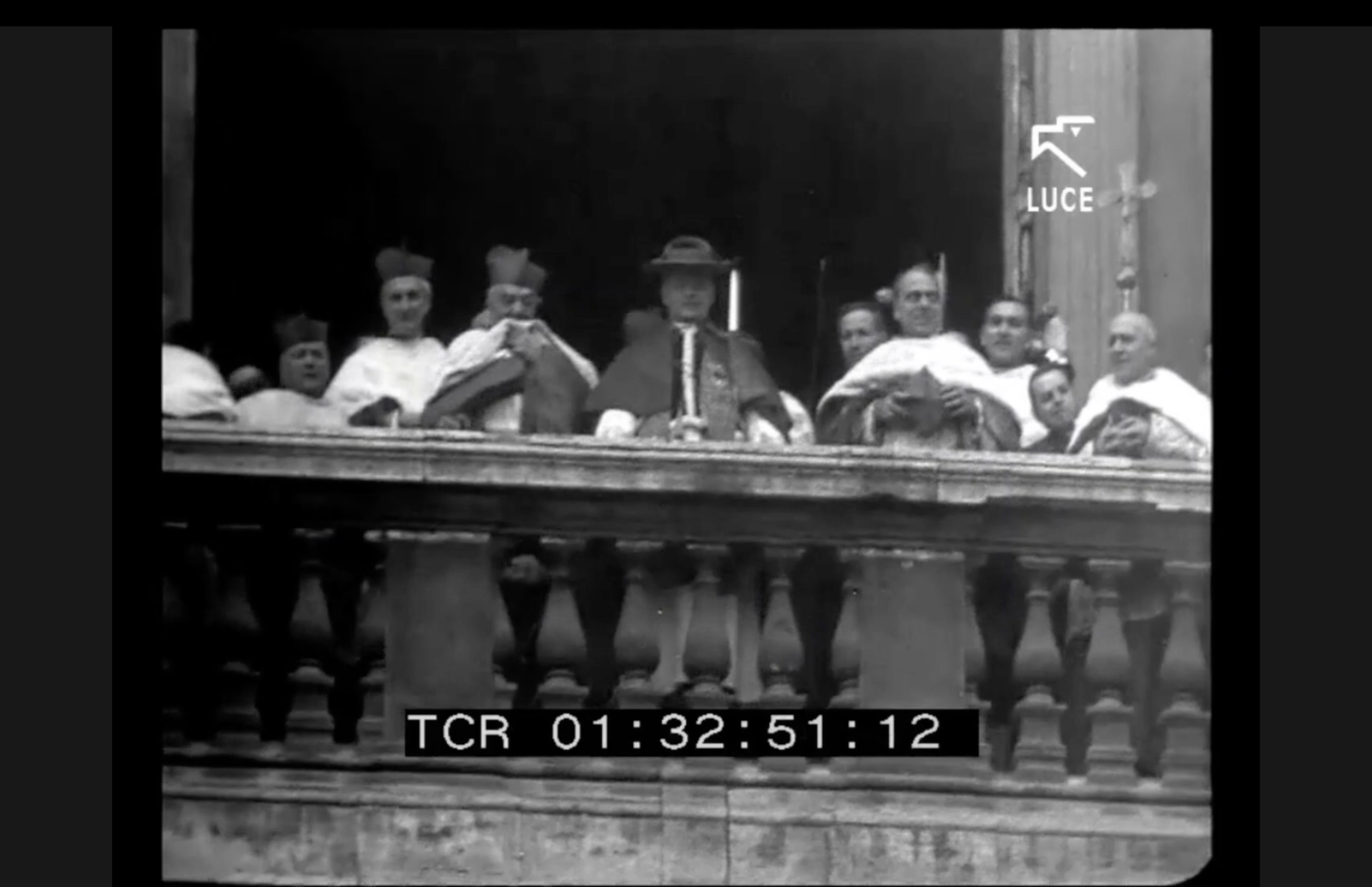
6 | “The Pope blessed with both hands”. La conciliazione fra l’Italia e il Vaticano, 1929, LUCE; sequence (click to watch).
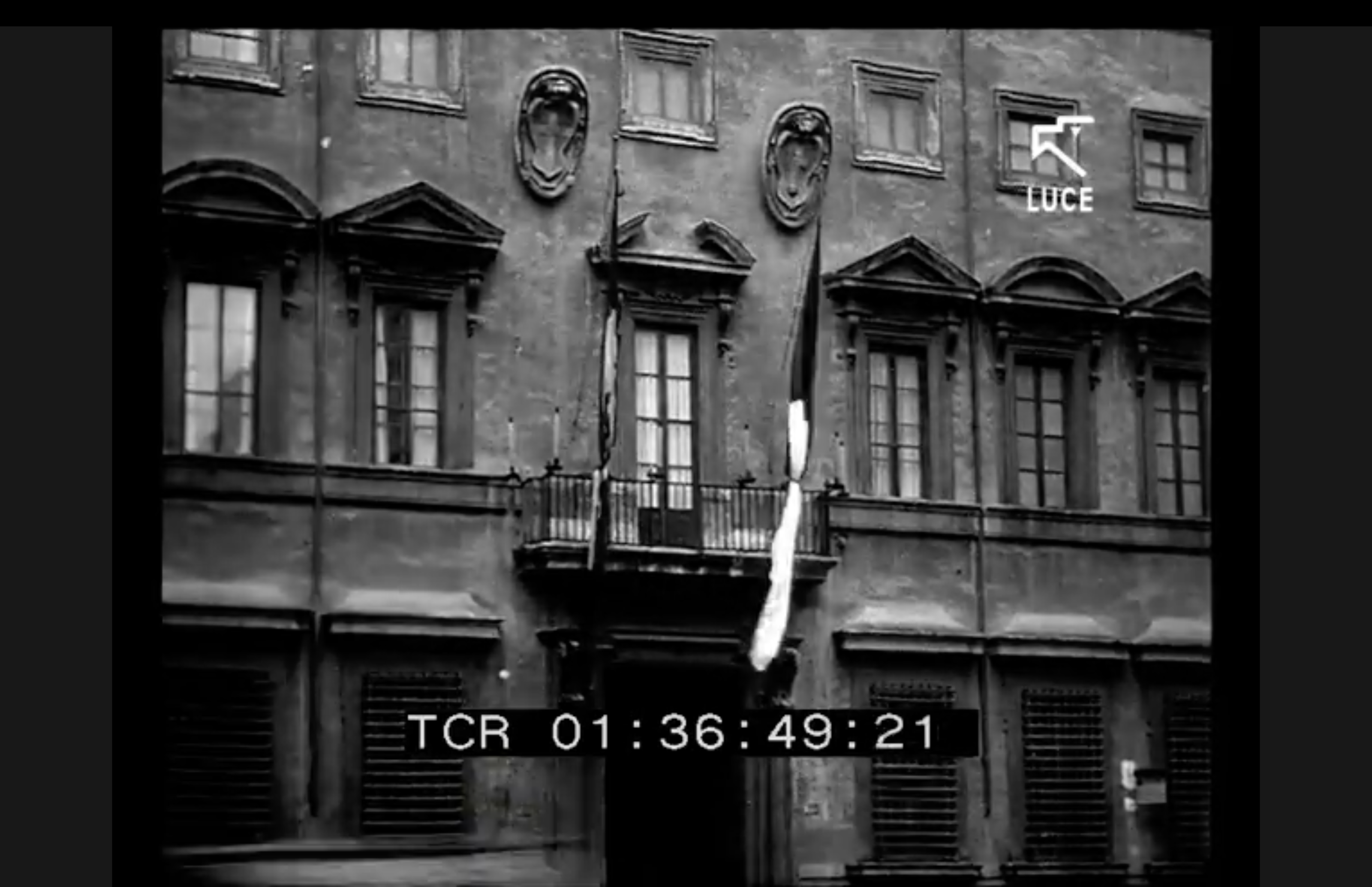
7 | “Only the two flags representing spiritual and material power are visible”. La conciliazione fra l’Italia e il Vaticano, 1929, LUCE; sequence (click to watch).
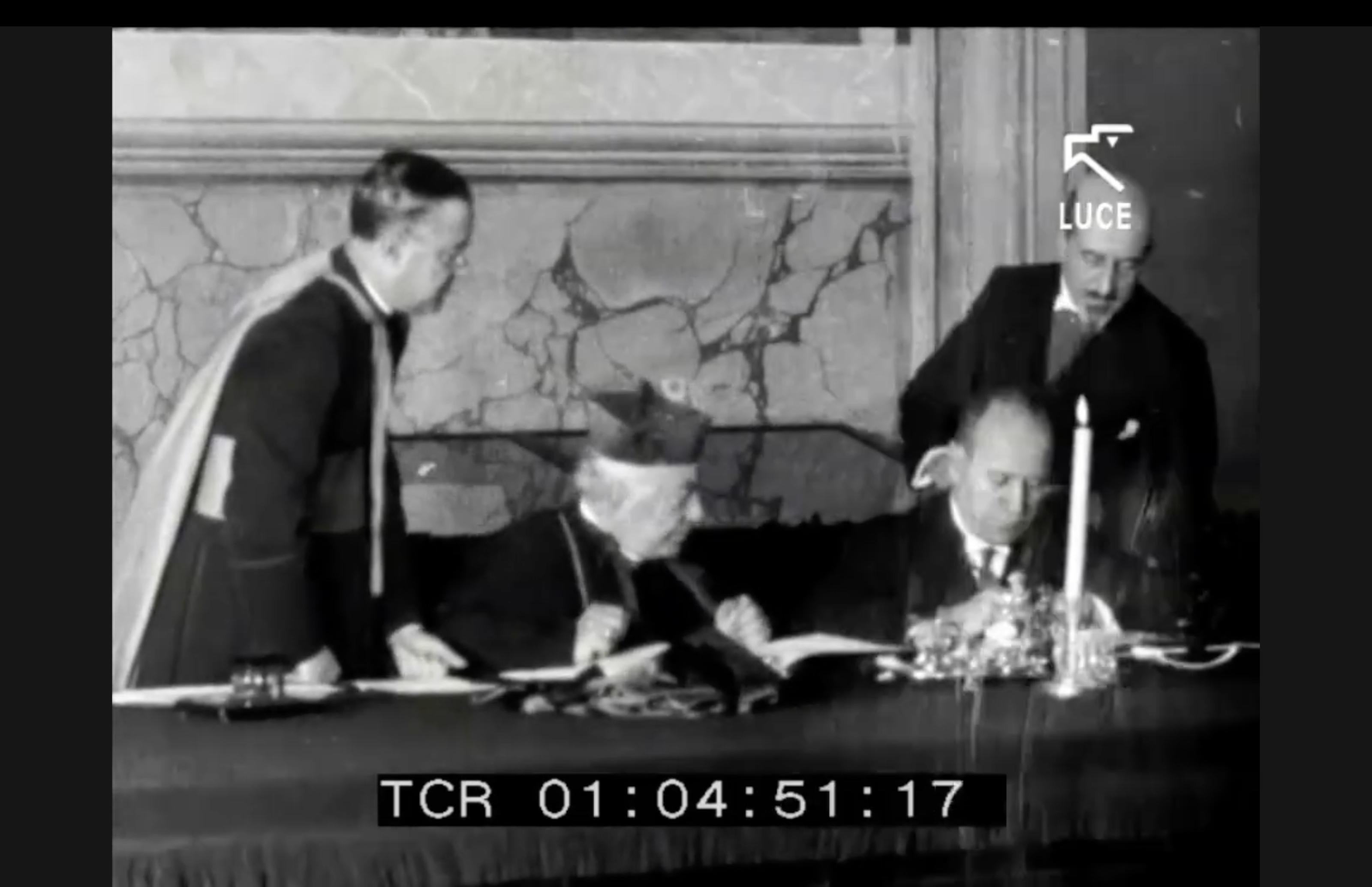
8 | “The Fascists have acclimatized”. La conciliazione fra l’Italia e il Vaticano, 1929, LUCE; sequence (click to watch).
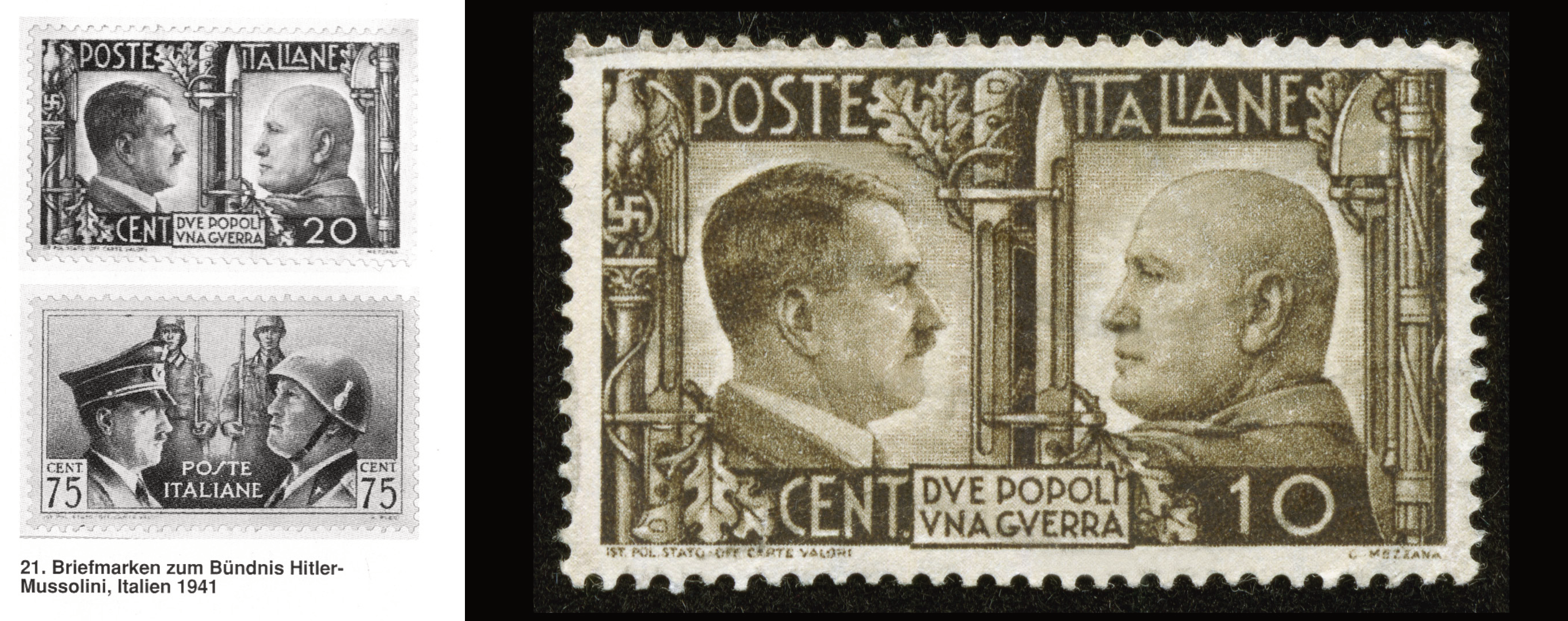
9, 10 | Italian stamps marking the alliance between Hitler and Mussolini (“Two Peoples at War”) from the Bildindex zur Politischen Ikonographie (Warnke 1992, 194). The stamp (right), designed by Italian artist Corrado Mezzana in 1941, depicts a kind of morphogenesis. The bundle of rods on the right transforms into the insignia of German fascism on the left. Bayonets decorated with oak leaves lead into an antique-style column with a Corinthian capital bearing an imperial eagle with a swastika.
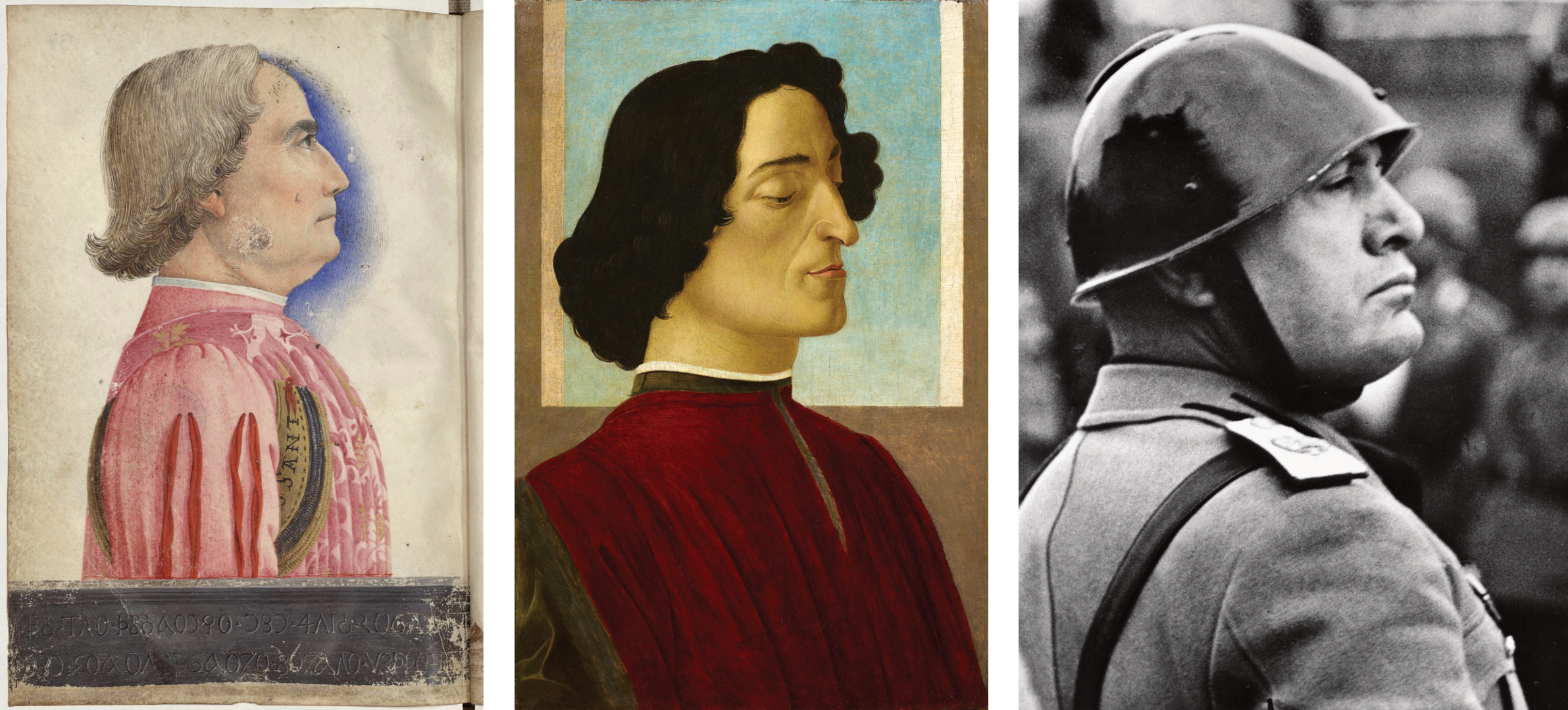
11 | Giovanni Bellini (attributed), Portrait of Jacopo Antonio Marcello, illumination on parchment (13 x 18,7 cm), c. 1453, Paris, Bibliothèque de l’Arsenal, Ms. 940, f.38v.
12 | Sandro Botticelli (attributed), Portrait of Giuliano de’ Medici, tempera on wood (39,3 x 59,5 cm), c. 1478-1480, Bergamo, Accademia Carrara.
13 | Benito Mussolini in Rome, 11 November 1937.
A letter to his wife (and family) in Hamburg on 19 February 1929, however, refers to a later event in which Warburg came into contact with cinema:
Gestern Abend waren wir im Kino, das nun in diesem Falle ein ganz unheimlich wunderbarer Mithelfer beim Erleben sogenannter grosser Augenblicke ist. Ich rate Euch dringend diesen Film […] anzusehen.
[We were at the cinema yesterday evening, which was in this case a really uncannily wonderful help in experiencing so-called great moments. I urgently advise you to see this film] (GS Briefe, I, 740).
Warburg was in Rome at the time, where he had recently lectured at the Bibliotheca Hertziana. It was during this period that the Lateran Treaty was signed by Pope Pius XI, Secretary of State Cardinal Pietro Gasparri, and Benito Mussolini. In short, the treaty defined the Vatican State in its current form based upon the mutual recognition of spiritual and secular spheres. The Holy See and the Italian state assured each other of their respective sovereignty. Warburg included thirteen photographs of the Lateran Treaty being signed and its subsequent ratification on Panel 78 in his Atlas.
The inclusion of these photographs in an art-historical image atlas may seem puzzling to some. At this point, Warburg was not interested in the artistic value of photography, nor in its recognition as an autonomous art form. Instead, their status as documents of an important event was their relevant quality. In earlier periods, such images, representative of important current events, also existed, but were created by painters. As an image historian, Warburg was interested in the transformations of symbols of spiritual and secular power. In line with Horst Bredekamp’s formulation, he understood that like political events, religious processions may be interpreted as symbolic acts or as “image acts” (Bredekamp 2018). In the case of the Lateran Treaty, the two spheres came together. Warburg felt compelled to attend the event in person.
But that’s not all. After reporting in detail in the KBW diary about the celebrations marking the signing of the treaty on 11 February 1929 (GS Tagebuch, 406-408), Warburg attended a film screening related to the event on 18 February 1929: “Im Kino die Conciliazione miterlebt. Eine zauberhafte Mithilfe des Erlebens, trotz allem” [“Witnessed the Conciliazione in the cinema. A magical aid to experience, in spite of everything”] (GS Tagebuch, 410).
Jost Philipp Klenner was able to identify this film as La conciliazione fra l’Italia e il Vaticano, a 36-minute documentary demonstrating the high level of media interest surrounding the event (Klenner 2007b, 454. The film can be viewed on the Archivio LUCE website; it is unclear whether the digitized version provided by the Archivio LUCE is the exact film that Warburg saw in Rome in 1929: his description of the sequence of events differs, and it contains passages that are not included in this version). The camera records the large number of other cameramen and photographers, repeatedly panning across a crowd of press to emphasize the scale of this media event. Perhaps some photographers seen in the film produced some of the photo prints in Warburg’s Atlas. Some of their photographs are reproduced in the film, as well.
In addition to the many photographs and postcards of the event that Warburg collected, the film corroborates his remarks about the event. One can easily imagine Warburg standing in the crowd “in the third row”, soaked by the rain. On 19 February 1929 he wrote to his wife Mary:
Mich trieb eine Art Pflichtbewusstsein auf den Platz von St. Peter, weil ich mir sagte dass, wenn einer den Historiker des Symbols markieren will, er selbst ein bischen Haut zu Markte tragen muss, auch wenn er gedrängt wird; das wurde er aber nicht einmal sehr. Ich wurde nur langsam bis in die dritte Reihe vorgeschoben, fast bis an den Militärkordon, den Kgl. Ital. Grenadiere im grauen kurzen Mantel und Stahlhelm formierten. Letzterer kam den Truppen sehr zu statten denn da ein ganz furchtbarer Platzregen losging, brauchten sie einfach etwas mit dem Kopf zu nicken, und das Wasser floss ab, während wir Zivilleute gänzlich durchweichte Filzhüte nach Hause brachten.
[A kind of sense of duty drove me to St. Peter’s Square, because I told myself that to distinguish oneself as an historian of the symbol, one must put oneself out there […]. I was slowly pushed forward to the third row, almost to the military cordon of Royal Italian Grenadiers in gray short coats and steel helmets. The latter was very practical for the soldiers, because when a heavy rain shower started, they simply had to nod their heads and the water ran off, while we civilians took our completely soaked felt hats home with us] (GS Briefe, I, 739).
Ich habe, da ich ein kleines Fernglas bei mir hatte, den Papst und die ganze Zeremonie sehr gut sehen können. Etwa 200.000 Leute mögen auf dem Petersplatz gewesen sein. Der Papst segnete mit beiden Händen, sonst wäre wohl zu wenig auf jeden gekommen, und lüftete sogar seinen Sommerhut, als er wieder in d. Kirche verschwand.
[As I had a small pair of binoculars with me, I was able to see the Pope and the whole ceremony very well. There must have been about 200,000 people in St. Peter’s Square. The Pope blessed with both hands, otherwise there would not have been enough for everyone, and even lifted his summer hat as he disappeared back into the church] (GS Briefe, I, 739).
Warburg also comments upon Mussolini’s performance at the event. At first, he notes, the Duce makes himself scarce:
Das Feinste am ganzen Vorgange ist wohl, dass der Duce sich an diesem Tage nicht persönlich zeigte. Der Papst und der König erscheinen, aber er lässt sich nicht auf den Balkon des Palazzo Chigi herausrufen; nur die beiden Fahnen, die die seelische und materielle Großmacht darstellen, werden vor dem Palazzo Chigi sichtbar.
[The finest thing about the whole affair is probably that the Duce did not show himself in person on that day. The Pope and the King appear, but he does not allow himself to be called out onto the balcony of the Palazzo Chigi; only the two flags representing spiritual and material power are visible in front of the Palazzo Chigi] (GS Briefe, I, 740; see also GS Tagebuch, 410).
Warburg’s first observations of Mussolini focus on his clothing:
Freilich, die Fascisten haben sich akklimatisiert, vom Schwarzhemd ist nichts mehr zu sehen, das missing link zwischen Frack und Schwarzhemd, der Cutaway, ist das Kleid der eleganten fascistischen Minister.
[Of course, the Fascists have acclimatized. There is no longer any sign of the black shirt, and the missing link between tailcoat and black shirt, the cutaway, is the dress of the elegant Fascist ministers] (GS Briefe, I, 740).
Warburg subsequently remarks upon Mussolini’s physical and facial expressions:
Mussolini, in gestraffter Haltung, ohne alle Zwinkerlichkeit im Wesen, ist ganz Aufmerksamkeit. Man sieht, wie sich sein Mund beim Sprechen formt; ich war erstaunt über die schöne caesarische Bosheit seines Lippenspiels.
[Mussolini, standing ramrod straight and without any hesitation, is completely focused. One sees the forms his mouth takes as he speaks; I was amazed at the beautiful Caesarean malice of the play of his lips] (GS Briefe, I, 740; see also GS Tagebuch, 410).
At first glance, this remark conveys a strange combination of fascination and fear (Angstlust). On the one hand, Warburg may have admired Mussolini’s exaggeratedly heroic masculinity, a trait also reflected in many contemporary descriptions. On the other hand, his remark alludes to the language of the body, treating it as a stage for politics, a theme later also continued by Martin Warnke (Modes 2022).
Warburg’s detailing of Mussolini’s Lippenspiel reveals the former’s interest in the eloquence of the body, a theme he had previously explored through dance and expressive gestures (Pathosformeln). Warburg’s iconography goes beyond art-historical interpretation, questioning the mechanisms and effects of political influence. Building upon this orientation, Martin Warnke later developed the field of political iconography. Like Warburg’s Bilderatlas, Warnke’s Index of Political Iconography, which is still at the Warburg-Haus in Hamburg today, was designed as a working and analytical tool (the index has recently been digitized by the German Documentation Center for Art History as part of a DFG project (2020-2024) and will be made available online). It is worth mentioning Warnke’s note on the motif of the “raised head”, which originated in medieval portraits of saints and was a gesture of “adoration towards heaven”, intended to express piety. Later, this meaning was secularized to signify military resolve and was ultimately coopted by the “tyrants of modern times” (Warnke 1992). Warnke concludes his series of illustrations with two postage stamps from 1941, each featuring double portraits of Hitler and Mussolini.
As someone interested in stamps as Bilderfahrzeuge (“vehicles for images”; see Esposito 2020), Warburg also would have noticed the fascist insignia in the depiction. On the right is the name-giving bundle of rods with an axe, the fasces, which Mussolini had chosen as the official emblem of the Kingdom of Italy in 1926, and which Warburg had already analyzed in his correspondence with Fritz Saxl as a sign of identification with the Roman Empire.
Warnke’s remarks largely substantiate Warburg’s observations on iconography. Bearing in mind Mussolini’s self-portrayal, Warnke’s attention to the raised head or the emphasis of the chin can also be traced to Renaissance portraits by Bellini and Botticelli. In a portrait of Giuliano de’ Medici by the latter, the lowered gaze could be cited as an example of a motif-based relationship that can be traced back to Mussolini.
In Mussolini’s case, this gesture later became exaggerated to a point of absurdity. It can be assumed that the dictator was aware of the effectiveness of this staging. Even intellectuals such as the philosopher and cultural official Giovanni Gentile, who vehemently campaigned for Mussolini, were affected by the dictator’s appearances. Warnke writes, “In Romance countries […] there is still a sensitivity to body language”, which is particularly important for the impact of “the political image” (Warnke 1992). He concludes by expressing the hope that the “raised head” gesture has been rendered outdated by twentieth-century dictators. The current US president’s social media presence (Bilderfahrzeuge of a new generation), however, reveals that this is far from the case.
Warburg’s seemingly uncritical word choice, “The beautiful Caesarian malice”, is belied by his careful monitoring of fascism since at least 1923. As a Jewish scholar without a university position, Warburg was acutely aware of the fascist party’s impending excesses. Of particular note is Warburg’s interest in Karin Michaëlis, a Danish journalist and writer who criticized Mussolini and Gabriele D’Annunzio in various daily newspapers. Warburg collected these and forwarded them to his scientist friends. He also took notes, which Julius Goldstein then used for his review of Michaëlis’s book Der Fall D’Annunzio (The Case of D’Annunzio), in consultation with Warburg, but without mentioning his name (Goldstein 1925). Warburg and Michaëlis exchanged personal correspondence regarding her mistaken description of D’Annunzio as Jewish, which perpetuated anti-Semitic propaganda (see the letter from Karin Michaëlis to Aby Warburg from 16 November 1925 and Warburg’s reply from 28 December 1925). A committed feminist and pacifist, Michaëlis continued to criticize Hitler and Mussolini, and provided shelter to Helene Weigel and Bertolt Brecht, among others, before emigrating in 1940.
1965
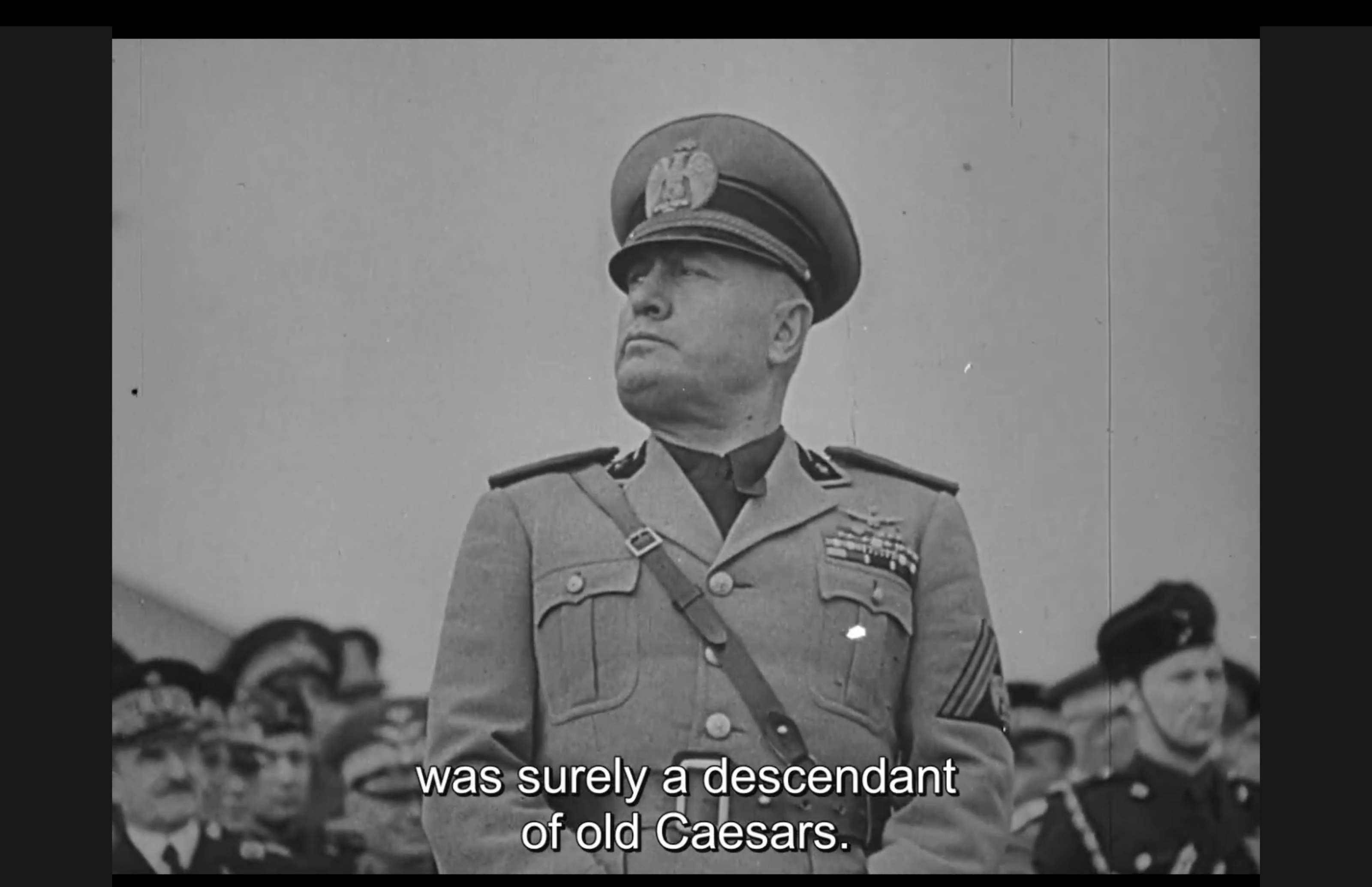
14 | Mikhail Romm, Ordinary Fascism, 1965; sequence (click to watch).
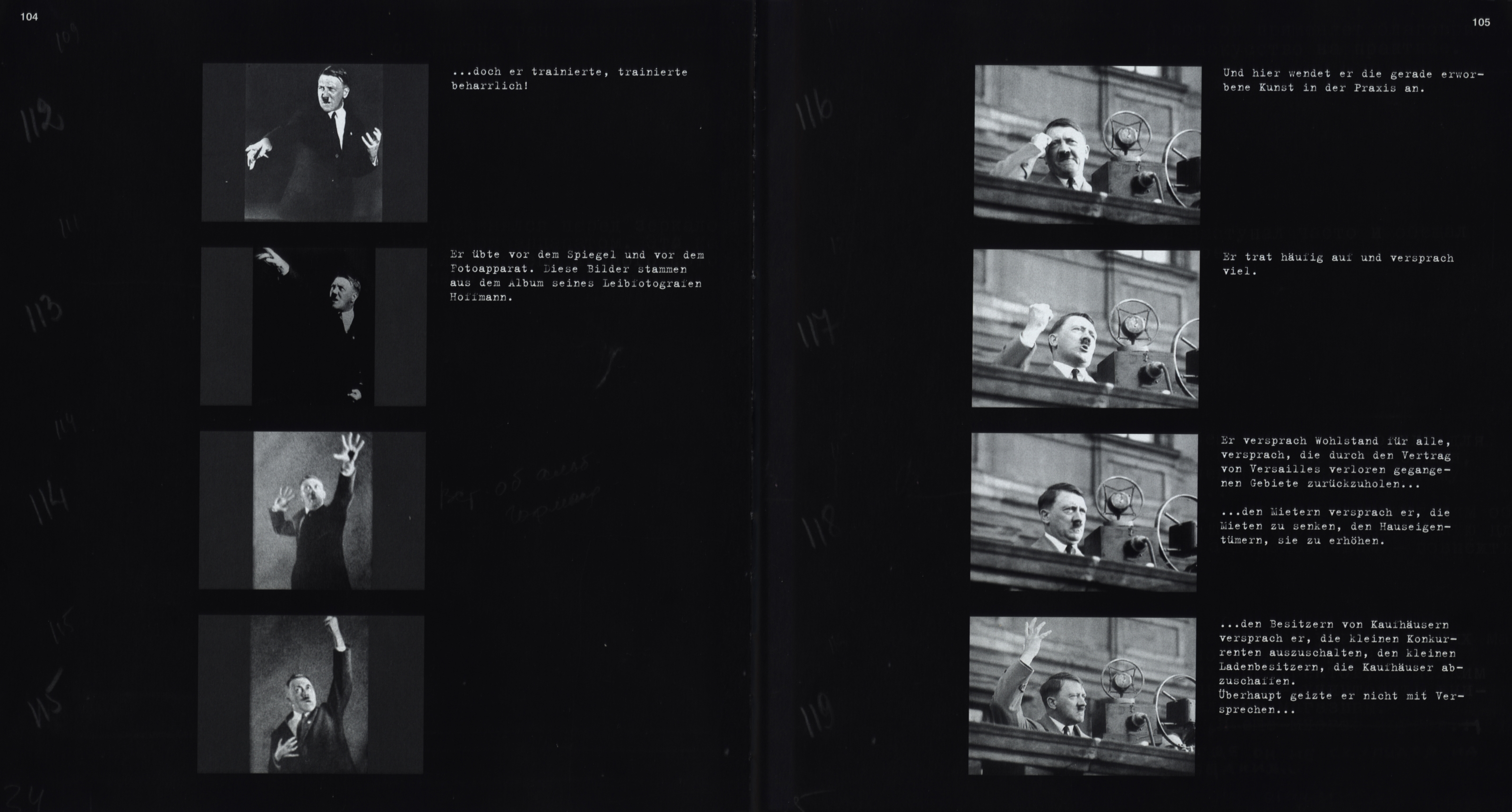
15 | Der gewöhnliche Faschismus. Ein Werkbuch zum Film von Michael Romm (Beilenhoff et al. 2009, 104-105).
Warburg’s fixation upon a detail such as Mussolini’s “lip movements” is surprising. It seems as if he used cinema (“a wonderful aid in experiencing”) in a similar way as the binoculars through which he had observed the Pope in St. Peter’s Square. This leads to a later discussion of fascism as a phenomenon that widely utilized film as an analytical tool (Mithelfer). The anti-fascist documentary film, Ordinary Fascism (Обыкновенный фашизм), by Soviet director Mikhail Romm and released in 1965, uses a compilation of historical photographs and film evidence to expose the propaganda machinery of fascism. Romm comments, for example, in narrative voice-over, upon public speeches of Hitler and Mussolini, focusing upon their delivery, performance, and mannerisms, calling their expressions and gestures artificial.
In this way, the film underwrites Warburg’s approach to a later film document featuring Mussolini. Since his appearance in the 1929 footage we saw previously, Mussolini had refined his mastery of film as a medium. As with Hitler, many of his speeches were recorded on camera in close-up. Romm notes that the production of these images was closely controlled, citing the retouching of images to remove unwanted figures (contrary to Romm’s assumption, it was not King Victor Emmanuel III of Italy who was retouched out of the picture, but the heads of two unidentified figures in the background. The speech given by Mussolini has not been dated). It is worth noting also that the cutaway, which Warburg mentioned in 1929, had been replaced by a uniform. The mimicry of normality towards the Church gave way to the open display of militarism. Fascism had elevated itself to the status of a cult. Instead of religious processions, we now see torchlight marches and military parades, a development that Warburg had already foreseen. Mussolini’s facial expressions appear exaggerated, as if he were “acting for the back row”, yet captured in close-up.
Hitler was also known to use theatrical gestures. The photographs taken by his personal photographer, Heinrich Hoffmann, which Romm also appropriated, have become quite famous. Like film stills, they depict Hitler rehearsing his repertoire of facial expressions and gestures, enacting a narcissistic mirror stage, creating a form of communication that accepts no contradiction.
Despite being subject to censorship—ironically, in the Soviet Union—Romm’s film was very successful internationally. Much of its found footage was being seen for the first time. The documentary is divided into sixteen chapters, separated by text panels, much like chapters in a book, and narrated via voice-over. Romm’s extensive research for the film included around two million meters of film material from various archives, as well as large quantities of photographs and other documents. These were images of atrocities and propaganda, unlike the artworks used by Warburg, which did not bear long cultural histories. In Romm’s work, visual art appears only as part of political propaganda.
Images in the film are interpreted through comparison and contextualization. Parts of the material are ridiculed from an antifascist perspective. The screenwriters, Maja Turowskaja and Yuri Chanjutin, aimed to depict the collective unconscious, according to Siegfried Kracauer’s 1947 study, From Caligari to Hitler. The film asserts that the present is shaped by the past, as suggested by the children’s drawings at the beginning. Aesthetically, the film relies upon abrupt cuts and Eisenstein’s “montage of attractions” (Beilenhoff et al. 2009, 12-17). Additional scenes shot for the film follow principles of ethnographic observation and cinéma vérité. It is worth mentioning as well that the film was originally conceived as a book, too, but was not published until 2008 due to censorship.
2025
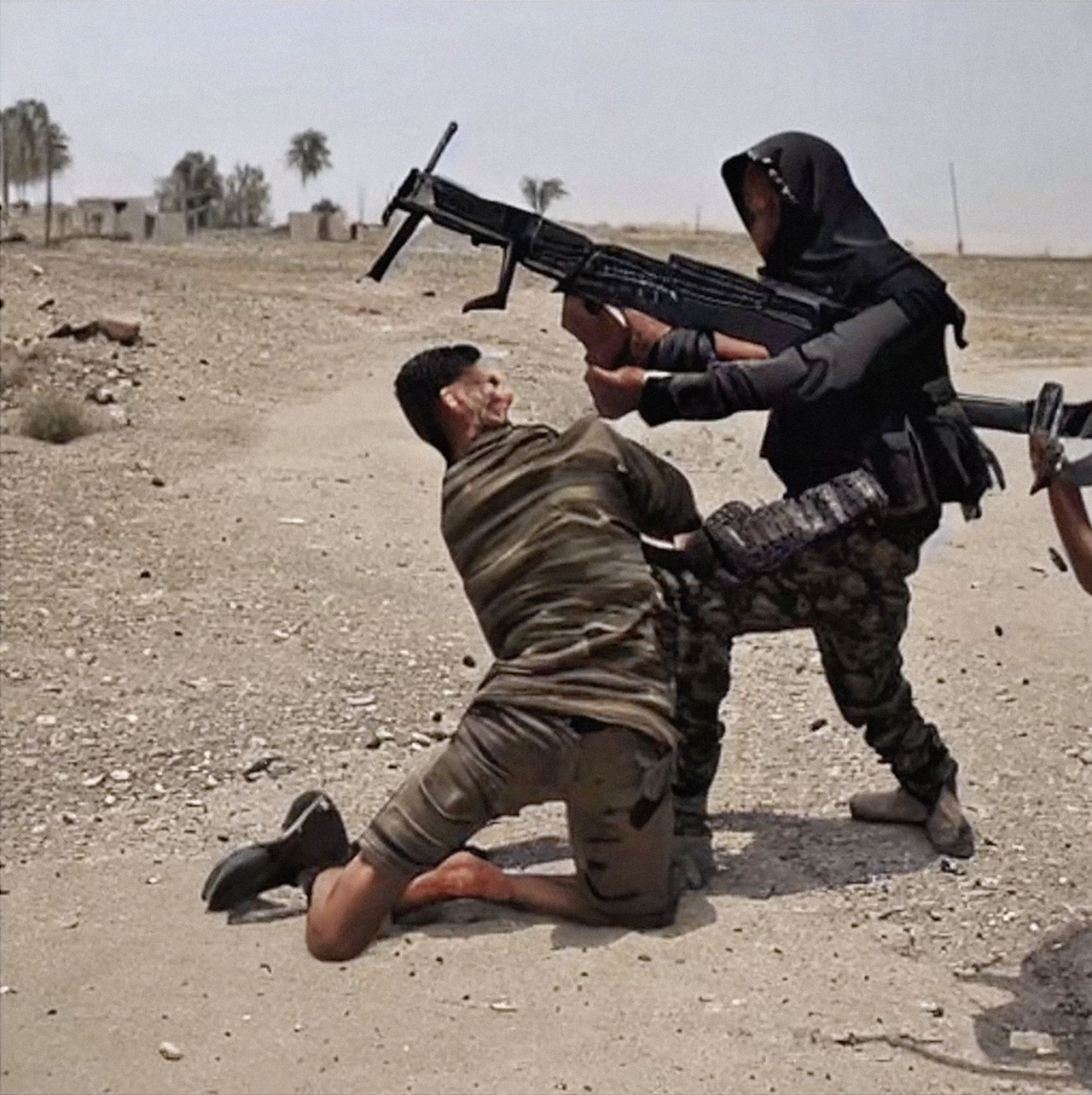
16 | Afterlives (Kevin B. Lee, 2025), Screenshot (Meyer 2025b).
Returning to Warburg’s conception of film as a “magical aid” and the potential he saw in film with regard to political iconology, we should remember that he did not consider film to be an art form in its own right. Rather, he considered it a recording technique, and cinema, a stage for social negotiations. La conciliazione fra l’Italia e il Vaticano documented on film the union of Church and State, and the ritualized procession associated with it, preserving it to be experienced beyond St. Peter’s Square and in other times. However, Warburg’s short phrase “in spite of everything” is also crucial. It refers to the film’s superficial propagandist intentions; intentions that can be subverted through analysis. Similarly, Romm’s Ordinary Fascism could be understood as a guide to reading the images and testimonies of fascist propaganda in a way that undergoes their original intentions and reveals their falseness. This characteristic also caught the attention of Roland Barthes, who revisited Romm’s film for his theory of the “third meaning” (Barthes [1970] 1973).
Although Warburg was blind to the artistic qualities of cinema, he saw something in film that is more relevant today, in the post-cinematic age. In 1930, Béla Balázs described cinema as a “lexicon of gestures and facial expressions” (Balázs [1924] 2010, 12). Warburg would certainly have liked this proposition, and filmmakers such as Jean-Luc Godard and Harun Farocki have expressed similar ideas (In 1995, Farocki initiated a project with Friedrich Kittler and Gary Smith for a “visual encyclopedia of cinematic terms”, which was discussed at the 2001 symposium, “Suchbilder. Schritte zu einem Bildarchiv filmischer Topoi” at Kunst-Werke Berlin, with reference to Warburg’s Atlas. Consequently, Farocki considers his video essays to be contributions to an “archive of cinematic expressions”. For Godard’s approach in this direction see Helbig 2024, 205f). Today, this lexicon is not limited to film and cinema, however. Social media functions as a new platform for social negotiation processes. Given the format of short messages and fragmented quotations (GIFs, video clips, and memes) that characterize it, social media is well placed to initiate a modern archive of gestures. This is very much in line with Warburg’s concept of the collective memory (Mneme), in which historical engrams, or embodied patterns of body language, are stored and passed on. Even traditional image agencies, such as Getty Images, have begun to collect and sell “expression movements”.
As we know, things turned out differently. Digital archives of gestures and faces are primarily used for facial recognition by large organizations and companies. Social media is flooded with artificially generated images (so-called AI-Slop) and clips, while historical image archives and the discourse surrounding them are disappearing. In her recent book Hyperreaktiv, Annkathrin Kohout describes this phenomenon as “response without speech”, borrowing a phrase coined by Jean Baudrillard, indicating that content is at risk of being buried by the gesture of hyperreaction (Kohout 2025, 17).
As Roland Meyer has shown, AI-generated content is fabricated to feed ‘nostalgic’ feelings and instrumentalized as political propaganda (Meyer 2025a). The sheer scale of this raises the stakes and demands new strategies for maintaining analytical or forensic perspectives to expose manipulation and fake news.
Looking ahead, I would like to mention Kevin B. Lee’s new film Afterlives, which will soon celebrate its German premiere. It is probably just coincidence that the title refers to Warburg’s well-known ‘afterlife’ theorem (Nachleben). Lee’s film, which focuses upon propaganda images of the so-called Islamic State, makes the point that images which have disappeared from digital archives still exist as training data for digital image generators such as Stable Diffusion. These images form part of an archive of the visual unconscious. Lee allows the images to become visible again by feeding the generators with targeted prompts, albeit only as distorted and deformed surrogates (Meyer 2025b).
Antidote
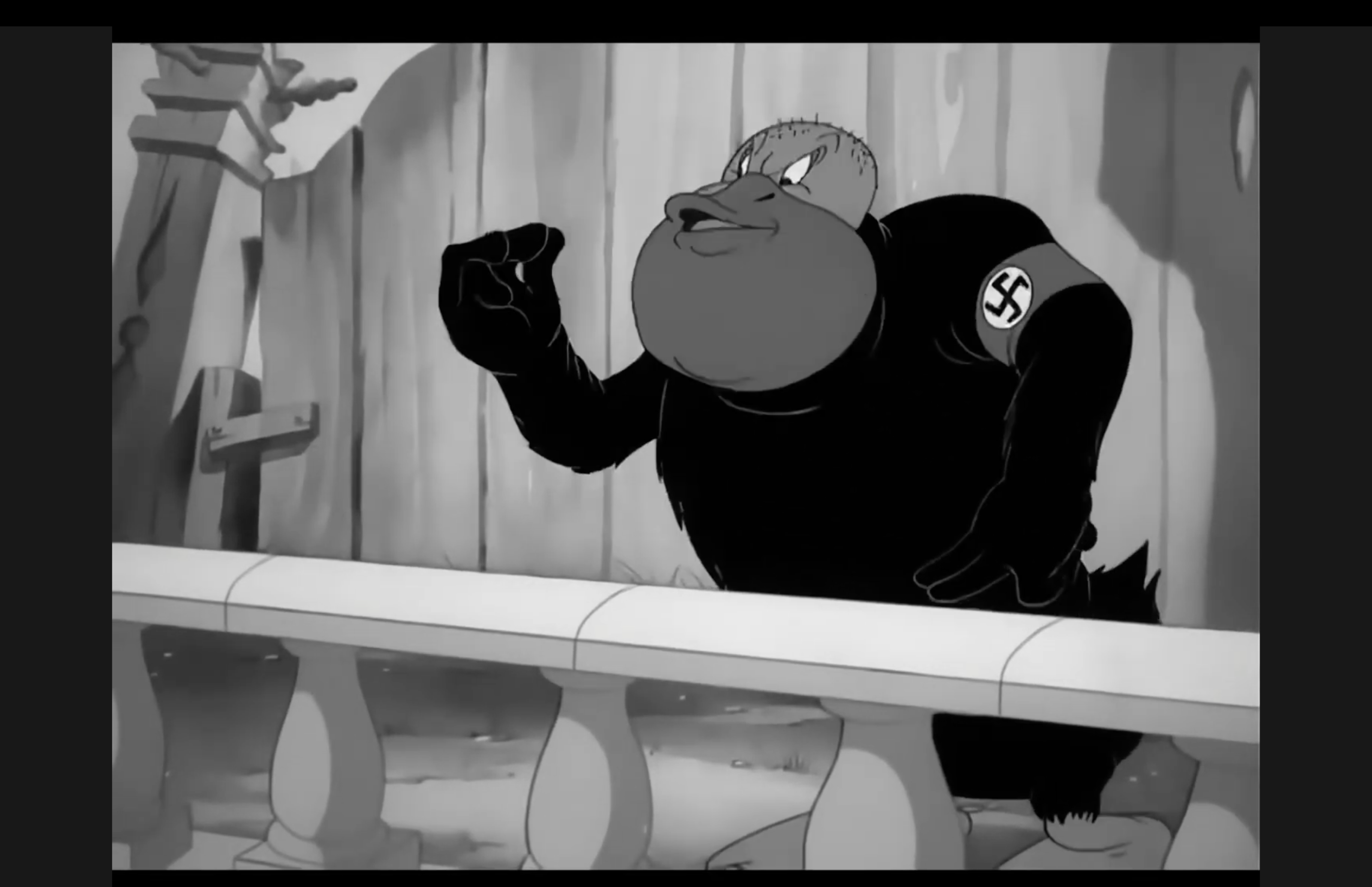
17 | Norman McCabe, Looney Tunes: The Ducktators, 1942, Warner Bros (click to watch).
The letters from Warburg quoted here were translated by the author. In some cases, existing translations (Schwartz 2020) were used and modified slightly. I thank Nicole Coffineau for her support.
Bibliography
Sources
- GS Atlas
A. Warburg, Der Bilderatlas Mnemosyne, hrsg. von M. Warnke und C. Brink, Berlin 2000. - GS Tagebuch
A. Warburg, Tagebuch der Kulturwissenschaftlichen Bibliothek Warburg, hrsg. von K. Michels und C. Schoell-Glass, Berlin 2001. - GS Ausstellungen
A. Warburg, Bilderreihen und Ausstellungen, hrsg. von U. Fleckner und I. Woldt, Berlin 2012. - GS Briefe
A. Warburg, Briefe, hrsg. von M. Diers, S. Haug mit T. Helbig, Berlin 2021.
Bibliographical references
- Balázs [1924] 2010
B. Balázs, Visible Man or the Culture of Film [Der sichtbare Mensch oder die Kultur des Films, Wien 1924], in Id., Early Film Theory: Visible Man and The Spirit of Film, edited by E. Carter, trans. R. Livingstone, New York/Oxford 2010, 1-90. - Barthes [1970] 1973
R. Barthes, The Third Meaning: Notes on some of Eisenstein’s Stills [Le troisième sens. Notes de recherche sur quelques photogrammes de Sergei Eisenstein, “Cahiers du cinéma” 222 (juillet 1970), 12-19], trans. R. Howard, in “Artforum” 11,5 (January 1973), 46-50. - Beilenhoff et al. 2009
W. Beilenhoff, S. Hänsgen, M. Turowskaja (Hrsg.), Der gewöhnliche Faschismus. Ein Werkbuch zum Film von Michael Romm, Berlin 2009. - Brecht [1955] 2008
B. Brecht, Kriegsfibel, hrsg. von B. Brecht-Schall, Berlin 2008. - Bredekamp [2010] 2018
H. Bredekamp, Image Acts, A Systematic Approach to Visual Agency [Theorie des Bildakts. Frankfurter Adorno-Vorlesungen 2007, Berlin 2010], edited by E. Clegg, Berlin 2018. - Diers 1991
M. Diers, Warburg aus Briefen: Kommentare zu den Kopierbüchern der Jahre 1905-1918, Weinheim 1991. - Ernst et al. 2003
W. Ernst, S. Heidenreich, U. Holl, Editorial. Wege zu einem visuell adressierbaren Bildarchiv, in Iid., Suchbilder. Visuelle Kultur zwischen Algorithmen und Archiven, Berlin 2003, 7-15. - Esposito 2020
F. Esposito, Beflügelte Bilderfahrzeuge für und wider Krieg und Faschismus, “Visual History” 18 Mai 2020. - Goldstein 1925
J. Goldstein, Karin Michaelis: Der Fall D'Annunzio, “Der Morgen” 5 Dezember 1925, 619-620. - Helbig 2024
T. Helbig, Film als Form des Denkens. Jean-Luc Godard. Geschichte(n) des Kinos, München 2024. - Klenner 2007a
J.P. Klenner, Mussolini und der Löwe. Aby Warburg und die Anfänge der politischen Ikonographie, “Zeitschrift für Ideengeschichte” 1,1 (Frühjahr 2007), 83-99. - Klenner 2007b
J.P. Klenner, Der Duce ist nicht aus Email. Aby Warburg, politisch?, in Ordnungen in der Krise. Zur politischen Kulturgeschichte Deutschlands 1900-1933, hrsg. von W. Hardtwig, München 2007, 449-480. - Kohout 2025
A. Kohout, Hyperreaktiv. Wie in Sozialen Medien um Deutungshoheit gekämpft wird, Berlin 2025. - McEwan 2008
D. McEwan, Die Pospisil – Warburg Korrespondenz im Warburg Institute / Korespondence Pospišil-Warburg uložená Warburgově institutu, in Hanák na Pacifiku. Zapomenutá osobnost Františka Pospíšila. A Man from Haná on the Pacific Coast. The forgotten figure of František Pospíšil, hrsg. von H. Dvořáková, Brno 2008, 183-206, 207-218. - Meyer 2025a
R. Meyer, “Platform Realism”. AI Image Synthesis and the Rise of Generic Visual Content, “Transbordeur” (September 2025). - Meyer 2025b
R. Meyer, Synthetische Archive, “Zett-Magazin” 2 Dezember 2025. - Modes 2022
J. Modes, Pressefotografie als Spielball der politischen Ikonographie, in Politische Ikonologie. Bildkritik nach Martin Warnke, hrsg. von J. Probst, Berlin 2022, 149-169. - Pospisil, Warburg [1926-1929] 2003
F. Pospisil, A. Warburg, Lettres, “Trafic. Revue du Cinéma” 45 (2003), 136-141. - Schwartz 2020
P.J. Schwartz, Aby Warburg and Cinema, Revisited, “New German Critique” 47 (February 2020), 105-140. - Warnke 1992
M. Warnke, Erhobenen Hauptes, in Die Beredsamkeit des Leibes. Zur Körpersprache in der Kunst, hrsg. von I. Barta-Fliedl, C. Geissmar-Brandi, Wien 1992, 190-194.
Filmography
- Afterlives, directed by Kevin B. Lee, D/BG, 2025.
- La conciliazione fra l’Italia e il Vaticano, LUCE, 1929.
- Ordinary Fascism [Обыкновенный фашизм], directed by Mikhail Romm, SU, 1965.
Abstract
Thomas Helbig’s contribution examines Aby Warburg’s engagement with cinema, focusing on his 1929 encounter with the documentary La conciliazione fra l'Italia e il Vaticano. Drawing on his letters, diary entries, and the Mnemosyne Atlas, the article traces Warburg’s analysis of fascist imagery—particularly Benito Mussolini's body language and self-staging—and situates it within a broader genealogy of political iconography.
keywords | Kevin B. Lee; Martin Warnke; Mikahil Romm; Siegfried Kracauer; Mussolini.
questo numero di Engramma è a invito: la revisione dei saggi è stata affidata al comitato editoriale e all’international advisory board della rivista
Per citare questo articolo / To cite this article: T. Helbig, A Magical Aid to Experience. Warburg’s Use of Film as an Object of Political Iconology, “La Rivista di Engramma” n. 233 (aprile 2026).