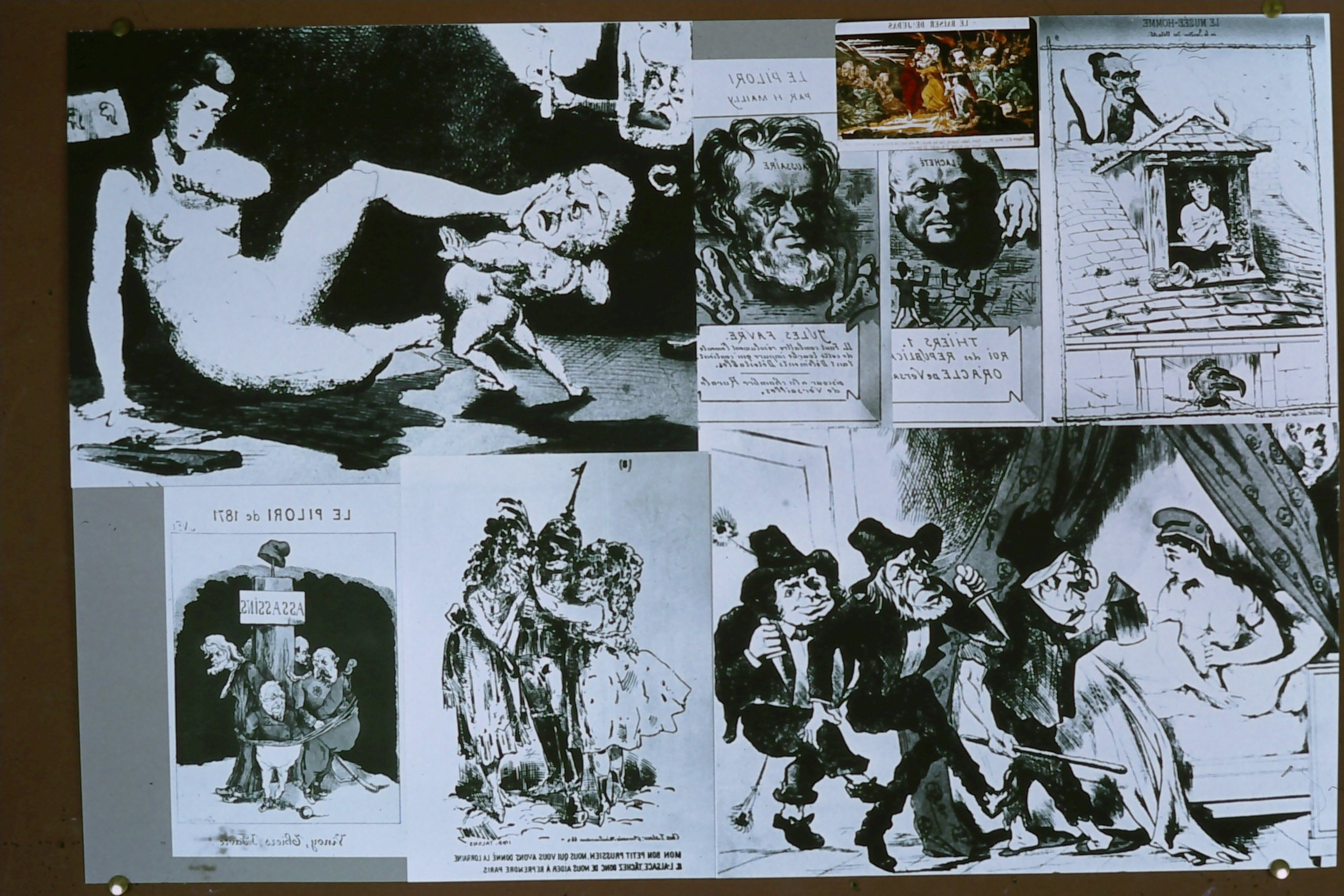
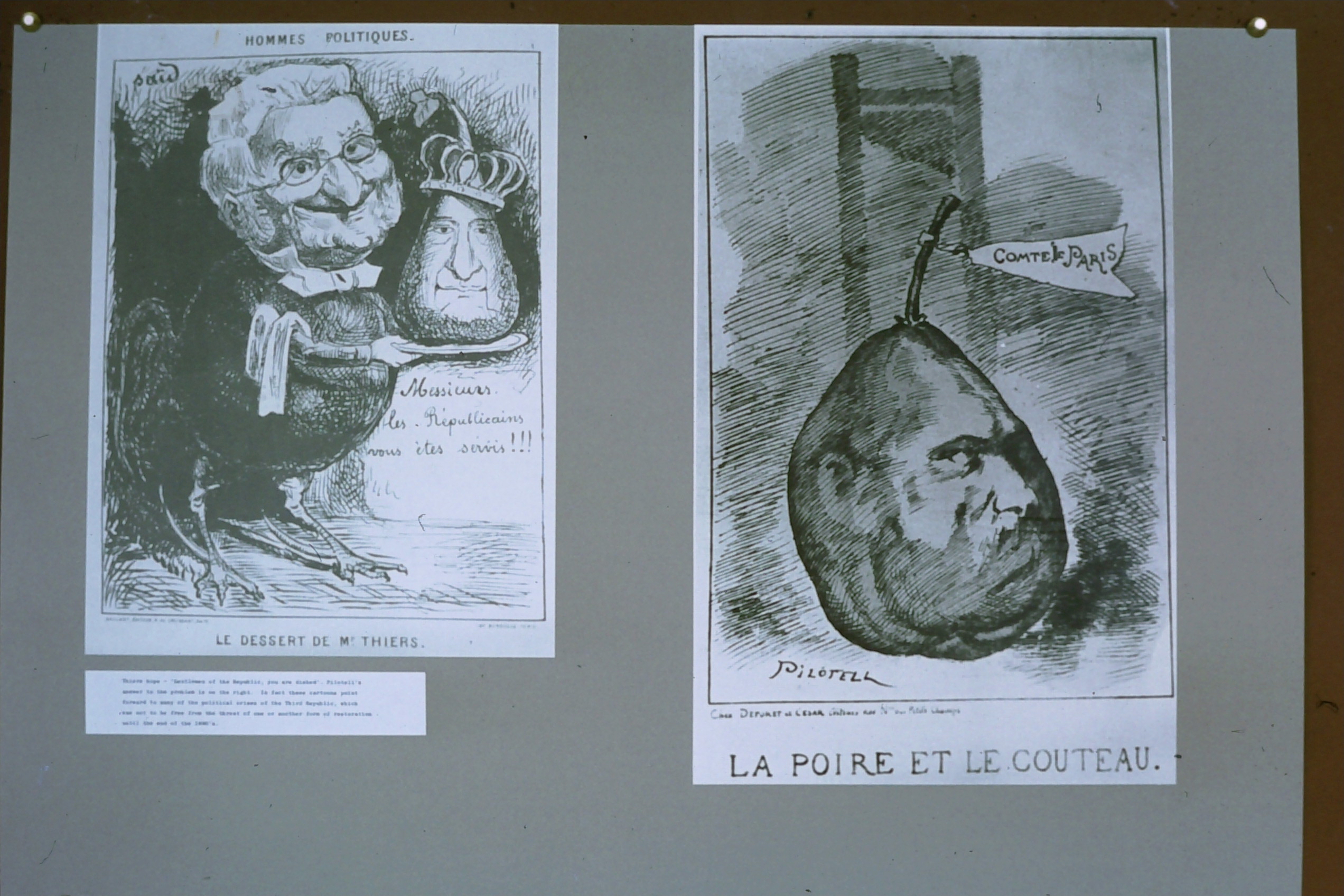
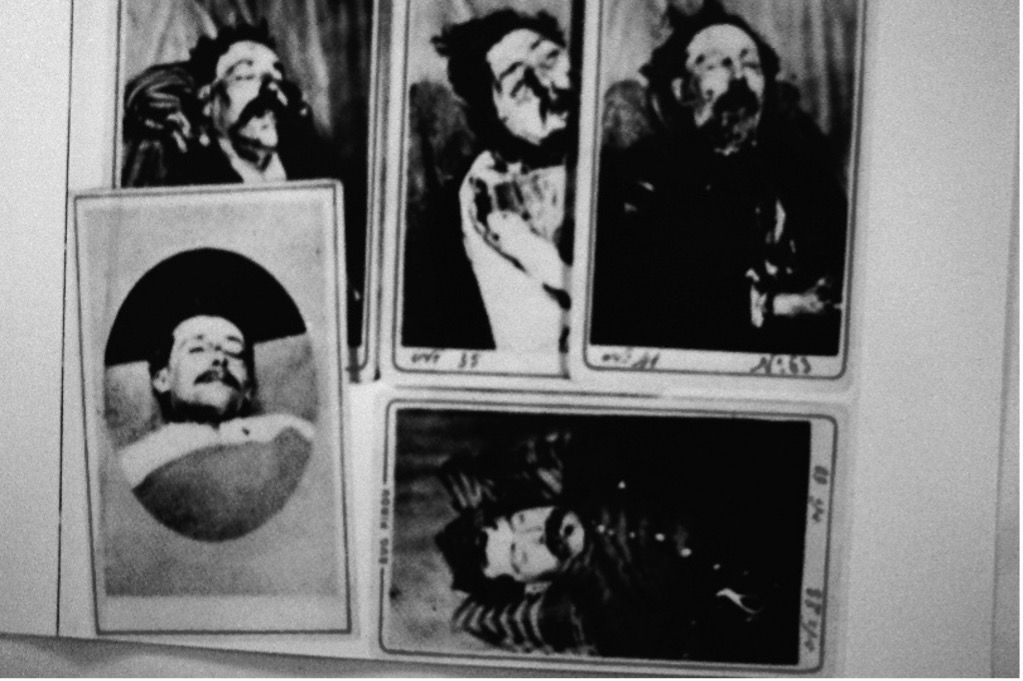
Let’s just write it in English or French, or rather just drop the German term of a Bilderatlas, or an atlas Mnemosyne, and call it a picture book that turns out to have become a map, neither Nachleben nor a set of Pathosformeln. This plate opens up the figural possibilities of displaying historical uprisings and revolutions, in this case the Club movement of the end of the Second Empire in Paris after 1867. Gesture, speech, gender, social class and situation, politics and profanity.
In Susanne Müller’s Aby Warburg – Fragments sur l’expression, the uncompleted complexity and endlessly deferred conclusions of Warburg’s reflections leave me in little doubt that the Atlas itself was ‘little’ more than an attempt to achieve a possible moment of arrest. What follows sets aside some of his key concepts of psychology as of Mnemosyne as such. If, in my exhibition of the Paris Commune of 1871 and its emergence from the closing years of the Second Empire, I invoked the previous revolutions of 1830 and 1848, this was rather to do with issues of the institutions of satirical production and the Parisian press and personnel of artists and draughtsmen.
At my pre-school in 1950 we cut and pasted a large and spread-out version of a book about the seasons in a single great tree, at my junior school a scrapbook of the coronation of Elizabeth II of England. This at least was an introduction to ‘picture research’, it was no longer play. Magazines, newspapers, commemorative chocolate and biscuit boxes, postcards, posters, advertisements for trips to London, abbeys, cathedrals, all pasted page after page, an album that grew to 3 cm thick with its accompaniment of objects, trinkets, souvenirs. Now it would look like a cabinet of curiosities, then it was a systematic exposition of the gestures of the British monarchy at that moment and our gesture of participation in them.
In Francesca Cernia Slovin’s novel as biography of Aby Warburg, Obsessed by Art, this bringing out of the world as image, of assemblage as cognition, is exactly how she understands Saxl’s care of the still damaged Warburg on his return from Kreuzlingen. It is not a question of making meanings, above all not the aleatoric third meaning to the theory of montage. These processes rather are the practice of parataxis, of one thing and then another, a practice of the comma, of ‘and’ and also of ‘and then’. These are matters of pleasure, caprice, fantasy, rather than of the reasoned production of argument or finality, the old desideratum of means without ends. It is a practice of delay and postponement, the rule of ‘and then’ over certainty…
When I first worked in the Warburg Institute Library in 1967 it was to read The Lecture on Serpent Ritual in Gertrud Bing’s unadorned translation. The Atlas was discreetly in the background, a story to be related rather than a living resource and, as such, it touched me greatly but as a ghost, a haunting. And this is why I was never much interested in the subsequent reconstructions.
So, my next picture atlas in my life was not mine but that of my carer, the live-in maid who looked after me and my sister. E came from the deeply traditional working class of an old industrial region of South East Lancashire in the Pendleton area of the city of Salford. The accentuation of her spoken English was specific to that locality yet, typical of a segment of that class she read a great deal of classic fiction and Westerns and was a regular cinema-goer and vastly knowledgeable of the reigning star system. It is her album of clippings from the magazine “Picturegoer” that was my enchantment with the process of creating a memory atlas and the personal form of Mnemosyne as such.
The organisation of films by genre, by storyline and stars, the folded in layers of great favourites at different times of their lives make for a true cartography of a type of viewer and of this viewer’s life. Cartographies, as Nepthys Zwer and Philippe Rekacewicz put it in their introduction to their Cartographie radicale. Explorations, “cartographies remain, according to a very general definition, attempts at a re-transcription of a world”.
This holds for my own exhibition – made around 1980 – of political and satirical cartoons and posters of the Paris Commune of 1871, framed in the closing years of the Second Empire and the repression that followed it. But if a narrative form were on my mind, it was not formed by AW nor of my many years shunting between the floors and idiosyncratic call numbers of the library at the WI. Rather it came from a theory and practice of British folk song as a radiophonic practice in the Radio Ballads. Sometime after these I was to make my own 11 essays in radiophony for the BBC which entailed an involution of words and sounds that enabled a narrative of urban song around singers like Piaf, Fréhel and Berthe Sylva. The craft of creating these works on 1-inch audio tape in the BBC studios in London was a world of pre-digital technical parataxis, floating in a song here under my words, cutting a noisy breath from my voice with a note of Édith Piaf.
Parataxis then, as a theory, came to me not from Adorno on Hölderlin, but from Charles Parker, sometime BBC radio producer and then, in 1978, director of a radical popular theatre company in Birmingham called Banner Theatre of Actuality. Theatrical actuality, as practised by Charles as well as by my own sister, who was to succeed him at Banner, was the theatrical juxtaposition of fragmentary accounts, recorded first-person accounts of lives, of the ‘menu peuple’, workers in dying industries – steel, coal -, farm workers or emergency health care, herring fishermen and their wives, cut together with historical songs and newly written music.
This process too had little to do with Brechtian ‘alienation’ but rather it drew an intense sympathy with a soundscape, enunciations, gestures. I might add that, much as I admired this work, it was mortally straight and sexually conventional, and that the emerging idea of a subtle queer narrative to accompany the rocking days of Gay lib was inherent in my processes. Many anti-Communard satires took ‘effeminacy’ as their focus of political derision, and that had to work as a visual infusion.
The model then was that of Radio Ballads made by Parker with singers like Peggy Seeger and A.L. Lloyd, who was also an eminent professor of classical theatre. For them parataxis was the narrative form of folk song and enunciation in general, transcending the limits of emplotment and structured narrative; perhaps owing something to Propp in his famous Morphology of the Folktale, or, for me, the early work of Arnold van Gennep. At the same time Parker believed parataxis to be a method at the heart of the three volumes of Karl Marx’s Das Kapital. The high point of the Radio Ballads I think was an exquisite account of the herring fishing industry of the East Anglia and north-east Scotland entitled Singing the Fishing (1960), while the Black Box, concerning the Black Panther Bobby Seale, was to be quietly omitted from the record.
The underpinning of this informal yet highly crafted structure was, at that time, the re-evaluation of ‘popular’ or ‘low’ art as having a value beyond that of the ethnographic museum, even if in the progressive manner of a G.-H. Rivière in his Musée des Arts et Traditions Populaires. Warburg himself fanatically excluded the aesthetic value of such art, his own tastes running mostly to a highly conservative civic realism. Edgar Wind also insisted that the semiotic substances he deployed were only significant insofar as they served his interpretation of the sublime enigma of the masterpiece. So, we were playing with fire made from the art of dispossession and of ‘subaltern’ cultures.
From 1968 to 1972 my main research efforts were directed at the French Academy and the social and ethno-linguistics of art writing and criticism beyond the framework of the traditional teleology of classicism and romanticism. Lévi-Strauss was more significant than Warburg. Such a method was suited to a teaching environment across art and art history. For example, in looking at the role of art in the formation of nineteenth-century nation states on one hand, or the emergence of Cultural Studies as a new discipline in Birmingham University, the inspiration of Stuart Hall. In my case this unfolded in a Polytechnic, a new model of open access higher education and art practice set up in 1969 as the summum of the slow evolution of post-war educational politics. This was the condition of my life as a teacher, freshly minted from the thinking of Wind and Rosenau, a grand student of Aby Warburg and Erwin Panofsky themselves, adrift in a new generation of studio work on the one hand and French and Historical studies on the other.
The first time that I tried to show art students in 1970 something of Wind’s Pagan Mysteries they thought that I was simply raving and, truly, I began to see that my iconology must come to be derived from them. Their doing and my intellectual histories had to meet as mutually and equally informing. The composer Cornelius Cardew’s great graphic score Treatise transformed the fundamental relation between figura and enunciation, and playing it out in concert through the randomly cast enigma of the I Ching offered yet another meta-language and meta figurality that was essentially a relation between grapheme and sounding. In my story boards the presence of song and music, academic and popular alike, running through my thought was fundamental – beat, rhythm, visual syncope.
William Morris’s writing on the elaboration of a “really useful knowledge” led me to a mode of art historical and visual thinking left out of even the most developed forms of social art history as adumbrated in the early work of a T.J. Clark, though the subtleties of Michael Baxandall’s Giotto and the Orators were a valuable paradigm for thinking how images can be a mode of address – somewhere on an axis between apostrophe and prosopopoeia. Essentially the historiographical modelling of the exhibition was formed in the processes of syllabus formation that cut across the old disciplinary restrictions of social- art- science- literary- history. It was to enable the address of our work, that of me and my colleagues, to the public of a small civic museum in an old naval town on the South coast of England.
The development of this anxiety to be useful had found me during the long summer breaks of 1974-1976 seated in the print room of the Bibliothèque Nationale struggling with the huge volumes of mounted prints that were the Collection de Vinck; and then the municipal collections of St Denis and Montreuil, Amsterdam’s International Institute of Social History and elsewhere, building a new archive, elaborating a different method of articulating its visibility out of the widely dispersed visual archives of the popular clubs of the closing years of the Second Empire in France, and the Paris Commune itself and its aftermaths. I sought advice on the legitimacy of my work from the great historian of the French Revolution, Albert Soboul, who agreed that it was viable and even necessary.
The display was a process of re-transcription not just of a series of events in the long duration of revolutionary movements in France but of the possibilities of academic research, teaching institutional structures of my area of higher education in provincial England.
In those days too production was the outcome of literal balancing acts, with hard to install tripods, a 35 mm camera with close-up lens and manual exposure, in national and regional libraries and collections of books and prints. Of those beautifully bound and heavy volumes in the Cabinet des Estampes in Paris, I took about 600 shots in these perilous conditions; and hundreds more from the thousands, the Victoria & Albert, Sussex University and the collections I have mentioned. Others purchased in old book shops; research as a paratactical displacement of the body and so of the conditions of perception of the materials, one might say a specific phenomenology of study and perception.
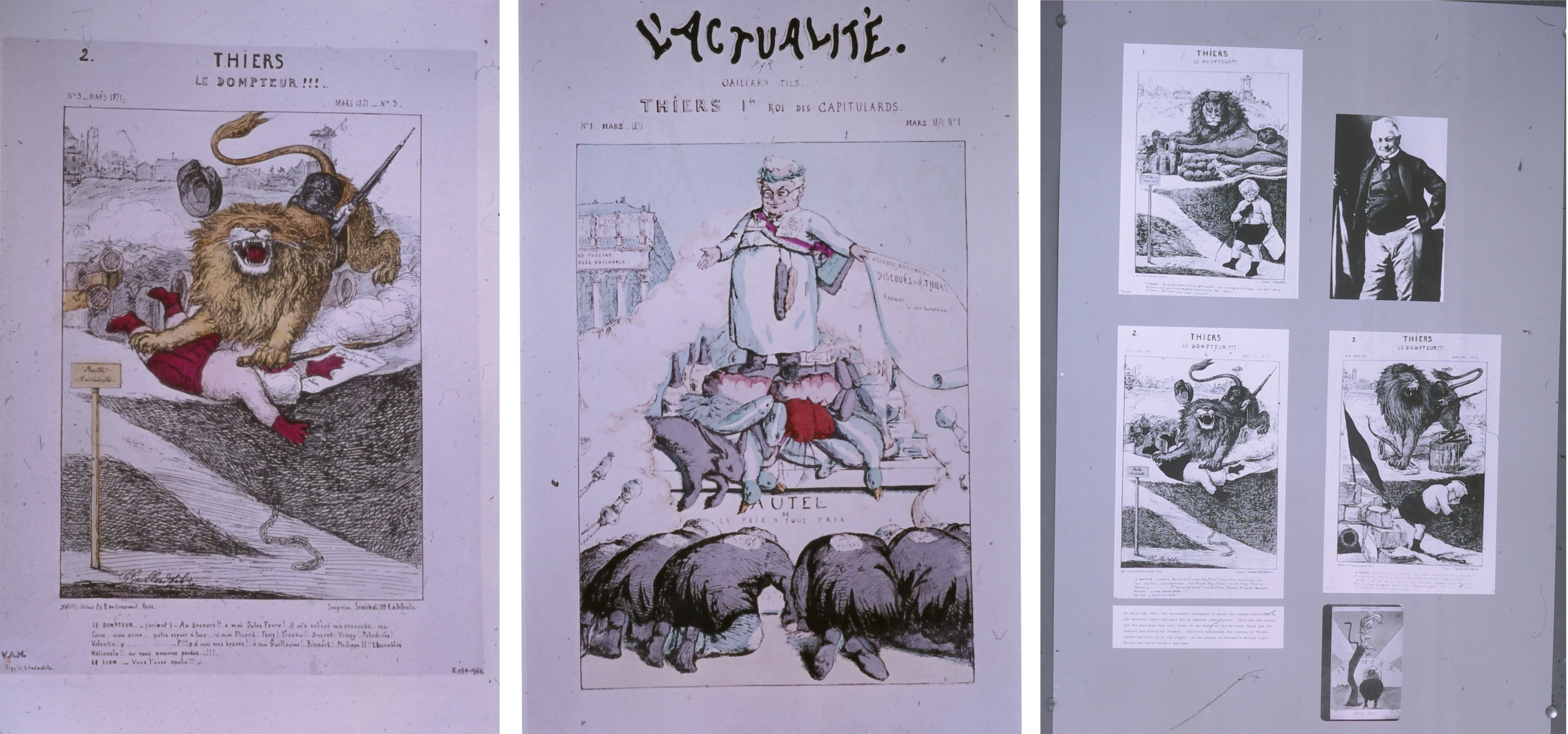
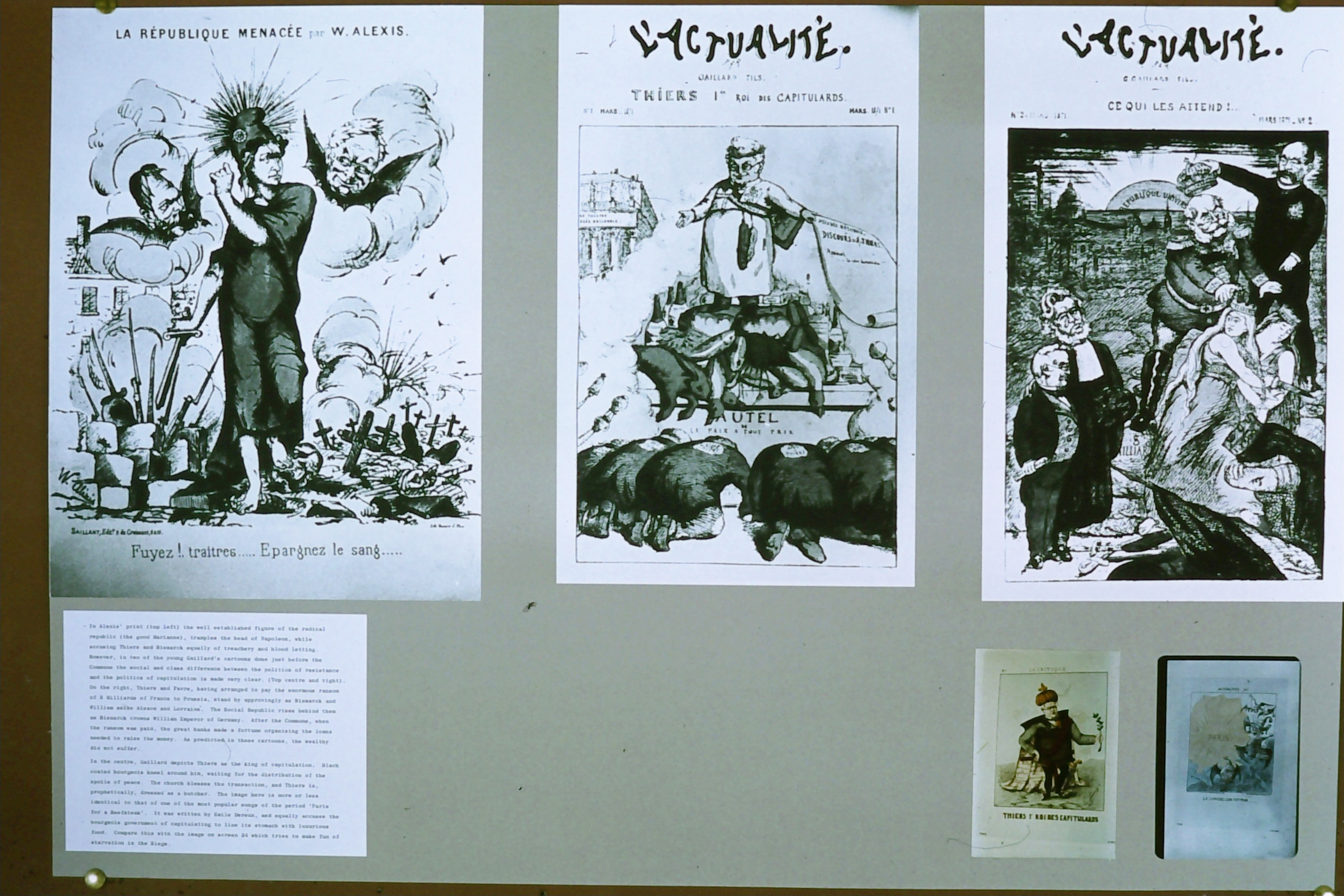
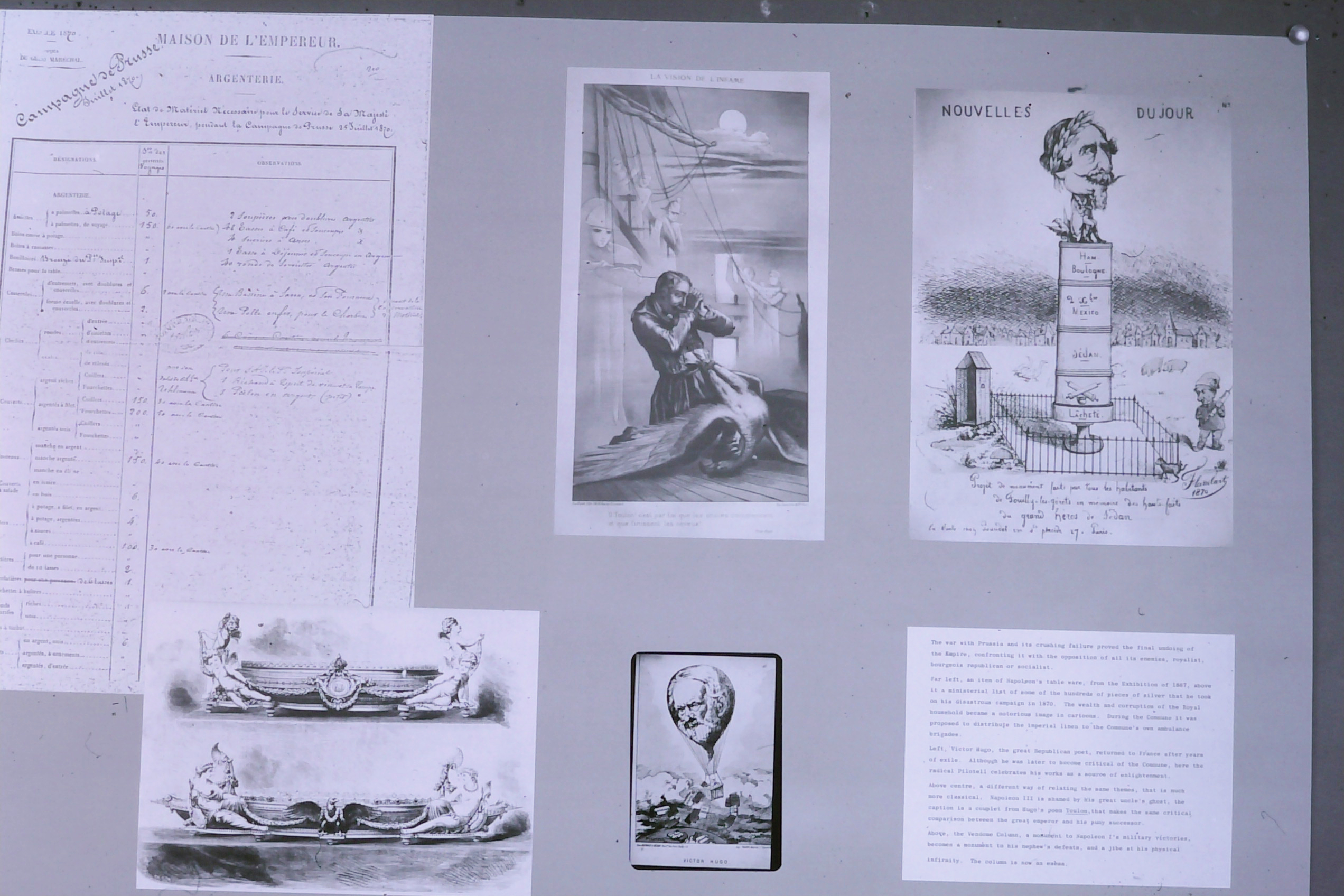
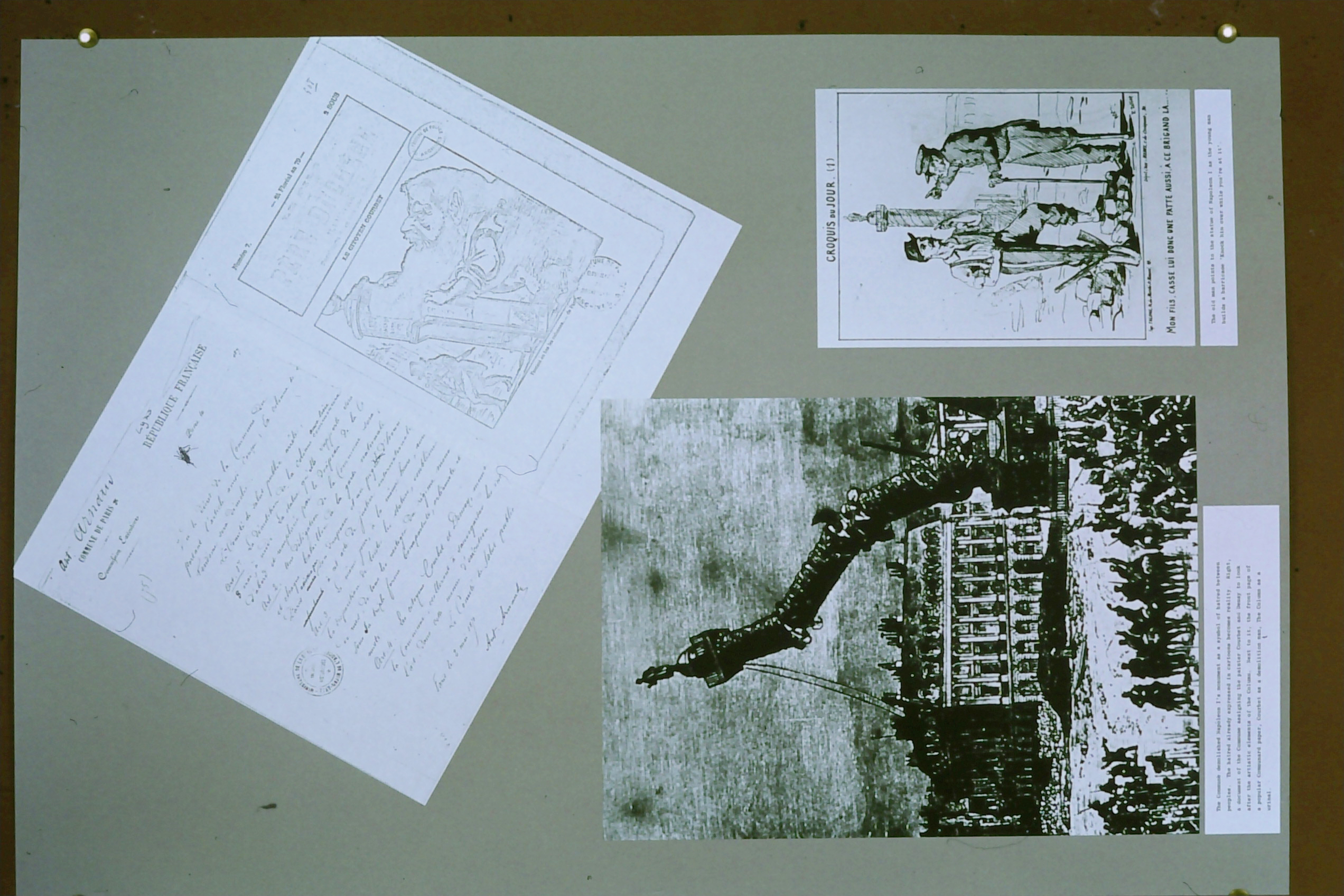
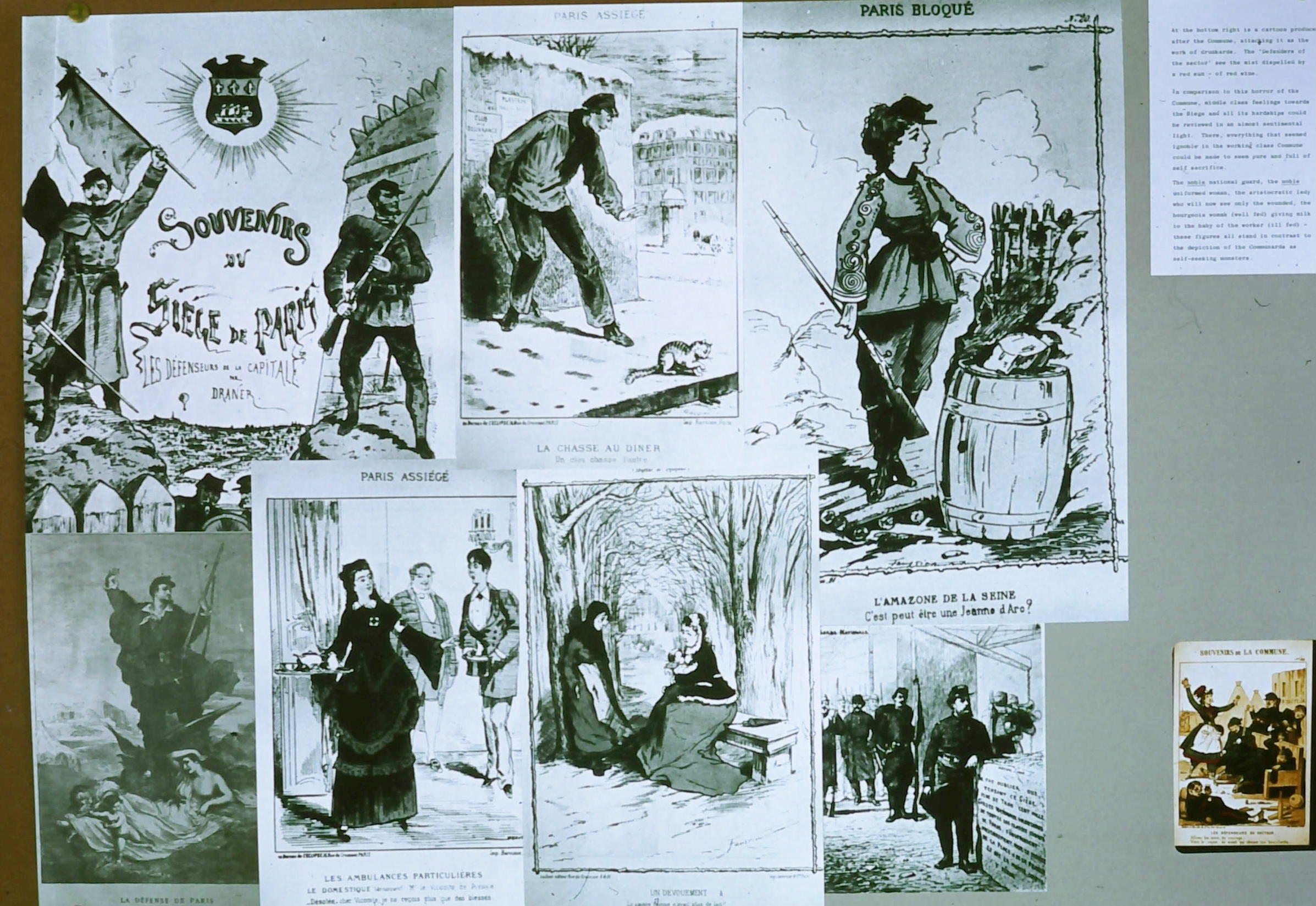
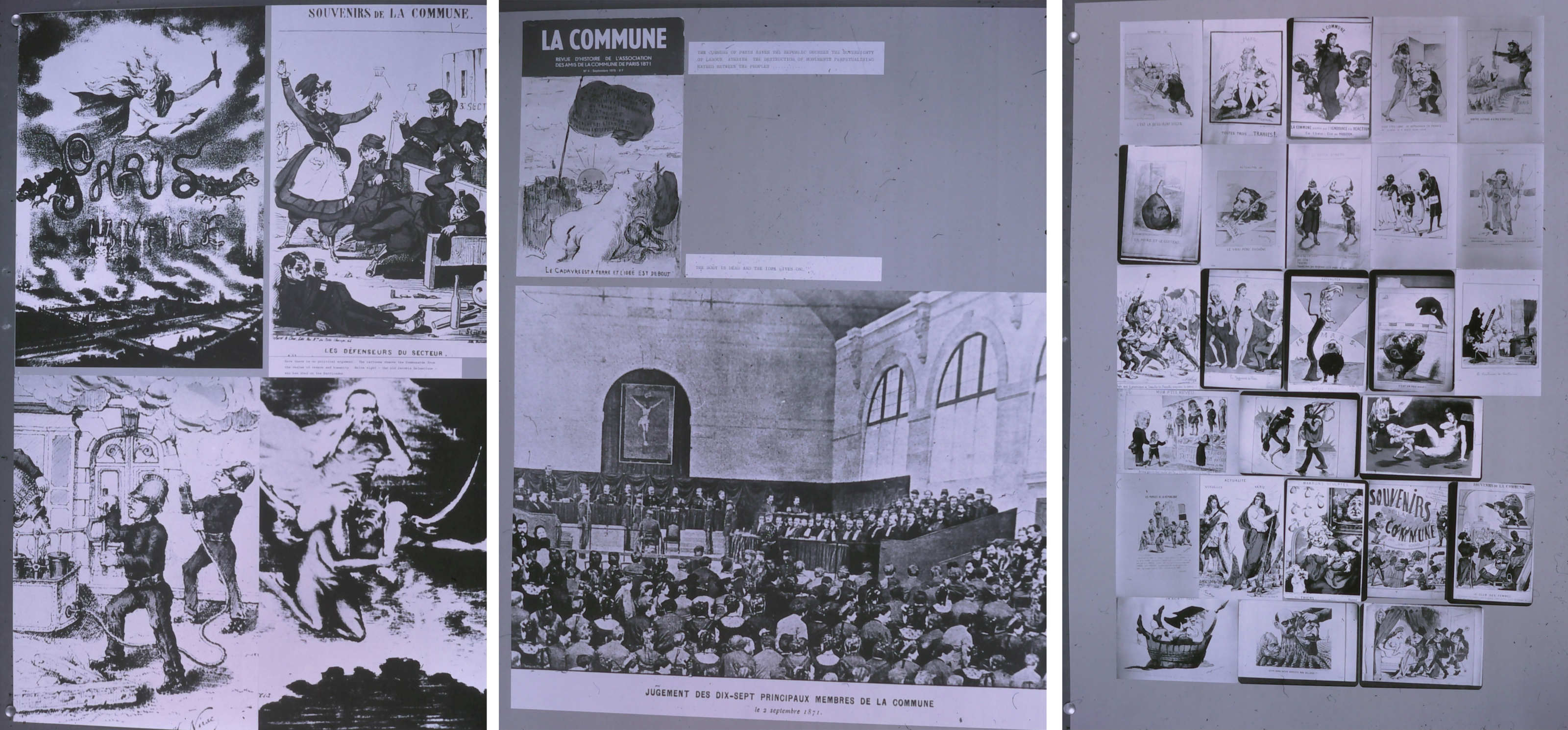
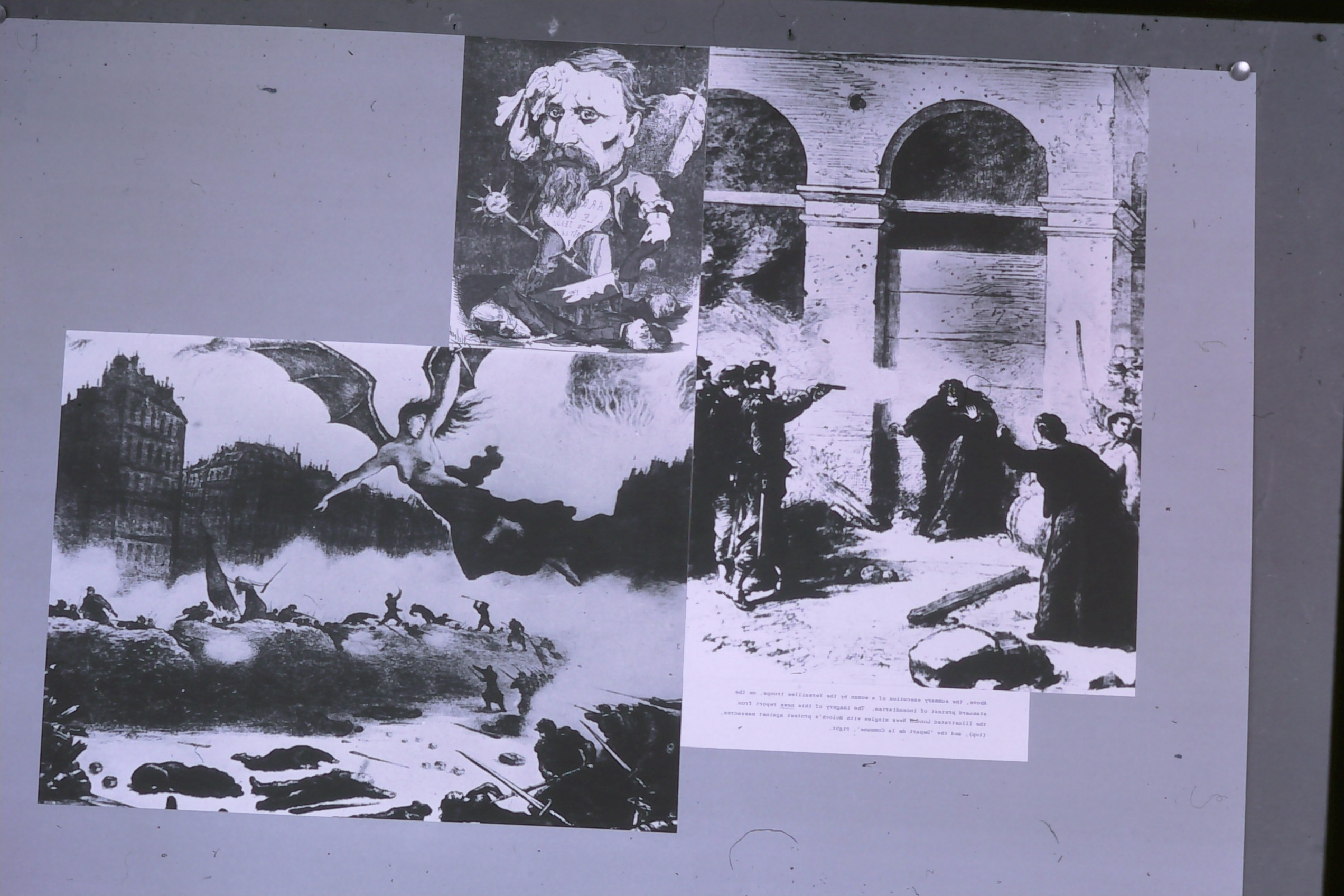
In the 51 A3 cards on which I mounted the images, all were taken, developed and printed by me, other than a small number of commercially printed colour slides. They included copies of the reports of police surveillance of radicals and revolutionaries from the Archives de la Police and de la Guerre in Paris, and here important art historical figures like Gustave Courbet and Jules Dalou could be no more than staging points. ‘Minor’ artists could be excavated from the archive of their revolutionary colleague Jules Perrier in the Bibliothèque publique et universitaire of Geneva. They were mounted first with double-sided tape to judge look and balance and finally heat glued with individually cut sheets of paper adhesive, and captions written to assist the viewer, not to carry the story. Who was this viewer? As I remarked there was the odd trickle of people who passed through the municipal gallery in Portsmouth and then students on the Historical Studies BA in the Polytechnic who were taking an option on French Revolutions after 1789. So, it was for teaching on the one hand and an attempt to resolve a seemingly impossible resolution to a process of quantitative visual-historical research.
For example, of the hundreds of images of Marianne, the founding allegorical image of the French republic from 1789, and its evolutions through to 1830, 1848 and the close of the Second Empire and the Commune, how could they be ordered perhaps to disclose a history of social and sexual and political comportments? This word I use with care, as an open understatement. There is the figure of the red bonnet and how it is worn or held, the Liberty of Delacroix was just a minor instance in the flood. Is an arm raised to waist level, or shoulder or above the head, invoking action or holding back attack – this alone expanded into a history or a repertory of theatrical gestures and their stratified proprieties, regulations governing entertainment and censorship. And then the dress, from chaste to baring one breast to the whole chemise being cast aside. You can see that the enterprise opens a whole atlas of possible pages, of impossibly numerous permutations.
In the face of this drama of impossible realisation the model of a Bilderatlas becomes a form of contemplation, of reverie, of a persistent empiricism of one thing and then another. Or, to take a more complex approach to what now turns out to have been the case (the world is also what was the case, Ludwig Wittgenstein was always on my mind), Edgar Wind’s Dewey-based pragmatism emerged in my contemplation of the research as the ruins of the superfluous; I never found what I was looking for so I had to make do with what I found.
The making is both a construction and a release. And – strangely – in reflecting on this essay it is John Locke’s An Essay Concerning Human Understanding that now offers me an insight into my own process that supersedes the Warburgian model and roots me in another aspect of my own intellectual history. In a sense one makes do, there was no master plan, rather a work that came to a stop and what was became that moment, not of completion but of arrest. As William of Baskerville says at the end of Umberto Eco’s The Name of the Rose, “There was no plot and I discovered it by accident”.
Now, looking at these boards, I have nothing much to say about them. When they were done, 10 years after the feted centenary of the Paris Commune, it is as if forgotten, even though it spread the seeds of a post-colonial thinking and anger. Here are some of them, here see, “hic rosa, hic salta”, as Marx put it of 1848.
Maybe it’s best to mention my three heroes of the visual world. One is the cartoonist Pilotell (Georges Labadie) who fled to London and the shoemaker Gaillard père and his son Gaillard fils. The father was the head of the Barricades of the Commune and the son a witty untrained draughtsman and clever writer, whose lives followed Courbet to a Swiss exile and later, after the amnesty of 1879, back to Paris and a political life of police surveillance. Gaillard fils seems to fit well enough the mannerisms of a young man seen as ‘gay’, and I fell for him. The father wrote a treatise on shoemaking in 1853 Mémoire descriptif du mode de fabrication de la chaussure française en gutta-percha.
Otherwise another theme concerned the musician Francisco Salvador Daniel, slaughtered at the end of the Commune. Clearly of North African Sefardic origins, he wrote extensively on Arab music and composed Berber songs, and was director of the Conservatoire during the Commune; his written work was recuperated only in 1911 by the English Free Thinker musicologist Henry George Farmer and he figures in some of these panels. My sharing Sefardi origins with him made our relation all the more intense.
Abstract
Adrian Rifkin revisits the making of an exhibition of political and satirical images of the Paris Commune and the final years of the Second Empire. Drawing on childhood scrapbooks, archival research, art teaching and radio production, he traces the practices of selection and juxtaposition that shaped his fifty-one display boards. While Aby Warburg’s Mnemosyne Atlas provides a point of reference, Rifkin locates the formation of his visual method in the Radio Ballads, popular theatre, music and the material labour of collecting and mounting images. Parataxis emerges as a way of bringing images, voices and gestures into relation without subordinating them to a predetermined narrative. The essay reflects on popular visual culture, class, gender and queer identification, and on the provisional moment at which an open-ended process of research comes to rest.
keywords | Paris Commune; Parataxis; Radio Ballads; Charles Parker; Edgar Wind; Cornelius Cardew; William Morris; Michael Baxandall; Gustave Courbet; Pilotell; Napoléon Gaillard; Francisco Salvador-Daniel.
Per citare questo articolo / To cite this article: A. Rifkin, Telling with Pictures, “La Rivista di Engramma” n. 239 (settembre 2026).