A Rabbit in the Throne Room
Mies, SANAA, Transparency and Spectacle
Daniel Barba Rodriguez
English abstract
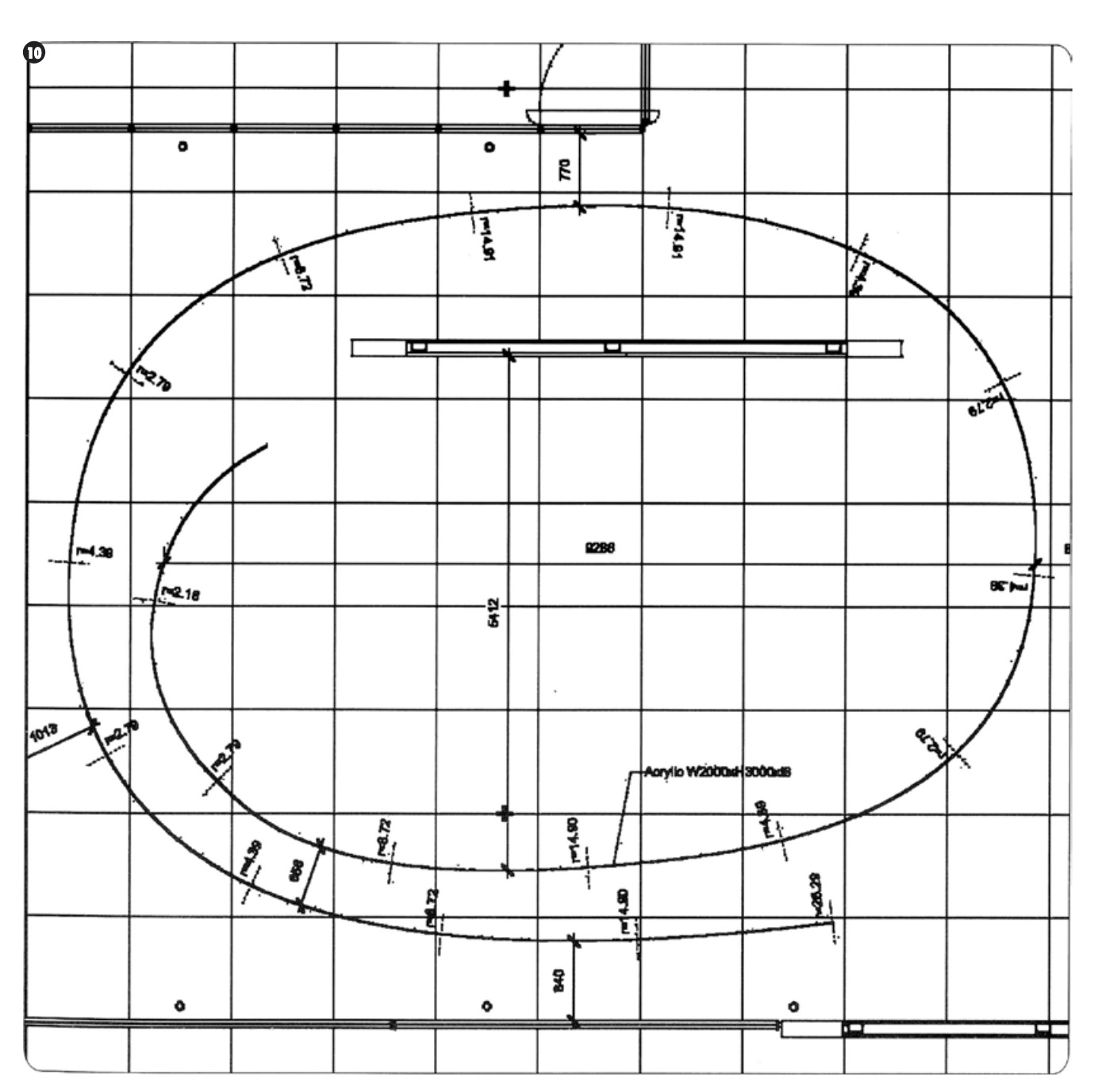
1 | SANAA, 2008. Intervention in the Mies van der Rohe Pavilion, Barcelona. Fundació Mies van der Rohe, 2010. ISBN: 978-84-92861187, 13.
Irony as Design Strategy – and Theoretical Anxiety. A Rabbit in the Throne Room
Can some acrylic glass and a simple chair alter the meaning of one of the most mythologized works of modern architecture? Can they expose the role of the ‘visitor’ within the society of the spectacle merely by juxtaposing it to one of the most sophisticated designs to ever exist? SANAA’s 2008 intervention in Mies van der Rohe’s Barcelona Pavilion operates within this double register.
The Barcelona Pavilion was conceived as a showpiece building for the German section of the 1929 Barcelona International Exposition. Although it did not house exhibitions in the conventional sense, its function was deeply ceremonial: it was designed to host the official reception of King Alfonso XIII of Spain and other institutional events related to the exhibition. Despite its radical break with historical forms of representation, the pavilion may still be understood as a contemporary interpretation of a Throne Room: a space organised around protocol, visibility, hierarchy and symbolic presence, but articulated through the abstract language of modern architecture.
It is no easy task to intervene in a space like this, conceived as a paradigm of modern elegance, a throne room articulated by the bare minimum of elements: boundless spatiality, two horizontal planes (plinth and ceiling), no visible supporting structure (which is concealed by the reflection from polishing the metal), a couple of parallel walls, some water, a sculpture, and two thrones (the celebrated Barcelona chairs – far from being ordinary pieces of furniture, were specifically designed for this occasion, occupying a prominent position within the space).
And yet, SANAA deepens the essentialism of this space with two precise gestures: a spiral-shaped glass structure – made of acrylic – that encloses the space and creates reflections and distortions, and a naïve rabbit-shaped chair – made of plywood – placed before the modern thrones. Two gestures that engage with the pavilion through a blend of respect and irony.
It could be argued that SANAA’s architecture continues the modern “new tradition” (Giedion 1941), following in the footsteps even of Mies himself: the search for essence, the use of minimal elements, a complexity concealed beneath a simple façade, a delicate understanding and use of materials, and a careful attention to spatial, optical and tactile clarity. And nevertheless, SANAA’s work is neither simple in its “design strategies” nor in its “theoretical anxiety” – two core concepts of architectural design coined by Rafael Moneo (Moneo 2004). On the contrary, it displays a sophistication that few have achieved regarding contemporary thought and aesthetics. They inherited modern pragmatism, order and rigour, while employing architectural strategies in accordance with the post-structuralist era in which we find ourselves: radical, experimental, surprising, ironic – in short, spectacular.
This modest yet ambitious intervention by SANAA serves as a manifesto explaining their stance on the current contemporary context: they are heirs to modernity, whilst at the same time having been exposed to postmodernity. Despite its apparent modern minimalism, above all, SANAA’s architecture is deeply phenomenological. Unlike Mies and other modern architects, SANAA’s aim does not appear to be the celebration of architecture as a self-defined object. Instead, it seeks the element of ‘surprise’ (Colomina 2019, 151-172), taking the optical and haptic effects of architecture to the extreme, even if this leads to the disappearance of the architectural object itself. Even more, in the hope that the design process will lead to the disappearance of architecture as an autonomous entity:
Within SANAA’s architecture, structure is never revealed. Their buildings are optical devices without any visible mechanisms […] To enter a SANAA project is to be caressed by a subtle softening of the territory. Even the reflections of trees in the outer layer of glass have a delicacy that one does not find in Mies’s work […] As they [Sejima] put it in an interview: ‘We try not to select options for which we can already imagine the outcome’. Theirs is an architecture of deliberately unclear vision […] SANAA’s architecture is not so much layerings of glass and acrylic as layerings of opacity – blurs, rather than lines. (Colomina 2019, 157-159)
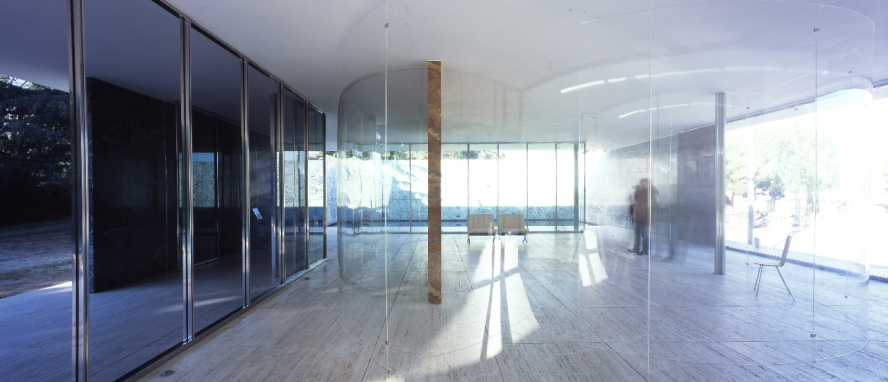
2 | SANAA, 2008. Intervention in the Mies van der Rohe Pavilion, Barcelona. Fundació Mies van der Rohe. ©SANAA / Ramon Prat / Fundació Mies van der Rohe (miesbcn.com/project/sanaa-intervention)
Through two apparently simple gestures, SANAA revisits some of modernity’s central concerns while subtly displacing their meaning: the acrylic spiral reconsiders the modern faith in transparency and fluid space through a veiled irony of distortions and reflections; meanwhile, the Rabbit chair addresses the pavilion’s representational dimension and the role of its visitors through a more direct irony. Taken together, these gestures reveal an attitude that is neither entirely critical nor entirely celebratory, but deeply ambiguous and never quite resolved.
Modernity and Transparency. A Glass Curtain
Nowadays, we are faced with a mythologised – and now also criticised – notion of ‘Modern Architecture’, shaped by the idealisation of the work of architects such as Mies, and in particular his most radical creations, such as the Barcelona Pavilion: a Royal Hall known for bearing no resemblance to the historical references of that typology. Lots has been written about Mies and his architecture, but to put it simply – because, after all, less is more – his essentialism and elegance lie in the radicalism and precision with which he approached spatiality.
In the Pavilion, to refer to ‘interior space’ is practically synonymous for ‘space beneath cover’, as one can hardly speak of enclosures or walls; and yet, the condition of ‘interior’ is unequivocal. The ceiling was designed with precision. It is positioned equidistant from the viewer’s eye level, which is generally 1.60 metres above the floor. This establishes a direct relationship with the body and the gaze. The ceiling appears to be unsupported; the structural elements disappear from perception. The metal supports are polished until they disappear in the reflection of their own surface. In turn, the three parallel walls on which the roof rests seem to exist to control the spatiality and direction of the gaze, but not to function as structural elements. In a sense, they are perceived more as just another piece of decor, with that elegance characteristic of Mies’s designs. The three interior walls guide the eye and, in a sense, define a potential enclosed private space, a sort of Throne room. Furthermore, the onyx wall serves a unique purpose. Its exquisite materiality lends it an imposing presence; given its density and its ability to confer symbolic significance – and therefore hierarchy – it could be argued that this is the element that defines the throne room.
Large glass panels enclose the space, creating physical but not visual boundaries. Transparency act as mechanism of delimitation, but not of confinement. The true boundary of the pavilion in relation to its context (originally, the 1929 Barcelona International Exposition) is established by the courtyard wall, the plinth and its water surfaces, forming an enclosure that could be defined as an outdoor yet enclosed space, within which is situated the pavilion itself (the-space-under-cover). A limited selection of furniture (four chairs designed by Mies), a sculpture by Georg Kolbe depicting a female torso (classical, organic and floating on water), the onyx wall, and the reflections on the glass constitute the decorative elements. They thus replace the traditional academic decor which, in the collective imagination, is associated with ceremonial spaces and royal halls. The glass enclosure acts as a mediator of the gaze and even as a protective element – just like the protective glass of a framed painting that separates it from the viewer.
This entire spatial strategy was based on the modern belief in transparency – although today that conception is understood more as a positivist stance, of a somewhat naïve nature. In the modern context “transparency [was] associated primarily with positive connotations and with hope […] Transparency [was] seen as a kind of polar opposite to everything that is hidden; indeed, it replaces doubt” (Herzog, De Meuron 2016, 9).
Nonetheless, as Colin Rowe and Robert Slutzky famously point out, the use of transparency was never about rendering reality perfectly clear, but rather about making it inherently ambiguous (Rowe, Slutzky [1964] 1997). Therefore, its significance lies not merely in the material quality, but also in the perceptual – both in a haptic and a cultural sense – linked to superimposition, interpretation and spatial ambiguity. It is precisely within this nuance that SANAA’s intervention operates.
In a touch of irony, SANAA appropriates Mies’s refined use of glass while subtly displacing its meaning. At the centre of the pavilion, it was installed a spiral glass structure whose utility – if it can indeed be called ‘useful’ – should be understood primarily in terms of physical and phenomenological experience. From a design-strategy standpoint, parallels can be drawn with artistic installations such as those of Richard Serra. Yet, while Serra prioritises the negation of vision in favour of haptic perception and spatiotemporal awareness, SANAA instead emphasizes the visual dimension of perception by ‘polishing’ materiality. Their approach follows a path already paved by other postmodern and Pop Art movements; perhaps the clearest example is Hyperrealism, in which deliberate ambiguity makes it difficult to determine the artist’s true intentions when depicting reality in such minute detail – perceived by some as an ironic approach and by others as a merely commercial decision, or even a cynical one.
Through the installation, SANAA gave physical form to two underlying theoretical anxieties: first, the need to confront the modern notion of ‘fluid space’ with a genuinely contemporary interpretation of the term; and second, to foreground the role of ‘transparency’ in a postmodern cultural context, shaped by the superimposition of images, distortions and reflections. Furthermore, their proposal is particularly appealing because they managed to resolve these two complex concerns with a seemingly simple design strategy: the installation of a “glass curtain” – as Beatriz Colomina delicately defined it.
In Mies’s imaginary, the notion of ‘fluid space’ seems inseparable from order and clarity: a continuous field precisely articulated through a minimal set of elements which, thanks to their exact placement, organise and subdivide without ever interrupting continuity. What appears to be open or fluid is rather a carefully orchestrated system of relations, where transparency serves to direct the gaze and stabilise perception. Here in no case does ‘fluidity’ mean indeterminacy. Then, applying a similar approach as Mies (the construction of the spatiality through essentialism and elegance), SANAA exposed this false fluidity or apparent lack of hierarchy by introducing a paradoxical central element – almost immaterial – that revealed how the original condition already contained an implicit orientation towards its symbolic core.
From a contemporary perspective, ‘fluid space’ can no longer be understood in terms of clarity or continuity, but rather through ambiguity, superimposition and instability (Bauman 2000). SANAA does not reject Mies’s logic but subverts it; as Rowe, Herzog and Colomina among others have pointed out: transparency is no longer a means to order, but a medium for distortion. The spiral glass neither fully encloses nor simply divides; it hovers in an indeterminate state between curtain and partition – between image and limit. What was created was not a new interior, but a dynamic perceptual field in which space was continuously redefined through layers of distortion, shifting the experience into a decidedly unstable realm – it was, perhaps, an updated and more honest formulation of ‘fluidity’.
The fascination with images and superficiality is not unique to SANAA, but forms part of a broader sensibility linked to postmodernity. From painters such as Roy Lichtenstein – particularly his Mirrors series – who explored this theoretical interest through the characteristic two-dimensionality of their discipline, to others such as Graham, who developed a spatialisation of reflection, transforming it into a perceptual experience within his pavilions. As Herzog, De Meuron point out, modern transparency – literal, visual and political – is re-examined by artists such as Graham and Gerhard Richter, who shift the focus towards its psychological implications (Herzog, De Meuron 2016). In the postmodern context, transparency gives way to reflection and/or distortion as an operational category.
The irony of the gesture lies precisely in its ability to take Miesian transparency even further, to the point where transparency ceases to clarify and begins to distort. Rather than seeing through, it is a matter of seeing overlapping layers. The curved acrylic glass was not an invisible boundary but rather became a surface of inscription: a screen where reflected images accumulate, overlap and intensify.
The point of maximum intensity is where the spiral folds onto itself, producing a dense threshold in which entry, reflection and distortion coincide. On one hand, the gesture delimited a space – a new interior – marking a subtle point of entry and establishing a threshold. On the other, it also intensified the pavilion’s perceptual condition by producing a doubled layer of transparency and distortion, far more concentrated than elsewhere – where the interplay between Mies’s flat glass enclosure and SANAA’s curved surface already generated a complex visual field. It was precisely this superimposition that gave rise to a dense layer of images, almost haptic in character – in a sense, more textile than tectonic – through which the curved acrylic operated not as absence, but as representation. As Colomina suggests, the spiral glass structure effectively took on the symbolic role previously played by drapery in ceremonial interiors: it was, after all, a glass curtain (Colomina 2019, 160).
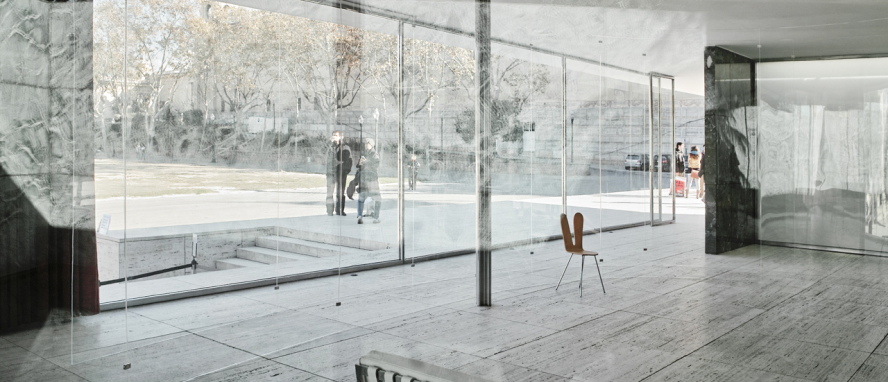
3 | SANAA, 2008. Intervention in the Mies van der Rohe Pavilion, Barcelona. Fundació Mies van der Rohe. © SANAA / Ramon Prat / Fundació Mies van der Rohe (miesbcn.com/project/sanaa-intervention)
Spectacle and Simulacra. A chair becomes a rabbit
In addition of the ‘glass curtain’, there was a second gesture in the installation: the placement of the Rabbit chair. And, same as before, it can only be understood within the post-structuralist framework.
For Walter Benjamin, aura no longer exists. For Guy Debord, every social act becomes spectacle. For Fredric Jameson, history and style dissolve into pastiche. For Jean Baudrillard, depth collapses into simulation. For Rem Koolhaas, narrative shapes reality. For Roland Barthes, signifiers detach from signifieds. And this is how a chair becomes a rabbit.
The presence of the chair – humble, almost childish – was as significant as the seductive curved glass enclosure, and perhaps even more intriguing. Nonetheless, it resisted any trace of seriousness, appearing almost misplaced, as if it did not fully belong. SANAA introduced an ironic gesture whose ambiguity lies precisely in its indeterminacy: it was never entirely clear whether it should be taken seriously, or even whether it was truly part of the installation rather than a stray utilitarian object. What appears as an unpremeditated action in fact condenses a dense theoretical lineage spanning over a century. Despite its banality – or rather, because of it – it carries a remarkable narrative intensity. Irony is used as a tool to highlight the underlying spectacle.
In the 1930s, Walter Benjamin warned the society of the risks that technique – and above all mechanical reproducibility – posed for art, explaining that it eroded what he famously defined as aura: “the here and now of the work of art” (Benjamin [1936] 1969). In the Rabbit chair, there is scarcely a trace of such aura. At most, one might speak of a fetishist value: an icon recognisable only to those who already knew it is a design by SANAA; its value does not reside in the object itself, but in the abstract condition of its design, in its reproducibility as concept or ‘image’ (Mitchell 2005). This becomes particularly evident when contrasted with the Barcelona chair: although also a product of industrial reproduction, Mies’s designs still retain a certain singular status as a ‘Design object’ – if not explicitly elitist. The Rabbit chair, by contrast, belongs to a different regime, one closer to mass reproducibility than to technical refinement. It lacks any residual aura and instead assumes a distinctly pop condition, in a double sense: both as something accessible, cheap and widely consumable (popular), and as an object whose very form aligns it with the logic of image, immediacy and visual spectacle – the shape of rabbit ears (Pop Art).
It is almost impossible to define briefly what ‘spectacle’ is and where it is to be found, yet it seems that in our society it is everywhere; it is everything. At least, that is what Guy Debord and others after him have firmly maintained (Debord [1967] 1977). Social relations are mediated by images, and the Exposition and its pavilions also operate within this economy of visibility. The Rabbit chair did not simply inhabit the space; it performed within it. Its irony was not incidental but structural. As Fredric Jameson categorically pointed out, late capitalism culture is marked by the exhaustion of historical depth, replaced by irony, quotation and cliché (Jameson [1984] 1992). In a postmodern society, there is no need for us to understand why a rabbit-shaped chair has been placed in the throne room, nor is there any need to point out that it is, in fact, a rabbit-shaped chair. We simply see it and accept it as part of the show.
The chair became a naïve yet unsettling vantage point from which the public oversees not only the spectacle of the throne, but that of architecture itself. Originally conceived as an institutional and representational space (a Throne room), nearly a century later, the pavilion has become a mythic and spectacular object in its own. It no longer simply signifies power; it has itself become a sign of it – an image that attracts a continuous pilgrimage of experts and tourists. As such, it operates as one more element within the machinery of consumption that defines the society of spectacle. It is precisely through the banality of the Rabbit chair that this condition is revealed. In doing so, SANAA inserts the visitor directly into the scene; they introduce us – ‘spectators’ of a mass-mediated culture. The chair allows us to sit back and watch the scene unfold. Irony can also be used as a tool to uncover simulacra.
Jean Baudrillard suggested that depth and ritual meaning have collapsed into self-created surfaces of simulation (Baudrillard [1981] 1994). Objects no longer refer to a stable origin or function; they simply circulate as a sign among signs. As Roland Barthes stated (Barthes [1980] 2010): the signifiers are detached from any fixed meaning. The Rabbit chair may have transformed ‘visitors’ into ‘spectators’, but at the same time it has itself become nothing – and yet nothing less – than a ‘sign’. The chair is no longer regarded as a piece of furniture, but as an ‘image’: a figure and a cultural code. Its meaning is not inherent, but produced through recognition, interpretation and repetition. It operated as an ironic, ‘paranoid-critical’ device: a method that embraces contradiction, allowing multiple readings to coexist without resolution (Koolhaas 1978).
The Rabbit chair can be seen as part of this postmodern tradition: an object which, beneath its apparent triviality, embodies a conscious irony – both playful and critical – while fully participating in the very logic it appears to uncover.
The Rabbit chair could signify all of this; it could extend this lineage; or, on the contrary, operate as a critique of it – of the cultural logic and even of the Mies’s pavilion. It could mean all these things, or none of them. The chair may, in fact, be nothing more than a misplaced object, later absorbed and mystified through photographs and retrospective narratives. That is precisely the power of irony: its capacity to sustain ambiguity without resolution; to operate meaningfully even in the absence of a fixed meaning.
Visitor or Spectator. Who gets to sit in the Rabbit chair?
So how did a glass curtain and a rabbit-shaped chair reveal the role of the ‘visitor’ within the society of the spectacle? SANAA’s glass enclosure turns the space itself into a museum piece, encasing it in a display case that confirms – and fixes – its mythical status. The glass curtain was not merely transparent: it acted as a screen that captured light and reflection. In an ironic twist, where Mies seemed to dissolve the centre, SANAA enclosed it; where the Miesian plane was straight and seemingly neutral, the intervention introduced a curvature that reorganised the experience.
On the other hand, the Rabbit chair introduces a frontal irony. Opposed to modern aura stands a pop, domestic object trouvé. If the Barcelona chair evokes the throne, the Rabbit chair marks the position of the contemporary spectator: omniscient, detached, and self-aware. The rabbit in the throne room does not simply parody Mies, it reveals the voyeuristic condition of the contemporary visitor and rewrites the pavilion as a theatre of the society of spectacle.
Bibliographical references
- Barthes [1980] 2010
R. Barthes, Camera Lucida. Reflections on Photography [La Chambre claire. Notes sur la photographie, 1980], New York 2010. - Baudrillard [1981] 1994
J. Baudrillard, Simulacra and Simulation [Simulacres et Simulation, 1981], Ann Arbor 1994. - Bauman 2000
Z. Bauman, Liquid Modernity, Cambridge 2000. - Benjamin [1936] 1969
W. Benjamin, The Work of Art in the Age of Mechanical Reproduction [Das Kunstwerk im Zeitalter seiner technischen Reproduzierbarkeit, 1936], New York 1969. - Colomina 2019
B. Colomina, X-Ray Architecture, Zurich 2019. - Debord [1967] 1977
G. Debord, Society of the Spectacle [La Société du Spectacle, 1967] Detroit 1977. - Giedion 1941
S. Giedion, Space, Time and Architecture. The Growth of a New Tradition, Cambridge (MA) 1941. - Jameson [1984] 1992
F. Jameson, Postmodernism, or the Cultural Logic of Late Capitalism, London [1984] 1992. - Koolhaas 1978
R. Koolhaas, Delirious New York, New York 1978. - Herzog, De Meuron 2016
J. Herzog, P. de Meuron, Treacherous Transparencies. Thoughts and Observations Triggered by a Visit to Farnsworth House, Barcelona 2016. - Moneo 2004
R. Moneo, Inquietud teórica y estrategia proyectual: en la obra de ocho arquitectos contemporáneos, Barcelona 2004. - Mitchell 2005
W.T.J. Mitchell, What Do Pictures Want? The Lives and Loves of Images, Chicago 2005. - Rowe, Slutzky [1964] 1997
C. Rowe, R. Slutzky, Transparency, Basel [1964] 1997.
English abstract
Can some acrylic glass and a simple chair alter the meaning of one of the most mythologised works of modern architecture? SANAA’s intervention in Mies van der Rohe’s Barcelona Pavilion suggests that they can. Conceived as a representative and ceremonial space for the 1929 Barcelona International Exposition, the pavilion can be understood as a modern Throne Room, organised around visibility, hierarchy and symbolic presence.
Through two apparently simple gestures – a spiral acrylic enclosure and the placement of the Rabbit Chair – SANAA revisits some of modernity’s central concerns while subtly displacing their meaning. The glass spiral transforms transparency from an instrument of clarity into a device of reflection, distortion and ambiguity, offering a contemporary reinterpretation of Miesian fluid space. The Rabbit Chair, positioned before the iconic Barcelona Chairs, introduces an ironic and seemingly naïve object that turns the visitor into a spectator while exposing the pavilion’s condition as a cultural image within the society of spectacle. Rather than opposing modernity, SANAA engages it through a complex mixture of homage, displacement and irony. The intervention reveals how transparency, representation and spectatorship have been transformed in contemporary culture, while demonstrating the capacity of irony to reinterpret architectural canon without abandoning it.
keywords | Contemporary architecture; Design strategies; Modern architecture; Spatiality; Transparency.
La Redazione di Engramma è grata ai colleghi – amici e studiosi – che, seguendo la procedura peer review a doppio cieco, hanno sottoposto a lettura, revisione e giudizio questo saggio
(v. Albo dei referee di Engramma)
Per citare questo articolo / To cite this article: Daniel Barba, A Rabbit in the Throne Room. Mies, SANAA, Transparency and Spectacle, “La Rivista di Engramma” n. 237, luglio 2026.
Per citare questo articolo / To cite this article: Daniel Barba, A Rabbit in the Throne Room. Mies, SANAA, Transparency and Spectacle, “La Rivista di Engramma” n. 237, luglio 2026, pp. xx-yy | PDF dell’articolo