Margins in Motion
Narrativity and Dynamic Viewing in 14th Century Ghent Marginalia
Alina Heiremans
Abstract
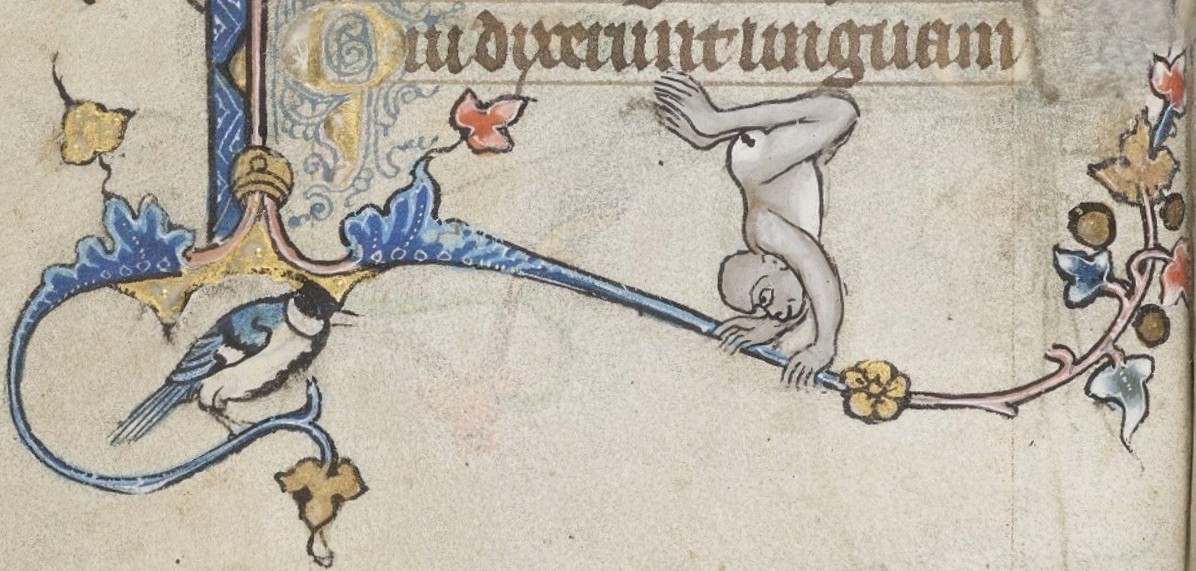
Postmodernist literature is known for its experiments with traditional storytelling, often challenging the assumption that narratives must unfold in a fixed, linear sequence. Works such as Julio Cortázar’s Hopscotch and Jorge Luis Borges’s The Garden of Forking Paths disrupted this expectation by presenting narrative as fragmented, dispersed and often non-sequential. Such works were often received as both disorienting and exhilarating, as they unsettled familiar reading habits while granting the reader an unusually active role in shaping the narrative. Rather than passively consuming a finished story, readers were invited to collaborate with the author, piecing together sequences, choosing among possibilities, and, in effect, co-creating the narrative as they moved through the text.
Although separated by many centuries and radically different cultural contexts, the margins of a group of fourteenth-century manuscripts made in or near Ghent – referred to here as the “Ghent group” – raise strikingly similar questions about the relationship between narrative and readerly participation. Far from functioning as purely decorative additions or playful drolleries, the marginal programmes of these manuscripts reveal a pronounced impulse towards narrativity and a broader concern with dynamic modes of viewing. Their imagery frequently unfolds through dispersed sequences, delayed revelation, and other visual strategies that actively pull the viewer into the manuscript’s narrative world and transform the codex into a dynamic visual field, one that calls upon the reader’s memory, interpretation, and physical interaction with the page.
Such observations resonate with broader developments in medieval art history, which have increasingly challenged the understanding of images as static representational objects. Recent scholarship has instead emphasised the performative and experiential dimensions of medieval viewing, stressing how images generate meaning through memory, staged revelation, and the physical handling of the book itself (Kessler 2004; Ganz 2016; Rudy 2024). Narrative, in this view, is not simply embedded within the image but emerges through the viewer’s physical and imaginative engagement with it. Likewise, scholars of medieval visuality have increasingly stressed the productive role of the viewer in completing and activating meaning through acts of imaginative reconstruction (Gertsman 2021). The study of manuscript marginalia has itself undergone a comparable expansion, moving from questions of iconographic identification and classification towards broader considerations of cultural meaning, textual interaction, and the role of the viewer (Randall 1957, 1960, 1966; Camille 1992; Sandler 1997, 2008, 2014; Wirth 2008). Within this substantial body of scholarship, however, the narrative and performative capacities of marginal imagery remain comparatively understudied.
This paper seeks to address that lacuna through an examination of the marginal imagery in a corpus of manuscripts attributed to a fourteenth-century workshop active in or near Ghent. Focusing primarily on the Douce Psalter (MSS Douce 5-6, Bodleian Library, Oxford), the Trinity Hours (MS B.11.22, Trinity College Library, Cambridge), and the Copenhagen Psalter (MS 3384, 8°, Det Kongelige Bibliotek, Copenhagen), it argues that the margins of these manuscripts cultivate narrativity not merely through isolated narrative scenes, but through a broader visual logic of dynamic engagement, foregrounding a high degree of viewer agency.
One of the challenges posed by marginal imagery is that scenes encountered on individual pages can appear isolated, while their narrative significance only becomes apparent when the manuscript is considered across a broader sequence of folios. In the “Ghent group” of manuscripts, such connections operate on several levels. Some emerge between images originally positioned on opposite sides of the same bifolium; others extend across successive pages, openings, quires and even larger groups of folios. In certain instances, moreover, the placement of marginal scenes corresponds to the organisation of the text itself. Rather than following a single structural principle, these relationships exploit different possibilities offered by the codex as a spatial and sequential medium. Reconstructing the original configuration of bifolia can nevertheless bring some of these connections into sharper focus. In the Douce Psalter and the Copenhagen Psalter, several marginal scenes situated on opposite sides of the same sheet correspond closely to one another; not all of these are particularly revealing; some simply mirror similar figures or animals across the two pages. Such instances might be described as unconscious overlaps, in which motifs do not repeat themselves exactly but resonate with one another in a dream-like manner. What is particularly fascinating is the cases where bifolia accommodate full narratives spread across both sides.
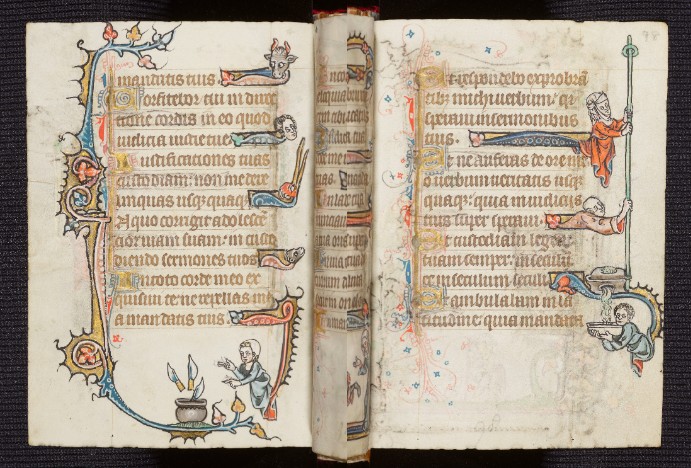
1 | A bifolium of ff. 94v and 98r. Douce Psalter, MS Douce 6, Bodleian Library, Oxford © Bodleian Library
On f. 94v of the Douce Psalter we see a marginal figure dressed as a peasant, before a cauldron with what appears to be three knives poking out of it [Fig. 1]. Facing this scene, on the opposite side of the bifolium (f. 98r) an almost identical figure is shown; wearing the same blue tunic, he collects liquid from the cauldron, tilted by two other peasants holding a long pole attached to the side of the cauldron. The scene may appear puzzling at first, unless one recalls the widely known folktale commonly referred to as “Stone Soup”, which circulated in many variations across medieval Europe. The story typically features a trickster – often a hungry traveller – who persuades villagers to contribute ingredients to a seemingly magical soup made from an inedible object, such as a stone, nail, or axe. The marginal motif in the Douce Psalter appears to draw on this flexible narrative tradition, presenting a playful adaptation of the tale. Its second part remains consistent with the story, showing the man collecting the “soup” with the help of other peasants.
Another motif, or rather a marginal scene from the Douce Psalter unfolds within one bifolium made up of ff. 103v-113r [Fig. 2]. In the bas-de-page of f. 103v we see a stag being hunted by a man, while on the right side of f. 113r, decorating one of the line endings, appears a stag with Christ’s face glowing between its antlers. The motif of a stag with an image of Jesus between its horns most certainly refers to the legend of Saint Hubertus, who (similarly to Saint Eustace) converted to Christianity after he had a vision of the crucifix between a stag’s antlers while hunting. Considering these elements collectively, as part of an ensemble, the man's pursuit of the stag on f. 103v becomes significantly more poignant.
It is worth remembering that the manuscript’s readers would not have experienced these two images as a direct sequence: the second part of the story – the divine vision of Saint Hubertus – only appears several pages later. This raises the question of whether other marginal scenes might unfold in a similarly delayed manner, beyond the limits of a single bifolium. Viewed in this way, a number of seemingly incoherent motifs begin to fall into place: the manuscript reveals itself as a series of dispersed fragments that, when traced across its pages, form a coherent narrative.
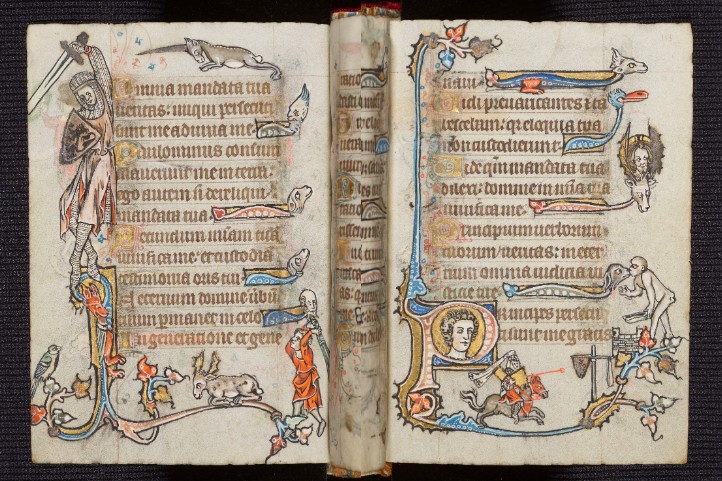
2 | A bifolium of ff. 103v and 113r. Douce Psalter, MS Douce 6, Bodleian Library, Oxford © Bodleian Library
A recurring motif in two of the “Ghent group” manuscripts is that of a man – or, in one instance, a monkey – putting on his boots [Fig. 3]; we encounter it in the Trinity Hours (f. 60r) and twice in MS Douce 5 (ff.112r and 191v). This image refers to the first part of a popular myth, recited in all medieval bestiaries: in order to catch a monkey, one should put on his shoes in the sight of it, then put a pair of shoes in front of the monkey – that way it will feel compelled to try them on, which will hinder its ability to climb and allow for its easy capture. However, on its own, an image of a man putting on his shoes does not make much sense; it only develops into a narrative when paired with the rest of the story, visualised only several pages later [Fig. 4]: on f. 71r in the Trinity Hours, and ff. 115v and 195v in Douce 5. The two sequences in Douce 5 reveal that this narrative division was closely coordinated with the textual structure of the manuscript. On f. 112r, a monkey puts on a shoe at the opening of Psalm 39, while the approaching hunter appears on f. 115v beside its closing lines. The second sequence operates in the same way: the preparation of the trap accompanies the beginning of Psalm 70 on f. 191v, and the monkeys are captured at the Psalm’s conclusion on f. 195v. The images therefore do more than divide a familiar bestiary story into a playful visual puzzle: they frame the Psalms themselves, establishing a delayed narrative progression between their openings and endings. The imagery also offers a loose visual gloss on the texts. Both Psalms contrast trust in God with false appearances, confusion, hostile speech, and the threat of being surrounded by evil. The monkey, traditionally associated with unthinking imitation, serves here as an embodiment of the folly of being deceived by appearances and consequently trapped and exposed. In the Trinity Hours, the two scenes do not coincide with the beginning and end of a single text, but a comparable verbal connection remains. The first appears directly below the opening of Psalm 115:
Credidi, propter quod locutus sum; ego autem humiliatus sum nimis. Ego dixi in excessu meo: Omnis homo mendax (Ps 115,10-11)
I kept my faith, even when I said, “I am greatly afflicted”; I said in my consternation, “Everyone is a liar” (NRSV)
– with the crucial word “mendax” continuing onto the opposite side of the page – while the second accompanies the declaration that God will destroy those who “loquuntur mendacium” (all that speak a lie) in Psalm 5, 7. The divided narrative thus links passages concerned with falsehood through the figure of the ape, the medieval impersonator par excellence.
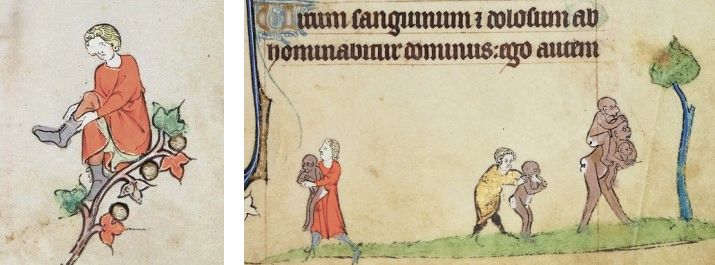
3 | F. 60r, Trinity Hours, MS B.11.22, Trinity College Library, Cambridge; 4 | F. 71r, Trinity Hours, MS B.11.22, Trinity College Library, Cambridge © Trinity College Library
This example is not exceptional. Similar instances of narrative partitioning recur elsewhere in the corpus and are particularly explicit in the Douce Psalter and the Trinity Hours. Within each manuscript, however, these sequences vary in scope: some take the form of brief pairings like the ones described above, while others develop into more extended narrative threads, such as the Reynard cycle or knightly romance scenes. Viewed in isolation, individual motifs may appear fragmentary or incoherent, but read in relation to one another they begin to form recognisable narrative sequences. It is important, however, not to overstate its prevalence: this dispersed, puzzle-like mode of narrative illumination – unfolding across multiple margins rather than within a singular image – is comparatively rare. Yet precisely for that reason, it emerges as a distinct and meaningful pattern, one that warrants careful and systematic study.
What seems clear is that not every marginal sequence was conceived with the same degree of deliberation or careful planning. The narratives contained within a single bifolium may in some cases have emerged through a more incidental overlap of motifs – a kind of lapse of thought in which one image prompted another without necessarily forming part of a fully worked-out narrative programme. The monkey-catching sequences, by contrast, demonstrate that the placement of marginal scenes within the book could be carefully calculated, using memorable visual cues that drew the reader further into the book, invited them to move back and forth through its pages, and encouraged repeated – and perhaps more meditative – engagement with the words before them. In this way, the images could have served as powerful mnemonic devices, participating in what Mary Carruthers associates with divisio: the visual structuring of a text into manageable units, while at the same time helping “to cue and trigger recollection of textual material that the reader already knows” (Carruthers [1990] 2008, 285).
In the codex, recollection is inseparable from movement and from the reader’s physical interaction with the book. Its hinged structure allows for the meaning to emerge through successive acts of concealment and revelation – the so-called Klappeffekte (‘flap effects’) described by David Ganz. In his discussion of late antique and early medieval ivory book covers and manuscript spreads, Ganz explores how foldable visual media operate in medieval art, and how movable picture supports – such as book pages, diptychs, triptychs, and other hinged or foldable objects – direct the viewer’s gaze and actively shape how images are seen and handled. These formats make it possible for narratives to unfold in sequence, for images to remain hidden and then be revealed over time, and for meaning to emerge through the interplay of presence and absence – something that Ganz and his collaborators argue was deliberately exploited by premodern artists (Ganz 2016). Ganz mainly discusses images in which this kind of reveal happens immediately, whereas the dispersed narratives discussed here would take the idea a step further, often introducing several pages between narrative moments. In that sense, the act of opening and closing the book, combined with this more delayed form of revelation, may in fact have created an even stronger sense of engagement and play, a kind of ‘cliff-hanger’ that encouraged readers to keep searching through the book in anticipation of the next visual cue. This delayed revelation, combined with the images’ mnemonic function, could effectively make these books into page-turners. Anne Rudloff Stanton describes this effect with regard to a group of English medieval Psalters that equally show a high degree of narrativity, arguing that their images could provide lay patrons with a more immediate focus of interest than the prayers themselves (Stanton 2011, 76). The manuscripts discussed by Rudloff Stanton offer an excellent example of such strategies of engagement, through which artists could direct the viewer’s movement through the book. The examples she discusses, however, concern more direct, sequential narratives whose progression is immediately legible, whereas the artists of the “Ghent group” often treat narrative with greater freedom and playfulness, as we have seen in the examples discussed above.
Another striking feature of these narratives is that they do not always follow their source stories to the letter, but instead display a certain degree of improvisation and freedom. There is often an element that does not quite align with the version of the story as we know it; for example in the “axes (stones) soup” motif, where knives appear in place of the expected axes. What seems to be happening here is that, more often than not (especially in the case of longer narrative sequences) the artists gave these stories a personal twist. Rather than following a fixed version, they reinterpreted familiar material, making it recognisable enough for the viewer while still leaving a clear personal imprint on it. If the images discussed here often draw on stories that circulated widely and must have been transmitted orally, the artists can, to some extent, be compared to minstrels or storytellers: assembling narratives from elements known to them and familiar to their audience, yet inevitably stitching them together with details of their own invention.
5 | F. 146v, Copenhagen Psalter, MS 3384, 8°, The Royal Library, Copenhagen © Det Kongelige Bibliotek, Copenhagen and
5b | Similar manicula drollerie in Luttrell Psalter (c. 1325-1340), British Library, London, Add MS 42130, f. 196r
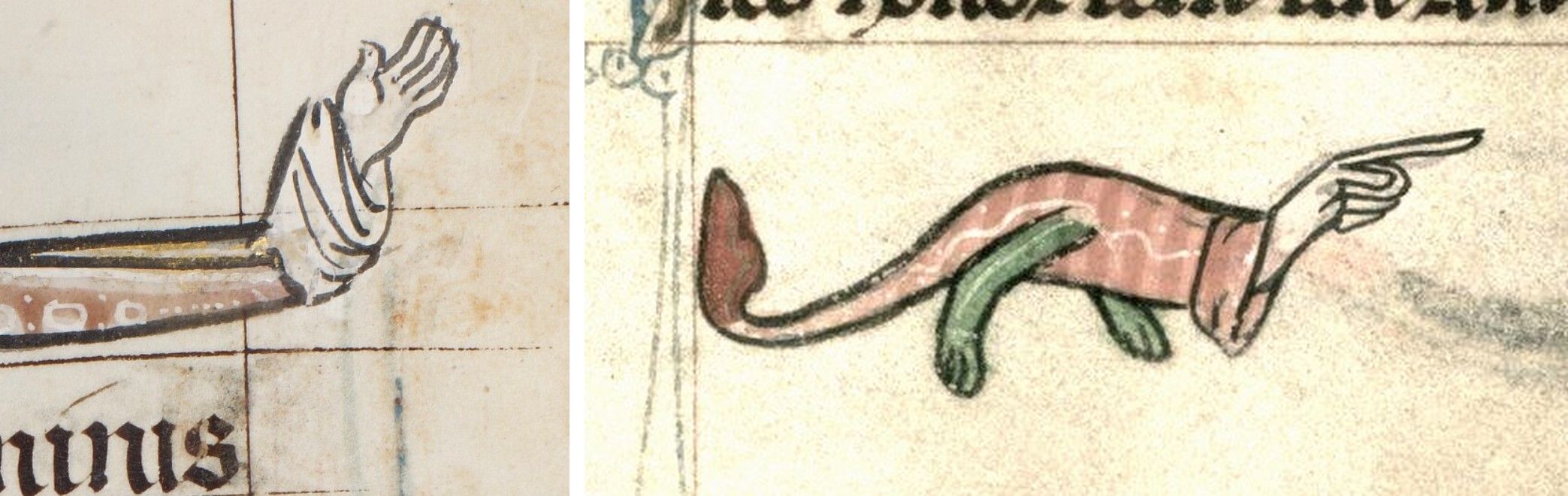
Even beyond clearly narrative sequences, the “Ghent group” manuscripts are filled with imagery closely tied to language, including proverbs and jokes. Some marginal figures quite literally hold up scrolls with text in Middle Dutch – almost like comic book characters with speech bubbles issuing from their mouths. Alongside these textual elements, gestures play a prominent role. These “talking hands,” found across the corpus (with the Copenhagen Psalter as a particularly rich example), function almost as visual glosses: they offer blessings, draw the reader’s attention to particular passages, or simply seem to engage in a dialogue with the reader. Among the most frequent is an open-palm gesture, commonly associated in medieval imagery with acts of communication and exchange (Garnier 1988, 174) [Fig. 5]. Rather than operating in isolation, such gestures often structure scenes as moments of dialogue, signalling speech, response, or acknowledgement. The expressive hands we see in the line-endings, stretching out from the page, thus become a means of communicating with the reader, breaking the silence without resorting to literal words.
Yet, these stories, proverbs, jokes, and gestures only come to life when the reader actively narrates them. The manuscript thus becomes a visual field that hints at acts of communication beyond the page. As Michael Camille has shown, medieval reading was not a silent or purely visual activity, but one embedded in a culture of speech. Images, like texts, functioned as signs referring back to the living voice, evoking rather than simply illustrating narrative (Camille 1985, esp. 28). The figures in the margins draw on a shared world of oral storytelling – romances, exempla, fabliaux, and proverbial speech – inviting the reader to activate these narratives through internal narration. In this way, the page becomes a space where visual and verbal modes intersect, directing attention beyond the manuscript’s surface towards the communicative acts it implicitly stages.
The comparison between illuminator and minstrel becomes particularly compelling in images that appear to refer to the manuscript’s owner. While such self-referential imagery typically takes the form of conventional donor portraits, the Douce Psalter expands this into a far more elaborate and unconventional sequence centred on a richly dressed young woman. Unfolding across quires 8 and 9, this sequence presents a loosely structured life narrative of a wealthy laywoman, identifiable by her blue or pink garments. In quire 8, the emphasis lies on courtship: she appears embracing her suitor under the God of Love (f. 80r), and later in more intimate scenes that echo familiar romance motifs [Fig. 6]. The placement of these romance and courtship motifs at a major Psalter division can hardly be accidental. It has been suggested that the manuscript functioned as a marriage gift (Moore Hunt 2007, 1002-1003). Given the sustained emphasis on female imagery throughout the book, however, it seems more likely that the woman herself was the intended owner of the manuscript. Significantly, she is not portrayed as a passive object of desire. On the contrary, she appears as an active agent within the narrative. On f. 83v, she ensnares a young man in a bird trap [Fig. 7], a pointed metaphor for seduction that resonates with other hunting motifs throughout the manuscript. Elsewhere, her status is elevated further through imagery that deliberately flirts with devotional iconography: she is placed within architectural frames suggestive of saintly representation, while her suitor adopts a pose reminiscent of prayer [Fig. 8]. The visual hierarchy is telling – she assumes an almost sacral role, while her admirer is subtly diminished. In quire 9, the sequence continues with scenes of charity, devotion, and daily life. Towards its conclusion, she appears to be moving house, accompanied by figures carrying furniture and possessions [Fig. 9]. Read in relation to the preceding imagery, this final episode is particularly suggestive: If the manuscript did indeed serve as a marriage gift, it is tempting to interpret this final episode as a visualisation of the bride moving into her new household.
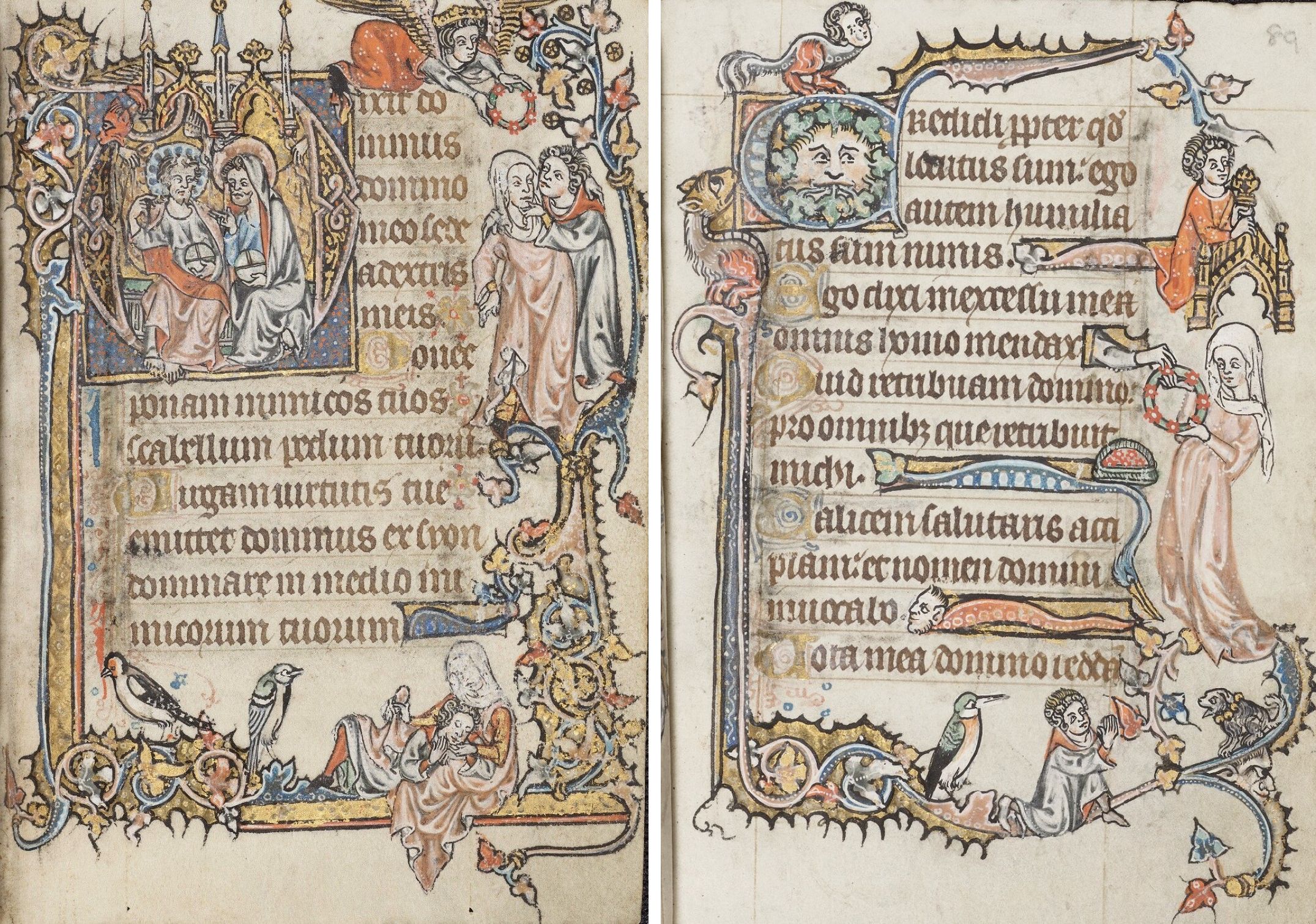
6 | F. 80r, Douce Psalter, MS Douce 6, Bodleian Library, Oxford. 8 | F. 89r, Douce Psalter, MS Douce 6, Bodleian Library, Oxford © Bodleian Library
A similar phenomenon has been observed by Michael Camille, who identified a narrative dimension in the marginal scene featuring the portrait of Sir Geoffrey Luttrell, the owner and commissioner of the Luttrell Psalter (Camille 1998, 82-83). The case at hand, however, goes considerably further. Rather than a single image with narrative implications, we are confronted with an extended sequence in which the manuscript’s owner becomes the central figure of a dispersed visual narrative. Appearing across multiple pages and engaged in a wide range of activities, she is granted a narrative presence comparable to that of the fictional protagonists who populate the margins of the “Ghent group” manuscripts, such as Reynard the Fox or the knights and ladies of the Lancelot cycle. The lady is, unsurprisingly, portrayed in a flattering light that consistently underscores her status and importance within the book. It is here that the artist-as-minstrel comparison becomes quite fitting. Much like a minstrel tailoring his tale to please the lord who hosts him, the artist shapes a narrative that presents the manuscript’s owner as the exemplary heroine of her own book. Yet this is not just a static exercise in praise; the sequence offers an unusually intimate glimpse into her life, unfolding as a story that leads right up to the moment of the manuscript’s production itself. We witness her meeting her future husband, being actively courted, and ultimately ensnaring him – quite literally – in her net. The wedding itself is not shown outright, but is suggested through her being crowned with a wreath, after which the imagery shifts towards her transition into married life and the establishment of a household. It is tempting to imagine how these images were experienced by the very people portrayed in them. Were they viewed in solitude, accompanied by the quiet thrill of recognition, or perhaps in a more social setting – much like a photo album, animated by the owner’s narration? In either case, such images may have been highly engaging, creating a sense of immersion in the book that is difficult to recapture from a modern perspective.
Manuscripts containing romance literature have often been associated with collective, performative reading, in which images could be viewed and shared by a wider audience (Zumthor 1987; Coleman 1996; Busby 2002). This is particularly evident in the large Lancelot-Grail manuscripts that have been related to the same workshop (e.g. MS Add. 10292-10294; MS Royal 14 E III), whose scale alone suggests such use. Strikingly, however, these manuscripts contain little marginal imagery: their visual programmes are dominated by framed narrative scenes closely aligned with the text, while marginal decoration remains largely uniform and non-narrative. As Alison Stones has observed, such marginalia “rarely […] fulfil a function intrinsic to the narrative” (Stones 2003).
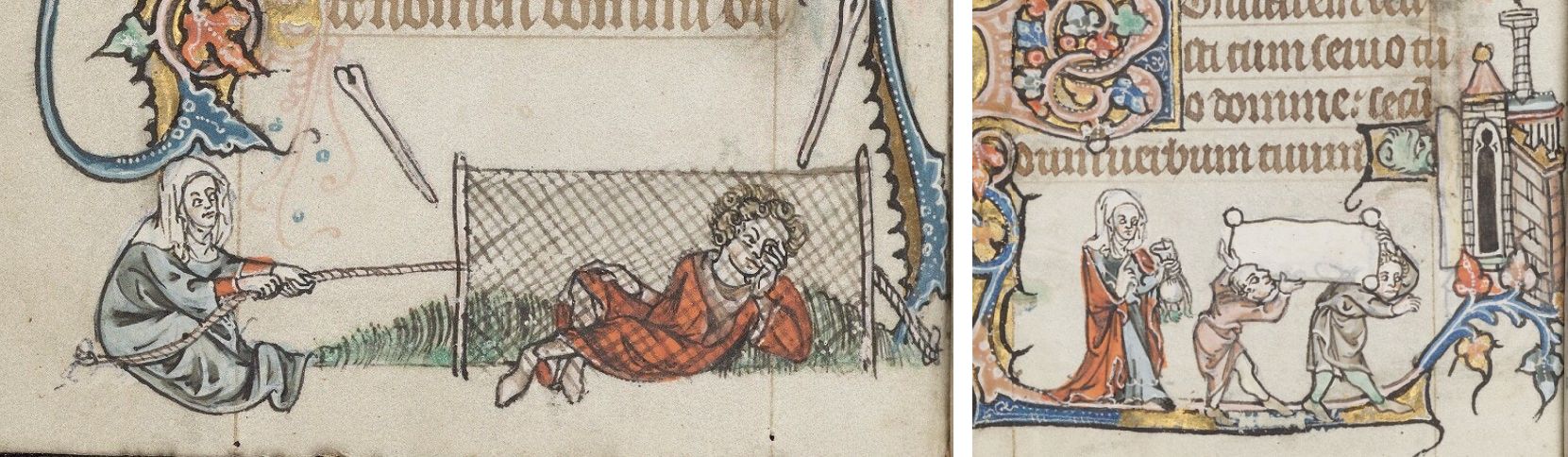
7 | F. 83v, Douce Psalter, MS Douce 6, Bodleian Library, Oxford. 9 | F. 100v, Douce Psalter, MS Douce 6, Bodleian Library, Oxford © Bodleian Library
This contrast is telling. Whereas the Lancelot-Grail manuscripts are narratological in both text and image, the religious manuscripts examined here showcase a different dynamic. Their principal imagery largely adheres to established iconographic conventions and functions as stable visual signs within the Psalter tradition. Psalters and Books of Hours, after all, are not narrative in essence, but structured around liturgical and devotional practice rather than storytelling.
Marginal imagery in these manuscripts thus seems to compensate for this lack of narrativity, enlivening the page with a multitude of scenes drawn from a widely recognisable vernacular repertoire, and at times even positioning the viewer within the visual narrative world of the manuscript, as we have observed. If we return to the fundamentally verbal character of much marginal imagery – its ‘verbosity,’ so to speak – it becomes all the more striking that, unlike many secular texts, Psalters and Books of Hours were primarily intended for individual devotional use, often involving forms of private or quiet reading. The imagery in these books thus appears to offset this silence, introducing elements of oral storytelling, performance, marketplace chatter and even music, thereby reactivating a sensory and communicative dimension otherwise absent from the act of reading. The performative force of this imagery is further intensified by the dispersed structure of some of the narratives, which demand a heightened level of engagement from the reader, who is drawn into moving through the manuscript, connecting images across openings and pages, and mentally assembling narrative sequences. In this way, narrativity becomes inseparable from the reader’s active encounter with the manuscript, drawing them into a world that spills beyond the page – alive with voices, gestures, and the familiar hum of 14th century Ghent.
Bibliographical References
- Busby 2002
K. Busby, Codex and Context: Reading Old French Verse Narrative in Manuscript, Amsterdam 2002. - Camille 1985
M. Camille, Seeing and Reading: Some Visual Implications of Medieval Literacy and Illiteracy, “Art History” 8, no. 1 (1985), 26-49. - Camille 1992
M. Camille, Image on the Edge. The Margins of Medieval Art, Cambridge/Massachusetts 1992. - Camille 1998
M. Camille, Mirror in Parchment. The Luttrell Psalter and the Making of Medieval England, Chicago/London 1998. - Carruthers [1990] 2008
M. Carruthers, The Book of Memory. A Study of Memory in Medieval Culture, Cambridge [1990] 2008. - Coleman 1996
J. Coleman, Public Reading and the Reading Public in Late Medieval England and France, Cambridge 1996. - Freeman Sandler 1997
L. Freeman Sandler, The Study of Marginal Imagery: Past, Present, and Future, “Studies in Iconography” 18 (1997), 1-49. - Freeman Sandler 2008
L. Freeman Sandler, Studies in Manuscript Illumination, London 2008. - Freeman Sandler 2014
L. Freeman Sandler, Illuminators and Patrons in Fourteenth-Century England. The Psalter and Hours of Humphrey de Bohun and the Manuscripts of the Bohun Family, Toronto 2014. - Ganz 2016
D. Ganz, Gelenkstellen von Bild und Schrift. Dyptychen, Doppelseiten und Buchenbände, in D. Ganz, M. Rimmele (eds.), Klappeffekte: Faltbare Bildträger in der Vormoderne, Berlin 2016, 55-108. - Garnier 1988
F. Garnier, Le langage de l’image au Moyen Âge. Signification et symbolique, Paris 1988. - Gertsman 2021
E. Gertsman, The Absent Image: Lacunae in Medieval Books, University Park, PA 2021. - Kessler 2004
H. L. Kessler, Seeing Medieval Art, Peterborough 2004. - Moore Hunt 2007
E. Moore Hunt, Illuminating the Border of Northern French and Flemish Manuscripts, 1270–1320, New York/London 2007. - Randall 1957
L. Randall, Exempla as a Source of Gothic Marginal Illumination, “The Art Bulletin” 39 (1957), 97-107. - Randall 1960
L. Randall, A Mediaeval Slander, “The Art Bulletin” 42 (1960), 25-38. - Randall 1966
L. Randall, Images in the margins of Gothic manuscripts, Berkeley 1966. - Rouse 2000
M. A. Rouse, R. H. Rouse, Manuscripts and their Makers: Commercial Book Producers in Medieval Paris, 1200–1500, London/Turnhout 2000. - Rudy 2024
K. M. Rudy, Touching Parchment: How Medieval Users Rubbed, Handled, and Kissed Their Manuscripts. Vol. 2: Social Encounters with the Book, Cambridge 2024. - Stanton 2011
A. Rudloff Stanton, Turning the Pages: Marginal Narratives and Devotional Practice in Gothic Prayerbooks, in S. Blick and L. D. Gelfand (eds.), Push Me, Pull You: Imaginative and Emotional Interaction in Late Medieval and Renaissance Art, vol. 1, Leiden/Boston 2011, 75-121. - Stones 2003
A. Stones, ‘Mise en page’ in the French Lancelot-Grail: The First 150 Years of the Illustrative Tradition, in C. Dover (ed.), A Companion to the Lancelot-Grail Cycle, Cambridge 2003, 125-146. - Wirth 2008
J. Wirth, Les marges à drôleries des manuscrits gothiques (1250-1350), Geneva 2008. - Zumthor 1987
P. Zumthor, La letter et la voix, Paris 1987.
Abstract
This paper examines the marginal imagery in a group of fourteenth-century manuscripts produced in or near Ghent, arguing that their margins cultivate narrativity as part of a broader system of reader engagement. Often treated as decorative or marginal to the meaning of the book, these images instead reveal a consistent logic that invites active participation from the reader. The study shows how marginal imagery deploys a range of devices that prompt such engagement: dispersed narrative sequences unfolding across bifolia and quires, delayed revelation, and other visual cues and references to widely circulating stories and proverbs. These elements encourage readers to establish connections, reconstruct sequences, and mentally narrate the images they encounter.
keywords | Marginalia; Visual storytelling; Illuminations; Ghent.
La Redazione di Engramma è grata ai colleghi – amici e studiosi – che, seguendo la procedura peer review a doppio cieco, hanno sottoposto a lettura, revisione e giudizio questo saggio (v. Albo dei referee di Engramma)
Per citare questo articolo / To cite this article: Alina Heiremans, Margins in motion. Narrativity and Dynamic Viewing in 14th Century Ghent Marginalia, “La Rivista di Engramma” n. 238, agosto 2026.