Quis non posset contristari
Christi Matrem contemplari
dolentem cum Filio?
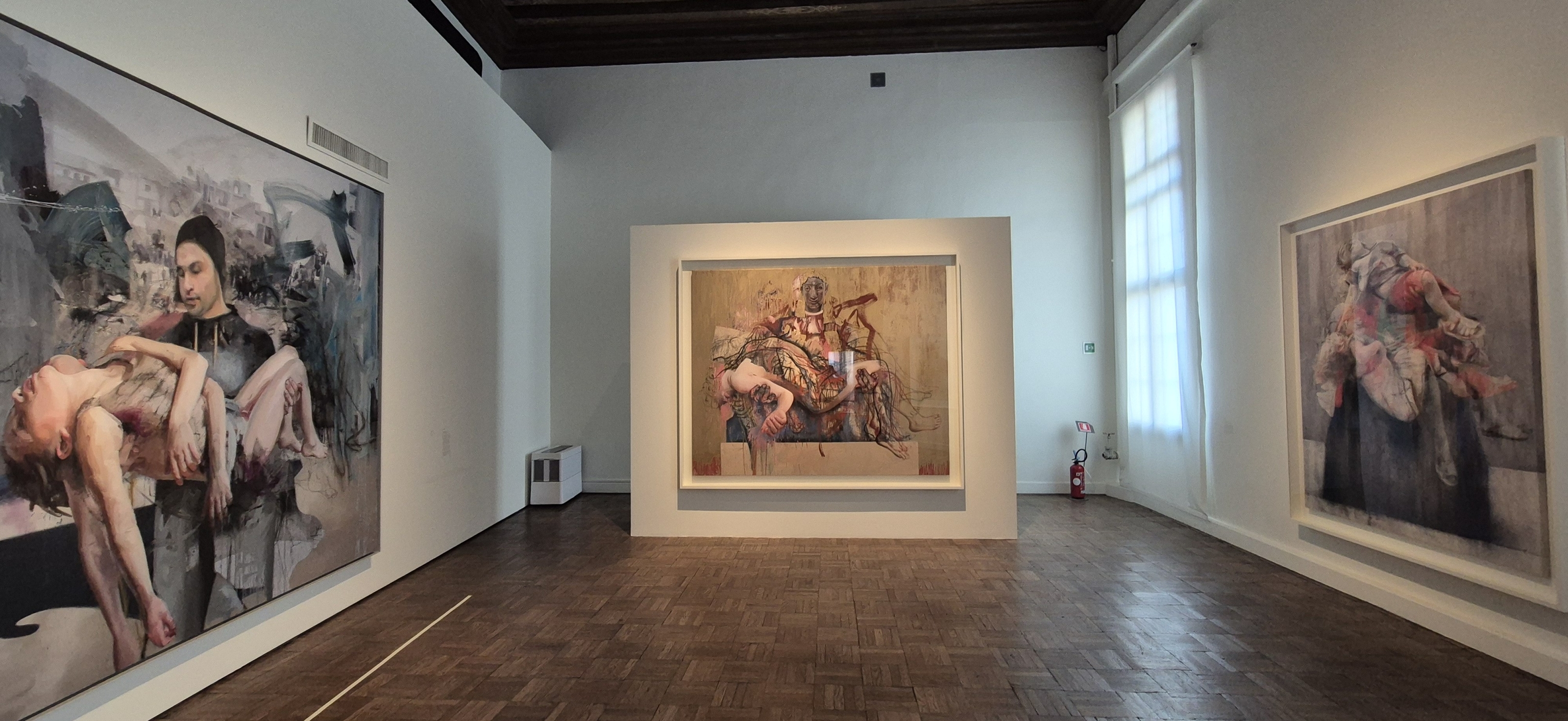
1 | Panoramic view of the room dedicated to the Pietà in the exhibition Jenny Saville a Ca’ Pesaro, Venezia, Galleria Internazionale d’Arte Moderna (March 28-November 22, 2026).
The exhibition Jenny Saville a Ca’ Pesaro, curated by Elisabetta Barisoni, is currently on view at the Galleria Internazionale d’Arte Moderna in Venice (March 28 through November 22, 2026). It is a striking exhibition not only because it features works representative of the artist’s career since the 1990s, but also because of the merit of her monumental paintings (on Jenny Saville’s work see the monograph Saville 2005, and the critical texts Schwabsky 2005 and Object Lessons Space 2018; on her exhibitions see the catalogues Jenny Saville 2005a and 2005b; Jenny Saville 2021; Saville. The Anatomy of Painting 2025, and now Saville a Ca’ Pesaro 2026). The exhibition is spread across a spacious area on the second floor of the Galleria. One room in particular addresses the theme of this issue of Engramma journal, which focuses on religious iconography. In the final room of the exhibition, Barisoni has arranged a square space featuring five works that draw on the iconography of the Christian Pietà [Fig. 1].
We are immediately struck by this familiarity with the Christian motif of Pietà, and the room takes on an air of sacredness, quite different from the prevailing atmosphere in the other spaces featuring the artist’s remaining paintings. It is precisely to produce this sacred atmosphere that the canvas Byzantium [Fig. 11] stands apart from the rest: isolated on its own wall and glowing with its gold ground, the painting turns the space into a sort of apse and itself into an altarpiece. Yet, grouped in the room by formal and thematic affinity, the works soon reveal to the viewer that Saville’s Pietà is not the same as those we already know. If we look at Blue Pietà [Fig. 2], it is not a woman holding a dead man in her arms. It is a man walking away from a ruined city with a dead child in his lap. There is something familiar, and at the same time strange, about this and Saville’s other Pietà scenes.
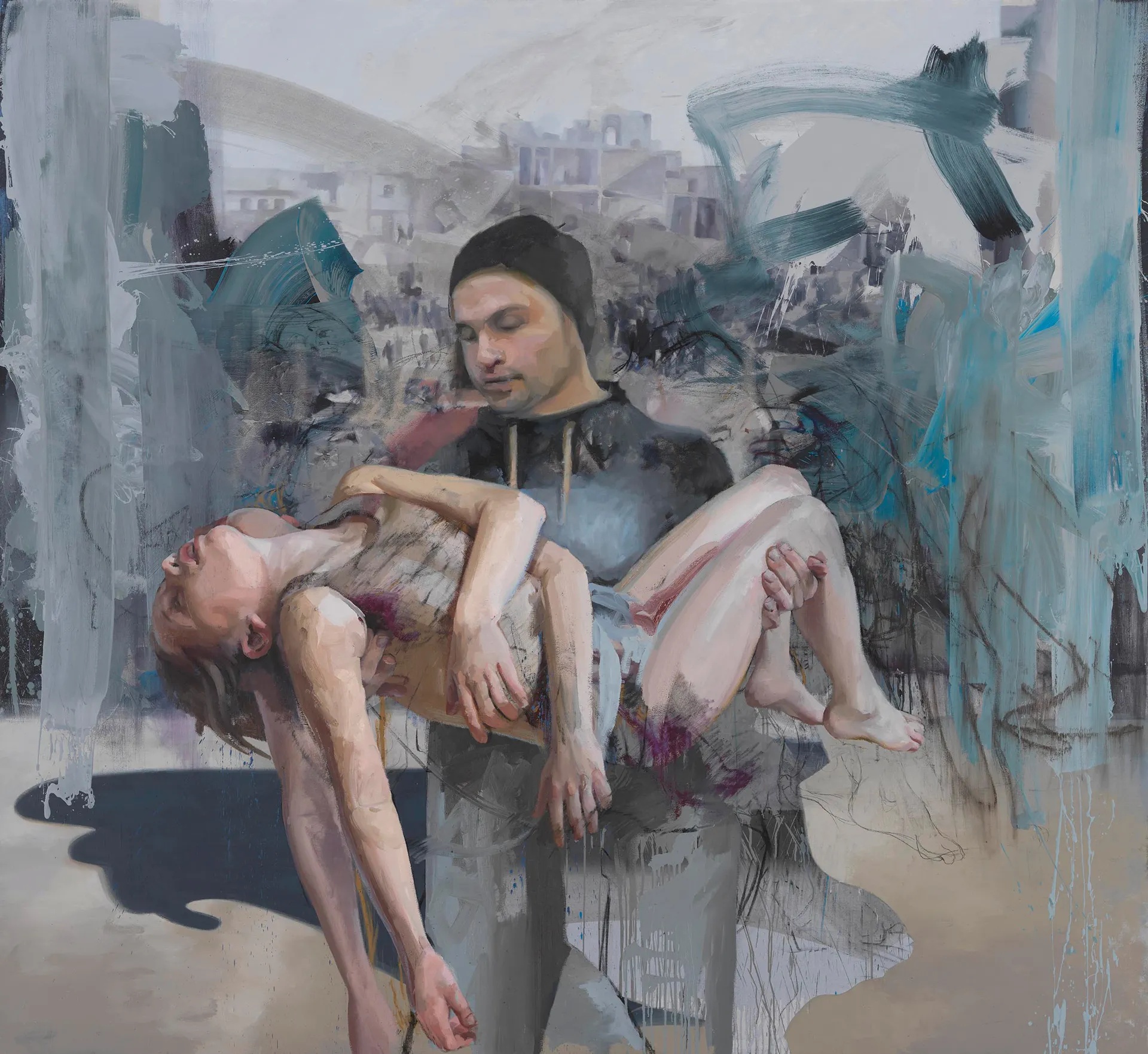
2 | Jenny Saville, Blue Pietà, oil on canvas, 2018, Los Angeles, The Broad Collection.
Iconography of the Pietà
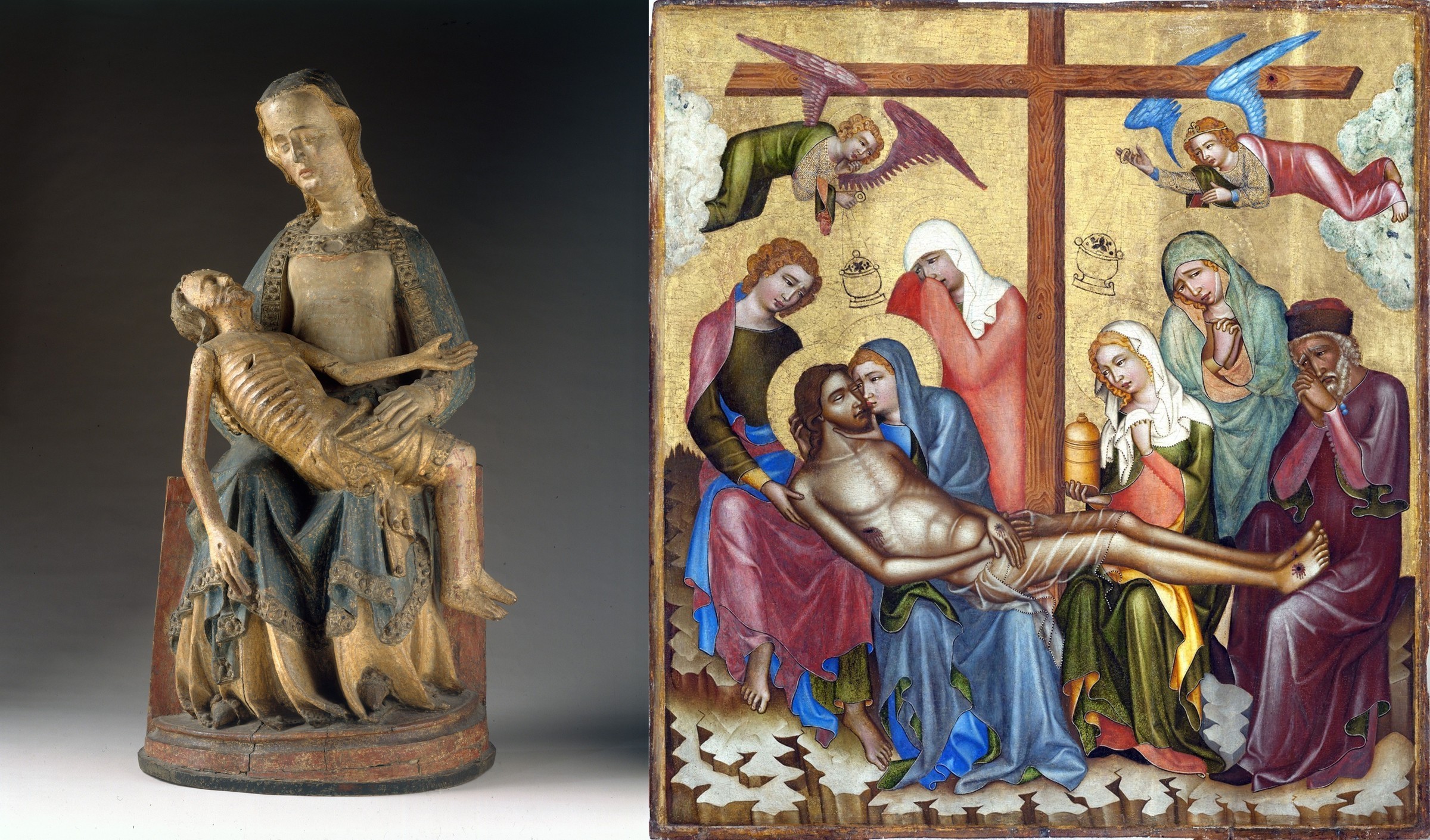
3 | Pietà (Vesperbild), poplar and plaster with paint and gilding, 1375-1400, New York, Metropolitan Museum of Art.
4 | Master of the Vyšší Brod (Hohenfurth) Altarpiece, Lamentation under the Cross, tempera on panel, 1345-1350, Praha, Národní galerie.
Familiar as it is, the Pietà has no scriptural source: paradoxically—as so often happens in the history of Christian iconography (Grabar 1968)—the motif is nowhere described in the Gospels. It depicts the moment immediately following Christ’s deposition from the Cross, conventionally represented by the actions of Nicodemus and Joseph of Arimathea. In the scene, the collective grief that unites the Three Marys and John gives way to the mother’s solitary weeping as she holds her dead son in her lap. The sources of the motif are stratified: they lie in the figurative tradition, in devotional practice, and—as we shall see—in a cultural memory that survives in gesture. In accordance with the most established art-historical literature, its origin lies in the wooden sculptures created in Germany around 1300, known as Vesperbilder. The term Vesperbild means ‘Image of Vespers’, a reference to Vespers, the evening hour of the Divine Office, and by extension to the moment of Christ’s death and deposition from the Cross. Settis explains that Dominican-inspired prayer techniques accompanied devotion to these images:
The assiduous practice of piety required that the believer’s gaze—fixed at times on the texts and at other times on the sacred images—be able to extract or distill intensely experienced passions and emotions, and therefore distinctly corporeal ones (Settis 2018, 31).
An example can be seen at the Metropolitan Museum of Art in New York [Fig. 3]. In this sculpture, which is at once expressive and simple, we recognise the Virgin Mary holding the dead Jesus in her lap. The son’s naked, emaciated, diminutive body contrasts with the richly dressed figure of the mother. The faces also stand in stark contrast: the inexpressiveness of Christ as opposed to Mary’s restrained suffering. The iconographic invention of the Vesperbild spread to Italy and evolved in form and pathos. The anti-classical ‘alla tedesca’ expressiveness of the Vesperbild gave way to “a new attention to proportions, to a sorrowful intimacy” (Settis 2018, 32). It is precisely that intimacy and that pathos that make the image so recognisable and so widely diffused, for it is rooted in human experience rather than in a text: “unbound by the precise observation of a text, it has been repeatedly interpreted by artists of every era with a rare emotional intensity” (Zuffi 2008, 118).
Louis Réau, a fundamental source for Christian iconography, does not include a specific entry for the Pietà in his survey of New Testament iconography. Under the broad heading of ‘The Lamentation’, he identified four scenes, which he called the ‘funeral tetralogy’ (Réau 1957, II/2, 513-528): the Descent from the Cross, the Deposition, the Lamentation, and the Burial. The Pietà is part of the scene of the Lamentation over the dead Christ. Réau’s brief inventory of works depicting the Lamentation is particularly useful, offering clues about how the image has evolved to reach us today. As Jérôme Baschet states, another important scholar of iconography: “images have their own history” (Baschet 2008, 10). An early reference is the Lamentation under the Cross, attributed to the Master of Vyšší Brod (Hohenfurth) (1345-1350), currently in the Národní galerie, Praha [Fig. 4]. Christ rests on Mary’s lap, and she tenderly presses her face against her son’s. Based on the iconographic attributes, Joseph of Arimathea—depicted here in rich purple robes—holds Christ’s feet, although he is more often shown supporting the back; here it is the young man at Christ’s shoulders, surely Saint John, who performs that role. The Saviour’s knees are supported by Mary Magdalene, the myrrh-bearer, who already carries the balm with which she will later anoint the dead body. The mourners’ heads tilted to the side, their hands clasped, and their sorrowful facial expressions all reinforce the gestures of lamentation.
Mater dolorosa in the “Theatre of Death”
It was Aby Warburg who likely contributed most to interpreting images in art history without stripping them of their potential. And he did so in a practical way as well, whether in his lectures structured through images (see above all Forster 2022) or in his celebrated Bilderatlas (reference is made here to the twenty years of work of the Seminario Mnemosyne published in Engramma, and now to the forthcoming Aby Warburg. L’Atlante delle immagini, edited by Maurizio Ghelardi and Monica Centanni, Roma 2026, and to its companion volume Lemmario dell’Atlante Mnemosyne, edited by Monica Centanni, Roma 2026). Numerous mothers appear in Warburg’s Mnemosyne Atlas. Drawing on a deep understanding of the images studied by the German art historian, Seminario Mnemosyne presents the theme by highlighting its unsettling polarity, from Antiquity to Renaissance art and above all along the line of the classical tradition: “mother of life, mother of death” (Bergamo 2005, 227-247; Bordignon, Bergamo 2019, 219-232). Focusing specifically on the Pietà, we can include it among the set of images that constitute the so-called ‘Theatre of Death’. The theme appears primarily in Panel 42 (Seminario Mnemosyne 2000b) [Fig. 5]. Another panel in the Mnemosyne Atlas that addresses the theme of the mother is Panel 5, whose caption reads “dispossessed mother”: “The Mother, goddess, sorceress, or mortal; potnia, powerful lady, gives life but also witnesses the death of her Son” (Seminario Mnemosyne 2000a, 79-82). The way Warburg compiled images of mothers in the Atlas goes far beyond merely presenting an iconographic formula such as the Pietà. In his prolific collection, he includes the mother who loses her child at the hands of another and the mother who leads her child to death, either directly or indirectly: Medea, Agave, Niobe, Altea.
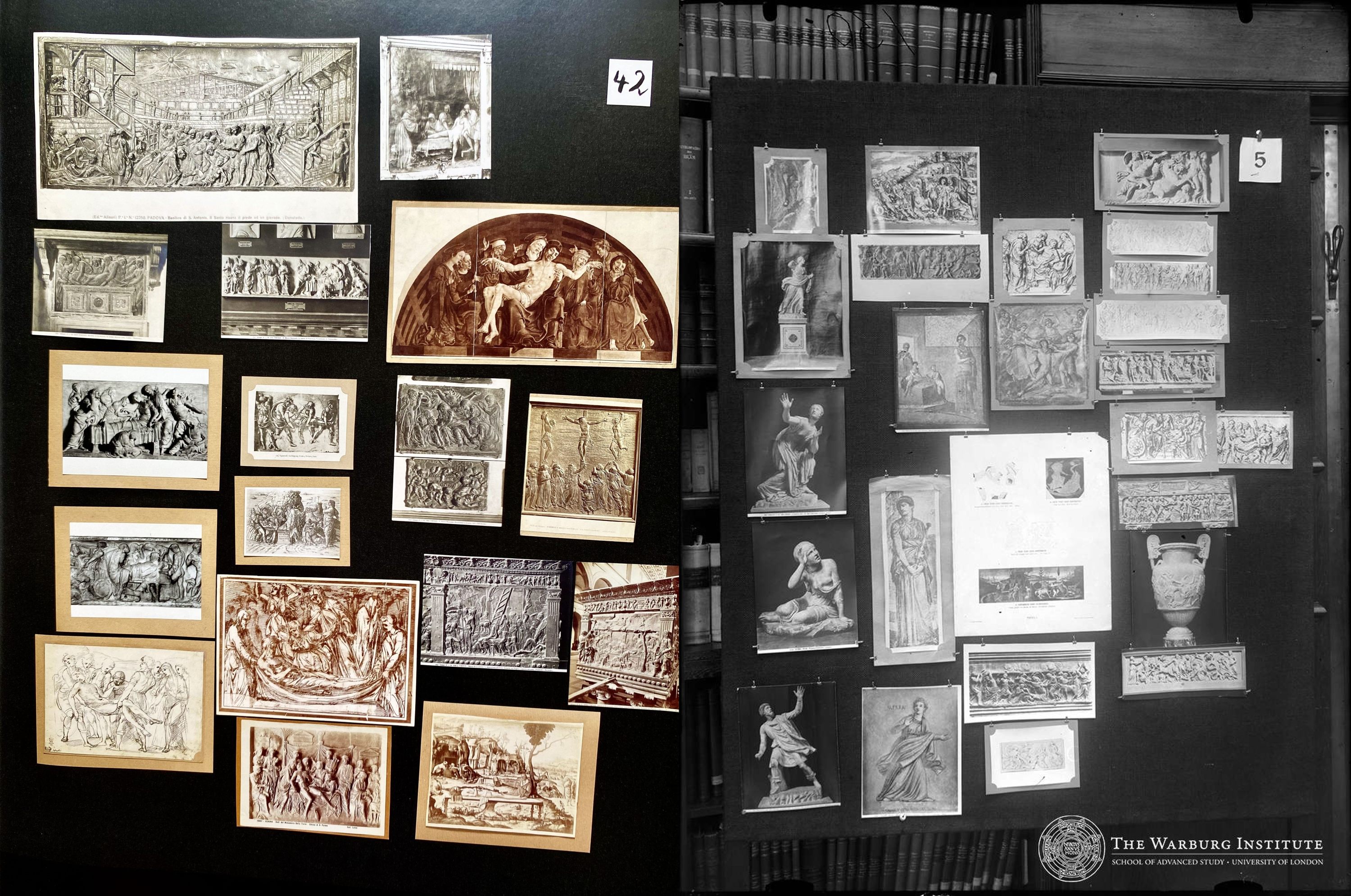
5 | Aby Warburg, Atlas Mnemosyne, Panels 42 and 5 (1929 version).
The issue of literary sources for images in the field of iconography was raised by Jérôme Baschet (2008) when he vehemently rejected the notion attributed to Pope Gregory the Great (540-604) and later disseminated by the French art historian Émile Mâle (1862-1954) that medieval art was a ‘Bible for the illiterate’. For Baschet, such a formulation reveals a “traditional approach to art history”, by placing the image “in a state of narrow dependence on texts and by justifying the surprising devaluation of its subject [...]” (Baschet 2008, 25). Mâle, he argues, subjected the image “to the hegemonic model of the text” and reduced “art to the status of a message conveying a doctrinal teaching that the clergy intended for the lay people” (Baschet 2008, 26). To overcome this perspective, Baschet proposes what he calls the ‘image-object’ and his methodological approach of relational and serial iconography. Bergamo affirms the relationship that Mâle establishes between medieval images and texts, but also emphasises that the French historian pointed out that scripture should be “taught, read, and spoken by all, and, as something sacred, should be celebrated, ritualised, and respected” (Bergamo 2011); in other words, even Mâle understood the inseparable link between images and liturgical practices. The Italian researcher, for her part, emphasises the dimension of action and gesture and warns that “the historian should not create a catalogue of gestures, or a grammar of a now-past visual reality—as manuals of medieval iconography sometimes seem to do—but rather a reference to the reality in which images, as signs, exist. The life of an image is, in fact, all the more complex the more it steps outside itself” (Bergamo 2011).
Erwin Panofsky and Fritz Saxl make a direct reference to Warburg when addressing the problem of classical mythology in medieval art. To understand this relationship, they suggest a sharp distinction between two different traditions of work: a ‘representational tradition’, in which the medieval artist would have before him “a series of versions of his particular subject which had come down to him as integral unities of subject matter and form” (Panofsky, Saxl 1933, 230); the ‘literary or textual tradition’, in which the artist had at his disposal only a “literary text describing a mythological subject, for the illustration of which he had to devise new types of forms having no visual connection with those of classical times” (Panofsky, Saxl 1933, 230). On this reading, the Pietà belongs to the ‘representational tradition’, which, as we have seen, dates to German sculpture, the Vesperbild.
Jenny Saville’s Contemporary Pietà
Jenny Saville openly acknowledges her iconographic sources. Blue Pietà [Fig. 2] stems from the artist’s collection of war images, in which she observed scenes depicting soldiers carrying wounded children in their arms. It is a painting in which the artist explores various effects from her major works featuring exposed bodies. Saville is often generous with the quantity and temperature of her paints—warm shades of reds and pinks, with flesh exposed across large surfaces. A significant part of her work is visceral—and the artist deliberately sought this quality, whether by collecting medical books or closely observing surgical procedures to understand the structure of bodily tissues: skin, fat, flesh. However, Blue Pietà is a work rendered in cool, bluish, and grey tones, except for some parts of the dead child’s body, which are rendered in carmine. Another characteristic of the artist’s work is the blending of figurative and abstract elements. On this point, she states that she is “quintessentially figurative” and a “picture maker, an image maker”:
Even if I start completely abstract, which I do often—just throw loads of paint on a canvas—my instinct, my animal instinct is to make something of it, you know, not to let it just be a sensation of paint but to create an image (Saville, as cited in Object Lessons Space 2018).
The man at the centre of the canvas is clearly defined from the upper body up, but his lower limbs have practically vanished into layers of grey and black—sometimes in brushstrokes in various directions, sometimes in streaks of dripped pigment. The background of the work is dominated by this gestural painting, which evokes many other artists widely mentioned in the critical literature on Saville, such as Willem de Kooning, about whom she stated: “De Kooning is my painting manual” (cited in Schwabsky 2005). In the background, in shades of light grey, almost evanescent, is the silhouette of a destroyed city. For a viewer in 2026, the scene immediately brings to mind the ruins of Gaza (see Engramma 230. Storia naturale della distruzione 2025). However, at the time the painting was created, the civil war in Syria was in the spotlight—the context for another painting in the exhibition, Aleppo [Fig. 6]. Even when the artist refers to specific wars, they serve as a pretext for addressing persistent human patterns:
A lot of images of war situations and they’re so remarkably similar whether they’re Rwanda, whether they’re Bosnia, whether they’re Iraq, Syria, you know that’s maybe the colour of skin and the physiology changes a little bit, but the basic impulse is the same and we do this again and again as humans. We just blow buildings up, we kill each other, we have children that are dying in our arms and you sort of think, gosh, we’re like, we just repeat this cyclic pattern (Saville, as cited in Object Lessons Space 2018).
Aleppo is another painting in which Saville’s typical lush sensuality is absent.
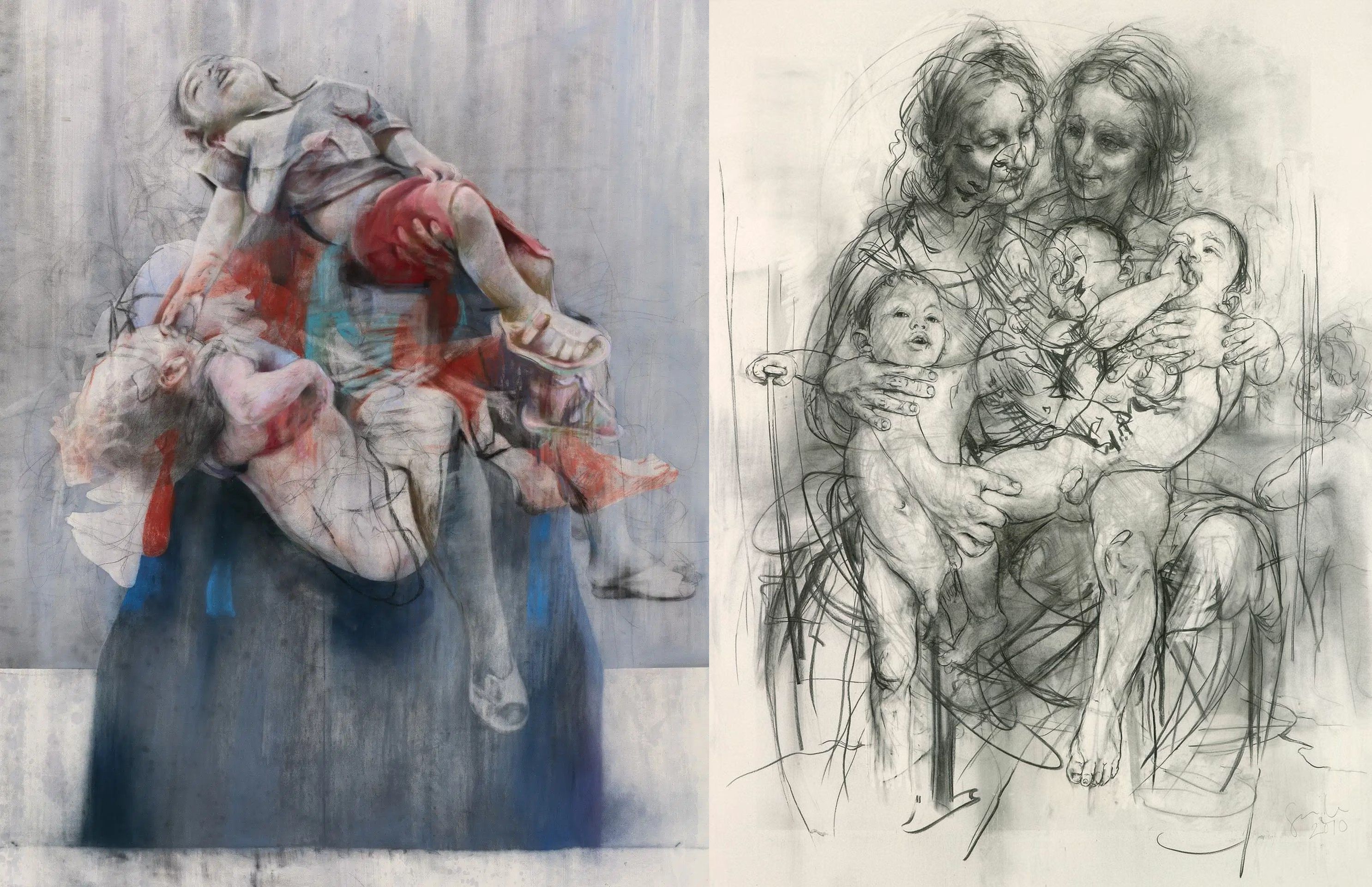
6 | Jenny Saville, Aleppo, pastel and charcoal on canvas, 2017-2018, artist’s collection.
7 | Jenny Saville, Reproduction drawing IV (After Leonardo cartoon), pastel on paper, 2010, artist’s collection.
We sense the Pietà, but the artist subverts the iconography. In the excerpt from the Stabat Mater that opens this article, we read about the compassion inspired by the mother of the dead Christ. But in this image, Saville has concealed the mother’s face. It is a Pietà without identity. How can we feel compassion for her? We see her skirt, like a cylindrical block of concrete, devoid of any warmth, rendered in charcoal and dry pastel. But we see the hands holding the children: two clearly visible; a third inferred by the feet, but whose body has also vanished. The invisible arms lift one of the children, a gesture that expresses an accusation: look at what they’ve done! There is another child off to the side, more contained in an embrace and with an invisible face. We see a technique frequently used by Saville: the overlapping of silhouettes that makes it difficult to distinguish the contours of the figures. These overlaps can be understood as traces of the process, as analysed by Simon Schama. The artist stated: “I want the journey of constructing the painting to be visible” (Saville, as cited in Schama 2005, 126). Leaving these traces of the process visible is a practice she emulates from artists of the past, such as Leonardo da Vinci and Michelangelo, especially in their sketches, which are naturally unfinished and ‘open’. Saville expressed her admiration for the work The Virgin and Child with Saint Anne and the Infant Saint John the Baptist, The Burlington House Cartoon (1506-1508). This appreciation is evident in her study of Leonardo’s drawing [Fig. 7].
In 2010, undoubtedly inspired by her own motherhood, Saville devoted herself to several paintings on this theme. But as with many of her works, the artist returns to the Western artistic tradition, and her drawing evokes the iconography of the Madonna and Child. This is not a Pietà. The child is alive and restless (the artist tries to pin him down, yet even then he multiplies into three); not even the multiplied arms characteristic of Saville’s poetics can calm him. He struggles and slips, a tiny, active, and agitated body, and the sense of an unfinished work points to the rapid movement of life, impossible to contain within a finalised drawing. In the images of Pietà by Saville, the multiplied limbs serve another function. They act as a kind of redundancy in the Theatre of Death. As we have already mentioned, Panel 42 of the Mnemosyne Atlas brings together images that would constitute the ‘gestural alphabet’ performed by the characters in this theatre, spanning a spectrum that ranges from the absolute dynamism of raging despair to the stasis and immobility of the corpse. As Bordignon and Bergamo state, “the physicality of the dead body is a powerfully persistent presence in the plate” (Bordignon, Bergamo 2019, 225). Settis (2013) and Ginzburg (2015) studied one aspect of this physicality: the so-called ‘arm of death’. In both Settis’s analysis of Raphael’s Deposition (1507) and Ginzburg’s analysis of Jacques-Louis David’s Death of Marat (1793), the influence of ancient models, most notably Roman sarcophagi, is evident. These served as a “basic repertoire” (Settis 2013, 97) featuring images of the hero’s death (Achilles, Patroclus, Meleager). The arm of death can be inferred, for example, from a sarcophagus in the collection of the Palazzo Doria Pamphilj [Fig. 8]. The outstretched arm does not appear on this sarcophagus, but it is possible to infer its presence because, due to its fragility, it did not physically survive the passage of time.
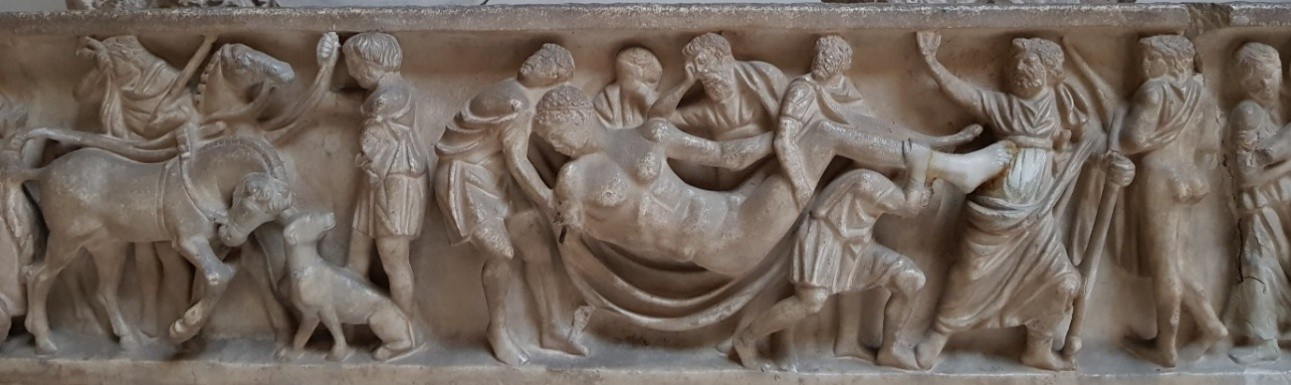
8 | Sarcophagus with the Transport of the body of Meleager (detail), marble, second half of the 2nd century CE, Roma, Palazzo Doria Pamphilj.
The position of the lifeless arm, “abandoned in the void” (Settis 2013), was a motif that effectively characterised the dead body. Both Settis and Ginzburg identified in Leon Battista Alberti’s De pictura (originally dated 1435) a description of the fundamentals for the representation of the dead body:
They praise a ‘historia’ in Rome, in which the dead Meleager is being carried away, because those who are bearing the burden appear to be distressed and to strain with every limb, while in the dead man there is no member that does not seem completely lifeless; they all hang loose; hands, fingers, neck, all droop inertly down, all combine together to represent death. This is the most difficult thing of all to do, for to represent the limbs of a body entirely at rest is as much the sign of an excellent artist as to render them all alive and in action (Alberti, De pictura II, 37).
This foundational text clearly reveals how ancient models were revitalised in Renaissance art, and Warburg and his collaborators demonstrated the persistence of these mourning motifs in Panel 42 of the Atlas. In Jenny Saville’s drawing inspired by Leonardo da Vinci, the arms of the mother and children are pure movement, which she intensified through a kind of explicit pentimento. In the other works on display at Ca’ Pesaro, however, the artist explored another lesson from the old masters and reproduced the ‘arm of death’, particularly in Blue Pietà [Fig. 2]. She duplicated the two arms of the dead child and experimented with this version of the arm crossed over the chest, following Alberti’s recommendation so that “all droop inertly down, all combine together to represent death”. In versions that differ slightly from the Pathosformeln derived from sarcophagi depicting the deaths of Greek heroes (Catoni 2026), the limbs (always multiple) likewise reproduce the quality noted by Alberti, and the artist depicted them as if they bore an unbearable weight, creating the impression of great effort and difficulty for those trying to hold them. This contrast between the effort of the figures carrying the dead body—with their muscles strained and their entire bodies in physical tension—and the inert, unbearably heavy corpse is a key element in the representation of the Theatre of Death. Saville explored this handling of the dead body in other works not on display at Ca’ Pesaro, such as Pietà I (2019-2021), shown in Florence in 2021 (Jenny Saville 2021), which is explicitly inspired by Michelangelo’s Pietà Bandini (1547-1555). This eloquent dynamic appears in the drawings on the wall at the entrance to the Pietà room: in Pietà III [Fig. 9], the man tries to prevent the young man on his lap from slipping.
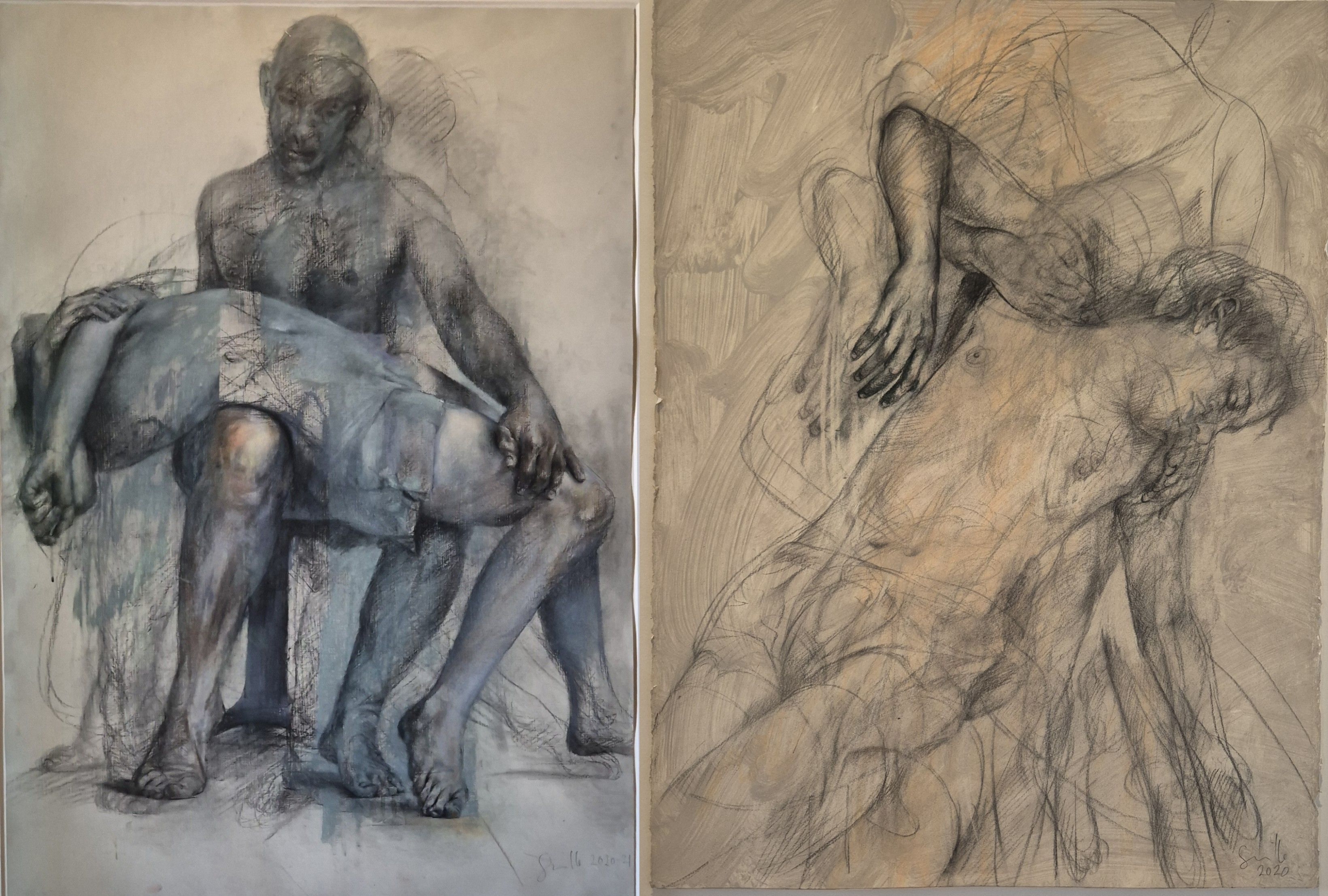
9 | Jenny Saville, Pietà III, charcoal and pastel on canvas, 2020-2021.
10 | Jenny Saville, Pietà Study III, charcoal and pastel on paper, 2020, private collection.
In Pietà Study III [Fig. 10], a nearly faded female figure supports an inert body that takes the shape of a diagonal cross, emphasising a precarious balance, an impossible act of support. In this drawing, the artist alludes more to the motif of the Descent from the Cross than to the Pietà. This work has an unfinished quality, with numerous overlapping lines, and is more graphic than pictorial in character. Once again, the distinctive pictorial density of the artist’s poetics gives way to a sombre, austere, dry palette.
Pagan Mater dolorosa
Isn’t there a literary tradition surrounding the Pietà motif? Monica Centanni provides a literary clue that predates Christian sources, stemming precisely from the classical tradition. One can uncover even older sources for the Pietà within the human experience as shaped by literature. In the classical tradition, there is a vast array of grieving mothers. Perhaps the most striking is Hecuba. With the Trojan War lost to the Greeks, the city burned, and Priam, Paris, and Hector dead, Hecuba believes her young son Polydorus is safe, for she had sent him to Thrace, into the care of King Polymestor. However, she soon discovers that the child had been killed by the very king to whom she had entrusted her son, who also appropriates the treasure that had been handed over to him along with the boy.
Centanni gives voice to Hecuba:
Era tutto finito: Priamo sgozzato, tutti i miei figli maschi morti. Anche Polidoro, il mio bambino più piccolo che avevo mandato via, lontano da Troia, perché almeno lui si salvasse. Seduta qui sulla sabbia grigia, ho tenuto tra le braccia il corpo di Polidoro che il mare mi aveva restituito, bianco e grigio come la sabbia. Bianco e grigio, e livido. Nel vento una voce, la sua voce, ripeteva che era tornato qui, da me, il mio bambino, a farsi cullare, ancora una volta nelle braccia di sua madre. Un altro fantasma che viene ad abitare nella mia mente, già affollata di ombre (Centanni 2021, 79).
[It was all over: Priam with his throat cut, all my sons dead. Polydorus too, my youngest child, whom I had sent away, far from Troy, so that he at least might be saved. Sitting here on the grey sand, I held in my arms the body of Polydorus, which the sea had given back to me, white and grey like the sand. White and grey, and livid. In the wind a voice, his voice, kept saying that he had come back here, to me, my child, to be cradled once again in his mother’s arms. Another ghost coming to dwell in my mind, already crowded with shades].
Gilbert Norwood (1920) asserts that it is Hecuba who supports Euripides’ play The Trojan Women (dated 415 BCE), through her ability to endure suffering and her resignation: “She is a pagan mater dolorosa” (Norwood 1920, 245). This connection to the classical tradition seems to be affirmed by Jenny Saville in Byzantium [Fig. 11]. Once again, we do not find all the attributes of the Christian Pietà. In place of Mary, the artist depicted a figure with distinctly archaic features (not Byzantine, as the name might suggest). Identification with the grieving mother is hindered by a hieratic face. Saville modelled the face of the Pietà after the head of the archaic chryselephantine sculpture on display at the Delphi Archaeological Museum [Fig. 12]. While there is no absolute certainty, the sculpture may refer to the god Apollo. Could the mother in the Pietà of Byzantium be a kind of oracle? The archaic countenance creates a sense of distance and eternity. Her gaze does not look at her dead son or at us; it is a gaze that pierces through the viewer and through time.
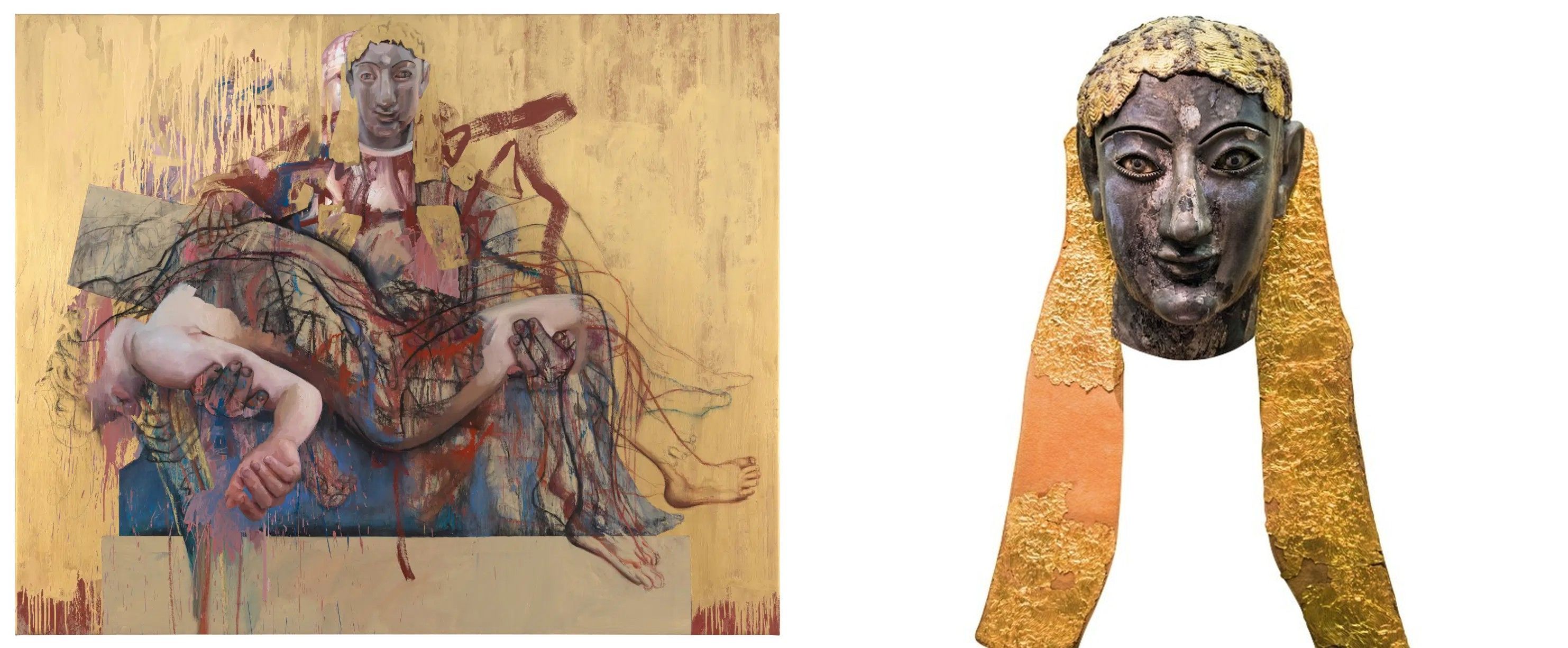
11 | Jenny Saville, Byzantium, charcoal, oil bar wax, oil stick and gold paint on canvas, 2018, Athens, The George Economou Collection.
12 | Archaic chryselephantine sculpture, gold and ivory, 6th-5th century BCE, Delphi, Delphi Archaeological Museum.
The enigmatic face in Byzantium contrasts with the figure of the dead child, whose face remains unfinished. We see the tender flesh of the neckline, but the artist denies the materiality of the child’s head, leaving only charcoal marks that provide little more than a sketch of its facial contours. The body, in turn, has been rendered in a hybrid manner. While the artist has depicted the flesh of the right arm, part of the chest, and the right thigh in a highly realistic manner, the rest of the child is a tangle of lines. There are at least two distinct types of lines: those we have seen in other works, such as the maternal-themed drawings from the 2010s; and those lines that evoke the human venous system. This body with exposed veins resembles Giuseppe Salerno’s anatomical machines, created in the mid-18th century [Fig. 13].
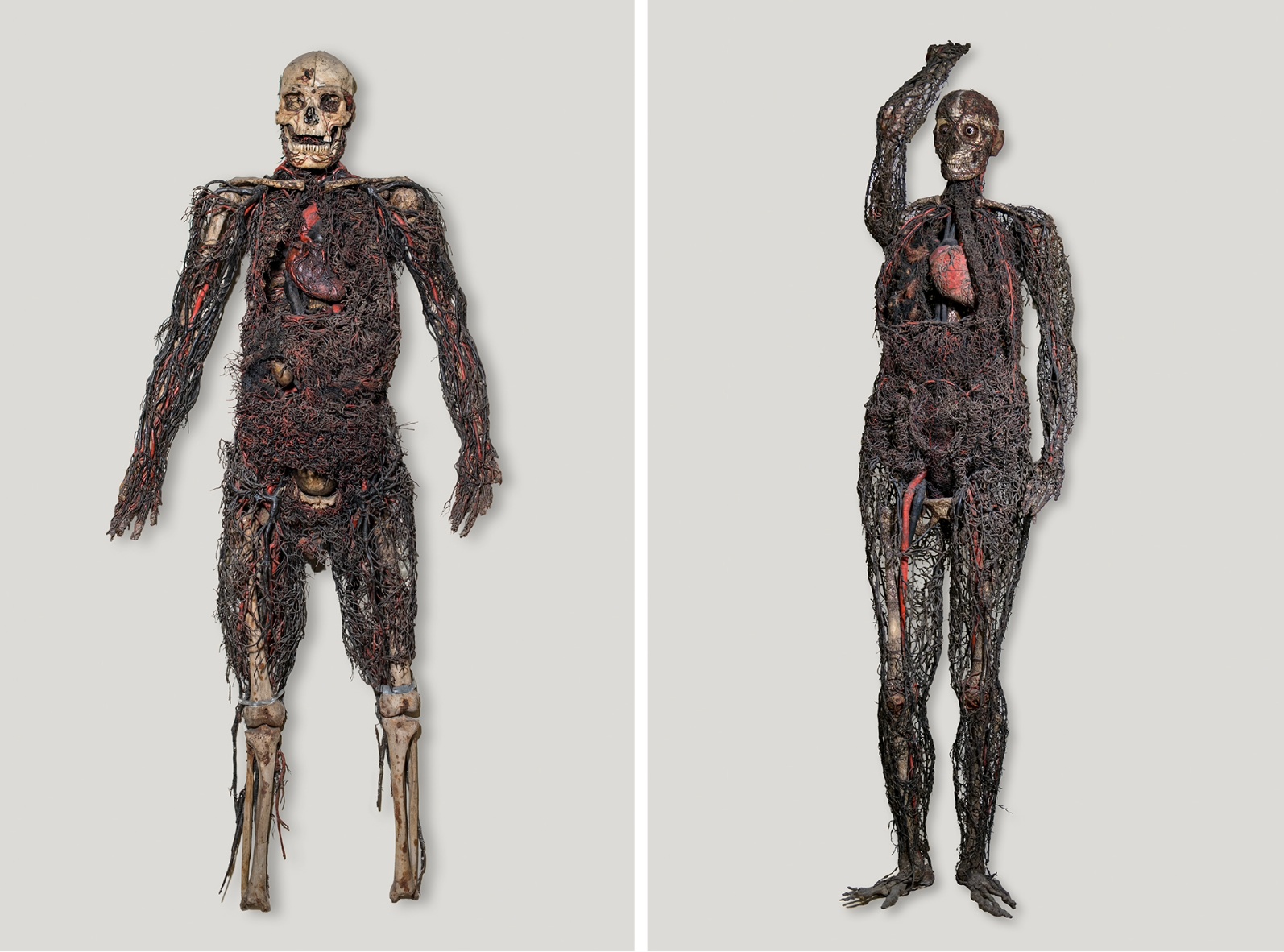
13 | Giuseppe Salerno, Macchina anatomica – Uomo, c. 1756 (left) and Donna, 1763-1764 (right), Napoli, Museo Cappella Sansevero.
Salerno was a physician from Palermo who is said to have produced anatomical models of remarkable precision for the time. The skeletons are human, while the blood vessels were made from various materials, including beeswax and dyes. They were commissioned by Raimondo di Sangro, Prince of San Severo, who was a military officer, inventor, anatomist, and esotericist. The prince kept his ‘anatomical machines’ on display in his palace in Naples. It is curious that Saville depicts the capillaries of the dead child. Death is precisely the end of all vital flow. It is, as Alberti had already taught, the opposite of movement. The painting’s gold background is the identifiable link to Byzantine art. It indicates that this is a scene outside of space and time. Unlike all other Pietà figures, this one seems least confined to a specific place (Aleppo, Syria) or period (Antiquity, the Renaissance, the contemporary era).
Jenny Saville referenced and subverted the iconography of the Pietà. She gave it a Greek face. Is Byzantium an oracle? Is the child a sacrifice? What future does it foretell? Let us return to Euripides, whom Aristotle, in the Poetics, describes as “the most tragic of the poets” (Arist. Poet. 1453a). Gilbert Murray, in the introduction to his translation of Euripides’ The Trojan Women, states that tragedy is “the first great expression of the spirit of pity for mankind exalted into a moving principle” (Murray 1905, 7). The pity to which Murray refers is not compassionate:
Pity is a rebel passion. Its hand is against the strong, against the organised force of society, against conventional sanctions and accepted Gods. It is the Kingdom of Heaven within us fighting against the brute powers of the world; and it is apt to have those qualities of unreason, of contempt for the counting of costs and the balancing of sacrifices, of recklessness, and even, in the last resort, of ruthlessness, which so often mark the paths of heavenly things and the doings of the children of light. It brings not peace, but a sword (Murray 1905, 7).
In the mysterious movement of images, the Christian Mater dolorosa is one facet of the dispossessed mother. Euripides’ tragedy condenses in literature what is embodied in the visual arts, from the Vesperbild to Saville’s reconfigured Pietà, as Norwood stated regarding Hecuba: “a figure summing up in herself all the sorrows of humanity” (Norwood 1920, 245). The tragedy The Trojan Women remains relevant today. Hecuba makes explicit through her forceful words—and gestures—an irrefutable accusation: in the scene where she takes her dead grandson’s small body into her arms, she utters “the stinging reproach of a ‘barbarian’ revolted by the crimes of ‘civilization’” (Norwood 1920, 245).
Saville’s Pietà echoes the reproach voiced by Hecuba. In a painting where the artist manipulates paint as if it were flesh, she exposes the horror of war evoked in images that continue to be repeated. The acute pain of a mother who loses her child does not fit within the meditative and silent mourning of the Vesperbild, or in the Pietà by the young Michelangelo. Pity is a rebel passion: a grieving mother never loses her power.
*This article was written during my time as a visiting professor at the Centro studi classicA of the Università Iuav di Venezia, where I took part in the preparation of the new editions of the Bilderatlas Mnemosyne and the Lemmario (Carocci 2026 and 2027).
Bibliography
Sources
- Arist. Poet.
Aristotle, Poetics, translated by S. Halliwell, in Aristotle, Poetics; Longinus, On the Sublime; Demetrius, On Style, Cambridge (MA)/London 1995, 1-27. - De pictura
Leon Battista Alberti, On Painting and On Sculpture. The Latin Texts of De pictura and De statua, edited and translated by C. Grayson, London 1972. - L’Atlante delle immagini
M. Ghelardi, M. Centanni (a cura di), Aby Warburg, L’Atlante delle immagini, Roma 2026. - Jenny Saville 2005a
D. Eccher (a cura di), Jenny Saville, catalogo della mostra (Roma, MACRO – Museo d’Arte Contemporanea, 22 gennaio-1 maggio 2005), edizione italiana e inglese, Milano 2005. - Jenny Saville 2005b
J. Gray, L. Nochlin, D. Sylvester (eds.), Jenny Saville, New York 2005. - Jenny Saville 2021
S. Risaliti (a cura di), Jenny Saville, catalogo della mostra (Firenze, Museo Novecento – Museo di Palazzo Vecchio – Museo dell’Opera del Duomo – Museo degli Innocenti – Casa Buonarroti, 30 settembre 2021-27 febbraio 2022), Firenze 2021. - Jenny Saville 2025
Jenny Saville. The Anatomy of Painting, exhibition catalogue (London, National Portrait Gallery – Fort Worth, Modern Art Museum, 20 June-7 September 2025), with contributions by J. Elderfield, A. Karnes, R. Gay, E. Coccia, S. Mann, N. Cullinan, S. Howgate, London 2025. - Jenny Saville 2026
Jenny Saville a Ca’ Pesaro, catalogo della mostra (Venezia, Ca’ Pesaro – Galleria Internazionale d’Arte Moderna, 28 marzo-22 novembre 2026), con un saggio di E. Barisoni e un’intervista di S. Ventra a J. Saville, New York 2026.
Bibliographical References
- Baschet 2008
J. Baschet, L’iconographie médiévale, Paris 2008. - Bergamo [2005] 2021
M. Bergamo, Matrici classiche della “Madonna in trono”: dalla tipologia all’archetipo e ritorno, in M. Centanni (a cura di), L’originale assente. Introduzione allo studio della tradizione classica, Dueville [2005] 2021, 227-247. - Bergamo 2011
M. Bergamo, Immagini di voci, di gesti, di riti: sul valore performativo dell’arte medievale, “La Rivista di Engramma” 88 (marzo 2011), 35-43. - Bordignon, Bergamo 2019
G. Bordignon, M. Bergamo, Iconographies and Pathosformeln of Pain in Aby Warburg’s Mnemosyne Atlas: A Pathway through Plates 5, 6, 41, 41a, 42, 53, 56 and 58, “Ikon. Journal of Iconographic Studies” 12 (2019), 219-232. - Catoni 2026
M.L. Catoni, Figure di violenza e d’orrore: le molte vite di una formula iconografica, in S. Settis (a cura di), Storia di un gesto: il mito di Meleagro dall’arte classica a Warburg, a Picasso, catalogo della mostra (Milano, Fondazione Luigi Rovati, 13 maggio-4 ottobre 2026), Monza 2026, 115-150. - Centanni 2021
M. Centanni, Contro Ulisse: un eroe sotto accusa, Roma 2021. - Centanni 2026
M. Centanni (a cura di), Lemmario dell’Atlante Mnemosyne, Roma 2026, in corso di stampa. - Forster 2022
K.W. Forster, Il metodo di Aby Warburg. L’antico dei gesti, il futuro della memoria, Dueville 2022. - Ginzburg 2015
C. Ginzburg, Paura, reverenza, terrore: cinque saggi di iconografia politica, Milano 2015. - Grabar 1968
A. Grabar, Christian Iconography: A Study of Its Origins, Princeton 1968. - Murray 1905
G. Murray, Introduction to The Trojan Women of Euripides, translated into English rhyming verse, London 1905, 5-7. - Norwood 1920
G. Norwood, Greek Tragedy, London 1920. - Object Lessons Space 2018
Object Lessons Space, Jenny Saville in Ten Works, 2018. - Panofsky, Saxl 1933
E. Panofsky, F. Saxl, Classical Mythology in Mediaeval Art, “Metropolitan Museum Studies” 4/2 (March 1933), 228-280. - Réau 1957
L. Réau, Iconographie de l’art chrétien, tome II, Iconographie de la Bible, II, Nouveau Testament, Paris 1957. - Schama 2005
S. Schama, Interview with Jenny Saville, in Jenny Saville 2005b, 124-129. - Schwabsky 2005
B. Schwabsky, Niente scuse, in Jenny Saville 2005a, 70-81. - Seminario Mnemosyne 2000a
Seminario Mnemosyne, Madre della vita, madre della morte. Figure e Pathosformeln. Saggio interpretativo e letture grafiche di Mnemosyne Atlas, Tavola 5, “La Rivista di Engramma” 1 (settembre 2000), 79-82. - Seminario Mnemosyne 2000b
Seminario Mnemosyne, Il teatro della morte. Saggio interpretativo di Mnemosyne Atlas, Tavola 42, “La Rivista di Engramma” 2 (ottobre 2000), 36-37. - Settis 2013
S. Settis, Ars moriendi: Cristo e Meleagro, in M.L. Catoni, C. Ginzburg, L. Giuliani, S. Settis (a cura di), Tre figure: Achille, Meleagro, Cristo, Milano 2013, 83-108. - Settis 2018
S. Settis, Archeologia della Pietà, in A. Mazzotta, C. Salsi (a cura di), Vesperbild. Alle origini delle Pietà di Michelangelo, Milano 2018, 31-34. - Zuffi 2008
S. Zuffi, Episodi e personaggi del Vangelo, Roma 2008.
Abstract
This article examines six works by contemporary British artist Jenny Saville (featured in her exhibition at Ca’ Pesaro in Venice) to reflect on the iconographic motif of the Pietà. A brief tracing of the iconographic tradition reveals that this theme does not stem from a literary source, as the scene of the Virgin Mary cradling her dead son does not appear in the Gospels. The origins of the motif are, therefore, visual; it traces back to wooden sculptures that appeared in Germany in the 14th century, known as Vesperbild (“Vespers images”), a name referring to the time of day when, according to tradition, Christ was taken down from the cross. Jenny Saville plays with this iconographic tradition to reconfigure it: her Pietà figures appear faceless, bear the hieratic visage of an ancient Greek sculpture, or take the form of a man holding a dead child. She multiplies arms and erases parts of the mothers’ and children’s bodies, thereby evoking an ancient mater dolorosa: Hecuba. The persistence of the motif of the dispossessed mother, across the past and present and throughout all artistic mediums, exposes the terrible, enduring logic of war.
keywords | Iconography; Pietà; Vesperbild; Jenny Saville; Atlas Mnemosyne.
La Redazione di Engramma è grata ai colleghi – amici e studiosi – che, seguendo la procedura peer review a doppio cieco, hanno sottoposto a lettura, revisione e giudizio questo saggio (v. Albo dei referee di Engramma)
Per citare questo articolo / To cite this article: Luana Maribele Wedekin, Pity is a Rebel Passion. Jenny Saville’s Contemporary Pietà, “La Rivista di Engramma” n. 238, agosto 2026.