Dance, Inversion, Grid
Salome in the Benedictine Abbey of Saint John in Müstair (c. 1160)
Barbara Baert
How many ropes does a man need to replace one
umbilical cord that was never properly spun?
David Grossman, Lion’s Honey, 120
Abstract
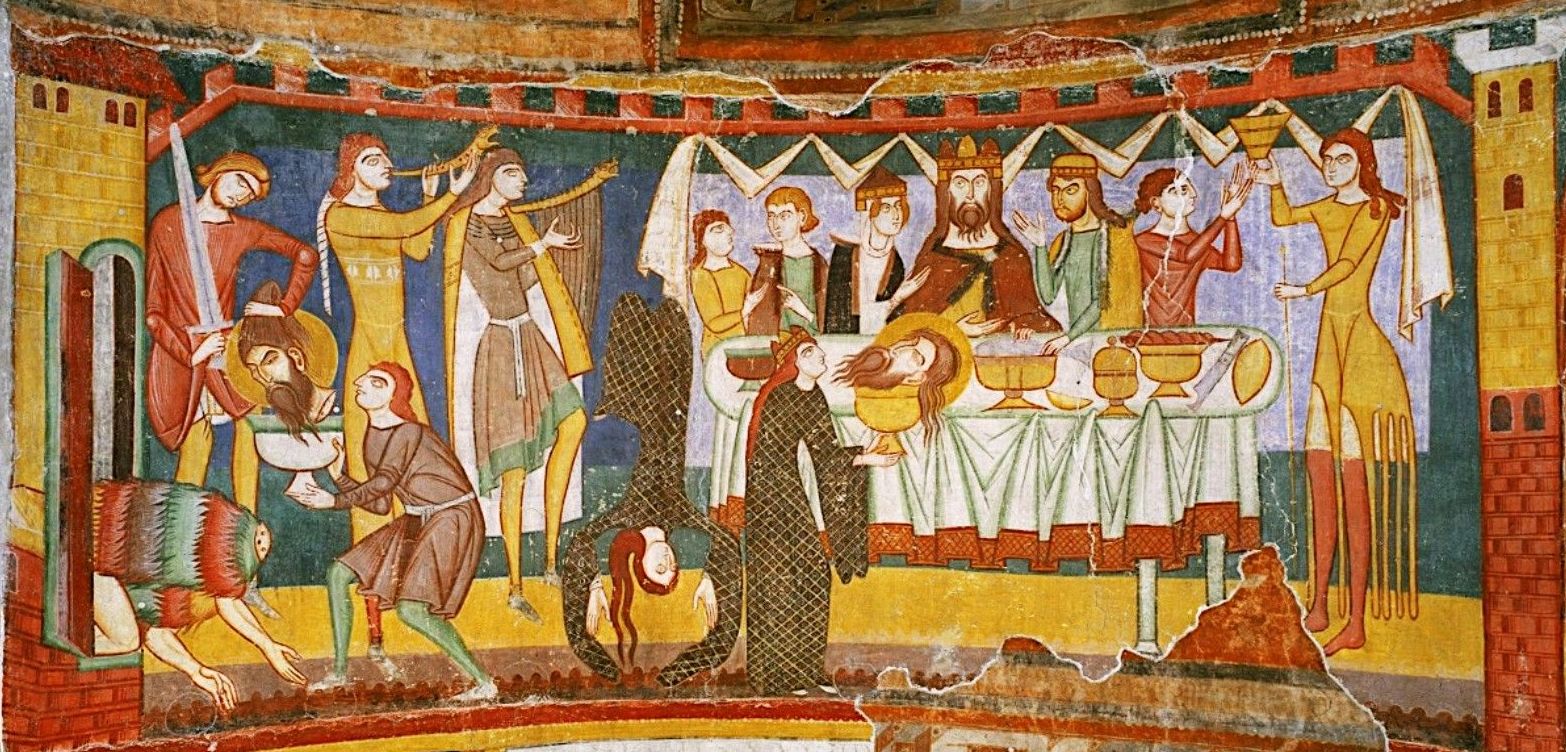
1 | Decapitation of John and the Dance of Salome, c.1160, mural, Müstair, Benedictine convent of St. John.
In this essay, I examine how the biblical narrative of the beheading of John the Baptist and Salome’s dance (Mark 6:14-29) was structured and functioned in the Romanesque murals of the apse of the Benedictine Abbey of Saint John in Müstair, Switzerland, dated to around 1160 [Fig. 1] (Goll 2007; Wolf 2007; Wyss 2002). Following recent developments in visual studies and the anthropological turn, I approach the murals through the interplay of text, image, and context. This requires both a synchronic and a diachronic perspective (Baert 2019, 5-6). On a synchronic level, visual exegesis compares the structure, rhetoric, and intertextuality of the biblical narrative with its visual translation, revealing both the passages selected for representation and those omitted or transformed. On a diachronic level, the murals are considered within their historical context of production and reception – their visual Wirkungsgeschichte – with particular attention to the embodied and performative dimensions of medieval religious art. In this regard, the liturgical context provides a crucial space in which text, image, body, and performance intersect.
Mimetic violence
The story takes place in a room that is festively decorated with textiles. Sat at the table are gesticulating guests, with a scheming Herodias manipulating the king. We see fish, wine and what seems a meat brochette. At the right end of the table, a server – perhaps a jongleur – raises a toast with a female guest. On the left, we see musicians with a flute and a harp. Further to the left, the beheading of John the Baptist is depicted. The prophet is wearing his traditional animal skin, referring to his ascetic lifestyle in the desert. Salome is pictured twice: on one side she is depicted upside-down – her hands not touching the floor – and on the other she is standing straight and crowned, presenting the platter with the head of John the Baptist to the partygoers. Mark 6:14-29 and Matthew 14:1-12 recount the death of John the Baptist. Herod had him imprisoned for denouncing as incestuous his marriage to Herodias, the former wife of his brother. During a banquet, Herodias’ daughter dances before Herod, who is so enchanted that he promised her everything she desires. At her mother’s behest, she demands the head of John the Baptist. The king honors her request and has the head delivered to her on a plate (in disco), which she gives to her mother. When John’s disciples discover his death, they bury his headless body.
The central verse Cumque introisset filia ipsius Herodiadis et saltasset et placuisset Herodi simulque recumbentibus (Mark 6:22a) could be slightly adapted as “When the daughter came in and danced, she pleased Herod and his guests” (Dormeyer 1998). In the original Greek text, the daughter is called korasion, a term usually used for a young girl not yet a woman (Gauthier 2008, 45). In verse 28, when the head is given to the daughter, the Latin Vulgate uses the word puella. For comparison, in Mark 5:23-35 Jairus’ daughter is likewise called korasion and puella (d’Angelo 1999). The daughter is hence a child with no name. The name Salome will be deduced later from accounts by Flavius Josephus (Joseph. Ant. Iud. XVIII, 136-137) so I will use this name throughout this article (Dottin-Orsini 1988). Her persona comprises only two words: Filia saltasset, the girl danced. Due to the soberness of this phrase, she is reduced to her own medium of dance. A dance, furthermore, that is not a dance of praise for the Lord, but a dance that is fatal.
The French literary critic René Girard (1923-2015) wrote a fascinating essay on the role of the dancing girl in Mark’s plot. The author analyzes the plot through the concept of mimesis. “Salome is a child. She has nothing to do with the dance of the seven veils and other orientalia”, he writes (Girard 1984, 314. The child imitates her mother’s wish and from the moment she is filled with this wish, the girl crosses a certain threshold. It is said in Mark that the girl “hastens” back –cum festinatione (Baert 2023) – and “immediately” demands John’s head in disco. The acceleration reflects the intensification of the plot that will converge in what Girard launched as ‘mimetic violence’. “At first she is a blank sheet of desire, then, in one instant, she shifts to the height of mimetic violence” (Girard 1984, 314). This peculiar rite of passage enacts itself in an inevitable determination of moments: from the silent dance, to the king’s giving voice to the oath, to the mother’s wish fulfilled, culminating in the dazzling horror of a head on a platter offered during a banquet (Renger 2014, 55). The culmination of mimetic violence is the result of a macabre irony (Derret 1965). When Herodias demands the head of St John – metaphorically meaning his death – the girl interprets the request literally (Girard 1984, 317). She copies the words “give me the head of St John” and then adds herself “on a platter” (in disco; pinakos). The platter, being the result of a misunderstanding, becomes the bearer of one of the most far-reaching revolutions in Salvation History – the death of the Prodromos (Forerunner) who is the voice of all voices, the last prophet and the proto-martyr (Focant 2006). To this day, the cathedral of Genoa claims to possess the larger ‛original’ dish of Salome, which is made of agate [Fig. 2] (Arndt & Kroos 1969).
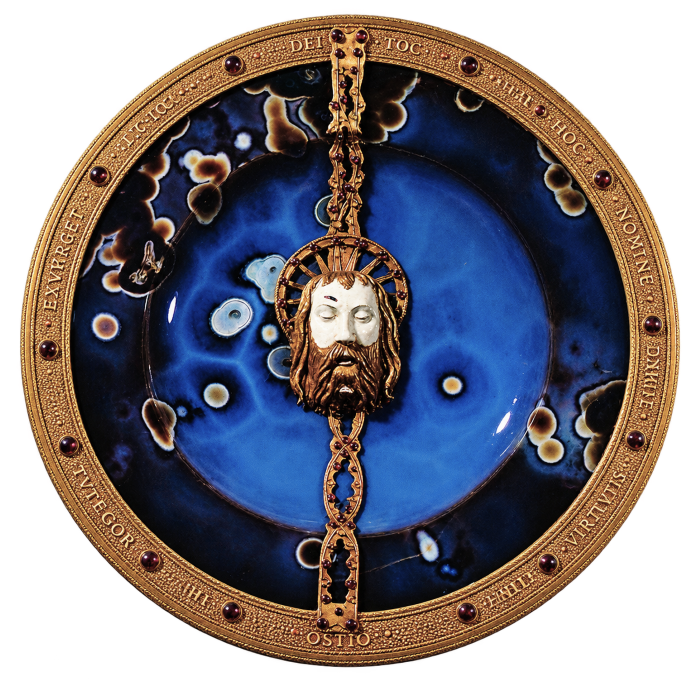
2 | Relic named Dish of Salome, composed vessel: agata plate, 1st century; gilt silver rim with vine decorations, c.1300; gold enamel Head of St. John, 1420, Genoa, Treasure Museum, Cathedral of St Lorence.
The gilt silver rim and the decorated holder on the back, with vines as a symbol of the Eucharist, were added later – presumably around 1300 – in a French workshop (Müller & Steingräber 1952, nr. 16). A cross with a medallion was adorned with delicate vines, a symbol of the Eucharist, sacrifice and martyrdom (John 15:5). An inscription on the rim reads: inter natos mulierum non surrexit maior Johannis Baptistae / among those born of women there has arisen no one greater than John the Baptist (Matt 11:11). Around 1420, a small head of St John in gold enamel was added in the middle of the dish and mounted in an aureole set with rubies.
Speed and inversions
Mark’s plot demonstrates a peculiar spatial energy: the way in which Salome is placed in different rooms seems flighty and even confusing [Fig. 3]. It starts with verse 22, “when the daughter comes in” (cumque introisset filia ipsius). Then, in verse 24, when she has finished her dance and Herod’s oath has been inescapably made, she leaves the room and asks her mother for advice. Her mother then whispers the fatal demand into her ear (quae cum exisset dixit matri / “and she went out and said to her mother”). In verse 25, the pace of the story picks up. Salome re-enters in the room and immediately addresses the king with haste (cumque introisset statim cum festinatione / “and she came in immediately in haste”). At this point, the events are interrupted by the beheading in the prison after which, in verse 28, the executioner gives the head to the girl, and the girl gives the head to the mother (et adtulit caput eius in disco et dedit illud puellae et puella dedit matri suae / “and brought his head on a platter and gave it to the girl, and the girl gave it to her mother”). The first transfer of the head, according to the context, happens in the hall where the party is held, while the second is suggested to have happened in a different room, since earlier, she had to leave to go see her mother. In short, the girl comes in, she leaves, she hastily goes in again, she receives the platter, she gives the platter to the mother.
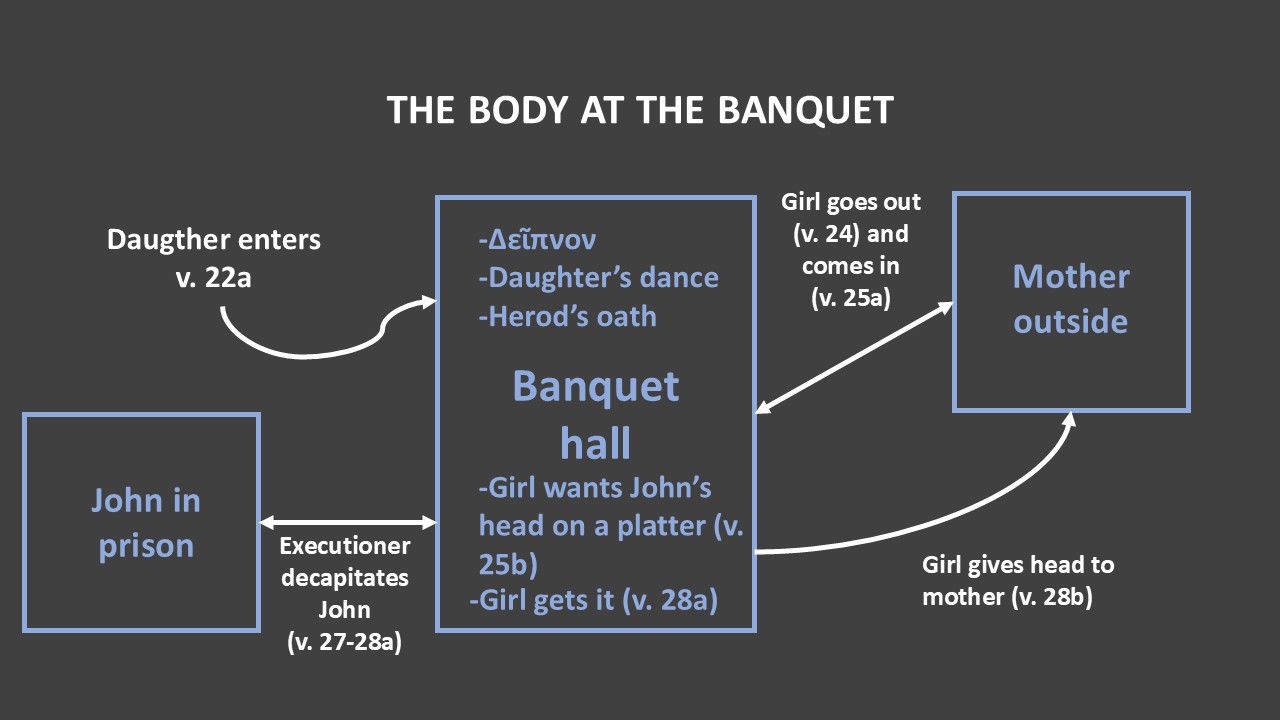
3 | Scheme of movements by the daughter and the spatial structure of the story in Mark 6:14-29 and Matthew 14:1-12 (copyright: dr. Laura Tack, KU Leuven).
Artists must have felt difficulties in transforming such spatial and temporal complexity into a visual narrative framing and were forced to visual solutions (Baert 2016; Ead. 2023). Also, they may have recognised the increasingly neurotic speed in which the consecutive actions were performed. The artist of Müstair addressed the challenges by both compressing the events into a single room and duplicating Salome at the center of the scene. On the right Salome is presenting the platter with the head of John the Baptist to the distinguished guests. On the left, she is depicted upside-down in an acrobatic dance. Her hands do not touch the floor; she seems to float in the air, pictorially frozen in a momentaneous situation of impossibility. She lost her crown to gravity. Iconographically, the duplication of Salome divides the narrative into ‘before’ (the dance) and ‘after’ (the transfer of the head), while placing her role in the fatal outcome at the center.
In all cultures, dance carries associations with celebration, thanksgiving, or reconciliation with the gods (Debarge 1992). In Christianity however, dance has retained its ambiguity. On the one hand, dancing is preserved as a psalmodic medium of praise. In the Proto-evangelion of James Mary dances in the Temple (Prot. Iac. 7, 2-3), and Athanasius of Alexandria in his Epistulae festales associates dance, as part of choral liturgy and bodily praise, with the soul’s ascent toward God (Athan. Ep. fest. I. X; Gauthier 2008, 131). On the other hand, the Church considered dancing dangerous, even diabolical (Backman [1945] 1952). From the 12th century onwards, depictions of Salome’s dance increasingly featured acrobatic poses. On the bronze doors of San Zeno in Verona (c. 1100) Salome is bending over and touching the ground with her hands [Fig. 4] (Merkel 1990, nr. 431).
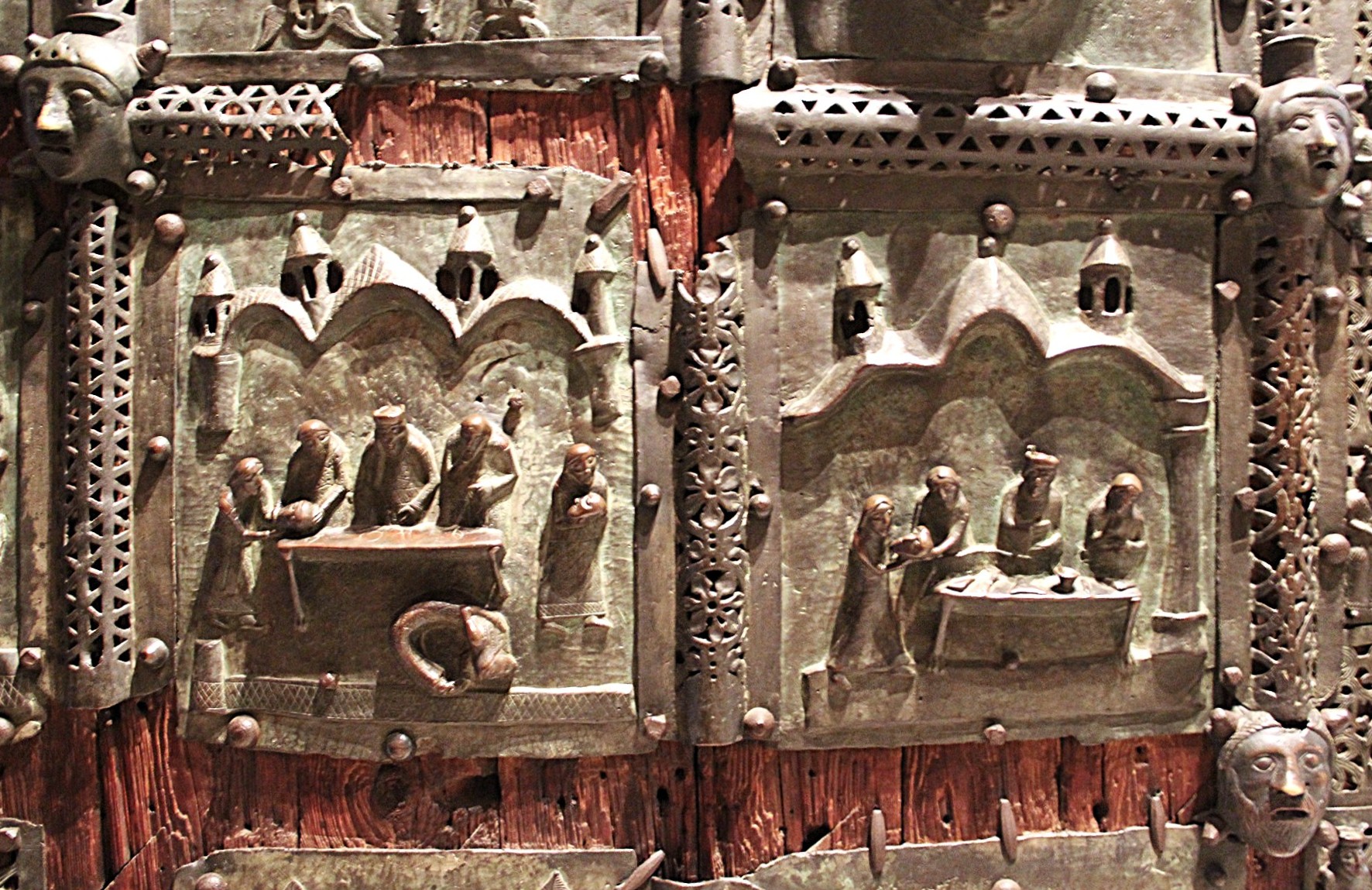
4 | Dancing Salome, c. 1100, details from bronze doors, Verona, St. Zeno Cathedral.
This acrobatic position was used by troubadours and jongleuses in the Middle Ages (Ingrassia 1989, 57-66). Jane Long writes: “Since the early medieval period jongleurs had been criticised consistently by clerics as obscene, unnatural, and lascivious, so it is not surprising to find Salome among their number” (Long 2013, 1156). This acrobatic position was also referred to as the arc-de-cercle (Fratini 2014, 95). The arch or the ‘bridging’ is a recurrent position of the body in spastic episodes, and during the Middle Ages was documented as a therapeutic dance (Vandenbroeck 1997, 85-97). Therapeutic dancing is part of popular devotion, cults, traditions and superstitions associated with Saint John the Baptist. John was invoked against epilepsy, cramps, fear of heights, and choreomania – a mental illness related to tarantism, as in the so -called tarantella music and dance known as St John’s illness (Hecker [1832] 1838, Carpitella 1961). The earliest mention of St John’s dancers and tarantism goes back to the year 1021.
Black and grid
The use of duplication by inversion together with Salome’s black gridded surface, represents an utterly intriguing decision by the Müstair painter. For the medieval mind, the black color means negativity because of the absence of light. The observer in the church of Müstair is a witness of a floating corpus, of black magic. In the context of John the Baptist’s beheading, the dance becomes a perversion, diverted toward taboo (incest), horror (decapitation), and excess (acrobatic). I quote Antonella Fenech:
En effet, la figure de Salomé à contre-sens s’incarne en une inversion radicale non seulement des valeurs incarnées par Jean-Baptiste et le Christ, mais plus profondément des interdits énoncés dans l’Ancien Testament en relation à l’inceste” / Indeed, the figure of Salome embodies a radical inversion, not only of the values personified in John the Baptist and Christ, but, more profoundly, of the prohibitions proclaimed in the Old Testament in relation to incest. (Fenech 2025, 178). It brings to mind Gregory of Nazianzus’ (329-389) warning: dance not like the daughter of Herodias, but like David (Greg. Naz. Or. 39, 4; Webb 1997, 135).
According to René Girard, the dance incorporates the idea of skandalon in Mark’s plot. In Greek, skazein means to stumble or limp. By extension, ‘scandal’ in its original meaning is nothing but an obstacle that attracts and repels. It is the stumbling block. Girard writes:
The movements of dance seem to untangle for us the otherwise unyielding knot of our desires. The art of the dance simultaneously excites and appeases desire. Desire does its best to turn the truth into a scandal (Girard 1984, 315-316).
Where the dance is oriented toward the untangling or liberation of the knot, the scandal causes one to fall, to limp, to become tied up in something. The dance of the child is a skandalon and the head of John the Baptist is its trophy. The Salome-doublure attracts and repulses at the same time. All the energy of the scene seems to implode in her with the peculiar grid pattern as its energetic conductor [Fig. 5]. It remains unclear if the grid is just a decorative-formal choice or part of an intentional semantic field (Gombrich 1984, 132). In my opinion, the latter is the case, since Salome is the only gridded space in the murals of the church. What might this ‘grid-on-black’ signify? Bernhard Siegert describes the role of the grid in his book Cultural Techniques. “The grid refers fundamentally to the principle of τάξις (táksis: Greek for order, position, rank) that uses pattern as denotation of empty space to be ‘filled’ or ‘fixated’” (Siegert [2003] 2015, 97). The grid is a technique or visual format for the paradoxical notion of ‘presence-absence-space’ (Siegert [2003] 2015, 100). In this context, Tim Ingold uses the term “dissolution of surface” (Ingold 2015, 85). Grids allow the surface to disappear. The grid is both absorbent (implosive) and restrictive (sticky, captive). In her iconic and seminal essay Grids Rosalind Krauss writes:
Although the grid is certainly not a story, it is a structure, and one, moreover, that allows a contradiction between the values of science and those of spiritualism [....]. As something repressed. In this matrix or ambi- & multivalence, the grid helps us to see, to focus on what is not there which is not story but something else, outside the narrative (Krauss 1979, 54-55).
Elina Gertsman and Vincent Debiais explain the grid in L’hypothèse abstraite as a formal device that disconnects the figure from its contingent historical moment, thereby elevating it to an absolute figura beyond time (Gertsman & Debiais 2025). In sum, according to these interpretations, Salome’s grid may present the unrepresentable (black magic) with a minimum of visual means into the realm of the representable. Salome has become more or less a membrane within the story. The black silhouette may also express the idea of mimetic desire. The empty dancing child is a ‘nothing’ (color and light absorbing) that needs to be (ful)filled by the mother. The grid channels this drama. The grid is the only taxis capable of rendering so many – no, too many – taboos bearable and fixated: incest, the oath, the sexualized child, the mother’s abuse of her own, the death of the prophet, the blood sacrifice through a throat.
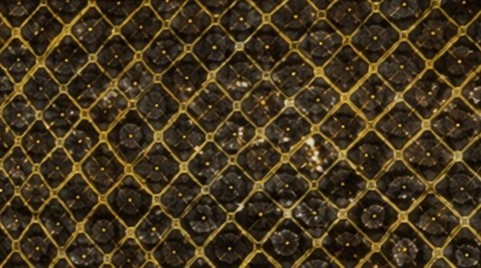
5 | Grid black and gold pattern from Salome’s dress in the mural painting in Müstair, Benedictine convent of St. John.
The performative space
Camille Focant explained Mark 6 as the prefiguration of Christ’s last supper and his sacrifice on the cross. For both banquets Mark used the word deipnon (Focant 2006, 17).
The scene in Müstair should be envisaged with the priest standing behind the altar, performing the ritual actions that culminate in the ostensio of the sacred sacrament. With outstretched arms, the host is elevated to nearly the same height as John’s platter. In the mural, John’s head rests not in the customary dish, but within a ciborium (or at minimum a deep-footed chalice). One might contend that the richly adorned table, set with gilded objects, reflects the altar and the priest’s liturgical paraphernalia. The priest acts while the narrative of Salome transpires in the background. The performative space between the ‘here and now’ of the holy mass and the ‘there and then’ of the image is sustained through exegetical typology (Baert 2012). The sacred altar versus the banquet table. Herod’s binding oath versus the transubstantiation pronounced. The priest showing the host as opposed to John’s head displayed upon the ciborium-golden chalice. The one sacrifice anticipates the other. John, the forerunner and the protomartyr signals this transition between prophecy and fulfillment. The York breviary (late 14th century) will even mention the head of John the Baptist as the ‘figure’ of the eucharistic body of Christ (Barb 1956, 46).
John the Baptist is, like Jesus and Mary, worshipped on his birthday, June 24th – the longest day of the year (Acta sanctorum XXV, 644-646). After that, sunlight will gradually fade until December 25 – the winter solstice and the coming of Christ. In John 3:30, John the Baptist points at Jesus and says: “He (Christ) must increase, but I must decrease” (Baert 2012, 323-366). The decreasing for the benefit of growth is comparable to the cycle of the sun, and John’s platter mirrors indeed the sun disc (Caspers 2005). The cosmic connection between the two men recalls the typology that Augustine (354-430) develops in his 288th Sermon on the concepts of vox and verbum. The church father juxtaposes John’s words Ego sum vox clamantis in deserto / “I am the voice of one crying out in the wilderness” in John 1:22-23 with the fourth evangelist’s prologue In principio, inquit, erat Verbum, et Verbum erat apud Deum, et Deus erat Verbum: hoc erat in principio apud Deum. Omnia per ipsum facta sunt, et sine ipso factum est nihil/ “In the beginning was the Word, and the Word was with God, and the Word was God. He was in the beginning with God”. All things were made through him, and without him was not an thing made that was made (John 1:1-3). Augustine proceeds:
Attendat Caritas vestra. Ioannes interrogatus quis esset, utrum Christus esset, utrum Elias, utrum propheta: Non sum, inquit: Christus, nec Elias, nec propheta. Et illi: Quis ergo es? Ego sum vox clamantis in deserto. Vocem se dixit. Habes Ioannem vocem. Quid habes Christum, nisi Verbum? Vox praemittitur, ut Verbum postea intellegatur. Et quale Verbum? Audi illud tibi clare ostendentem. In principio, inquit, erat Verbum, et Verbum erat apud Deum, et Deus erat Verbum: hoc erat in principio apud Deum et Deus erat Verbum: hoc erat in principio apud Deum. Omnia per ipsum facta sunt, et sine ipso factum est nihil. Si omnia, et Ioannes. Quid miramur, si Verbum fecit sibi vocem? Vide, vide utrumque ad flumen, et vocem et Verbum. Vox Ioannes, Verbum Christus (Aug. Serm. 288, In Natali Ioannis Baptistae aut De voce et verbo)
Let your Charity pay attention. John, when asked who he was, whether he was the Christ, whether Elijah, or whether a prophet, said: 'I am not the Christ, nor Elijah, nor a prophet.' And they said: 'Who then are you? I am the voice of one crying in the wilderness.' He called himself a voice. You have John as the voice. What do you have Christ as, if not the Word? The voice is put first, so that the Word may be understood afterward. And what kind of Word? Hear the text clearly showing it to you: 'In the beginning,' it says, 'was the Word, and the Word was with God, and the Word was God. He was in the beginning with God. All things were made through Him, and without Him nothing was made.' If all things, then John too. Why do we wonder if the Word made a voice for Himself? Look, look at both of them by the river, both the voice and the Word. John is the voice; Christ is the Word. (transl. by E. Hill).
Because it is hard to distinguish word from voice, even John himself was thought to be the Christ. The voice was thought to be the word. But the voice acknowledged what it was, anxious not to give offence to the word. I am not the Christ, he said, nor Elijah, nor the prophet. And the question came: Who are you, then? He replied: I am the voice of one crying in the wilderness. Prepare the way for the Lord. The voice of one crying in the wilderness is the voice of one breaking the silence. Prepare the way for the Lord, he says, as though he were saying: I speak out in order to lead him into your hearts, but he does not choose to come where I lead him unless you prepare the way for him. The Voice was John; the Word was the Christ. As the mediator between the Old and New Covenant, John the Baptist assumed the role of a ‘bracket’ symbol. Sicard of Cremona (c. 1155–1215) in his writes: Joannes fuit lapis angularis inter Vetus et Novum Testamentum / “John was the cornerstone between the Old and the New Testament” (Sic. Crem. Mitr. IV, 16). John’s head is the clamp between old and new, and therefore often represented exactly in ‘hinging’ tectonics on the one hand (corners, keystones) and central cross-axed compositions on the other, as in the mural painting of Müstair (Baert 2015).
The Salome iconography in the Müstair apse stages the prefigured Christ’s martyrdom: a banquet which, despite its literary perversity, enacts the initial sacrifice of the prophet’s voice, accelerating salvation history (cum festinatione) and clearing the path for the supreme, far grander sacrifice of the Messiah. The moment Salome brings the head to the banquet, everything is set in motion. One minute before, when the executioners cut the head of John, the tazza was still white with a green rim. But as soon as Salome carries the head to the mensa, the tazza transforms into a gilded ciborium. Now the viewer understands that the tipping point toward the New Covenant has been established and will liturgically recur in daily reality. Neither Herodias nor the guest to his left at the banquet realizes that what they brush with their fingertips – a delicate blue fish from the nearby Rombach River – carries a name: Ichthys.
Bibliography
Sources
- Acta sanctorum
Societas Bollandiana, Acta Sanctorum, vol. 25, Junii tomus IV: quo dies XX–XXIV continentur, Paris 1867, 644-646. - Aug. Serm.
Augustinus Ipponensis, Sermones, in J.-P. Migne (ed.), Patrologiae cursus completus. Series Latina, vol. 38, Paris 1845; consulted in The Works of Saint Augustine: A Translation for the 21st Century, ed. by E. Hill, part III, vol. 8, 273-305, New City Press, 1994. - Bible ESV
The Holy Bible, English Standard Version (ESV), Wheaton (IL), Crossway, 2001. - Joseph. Ant. Iud.
Flavii Iosephi opera, vol. IV: Antiquitatum Iudaicarum libri XVI–XX et Vita, in: Benedikt Niese (ed.), Berlin 1890, p. 151. - Prot. Iac.
Protoevangelium of Jacob, in: Wilhelm Schneemelcher (ed.), New Testament Apocrypha, vol. I, Louisville 1991, pp. 421–439. - Athan. Ep. fest.
Athanasius Alexandriæ, Epistulae festales, in: J.-P. Migne (ed.), Patrologiae cursus completus. Series Graeca, vol. 26, Paris 1857, coll. 1351–1444. - Greg. Naz. Or.
Gregorius Nazianzienus, Oratio XXXIX, 4 (In sancta lumina), in: J.-P. Migne (ed.), Patrologiae cursus completus. Series Graeca, vol. 36, Paris 1858, coll. 336–341, spec. col. 340. - Sic. Crem. Mitr.
Sicardo from Cremona, Mitrale sive de officiis ecclesiasticis, in J.-P. Migne (ed.), Patrologiae cursus completus. Series Latina, vol. 213, Paris 1855.
Bibliographical References
- Arndt & Kroos 1969
H. Arndt & R. Kroos, Zur Ikonographie der Johannesschüssel, “Aachener Kunstblätter” 38 (1969), 243-328. - Backman [1945] 1952
E.L. Backman, Religious Dances in the Christian Church and in Popular Medicine [Religiösa danser, Stockholm 1945], translated by E. Classen, London 1952. - Baert 2012
B. Baert, Caput Johannis in Disco. Essay on a Man’s Head, Leiden 2012. - Baert 2015
B. Baert, {Arm} {Head} {Cut}: Framing as Decapitation. The casus of St. John in Early Modern Painting, in E. Harlizius-Klück, H. Körner &S. Kacunko (eds.), Framings, Berlin 2015, 211-233. - Baert 2016
B. Baert, Revisiting Salome’s Dance in Medieval and Early Modern Iconology, Leuven-Walpole 2016. - Baert 2019
B. Baert, Interruptions & Transitions. Essays on the Senses in Medieval and early Modern Visual Culture, Leiden 2019. - Baert 2023
B. Baert, Cum festinatione. Celebrating Salome’s Dance Again, “La rivista di Engramma” 200 (marzo 2023), 41-52. - Barb 1956
A.A. Barb, Mensa Sacra. The Round Table and the Holy Grail, “Journal of the Warburg and Courtauld Institutes” 19 (1956), 40-67. - Carpitella 1961
Diego Carpitella, L’esorcismo coreutico-musicale del tarantismo, Appendice III in Ernesto De Martino, La terra del rimorso. Contributo a una storia religiosa del Sud, Milano 1961, 335–372. - Caspers 2005
Ch. M. A. Caspers, Het Sint Jansfeest in kerk- en volksgebruik, in L. Janssen & K. Loeff (eds.), Getuigenis op straat: De Laremse Sint Janstraditie, Laren 2005, 121-135. - d’Angelo 1999
M.R. d’Angelo, Gender and Power in the Gospel of Mark: The Daughter of Jairus and the Woman with the Flow of Blood, in J.C. Cavadini (ed.), Miracles in Jewish and Christian Antiquity: Imagining Truth, Notre Dame 1999, 83-109. - Debarge 1992
L. Debarge, De la danse sacrée aux liturgies dansantes, “Mélanges de science religieuse” 49 (1992), 143-161. - Derret 1965
J.D.M. Derrett, Herod’s oath and the Baptist’s head, “Biblische Zeitschrift” 49, 9 (1965), 46-59. - Dormeyer 1998
D. Dormeyer, Der gewaltsame Prophetentod des Täufers und die weiteren Umstände (Mk 6,17-29), in J. Kerkovsky (ed.), Epitoauto: Studies in honor of Petr Pokorný on his sixty-fifth birthday, Prague 1998, 96-106. - Dottin-Orsini 1988
M. Dottin-Orsini, Salomé (appelée Hérodiade ou Hérodias), in B. Brunel (ed.), Dictionnaire des mythes littéraires, Paris 1988, 1232-1243. - Fenech 2025
A. Fenech Corps à contresens. Pour une iconologie de la verticalité négative, (unpubl. diss. Hab.), Paris 2025. - Focant 2006
C. Focant, Les mises en récit par Marc et par Flavius Josèphe de la mort de Jean le Baptiste, “Graphè: La Bible, Arts, Littératures, Philosophie” 16 (2006), 15-26. - Fratini 2014
R. Fratini Vacabimus. Appunti per una cinesiologia dantesca, in L. Buttà, J. Carruesco, F. Massip & E. Subías (eds.), Dancing Images and Tales, Tarragona 2014, 85-108. - Gauthier 2008
C. Gauthier, Saint Jean et Salomé: Anthropologie du banquet d’Hérode, Tours 2008. - Gertsman & Debiais 2025
E. Gertsman & V. Debiais, L’hypothèse abstraite, Paris 2025. - Girard 1984
R. Girard, Scandal and the dance. Salome in the Gospel of Mark, “New Literary History” 15, 2 (1984), 311-324. - Goll 2007
J. Goll, M. Exner & S. Hirsch, Müstair: Die mittelalterlichen Wandbilder in der Klosterkirche, Munich 2007. - Gombrich 1984
E.H. Gombrich, The Sense of Order: A Study in the Psychology of Decorative Art, London 1984. - Grossman [2005] 2007
D. Grossman, Lion’s Honey. The Myth of Samson [דבש אריות (Dvash Arayot), Tel Aviv, 2005], translation S. Schoffman, Edinburgh 2007. - Hecker [1832] 1838
J. F. C. Hecker, La danzimania: Malattia popolare nel Medio-Evo [Die Tanzwuth. Eine italienische Volkshysterie, Berlin 1832], translation V. Fassetta, Firenze 1838. - Ingold 2015
T. Ingold, Bauen Knoten Verbinden, “Zeitschrift für Medien- und Kulturforschung” 6, 1 (2015), 81-100. - Ingrassia 1989
C. Ingrassia, Danseurs, acrobates et saltimbanques dans l’art au Moyen-Âge: Recherches sur les représentations ludiques, chorégraphiques et acrobatiques dans l’iconographie médiévale, (unpubl. diss.), vol. 1, Paris 1989. - Krauss 1979
R. Krauss, Grids, “October” 9 (1979), 50-64. - Long 2013
J.C. Long, Dangerous Women: Observations on the Feast of Herod in Florentine Art of the Early Renaissance, “Renaissance Quaterly” 66 (2013), 1153-1205. - Merkel 1990
K. Merkel, Salome: Ikonographie im Wandel, Frankfurt a.M. 1990. - Müller & Steingräber 1952
Th. Müller & E. Steingräber, Die franzözische Goldemailplastik um 1400, “Münchener Jahrbuch der bildende Kunst” 3, 5 (1952), cat. no. 16. - Renger 2014
A.-B. Renger, “Imite-moi et ne m’imite pas”: Das „mimetische Begehren“ als Ursprung des krisenhaften Verlaufs der Meister-Schüler-Beziehung nach René Girard, “Paragrana. Internationale Zeitschrift für Historische Anthropologie” 23, 2 (2014), 48-62. - Siegert [2003] 2015
B. Siegert, Cultural Techniques. Grids, Filters, Doors, and Other Articulations of the Real [Kulturtechniken. Rastern, Filtern, Zählen und andere Artikulationen des Realen, Baden-Baden 2003], translation G. Winthrop-Young, New York 2015. - Vandenbroeck 1997
P. Vandenbroeck, De kleuren van de geest: Dans en trance in Afro-Europese tradities, Antwerp 1997. - Webb 1997
R. Webb, Salomé’s Sisters: The Rhetoric and Realities of Dance in Late Antiquity and Byzantium, in Liz James (ed), Women, Men and Eunuchs: Gender in Byzantium, London 1997, 119-148. - Wolf 2007
M. Wolf, Müstair: Falttafeln zu den mittelalterlichen Wandbildern in der Klosterkirche, München 2007. - Wyss 2002
A. Wyss (ed.), Die mittelalterlichen Wandmalereien im Kloster Müstair, Zurich 2002.
Abstract
In this essay I explore how the biblical narrative on the decapitation of John the Baptist and the dance of Salome (Mark 6:14-29) was organized in the 12th-century Romanesque murals in the apse of the Benedictine Abbey of Saint John in Müstair, Switzerland (c. 1160) The story unfolds within a richly adorned space draped in festive textiles. We notice the gesticulating guests, the scheming Herodias, subtly manipulating the king. To the right, a servant enters bearing food. To the left, musicians play a flute and a harp. Further still to the left, the beheading of John the Baptist is taking place. The daughter (puella), later named Salome, is pictured twice. On the one side she is presenting the platter with the head of John the Baptist to the distinguished guests. On the other, she is depicted upside-down in an acrobatic dance. Her hands do not touch the floor. She seems to float in the air. Pictorially frozen in a momentaneous situation of impossibility. Her crown she lost to gravity. Salome splits the storytelling - before and after - yet she also doubles its center, its focus, its impact, its dangerous outcome. The use of duplication by inversion and Salome’s black gridded surface, all together, represents an utterly intriguing artistic decision, for which I know no parallel. I develop new hypotheses to understand this enigma in the context of the exegetical interpretation of the verse puella saltasset.
keywords | Anthropological turn; Benedictine abbey; Black; Grid; Liturgy; Müstair (Switzerland); Saint John the Baptist; Salome; Visual exegesis.
La Redazione di Engramma è grata ai colleghi – amici e studiosi – che, seguendo la procedura peer review a doppio cieco, hanno sottoposto a lettura, revisione e giudizio questo saggio (v. Albo dei referee di Engramma)
Per citare questo articolo / To cite this article: Barbara Baert, Dance, Inversion, Grid. Salome in the Benedictine Abbey of Saint John in Müstair (c. 1160), “La Rivista di Engramma” n. 238, agosto 2026.