The Lost Grammar of Anti-Jewish Iconography
Rediscovering Medieval Visual Literacy in Istria
Ivana Čapeta Rakić
Abstract
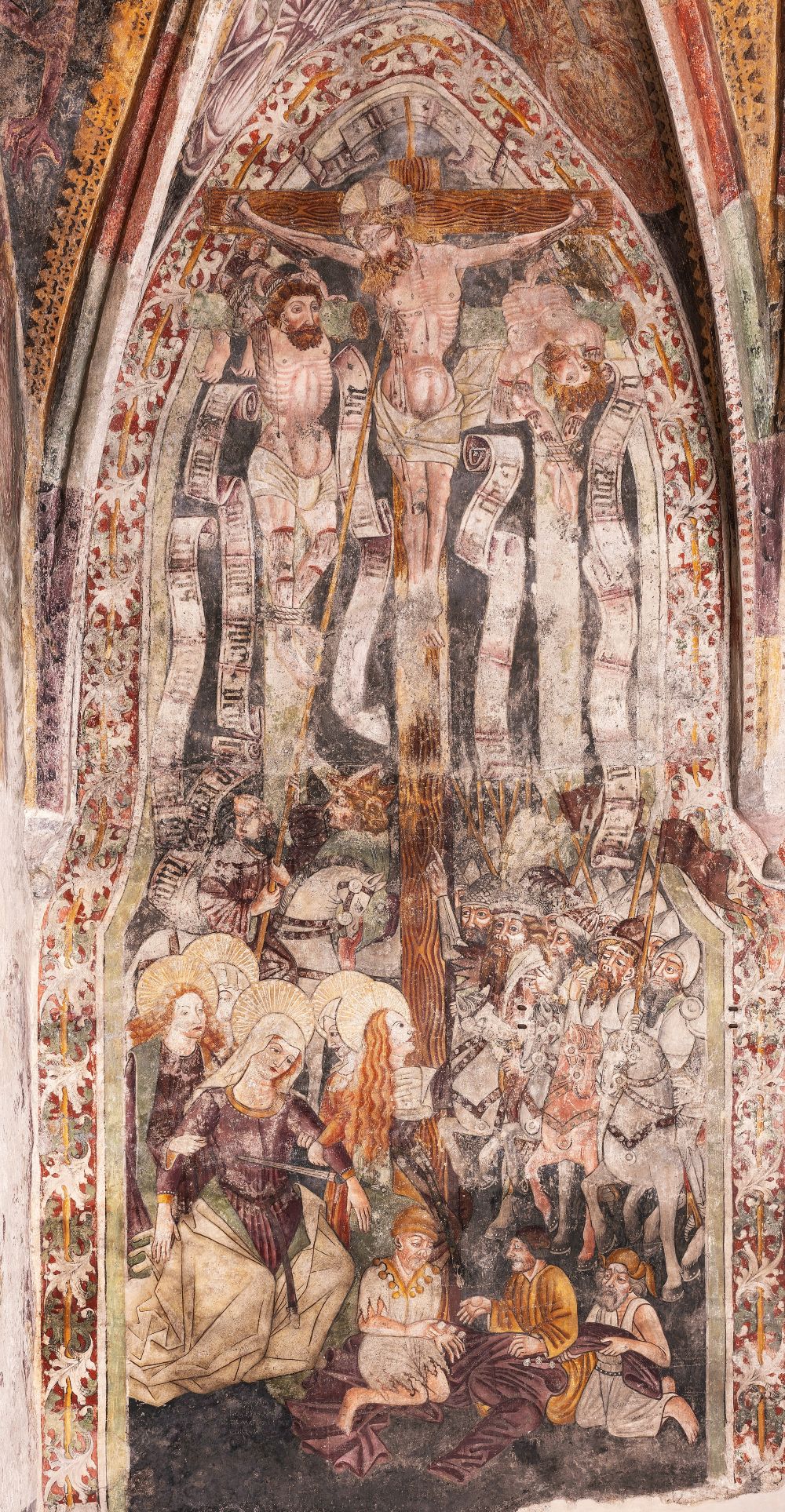
1 | Kastav workshop, Crucifixion, fresco, parish church of St George, Lovran, north wall of the sanctuary, c. 1470-1479, photo: Croatian Conservation Institute.
Introduction: Zoomorphic Iconography and the Construction of Otherness
This paper examines the visual language of late medieval wall painting in Istria, focusing on aspects that have received limited attention within existing scholarship (*). While previous studies offered important insights through stylistic, patronage, and narrative approaches (e.g. Fučić 1963; Fučić 1964; Fučić 2006-2007; Bistrović 2017), and more recent contributions further supported recording, dating, and broader recognition of this artistic heritage (Matejčić et al. 2023), the symbolic and iconographic dimensions of these images have remained comparatively underexplored. In particular, the anti-Jewish aspects of their visual language have received only limited attention (Čapeta Rakić, Capriotti 2022; Čapeta Rakić 2025). The analysis is based on selected case studies, including the allegorical Crucifixion in the church of St George in Lovran, the frescoes of the Living Cross and the personifications of Ecclesia and Synagoga in St Catherine in Lindar, and related examples from the Istrian region. Building on the understanding of Christian art as a structured yet historically variable system of meaning, the paper argues that this gap is partly linked to a modern loss of iconographic literacy. Motifs that would have been readily legible to medieval viewers are not always interpreted within their original iconographic frameworks today, leaving certain layers of meaning underexplored – even when some elements remain visually striking or immediately recognizable.
The analysis does not assume a single, fixed meaning for each motif; rather, it seeks to reconstruct a historically grounded field of associations within which such imagery operated. This is particularly evident in the case of zoomorphic motifs that structure anti-Jewish visual narratives. Accordingly, the study reads these frescoes as expressions of a coherent visual language through which ‘difference’ and ‘otherness’ were articulated in sacred space. It also considers traces of historical reception, suggesting that these images were not only legible but actively interpreted by their contemporary audiences. By re-examining these materials through the lens of medieval visual literacy, the study seeks to rediscover aspects of meaning that have become less accessible in modern, increasingly secularized contexts.
The following analysis focuses on a group of recurring zoomorphic motifs – most notably the pig, the donkey, and the scorpion – through which religious ‘otherness’ is articulated in late medieval Istrian fresco painting. Far from being incidental, these animal attributes operate within a shared symbolic framework that encodes moral, theological, and polemical meanings. When attached to figures coded as Jewish within medieval Christian visual culture, they contribute to a visual rhetoric of degradation, exclusion, and dehumanization.
The Pig: Dehumanization and Polemical Inversion
The association of Jewish figures with the pig constitutes one of the most polemical motifs within medieval Christian visual culture. In Istrian fresco painting, this motif functions as a deliberate strategy of degradation, grounded in established theological and exegetical traditions. A particularly telling example appears in the allegorical Crucifixion scene on the north wall of the presbytery in the church of St George in Lovran (c. 1470-1479), attributed to the Kastav workshop (Fučić 1982, 234; Bistrović 2017, 13, 190) [Fig. 1]. Three figures within the composition display caricaturally distorted noses that evoke an animal snout. Two are positioned to the right of the Cross – an area often associated in allegorical Crucifixion imagery with negatively connoted figures – while a third appears directly beneath it. Among them, one figure is especially emphatic: he points directly to his own nose, which most closely approximates a porcine form [Fig. 2], thereby rendering the motif unmistakable within the visual field. While biblical prohibitions (Lev 11:2-8; Deut 14:6-8) classify the pig among “unclean” animals, medieval Christian exegesis reinterpreted this dietary restriction in moralizing terms. Among the animals forbidden by Jewish law, the pig became particularly charged in Christian–Jewish polemic, serving as a privileged vehicle for articulating moral and theological difference. It came to signify gluttony, lust, and corporeal excess – qualities polemically attributed to Jews. Authors such as Isidore of Seville, who associated the term porcus with spurcus (“unclean”), and Rabanus Maurus, who explicitly linked Jewish identity with porcine vice, contributed to the consolidation of this symbolic equation (Isidore of Seville, Etymologiae XX.12.1.25; Rabanus Maurus, De universo XXII.7.206D). Within this framework, the attribution of porcine features to human figures constitutes a form of visual dehumanization – more precisely, a process of animalization that collapses the boundary between human and animal in order to assert moral and theological inferiority (Resnick 2017, 75-88). Such strategies do not merely mark difference but actively construct it, embedding polemical meaning within the very physiognomy of the depicted figures.
In Lovran, the strategy of marking negatively connoted figures is further reinforced through additional visual elements. The porcine distortion operates in conjunction with markers conventionally associated with Jews in medieval Christian iconography, most notably distinctive or pointed headgear (Mellinkoff 1993; Blumenkranz [1966] 2003; Lubrich 2015). This combination of physiognomic and sartorial signs contributes to a layered process of visual differentiation within the composition. This logic extends to the figures positioned to the right of the Cross. One of them – already noted for his emphatic gesture – displays the most explicit porcine deformation, while a second figure nearby shares similar physiognomic and sartorial traits. Both are situated within the zone of mounted soldiers, among equestrian figures that clearly evoke a military context. At the same time, many of the surrounding figures are equipped with helmets and armor, and notably, these helmeted figures do not display comparable facial distortions. The result is a differentiated visual coding in which markers of identity are unevenly distributed across the group, rather than consistently applied.
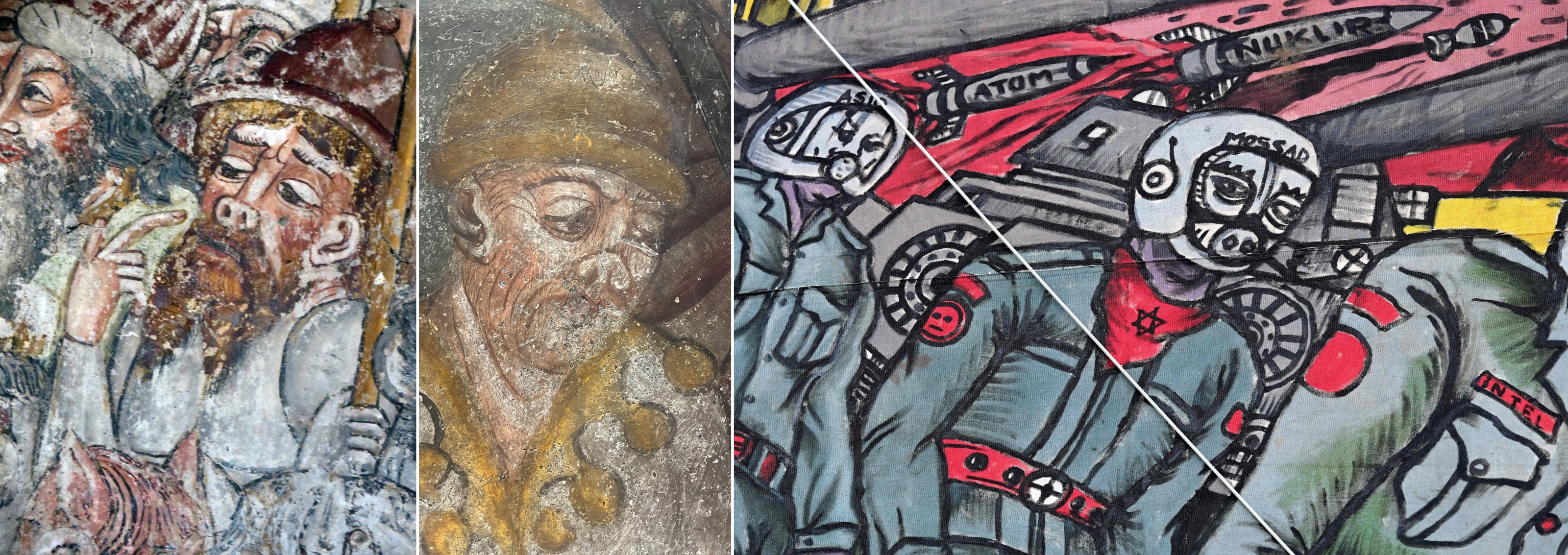
2 | Kastav workshop, Crucifixion (detail: figure to the right of the Cross), fresco, parish church of St George, Lovran, north wall of the sanctuary, c. 1470-1479, photo: Ivana Čapeta Rakić.
3 | Kastav workshop, Crucifixion (detail: figure beneath the Cross), fresco, parish church of St George, Lovran, north wall of the sanctuary, c. 1470-1479, photo: Borja Franco Llopis.
4 | Taring Padi, People’s Justice (detail), 2022, Documenta 15, Kassel, photo: Daily Sabah.
A related ambiguity emerges in the figure at the foot of the Cross engaged in casting lots for Christ’s garments, whose nose is likewise distorted in a way that suggests an animal-like form. [Fig. 3] Although the Gospels explicitly identify these figures as Roman soldiers, the figure in Lovran is not rendered with recognizable military attributes, nor does he visually align with the helmeted soldiers elsewhere in the scene. Instead, he shares the same physiognomic distortion and visual markers associated with other negatively marked figures and is further distinguished by attire that recalls that of a court jester, introducing an additional layer of connotation related to folly and ridicule. This association is reinforced by the biblical figure of the fool – insipiens – evoked in Psalms 13 and 53 (Dixit insipiens in corde suo non est Deus), a motif frequently visualized in medieval psalters and occasionally incorporated into Passion imagery, further destabilizing his biblical identity (Gifford 1974, 336-342; Bath 2018, 1-22).
The figures beneath the Cross are thus constructed through a set of visual strategies that combine animalization with other symbolic markers conventionally associated with Jews in medieval Christian imagery, intensifying the polemical charge of the scene.
While such visual strategies are often regarded as belonging to a distant past, their underlying mechanisms remain operative and legible within contemporary visual culture. A revealing example emerged at Documenta 15 in Kassel (2022), where the mural People’s Justice by the Indonesian collective Taring Padi was removed following the identification of caricatural figures combining Jewish markers with animal features, including a pig’s head. [Fig. 4] The immediacy with which these elements were recognized and publicly debated underscores the continued semiotic potency of such associations (Duindam 2024).
The contrast with the Istrian fresco is instructive. Despite the clarity with which the same visual logic operates in Lovran, it has not provoked comparable responses within modern art-historical discourse. This discrepancy does not necessarily reflect a difference in intention, but rather points to historically contingent conditions of perception and interpretation. In this sense, the fresco reveals not only a medieval strategy of visual polemic, but also the historical limits of its subsequent recognition.
The Donkey: Blindness, Folly, and Spiritual Error
In the present analysis, the donkey constitutes a second zoomorphic marker within the visual construction of Jewish ‘otherness’, associated with blindness, folly, and spiritual error. Unlike the pig, which primarily signifies impurity and moral excess, the donkey is more directly linked to notions of stubbornness and the inability to recognize divine truth. While the donkey also carries positive connotations within Christian symbolism – most notably humility, patience, and its role in Christ’s Entry into Jerusalem – its negative associations are here deliberately foregrounded, in keeping with the polemical logic of the image. The association of the donkey with foolishness also draws on a broader cultural tradition, in which the animal functions as a common insult, as already attested in Aesopian fables.
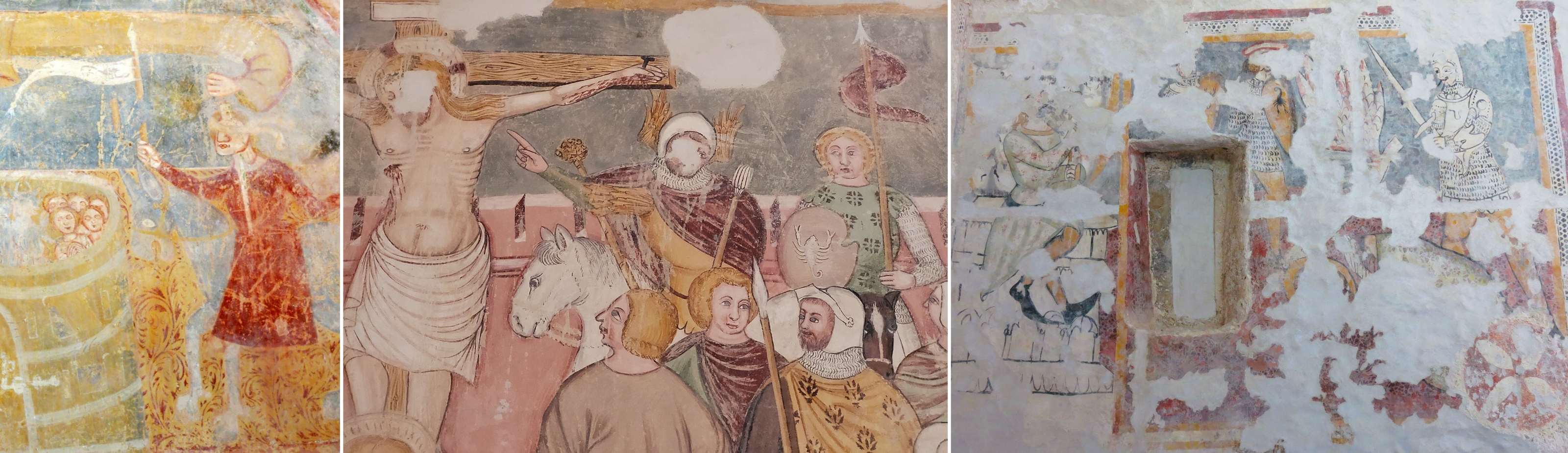
In the Lovran Crucifixion, this symbolic framework is articulated not only through painted form, but also through later interventions in the surface of the fresco. Glagolitic graffiti, incised from the time of the painting’s creation and continuing into subsequent periods, testify to an ongoing engagement with the image. Among these inscriptions, one records: Ja Luka pisah to na dan sv. Marije 1522 (“I, Luka, wrote this on the day of St. Mary, 1522”), while nearby the word OSAL (ass) is carved across the legs of the figures engaged in casting lots – figures which, as previously noted, are represented with attributes that in medieval Christian iconography are conventionally associated with pejorative depictions of Jews (for the Glagolitic inscriptions cf. Fučić 1982, 237). One of these figures is further distinguished by an unusual head covering with elongated, ear-like projections. Although this feature does not correspond to a clearly defined iconographic type, its visual resemblance to animal ears becomes significant when read alongside the nearby inscription, suggesting a convergence of visual and verbal cues that reinforces the association with donkey-like characteristics.
Although it remains uncertain whether the term was directed at the depicted figures, at Luka himself, or at another individual, its placement within the scene is significant. The inscription introduces a verbal layer that intersects with the painted composition, activating a well-established symbolic association of the donkey with foolishness, obstinacy, and limited perception. In doing so, it echoes and reinforces the visual rhetoric of blindness and moral error already suggested by the scene, demonstrating how such meanings could be rearticulated and extended through later acts of inscription.
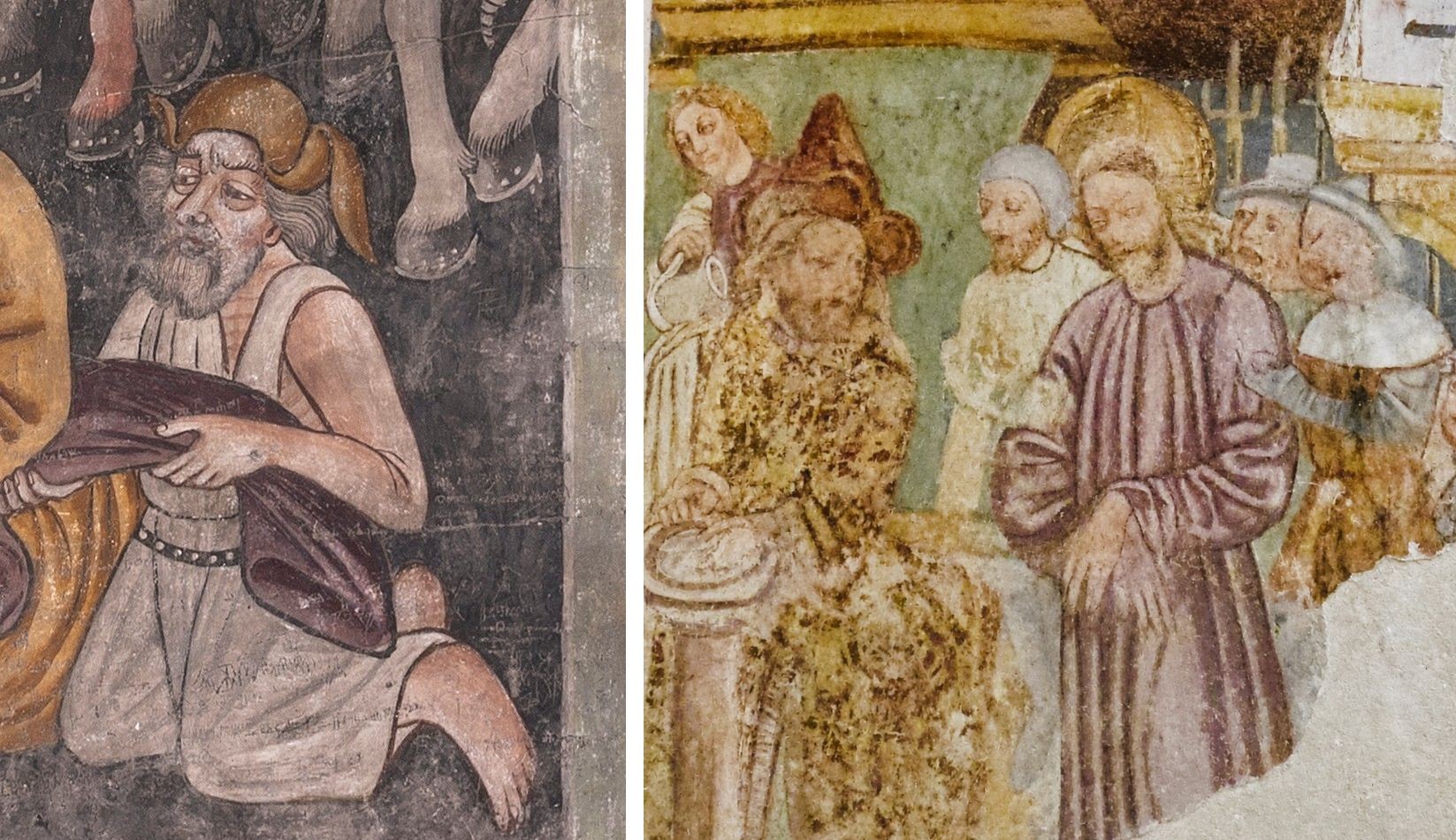
5 | Unknown artist, Living Cross, fresco, Church of St Catherine, Lindar, 1409, photo: Historical and Maritime Museum of Istra 2023.
6 | John of Kastav, Christ before Pilate, fresco, Church of the Holy Trinity, Hrastovlje (Slovenia), 1490, photo: Ivana Čapeta Rakić.
A comparable use of the insult appears in the church of the Holy Trinity at Hrastovlje (Slovenia), a site belonging to the same chronological and cultural milieu as the Lovran fresco. In the scene of Christ before Pilate, painted by John of Kastav, a graffiti inscription addresses Pilate with the words: “Donkey! Do not beat this holy man who created heaven and earth…” (Fučić 1982, 184). At the same time, the figure is marked by the conical hat typically used to identify Jews in medieval Christian iconography [Figg. 5-6]. This combination produces a significant displacement: Pilate, a Roman authority, is visually recoded as a Jewish figure, thereby transferring responsibility for Christ’s suffering onto the Jewish ‘other’.
This interpretative shift corresponds to a broader tendency within medieval Christian exegesis. Following the establishment of Christianity as the official religion of the Roman Empire, theological and visual traditions increasingly sought to minimize Roman responsibility for Christ’s Passion, attributing culpability to the Jews. Within this framework, the donkey operates as a concise verbal marker of blindness, reinforcing the notion of an inability to recognize divine truth. This association is also articulated in patristic exegesis: Gregory the Great, for instance, explicitly compares Jewish blindness to the short-sightedness of the donkey (Germ 2006, 153-154).
This symbolic association is further developed in the personification of Synagoga in the fresco of the Living Cross in the church of St Catherine in Lindar, a rare and iconographically complex example from early fifteenth-century Istria (Fučić 1950; Füglister 1964, 24-25; Balog 2008; Hlača 2017; Čapeta Rakić, Capriotti 2022). The composition centers on a crucified Christ whose cross transforms into animated arms enacting divine judgment. While one arm blesses Ecclesia, seated on the tetramorph and crowned as the embodiment of the Church, another thrusts a sword into the head of Synagoga, depicted as a blindfolded woman riding a donkey [Fig. 7]. Here, the donkey functions as a visual extension of Synagoga’s condition. Her blindfold signifies not physical impairment but a metaphorical incapacity to perceive the truth of redemption (on blindness in art see Barasch 2001), while the animal she rides embodies obstinacy and resistance to divine revelation. Additional attributes reinforce this negative characterization: her exaggerated, almost caricatural facial features, the broken banner bearing a black scorpion – a symbol associated with vice and, in late medieval contexts, with Jews – and the presence of a demonic figure above her further intensify the polemical message.
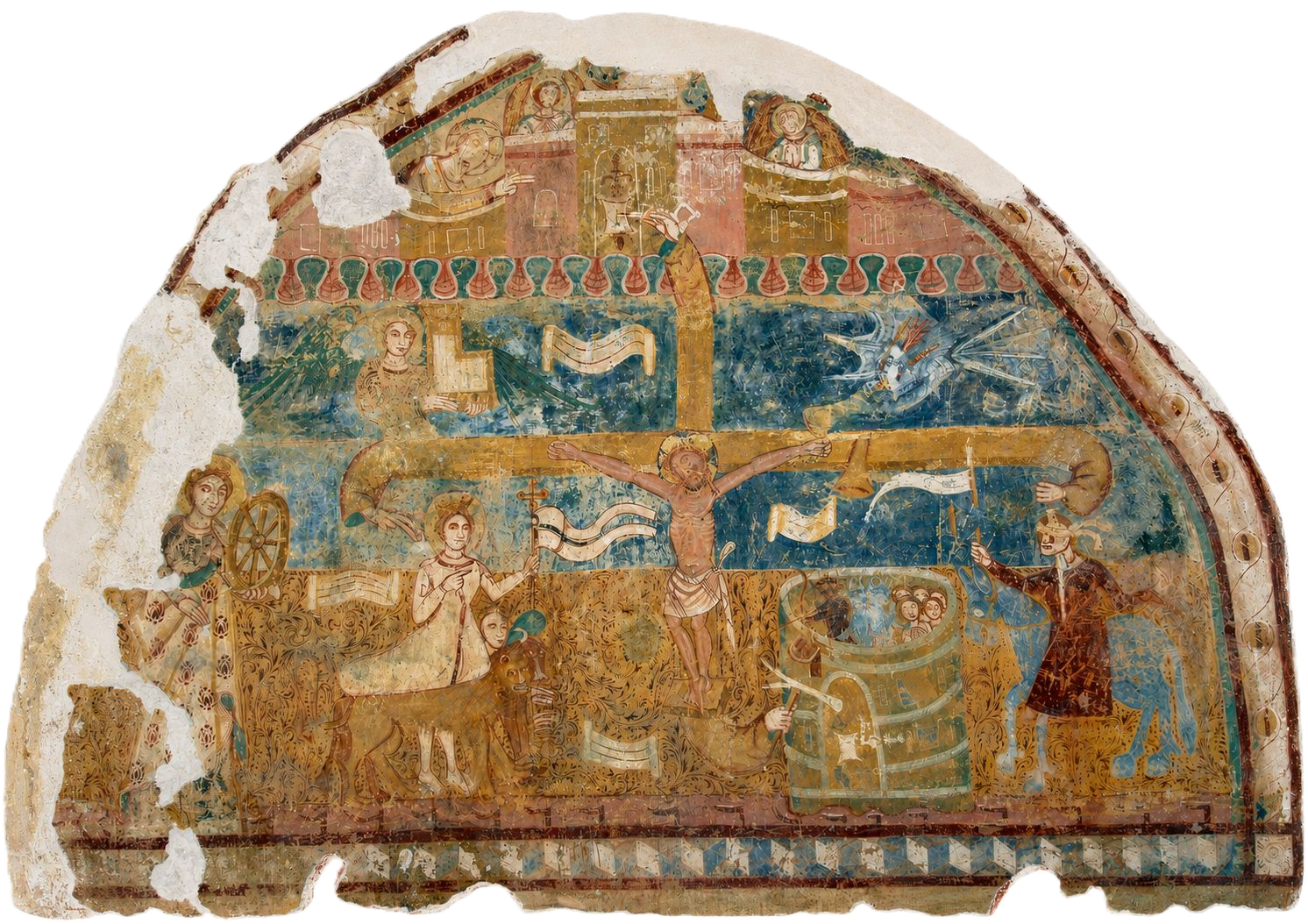
7 | Unknown artist, Living Cross, fresco, Church of St Catherine, Lindar, 1409, photo: Historical and Maritime Museum of Istra 2023.
The Lindar fresco participates in a broader iconographic tradition of Ecclesia and Synagoga, whose origins can be traced back to early Christian and Carolingian imagery, where the two figures initially appear as parallel witnesses to the Crucifixion. From the twelfth century onward, however, this relationship becomes increasingly antagonistic, with Synagoga progressively marked by signs of blindness, defeat, and exclusion (Blumenkranz 1960; Seiferth 1970; Rubin 2014).
Taken together, these examples demonstrate that the donkey operates as a coherent and highly legible symbol, condensing notions of blindness, folly, and theological error into a single visual sign. Its recurrence across different contexts suggests a consistent strategy of representing figures coded as Jewish within medieval Christian visual culture as embodying a form of spiritual and cognitive failure—one that could be activated both within the painted image and through subsequent acts of viewer engagement.
The Scorpion: Treachery, Violence, and Polemical Continuity
The scorpion represents a further extension of the zoomorphic vocabulary through which Jewish otherness is constructed in late medieval Istrian fresco painting. Unlike the pig and the donkey, which are primarily attached to the human body through processes of physiognomic distortion or allegorical association, the scorpion most often appears as an attribute – on banners, shields, or emblems – thereby extending the anti-Jewish visual code beyond the figure itself and into the broader narrative and symbolic field (Bulard 1935, 39; Mellinkoff 1993, 46; Capriotti 2014).
A particularly explicit example can be observed in the fresco of the Living Cross in the church of St Catherine in Lindar, where the personification of Synagoga holds a broken banner marked with the image of a scorpion [Fig. 8]. The fractured staff already signals her defeat in relation to Ecclesia, while the scorpion reinforces this condition through its established symbolic associations. Biblical sources provide an important foundation for this imagery: in Luke 10:19, Christ grants his disciples power to “tread on serpents and scorpions,” a passage that was frequently interpreted in the Middle Ages as a metaphor for the triumph of the Church over its spiritual adversaries. Medieval exegetical and allegorical traditions further elaborated the meaning of the scorpion, consistently associating it with deceit, treachery, and latent violence. Its sting – striking from behind – made it an apt symbol of betrayal, a quality polemically attributed to Jews, most notably in interpretations that liken Judas’s kiss to a scorpion’s attack. In certain allegorical contexts, particularly those accompanying the figure of Dialectica within cycles of the Seven Liberal Arts, the scorpion could also signify deceptive reasoning or false argumentation, sometimes framed in polemical discourse in terms that associate such reasoning with Jewish intellectual otherness.
8 | Unknown artist, Living Cross (detail: personification of Synagoga), fresco, Church of St Catherine, Lindar, 1409, photo: Historical and Maritime Museum of Istra 2023.
9 | Unknown artist, Crucifixion (detail: soldiers’ shields with scorpions), fresco, Church of St Barnabas, Vižinada, late 15th century, photo: Ivana Čapeta Rakić.
10 | Unknown artist, Beheading of St John the Baptist (detail: executioners’ shields with scorpions), fresco, Church of St John the Baptist, Lovran, 15th century, photo: Ivana Čapeta Rakić.
This symbolic association is not confined to allegorical figures but extends into narrative scenes. In the church of St Barnabas in Vižinada (Matejčić 2002), scorpions appear on the shields of soldiers participating in the Crucifixion, visually marking them within the same semantic field [Fig. 9]. A comparable motif occurs in the fresco of the Beheading of St John the Baptist on the north wall of the church of St John the Baptist in Lovran (Bistrović 2007; Bistrović 2010), where the shields of the executioners bear the same sign [Fig. 10]. In such cases, the scorpion functions as a transferable emblem, capable of attaching itself to different agents within the visual narrative, thereby ensuring the persistence of its polemical meaning across contexts.
The frequent combination of the scorpion with a yellow ground further intensifies its semantic charge. In medieval visual culture, yellow was already established as a marker conventionally associated with Jews, particularly through badges, hats, or garments imposed by legal regulation. The conjunction of chromatic and zoomorphic signifiers thus produces a layered system of visual denigration, in which color and symbol operate together to reinforce the construction of the Jewish ‘other’.
These examples demonstrate that the scorpion operates not only as a symbol of treachery and violence, but also as a mechanism of polemical continuity. By migrating across figures, objects, and narrative settings, it sustains and amplifies the anti-Jewish visual code, embedding it deeply within the iconographic fabric of Istrian fresco painting.
Toward a Visual Grammar of ‘Otherness’
Considered in conjunction, the pig, the donkey, and the scorpion do not function as isolated motifs but as elements within a coherent visual system through which difference was constructed and communicated in late medieval Istrian painting. Each operates within a distinct semantic register – the pig through processes of animalization and moral degradation, the donkey through associations with blindness and spiritual incapacity, and the scorpion as a mobile emblem of treachery and latent violence. Their combined presence reveals a structured visual grammar in which zoomorphic signs articulate layered forms of polemical meaning.
This system is further characterized by the differentiated distribution of particular markers across bodies, attributes, and narrative settings. While some signs are inscribed directly onto the human figure, others circulate through objects, gestures, or spatial positioning, creating a complex network of associations that exceeds any single iconographic element. In this sense, the images do not merely represent otherness but actively produce it through the interaction of multiple visual codes.
At the same time, traces of historical reception – most notably in the form of graffiti – suggest that this visual language was not only legible but also open to reinterpretation. Later interventions do not stand outside the original imagery but engage with and reactivate its symbolic potential, demonstrating that such meanings remained operative beyond the moment of production.
The relative opacity of these motifs to modern viewers points not to their insignificance, but to a shift in the conditions of visual literacy. What once functioned as a readily intelligible system of signs has, in many cases, become only partially accessible, its meanings obscured by the loss of the interpretative frameworks within which it originally operated. Rediscovering this lost grammar does not imply the restoration of a single, fixed meaning, but rather the reconstruction of a historically situated field of associations through which such images could be understood.
In this light, the frescoes of Istria emerge not simply as documents of artistic production, but as complex visual arguments in which theological, social, and polemical meanings are embedded within a carefully structured yet historically contingent system of signs.
* This article originates from the research carried out within the project CIRCE – InClusive valorIsation model foR Controversial cultural hEritage in the Mediterranean Harbours and beyond, funded by the European Union under the Marie Skłodowska-Curie Actions (grant agreement No. 101235092).
Bibliographical References
- Balog 2008
Z. Balog, Živi križ u Lindaru – ikonografsko-ikonološka studija, “Peristil” 51 (2008), 131-148. - Barasch 2001
M. Barasch, Blindness. The History of a Mental Image in Western Thought, New York 2001. - Bath 2018
M. Bath, A Jester at the Crucifixion? The Fool at Fowlis, in M. Bath (ed.), Emblems in Scotland. Motifs and Meanings, Leiden-Boston 2018, 1-22. - Bistrović 2007
Ž. Bistrović, Gotičko zidno slikarstvo u Istri (novi prilozi jednoj budućoj sintezi), “Annales. Series Historia et Sociologia” 17 (2007), 277-290. - Bistrović 2010
Ž. Bistrović, Kulturno-povijesna važnost crkve Sv. Ivana u Lovranu (prilog problematici srednjovjekovne povijesti Lovrana), “Zbornik Lovranšćine” 1 (2010), 255-279. - Bistrović 2017
Ž. Bistrović, Kastavska slikarska škola. Problemi geneze i stila, Ph.D. Thesis, University of Zadar 2017. - Blumenkranz 1960
B. Blumenkranz, Juifs et chrétiens dans le monde occidental, 430-1096, Paris 1960. - Blumenkranz [1966] 2003
B. Blumenkranz, Il cappello a punta. L’ebreo medievale nello specchio dell’arte cristiana[Le Juif médiéval au miroir de l'art chrétien, Paris 1966], Roma 2003. - Bulard 1935
M. Bulard, Le scorpion. Symbole du peuple juif dans l’art religieux des XIVe, XVe, XVIe siècles, Paris 1935. - Capriotti 2014
G. Capriotti, Lo scorpione sul petto. Iconografia antiebraica tra XV e XVI secolo alla periferia dello stato pontificio, Roma 2014. - Čapeta Rakić, Capriotti 2022
I. Čapeta Rakić, G. Capriotti, An inquiry into the image of Jews in 15th-century Istria: the iconography of the Jewish-Christian dispute, “Ikon” 15 (2022), 43-56. - Čapeta Rakić 2025
I. Čapeta Rakić, The “controversial” image of the Jews. The case of the parish church of Saint George in Lovran, “Il Capitale culturale” 19 (2025), 25-53. - Duindam 2024
D. Duindam, Entangled Memories of Colonialism and Antisemitism: The Scandal of Taring Padi’s “People’s Justice” at Documenta 15 (2022), in I. Saloul, P. Violi, A.M. Lorusso, C. Demaria (eds.), Questioning Traumatic Heritage: Spaces of Memory in Europe and South America, Amsterdam 2024, 225-242. - Fučić 1950
B. Fučić, Živi križ u Lindaru, “Istarska Danica” (1950), 81-86. - Fučić 1951
B. Fučić, The Living Cross in Lindar, “Istarska Danica” 6 (1951), 81-86. - Fučić 1963
B. Fučić, Istarske freske, Zagreb 1963. - Fučić 1964
B. Fučić, Srednjovjekovno zidno slikarstvo u Istri, Ljubljana-Rijeka 1964. - Fučić 1982
B. Fučić, Glagoljski natpisi, Zagreb 1982. - Fučić 1992
B. Fučić, Vincent iz Kastva, Zagreb-Pazin 1992. - Fučić 2006-2007
B. Fučić, Iz istarske spomeničke baštine, Zagreb 2006-2007. - Füglister 1964
R.L. Füglister, Das Lebende Kreuz. Ikonographisch-ikonologische Untersuchung der Herkunft und Entwicklung einer spätmittelalterlichen Bildidee und ihrer Verwurzelung im Wort, Einsiedeln-Zürich-Köln 1964, 24-25. - Germ 2006
T. Germ, Simbolika živali, Ljubljana 2006. - Gifford 1974
D.J. Gifford, Iconographical Notes towards a Definition of the Medieval Fool, “Journal of the Warburg and Courtauld Institutes” 37 (1974), 336-342. - Hlača 2017
T. Hlača, The Living Cross Image in Lindar: Contexts of Style, Iconography, and History, M.A. Thesis, CEU, Budapest 2017. - Lubrich 2015
N. Lubrich, The Wandering Hat: Iterations of the Medieval Jewish Pointed Cap, “Jewish History” 29 (2015), 203-244. - Matejčić 2002
I. Matejčić, Freske crkve Sv. Barnabe u Vižinadi, Poreč 2002. - Matejčić et al. 2023
I. Matejčić, N. Maraković, Ž. Bistrović, Slikarstvo od 4. do 15. stoljeća, Pula 2023. - Mellinkoff 1993
R. Mellinkoff, Outcasts: Signs of Otherness in Northern European Art of the Late Middle Ages, Berkeley-Los Angeles 1993. - Resnick 2017
I. Resnick, The Pig and Messianism in Medieval Jewish-Christian Polemics. Dietary Laws and Moral Behavior, in D. Weltecke (ed.), Essen und Fasten / Food and Fasting. Interreligiöse Abgrenzung, Konkurrenz und Austauschprozesse / Interreligious Differentiations, Competition and Exchange, Köln-Weimar-Wien 2017, 75-88. - Rubin 2014
M. Rubin, Ecclesia and Synagoga: the changing meanings of a powerful pairing, in I.J. Yuval, R. Ben-Shalom (eds.), Conflict and Religious Conversation in Latin Christendom. Studies in Honour of Ora Limor, Turnhout 2014, 55-86. - Seiferth 1970
W.S. Seiferth, Synagogue and Church in the Middle Ages: Two Symbols in Art and Literature, New York 1970.
Abstract
This paper examines the visual language of late medieval wall painting in Istria, focusing on its anti-Jewish iconographic dimension. It argues that this aspect has remained insufficiently interpreted due to a modern loss of iconographic literacy, which has obscured symbolic structures that would have been legible to medieval viewers. The analysis is based on selected case studies, including the allegorical Crucifixion in the church of St George in Lovran, the frescoes of the Living Cross and the personifications of Ecclesia and Synagoga in St Catherine in Lindar, and related examples from the Istrian region. Particular attention is given to the role of zoomorphic motifs – most notably the pig, the donkey, and the scorpion – as well as to gestural signs and specific attributes conventionally associated with Jews in medieval Christian visual culture. The study demonstrates that these elements operate not as isolated details but as components of a differentiated visual system in which animalization, metaphorical blindness, and emblematic signs function within distinct yet interconnected semantic registers. This system contributes to the construction of religious otherness through a structured visual rhetoric embedded in sacred space. Glagolitic graffiti incised into the frescoes further indicate that such imagery was not only legible but actively interpreted by contemporary viewers. These later interventions reveal a continuity of meaning that extends beyond the moment of production, while also highlighting the distance between medieval and modern modes of visual understanding. By reconstructing this symbolic framework, the paper proposes a method for recovering aspects of medieval visual literacy and offers a reassessment of the role of anti-Jewish imagery in the Istrian fresco tradition.
keywords | Anti-Jewish iconography; Medieval Istria; Fresco painting Istria; Zoomorphic symbols.
La Redazione di Engramma è grata ai colleghi – amici e studiosi – che, seguendo la procedura peer review a doppio cieco, hanno sottoposto a lettura, revisione e giudizio questo saggio (v. Albo dei referee di Engramma)
Per citare questo articolo / To cite this article: Ivana Čapeta Rakić, The Lost Grammar of Anti-Jewish Iconography. Rediscovering Medieval Visual Literacy in Istria, “La Rivista di Engramma” n. 238, agosto 2026.