The Bilderatlas Mnemosyne by Aby Warburg
On: Roland Recht (édité par), L’Atlas Mnémosyne (l’écarquillé, Paris 2012)
Roland Recht
Abstract | Version française originale
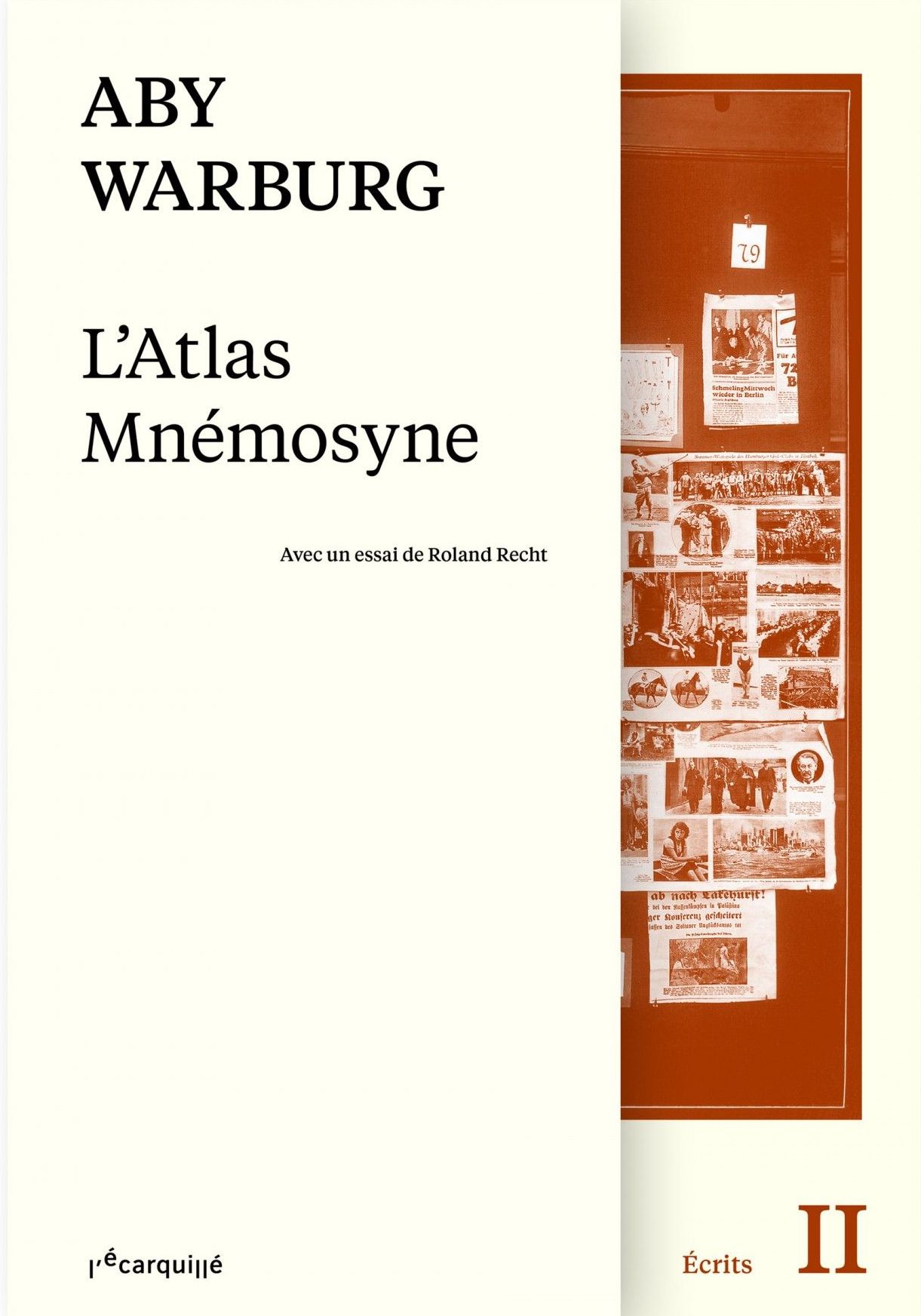
A. Warburg, L’Atlas Mnémosyne, édité par R. Recht (l’écarquillé, Paris 2012).
Sommaire
Essai introductif de Roland Recht
Aby Warburg, Introduction à l’Atlas Mnémosyne
Reproduction des 63 planches de l’Atlas
Index
Roland Recht’s essay has occupied two different places in the French Atlas published by l’écarquillé. It opened the large-format L’Atlas Mnémosyne (Paris 2012, 7-48), where readers encountered his account of the library, the lecture room and the making of the panels before turning to Warburg’s Einleitung, in Sacha Zilberfarb’s translation. In the pocket edition of 2019 the reader turns the book sideways to see each panel and its diagram across four pages. An abridged version of Recht’s essay follows the sequence (274-287), now offering a retrospective reading. The full French essay, with its closing comparison between the Atlas and the movable sheets of Mallarmé’s projected “Livre”, appears here in English translation alongside the original.
Aby Warburg’s Mnemosyne Atlas
Acknowledgements
I should like to thank the many people who assisted me while I was writing this text. First and foremost, Susanne Müller and Maurizio Ghelardi, who most generously placed at my disposal a number of transcriptions of manuscripts and typescripts held in the archives of the Warburg Institute in London and offered invaluable comments; Uwe Fleckner, who kindly sent me the introduction to the latest volume of the Gesammelte Schriften before its publication; Pascal Griener, whose legendary helpfulness enabled me to complete the iconographic documentation; and, at the Warburg Institute in London, Claudia Wedepohl and Eckart Marchand for their welcome, and François Quiviger for his efficiency. I should also like to thank Corinne Maisant and Eva Renzulli, my colleagues at the Collège de France, as well as Sacha Zilberfarb—and Samuel Delerue for his inexhaustible patience. Marie’s assistance was, as ever, especially precious. I am also grateful to Maurizio Ghelardi and Susanne Müller for sharing their views on several points of interpretation.
Introduction
The Mnemosyne Atlas, probably Aby Warburg’s most frequently cited work, was published in the original volume for the first time in French and in a complete edition. Left unfinished at its author’s death, and having absorbed all his intellectual and physical energies during the final years of his life, Mnemosyne may be regarded as the culmination of his entire research. The complexity of the problems that Warburg was compelled to confront in dealing with this immense corpus of images drew the attention of the humanities as a whole to his work.
Born into a Hamburg banking family, Aby (Abraham Moritz) Warburg (1866-1929) studied at the University of Bonn from 1886 under the art historians Carl Justi and Henry Thode, the philologist Hermann Usener, and the historian Karl Lamprecht. At the prompting of August Schmarsow, with whom he stayed in Florence in 1888-1889, he decided to work on Botticelli. In the doctoral dissertation he defended at Strasbourg in 1892 under Hubert Janitschek’s supervision, he directed the interpretation of Botticelli’s Birth of Venus and Primavera towards the expressive values of bodies and garments, whose literary origins he traced to the works of Ovid and Poliziano. Further periods in Florence enabled him to deepen his research into Florentine Renaissance society; then, during a journey to the United States in 1896, he travelled to Native American reservations in the West to study Hopi myths. In 1897 he married the painter and sculptor Mary Hertz, with whom he had three children: Marietta, Max Adolph, and Frede Charlotte. He declined a teaching post at the University of Kiel in favour of regular stays in Florence, alternating with periods in Hamburg, until 1904. He likewise refused the curatorship of the Hamburg museum offered to him by Alfred Lichtwark, and later turned down two further appointments: a chair at Breslau in 1906 and, in 1912, succession to the eminent art historian Adolf Goldschmidt at Halle. In that same year, the Hamburg Senate conferred on him the title of honorary professor.
In 1900, following an agreement with his brother Max, Warburg began acquiring the books that would form the future Kulturwissenschaftliche Bibliothek Warburg (KBW); from 1904 onwards, he was once again based in Hamburg with his family. In the aftermath of the First World War, however, his mental health deteriorated. After periods in neurological clinics in Hamburg and Jena, he was admitted in 1921 to the Bellevue sanatorium at Kreuzlingen, near Lake Constance in Switzerland, where the psychiatrist Ludwig Binswanger diagnosed schizophrenia and, somewhat later, a manic-depressive condition. When Warburg left Bellevue on 12 August 1924, considered recovered, he returned to his library, whose management his brother had entrusted to Fritz Saxl, a Viennese art historian who had worked with Warburg since 1913. Saxl’s role was crucial both in maintaining the institution’s scholarly rigour during Warburg’s absence and in supporting a man so severely tried, whom he continued to visit frequently. Between 1925 and 1926, a purpose-built home for the KBW was erected beside the family villa acquired in 1909 at 114 Heilwigstrasse. Warburg now taught at the University of Hamburg as a Privatdozent and held seminars in his library’s reading room until 1929. The true beginning of the vast project to which Warburg gave the name Mnemosyne—the picture atlas—may be dated to the summer of 1926; the project was interrupted by his sudden death in October 1929. In 1933, as the rise of Nazism threatened the KBW, the library, photographic collection, and archives were shipped to London, where they remain today.
Warburg did not write weighty volumes. Most of his texts originated as lectures and appear to concern points of detail: Dürer and Italian Antiquity in October 1905; The Gods of Antiquity and the Early Renaissance in Southern and Northern Europe in December 1908; Italian Art and International Astrology in the Palazzo Schifanoia, Ferrara in October 1912; and The Emergence of the Antique as a Stylistic Ideal in Early Renaissance Painting in April 1914. Yet these lectures contributed significantly to his intellectual standing within art history and, since the 1970s, have continued to stimulate research by historians, art historians, anthropologists, and psychologists. He also left thousands of manuscript pages that cast a compelling light on both the man and his work. The idiosyncrasy of his style—its neologisms, profusion of nouns and synonyms, scarcity of verbs, fragmentary form, and frequent recourse to diagrams—does not make his perpetually mobile thought easy to grasp. Until the 1960s, Warburg was known only to a handful of art historians, who often had no more than an approximate sense of his originality, not least because Erwin Panofsky’s stature had tended to eclipse it. Ernst Gombrich’s monograph, published in 1970 (Gombrich 1970), inaugurated a new era, whose scale may be gauged from Dieter Wuttke’s bibliography of 3,102 entries (Wuttke 1998). Yet on many points Gombrich distorted Warburg’s intellectual legacy, interpreting it through the lens of the historians of the Vienna School, among whom he may himself be numbered.
The edition envisaged in 1932 by Gertrud Bing and Fritz Saxl, with the collaboration of Fritz Rougemont, was to comprise all the writings Warburg had published before his death, the Mnemosyne Atlas, his lectures, his research on expression, his letters, aphorisms and autobiographical writings, and the catalogue of his library; it was soon abandoned (GS). Until recently, the only substantial collection available was that edited by Dieter Wuttke in 1979 (Wuttke [1979] 1980). Only in 1998 did the editorial programme of 1932 begin to be realised—a process still far from complete—but increasing access to Warburg’s writings is gradually allowing those interested in his work to discuss it on a firmer basis (WEB). In parallel, Maurizio Ghelardi has carried out an immense body of work in Italy on Warburg’s unpublished texts (Il mondo di ieri; AWO I.1; AWO II.2; AWO I.2; Warburg [1888-1901] 2011). The undertaking pursued here by L’écarquillé has the same ambition: to make available to French-speaking readers a body of texts previously unknown, or known only in fragments. Some of these texts remain unpublished even in German.
To understand the significance of the atlas published in the original volume, the reader must first be acquainted with the principal concerns that recur throughout Warburg’s work as a historian. The title he chose—Mnemosyne, a name already inscribed above the entrance to his library—sufficiently indicates the extent to which memory forms the guiding thread of his oeuvre. In assembling his vast library and photographic collection, he engaged memory in two ways: by bringing together books and images that preserve the discursive and figurative thought of the past, and by conceiving first the arrangement and then the architecture of the library as a spatialisation of memory, a mnemonic means of retrieving books, and a mode of thought. We shall then examine the meaning Warburg gave to the notion of the ‘symbol’ and the definition he assigned to what he called the Denkraum—a space of thought or mental space—both symbol and Denkraum occupying the interval between humanity and the world. At the centre of Warburg’s anthropology, the Pathosformel—the pathos formula—encompasses the register of expressivity driven by the passions, while also showing more broadly how those passions may be placed at the service of the vital need for orientation. Although he described himself not as an “art historian” but as a “historian of images”, and although he abhorred formalism, Warburg attached great importance to the artist’s style, which he understood as the formative intuition that enabled expressive motifs prefigured in antiquity to be integrated into a new work. Finally, we shall consider the presentation of the Mnemosyne Atlas, recalling its stakes, its genesis, and the obsessive search for an exact title. The final section will ask within which editorial tradition the atlas may be situated.
Memory
The upheavals that affected Europe towards the end of the nineteenth century were accompanied by a fear of amnesia that would rapidly efface every form of tradition. This movement appears to have had its epicentre in Habsburg Vienna, from which it spread throughout Europe. From the late nineteenth century until the aftermath of the First World War, memory consequently became an active concern for a great many intellectuals. In literature, Marcel Proust’s oeuvre is governed throughout by reminiscence; in other fields of thought one may cite Sigmund Freud, Hermann Ebbinghaus, Ewald Hering and Richard Semon, Edmund Husserl and Henri Bergson, Maurice Halbwachs and Aby Warburg.
The work of Freud and Halbwachs alike brought to light the role of society in the (re)construction of the individual past. For Halbwachs, the social frameworks of memory allow individuals, in response to the demands of their own time, to conform the past to the present—but it is a reconstructed past. He held that, at bottom, there is no individual memory, since our knowledge of the past, including our own past, extends only to what society or the family allows us to know (Halbwachs [1950] 1997). For Aby Warburg, memory is a force manifested across human destiny as a common inheritance. He is surely the only historian of his period whose entire oeuvre is traversed by the question of memory and who linked it—in another respect that distinguishes him from his contemporaries—to the painful tensions at work within the psyche, to the sufferings of the soul; and he alone approached memory through images. These were not mental images, of the kind discussed by Bergson and Freud, but material images: works of art. Warburg understood them as part of a larger whole that he called “social memory”; they bear witness to the tension that animates every human group as it seeks to preserve a passage for “survivals” between forgetting and memory.
In 1924, in a note for the lecture on his journey among the Hopi—later known by the apocryphal title Serpent Ritual—which he delivered before the patients and physicians of the Kreuzlingen sanatorium (Warburg [1923] 1988; Warburg [1923] 2006; WEB, 495-602), Warburg described the role that his library, devoted to a science of culture, was to play as an archive of memory:
Memory is nothing but a collection of those stimuli which had been responded to by vocal utterances (overt or internal speech). Therefore I envisage as a description of the aims of my library the formulation: a collection of documents relating to the psychology of human expression. The question is: how did human and pictorial expressions originate; what are the feelings or points of view, conscious or unconscious, under which they are stored in the archives of memory? Are there laws to govern their formation or re-emergence? The means of my library should serve to answer the question which Hering formulated so aptly as “memory as organized matter”; likewise it should make use of the psychology of primitive man—that is the type of man whose reactions are immediate reflexes rather than literary responses—and also take account of the psychology of civilized man who consciously recalls the stratified formation of his ancestral and his personal memories. With primitive man the memory image results in a religious embodiment of causes, with civilized man in detachment through naming. All mankind is eternally and at all times schizophrenic. Ontogenetically, however, we may perhaps describe one type of response to memory images as prior and primitive, though it continues on the sidelines. At the later stage the memory no longer arouses an immediate, purposeful reflex movement—be it one of a combative or a religious nature—but the memory images are now consciously stored in pictures and signs. Between these two stages we find a treatment of the impression that may be described as the symbolic mode of thought (Gombrich 1970, 222-223; Hering 1905).
A little later, apparently from 1927 onwards, the problem of memory increasingly preoccupied him (Naber 1995, 104-129). For Warburg, memory performs a dual recording function: on the one hand, it accumulates primitive phobic impressions against which humanity has been able to struggle by creating mythical beings; on the other, it stores words and images that make it possible to conceive an objective universe. The struggle waged by primitive humanity remains current: those fears return, and the means at humanity’s disposal for combating them are stored in memory. The lecture by Heinrich Ewald Hering (1834-1918) whose publication Warburg mentions, emphasised memory as a function of “organised matter”; he described that memory as collective.
Where Petrarch regarded antiquity as a continent to be (re)discovered, whose (re)discovery might guide modern humanity, and where Winckelmann treated ancient art as an ideal and a model for imitation, the great novelty of Warburg’s thought lies elsewhere: antiquity is not a project. Its presence is latent within Western civilisation, and it is characterised not by ideal beauty but by two antagonistic poles whose recurrent conflict manifests itself within the psyche. What revivifies antiquity is not a deliberate idealist orientation, but a given historical situation—such as that of the Quattrocento—which enables people to see certain images from the ancient past differently, as images possessing a cathartic function.
Warburg described himself as a “historian”, a “historian of images” rather than of art. As such, he sought, through the examination of images, to recover or construct the links that appear to connect historical periods. There is nothing intrinsically new in such an undertaking (Ettlinger [1971] 1980, 499-513). What makes Warburg distinctive is his interest in that which is not the image, but which the image makes accessible and which, in turn, renders the image intelligible: human lives, passions, fears and desires, activities, and modes of thought. His choice of the longue durée—to which Mnemosyne bears witness—and of two principal axes, or two narrative threads, namely spatial orientation and pathos formulae, attests to a memory that, under the ever-present threat of submersion, sorts and selects among images. These axes act as transmitters of forms. To write history is not to ‘smooth out’ the architecture formed by a body of data to which the historian claims to impart coherence and meaning. It is, on the contrary, to allow the most contradictory phenomena to retain their full weight and singular physiognomy, thereby giving them the density of life and remaining faithful to Jacob Burckhardt’s lesson.
The spatialisation of memory and knowledge: the Library of Cultural Science (Kulturwissenschaftliche Bibliothek Warburg)
Warburg began buying books regularly in 1886, but his acquisitions became systematic only in 1901-1902. By 1911, when Fritz Saxl first entered it, the resulting library contained 15,000 volumes; when it was moved to London in 1933, it held 60,000 volumes and more than 25,000 photographs. Its governing order bears witness to the constant mobility of Warburg’s thought, first of all in the organisation of its contents. Its classification followed not the system adopted by public libraries but the major themes on which Warburg was working and, gradually, those that also engaged his pupils. In 1927, he defined the library’s contents as follows:
The significance of the “rare book” for an art history oriented towards universal history and the human sciences: this would adequately formulate the inner programme of the KBW (Tagebuch, 11 April 1927).
It is possible, as Fritz Saxl suggested, that Warburg’s experience in Strasbourg between 1889 and 1891, while preparing his dissertation on Botticelli, helped shape his conception of a library formed by bringing several specialist libraries together. In the Seminargebäude, completed in 1884 on what is now the Place de l’Université in Strasbourg to designs by the architect Otto Warth, the first floor of the west wing housed seminar rooms and specialist libraries, including those devoted to art history and archaeology. Students could move freely from one seminar room to another and find on a single floor the books required for their research. This unusual arrangement was unfortunately destroyed by alterations undertaken in the 1980s. In one entry in the Tagebuch, Warburg refers to his “apprenticeship in the freely accessible seminar libraries of Strasbourg”, which had provided “confirmation” of what he intended his own library to become (Tagebuch, 21 August 1927; Wuttke 1979). The classification and arrangement of books can assist their memorisation: a library is a summa of knowledge and possesses a mnemonic function. The English philosopher Francis Bacon had organised knowledge into three great divisions: Memory, from which natural and civil history proceed; Imagination, from which Poetry proceeds; and Reason, from which Philosophy proceeds, itself subdivided into the knowledge of God, of Nature, and of humanity (Bacon 1605, cited in Settis 1996, 122-173). Although it underwent transformations until the end of the nineteenth century, this system remained dominant into the seventeenth century in the English-speaking world and even in France. A different mode of classification would spread in Germany, but Warburg’s system took no more account of that model than of Bacon’s.
Fritz Saxl, one of Warburg’s closest collaborators, described one section in terms that apply to the structure of the library as a whole. The left-hand bay was devoted to religion, the right-hand bay to philosophy. In both cases, the arrangement descended from general problems to general history—of religion and philosophy respectively—then to the history of the ancient period, and finally to late antiquity in the case of religion, and as far as the Middle Ages in that of philosophy. The history of science occupied the central bay, intended to connect those devoted to religion and philosophy: the history of the natural sciences and medicine above, the history of Arab culture below (Settis 1996, 137). This arrangement deserves mention because it also illuminates the principles governing the ordering of the panels in the Mnemosyne Atlas. To paraphrase Saxl, the history of science forms a bridge between religion and philosophy, since Arabic translations transmitted the medicine and science of the ancients to the West.
In accordance with what he called “the law of the good neighbour”, Warburg sought to encourage an original way of using the library. As readers wandered through it, they were to be able to leaf through a book and, by virtue of the adjacencies created by Warburg’s classifications, discover another volume shelved close to the one they had been seeking. Such encounters might yield answers to questions posed elsewhere, or generate new questions. Ernst Cassirer could therefore describe the Warburg Library not “as a mere collection of books, but [as] a collection of problems” (Tagebuch, 15 July 1928).
To grasp the library’s originality, one must keep in view the polarities that, for Warburg, structured the science of culture—polarities he had identified in the thought and art of the Florentine Renaissance. The proximity of magic and science generates, through association, new questions that would never arise within a scholastic division of books. Yet those questions do not necessarily lead to answers: it is as though the goal to be attained—the truth to be grasped—were continually deferred and placed beyond reach (Cassirer 1927; Cassirer [1927] 1983; Krois 1995).
After Warburg returned to Hamburg in August 1924, the constantly expanding library required premises other than the family home. Beside his villa at 114 Heilwigstrasse he commissioned a building whose elliptical central space—a form expressly requested by Warburg—served as both reading room and lecture hall. The building was designed by the architect Gerhard Langmaack, although Saxl would have preferred to entrust it to Le Corbusier or Walter Gropius. In the new building, the books were distributed over four floors according to the following logic: the first floor was devoted to the “image”, the second to “orientation”, the third to the “word”, and the fourth to the drômenon, that is, action (Wind 1934, 193-195). Salvatore Settis has argued persuasively that this distribution did not remain constant. Although it reappeared in the library’s fourth configuration—in London in 1958—it was observed neither around 1932 nor in 1934, at the time of the first London installation. In the former case, the order from bottom to top was orientation, image, word, action; in the latter, orientation, word, image, action (Settis 1996, 162). Did the primacy accorded to orientation, although established after Warburg’s death, reflect a preference of his that Gertrud Bing and Fritz Saxl put into practice? This is all the more plausible because Warburg strongly insisted that three panels devoted to orientation should introduce the Mnemosyne Atlas. As Saxl recalled, this topographical structure corresponded directly to Warburg’s conception of his principal concern: knowledge of the “forms of expression of the mind, their essence, their history, and their relations”. Today the order, from bottom to top, is image, word, orientation, action.
A history of the transformations affecting the KBW’s classification in the new building would need to be written on the basis of the Tagebuch (Tagebuch, 29 November 1927). I shall single out only one moment in order to indicate the heuristic value of such an account. In November 1926, Warburg’s collaborator Gertrud Bing recorded in the library diary a reclassification of philosophy. By redistributing philosophy’s subdivisions according to their respective affiliations—philosophy of religion with religion, philosophy of nature with cosmology, and so forth—the parent section, “philosophy”, was refocused upon the three fields exclusively concerned with the “totality of thought”: epistemology and logic; psychology; and, thirdly, “symbolics, the philosophy of expression and signs”, which was to be placed between the first, objective aspect and the second, subjective one. Bing concluded:
Philosophy is thereby defined in its own right as a discipline and as a “symbolic form”. The other disciplines are not subsumed under it but set beside it; philosophy thus takes its place alongside religion and art, in keeping with the spirit of the KBW (Miroirs de faille, 31-32).
This shift of emphasis may be related to Wilhelm Dilthey’s reflections. For Dilthey, the modern division of labour brought about by the Industrial Revolution found an analogue in the process by which the individual sciences detached themselves from the philosophy that had once united them under the authority of Reason. Both processes favoured the bourgeoisie, which benefited from the differentiation of classes as well as from the emancipation of the separate sciences. The “fragmentation” of philosophy within the KBW appears as a symptom of the condition diagnosed by Dilthey (Dilthey 1970; Dilthey 1988). Yet the operation proposed by Gertrud Bing and approved by Warburg consisted precisely in laying bare the survivals that connect past and present: an attempt, by means quite distinct from those envisaged by Dilthey, to use historical consciousness to recover a link between past and future. Like Cassirer, Warburg wished to rethink philosophy’s role as both a theory and a history of knowledge. The proposal to compare the symbolic culture of the Hopi with that of the Florentine Renaissance rests on this critical conception of the philosophy of knowledge: it entails a historical enquiry into the ways in which human knowledge may advance, regress, or attain a provisional equilibrium.
These changing configurations within the KBW attest to the care with which Warburg and his collaborators examined the potential of each domain of the mind, seeking, as it were, to reactivate it within new adjacencies. The Mnemosyne Atlas evolved through an identical process. The arrangement of the library responded organically to Warburg’s changing interests and to the manner in which he believed problems should be approached.
The elliptical plan adopted for the new building allowed an audience to listen to a speaker as though in an amphitheatre. It has been noted that an oval form had already been used in the architecture of the Wolfenbüttel Library (1705-1713), whose plan by Hermann Korb owed its conception to Leibniz, then the library’s director (Reuther 1966, 349-360). The ellipse also allowed the large panels of the Mnemosyne Atlas to be displayed in an unbroken sequence. On 12 August 1928, Warburg wrote:
At last all the panels are displayed together in the reading room, horizontally along the ellipse’s major axis. The diagonal line was unsuitable. I have breathing space for the emancipation of the motifs! Donatello becomes the special guide. I have long known that the perspective of the ceiling must be integrated. The conquest of infinity in the vertical dimension (Tagebuch, 12 August 1928).
This remark demonstrates the crucial role played by the lecture’s ‘stage’, both in the disposition of the illustrative panels and in Warburg’s movements before them. Kepler’s demonstration that planetary orbits are elliptical surely also contributed to the choice of this form for the room’s plan.
In a letter of November 1925, Warburg defined what was at stake in the library in relation to the history of images:
The library seeks to transform the metaphorical material of art history into a collection of documents for a comparative science of culture; image and the thought attached to it must be examined together, historically or psychologically. This thought has to be extracted from the word, whether it presents itself in documentary prose or is accessible only within the desired realm of the philosophical-didactic postulate or of poetic longing. Only when the figurative element has in this way acquired a further dimension through the word associated with it does the work of art become evidence for the significance of the phenomenon in itself: metaphorical orientation in space and time (Panofsky [1910-1936] 2001, 181-182; Tagebuch, 4 August and 21 July 1929).
Gertrud Bing regarded this relation between image and word—more precisely, “the changing relationship between pictorial expression and spoken language”—as the true object of Aby Warburg’s studies and research; by comparison, “his interest in the content of images and his attention to the survival of antiquity were means rather than ends” (Bing [1965] 1966; Bing [1965] 1980, 440).
In a short text of 1930, written after Warburg’s death, Saxl once again defined the library’s mission and concluded by quoting Warburg’s own formulation:
In the still unwritten handbook for the self-education of humankind, the library would constitute a chapter that might be entitled: “On humanity’s orientation within itself and in the cosmos, from myth and fear towards science and reason”. The methodological singularity of the Warburg Library of Cultural Science would then emerge in two respects: 1. in the fact that this chapter is illustrated—that is, that the pendular movement between mythical and scientific conceptions, as reflected in artistic form from fetish to drama, is examined systematically and historically over a period of some three millennia and presented through a selected sequence of reproductions; 2. in the fact that this pendular oscillation of the psyche can be grasped in concrete geographical terms as a Mediterranean phenomenon, insofar as expressive values in language, the visual image, or drama are studied in their central or peripheral relations to the creative force fields we call Babylon, Athens, Alexandria, Jerusalem, and Rome, thus offering insight into the forces that shaped the European mentality (Saxl [1930] 1980, 334; Settis 1996, 149-150).
Above the entrance to the new library, opened in 1926, a single word was inscribed: MNEMOSYNE.
Symbol and Denkraum
Edgar Wind observed that the question of the symbol is closely bound to that of memory:
For the historian of the symbol, recollection is a central aspect of the philosophy of history: not only because it is itself the organ of historical knowledge, but because through its symbols it also creates the reservoir of forces that will discharge themselves historically in a given situation (Wind 1935, 193, cited in Kany 1987, 177).
Warburg derived his conception of the symbol from Friedrich Theodor Vischer, whose essay of that title he cited in his dissertation on Botticelli (Todorov 1977; Schlesinger 1912; Vischer 1887; Volkelt 1876). Vischer distinguished three types of relation between image and meaning. The first is an obscure relation in which image and meaning are confused (verwechselt)—a “magical” bond, as Warburg would call it—and belongs to the religious consciousness of natural religions (Wind [1931] 1979). At the opposite extreme is the relation found in the sacrament of the Eucharist, when the words “This is my body…” are taken not literally—which would be magic—but metaphorically. Image and meaning are then wholly distinct. There is, finally, a third situation in which the image retains a magical dimension even as the symbol is understood as a sign; this releases the creative imagination. Myth then becomes an “aesthetic motif”. Of this third mode, which he described as genuine “symbolic belief”, Vischer wrote:
It extracts the content from its organic, though aesthetically beautiful, interweaving with the image of living persons and actions; the content is therefore not exactly covered by the image, as it is in the representation of mythical belief (Dittmann 1967, 89).
Friedrich Theodor Vischer was caught between the exaltation of a free, thinking subject who thereby rejects myth and the recognition that an “obscure symbolism of the soul” is nevertheless necessary (Dittmann 1967, 100). Warburg formulated this symbolic polarity differently, but it remained intact. For both Vischer and Warburg, art occupies the interval between the unconscious and the all-powerful realm of nature on the one hand, and lucid consciousness on the other. The artistic act produces a provisional equilibrium between these two poles. Warburg wrote in the Tagebuch:
Essence of the symbol: the recording of animated infinity by means of an imaginary delimitation, whether figurative or in the form of a sign, in which the creator’s mnemonic faculty selects, with a view to “significant intensification”, from among the imprints of expressive values preserved by social tradition as a hereditary estate (Tagebuch, 14 August 1928).
Warburg also read closely another text, On the Optical Sense of Form, by Robert Vischer, Friedrich Theodor’s son, which he likewise mentioned in his dissertation (Vischer 1873). There he found an account of the Renaissance artists’ pursuit of “empathy” (Einfühlung) as a power that creates style (Warburg 1893), although Warburg replaced the term “empathy” with the phrase “psychological aesthetics”. As Lorenz Dittmann recalled, the aesthetic background against which the work of Warburg—and also that of Wölfflin in the 1890s—emerged was formed by Adolph von Hildebrand’s sculpture and theories (Wölfflin 1886). Empathy creates style: “Mannerism or idealism in art is only a special case of the automatic reflex of the artistic imagination” (Warburg [1893] 1999, 143; Dittmann 1967, 98).
Warburg was deeply attracted by the veritable physics of the human psyche that Richard Semon described through the concept of the engram: the deposit in memory of an event belonging even to the distant past, which may be reactivated under certain circumstances (Semon [1904] 1908). In his unpublished Grundbegriffe of 1928-1929 (Warburg Institute Archive), Warburg called this engram a symbol; in his view, the symbol is a polarisation of energies already experienced by primitive humanity. Warburg saw Semon’s engrams inscribed in marble. In one respect, his conception may be compared with that of the philosopher Karl Philipp Moritz: the sources of artistic imagination lie in unconscious life, of which the work of art is the symbolic manifestation.
For Warburg, the symbol manifests itself in the two aspects of culture he regarded as fundamental: spatial orientation and the expression of affect. Both are present in Mnemosyne, whose two great themes may each be described as a Pathosformel—a pathos formula. Warburg’s method of working through polarities could thus bring them together, as in the case of astrology and superlative expressive gestures (van Huisstede 1995, 130-171). In fact, every problem he sought to resolve through the model of polarities had to find its place between the poles. Hence, in the Grundbegriffe devoted to Mnemosyne as well as in the Tagebuch, he introduced the notion of an Ikonologie des Zwischenraums—an “iconology of the interval”—applied to “material […] drawn from the history of art […] between figurative causality and symbolic causality” (Tagebuch, 11 April 1929).
For Warburg, the question of the symbol is directly linked to that of the Denkraum, the “space of thought”. To conquer this space, humanity must engage in a permanent struggle for orientation. Awareness of the distance thereby achieved produces a sense of security and hence of freedom (Naber 1995). Attempting to quote Kant, Warburg committed a slip—deliberate or otherwise—when he wrote on the eve of his death:
Kant: what does it mean to orient oneself in space (incorrect title)? (Tagebuch, 25 October 1929).
It is nevertheless instructive to reread Kant’s short text. His reflections on What Does It Mean to Orient Oneself in Thinking?, the essay’s actual title, begin with spatial orientation. For Kant, spatial orientation is mathematical, whereas orientation in thought is logical. In Warburg’s conception, the exertion of rationality creates the distance between subject and object that he calls Denkraum, while magic seeks to abolish it:
The study of a French manuscript of the Picatrix type gradually makes Colleague Bing realise that magic is, in essence, a systematic cosmological practice aimed at destroying the space of thought (18 April 1929, Miroirs de faille, 119).
Yet this distance may also be cancelled by the intensification of technological progress—by telecommunications—and Warburg did not fail to warn of the danger. In order to escape the omnipotence of myth, and with it the identity between the symbol and that which it represents, humanity had in a certain sense gained control over nature through science and learned to transform the symbol into poetic metaphor. That distance was now once again at risk.
The space of thought is an anthropological, almost ‘metrical’, concept whose place of origin Warburg located between the organs of apprehension:
In the interval between the grasping hand, the eye, and the mouth—the space of thought in statu nascendi (Tagebuch, 12 October 1929).
Images—situated “between an imagination that identifies with its object and a reason that distances itself from it” (Warburg [1929] 2012, 54)—play a major role in this process. The creation of a space of thought has a “cultural function”—one might even add that it constitutes the cultural act par excellence—and a “universal history of images” forms the basis of a genuine “psychology of human orientation” (Tagebuch, 11 October 1929; Warburg 1929, f. 26). In the course of this reflection, Warburg interpreted Ghirlandaio’s use of grisaille for scenes in the Sassetti Chapel in Florence as a means of establishing distance from the pagan world. By imitating ancient relief, grisaille places another level of reality between beholder and image (Warburg [1907] 1990, 186 ff.). Warburg saw in this example the expression of a critical situation: the patron, having failed to liberate Ghirlandaio’s style, leaves the painter unable to appropriate the style of Roman antiquity. He remains a mere spectator of it, viewing the forms of the past like an antiquarian, as though paralysed between the Middle Ages and the beginning of the Renaissance.
Pathosformel
Already in his doctoral dissertation on Botticelli’s Birth of Venus and Primavera, Warburg discussed windblown hair and garments as expressive forms inspired by the painter’s reading of Ovid and Poliziano. In 1905, in a lecture on Dürer, he used the term Pathosformel for the first time (Saxl 1932; Saxl [1932] 1980, 419-431) to designate a figurative motif borrowed by the Renaissance from antiquity as a superlative form for expressing the passions. The concept, if not the word, nevertheless has a far older history rooted in ancient rhetoric. One important stage in that history is the notion of “pathognomy”, employed by Georg Christoph Lichtenberg in his polemic against Lavater. Lichtenberg disputed Lavater’s claim that physiognomy could be studied solely from motionless faces, arguing that “the entire semiotics of the affects, or the knowledge of the natural signs of the movements of the soul in all their combinations”, can be observed only in faces in motion (Lichtenberg [1778] 1992, 256-295).
Although the earliest theoretical testimony recommending recourse to ancient sculpture for the faithful expression of the passions occurs in an academic lecture delivered in 1667 by the sculptor Gérard Van Opstal (Van Opstal [1667] 2006, 127-135), a particularly important place must be accorded here to Lessing and his Laocoön.
While still a student at Bonn, Warburg prepared for his teacher Carl Justi’s seminar a paper on Lessing entitled Draft of a Critique of the Laocoön from the Perspective of Florentine Quattrocento Sculpture. The young scholar sought to show that, in the reliefs of the Gates of Paradise on the Florence Baptistery, Ghiberti suggests the “transitory”, an “affect”, whereas Lessing had maintained that this capacity belonged to poetry alone.
In notes on the same subject written that year, Warburg observed of Florentine sculpture between 1400 and 1450:
Drapery in motion is regarded and valued as a psychologically intensifying feature (Warburg [1888–1901] 2011, frag. 72, 34; Ghelardi 2012, 104-107).
Here we can identify the moment at which the problem of the pathos formula crystallised around what Warburg would call “animated accessories” and the emotive impulse from which they arose. While preparing his atlas, Warburg alluded to Lessing’s Laocoön, stating, among other things, that Mnemosyne was merely its continuation and aimed to assemble visual evidence of the “transitory” in art since the Renaissance (Tagebuch, 12 February and 1 December 1927). He intended to address this theme in a paper for the Fourth Congress of Aesthetics and General Art Studies, scheduled for October 1930 and devoted primarily to Lessing (Noack 1931, 1-9).
Warburg presented his 1901 essay The Art of Portraiture and the Florentine Bourgeoisie as a sequel to The Portrait in Italian Painting, which Burckhardt had written shortly before his death and which, together with The Altarpiece and Collectors, exemplified an “art history according to programmes” (Burckhardt [1898] 2000). The Basel historian’s text sought to show how portraiture had, as it were, consecrated the “universal individual” whom the Renaissance was thought to have placed at the threshold of modernity. This image, exalted throughout the nineteenth century, was not the one transmitted by Warburg. The phobic imprint compels the individual to seize upon pathos formulae and assigns them a place in social memory:
When conflicting worldviews kindle partisan emotions, setting the members of a society at each other’s throats, the social fabric inexorably crumbles; but when those views hold a balance within a single individual— when, instead of destroying each other, they fertilize each other and expand the whole range of the personality—then they are powers that lead to the noblest achievements of civilization. Such was the soil in which the Florentine early Renaissance blossomed (Warburg [1902] 1999, 190).
Warburg intensified the Dionysiac dimension—first brought to attention by Friedrich Schlegel after Winckelmann had established the absolute triumph of Apollonian beauty—to such a degree that the most powerful passions became his principal concern. Here one recognises the reader of Nietzsche (Pfotenhauer 1985, 298-313; Stumpfhaus 1995, 104-113). The dark face of the psyche, perpetually prey to demons and never entirely brought under the control of reason, may invade the self until all light is driven from it. Warburg lived through this tragedy for many years: the demons that the Greeks had succeeded in transforming into images became his daily companions, unleashed, in a sense, by Germany’s defeat. At the time, Warburg was convinced that German antisemitism, by preventing the recruitment of Jewish officers, might have contributed to that defeat. Terror took possession of him and plunged him into torments from which his knowledge of demons could no longer distance him. Phobic obsessions and terrors now occupied his entire mind.
In his dissertation on Botticelli, Warburg had already indicated the expression of an “agitation caused by passion” that would become a central object of his research. In considering his interest in these superlative forms, it is important to emphasise the crucial role played by an artist’s style. By adopting “formulae” transmitted from the Greeks—who had thereby tamed the savagery of their ancestors—artists of the Florentine Quattrocento pursued analogous ends. They appropriated what Warburg called “accessory forms in motion”, using windblown hair and garments to render movement, yet reformulating these devices through their own expressive values. Here each artist’s style performs an indexical function: it deliberately allows the ancient model to remain visible, so that the line of descent can still be recognised, while simultaneously impressing upon it an individual hand. It would nevertheless be mistaken to treat the adoption of such motifs as a simple procedure of collage. Fluttering draperies and hair must make the body’s wholeness and presence within the depicted scene more readily perceptible (Warburg [1912] [1922] 1990, 197-220). That perception can be effective—can, in turn, affect the beholder—only if it possesses such presence. Warburg never truly theorised, however, the distinction between an ancient model-image appropriated by the modern artist and an archaic image that both artist and beholder might, as it were, experience existentially (Pinotti 2001).
In the essay on Sassetti, Warburg analysed the use of pathos formulae in the liberation of the individual—in this case, Francesco Sassetti:
He believed that he had laid the unquiet spirits of antiquity to rest by building them into the solid conceptual architecture of medieval Christianity (Warburg [1907] 1999, 249; Panofsky [1910-1936] 2001, 36).
His annotated reading in 1905 of Nietzsche’s Birth of Tragedy supplied the model of the Apollonian-Dionysiac polarity, which he would relocate within the human psyche (Pfotenhauer 1985; Stumpfhaus 1995). In the recurrent appropriation of motifs devised by the ancient Greeks to combat their fears, Warburg saw a determining element of European culture’s originality. The ways in which people in a given period took possession of pathos formulae revealed the nature of their emotions, and Warburg sought to gather these manifestations into a system (Tagebuch, 15 April 1928). The Greek formula of tragic pathos or the Roman formula of triumphal pathos is energetically restored or inverted within a new semantic context. Warburg’s theory of polarities—between the “religious desire for incorporation” and the effort to attain reason—forms the methodological background to these processes (Naber 1995).
At the end of the nineteenth century, under the impetus first of Gustav Theodor Fechner (Fechner 1860) and then of Wilhelm Wundt, psychophysics turned to the experimental study of relations between stimuli and sensations, a field that necessarily included the expression of emotion. To this extent, Warburg’s concerns were very much of their time, both in psychology and in the study of Italian art, which enjoyed extraordinary success in Germany. As Gertrud Bing wrote when contemplating a biography of her teacher, Warburg was never more original than “when he transformed the legacy of the nineteenth century” (Bing, letter of 10 July 1963, in Panofsky [1962-1968] 2011, 356-363). The pages Wundt devoted in his Völkerpsychologie to ecstatic dances, for example, or to the development of “Gorgon”-type masks, can hardly have left Warburg indifferent, even though Wundt’s ambition differed from his in that he sought to assemble a “universal” ethnographic corpus. In discussing masks, Wundt traced an instructive development from the motif’s monstrous, animal origins to its idealisation, with the expression of affect progressively attenuated. He too described polarities, but maintained that peoples chose one register or another—terror, fear, or pain—according to their “level of culture”. This example shows how Warburg, even when studying analogous problems, situated them within a more exacting analytical register.
In October 1888, Warburg was admitted, together with several other students, to a seminar held in Florence by August Schmarsow, then professor of art history at Breslau (Wrocław). The years immediately preceding the Botticelli dissertation, and this period with Schmarsow in particular, left a lasting mark on Warburg’s thought. The Breslau professor held that:
Art is humanity’s creative confrontation [Auseinandersetzung] with the world in which it finds itself, if only because its achievement presupposes two poles: humanity and the world (Schmarsow 1905, 33).
This “humanity” is to be understood as mind, but also as body. In Schmarsow’s persistent effort to forge concepts, he repeatedly returned to the body as the primary and decisive experience through which the world is apprehended and the work of art produced. As a committed evolutionist, he accepted that:
The behaviour and conduct of the body may be regarded as reflex movements (Schmarsow 1903, 23 ff.).
Long before the emergence of articulate language, gestures and physiognomic expressions—what Schmarsow called “mimic expression”—constituted the first manifestations of human expression. In his study of Donatello, Schmarsow described the emergence in the Quattrocento of a new conception of the world, from which the artist first had to free himself from that of the Middle Ages:
Hence the oscillation between calm harmony […] and, on the other hand, nervous confusion, passionate agitation, and the unleashing of the passions of the soul, in which the human body becomes merely the nervously animated agent of the demon that sets it in motion (Schmarsow 1886, 50, 53; Roeck 1997, 61).
Several of Warburg’s central ideas are rooted directly in analyses of this kind (Tagebuch, 12 March 1928).
The Mnemosyne Atlas
Aby Warburg worked on this project with no substantial interruption from 1924 until his death (Kany 1987; van Huisstede 1992; van Huisstede 1995; Mmemosyne Atlas Hamburg 1994; Diers 1995; Didi-Huberman 2002; Mmemosyne Atlas Berlin 2000; Mmemosyne Atlas Torino 2002; Wedepohl 2012; Forster, Mazzucco 2002). The name Mnemosyne first appears in the margin of his copy of Ernst Cassirer’s Language and Myth. In the third chapter, Cassirer discusses the way in which the historian of religion Hermann Usener, in his celebrated work on the names of the gods, described the objectification of the “momentary god”:
The figure of the momentary god not only preserves the memory of the first significance it held for humanity—the memory of a terror dispelled and a deliverance, of a wish or hope fulfilled—but persists and endures long after that memory has faded and finally disappeared altogether (Cassirer [1925] 1973, 52; Usener 1896).
At the beginning of the introduction to Mnemosyne, Warburg defined “the conscious creation of distance between the self and the external world” as “the fundamental act of civilization”. This distance makes human life possible, yet it is also the imperious drive of life itself that gives humanity the capacity to establish it. Where this gap becomes the substrate of artistic creation, the awareness of distance can “achieve a lasting social function”. Memory plays a crucial role in this process. It offers opposed models: “the rhythmical change between the identification with the object and the return to detachment”, thereby displaying “that oscillation between the cosmology of images and that of signs”. Memory “draws on an indestructible inheritance of memories”, but does not place it indiscriminately at the artist’s disposal: it tends to give decisive weight to “the full impact of the religious personality, stirred by the mysteries of faith into suffering and fear”, which intervenes in the work of art and helps form its style. Warburg situated the artistic act between an imagination that moves inward towards identification and a reason that moves outward towards detachment, between “imaginary grabbing” and “conceptual contemplation”; he defined it as “the exploration by the groping hand of the object”, followed by its plastic or pictorial reflection. He then observed:
These are the two aspects of the image, one devoted to the fight against chaos—because the work of art selects and clarifies the contours of the individual object—the other requiring the beholder to submit to the worship of the created idol that he sees. Hence the predicament of civilized man, which ought to be the true subject of a science of culture that takes as its object the illustrated psychological history of the interval between impulse and action (Gombrich 1970, 288-290).
The terms “fight against chaos” and “clarifies” might tempt one to align certain properties of the artistic act with Konrad Fiedler, but the continuation of the passage contradicts that analogy: the idolatrous cult aroused by the other face of the artistic act reintroduces the “orgiastic surrender to emotion” opposed to “calm contemplation”.
It is this process which the Atlas Mnemosyne is intended to illustrate. It is concerned with the effort psychologically to absorb these pre-existent coinages for the rendering of life in movement. On the basis of the iconographic material whose reproductions compose the present atlas, Mnemosyne offers above all an inventory of ancient prefigurations that contributed, in the Renaissance, to shaping the style used to represent life in motion (Gombrich 1970, 291; Warburg [1929] 2011a, 140-141).
For this reason, Warburg could also write in December 1927:
By the time of the Congress, our atlas—which is, after all, nothing more than a supplement to Lessing (“The Transitory under the Influence of Antiquity since the Renaissance”)—must be completed’ (Tagebuch, 1 December 1927).
What is striking is the gradual transformation in the function of these panels. Warburg initially used them to support his lectures as a visual apparatus; little by little, however, they crystallised into an ensemble that, at least in his eyes, was self-sufficient and possessed a discursive function of its own.
I. Its genesis
Jacob Burckhardt had already formulated the idea that the atlas was the only form appropriate to a comparative history of art (Meier 2002, 259-297, especially 272). In 1905, Warburg referred to an atlas divided into four areas:
The cycle of the triumphal arch, the return of Victoria, the substitution of the courtly genre picture; the cycle of images on Burgundian panni dipinti’—four sequences gathered under the title The Entry of Antiquity into the Pathos-Style of Early Florentine Renaissance Painting (Gombrich 1970, 285).
Warburg formulated the project of a picture atlas while working on Dürer and Italian Antiquity, the paper he delivered at the Forty-eighth Congress of German Philologists and Teachers in Hamburg’s Konzerthaus on 3 October 1905. At his own expense, he devised and printed a portfolio of comparative plates; one survives attached to Panel 5 of Mnemosyne, nos. 12/1-12/48: plate I from the series The Death of Orpheus (1905). He emphasised that he had presented his audience with “an atlas of the history of the superlatives of the classicising language of gesture, or of the Dionysiac superlatives of bodily ecstasy”. His aim, he said, would be achieved when members of the audience had entered into this atlas “new stages following the interpretation of Euripides’ Bacchae or a reading of Lessing’s Laocoön” (Hurttig 2012, 13-32).
Only after his return from Kreuzlingen, however, did Warburg gradually, and then ever more intensely, concentrate on the project. From 1924 onwards he used black screens to which he pinned images while preparing his lectures and as illustrations during their delivery. It is worth noting that he employed several media to accompany his lectures (Pollock 2011, 73-100): he had a slide projector and an epidiascope, but also used individual images—engravings or photographs—and panels with either white or black backgrounds, black eventually becoming his definitive choice. The panels were hung in the new library’s reading room, allowing the speaker to walk before them and direct the audience’s attention to particular images. Warburg appears increasingly to have favoured this mode of illustration.
The Mnemosyne project took shape through the regular addition of new series of images and the formation of new panels, prompted by lectures delivered by Warburg or his guests, by discussions with scholars to whom he listened attentively, and by the work of collaborators such as Gertrud Bing, Fritz Saxl, and Edgar Wind, as well as the library assistants Lothar Freund, Edgar Breitenbach, and Hermann Noack. The first mention of a “picture atlas” occurs in the Tagebuch on 26 August 1926 (Tagebuch, 26 August 1926). The title Mnemosyne was adopted on 14 July of the following year, when work on the atlas began in earnest, as the multiplying references in the Tagebuch attest. Warburg’s lectures continued to feed the atlas until he came to declare himself more concerned with pursuing it than with delivering further lectures. At times, the atlas’s underlying conception and the treatment of a specific problem within a lecture placed him in a difficult position. Thus, on 15 April 1928, the day after his lecture on the Medici Festivals at the Hamburg Chamber of Commerce, he wrote in the Tagebuch:
I sought to forestall the danger that the lecture might seriously obstruct the atlas by making it proceed from the atlas’s broad foundation (GS Tagebuch, 239; Stimilli [2005] 2007, 239-240).
After concluding his seminar on Jacob Burckhardt on 27 July 1927, Warburg indeed seems to have become increasingly determined to reserve his physical and intellectual energies for the continuation—perhaps the completion—of his project.
It is useful to recall the lectures that enriched the atlas’s material. The recent publication, in the German edition of Warburg’s works, of the volume devoted to Picture Series and Exhibitions makes it possible to form a precise idea of the projects he initiated, whether for illustrated lectures or for exhibitions through which he himself led visitors (GS Ausstellungen). On 25 April 1925, at the KBW, he delivered a lecture commemorating his friend, the philologist Franz Boll (d. 1924), a leading specialist in astrology, entitled The Influence of the Sphaera barbarica on Attempts at Cosmic Orientation in the West. As far as current knowledge allows us to judge, this was also the first occasion on which a substantial exhibition accompanied one of Warburg’s lectures (Warburg [1925] 2008). On 29 May 1926, in the new library, he spoke on Italian Antiquity in the Age of Rembrandt—Ernst Cassirer had been the first person to lecture in the new building (Stimilli [2005] 2007, 239-240). During the Conference of German Orientalists held in Hamburg from 28 September to 2 October 1926, Warburg welcomed the delegates to the KBW with a brief talk on Orientalising Astrology. An exhibition mounted for the occasion, with Fritz Saxl’s assistance, expanded the theme of the 1925 presentation. Reproductions of the Ferrara frescoes occupied the centre of six panels, which displayed further pictorial material on “the history and psychology of the Sphaera barbarica, which supplied the hitherto largely unknown or uncomprehended link between two alternative attitudes to antiquity: the Oriental and daemonic on the one hand, the Italian and Olympian on the other” (Warburg [1927] 1999, 700).
At an undetermined date, probably in 1926-1927, there appears a set of photographs reproducing panels that cannot be connected with any particular lecture. Each image was mounted separately on a passe-partout of uniform size, and the whole was attached to black wooden screens (Barta Fliedl, Geissmar 1992, 157 ff.). What is remarkable here is Warburg’s chronological ordering—antiquity, Middle Ages, Renaissance—which exposes the lack of correspondence between the stylistic tradition of a gestural expression as used in a particular work and the chronological phase in which that expression was reused.
From 29 January to 12 February 1927, an exhibition devoted to Ovid was displayed in the KBW reading room to accompany a lecture on Primal Words in the Language of Passionate Gesture by M. D. Henkel, curator of the Amsterdam print room. Photographs of the exhibition panels survive. They show engravings and illustrated editions of Ovid dating from the fifteenth, sixteenth, and seventeenth centuries. Only some came from the KBW; the others had been borrowed from libraries in Hamburg, Berlin, Göttingen, Wolfenbüttel, Königsberg, and Gotha. Books opened at the relevant pages were secured with cords along the lower edges of the panels. From 27 February 1927 onwards, Warburg and his collaborators were occupied by plans for an exhibition on astrology at the Deutsches Museum in Munich. Photographs of the panels and framed displays are held at the Warburg Institute (Warburg [1927] 2007b, 698 ff.). On 10 April of the same year, the Lower Saxony librarians’ association visited the KBW, and Warburg enlarged the exhibition created for the Orientalists’ Conference with material from the Ovid exhibition, placing particular emphasis on pathos formulae grouped by theme and supplied with captions (Warburg [1927] 2007a, 660 ff.). He was so satisfied with the title he gave it—The Significance of the “Rare Book” for a Universal Art History Oriented towards the Human Sciences—that he wrote in the Tagebuch:
This would adequately formulate the inner programme of the KBW (Tagebuch, 11 April 1927).
On 6 June 1927, Warburg marked his brother Max’s birthday with a lecture entitled The Function of Surviving Antiquity in the Expression of Energetic Symbolism, conceived as an account of his research and an acknowledgement of his debt to his family. Three days earlier, he had installed an exhibition built around the core of the one devoted to Boll and extended it across the entire range of his research, as far as postage stamps. He wished to present it to his brothers as “a demonstration in images of the nature of the grateful KBW” (Tagebuch, 30 May 1927). On 16 July 1927, speaking on the occasion of a lecture by the anthropologist and philosopher Erich Rothacker, he discussed “the function of the social mneme as guardian of the classicising dynamo-engrams of the language of gesture”. For this intervention he once again assembled picture panels (Fleckner, Woldt 2012, 135-140), including postage stamps, which became the subject of his next lecture and exhibition on 13 August 1927: “The Function of Postage-Stamp Images in the International Circulation of the Mind”. Warburg’s interest in stamps as vehicles of symbols was genuinely novel within the field of iconology.
The human need for orientation concerned Warburg from an early stage and explains his intense interest in the celestial constellations. Indeed, Mnemosyne may be understood as an instrument of orientation that he wished to place at humanity’s disposal (McEwan 2006, 243-268). In 1927, he was especially occupied with a plan for a permanent exhibition on astrology at the Deutsches Museum in Munich. On 12 and 13 September 1927, he presented the museum’s director with sixteen panels, preserved in photographs, on the theme “The Image of Man in the Heavens”. During a stay in Florence, on 29 October he opened the Kunsthistorisches Institut’s lecture series with a paper accompanied by an exhibition, of which only the diagrams he drew in his customary manner survive. Its subject was Medicean Pageantry at the Valois Court in the Flemish Tapestries of the Galleria degli Uffizi (Woldt 2012a, 235-241). Another exhibition, likewise known only through diagrams, accompanied the lecture Images of Renaissance Festivals, delivered to members of the Hamburg Chamber of Commerce on 14 April 1928 (Woldt 2012b, 275-279). During his stay in Rome, Warburg lectured on Roman Antiquity in Domenico Ghirlandaio’s Workshop at the Bibliotheca Hertziana in Palazzo Zuccari on 19 January 1929. The accompanying display of images offered a kind of summary of his ideas and remained in place until the end of the month (Warburg [1929] 2007a, 829 ff.). Photographs of the panels and drawn diagrams are held at the Warburg Institute (GS Ausstellungen, 303 ff.). The last lecture for which both text and photographic documentation survive was delivered at the Palace Hotel in Rome on Manet and Italian Antiquity. It occasioned further revisions of the atlas and, according to the Tagebuch, considerable progress in the writing (Miroirs de faille, 66-67; Tagebuch, 14 May and 19 March 1929). These panels, however, were not shown to the public: in a gesture of profound symbolic and affective significance, Warburg ‘offered’ them to his collaborator Gertrud Bing. A few months earlier in Rome he had recorded this note in the Tagebuch:
Am utterly grateful and happy that Colleague Bing has accompanied me; things are not always easy between us, but it is from her that the firm and exquisitely subtle will to clarification proceeds, compelling me, an old melancholy owl, to gather up and refurbish my dusty intuitions and judgements. Without her, I should never again have set myself to the active shaping of the Italian engrams (Tagebuch 15 November 1928, Miroirs de faille, 23-24).
The celebration, on 30 July 1929, of three doctorates completed at the University of Hamburg gave Warburg an opportunity to deliver a short talk based on a page from the supplement to the previous day’s Hamburger Fremdenblatt; we shall return to it below (GS Tagebuch, 481; Warburg [1929] 2007b, 903 ff.).
Some of the photographic material displayed for these lectures was simply reused by Warburg on panels in the version of the atlas published here; in that form, it had not been intended for publication. When one considers the immense labour demanded by most of the exhibitions—especially that at the Hertziana—one also understands why the atlas can sometimes appear to offer arbitrary groupings. It is the outcome of reflections, layouts, and visual experiments undertaken within a very short span of time, from April 1925 to February 1929.
II. A chronicle of the atlas
Nothing conveys more clearly than the following entries from the Tagebuch the intensification of Warburg’s interest in the atlas and his ability to communicate that interest to his collaborators. The translation remains as close as possible to Warburg’s erratic writing, its ambiguities and abrupt transitions. Each quotation is preceded by the name of its author—usually Warburg, occasionally Bing or Saxl. Warburg frequently refers to his female collaborator with the grammatically masculine title “Colleague Bing”.
7 March 1928, Bing: The “book” now displayed in the old room is the first volume of the atlas: the methodological introduction and quasi-instruction manual for handling the entire body of pictorial material (on the survival of antiquity) that follows in the second volume. If, as a supplementary third volume, we publish the KBW catalogue as the bibliography, the whole will form the most marvellous “Foundation of a Science of Culture” imaginable.
7 March 1928 [Warburg]: Inspection of the 378 photographs in the room with Colleague Bing and Freund. […] Yesterday approximately 300 images. First selection: 176. Third attempted murder: 114. Fourth: 99.
19 April 1928: By tomorrow before noon the panels “Human Expression (and Ancient Prefiguration)” must be in order, that is, numbered so that they can be removed in favour of the panels “Cosmological Symbol”. 175 cosmological photographs; 454 “Expression”.
25 April 1928: Have put the Mnemosyne Atlas out to tender—if only so as to have something in hand in dealing with Teubner, the publisher.
28 April 1928: Reclassifying the photographic panels is enormously difficult: how can the struggle for the classicising ideal style be made comprehensible as 1) an opposition between North and South and 2) an expressive gesture caused by the most archaic passion?
29 April 1928: Massive rearrangement within the photographic panels. Six new ones must arrive by tomorrow evening (then 39; another six have been ordered).
2 May 1928: In the two rooms of the old house, in the vestibule, and in the reading room, approximately 670 reproductions on about 40 screens (not counting the Perseus illustrations), therefore in reality already around 750.
On 3 May 1928, Warburg led his wife, Bing, and Freund “through the world of the panels”, prompting numerous changes in their classification and a new grouping that he regarded as “decisive”:
Decisive new grouping: I. Dürer according to “Perseus”. Substrate of the classicising transformation: Burgundian-courtly costume realism—positive self-consciousness. II. Primal words of the language of gesture in the antique style—Fortuna—seizure, abduction, persecution—murder (of a child), funeral laments, death frenzies (Laocoön)—negative self-consciousness: the justice of Trajan, Scipio Continentia—Victory (headhunter), triumph (with negative omens: Petrarch’s Dance of Death)—Tribute, “Nymph”—heroism in the Roman manner—negation of the individual will produced by chirocracy. III. The restitution of the antique dynamics of the soul and of bodily energetics, converging at Mantegna. IV. Daemonic Oriental antiquity as the substrate of transformation towards Olympian classicism. “Perseus”, released from enchantment by the Egyptian priest with a double axe, becomes Saviour. Sphaera barbarica. The transformation of antiquity converging at Dürer. The restitutio of the daemonic in Luther. V. Antiquity as ceremonious servant and triumphant power, the substrate of transformation into a musical drama of the soul (opera) or a flying machine. Continentia as active repression: the Hamlet tension in Rembrandt—chirocratic restraint. VI. The dynamics of life in the form of an antique imprint as the primal source of modern energetic political symbolic power (postage stamp).
5 May 1928 [Bing]: The panels will be photographed from Monday onwards.
7 May 1928: Alterations are being made to the panels in accordance with Professor Warburg’s written instructions. Lionardo is included; the Rembrandt-Rubens Fortuna, the continentia Scipionis, and the anatomy of Hippocrates are brought together on one panel under the idea “chirocracy and space of thought”.
21 May 1928: Long discussion with him [Freund] about atlas panels 1-13; as a result we shall have various proposals to make for their improvement (I hope!).
24-25 May 1928 [Warburg]: Representations of primitive man require a separate panel, as do the witches. In any case, it is inevitable that we place the cosmological symbolism of surviving antiquity at the very beginning.
9 June 1928: Cassirer can certainly round off [runden] and complete his own work without the KBW, although only the experience of the “becoming of Mnemosyne” would place him in a position to write his symbolism of art.
29 July 1928: Panels (53) displayed, 979 reproductions for Mnemosyne. Difficulty: the position of [Agostino di] Duccio, who must not be separated from the “Lamentation” and “Medea”. Perhaps a separate chapter, Donatello-Duccio-Bertoldo, as underground fire?—“Energetic inversion within classicising pathos formulae”.
8 August 1928: This morning I was able to establish the general disposition of Mnemosyne (two screens above in the room), but more than 60 “sections”.
12 August 1928: At last all the panels are displayed in the reading room, horizontally along the line of the ellipse’s principal axis. The diagonal line was unsuitable. I have breathing space for the emancipation of the motifs! Donatello becomes the principal guide. I have long known that the perspective of the ceiling must be integrated. The conquest of infinity in the vertical dimension.
14 August 1928: Worked on the panels: like one of the damned. Having a better overview gives me the courage to take up again the outstanding pieces from the Saxl-Breitenbach atlas.
18 August 1928: Before noon, desperate battle with the Company of Ghosts: 1,051 images demand to be presented. Salutary discarding by Colleague Bing and Freund before the lecture. In the end about nine panels remained for the exhibition. From cosmology via Donatello-Duccio to Lucrezia Tornabuoni (not Teubner), and from there to Rembrandt (Return to Nazareth). A genuinely amusing dinner, followed by a tournament of eloquence in the style practised thirty years ago (with Aunt Malchen). I was, truth be told, in a foul mood when I embarked upon this pitiless selection from the treasure of Mnemosyne.
18 August 1928, later: Today, in the room, thanks to the calm and to moving things about freely, I clarified the material further by differentiating more sharply between objects and topological points of view; thus, for example, the Death of Orpheus panel is properly shifted into the Italian and Northern section (GS Tagebuch, 330-331).
On 19 August, Warburg lamented that he had not yet been able to present the “plan of Mnemosyne” to his brother Max: “Will follow soon”, he added. On 2 September 1928, he went to Kösterberg to explain the Atlas’s structure to Max. He worked intensively on it on 26 and 27 August, and again on the 29th.
28 August 1928: For Mnemosyne: 77 panels with 1,292 reproductions. Pronti!
On 23 September, Warburg discussed Mnemosyne with Edgar Wind:
Physics of the engram: what is called the “symbol” then performs the function of an energetic transformer (+ or –) […]. Prolegomena to a physics of the soul’s distance.
On 25 October, Warburg noted that Saxl had raised highly interesting criticisms of Mnemosyne:
10 February 1929: Mnemosyne arranged this afternoon on two screens covered with hessian. The entire construction, from Babylon to Manet, can now be surveyed and criticised without mercy. Upstream Petrarch is missing, herald of greater or lesser tension; retrospective triumphator of life and “present-day” abdicator, mirror in hand’ (Miroirs de faille, 72; GS Tagebuch, 405).
14 May 1929: This morning I dictated the draft of the general introduction to Mnemosyne—“The Entry of the all’antica Language of Gesture into the Representation of the Human Figure in the Early Italian Renaissance”—which at last unites the double problem of the primitive: naïve and mnemic prefiguration.
20 June 1929: Mnemosyne needs a much clearer introduction to the problem. The Mediterranean basin as a stage encompassed by a bird’s flight through aerial perspective. Rome between the barbarisms of practical Hellenistic magic—that is, Alexandria—and the barbarisms of the chivalric adventure tale, Paris-Bruges. Question: will buried Athens, the primal mother [Urmutter] of harmonic cosmology, reform the double monster? So that the space of thought may experience its restitution?
4 September 1929: The fact that I now have 114 Heilwigstrasse at my disposal is indispensable to the completion of Mnemosyne. Last night, despite mortal fatigue, and with the help of my wife, the indefatigable ant of the screens, moved a great deal of material. The groupings now appear as follows: I. Sphaera graeca and Sphaera barbarica in pagan antiquity. II. Sphaera barbarica in the Oriental Middle Ages. Emancipation of the monster and of the Minerva schema as “fall”. III. Between Bruges and Baghdad! (Paris), Padua (spring 1930!). IV. The restitution of the all’antica language of pathos-laden gesture. Sculptors: Donatello, Agostino. Painters: Pollaiuolo, Botticelli, Ghirlandaio. Primitive thiasic ecstasy in Raptus cosmicus in coelum or Passio terrestris.
20 September 1929 [Warburg]: Rearrangement of supports. Without Masaccio at the beginning (Tabitha, Healing by Saint Peter’s Shadow), it does not work.
25 September 1929 [Bing]: Recently we have needed a great many photographic enlargements—for Mnemosyne as well.
3 October 1929: The day before the day before yesterday, 1 October, Dr Dekker with his sister, Miss Kerkert, and Miss Basting (recommended by Cassirer) in the library. Very intensive tour, 4.30 to 7.45 p.m., from Teucer to Rembrandt! I had never before attempted to organise the entire organism so comprehensively.
This itinerary would correspond to the full sequence of panels in the last published version.
6 October 1929: Atlas of approximately 200 panels (two maps; approximately 500-600 reproductions); two text volumes: I. Explanations of the panels and documents; II. Presentation. […] Despite severe [Hafer-Malesch], assisted by Marieke as an active ant of the screens, made decisive rearrangements.
The meaning of Hafer-Malesch remains uncertain: the word may be Warburg’s invention, a playful deformation of Hafermehl, a disguised Yiddish expression, an association with the Hebrew hafakh (“to turn, invert”), or with the Egyptian Arabic interjection malesh (“bad luck”, “that is life”).
9 October 1929: In the afternoon, at 5.30, despite slight fatigue, showed the Winds Botticelli in the desired space between the realist present of Burgundian costume and the romanticism of the Ovidian and pantheistic Dance of Death. Placed Pollaiuolo and the tapestries. Very powerful mutual stimulation.
13 October 1929: Extensive rearrangement of screens because of Ghirlandaio: presented him to the Winds as a function within the ideal space of the Medici consorterie. Rembrandt as final image (Masaccio and Rembrandt, Healing by the Shadow, Claudius Civilis, and Leonardo).
20 October 1929: Rearrangement of screens with Freund and my wife. Approximately 80 screens with about 1,160 reproductions. I shall set up approximately six panels on epistemology and the practice of positioning symbols (A, B, C, D…). The physically defeated as victor in thought (the reclining figures in Le Déjeuner sur l’herbe).
23 October 1929 [Bing]: Although it showed that the entire question relating to the Picatrix cannot yet be formulated in quite this way for the atlas, the evening was nevertheless highly instructive […]. The evening brought together the expanded quartet: Mary, Frede, Jaffé, Meyer, Freund, and Rougemont
23 October 1929 [Warburg]: The attempt to show the entire atlas to Colleague Bing and the Winds could have gone far worse. Nietzsche once spoke of the “devilish spiritual courage of the Jews”. Last night I truly felt that one must already be possessed by it to commit oneself to these problems of spirit migrations. White magic = historical Weltanschauung.
25 October 1929: Rearranged screens. In the afternoon, closure of Ghirlandaio. (GS Tagebuch, 552-553).
Aby Warburg died of a myocardial infarction on 26 October 1929.
Reading this chronicle, one may legitimately wonder whether the work would ever have reached an end. The accelerating pace of work on the atlas probably owed less to Warburg’s determination to bring it to completion than to a premonition of death (Tagebuch, 9 October 1929). Moreover, the difficulties he encountered in configuring each panel, although repeatedly articulated, had not been resolved. They seem to have concerned above all the establishment of a network among the images. The coherence of diachronic thematic sequences—the maenad, the triumphal gesture, and so forth—was incompatible with the geographical sequences that nevertheless held great importance for him. These ‘migrations’ take place in space as well as through time.
III. A tableau of styles
I should like to pause over a single example that illustrates Warburg’s hesitation when faced with a given body of visual material and the need to integrate it simultaneously into two sequences, one expressive and the other historical—or, in Warburg’s formulation, to find its “phenomenologically and chronologically correct position” (Tagebuch, 7 September 1929). The sculptures and reliefs decorating the interior of San Francesco in Rimini, the Tempio Malatestiano, represent the theological and cardinal Virtues, Prophets and Sibyls, the Liberal Arts, signs of the Zodiac, the planets, and Mars, Venus, Saturn, Apollo, Mercury, Diana, and Jupiter. Recent studies have distinguished the respective contributions of Agostino di Duccio and Matteo de’ Pasti, who worked simultaneously on the building; that question need not concern us here (Pope-Hennessy [1958] 1996, 243 ff.).
Let us consider instead how these works, which had accompanied Warburg’s thought since his youth, imposed themselves upon him ever more forcefully while continuing to present difficulties. After recording in the Tagebuch on 25 July 1928:
It becomes clear: Duccio advances ever more distinctly as a prelude; the personality’s own dynamic value as the fundamental experience of a remembering empathy, sive: of modern aesthetic enjoyment (Warburg [1888–1901] 2011, frag. 68, 36).
Yet only a few days later Warburg was still having difficulty classifying Duccio. We may assume that the following remark preceded the arrangement of Panel 25. Warburg then wrote:
Difficulty: the positioning of Duccio, who must not disappear from the “Lamentation” and “Medea”. Perhaps a special section, Donatello-Duccio-Bertoldo, as underground fire? BING: energetic inversion within classicising pathos formulae (GS Tagebuch, 320).
On Panel 42, works by Bertoldo di Giovanni and Donatello, among others, illustrate the Lamentation ; on panel 25, several reproductions of works by Agostino di Duccio give the ensemble its title: “Rimini: pneumatic representation of the spheres as opposed to fetishising classicising form”. On this panel, the infanticidal Medea is ‘energetically’ inverted in the figure of the mother who asks Saint Bernardino to save her children.
On 30 July he returned to the theme:
‘Dialectic: 1. The cosmos becomes the equivalent of man (as an act of spatial orientation by means of the monster). 2. The human crowd and individual pathos (as a function determining purpose in time) in Agostino Duccio [sic]: cosmic pneuma = simple individual pathos. Must find a common source: my doctrine of Mary-Eros.’
In May 1929, Warburg returned once again to the iconography-iconology of Duccio’s sculptures in the Tempio Malatestiano at Rimini, and the reproductions included on Panel 25 began to converge:
The circulation between self-abnegation and self-assertion must be explored more deeply in relation to the figurative creation of symbols. Thus: Rimini, sunrise through the planets ; Cosmos-Helios in his chariot ; Apollo, artistic ruler of the spheres ; Jupiter Heliopolitanus ; with, as prayer: Pimander ; the hymn: Isotta-Psyche. N.B. Not yet studied: Plethon’s science of the gods of the spheres!
Pimander is the name improperly given to the entire Corpus Hermeticum translated by Marsilio Ficino in 1463 and first printed in 1471. Isotta was the third wife of Sigismondo Malatesta, who commissioned the Tempio. Gemistos Plethon, the Neoplatonist philosopher and head of the School of Mistra, was buried there.
It should be recalled that Agostino di Duccio had attracted Warburg’s attention as early as his dissertation on Botticelli (1891), where he connected animated motifs with Alberti’s treatise Della pittura. Alberti, the architect of the Tempio, may have suggested to Duccio the idea of emphasising the movement of draperies and hair, whose study he explicitly recommended in this treatise for artists. Hubert Janitschek, who supervised Warburg’s dissertation, had offered an acute analysis of the extent to which the sculptures at Rimini depended both on the depth of a pre-existing philosophical programme, directed by the patron, and on the artists’ creative imagination (Janitschek 1879, 40 ff.). Across thirty-eight years of reflection on Duccio, Warburg linked the problem of style with that of the iconographic programme. The breath—the pneuma—of the spheres impresses incessant motion upon Duccio’s figures, while his representations of planetary divinities derive not from Graeco-Roman models but from a range of Oriental sources. Duccio’s work touches upon something fundamentally archaic. As for the style of the finest reliefs, it has rightly been described as Greek in inspiration, mediated by Neo-Attic reliefs depicting maenads (Burckhardt in Ghelardi, Müller, Seidel 2006, 461). This interpenetration of iconographic innovations and formal novelties drawn from different sources makes Duccio’s work exceptionally difficult to incorporate into a system. Warburg did not wish to frame the problem as a balance between form and content, as Jean Seznec—at once a Warburgian and a pupil of Focillon—would later formulate it:
‘Once a certain level of symbolism has been reached, the balance between form and idea can no longer be maintained’ (Seznec [1940] 1953, 254).
For Warburg, this mechanistic explanation of style made no sense. What fascinated him in the figurative symbol was certainly the tension between the form of the borrowed motif and what it was required to signify, but also the tension created between that motif and the pictorial field in which it was placed. In a concise formulation from his final course on Burckhardt and Nietzsche, Warburg established the following opposition:
On one side Agostino di Duccio and Nietzsche ; on the other Burckhardt and the architects: tectonics against line.
Does a Quattrocento artist who appropriates an ancient figurative motif truly introduce a new style? The question arises quite legitimately when one examines, for example, Ghirlandaio’s Birth of Saint John the Baptist. The maidservant “bursts” into the scene in two respects: through her animated movement and through her “style”, which distinguishes her within the pictorial field. Contrary to Warburg’s claim, therefore, it is not Ghirlandaio’s “style” in its entirety that is altered by the reference to an ancient sarcophagus relief. The forms of the Nymph do not contaminate those of the scene’s other protagonists ; it is precisely this difference that creates the tension. Duccio’s case is quite different, since his figures are isolated, and the “pneumatic” movement imparted to them generates lineaments of such freedom that they verge on ornament. Where we might be tempted to interpret Duccio’s art as tending towards ornament, Warburg offered an organic account in which “line” could only be the result of an excess of life (Burckhardt in Ghelardi, Müller, Seidel 2006, 36).
At bottom, the atlas is the culmination of reflections that attest to the importance Warburg assigned to style. Writing to his pupil Klaus Berger in Baden-Baden, he stated that the work “must contribute to the overall picture of these stylistic movements, as I characterised them in my lectures” (Naber 1995). Indeed, the great project Warburg began to sketch out in 1897, the year he left for Florence, occupied him for more than a decade before ultimately resurfacing in the form of the Mnemosyne Atlas. This study too assumed a succession of titles: “Stylistic Development in the Secular Painting of the Early Renaissance”, “The Struggle for Style”, “The Nature of the Festival as an Intermediate Formation of Intensified Form”, and “Essay towards a Phenomenology of Stylistic Change in the Fifteenth Century as a Comparative Phenomenon” (Wedepohl 2012, 33-50).
Warburg described this process by negation during visits to the Pinacoteca in Perugia, showing how Perugino’s work stood at the opposite pole from that of the Florentines and anticipated Raphael’s classicism:
Where antique motifs appear (Boccati), they fall outside the picture as a whole and do not permeate it. Fiorenzo di Lorenzo knows—like Francesco di Giorgio in Siena, for example—the growing expressive significance of animated drapery, but because he employs it detached from its function of clarifying the body, it remains an unconvincing flutter. The strength of Umbrian painting consequently lies not in dramatic power—not, that is, in the quality for which Florence and Northern Italy appeal to antiquity—but in the expression of gentle religiosity. What distinguishes Perugino from his predecessors is not greater firmness of the body or greater power of passionate expression, but—in my view—the suppression of local tones in favour of a sfumato throughout the colouring, which further reinforces its gentleness and inwardness. It is remarkable that precisely this calm—an archaicising principle opposed to Florence—should become the point of departure for the “classical” painting of the High Renaissance embodied by Raphael (Tagebuch, 1 November 1928).
Jacob Burckhardt, like Schmarsow, had already expressed similar judgements on Perugino’s art (in Tauber 2003, 37).
Motifs “preformed” in antiquity are constitutive of style and thus create “energetic” poles within the pictorial field (Tagebuch, 14 April 1929). They are symptoms that might be called iconological, since their emergence can be explained only by studying the social, political, and psychological conditions that favour it. Yet Warburg declared:
That image-bearers lead a sovereign existence of their own, not subject to the history of the moment, insofar as they are the imprints of maximal expressive values—positive or negative, static or dynamic. On the level of the soul: sound-mufflers or loudspeakers (Tagebuch, 20 July 1928).
By “image-bearers” (Bildträger), Warburg meant the elements that, within the image or in the form of images, carry qualities referring to mental representations, character traits, and emotions. A closer translation would be “that which, within the image, functions as a bearer—support or vector—of expression” (see Warburg [1888-1901] 2011, frags. 52-53, 70-71, 106-107, 138, and 316).
Yet this “sovereign existence of their own” is only one aspect of the life of images: the aspect connecting them with an existential experience on the part of the patron and/or the artist. The engrams underlying superlative expressions belong to an atemporal order ; but the stimuli that reactivate them arise within a particular historical context.
IV. Its title
It is worth recalling the succession of attempts to name the atlas—or, more precisely, to define its contents. The selection that follows records not only changes of title but also statements that make palpable the difficulties Warburg encountered when faced with the immense extent of the corpus and the themes he had pursued since Bonn, Strasbourg, and Florence (van Huisstede 1995, 151-153). In the summer of 1927, he proposed a title for the first time, after presenting sixty guests assembled for his brother Max’s sixtieth birthday with “the demonstration from the ‘Monster to the Sphaera’, then from triumph to the drama of the soul […] (without piano)”:
30 July 1927 [Warburg]: The atlas’s general framework may be formulated as follows (a reflection in the science of culture): on the surviving force with which ancient expressive values impress themselves upon the European economy of the mind (cultural circle) (Tagebuch, 30 July 1927).
14 September 1927 [Saxl]: As regards publication, the form of an atlas is certainly the best. It should be organised as in an ethnographic museum: there are two sections: a) collections of materials, perhaps also classified in chrono-topographical groups ; b) the systematic synopsis: Perseus, Saturn, the migrations of the microcosm figure, and so forth. [Warburg]: Excellent! But I hope an overall designation can be found, so that the “primal forms of the language of gesture” may also be published in the atlas (second part) (Perseus as a star in the title). [Saxl then supplied a list of the principal parts, and Warburg responded:] However rich it may be, this material will become truly alive only when supplemented by a migration map and a psychology of the science of religion! [Saxl]: I shall do everything in my power to see that you board the ship for America with the atlas under your arm.
11 December 1927 [Warburg]: By the Congress of Aesthetics, our atlas must be completed ; it is, after all, nothing more than a supplement to Lessing (“The Transitory under the Influence of Antiquity since the Renaissance”).
22 December 1927: Title of the atlas: Restitutio (Expressionem) Eloquentiae (expressiva would be easier to understand, but it is not Latin). General title: Mnemosyne […] Restitutio Eloquentiae? In a broader sense (“pathos formula”, for example), it would work very well. But cosmic ordering, sphaerology, would be absent. It would suffice only as a chapter title. True general title: Mnemosyne.
10 March 1928 [Warburg]: Today I wrote, among other things, to my brother that, rather than going to America, I should like to leave behind here a work ready for the press, in which all my particular investigations would be united, under approximately this title: “Reflections in the Science of Culture on Stylistic Changes in the Representation of the Human Figure in the European Renaissance” (I invite counter-proposals for the title). [Bing]: 1. Is “representation of the human figure” too narrow? 2. Too formal for my taste—it says nothing about the psychological or historical results. Is that intentional? [Warburg]: Justified criticism. I should prefer to say Mnemosyne, with an explanatory subtitle.
12 March 1928: Title: “Mnemosyne. Picture Series for a Cultural-Scientific Consideration of the European Renaissance”.
14 March 1928: Title: “Mnemosyne. Picture Series for a Cultural-Scientific Consideration of the Classicising Expressive Imprint (in the Renaissance)”. [Bing]: Eureka! Perfectly in order.
21 May 1928: Mnemosyne: a picture series for the cultural-scientific study of classicising pre-formative expressions in the representation of cosmic and human movement in Renaissance Europe.
13 July 1928 [Bing]: Current state of Mnemosyne: entry of the classicising mneme as a polar function that assists in detaching the monstrous figurative element from teleological structure and transforming it, thereby liberating figurative value as a field of play and arena for the dispassionate empathy of the individual.
8 April 1929 [Warburg]: Mnemosyne. The awakening of the pagan gods in the age of the European Renaissance as an act forming energetic expressive values. An essay in the science of culture within the field of art history. Two text volumes, accompanied by an atlas containing approximately 2,000 reproductions. Index compiled by Gertrud Bing. By Aby Warburg.
11 April 1929: Formulation found on the 8th: “The pre-formative function of pagan elemental divinities in the evolution of the modern feeling for nature”. On the 11th: iconology of the interval. Material drawn from the history of art for an evolutionary psychology of the pendular movement between figurative causality and symbolic causality.
16 July 1929: Essential esoteric title for Mnemosyne: Transformatio energetica as the object of research and intrinsic function of a comparative and historical library of the symbol: the symbol as catalytic quintessence.
6 October 1929: Image and number as the polar, anti-chaotic function of memory in the service of orientation’ [esoteric]. […] Mnemosyne. Picture series for the study of the function of preformed ancient expressive values in the representation of animated life in the art of the European Renaissance. Atlas of approximately 200 panels (two maps ; approximately 500-600 reproductions) ; two text volumes: I. Explanations of the panels and documents ; II. Presentation. A. Sphaera barbarica. B. Gestus heroicus. C. Ascent to Olympus. D. Surviving demons. E. Rembrandt’s Holland and Italian antiquity. The Leyden jar as a Hamlet problem. For A, Sphaera barbarica: global topology of the heavens ; the globe’s phylactery: strip of calendar leaves ; the book! Migration towards the oracular sentence (Loos, Padua). F. Guiding energetics: wheel and reins. Goethe. Barbados. Immanent energy: the smallest and invisible systems as causa (the loop before Madeira). Eckener.
The Leyden jar is an electrical capacitor first tested in 1745.
10 October 1929: I have found a new principle for dividing Mnemosyne into chapters, allowing a better systematic distribution of the pictorial material—and this while in a physically wretched and wholly indescribable condition.
Recapitulation
Any attempt to apprehend Warburg’s oeuvre as a closed system, or to force it into familiar conceptual categories, risks diminishing its scope. Art historians close to Warburg, such as Fritz Saxl and Edgar Wind, followed paths of their own that cannot be regarded as mere continuations of his research. Through Erwin Panofsky, iconological interpretation became the hallmark of the Warburgians ; this identification rests upon a profound misunderstanding. Neither iconographic enquiry—exemplified by the existence of the KBW and the atlas—nor iconological interpretation, to which Warburg repeatedly referred as the necessary priority over every form of dilettantism, constitutes the true epistemological innovation he introduced into art history. Against any purely formal genealogy, Warburg set a two-stage analysis. First, a significant motif is isolated within the image ; second, the validity of that isolation must be demonstrated. The motif is identified here, in a particular image, because it is visible elsewhere in another configuration ; interpretation then consists in revealing the type of internal relation it establishes within this framework and in each individual case. The recurrence of the same motif, reworked yet still recognisable, turns it into a pictorial topos. Just as his pupil Ernst Robert Curtius would bring to light the importance of topoi within the rhetorical tradition, Warburg isolated recurrent pictorial motifs and studied their function within a given cultural sphere.
The motif of the Nymph—the female figure whose hair and drapery are stirred by the wind (WEB, 187-312)—is treated as an indivisible whole composed of body, garment, and movement. This organic unity arises not from the painter’s servile observance of adopted rules, but from an act of selection itself determined by a collective framework:
Despite the apparent evidence of free choice in the selection of the model, organised matter in fact predominates and absorbs the artist’s act of weighing into itself (Warburg [1888-1901] 2011, frag. 422).
Animated life itself is thereby made intelligible as a coherent whole, possible only through the painter’s reconquest of the motif’s meaning. Movement is not merely equivalent to a body’s displacement in space ; it is the result of an impulse. Garment is not merely an accessory concealing the body ; it renders movement through the energy imparted to it by the body and through the resistance of the air. The body is not merely a mass in motion ; it is the outward appearance of an inward animation—emotion. Everything that constitutes the represented body is nothing other than organic life, without which there can be no art (Warburg [1888-1901] 2011, frags. 225 and 87).
Warburg saw each image as a force field in which certain motifs exert a more intense radiance upon others. The laws governing the selection of these motifs and their inscription within the pictorial field belong to physics, as his vocabulary makes clear: “polarities”, “transformer”, “dynamogram”, “tension”, “pendular movement”, “dynamic”, “energetic inversion”, “amplification”, and so forth. Warburg thus elaborated a genuine physics of the human passions. His interpretation of pathos formulae and of the need for orientation displays strong affinities with the conviction, widespread in the classical age, that the physical explanation of the universe extended to the world of the mind. The manner in which experimental physics came to appropriate both domains also manifested itself in the interpretation of works of art: the entire theory of the expression of the passions rests upon the idea of a correspondence between bodily manifestations and inner life. Nor should one underestimate the role of Goethe’s theory of polarities, later adopted and developed by Schelling. Goethe’s principles of “expansion” and “contraction” in plant development were held to apply to organic life as a whole (Recht 2011, 101-121). The same principle orders Warburg’s polarities: the fall of Phaethon, the death of Orpheus, and the Laocoön are figures of contraction, whereas the Nymph and the Roman triumphator correspond to figures in expansion. The originality of Warburg’s procedure lies in what he called “energetic inversion”: Marcantonio’s river god, reclining upon the earth to which his elemental nature binds him, becomes in Manet’s Le Déjeuner sur l’herbe a man inwardly raised upright by thought (Warburg [1929] 2011b, 125-138). In other words, an apparent figure of contraction may signify expansion.
The notion of “energy” deserves further emphasis. Only a pathos formula sufficiently “charged with energy” can bring about the “rupture” of pictorial conventions and thereby assume a determining aesthetic function (Warnke 1980, 61 ff. ; Hirth 1898 ; Warburg [1888-1901] 2011, frags. 107 and 57). The earliest occurrence of the word “energy” in German is said to date from 1732, but it was the Swiss thinker Johann Georg Sulzer who developed a theory of “energy in the fine arts” (Sulzer 1765, 475 ff.). He distinguished three modes in which this energy acts upon the beholder. The first, purely accidental, is surprise. The second is essentially aesthetic, since it adds to the effect of the represented objects the sensation induced by their artistic elaboration. The third reaches the moral sentiments and passions of the soul. Such energy may be produced by a landscape painting or a work of architecture, by drama or by opera—opera being, for Sulzer as later for Nietzsche, the art form in which the greatest energy is concentrated (Delon 1988, 105 ff.). Like Warburg, Sulzer was a Leibnizian and regarded everything as being in motion: energy operates both in the creative act and in the emotion experienced by the beholder. Warburg sometimes saw this energy undergo inversion. The psyche is held in tension between opposed poles: irrational belief and rational knowledge, proximity and distance, ecstasy and self-control. One of the great strengths of Warburg’s thought lies in his capacity to perceive within a single motif both a given energy and its inversion. The panels of Mnemosyne offer numerous examples: the Nymph bearing a basket and her inversion as a headhunter ; the infanticidal Medea and the loving Mother ; the river god bound to the elements and the rational man inwardly raised upright (Warburg 1929), and so forth. Warburg attached methodological importance to this question:
Until the problem of energetic inversion—the fact, for example, that the Death of Pentheus in Donatello gives form to its opposite, the Healing of the Child — has been clearly recognised as a fundamental datum, the emergence of the surviving superlative is not understood in its polarity, and agreeable see-saw phraseology is given free rein (Tagebuch, 7 December 1927 ; Boehm 2002, 179-184).
The image understood as a force field prompted Warburg to develop a new way of apprehending it. In stylistic or iconographic analysis, an image is subjected to conceptual treatment that remains confined to two dimensions. In other words, the procedures that permit comparison—the juxtaposition of one image with another—are reduced to the visible surface of the image plane. Warburg added a procedure opening onto knowledge of a third dimension, not spatial but existential. In the density of the Nymph’s form, he discerned an especially intense human emotion that, through representation, is in some sense brought under control. As a beholder, he therefore saw in it the “lived” expression of the establishment of distance:
Only objects that have been ordered or mastered, either in representation or in practice, and are no longer to be feared, are reproduced in the visual arts (Warburg [1888-1901] 2011, frag. 35).
Warburg described a pendular movement between myth and logos, between the unleashing of the passions and reason. Reason triumphs only provisionally, and the age of myth is never over. The painful experience of war doubtless impressed this conviction definitively upon his wounded mind. His work cannot be understood if one forgets the principle he formulated in Pagan-Antique Prophecy in Words and Images in the Age of Luther:
The spirit world of antiquity was brought back to life by a kind of polar functioning of the empathetic pictorial memory. […] Thus understood, the images and words here discussed […] are to be regarded as hitherto unread records of the tragic history of freedom of thought in modern Europe’ (Warburg [1920] 1999, 650; Diers 1992, 19-39).
The great historian’s work constitutes a major contribution to Kulturwissenschaft, a field that emerged at the end of the nineteenth century and for which Jacob Burckhardt’s work provided a model, at least for art historians and historians more broadly. Psychology then appeared as a unifying element in the historical, philological, political, and artistic knowledge of the past. With the tools psychology supplied, but within the wider field of the “science of culture”, Warburg sought to interrogate the significance of images. He pursued the analysis of images and the exploration of the self simultaneously. Whether in the Florentine archives, among the Hopi—where his wish to resolve questions concerning primitive thought had led him—in the works of Agostino di Duccio or Manet, in the magical symbolism of the stars or the ceremonial of the Lateran Accords, Warburg identified in certain images the return of primitive gestures or signs belonging to humanity’s psychophysiological inheritance.
In a text published long after Warburg’s death, his close friend the philosopher Ernst Cassirer sought to define an ideal of humanity founded not exclusively upon ethics, but rather upon the “capacity to produce form”, which “would constitute the distinctive and proper characteristic of humanity” as conceived in the seventeenth century:
The fundamental characteristic of every human being would seem to be that one does not simply dissolve into the plenitude of external impressions, but masters it by imparting to it a determinate form whose ultimate source lies within oneself—that is, in the subject who thinks, feels, and wills (in Capeillères 1988, 38-39; Cassirer [1928] [1995] 1996).
Was it not a definition of this kind that guided Warburg’s exploration of the world and of images?
Epilogue / Mnemosyne and the “Book”
It would, I think, be a misunderstanding to isolate the atlas from its context: the library. Although it was first mentioned in 1905, the most intense phase of its gestation may be located chronologically between 1924 and 1929 and topographically in the library’s reading room—also its lecture hall—which was its nourishing environment. There the atlas assumed material form ; there it was generated through the lectures delivered in the room, before becoming an end in itself. The project certainly evolved over those five years, but Warburg ultimately settled upon the following form for the book:
‘The panels are to be catalogued separately by Breitenbach for an atlas made up of unbound plates. Printing should begin in the spring’ (Tagebuch, 15 September 1927).
The absolute coherence between the library and Mnemosyne was made concrete in Gertrud Bing’s 1928 proposal that the atlas’s first two volumes should be joined by a third containing the KBW catalogue, which would constitute, as it were, its bibliography. Together, she added, they would form “the most marvellous ‘foundations of a science of culture’ imaginable” (Tagebuch, 7 March 1928). The result would therefore have been a sequence of plates, probably printed on the recto only, unbound and hence free to be removed from the portfolio and arranged in turn according to the book-owner’s wishes. These plates were, so to speak, arrested projections of light.
Unlike images shown to an audience as a lecture unfolds—whether photographs passed from hand to hand, as Jacob Burckhardt did; enlarged details projected onto a screen, as Grimm advocated in Berlin; or the simultaneous double projections favoured by Heinrich Wölfflin (Dilly 2009, 91-116)—Warburg placed before the public an ensemble of images that each beholder’s gaze could traverse in either direction, with the largest images exerting the most immediate and powerful visual impact. Needless to say, only listeners seated in the front rows could follow the lecturer’s explanations with the aid of the images he discussed.
Several scholars have examined the rich nineteenth-century tradition of the atlas in an attempt to identify Warburg’s most direct model or models (Keller 2001, 179-199; Daston, Galison 1992, 81-128). Ernst Gombrich drew attention to the atlas by the ethnographer Adolf Bastian that Warburg owned (Bastian 1887). Bastian was indeed interested in the expressive forms of the psyche, as well as in cosmologies and mythologies, including those of the Native American peoples of North America; there was therefore more than one point of contact between the two scholars’ concerns. Yet the configurations Bastian selected for his plates do not always correspond to any clearly articulated authorial idea (Zöllner 2010, 279-304).
Alongside geographical and historical atlases there emerged the atlas whose systematically organised illustrations offered the reader thematic tableaux; the volume of plates generally formed a self-contained whole distinct from the text. Such is the collection of plates that Joseph Eiselein added to the complete works of Winckelmann published in 1829 (in Eiselein 1825-1829, XIII). The KBW contained Hans Haas’s Bilderatlas zur Religionsgeschichte, published from 1924 onwards, Albert von Le Coq’s Bilderatlas zur Kunst und Kulturgeschichte Mittel-Asiens of 1925, and Wilhelm Tesdorpf’s Bilderatlas zur Einführung in die Kunstgeschichte of 1909. As early as 1899, however, Julius Ziehen had published a teaching manual entitled Kunstgeschichtliches Anschauungsmaterial zu Lessings Laokoon, intended to illustrate Lessing’s theses for teachers through images classified thematically rather than chronologically (Hurttig 2012, 13-32). Another, older pupil of the Strasbourg archaeologist Adolf Michaelis, Friedrich Hauser, published in his 1889 doctoral dissertation on Die neu-attischen Reliefs plates illustrating, for example, the maenad type (Wedepohl 2012, 37).
One may look further back and recall the editorial tradition inaugurated by Seroux d’Agincourt’s History of Art by Its Monuments, from Its Decline in the Fourth Century to Its Renewal in the Sixteenth, with its 325 plates, each containing a number of engraved images reproducing monuments of architecture, sculpture, or painting. Among those devoted to the “renewal” of painting—that is, to the Renaissance—Seroux d’Agincourt composed a plate entitled Sketches and Drawings by Raphael Compared with Antiquity, Sixteenth Century. It juxtaposes details from drawings and reliefs in a formal comparison intended to demonstrate the painter’s ancient inspiration. Plates of this type are relatively rare beside those assembling images—details or general views—designed to furnish the antiquarian and the art lover with abundant documentation (Seroux d’Agincourt 2005, VI, pl. CLXXXIII; III, 172). More generally, the intention that images should speak for themselves dates back to the eighteenth century (Griener 2010, 221 ff.).
Before becoming a book, Warburg’s displayed panels formed an instrument serving his lectures and therefore belonged to a discursive protocol. Each panel placed images of different sizes on a single plane, and its arrangement was continually revised in response to new discoveries or affinities that gradually emerged among the images. This was not thought through images, because the panels required the lecturer’s accompanying discourse. They were instruments of persuasion and thus belonged to an ancient didactic tradition. An eighteenth-century engraving by Daniel Chodowiecki entitled Improvement of Morals offers an eloquent example. Standing on a platform and accompanied by a fiddler, a showman points with a stick to thirteen images attached to a panel serving as a backdrop, each illustrating a moral exemplum. Instruction through images derived its efficacy from the accentuation of figures’ features, gestures, and physiognomic expressions (Heckscher 1964, 239-262; Forster 1991, 11-37; Didi-Huberman 2002, 478 ff.).
Gombrich supposed that Fritz Saxl, the Viennese art historian who directed the KBW during Warburg’s long absence, may have spoken with his teacher about his political activities and his didactic use of panels covered with images and texts. Politically committed to the left, Saxl had, in the aftermath of the First World War, delivered lectures and organised exhibitions under the auspices of the Reichsbildungsamt—on subjects such as The Yoke of War and Alcohol and Venereal Disease—intended to foster a form of popular education in the Austrian provinces (Rappl 1996, 40-52).
At the turn of the twentieth century, moreover, the question of educating the bourgeois public through art history occupied a significant place at congresses devoted to art education, aesthetics, or art history—for example, the Kunsterziehungstag held in Dresden in September 1901. Several German university professors expressed this concern, and it was not neglected in France (Schmarsow 1903, 1-22; Mâle 1894, 10-20). Warburg himself regarded the lecture—accompanied by projections, by images pinned to panels, or by both—and the exhibition as means of disseminating scholarly culture and, when circumstances required, making it accessible (Fleckner 1993, 316-341). He did not always make great efforts to be accessible, however, as several witnesses report (Fleckner 2012, 304-305; Heise 2005, 43-44; Stimilli [2005] 2007, 224-225). The extensive use of panels fixed around the lecture room, increasingly common in his final years, seems to have afforded him greater rhetorical freedom than the measured succession of projected slides. Surrounded by walls of images, he could allow his argument to unfold freely—so freely that he often greatly exceeded the allotted time and assumed in his listeners a familiarity with ideas known to only a few. Yet he was borne along by a kind of enthusiasm and, when the moment came, knew how to dramatise his performance:
Either I speak authoritatively—in a theatre suited to the ceremony of a valiant old actor taking his leave—or else only for a few (Tagebuch, 8 December 1928).
The only intellectual enterprise to have been compared with Warburg’s atlas is Walter Benjamin’s Passagen-Werk. There is no need to rehearse the parallel here. Pursued between 1927 and 1940 and likewise interrupted by its author’s death, this project for an “archaeology of modernity”, as Adorno called it, led Benjamin to collect every evocation of the modern city. Like Warburg, he sought to isolate each “historical object” from its context:
For Robespierre, Roman antiquity was a past charged with the present, blasted out of the continuum of history. The French Revolution understood itself as a Rome begun anew. It cited ancient Rome (Benjamin [1927-1940] 1982, 33).
Benjamin wished, in a phrase that Warburg too might have used, “to discover, in the analysis of the small isolated moment, the crystal of the total event” (Benjamin [1927-1940] 1982, 570 ff.).
Despite all these possible models, one must acknowledge that Mnemosyne is an absolutely original and unique work. It was certainly nourished by Warburg’s knowledge of the atlases of his day, especially ethnographic ones, but its structure and conception were developed within his library and, like the library itself, would probably never have reached a final form. One might apply to Mnemosyne the words Ernst Cassirer spoke when he first entered the library in 1920:
This library is dangerous. I shall either have to avoid it altogether or imprison myself in it for years. The philosophical problems posed here are close to my own, but the concrete historical material assembled by Warburg is overwhelming (Saxl, cited in Capeillères 1988, 159 n. 39).
Warburg’s editorial undertaking may be viewed from another perspective, one that brings out its poetic dimension: that of the “master books of our time” situated within the “posterity of Mallarmé’s Book” (Moutote 1988). What does this mean? The poet’s entire oeuvre was to culminate in the “Book”. Igitur and A Throw of the Dice Will Never Abolish Chance—of which Mallarmé himself wondered whether it was not an “act of madness”—would have been two provisional formulations; the “Book” itself was never realised and survives only as fragments that are difficult to reassemble (Scherer [1957] 1977). The destinies of Mallarmé and Warburg are strikingly analogous in several respects: psyches shaken by profound crises; a lasting obsession with an intellectual project whose completion would exceed their remaining strength. One should also note how closely they are brought together by the idiosyncrasy of a disconcerting syntax.
Mallarmé’s fascination with astral constellations—white on black—determined his conception of poetic writing, composed of inverted signs, black on white. The panels of Mnemosyne resemble the constellated sky: their black ground breaks with the editorial tradition of atlases and cannot be considered accidental. Mallarmé likewise defined his total poetic project as the theatre of a representation “of the drama written upon the folio of the sky and mimed by Man with the gesture of his passions” (Mallarmé, Œuvres, 294, cited in Scherer [1957] 1977, 26). Why “theatre”? Because Mallarmé envisaged his “Book” being read aloud by its author—termed the “operator”— and commented upon before an audience according to “a complicated ceremonial”, which assimilates it to theatre (Scherer [1957] 1977, 37). The highly singular scenography of the elliptical room in Hamburg, lined with black-covered screens across which a constellation of photographs unfolded and before which the professor moved animatedly, must likewise have possessed all the appearance of a ceremonial.
Like the panels of Mnemosyne, the sheets of Mallarmé’s “Book” were to be mobile (Moutote 1988, 53 ff.). One commentator on the poet has emphasised that the “Book” thereby shifts from the status of book to that of a “codex of cards”, a dossier: it was to be read both as “classification” and as “combinatorial system”, exactly like Warburg’s atlas (Moutote 1988, 19-20). Scherer explains that the Mallarméan “Book” would have been grounded in “creative and progressive symmetries” arising from confrontations between two distinct realities, so as to reveal a “profound identity” between them that neither, taken separately, allowed one to perceive (Scherer [1957] 1977, 59). The motifs that become intelligible only when interpreted within the “intermediate space” of polarities, and the “creative symmetries” formed by inversions in Warburg, correspond to the same definition. These similarities should not, of course, be read as evidence of any supposed filiation: Warburg had probably never heard of Mallarmé. Yet both the “Book” and Mnemosyne testify to an effort that mobilised every power of thought to the point of exhaustion and thereby left a lasting mark on intellectual history. Whereas Warburg sought to create new conditions for reading and interpreting images, introducing a Physics of the Passions and a history of suffering humanity, Mallarmé attempted to elaborate meticulously every phase in the dramaturgy of a metaphysical theatre. Both paid a heavy price, yet each pursued with admirable tenacity the attempt to bind existence and knowledge together.
L’Atlas Mnémosyne d’Aby Warburg
Le passé n’est pas passé tant qu’il s’exprime à l’aide de traces inaltérables dans chaque créature humaine à venir, et l’ancien n’est pas devenu vieux,
tant qu’il doit encore rajeunir dans chaque nouvelle puissance imaginative en germe.
Karl Philipp Moritz
La connaissance, c’est lorsqu’on se bat avec des légions de fantômes
et qu’on regarde les vivants comme s’ils étaient des fantômes.
Aby Warburg
Un livre ne commence ni ne finit : tout au plus fait-il semblant.
Stéphane Mallarmé
Remerciements
Je tiens à remercier plusieurs personnes qui m’ont apporté leur aide au cours de la rédaction de ce texte. En premier lieu, Susanne Müller et Maurizio Ghelardi : avec une grande générosité, ils ont mis à ma disposition un certain nombre de transcriptions de manuscrits ou de tapuscrits conservés aux archives du Warburg Institute à Londres, et m’ont fait part de leurs très précieuses remarques ; Uwe Fleckner a eu la courtoisie de me communiquer la présentation du dernier volume des Gesammelte Schriften avant parution ; avec sa disponibilité légendaire, Pascal Griener m’a aidé à compléter ma documentation iconographique ; au Warburg Institute de Londres, j’ai bénéficié de l’accueil de Claudia Wedepohl, Eckart Marchand et de l’efficacité de François Quiviger. Que soient également remerciés Corinne Maisant et Eva Renzulli, mes collaboratrices au Collège de France, ainsi que Sacha Zilberfarb – et Samuel Delerue pour son inépuisable patience. L’aide de Marie m’a été, comme toujours, particulièrement précieuse. Je remercie également Maurizio Ghelardi et Susanne Müller de m’avoir fait part de leur opinion sur plusieurs points de l’analyse.
Introduction
L’Atlas Mnémosyne, sans doute l’œuvre la plus fréquemment citée d’Aby Warburg, est publié ici pour la première fois en français et en édition intégrale. Resté inachevé à la mort de l’auteur, ayant mobilisé toute son énergie intellectuelle et physique durant les dernières années de sa vie, Mnémosyne peut être considéré comme l’aboutissement de toutes ses recherches. Par la complexité des problèmes que Warburg est amené à aborder face à cet immense corpus d’images, c’est l’attention de l’ensemble des sciences humaines qu’il a attirée sur son œuvre.
Issu d’une famille de banquiers hambourgeois, Aby (Abraham Moritz) Warburg (1866-1929) fait des études à l’université de Bonn (1886) auprès des historiens de l’art Carl Justi et Henry Thode, ainsi que du philologue Hermann Usener et de l’historien Karl Lamprecht. C’est sur l’instigation d’August Schmarsow, avec lequel il séjourne à Florence en 1888-1889, qu’il décide de travailler sur Botticelli. Dans sa thèse de doctorat soutenue à Strasbourg sous la direction de Hubert Janitschek en 1892, il oriente l’interprétation de la Naissance de Vénus et du Printemps de Botticelli vers l’étude des valeurs expressives des corps et des vêtements, dont il découvre l’origine littéraire dans les œuvres d’Ovide et de Politien. De nouveaux séjours à Florence lui permettent d’approfondir ses recherches sur la société florentine de la Renaissance puis en 1896, à l’occasion d’un voyage aux États-Unis, il se rend dans les réserves indiennes de l’Ouest pour y étudier les mythes des Hopi. En 1897, il épouse la peintre et sculptrice Mary Hertz, union d’où naîtront trois enfants : Marietta, Max Adolph et Frede Charlotte. Il refuse un poste d’enseignant à l’université de Kiel au profit de séjours réguliers à Florence, alternant avec sa présence à Hambourg, jusqu’en 1904. Il refuse également le poste de conservateur au musée de Hambourg que lui propose Alfred Lichtwark, puis déclinera encore deux autres propositions, celle d’une chaire à Breslau (en 1906) et la succession de l’éminent historien de l’art Adolf Goldschmidt à Halle (en 1912), l’année où le sénat de Hambourg lui octroie le titre de professeur honoraire.
En 1900 et à la suite d’un accord avec son frère Max, il entreprend l’acquisition des livres qui constitueront la future Kulturwissenschaftliche Bibliothek Warburg (KBW), et à partir de 1904, il est de retour à Hambourg avec sa famille. Mais au lendemain de la Première Guerre, son état psychique se dégrade et il effectue des séjours dans des cliniques neurologiques à Hambourg et à Iéna, pour être finalement accueilli en 1921 au sanatorium Bellevue de Kreuzlingen (près du lac de Constance, en Suisse), où le psychiatre Ludwig Binswanger diagnostique une schizophrénie, un peu plus tard un état maniaco-dépressif. Lorsqu’il quitte Bellevue, le 12 août 1924, considéré comme guéri, Warburg retrouve sa bibliothèque dont son frère avait confié la responsabilité à Fritz Saxl, un historien de l’art viennois qui travaille avec Warburg depuis 1913. Le rôle de Saxl a été considérable dans l’exigence scientifique de l’institution qui continue ainsi de se manifester durant l’absence de Warburg, mais aussi auprès de l’homme si durement éprouvé qu’il n’a cessé de soutenir par ses fréquentes visites. De 1925 à 1926 est construite la KBW, à côté de la villa familiale acquise en 1909 au n° 114 de la Heilwigstrasse. Warburg enseigne alors à l’université de Hambourg comme Privatdozent et donne des séminaires dans la salle de lecture de sa bibliothèque jusqu’en 1929. C’est en été 1926 que l’on peut situer le véritable début de ce vaste projet connu sous le nom que lui a donné Warburg, l’atlas d’images Mnémosyne, projet qui sera interrompu par sa mort brutale en octobre 1929. En 1933, sous la menace que faisait peser sur la KBW la montée du nazisme, la bibliothèque, la photothèque et les archives sont acheminées par bateau à Londres, où elles se trouvent toujours.
Warburg n’a pas écrit d’épais volumes. La plupart de ses textes sont issus de conférences et portent, en apparence, sur des points de détail – en octobre 1905 sur Dürer et l’Antiquité italienne, en décembre 1908 sur Le monde des dieux antiques et la première Renaissance au Sud et au Nord, en octobre 1912 sur la Cosmologie antique dans les représentations des mois du Palais Schifanoia à Ferrare et en avril 1914 sur L’entrée du style idéal antiquisant dans la peinture de la première Renaissance. Cependant, ces conférences ont contribué d’une façon notable à son rayonnement intellectuel dans le monde de l’histoire de l’art et ne cessent, depuis les années 1970, de stimuler la recherche d’historiens, d’historiens de l’art, d’anthropologues et de psychologues. Mais il nous a légué des milliers de pages manuscrites qui apportent un éclairage passionnant sur l’homme et l’œuvre. L’idiosyncrasie de son style, avec ses néologismes et l’abondance de substantifs, de synonymes, la rareté des verbes, ne facilite pas la compréhension de sa pensée, sans cesse en mouvement, formulée sous forme de fragments, et qui a souvent recours à des diagrammes. Jusque dans les années 1960, Warburg n’était connu que de quelques historiens de l’art qui n’avaient souvent qu’une idée très approximative de son originalité, que la stature d’Erwin Panofsky n’avait pas peu contribué à éclipser. C’est la monographie d’Ernst Gombrich, parue en 1970 (Gombrich [1970] 1981), qui a inauguré une ère nouvelle dont la publication des 3 102 références bibliographiques par Dieter Wuttke (Wuttke 1998) permet de mesurer l’importance. Néanmoins, Gombrich a, sur beaucoup de points, déformé l’héritage intellectuel de Warburg qu’il a interprété avec les lunettes des historiens de l’“ école de Vienne ”, parmi lesquels il peut être rangé.
L’édition de l’ensemble de ses écrits publiés avant sa mort, de l’Atlas Mnémosyne, de ses conférences, de ses recherches sur l’expression, de ses lettres, de ses aphorismes et de ses écrits autobiographiques ainsi que du catalogue de la bibliothèque, envisagée par Gertrud Bing et Fritz Saxl avec la collaboration de Fritz Rougemont en 1932, fut très tôt interrompue (GS). On ne disposait jusqu’à une époque récente que de l’ensemble de textes édités par Dieter Wuttke en 1979 (Wuttke [1979] 1980) car c’est seulement depuis 1998 que le programme éditorial de 1932 trouve sa réalisation, qui est, à l’heure actuelle, loin d’être achevée ; mais la connaissance de ses écrits autorise peu à peu tous ceux qui s’intéressent à l’œuvre de Warburg à en parler en meilleure connaissance de cause (WEB). Parallèlement a été accompli en Italie un immense travail sur les textes inédits de Warburg, par Maurizio Ghelardi (Il mondo di ieri ; AWO I.1 ; AWO II.2 ; AWO I.2 ; Warburg [1888–1901] 2011). L’entreprise menée ici même par les éditions L’écarquillé nourrit la même ambition : celle de livrer au public francophone un ensemble de textes qu’on ignorait ou dont on ne connaissait jusqu’ici que des fragments. Certains d’entre ces textes sont encore inédits en allemand (GS Tagebuch ; EF).
Pour comprendre l’intérêt de l’atlas que nous publions ici, il faut familiariser le lecteur avec les préoccupations principales de Warburg qui s’imposent d’une manière constante durant son activité d’historien. Le titre retenu, qu’il avait déjà fait inscrire par-dessus la porte de sa bibliothèque – Mnémosyne –, indique suffisamment combien la mémoire est le fil conducteur de son œuvre. En constituant son immense bibliothèque ainsi que sa photothèque, il se réfère à la mémoire de deux manières : en réunissant livres et images qui conservent la mémoire de la pensée discursive et figurative du passé, mais aussi en concevant la disposition, puis l’architecture de la bibliothèque comme une spatialisation de la mémoire, un moyen mnémotechnique pour retrouver les livres, et comme un mode de pensée. Nous examinerons ensuite quel sens Warburg a donné à la notion de “ symbole ” et quelle définition il accorde à ce qu’il appelle un Denkraum – espace de pensée ou espace mental – symbole et Denkraum prenant place entre l’homme et le monde. Au centre de l’anthropologie warburgienne, la Pathosformel – formule de pathos – couvre le registre de l’expressivité mue par les passions mais montre aussi, plus largement, comment ces passions peuvent être mises au service d’un besoin vital qui est celui de l’orientation. Bien qu’il se définisse non pas comme “ historien de l’art ” mais comme “ historien des images ”, et tout en abhorrant le formalisme, Warburg accorde une grande importance au style de l’artiste, qui est, pour lui, l’intuition formatrice lui permettant d’intégrer les motifs expressifs préfigurés par l’Antiquité. Enfin, nous aborderons la présentation de l’Atlas Mnémosyne en rappelant ses enjeux, sa genèse, la recherche obsessionnelle d’un intitulé juste. En dernière partie, il s’agira de s’interroger sur la tradition éditoriale à laquelle il peut être rattaché.
La mémoire
Les bouleversements qui affectent l’Europe vers la fin du XIXe siècle s’accompagnent de la crainte d’une amnésie qui effacerait rapidement toute forme de tradition. Ce mouvement semble avoir comme épicentre la Vienne des Habsbourg et se propage à partir de là dans toute l’Europe. Alors, de la fin du XIXe siècle jusqu’au lendemain du premier conflit mondial, la réflexion sur la mémoire est active chez un grand nombre d’intellectuels : en littérature, l’œuvre de Marcel Proust est entièrement commandée par la réminiscence, mais dans les autres domaines de la pensée on peut citer Sigmund Freud, Hermann Ebbinghaus, Ewald Hering ou Richard Semon, Edmund Husserl et Henri Bergson, Maurice Halbwachs et Aby Warburg.
Les travaux de Freud comme ceux de Halbwachs ont mis en évidence le rôle de la société dans la (re)construction du passé individuel. Pour ce dernier, ce sont les cadres sociaux de la mémoire qui fournissent à l’individu, face aux exigences de son propre temps, la capacité d’y conformer le passé, mais un passé reconstruit. Halbwachs considère qu’il n’y a pas au fond de mémoire individuelle puisque nous ne connaissons du passé – y compris de notre propre passé – que ce que la société ou la famille nous en fait connaître (Halbwachs [1950] 1997). Pour Aby Warburg, la mémoire est une force qui se manifeste au cours de la destinée humaine en tant qu’héritage commun. Il est assurément le seul historien de cette époque dont toute l’œuvre est travaillée par cette question de la mémoire à laquelle il associe, et cela aussi le distingue de ses contemporains, les tensions douloureuses qui sont à l’œuvre dans la psyché, autrement dit les souffrances de l’âme, le seul à aborder cette question de la mémoire en ayant recours aux images. Non pas aux images mentales, dont traitent aussi bien Bergson que Freud, mais aux images matérielles, aux œuvres d’art. Pour Warburg, elles sont comprises dans un ensemble plus vaste qu’il nomme “ mémoire sociale ” et portent témoignage de cette tension qui anime chaque groupe humain pour qu’un chemin soit réservé aux “ survivances ” entre l’oubli et la mémoire.
En 1924, dans une notice à sa conférence sur le voyage chez les Indiens Hopi connue sous le titre apocryphe Le Rite du serpent et qu’il tiendra devant les patients et les médecins du sanatorium de Kreuzlingen (Warburg [1923] 1988 ; Warburg [1923] 2006 ; WEB, 495-602), Warburg parle du rôle que doit jouer sa bibliothèque dédiée à une science de la culture, comme archive de la mémoire :
La mémoire n’est qu’une collection choisie d’excitations auxquelles répondent des manifestations (à voix haute ou à voix basse). C’est pourquoi, je songe pour ma bibliothèque à une désignation fonctionnelle : une collection de sources pour la psychologie d’une science de l’expression humaine. La question est de savoir comment naissent les expressions phonétiques ou figurées, selon quel sentiment ou quel point de vue, conscient ou inconscient, elles sont conservées dans les archives de la mémoire, et s’il existe des lois selon lesquelles elles s’y déposent et émergent à nouveau. Le problème si heureusement formulé par Hering dans Sur la mémoire comme [fonction générale de la] matière organisée doit trouver sa réponse par les moyens de ma bibliothèque, en saisissant d’une part la psychologie de l’homme primitif, c’est-à-dire qui réagit immédiatement de façon réflexe et non-langagière, et d’autre part celle de l’homme civilisé et historique conscient de la formation stratifiée (historique) de son propre passé et de celui de ses ancêtres. Chez l’homme primitif, l’image de mémoire conduit à une incorporation unie à la religion, chez l’homme civilisé à une explication significative. Toute l’humanité est, à toutes les époques et pour toujours, schizophrène. Cependant, ne peut-on définir une relation ontogénétique aux images de mémoire comme première et primitive, mais qui demeure cependant secondaire ? Dans une phase ultérieure, l’image de mémoire ne libère pas au hasard un mouvement réflexe pratique et immédiat – qu’il soit manifestation de lutte ou religieux –, mais les images-souvenirs sont consciemment superposées en images et en signes. Entre ces deux phases prend place le traitement que subit l’impression, traitement que l’on peut définir comme une forme de pensée symbolique (Warburg [1888–1901] 2011, fr. 87, 150 ; Hering 1905 ; sur le jeu de mots entre geschichtet et geschichtlich, voir Gombrich [1970] 1981, 300-301).
Un peu plus tard, à partir de 1927 semble-t-il, le problème de la mémoire le préoccupe de plus en plus (Naber 1995, 104-129). Elle possède pour Warburg une double fonction d’enregistrement : d’une part, elle amasse des impressions primitives phobiques contre lesquelles l’homme a pu lutter en créant des êtres mythiques ; d’autre part, elle accumule mots et images qui vont lui donner la possibilité de concevoir un univers objectif. Car le combat mené par l’homme primitif est encore d’actualité : ces peurs renaissent et les moyens dont l’homme dispose afin de les combattre sont entreposés dans sa mémoire. La conférence de Heinrich Ewald Hering (1834-1918) mettait l’accent sur la mémoire comme fonction de la “ matière organisée ” ; cette mémoire, il la qualifie de collective.
Tandis que Pétrarque considérait l’antique comme un continent à (re)découvrir et dont la (re)découverte pouvait guider l’homme moderne, tandis que pour Winckelmann l’art antique constituait un idéal et un modèle à imiter, la grande nouveauté contenue dans la pensée de Warburg consiste en ceci : l’antique n’est pas un projet, sa présence est latente dans la civilisation occidentale et ce n’est pas le beau idéal qui le caractérise, mais deux pôles antagoniques dont l’affrontement récurrent se manifeste dans la psyché. Ce qui revivifie l’antique, ce n’est pas une orientation idéaliste intentionnelle mais une situation historique donnée – comme celle du Quattrocento – qui permet à l’homme de voir autrement certaines images du passé antique qui possèdent une fonction cathartique.
Warburg se définit lui-même comme “ historien ”, un “ historien des images ” et non de l’art. En tant que tel, il cherche à retrouver ou à construire les liens qui paraissent unir les époques à partir de l’examen des images. Une telle démarche n’a en soi rien de très nouveau (Ettlinger [1971] 1980, 499-513). Ce qui fait son originalité, c’est l’intérêt qu’il manifeste pour ce qui n’est pas l’image, mais que celle-ci rend accessible et qui rend celle-ci compréhensible : la vie des hommes, leurs passions, leurs peurs et leurs désirs, leurs activités, leurs modes de pensée. Le choix de la longue durée – dont témoigne Mnémosyne – et celui de deux axes principaux, de deux fils narratifs en quelque sorte, que sont l’orientation dans l’espace et les formules de pathos, attestent d’une mémoire qui, sous la menace toujours présente d’une submersion, opère des tris dans les images. Ils sont comme des émetteurs de formes. Écrire l’histoire, ce n’est pas “ lisser ” l’architecture formée par un ensemble de données auxquelles l’historien prétend conférer une cohérence et un sens. C’est au contraire laisser tout leur poids et leur physionomie singulière aux phénomènes les plus contradictoires, afin de leur conférer l’épaisseur de la vie, se montrant ainsi fidèle à la leçon de Jacob Burckhardt.
Spatialisation de la mémoire et du savoir : la bibliothèque des sciences de la culture (Kulturwissenschaftliche Bibliothek Warburg)
À partir de 1886, Warburg achète régulièrement des livres mais c’est en 1901-1902 que les achats deviennent systématiques. La bibliothèque ainsi réunie est, en 1911 lorsque Fritz Saxl y entre pour la première fois, riche de 15 000 volumes – elle en comptera 60 000, en plus de 25 000 photographies, lorsqu’elle sera déménagée à Londres en 1933. L’ordre qui y préside témoigne de la pensée constamment mouvante de Warburg. D’abord, du point de vue du dispositif. Son classement repose non pas sur l’ordre adopté par les bibliothèques publiques, mais sur les grands thèmes sur lesquels il travaille puis, peu à peu, sur ceux qui intéressent aussi ses élèves. Voici comment il définit le contenu de la bibliothèque en 1927 :
La signification du “ livre rare ” pour une histoire de l’art orientée vers l’universel et les sciences de l’esprit : ainsi serait formulé d’une façon suffisante le programme intérieur de la KBW (Tagebuch, 11 avril 1927, 81).
Il n’est pas impossible, comme l’a suggéré Fritz Saxl, que l’expérience strasbourgeoise faite par Warburg entre 1889 et 1891 durant la préparation de sa thèse sur Botticelli ait contribué à former le dessein d’une bibliothèque conçue comme la réunion de plusieurs bibliothèques spécialisées. Dans le bâtiment des séminaires (Seminargebäude), achevé en 1884 sur l’actuelle place de l’Université à Strasbourg et dû à l’architecte Otto Warth, s’étendaient au premier étage, dans l’aile ouest, les salles de séminaires et les bibliothèques spécialisées, dont celles d’histoire de l’art et d’archéologie. L’étudiant pouvait alors circuler librement d’une salle de séminaire à l’autre et trouvait sur un même étage les livres nécessaires à ses recherches. Ce dispositif original a malheureusement été détruit par des réaménagements entrepris dans les années 1980. Dans une page du Tagebuch, Warburg parle de son “ apprentissage dans les séminaires librement accessibles de Strasbourg ”, qui a apporté la “ confirmation ” de ce qu’il veut faire de sa bibliothèque (Tagebuch, 21 août 1927 ; Wuttke 1979). Le classement et la disposition des livres peuvent favoriser leur mémorisation : une bibliothèque est une somme de connaissances et possède une fonction mnémonique. Le philosophe anglais Francis Bacon avait défini son agencement selon trois grandes divisions : la Mémoire, dont émanent l’Histoire naturelle et civile ; l’Imagination, dont émane la Poésie ; la Raison, dont émane la Philosophie, elle-même subdivisée en Sciences de Dieu, Sciences de la Nature et Sciences de l’homme (Bacon 1605, cité dans Settis 1996, 122-173). Bien qu’ayant fait l’objet de transformations jusqu’à la fin du XIXe siècle, ce système est resté dominant au XVIIe siècle encore dans les pays anglo-saxons et même en France. En Allemagne allait se propager un autre mode de classement, dont celui adopté par Warburg ne tiendra pas davantage compte.
Fritz Saxl, l’un des plus proches collaborateurs de Warburg, donne la description de l’une des sections, qui vaut pour la structure de la bibliothèque tout entière. La travée de gauche est consacrée à la religion, celle de droite à la philosophie. Dans les deux cas, on passe, du haut vers le bas, de problèmes généraux à l’histoire générale – respectivement de la religion et de la philosophie –, puis à l’histoire de la période ancienne (antique) et enfin à l’Antiquité tardive pour la religion, et même jusqu’au Moyen Âge pour la philosophie. L’histoire des sciences occupe la travée médiane destinée à relier les deux travées de la religion et de la philosophie : en haut l’histoire des sciences naturelles et de la médecine, en bas l’histoire de la culture arabe (Settis 1996, 137). Cette disposition mérite d’être mentionnée car elle explique aussi les idées qui ont présidé à l’ordonnance des planches de l’Atlas Mnémosyne. En effet – je paraphrase Saxl –, l’histoire des sciences est un pont jeté entre religion et philosophie, dans la mesure où ce sont les traductions arabes qui ont transmis à l’Occident la médecine et la science des Anciens.
Fidèle à ce qu’il appelait “ la loi du bon voisinage ”, Warburg voulait privilégier un mode d’emploi original de la bibliothèque : au gré de la pérégrination à laquelle se livre le lecteur, il doit pouvoir feuilleter un livre et découvrir, en fonction des voisinages suscités par les classements de Warburg, un livre classé à proximité de celui qu’il cherchait. De là pouvaient émerger les réponses aux questions posées ailleurs ou naître de nouvelles questions. C’est ainsi qu’Ernst Cassirer a pu qualifier la bibliothèque Warburg non pas “ comme une simple collection de livres, mais [comme] une somme de problèmes ” (Tagebuch, 15 juillet 1928).
Pour saisir l’originalité de la bibliothèque, il faut garder à l’esprit la conception des polarités qui structurent la science de la culture aux yeux de Warburg, ces polarités qu’il a mises en évidence dans la pensée et l’art de la Renaissance florentine. De la contiguïté entre magie et science naissent, par association, des questions nouvelles qui ne se poseraient pas en face d’une division des livres de type scolastique. Mais ces questions ne mènent pas nécessairement à des réponses : c’est un peu comme si le but à atteindre – la vérité à saisir – se trouvait indéfiniment reculé, mise hors de portée (Cassirer 1927 ; Cassirer [1927] 1983 ; Krois 1995).
Après le retour de Warburg à Hambourg, en août 1924, la bibliothèque devait trouver un autre lieu que la demeure familiale, qui répondît aux nécessités d’un contenu s’enrichissant d’une façon constante. Il fit construire à côté de sa villa du n° 114 de la Heilwigstrasse un bâtiment dont la partie centrale en forme d’ellipse – précisément souhaitée par Warburg – fera office de salle de lecture et de salle de conférences, bâtiment dessiné par l’architecte Gerhard Langmaack, mais que Saxl aurait voulu confier à Le Corbusier ou à Walter Gropius. Dans ce nouveau bâtiment, l’ordonnance des livres sur les quatre étages répondait à la logique suivante : le premier étage était consacré à l’“ image ”, le deuxième à l’“ orientation ”, le troisième au “ mot ” et le quatrième au drômenon, c’est-à-dire à l’action (Wind 1935, 193-195). Salvatore Settis a montré avec de bons arguments que cette répartition n’est pas toujours restée la même : si on la retrouve dans le quatrième état de la bibliothèque – c’est-à-dire à Londres, en 1958 –, elle ne fut respectée ni aux environs de 1932 ni en 1934, lors de la première installation londonienne ; dans le premier cas, l’ordre de bas en haut était : orientation, image, mot, action ; dans le second : orientation, mot, image, action (Settis 1996, 162). Le choix d’une prééminence accordée à l’orientation, bien que postérieur à la mort de Warburg, répondait-il à une préférence de celui-ci, qu’auraient mise en pratique Gertrud Bing et Fritz Saxl? Cela est d’autant plus plausible que Warburg tenait fortement à ce que trois planches consacrées à l’orientation introduisent l’Atlas Mnémosyne. Cette structure topographique répond directement à la conception qu’avait Warburg de ce qui constituait son intérêt principal, comme le rappelle Saxl : la connaissance des “ formes d’expression de l’esprit, leur essence, leur histoire et leurs relations ”. Aujourd’hui, la disposition est la suivante, de bas en haut : l’image, le mot, l’orientation, l’action.
Il faudrait écrire l’histoire des mutations qui ont affecté le classement de la KBW dans le nouveau bâtiment à partir du Tagebuch (Tagebuch, 29 novembre 1927). Je ne retiendrai qu’un seul moment afin de souligner l’intérêt heuristique que présenterait un tel bilan. En novembre 1926, la collaboratrice de Warburg, Gertrud Bing, évoque dans le Tagebuch de la bibliothèque un reclassement de la philosophie. En redistribuant les subdivisions de la philosophie selon leurs appartenances respectives – philosophie de la religion avec religion, philosophie de la nature avec cosmologie, etc. –, on recentre la section mère “ philosophie ” autour des domaines qui concernent exclusivement la “totalité de la pensée” et qui sont au nombre de trois : la théorie de la connaissance et la logique ; la psychologie ; et, en troisième lieu, “ la symbolique, la philosophie de l’expression et des signes ”, celle-ci devant se placer entre la première – aspect objectif – et la seconde – aspect subjectif. Ainsi, conclut Bing :
La philosophie se trouve définie elle-même comme une discipline et en tant que “ forme symbolique ”, les autres ne lui étant pas subsumées mais juxtaposées, c’est-à-dire qu’elle intègre un rang aux côtés de la religion et de l’art, correspondant ainsi à l’esprit de la KBW (Miroirs de faille, 31-32).
Ce déplacement du centre d’intérêt peut être mis en relation avec les réflexions qu’avait développées Wilhelm Dilthey. Pour le philosophe, la division moderne du travail consécutive à la révolution industrielle trouve son analogie dans le mouvement qu’ont accompli les différentes sciences en se détachant de la philosophie qui les réunissait jadis sous l’autorité de la Raison, les deux processus étant favorables à la bourgeoisie qui met à profit et la différenciation des classes et l’émancipation des sciences particulières. L’“ éclatement ” de la philosophie dans la KBW se présente comme un symptôme de ce dont Dilthey avait fait le diagnostic (Dilthey 1970 ; Dilthey 1988). Cependant, l’opération que préconise Gertrud Bing, approuvée par Warburg, consiste bien en une mise à nu des survivances qui relient le passé au présent, donc en une tentative de retrouver, certes selon des voies bien distinctes de celles qu’entrevoyait Dilthey, une possibilité de saisir à nouveau, à l’aide de la conscience historique, un lien entre le passé et le futur. Comme Cassirer, Warburg veut repenser le rôle de la philosophie comme théorie et comme histoire de la connaissance. L’idée de procéder à une comparaison entre la culture symbolique des Indiens Hopi et celle de la Renaissance florentine repose sur cette conception critique de la philosophie de la connaissance : il s’agit de mener une enquête historique sur la façon dont la connaissance humaine peut progresser, régresser ou atteindre un équilibre provisoire.
Ces configurations changeantes à l’intérieur de la KBW attestent de l’attention avec laquelle Warburg et ses collaborateurs examinent les potentialités de chaque domaine de l’esprit afin de les réactiver, en quelque sorte, à l’intérieur d’autres voisinages. C’est un processus identique que connaît l’évolution de l’Atlas Mnémosyne. La disposition de la bibliothèque répondait selon un processus d’évolution organique aux intérêts de Warburg et à la façon dont il pensait devoir aborder les problèmes.
Quant au plan en ellipse appliqué au nouveau bâtiment, il favorise l’emplacement d’un public écoutant un orateur comme dans un amphithéâtre. Il a été rappelé que la forme d’un ovale avait été adoptée dans l’architecture de la bibliothèque de Wolfenbüttel (1705-1713), dont le plan, dû à l’architecte Hermann Korb, devait sa conception à Leibniz, qui en fut le bibliothécaire (Reuther 1966, 349-360). Le plan en ellipse permettait ainsi une disposition en continu des grandes planches de l’Atlas Mnémosyne. En effet, en date du 12 août 1928, Warburg écrit :
Enfin toutes les planches sont disposées ensemble dans la salle de lecture, horizontalement selon le grand axe de l’ellipse. La ligne oblique était inopportune. J’ai de l’air pour l’émancipation des motifs ! Donatello devient le guide spécial. Je sais depuis longtemps que la perspective du plafond doit être intégrée. La conquête de l’infini dans la verticale (Tagebuch, 12 août 1928).
Une telle remarque prouve à quel point la “ scène ” de la conférence jouait un rôle crucial, aussi bien par la disposition des planches illustratives que par les déplacements de Warburg devant elles. La forme ellipsoïdale des orbites planétaires, mise en évidence par Kepler, a certainement contribué au choix de cette forme pour le plan de la salle.
Dans une lettre de novembre 1925, Warburg définit l’enjeu de cette bibliothèque par rapport à l’histoire des images :
Avec la bibliothèque, on cherche à transformer le matériau métaphorique de l’histoire de l’art en une collection de documents en vue d’une science comparative de la culture ; il s’agit d’examiner ensemble l’image et la pensée qui s’y rattache au plan historique ou psychologique. Cette pensée doit être extraite du mot, qu’il s’offre dans la prose documentaire ou qu’il soit seulement accessible dans l’aire désirée du postulat philosophico-didactique ou dans celle de la nostalgie poétique. Ce n’est qu’au moment où l’élément figuré se trouve ainsi enrichi d’une dimension à l’aide du mot qui s’y rapporte que l’œuvre artistique constitue un témoignage sur la signification du phénomène en soi qu’est l’orientation métaphorique dans l’espace et le temps (Panofsky [1910-1936] 2001, 181-182 ; Tagebuch, 4 août et 21 juillet 1929).
Cette relation image-mot, plus précisément “ le rapport changeant qu’entretient l’expression figurative avec le langage parlé ”, a été considérée par Gertrud Bing comme le véritable objet des études et des recherches d’Aby Warburg, à côté duquel “ son intérêt pour le contenu des images, son attention à la survivance de l’Antiquité, sont plutôt des moyens que des objectifs ” pour y parvenir (Bing [1965] 1966 ; Bing [1965] 1980, 440).
Dans un court texte de 1930, donc postérieur à la mort de Warburg, Saxl définit une nouvelle fois la mission de la bibliothèque et, en conclusion, cite cette définition donnée par Warburg lui-même :
Dans le manuel d’auto-éducation du genre humain qui reste encore à écrire, la bibliothèque constitue un chapitre qui pourrait s’intituler : “ De l’orientation de l’homme en lui-même et dans le cosmos, à partir du mythe et de la peur, en direction de la science et du raisonnement ”. La singularité méthodologique de la Bibliothèque Warburg des sciences de la culture apparaîtrait alors sous deux aspects : 1. par le fait que ce chapitre est illustré, c’est-à-dire que ce mouvement pendulaire entre la conception mythique et scientifique reflétée dans la forme artistique – du fétiche jusqu’au drame – est examiné sur une période d’environ trois millénaires d’une façon systématique et historique et est restitué en une sélection d’une série de reproductions ; 2. par le fait que cette oscillation pendulaire de la psyché peut être appréhendée d’une façon concrète géographiquement comme un phénomène méditerranéen, dans la mesure où les valeurs expressives considérées dans la langue, l’image figurée ou le drame sont étudiées dans leurs références centrales ou périphériques à des champs de forces créateurs que nous nommons Babylone, Athènes, Alexandrie, Jérusalem, Rome, et nous offrent ainsi un aperçu sur l’œuvre formatrice de la mentalité européenne (Saxl [1930] 1980, 334 ; Settis 1996, 149-150).
Dans la nouvelle bibliothèque ouverte en 1926, un mot est inscrit par-dessus l’entrée : MNEMOSYNE.
Symbole et Denkraum
Edgar Wind note que la question du symbole est étroitement liée à celle de la mémoire :
Le souvenir est pour l’historien du symbole un aspect central du problème de la philosophie de l’histoire : non seulement parce qu’il est lui-même l’organe de la connaissance historique, mais parce que – à travers ses symboles – il crée en même temps le réservoir des forces qui vont se décharger historiquement dans une situation donnée (Wind 1935, 193, cité dans Kany 1987, 177).
Warburg emprunte sa conception du symbole à Friedrich Theodor Vischer, dont il cite l’essai éponyme dans sa dissertation sur Botticelli (Todorov 1977 ; Schlesinger 1912 ; Vischer 1887 ; Volkelt 1876). Vischer considère qu’il existe trois types de relations entre image et signification. Une première relation obscure, où image et signification sont confondues (verwechselt) – un lien “ magique ”, dira Warburg – relève de la conscience religieuse propre aux religions naturelles (Wind [1931] 1979). Une autre relation, tout à son opposé, apparaît dans le sacrement de l’eucharistie, lorsque les paroles “ Ceci est mon corps… ” sont prises non pas littéralement – ce serait alors de la magie – mais dans un sens métaphorique. L’image et la signification sont alors absolument distinctes l’une de l’autre. Il existe enfin une troisième situation, celle où l’image possède toujours une dimension magique en même temps que le symbole est compris en tant que signe : elle libère la fantaisie créatrice. Le mythe devient alors un “ motif esthétique ”. Sur ce troisième aspect, qu’il qualifie de véritable “ croyance symbolique ”, Vischer écrit :
Elle extrait le contenu de son imbrication organique, quoique esthétiquement belle, avec l’image de personnes vivantes et d’actions, et ainsi ce contenu n’est pas exactement recouvert par l’image comme dans la représentation d’une croyance mythique (Dittmann 1967, 89).
Friedrich Theodor Vischer était pris dans une contradiction entre l’exaltation d’un sujet libre qui pense et qui, par là même, récuse le mythe, et la conscience de l’existence nécessaire d’une “ obscure symbolique de l’âme ” (Dittmann 1967, 100). Cette polarité symbolique est formulée autrement par Warburg, mais elle subsiste. Pour Warburg comme pour Vischer, l’art se situe entre l’inconscient et le règne tout-puissant de la nature d’une part, et la claire conscience d’autre part. L’acte artistique produit un équilibre provisoire entre ces deux pôles. Warburg écrit dans le Tagebuch :
Essence du symbole, enregistrement de l’infini animé à l’aide d’une délimitation imaginaire, figurée ou sous la forme d’un signe, où la faculté mnémonique du créateur opère une sélection en vue d’une “ exagération significative ” parmi les empreintes des valeurs expressives conservées par la tradition sociale tel un patrimoine héréditaire (Tagebuch, 14 août 1928).
Mais Warburg a lu de près un autre texte, Sur le sentiment optique de la forme, de Robert Vischer, le fils du précédent, qu’il mentionne également dans sa thèse (Vischer 1873). Il y a trouvé l’explication de cette quête propre aux artistes de la Renaissance d’une “ empathie ” (Einfühlung) comme puissance créatrice de style (Warburg 1893), “ empathie ” à laquelle Warburg substitue l’expression d’“ esthétique psychologique ”. Comme l’a rappelé Lorenz Dittmann, l’arrière-plan esthétique sur lequel se détachent les travaux de Warburg, mais aussi de Wölfflin dans les années 1890, est constitué par l’œuvre plastique et les théories d’Adolph Hildebrand (Wölfflin 1886). L’empathie crée du style, par exemple lorsque “ le maniérisme ou l’idéalisme artistique [ne sont que des] cas spécifiques du réflexe automatique de l’imagination créatrice ” (Warburg 1893, 58 ; Dittmann 1967, 98).
Warburg a été très séduit par la véritable physique de la psyché humaine que décrit Richard Semon en parlant de l’engramme, ce dépôt, dans la mémoire, d’un événement appartenant à un passé même lointain et qui peut se trouver réactivé dans certaines circonstances (Semon [1904] 1908). Dans ses Grundbegriffe (1928-1929) inédits (Warburg Institute Archive, WIA 102.3-4), Warburg donne le nom de symbole à cet engramme, le symbole étant à ses yeux une polarisation d’énergies dont l’expérience a été faite par les hommes primitifs déjà. Les engrammes de Semon, Warburg les voit inscrits dans le marbre. D’une certaine façon, la conception de Warburg peut être rapprochée de celle du philosophe Karl Philipp Moritz : les sources de l’imagination artistique se trouveraient dans la vie inconsciente et l’œuvre d’art en serait la manifestation symbolique.
Pour Warburg, le symbole se manifeste sous les deux aspects de la culture qu’il considère comme fondamentaux : l’orientation spatiale et l’expression des affects. Nous trouvons l’une et l’autre dans Mnémosyne, dont elles forment les deux grands thèmes que l’on peut qualifier, l’un comme l’autre, de Pathosformel – formule de pathos. Ainsi, la méthode warburgienne qui consiste à utiliser des polarités peut conduire celles-ci à se rejoindre – c’est le cas de l’astrologie et des gestes expressifs superlatifs (van Huisstede 1995, 130-171). En réalité, tout problème qu’il cherche à résoudre à l’aide du modèle des polarités doit trouver sa place entre les pôles. C’est pourquoi il introduit dans ses Grundbegriffe consacrés à Mnémosyne, de même que dans le Tagebuch, la notion d’Ikonologie des Zwischenraums – “ iconologie de l’intervalle ” – qui s’applique à un “ matériau […] puisé dans l’histoire de l’art […] entre causalité figurative et causalité symbolique ” (Tagebuch, 11 avril 1929).
La question du symbole est directement liée chez Warburg à celle du Denkraum – “ espace de pensée ”. Pour la conquête de cet espace, l’homme doit livrer un combat permanent en vue de son orientation. La conscience de la distance ainsi acquise lui donne le sentiment de la sécurité et donc de la liberté (Naber 1995). Voulant citer le texte de Kant, Warburg commet un lapsus, volontaire ou non, en écrivant la veille de sa mort : “ Kant : que signifie s’orienter dans l’espace (titre incorrect)? ” (Tagebuch, 25 octobre 1929).
Il est cependant intéressant de relire le court texte de Kant : on s’aperçoit alors qu’il ouvre sa réflexion sur “ Que signifie s’orienter dans la pensée? ”, le véritable titre de son essai, par l’orientation spatiale. Pour Kant, celle-ci est d’ordre mathématique, tandis que l’orientation dans la pensée est d’ordre logique. Dans l’esprit de Warburg, l’effort de rationalité crée cette distance entre le sujet et l’objet qu’il nomme Denkraum, pendant que la magie cherche à l’abroger :
L’étude d’un manuscrit français dans le genre du Picatrix éclaire peu à peu Collègue Bing sur le fait que la magie est par essence une pratique cosmologique systématique visant à détruire l’espace de pensée (Tagebuch, 18 avril 1929 ; Miroirs de faille, 119).
Mais cette distance peut aussi se trouver annulée par l’intensification des progrès techniques – les moyens de télécommunication – et Warburg ne manque pas d’en signaler le danger. Afin d’échapper à la toute-puissance du mythe, et en même temps à l’identité entre le symbole et ce qu’il recouvre, l’homme a pris d’une certaine façon le contrôle de la nature à l’aide des sciences et a su retourner le symbole en métaphore poétique. Cette distance risque d’être à nouveau menacée.
L’espace de pensée est une notion anthropologique, quasiment “ métrique ”, dont il situe le lieu de naissance entre les organes de préhension : “ Dans l’écart entre la main qui saisit, l’œil et la bouche – l’espace de pensée en statu nascendi ” (Tagebuch, 12 octobre 1929).
Les images – “ entre imagination identificatrice et raison distanciatrice ” (Warburg [1929] 2012, 54) – jouent un grand rôle dans ce processus. La création d’un espace de pensée a une “ fonction culturelle ” – on peut même ajouter qu’il s’agit de l’acte culturel par excellence – et une “ histoire universelle des images ” forme la base d’une véritable “ psychologie de l’orientation humaine ” (Tagebuch, 11 octobre 1929 ; Warburg 1929, f. 26). Au cours de cette réflexion, Warburg explique le recours à la peinture en grisaille que Ghirlandaio réserve à des scènes peintes dans la chapelle des Sassetti, à Florence, comme une mise à distance avec le monde païen. La technique de la grisaille, imitant le relief antique, place entre le spectateur et l’image un autre niveau de réalité (Warburg [1907] 1990, 186 ss.). Warburg voit dans cet exemple l’expression d’une situation critique, au cours de laquelle le commanditaire, qui n’a pas été à même de libérer le style de Ghirlandaio, maintient le peintre dans l’incapacité de s’approprier celui de l’Antiquité romaine dont il demeurerait un simple spectateur, considérant les formes du passé en antiquaire, comme tétanisé entre le Moyen Âge et le début de la Renaissance.
Pathosformel
Déjà dans sa thèse de doctorat sur La Naissance de Vénus et Le Printemps de Botticelli, Warburg évoque les cheveux et les vêtements agités par le vent comme des formes expressives inspirées au peintre par la lecture d’Ovide et de Politien. En 1905, il emploie le terme de Pathosformel pour la première fois dans une conférence sur Dürer (Saxl 1932 ; Saxl [1932] 1980, 419-431) pour désigner un motif figuré que la Renaissance emprunte à l’Antiquité en tant que forme superlative de l’expression des passions. Mais le contenu, sinon le mot, possède une histoire très ancienne qui a ses racines dans la rhétorique antique. Un jalon mérite cependant d’être signalé : il s’agit de la notion de “ pathognomie ” dont se sert Georg Christoph Lichtenberg lorsqu’il polémique avec Lavater. Il conteste que celui-ci puisse prétendre étudier la physiognomonie uniquement à partir de visages immobiles, arguant du fait que “ toute la sémiotique des affects ou la connaissance des signes naturels des mouvements de l’âme selon tous leurs composés ” ne peuvent être observées que sur des visages en mouvement (Lichtenberg [1778] 1992, 256-295).
Si le plus ancien témoignage théorique recommandant le recours à la sculpture antique en vue d’une expression fidèle des passions se trouve dans une conférence académique de 1667 par le sculpteur Gérard Van Opstal (Van Opstal [1667] 2006, 127-135), il faut ici faire une place toute particulière à Lessing et à son Laocoon.
Encore étudiant à Bonn, Warburg a préparé pour le séminaire de son professeur Carl Justi un exposé sur Lessing, une “ Esquisse d’une critique du Laocoon à partir de la sculpture florentine du Quattrocento ”. Le jeune homme cherche à montrer que dans les reliefs de la porte du Paradis du baptistère de Florence, Ghiberti suggère ce qui est “ transitoire ”, un “ affect ”, alors que Lessing avait prétendu tout au contraire que cette capacité n’appartenait qu’à la poésie.
Dans des notes prises la même année sur ce thème, Warburg constate, à propos de la sculpture florentine entre 1400 et 1450 : “ Le drapé en mouvement est considéré et valorisé comme un caractère amplificateur au plan psychologique ” (Warburg [1888-1901] 2011, fr. 72, 34 ; Ghelardi 2012, 104-107).
Nous cernons là le moment où la question de la formule de pathos se cristallise autour de ce qu’il nommera les “ accessoires animés ” et l’impulsion émotive qui est à leur origine. Warburg fait allusion au Laocoon de Lessing lorsqu’il prépare son atlas en disant notamment que Mnémosyne n’est que son prolongement, qui se donne pour objectif de réunir les témoignages figurés du “ transitoire ” dans l’art depuis la Renaissance (Tagebuch, 12 février et 1er décembre 1927). C’est le thème qu’il comptait traiter dans une communication lors du 4e Congrès d’Esthétique et de Science générale de l’art, en octobre 1930, principalement consacré à Lessing (Noack 1931, 1-9).
Warburg présente son essai sur L’art du portrait et la bourgeoisie florentine, de 1901, comme une suite au “ Portrait dans la peinture italienne ” que Burckhardt avait rédigé peu avant sa mort et qui formait, avec “ le retable ” et “ les collectionneurs ”, l’illustration d’une “ histoire de l’art selon des programmes ” (Burckhardt [1898] 2000). Le texte de l’historien bâlois cherchait à mettre en évidence à quel point le portrait venait en quelque sorte consacrer cet “individu universel” que la Renaissance aurait placé au seuil des temps modernes. Mais cette image exaltée par tout le XIXe siècle n’est pas celle que transmet Warburg. L’empreinte phobique pousse l’individu à s’emparer de formules de pathos et leur assigne une place dans la mémoire sociale :
Quand des manières contradictoires de concevoir la vie jettent les membres isolés de la société dans des affrontements mortels et leur inspirent une passion unilatérale, elles causent irrésistiblement le déclin de la société ; et pourtant, ce sont en même temps des forces qui favorisent l’épanouissement de la civilisation la plus haute quand, à l’intérieur de l’individu, ces mêmes contradictions s’atténuent, s’équilibrent et, au lieu de se détruire, se fécondent mutuellement, apprenant ainsi à élargir l’ensemble de la personnalité. C’est sur ce terrain que croît la fleur de la civilisation de la Renaissance florentine (Warburg [1902] 1990, 110).
Cette accentuation du dionysiaque sur laquelle Friedrich Schlegel a le premier attiré l’attention après que Winckelmann eut établi le triomphe absolu de la beauté apollinienne est portée par Warburg à un degré tel que ce sont les passions les plus fortes qui retiennent son attention. On reconnaît là le lecteur de Nietzsche (Pfotenhauer 1985, 298-313 ; Stumpfhaus 1995, 104-113). La face obscure de la psyché, celle qui est sans cesse en proie aux démons, celle que la raison ne parvient jamais à contrôler entièrement, est susceptible d’envahir l’être au point d’en éloigner la lumière. Warburg a vécu cette tragédie durant de longues années : les démons que les Grecs étaient parvenus à transformer en images sont devenus ses compagnons quotidiens, déchaînés d’une certaine façon par la défaite de l’Allemagne. Warburg était alors persuadé que l’antisémitisme allemand, en empêchant le recrutement d’officiers juifs, avait pu contribuer à la défaite. L’effroi s’est emparé de lui et l’a jeté dans des tourments que le savoir qu’il possédait sur les démons ne peut plus mettre à distance. Ses obsessions phobiques, ses terreurs, voilà tout ce qui occupe alors son esprit.
Dans sa thèse sur Botticelli, il avait donné des indications sur l’expression de l’“ agitation provoquée par les passions ” qui fera l’objet de ses recherches. Dans l’intérêt qu’il manifeste pour ces formes superlatives, il convient de souligner à quel point le style d’un artiste joue un rôle capital. En adoptant des “ formules ” transmises depuis les Grecs qui avaient ainsi dompté la sauvagerie de leurs ancêtres, les artistes du Quattrocento florentin visent des objectifs analogues. Ils s’approprient ces “ accessoires mobiles ”, comme les nomme Warburg, traduisant le mouvement à l’aide des cheveux ou des vêtements soulevés par le vent, mais en les reformulant à l’aide de leurs propres valeurs expressives. C’est là que le style de chaque artiste détient une fonction indicielle : à la fois parce qu’il laisse intentionnellement transparaître le modèle antique afin que la filiation demeure visible, et qu’il lui imprime en même temps son écriture propre. Cependant, il serait faux de penser que l’adoption de tels motifs relève d’un simple procédé de collage. Le drapé et les cheveux flottants doivent contribuer à rendre plus efficaces la perception du corps dans sa totalité et sa présence dans la scène figurée (Warburg [1912] [1922] 1990, 197-220). Et cette perception ne peut se révéler efficace, c’est-à-dire toucher à son tour l’affect du spectateur que si elle détient cette présence. Mais Warburg n’a jamais à vrai dire théorisé cette distinction entre une image-modèle antique dont s’empare l’artiste moderne et une image archaïque dont il ferait – et dont le spectateur ferait – pour ainsi dire l’expérience existentielle (Pinotti 2001).
Dans l’essai sur Sassetti, Warburg analyse le recours à des formules de pathos en vue de la libération de l’individu, en l’occurrence Francesco Sassetti :
Il pensait avoir banni les esprits étrangement angoissants, quoique bien vivants, en les intégrant en quelque sorte dans la solide architecture intellectuelle du christianisme médiéval (Warburg [1907] 1990, 188 ; Panofsky [1910-1936] 2001, 36).
La lecture de La Naissance de la tragédie de Nietzsche annotée en 1905 lui a fourni le modèle de la bipolarité apollinien-dionysien qu’il va déplacer à l’intérieur de la psyché humaine (Pfotenhauer 1985 ; Stumpfhaus 1995). Dans ce recours périodique aux motifs que les anciens Grecs avaient imaginés pour lutter contre leurs peurs, Warburg voit une part déterminante de l’originalité de la culture européenne. La façon dont les hommes d’une époque donnée s’emparent des formules de pathos permet de comprendre la nature de leurs émotions et cet ensemble de manifestations, il veut les regrouper en un système (Tagebuch, 15 avril 1928). La formule grecque du pathos tragique, ou la formule romaine du pathos triomphal est restituée ou inversée énergétiquement dans un contexte sémantique nouveau. La théorie des polarités warburgiennes entre “ désir d’incorporation religieux ” et effort pour atteindre la raison forme l’arrière-plan méthodologique de ces processus (Naber 1995).
À la fin du XIXe siècle, sous l’impulsion de Gustav Theodor Fechner (Fechner 1860), puis de Wilhelm Wundt, la psychophysique s’intéresse à l’étude expérimentale des relations qu’entretiennent les stimulations et les sensations, champ dans lequel entre évidemment l’expression des émotions. Dans cette mesure, les préoccupations de Warburg sont bien de leur temps, que ce soit dans le domaine de la psychologie ou de l’histoire de l’art italien qui connaissait en Allemagne un extraordinaire succès. Comme l’a écrit Gertrud Bing au moment où elle envisageait de publier une biographie de son maître, Warburg n’est jamais aussi original que “ lorsqu’il transforme l’héritage du XIXe siècle ” (Bing, lettre du 10 juillet 1963, dans Panofsky [1962-1968] 2011, 356-363). Les pages que Wundt consacre dans sa Völkerpsychologie aux danses extatiques, par exemple, ou au développement des masques de type “ Gorgone ”, même si son ambition est différente de celle de Warburg puisqu’il veut rassembler un corpus ethnographique “universel”, n’ont pas pu laisser Warburg indifférent. À propos des masques, Wundt retrace un intéressant développement depuis les origines monstrueuses, animales, du motif, jusqu’à son idéalisation, l’expression d’un affect se trouvant ainsi progressivement atténuée. Il décrit lui aussi l’existence de polarités, mais en affirmant que les peuples qui choisissent l’un ou l’autre registre – terreur, peur, douleur – le font en fonction de leur “ niveau de culture ”. Cet exemple nous montre à quel point Warburg, s’il étudie des problèmes analogues, sait les placer dans un registre analytique plus exigeant.
En octobre 1888, Warburg est admis avec quelques autres étudiants à rejoindre Florence afin d’y suivre un séminaire d’August Schmarsow, qui occupait alors la chaire d’histoire de l’art de Breslau (Wrocław). Ces années qui précèdent immédiatement la thèse sur Botticelli, et tout particulièrement ce séjour avec Schmarsow, ont marqué la pensée de Warburg. Le professeur de Breslau considérait que :
L’art est une confrontation [Auseinandersetzung] créative de l’homme avec le monde dans lequel il prend place, ne serait-ce que parce que son accomplissement suppose deux pôles, l’homme et le monde (Schmarsow 1905, 33).
Cet “ homme ” est à entendre comme esprit, mais aussi en tant que corps. Dans l’effort obstiné de Schmarsow pour élaborer des concepts, il revient constamment au corps comme expérience première et décisive à partir de laquelle le monde est appréhendé et l’œuvre d’art élaborée. En bon évolutionniste, il admet que : “ Le comportement et la conduite du corps peuvent être tenus pour des mouvements-réflexes ” (Schmarsow 1903, 23 ss.). Bien avant l’apparition du langage articulé, ce sont les gestes et les expressions de la physionomie – ce qu’il nomme la “ mimique ” – qui constituent les premières manifestations de l’expression humaine. Dans son étude sur Donatello, Schmarsow évoque la naissance, au Quattrocento, d’une nouvelle conception du monde où l’artiste doit d’abord se dégager de celle du Moyen Âge :
D’où ce balancement entre une calme harmonie […] et d’autre part la confusion nerveuse, l’agitation passionnée, le déchaînement des passions de l’âme, où le corps humain ne devient plus que l’agent nerveusement animé du démon qui le met en mouvement (Schmarsow 1886, 50, 53 ; Roeck 1997, 61).
C’est dans le droit fil de ces analyses que sont ancrées quelques-unes des idées maîtresses de Warburg (Tagebuch, 12 mars 1928).
L’Atlas Mnémosyne
Aby Warburg a travaillé à ce projet sans interruption notable de 1924 jusqu’à sa mort (Kany 1987 ; van Huisstede 1992 ; van Huisstede 1995 ; Mnemosyne Atlas Hamburg 1994 ; Diers 1995 ; Didi-Huberman 2002 ; Warburg [1929] [2000] 2002 ; Warburg [1929] [2000] 2008 ; Wedepohl 2012 ; Forster, Mazzucco 2002). Le nom de Mnémosyne a été porté pour la première fois en marge de son exemplaire de Langage et mythe d’Ernst Cassirer. Au cours du troisième chapitre, Cassirer évoque la manière dont l’historien des religions Hermann Usener, dans son célèbre ouvrage sur Les noms de dieux, décrit l’objectivation du “ dieu de l’instant ” :
La figure du dieu de l’instant ne maintient pas seulement le souvenir de la première signification qu’il a eue pour l’homme, le souvenir d’une frayeur dissipée et d’une délivrance, d’un vœu ou d’un espoir satisfait, mais persiste et reste longtemps après que ce souvenir fut affaibli, et eut finalement totalement disparu (Cassirer [1925] 1973, 52 ; Usener 1896).
Dans le début de l’introduction à Mnémosyne (Warburg [1929] 2012, 54), Warburg définit la “ création consciente d’une distance entre soi et le monde extérieur ” comme “ l’acte fondamental de la civilisation humaine ”. Cette distance permet à l’homme de vivre, mais c’est aussi à l’impérieuse pulsion de la vie qu’il doit la capacité de la mettre en place. Grâce à l’art, la conscience de cette distance peut “ revêtir une fonction sociale durable ”. La mémoire joue dans tout ceci un rôle considérable : elle livre à l’homme des modèles opposés, “ l’oscillation rythmique entre immersion dans la matière et retour à la sophrosyne ”, donnant à voir “ le mouvement cyclique entre une cosmologie de l’image et une cosmologie du signe ”. Cette mémoire “ mobilise un fonds héréditaire inaliénable ”, mais qui ne sert pas indifféremment les mobiles de l’artiste : elle tend à donner un poids déterminant à la “ fureur de la personnalité croyante, phobique et passionnelle […] qui se projette dans l’œuvre d’art et contribue à former son style ”. Warburg situe l’acte artistique entre “ imagination identificatrice ” et “ raison distanciatrice ”, entre “ appréhension de l’objet ” et “ conceptualisation ” ; il le définit comme une “ manipulation tactile de l’objet ” afin d’en produire le reflet plastique. Warburg relève alors :
Duplicité de l’art, entre une fonction que l’on pourrait dire antichaotique – dans la mesure où la forme artistique implique un choix et une clarification des contours d’un objet singulier – et le culte que voue à l’idole créée celui qui la contemple, procède de ces embarras de l’esprit humain qui devraient constituer le véritable objet d’une science de la culture dévolue à l’histoire psychologique illustrée de l’intervalle séparant l’impulsion de l’action (Warburg [1929] 2012, 54).
À la lecture des termes “ antichaotique ” et “ clarification ”, on pourrait être tenté de situer certaines propriétés de l’acte artistique du côté de Konrad Fiedler, mais la suite contredit cette analogie : le culte idolâtre que peut susciter l’autre face de l’acte artistique réintroduit la “ ferveur orgiaque ” opposée à la “contemplation calme”.
À travers son matériau iconographique, l’Atlas Mnémosyne entend illustrer ce processus, que l’on pourrait définir comme la tentative d’assimiler psychiquement, à travers la représentation de la vie en mouvement, un certain nombre de valeurs expressives préexistantes. Fondée sur ce matériau iconographique dont les reproductions composent le présent atlas, Mnémosyne propose avant tout un inventaire des préfigurations antiques ayant contribué, à l’époque de la Renaissance, à forger le style de la représentation de la vie en mouvement (Warburg [1929] 2011a, 140-141).
C’est pourquoi il peut aussi écrire en décembre 1927 :
D’ici au Congrès, notre atlas, qui n’est après tout rien d’autre qu’un supplément à Lessing (‘Le transitoire sous l’influence de l’antique depuis la Renaissance’), doit être terminé (Tagebuch, 1er décembre 1927).
Ce qui est frappant, c’est le changement progressif de fonction de ces planches que Warburg utilisait en appoint de ses conférences, donc comme leur support figuré, mais qui se sont cristallisées peu à peu en un ensemble se suffisant à lui-même, du moins aux yeux de Warburg, au point de détenir une fonction discursive.
I. Sa genèse
L’idée que la forme de l’atlas serait la seule convenant à une histoire comparative de l’art avait été formulée par Jacob Burckhardt (Meier 2002, 259-297, en particulier 272). En 1905, Warburg fait allusion à un atlas qu’il répartirait en quatre domaines :
L’entrée de l’antique dans le style pathétique de la première Renaissance florentine : le cercle de l’arc de triomphe, le retour de la Victoire, la substitution du tableau de genre courtois, le cercle des images sur les tapisseries de Bourgogne (Gombrich [1970] 1981, 377).
Le projet d’un atlas d’images est formulé par Warburg lorsqu’il travaille sur Dürer et l’Antiquité italienne, titre de sa communication lors du 48e Congrès des philologues et pédagogues allemands, le 3 octobre 1905, au Konzerthaus de Hambourg. Il conçoit et fait imprimer à ses frais un portfolio avec des planches comparatives : on en trouve une agrafée sur la Planche 5 de Mnémosyne – n° 12/1 à 12/48 ; il s’agit de la planche I de la série La Mort d’Orphée (1905). Il insiste sur le fait qu’il a livré à l’assistance “ un atlas de l’histoire des superlatifs du langage des gestes antiquisant ou des superlatifs dionysiaques de l’extase corporelle ”. Son but, dit-il, sera atteint lorsque son auditoire aura inscrit dans cet atlas de “ nouvelles étapes à la suite de l’explication des Bacchantes d’Euripide ou à la lecture du Laocoon de Lessing ” (Hurttig 2012, 13-32).
Cependant, c’est seulement après son retour de Kreuzlingen que Warburg se concentre peu à peu, puis de plus en plus intensivement, sur ce projet. À partir de 1924, il se sert de châssis noirs sur lesquels il agrafe des images en vue de la préparation de ses conférences mais aussi afin de les illustrer. Il est à noter qu’il utilisait différents médias (Pollock 2011, 73-100) pour accompagner ses conférences : il disposait d’un projecteur de plaques et d’un épidiascope, mais il faisait aussi usage d’images isolées (gravures ou photographies) et de planches sur fond blanc ou noir – c’est cette dernière couleur qui sera définitivement retenue par lui. Les planches seront suspendues dans la salle de lecture de la nouvelle bibliothèque : l’orateur pouvait alors déambuler devant elles et attirer l’attention du public sur telle ou telle image. Il semble que c’est le mode d’illustration qu’il préconisera de plus en plus fréquemment.
Le projet de Mnémosyne se concrétise par l’adjonction régulière de nouvelles séries d’images et la formation de planches nouvelles, imputables aux conférences tenues par Warburg ou par ses invités, mais aussi aux discussions qu’il peut avoir avec l’un ou l’autre savant auquel il accorde beaucoup d’attention, enfin à ses collaborateurs tels que Gertrud Bing, Fritz Saxl ou Edgar Wind, à ses assistants bibliothécaires Lothar Freund, Edgar Breitenbach, Hermann Noack…. À la date du 26 août 1926, on lit la première mention d’un “ atlas d’images ” dans le Tagebuch (Tagebuch, 26 août 1926). Le 14 juillet de l’année suivante le titre Mnémosyne est adopté, l’atlas étant alors véritablement mis en chantier, ce dont témoigne la multiplication des références dans le Tagebuch. On peut constater que les conférences que tient Warburg nourrissent l’atlas jusqu’à ce qu’il se dise même davantage soucieux de s’y consacrer que de tenir d’autres conférences. Parfois, l’idée sous-jacente de l’atlas et le traitement spécifique d’un problème dans le cadre d’une conférence mettent Warburg dans l’embarras. Ainsi, le 15 avril 1928, au lendemain de sa conférence sur les Fêtes des Médicis à la Chambre de Commerce de Hambourg, il écrit dans le Tagebuch : “ Le danger que la conférence puisse se mettre profondément en travers de l’atlas, j’ai cherché à le prévenir en la faisant procéder du large fondement de l’atlas ” (Tagebuch ; Stimilli [2005] 2007, 239-240).
Après la clôture de son séminaire sur Jacob Burckhardt le 27 juillet 1927, Warburg semble en effet de plus en plus déterminé à réserver ses forces physiques et intellectuelles à la poursuite (l’achèvement?) de son projet.
Il nous faut rappeler les conférences qui ont été prononcées et qui ont enrichi le matériau de l’atlas. La publication récente, dans l’édition allemande des œuvres de Warburg, du volume consacré aux Suites d’images et expositions, permet de se faire une idée précise des chantiers que Warburg avait ouverts, soit en vue de conférences illustrées, soit en vue d’expositions dont il assurait des visites guidées (GS Ausstellungen). Le 25 avril 1925, il tient à la KBW une conférence en hommage à son ami le philologue Franz Boll (mort en 1924), grand spécialiste de l’astrologie, consacrée à L’influence de la Sphaera barbarica sur les tentatives d’orientation dans le cosmos en Occident : il apparaît que c’est aussi la première fois, du moins dans l’état actuel de nos connaissances, qu’une exposition d’envergure accompagne un exposé de Warburg (Warburg [1925] 2008). Le 29 mai 1926, c’est dans la nouvelle bibliothèque qu’il parle de L’Antiquité italienne à l’époque de Rembrandt – Ernst Cassirer avait été le premier à prononcer une conférence dans ce nouveau bâtiment (Stimilli [2005] 2007, 239-240). À l’occasion des Journées des Orientalistes allemands à Hambourg, qui se tiennent du 28 septembre au 2 octobre 1926, Warburg accueille les congressistes à la KBW par une brève causerie sur L’astrologie orientalisante. Une exposition est présentée à cette occasion, élargissant, avec l’aide de Fritz Saxl, le thème de la présentation de 1925. Les images des fresques de Ferrare figurent au centre de six panneaux afin d’illustrer “ l’histoire et la psychologie de la Sphaera barbarica constituant les étapes intermédiaires qui, en partie, étaient jusqu’ici ignorées ou incomprises, étapes conduisant de la conception orientale-démonique à la conception italienne-olympique de l’Antiquité ” (Warburg [1927] 1932, II, 562).
À une date indéterminée, mais sans doute en 1926-1927, s’intercale un ensemble de photographies reproduisant des planches que l’on n’est pas en mesure de rattacher à une conférence précise : les images sont toutes montées séparément sur des passe-partout de même format, le tout accroché sur des panneaux de bois de couleur noire (Barta Fliedl, Geissmar 1992, 157 ss.). Ce qui est remarquable dans ce cas, c’est l’ordonnance chronologique adoptée par Warburg – Antiquité, Moyen Âge, Renaissance –, qui fait apparaître la non-concordance entre la tradition stylistique d’une expression gestuelle telle qu’elle est employée dans une œuvre et la phase chronologique de ce remploi.
Du 29 janvier au 12 février 1927, on peut voir dans la salle de lecture de la KBW une exposition consacrée à Ovide à l’occasion d’une conférence sur les Mots primitifs du langage des gestes passionnés par le conservateur du cabinet des estampes d’Amsterdam, M.D. Henkel. Les photographies des panneaux d’exposition sont conservées. Il s’agit d’une présentation de gravures et d’éditions illustrées d’Ovide des XVe, XVIe et XVIIe siècles, dont une partie seulement provient de la KBW, les autres ayant été empruntées aux bibliothèques de Hambourg, Berlin, Göttingen, Wolfenbüttel, Königsberg et Gotha. Les livres ouverts aux pages concernées sont maintenus à l’aide de cordelettes au bas des panneaux. À partir du 27 février 1927, le projet d’une exposition sur l’astrologie au Deutsches Museum de Munich occupe l’esprit de Warburg et de ses collaborateurs. Des photographies des planches et des sous-verres sont conservées au Warburg Institute (Warburg [1927] 2007b, 698 ss.). La même année, le 10 avril, l’association des bibliothécaires de Basse-Saxe effectue une visite à la KBW et Warburg élargit l’exposition des Journées des Orientalistes avec le matériau de l’exposition Ovide, mettant tout particulièrement l’accent sur les formules de pathos regroupées par thèmes et munies de légendes (Warburg [1927] 2007a, 660 ss.). Le titre qu’il lui octroie – La signification du ‘livre rare’ pour une histoire de l’art universelle et orientée vers les sciences de l’esprit – le satisfait au point d’écrire dans le Tagebuch :
Ainsi serait formulé d’une façon suffisante le programme intérieur de la KBW (Tagebuch, 11 avril 1927).
Le 6 juin 1927, Warburg célèbre l’anniversaire de son frère Max par une conférence intitulée La fonction de l’Antiquité survivante dans l’expression de la symbolique énergétique, qui a pour ambition de rendre compte de ses recherches en guise de reconnaissance à l’adresse de sa famille. Trois jours plus tôt, il avait installé une exposition à partir du noyau de celle consacrée à Boll et l’avait étendue, à travers l’ensemble de ses recherches, jusqu’aux timbres-poste, exposition qu’il a voulu présenter à ses frères comme une “ démonstration par les images de la nature de la KBW reconnaissante ” (Tagebuch, 30 mai 1927). En date du 16 juillet 1927, il prend la parole à l’occasion d’une conférence de l’anthropologue et philosophe Erich Rothacker et traite de “ la fonction de la mnémé sociale comme gardienne des dynamo-engrammes antiquisants du langage des gestes ”, exposé pour lequel il avait à nouveau réuni des tableaux d’images (Fleckner, Woldt 2012, 135-140), dont des timbres-poste qui formeront le thème de sa conférence et de son exposition suivantes, le 13 août 1927 : “ La fonction des images de timbres-poste dans la circulation mondiale de l’esprit ”. L’intérêt que manifestait Warburg pour les timbres comme véhicules de symboles constitue alors une réelle nouveauté dans le champ de l’iconologie.
Le besoin de l’homme de s’orienter a préoccupé très tôt Warburg et explique son vif intérêt pour la constellation céleste. On peut dire, en effet, que Mnémosyne n’est autre chose qu’un outil d’orientation qu’il veut mettre à la disposition de l’homme (McEwan 2006, 243-268). En 1927, Warburg est particulièrement occupé par le projet de présentation permanente d’une exposition sur l’astrologie au Deutsches Museum de Munich. Les 12 et 13 septembre 1927, il expose à l’intention du directeur de ce musée seize planches dont les photographies sont conservées, sur le thème de “ L’image de l’homme dans le ciel ”. Durant son séjour à Florence, il inaugure le 29 octobre le cycle de conférences du Kunsthistorisches Institut en accompagnant son intervention d’une exposition dont ne sont conservés que les schémas qu’il a lui-même exécutés, selon son habitude : le thème en est Fêtes médicéennes à la cour des Valois sur des tapisseries bruxelloises de la Galerie des Offices (Woldt 2012a, 235-241). Une autre exposition, dont on n’a retrouvé que des schémas, accompagne la conférence que Warburg destine aux membres de la Chambre de Commerce de Hambourg le 14 avril 1928 sur les Images des fêtes de la Renaissance (Woldt 2012b, 275-279). Durant son séjour à Rome, il donne une conférence – L’Antiquité romaine dans l’atelier de Domenico Ghirlandaio – à la Bibliotheca Hertziana, dans le palais Zuccari, le 19 janvier 1929, accompagnée d’une exposition d’images qui constituent une sorte de résumé de ses idées et qu’il laissera en place jusqu’au dernier jour du mois (Warburg [1929] 2007a, 829 ss.). Les photographies des planches et les schémas dessinés sont conservés au Warburg Institute (GS Ausstellungen, 303 ss.). La dernière conférence dont on conserve le texte et la documentation photographique est celle qu’il donne au Palace Hotel à Rome sur Manet et l’Antiquité italienne : c’est l’occasion de nouvelles mises au point dans l’atlas et aussi, selon le Tagebuch, de considérables progrès dans la rédaction (Miroirs de faille, 66-67 ; Tagebuch, 14 mai et 19 mars 1929). Mais ces planches ne seront pas montrées au public : dans un geste d’une haute signification symbolique et affective, Warburg les “ offre ” à sa collaboratrice Gertrud Bing. À Rome, quelques mois plus tôt, il avait consigné cette note dans le Tagebuch :
Suis tout à fait reconnaissant et heureux que Collègue Bing m’ait accompagné ; ce n’est pas toujours facile entre nous : mais c’est d’elle que part la volonté de clarification ferme et toute de finesse, qui me force, moi vieux hibou triste, à ramasser et refourbir mes intuitions et jugements poussiéreux. Sans elle je ne me serais plus jamais attelé à l’active mise en forme des engrammes italiens (Tagebuch, 15 novembre 1928 ; Miroirs de faille, 23-24).
La célébration de trois doctorats soutenus à l’université de Hambourg, le 30 juillet 1929, donne à Warburg l’occasion de faire une causerie à partir d’une page du supplément du Hamburger Fremdenblatt paru la veille : nous y reviendrons (GS Tagebuch, 481 ; Warburg [1929] 2007b, 903 ss.).
Le matériau photographique déployé à l’occasion de ces conférences a parfois été repris simplement par Warburg dans les planches de la version de l’atlas que nous publions : il n’était pas destiné sous cette forme à figurer dans une publication. Quand on pense au travail considérable qu’ont exigé la plupart des expositions – en particulier celle de la Hertziana – on comprend aussi que l’atlas donne parfois le sentiment de proposer des regroupements arbitraires : il constitue l’aboutissement de réflexions, de mises en pages, d’expérimentations visuelles effectuées dans un laps de temps très court – d’avril 1925 à février 1929.
II. Une chronique de l’atlas
Rien ne peut mieux que les mentions qui suivent, recueillies dans le Tagebuch, donner une idée de l’intensification de l’intérêt que Warburg porte à l’atlas et qu’il a su communiquer à ses collaborateurs. La traduction reste au plus près de l’écriture erratique de Warburg, de ses ambiguïtés et de ses ruptures. Chaque citation est précédée du nom de son rédacteur – le plus souvent Warburg, parfois Bing ou Saxl. Warburg parle fréquemment de sa collaboratrice au masculin : “ Collègue Bing ”.
7 mars 1928 [Bing] : Le “ livre ” qui est à présent exposé dans l’ancienne salle est le premier volume de l’atlas, l’introduction méthodologique et le quasi-mode d’emploi pour le traitement de l’ensemble du matériau figuré (sur la survivance de l’antique) qui suit dans le deuxième volume. Si nous publions comme troisième volume complémentaire le catalogue de la KBW en tant que bibliographie, le tout formera le plus merveilleux “ Fondement d’une science de la culture ” que l’on puisse imaginer.
7 mars 1928 [Warburg] : Visite des 378 photos dans la salle avec Collègue Bing et Freund. […] Hier environ 300 images. Première sélection : 176. Troisième tentative de meurtre : 114. Quatrième : 99.
19 avril 1928 : Demain avant midi les planches “ expression humaine (et préfiguration antique) ” doivent être en ordre, c’est-à-dire numérotées de façon qu’elles puissent être enlevées au profit des planches “ Symbole cosmologique ”. 175 photographies cosmologiques ; 454 “ Expression ”.
25 avril 1928 : Ai fait un appel d’offres pour l’Atlas Mnémosyne – ne serait-ce que pour avoir quelque chose en mains vis-à-vis de Teubner, le nom de l’éditeur.
28 avril 1928 : Le reclassement des planches photographiques donne énormément de mal : comment peut-on rendre compréhensible la lutte pour le style idéal antiquisant comme 1) opposition entre Nord et Sud et 2) comme geste expressif causé par la passion la plus archaïque?
29 avril 1928 : Déplacement massif à l’intérieur des planches photographiques. Six nouvelles doivent arriver demain soir (puis 39 ; six autres sont commandées).
2 mai 1928 : Dans les deux salles de l’ancienne maison, dans le vestibule et dans la salle de lecture, environ 670 reproductions sur environ 40 châssis (sans les illustrations de Persée), donc en réalité déjà environ 750.
Le 3 mai 1928, Warburg a conduit sa femme, Bing et Freund “ à travers le monde des planches ”, d’où de nombreuses modifications dans le classement et un nouveau regroupement, “ décisif ” selon lui :
Nouveau regroupement décisif : I. Dürer selon “ Persée ”. Substrat de la transformation antiquisante : le réalisme burgondo-courtois des costumes de la Bourgogne – conscience de soi positive. II. Mots primitifs du langage des gestes dans le style antique – Fortuna – saisissement, rapt, persécution – meurtre (d’enfant), chants funèbres, transes mortelles (Laocoon) – conscience de soi négative : la justice de Trajan, Scipio Continentia – Victoire (chasseur de têtes), triomphe (avec des présages négatifs : danse des morts de Pétrarque) – Tribut, “ Nymphe ” – héroïque à la romaine – négation de la volonté individuelle suscitée par la chirocratie. III. La restitution de la dynamique antique de l’âme et de l’énergétique corporelle réunie au point Mantegna. IV. L’Antiquité orientale démonique comme substrat de la transformation dans la direction du classicisme olympique. “ Persée ” dans son désenvoûtement à l’aide d’une double hache par le prêtre égyptien pour devenir Sauveur. Sphaera barbarica. La transformation de l’antique réunie au point Dürer. La restitutio du démonique chez Luther. V. L’Antiquité solennellement servante et triomphante comme substrat de la transformation en drame musical de l’âme (opéra) ou en machine volante. La Continentia comme refoulement actif : la tension Hamlet chez Rembrandt – rétention chirocratique. VI. Dynamique de vie sous la forme d’empreinte antique comme source primitive de la puissance symbolique politique énergétique moderne (timbre-poste).
5 mai 1928 [Bing] : Les planches seront photographiées à partir de lundi.
7 mai 1928 : On entreprend des modifications dans les planches conformément aux indications écrites laissées par le Prof. Warburg. Lionardo est inclus ; la Fortuna de Rembrandt-Rubens, la continentia Scipionis et l’anatomie d’Hippocrate sont réunies sur une planche sous l’idée “ chirocratie et espace de pensée ”.
21 mai 1928 : Longue discussion avec lui (Freund) à propos des planches 1-13 de l’atlas, d’où nous aurons différentes propositions à faire pour les améliorer (je l’espère!).
24-25 mai 1928 [Warburg] : Les représentations de l’homme primitif exigent une planche séparée, de même que les sorcières. Il est en tout cas inévitable que nous placions la symbolique cosmologique de l’Antiquité survivante tout au début.
9 juin 1928 : Cassirer pourra certainement arrondir [runden] et achever son propre ouvrage sans la KBW, bien que seul le fait de vivre le “ devenir de Mnémosyne ” le mettrait en situation d’écrire sa symbolique de l’art.
29 juillet 1928 : Planches (53) exposées, 979 reproductions pour Mnémosyne. Difficulté : l’emplacement de [Agostino di] Duccio, qui ne doit pas être séparé de la Lamentation et de Médée. Peut-être un chapitre à part Donatello-Duccio-Bertoldo en tant que feu souterrain? – Inversion énergétique à l’intérieur des formules pathétiques antiquisantes.
8 août 1928 : Ce matin, j’ai pu procéder à la disposition générale de Mnémosyne (deux châssis en haut dans la chambre), mais plus de 60 “ sections ”.
12 août 1928 : Enfin toutes les planches sont disposées dans la salle de lecture, horizontalement dans la ligne de l’axe principal de l’ellipse. La ligne oblique était impropre. J’ai de l’air pour l’émancipation des motifs ! Donatello devient le guide principal. Je sais depuis longtemps que la perspective du plafond doit être intégrée. La conquête de l’infini dans la verticale.
14 août 1928 : Travaillé aux planches : tel un damné. D’avoir une meilleure vue d’ensemble me donne le courage de reprendre les pièces marquantes de l’atlas de Saxl-Breitenbach.
18 août 1928 : Avant midi, combat désespéré avec la Compagnie des Fantômes : 1 051 images prétendent être présentées. Mise au rebut salutaire par Collègue Bing et Freund avant la conférence. Finalement sont restées pour l’exposition environ neuf planches. Depuis la cosmologie par-delà Donatello-Duccio jusqu’à Lucrezia Tornabuoni (pas Teubner) et de là jusqu’à Rembrandt (Retour à Nazareth). Un dîner vraiment drôle, suivi d’un tournoi d’éloquence dans le style pratiqué voici trente ans (avec tante Malchen). J’étais à vrai dire mal disposé en me mettant à cette sélection impitoyable du trésor de Mnémosyne.
18 août 1928, plus tard : Aujourd’hui, dans la salle, grâce au calme et en bougeant librement les choses, j’ai clarifié davantage le matériau à l’aide d’une plus forte différenciation selon les objets et les points de vue topologiques ; ainsi, par exemple, la planche de la Mort d’Orphée est proprement déplacée dans la partie italienne et nordique (GS Tagebuch, 330-331).
Le 19 août, Warburg déplore de ne pas encore avoir pu présenter à son frère Max le “ plan de Mnémosyne ” : “ Suivra bientôt ”, ajoute-t-il. Le 2 septembre 1928, il va à Kösterberg pour expliquer à Max la structure de l’atlas. Il y travaille activement les 26 et 27 août, puis à nouveau le 29.
28 août 1928 : Pour Mnémosyne : 77 planches avec 1 292 reproductions. Pronti !
Le 23 septembre, discussion avec Edgar Wind au sujet de Mnémosyne :
Physique de l’engramme : ce qu’on appelle le “ symbole ” remplit alors la fonction d’un transformateur énergétique (+ ou –) […] Prolégomènes à une physique de la distance de l’âme.
Le 25 octobre, Warburg souligne que Saxl émet des critiques très intéressantes à propos de Mnémosyne.
10 février 1929 : Mnémosyne disposé cet après-midi sur deux châssis tendus de toile de jute. À présent on peut embrasser du regard, et critiquer sans ménagement, toute la construction depuis Babylone jusqu’à Manet. En amont, il manque Pétrarque, annonciateur de la plus ou moins grande tension ; triomphateur rétrospectif de la vie et “ actuel ” abdicateur tenant son miroir à la main (Miroirs de faille, 72 ; GS Tagebuch, 405).
14 mai 1929 : Ce matin, j’ai dicté le brouillon de l’introduction générale pour Mnémosyne – “ L’entrée du langage des gestes all’antica dans la représentation humaine de la première Renaissance italienne ” – qui réunit enfin le double problème du primitif, préfiguration naïve et mnémique.
20 juin 1929 : Il faut à Mnémosyne une introduction bien plus claire au problème. Le bassin méditerranéen comme scène de la portée d’un vol d’oiseau à l’aide de la perspective aérienne. Rome entre les barbaries de la magie pratique hellénistique, c’est-à-dire Alexandrie, et les barbaries du récit d’aventure chevaleresque, Paris-Bruges. Question : est-ce que l’Athènes enfouie, la mère primitive [Urmutter] de la cosmologie harmonique, va réformer le double monstre? De façon que l’espace de pensée vive sa restitution?
4 septembre 1929 : Le fait que je dispose pour moi du 114 de la Heilwigstrasse est à présent indispensable pour l’achèvement de Mnémosyne. Hier soir, malgré une fatigue mortelle, avec l’aide de ma femme, l’infatigable fourmi des châssis, déplacé beaucoup de matériaux. Les regroupements se présentent maintenant ainsi : I. Sphaera graeca et Sphaera barbarica dans l’Antiquité païenne. II. Sphaera barbarica au Moyen Âge oriental. L’émancipation du monstre et du schéma de la Minerve comme “ chute ”. III. Entre Bruges et Bagdad ! (Paris), Padoue (printemps 1930 !). IV. La restitution du langage pathétique des gestes all’antica. Sculpteurs : Donatello, Agostino. Peintres : Pollaiuolo, Botticelli, Ghirlandaio. Extase primitive thiasique en Raptus cosmicus in coelum ou Passio terrestris.
20 septembre 1929 [Warburg] : Déplacement de supports. Sans Masaccio au début (Tabitha, Guérison par l’ombre de Pierre), ça ne va pas.
25 septembre 1929 [Bing] : Nous avons besoin ces derniers temps de beaucoup d’agrandissements photographiques – aussi pour Mnémosyne.
3 octobre 1929 : Avant-avant-hier, le 1er octobre, le Dr Dekker avec sa sœur, Mlle Kerkert et Mlle Basting (recommandés par Cassirer) dans la bibliothèque. Visite très intensive de 16 h 30 à 19 h 45, de Teukros à Rembrandt ! Je n’avais jamais encore essayé d’organiser d’une façon si complète la totalité de l’organisme.
Ce parcours correspondrait à la totalité des planches de la dernière version publiée.
6 octobre 1929 : Atlas d’environ 200 planches (deux cartes ; environ 500-600 reproductions) ; deux volumes de texte : I. Explications des planches et documents ; II. Présentation. […] Malgré d’âpres [Hafer-Malesch], aidé par Marieke en active fourmi des châssis, ai procédé à de fermes déplacements.
Le sens de Hafer-Malesch reste incertain : le mot pourrait être une invention de Warburg, une déformation ludique de Hafermehl, un terme yiddish maquillé, un rapprochement avec l’hébreu hafakh (“ retourner, inverser ”) ou encore avec l’interjection arabe égyptienne malesh (“ pas de chance ”, “ c’est la vie ”).
9 octobre 1929 : L’après-midi, à 5 h 30, malgré une légère fatigue, ai montré aux Wind Botticelli dans l’espace désiré entre le présent réaliste des costumes bourguignons et le romantisme de la danse des morts ovidienne et panthéiste. Ai placé Pollaiuolo et les tapisseries. Ce fut une très forte émulation réciproque.
13 octobre 1929 : Abondants déplacements des châssis à cause de Ghirlandaio : l’ai présenté aux Wind comme fonction dans l’espace idéal des Consorterie Medici. Rembrandt comme image finale (Masaccio et Rembrandt, Guérison par l’ombre, Claudius Civilis et Leonardo).
20 octobre 1929 : Déplacement de châssis avec Freund et ma femme. Environ 80 châssis avec environ 1 160 reproductions. Je vais mettre en place environ six planches sur la théorie de la connaissance et la pratique du placement des symboles (A, B, C, D…). Le vaincu physiquement comme vainqueur par la pensée (les figures allongées dans Le Déjeuner sur l’herbe).
23 octobre 1929 [Bing] : Bien qu’elle ait montré que toute la question relative au Picatrix ne peut pas encore être tout à fait formulée ainsi pour l’atlas, la soirée fut cependant très instructive […]. La soirée réunissait le “ quatuor élargi ” : Mary, Frede, Jaffé, Meyer, Freund et Rougemont (GS Tagebuch, 552-553).
23 octobre 1929 [Warburg] : La tentative de montrer l’ensemble de l’atlas à Collègue Bing et aux Wind se serait déroulée bien plus mal. Nietzsche a parlé un jour du “ courage spirituel diabolique des Juifs ”. Hier soir, j’ai vraiment senti qu’il faut déjà être obsédé par lui pour s’attacher à ces problèmes de migrations des esprits. Magie blanche = Weltanschauung historique.
25 octobre 1929 : Déplacé des châssis. L’après-midi, clôture de Ghirlandaio.
Aby Warburg meurt le 26 octobre 1929 d’un infarctus du myocarde.
À la lecture de cette chronique, on peut légitimement se demander si l’œuvre aurait eu une fin. Cette accélération du rythme de travail sur l’atlas est sans doute moins imputable à sa détermination d’y mettre un point final qu’au pressentiment de la mort (Tagebuch, 9 octobre 1929). De plus, les difficultés éprouvées par Warburg dans la configuration de chaque planche, bien que régulièrement explicitées, n’avaient pas trouvé de solution. Elles semblent surtout porter sur la mise en réseau des images : la cohérence des séquences thématiques diachroniques – la ménade, le geste triomphal, etc. – n’était pas compatible avec la prise en compte des séquences géographiques qui, pourtant, avaient une grande importance à ses yeux. Car les “ migrations ” s’effectuent à la fois dans la durée et dans l’espace.
III. Un tableau des styles
J’aimerais m’arrêter à un seul exemple qui illustre les hésitations de Warburg en présence d’un matériau figuré donné lorsqu’il s’agit de l’intégrer simultanément dans deux séquences, l’une expressive, l’autre historique, ou, comme le formule Warburg, “ l’emplacement phénoménologiquement et chronologiquement juste ” (Tagebuch, 7 septembre 1929). Les sculptures et reliefs qui ornent l’intérieur de San Francesco de Rimini ou Tempio Malatestiano représentent les Vertus (théologales et cardinales), les Prophètes et les Sibylles, les Arts libéraux, les signes du Zodiaque, les planètes, ainsi que Mars, Vénus, Saturne, Apollon, Mercure, Diane et Jupiter. Des études récentes ont montré quelles pouvaient être les contributions respectives d’Agostino di Duccio et de Matteo de’ Pasti, simultanément actifs sur le chantier : elles ne retiendront pas notre attention ici (Pope-Hennessy [1958] 1996, 243 ss.).
Examinons plutôt combien ces œuvres qui accompagnent la pensée de Warburg depuis sa jeunesse s’imposent toujours davantage et lui posent cependant encore des problèmes. Après avoir consigné dans le Tagebuch en date du 25 juillet 1928 :
Cela devient clair : Duccio s’avance de plus en plus en tant que prélude ; la valeur dynamique propre de la personnalité comme expérience fondamentale d’une empathie mémorisante, sive : de la jouissance esthétique moderne (Warburg [1888-1901] 2011, fr. 68, 36).
Warburg éprouve pourtant, à peine quelques jours plus tard, des difficultés avec le classement de Duccio. On peut supposer que la remarque qui suit précède la disposition de la Planche 25. Warburg écrit alors :
Difficulté : le placement de Duccio, qui ne doit pas disparaître de la Lamentation et de Médée. Peut-être une section spéciale Donatello-Duccio-Bertoldo comme feu souterrain? BING : inversion énergétique à l’intérieur des formules de pathos antiquisantes (GS Tagebuch, 320).
Sur la Planche 42, Bertoldo di Giovanni et Donatello, entre autres, illustrent la Lamentation et dans la Planche 25, plusieurs reproductions d’œuvres d’Agostino di Duccio ont donné pour titre à l’ensemble : “ Rimini : représentation pneumatique des sphères à l’opposé de la forme antiquisante fétichisante ”. Sur cette planche, la Médée infanticide se trouve inversée “ énergétiquement ” dans la figure de la mère qui demande à saint Bernardin de sauver ses enfants.
Le 30 juillet, il revient sur ce thème :
Dialectique : 1. Le Cosmos devient l’équivalent de l’homme (en tant qu’acte d’orientation spatiale à l’aide du monstre). 2. La foule humaine et le pathos individuel (comme fonction déterminante du but dans le temps) chez Agostino Duccio [sic] : pneuma cosmique = simple pathos individuel. Devoir trouver une source commune : ma doctrine de Marie-Eros.
En mai 1929, Warburg revient encore sur l’iconographie-iconologie des sculptures de Duccio au Tempio Malatestiano de Rimini et les reproductions présentes dans la Planche 25 tendent à converger :
La circulation entre abnégation et affirmation doit être approfondie dans sa relation avec la création symbolique figurée. Donc : Rimini, lever du soleil par les planètes ; Cosmos-Hélios sur son char ; Apollon, le régent artistique des sphères ; Jupiter Heliopolitanus ; avec comme prière : Pimandre ; l’hymne : Isotta-Psyché. N.B. Pas encore étudié : la science des dieux des sphères de Pléthon!
Pimandre est le nom donné abusivement à l’ensemble du Corpus Hermeticum traduit en 1463 par Marsile Ficin et imprimé pour la première fois en 1471 ; Isotta est la troisième épouse de Sigismondo Malatesta, commanditaire du Tempio ; Gémiste Pléthon, philosophe néoplatonicien et chef de l’École de Mistra, fut enterré dans le Tempio.
Rappelons qu’Agostino di Duccio est l’objet de l’attention de Warburg dès sa thèse sur Botticelli (1891), où il met en relation les motifs animés et le traité Della Pittura d’Alberti, l’architecte du Tempio. C’est lui qui aurait pu inspirer à Duccio l’idée de favoriser le mouvement des drapés et des chevelures, dont il recommande justement l’étude dans ce traité destiné aux artistes. Hubert Janitschek, qui dirigea la thèse de Warburg, avait laissé une belle analyse de ce que les œuvres sculptées de Rimini devaient à la fois à la profondeur d’un programme philosophique préalable (orienté par le commanditaire) et à la fantaisie créatrice des artistes (Janitschek 1879, 40 ss.). Warburg lie, dans toute cette réflexion sur Duccio menée depuis 38 ans, la question du style à celle du programme iconographique : le souffle – pneuma – des sphères imprime aux figures de Duccio ce mouvement incessant et les représentations qu’il donne des divinités planétaires ne sont pas inspirées de modèles gréco-romains mais de diverses sources orientales. L’œuvre de Duccio touche à quelque chose de fondamentalement archaïque. Quant au style des meilleurs reliefs, on a parlé avec raison d’une inspiration grecque, véhiculée par des reliefs néo-attiques montrant des Ménades (Burckhardt in Ghelardi, Müller, Seidel 2006, 461). C’est cette interpénétration entre des innovations iconographiques et des nouveautés formelles puisées à des sources différentes qui rend la situation de l’œuvre de Duccio si problématique si on veut l’incorporer dans un système. Warburg ne voulait pas voir le problème sous l’angle d’un équilibre entre la forme et le contenu, tel que le formule Jean Seznec, à la fois warburgien et disciple de Focillon, en disant :
Après qu’un certain niveau de symbolisme a été atteint, la balance entre la forme et l’idée ne peut pas être maintenue davantage (Seznec [1940] 1953, 254).
Pour Warburg, cette explication mécaniste du style n’avait pas de sens. Ce qui le fascinait dans le symbole figuré, c’était bien la tension entre la forme du motif emprunté et ce qu’elle devait signifier, mais aussi la tension créée entre ce motif et le champ figural dans lequel il prend place. Dans une formulation concise de son dernier cours sur Burckhardt et Nietzsche, Warburg établit l’opposition suivante :
D’un côté Agostino di Duccio et Nietzsche, de l’autre Burckhardt et les architectes : la tectonique contre la ligne.
L’artiste du Quattrocento qui s’empare d’un motif figuré antique introduit-il véritablement un nouveau style? Cette question s’impose d’une façon tout à fait légitime lorsqu’on examine, par exemple, la Naissance de saint Jean-Baptiste de Ghirlandaio : la servante “ surgit ” dans la scène à double titre, par son mouvement animé et par son “ style ”, qui la singularise à l’intérieur du champ figural. Ce n’est donc pas, contrairement à ce que dit Warburg, le “ style ” de Ghirlandaio qui se trouve affecté dans sa totalité par la référence à un relief de sarcophage antique : les formes de la Nymphe ne contaminent pas celles des autres protagonistes de la scène peinte, et c’est cette différence qui crée une tension. Le cas de Duccio est tout autre, dans la mesure où ses figures sont isolées, le mouvement “ pneumatique ” qui leur est communiqué suscitant les linéaments les plus libres pour confiner à l’ornement. Là où nous serions tentés d’interpréter l’art de Duccio comme porté à l’ornement, Warburg en a une vision organique où “ la ligne ” ne peut être que le résultat d’un excès de vie (Burckhardt in Ghelardi, Müller, Seidel 2006, 36).
L’atlas est au fond l’aboutissement de réflexions qui attestent de l’importance que Warburg accorde au style : il écrit à son élève Klaus Berger, à Baden-Baden, que cette œuvre “ doit contribuer à l’image d’ensemble de ces mouvements stylistiques, telle que je l’ai caractérisée dans mes cours ” (Naber 1995). En effet, le grand projet qu’esquisse Warburg à partir de 1897, année de son départ pour Florence, et qui le préoccupe durant plus de dix ans pour resurgir finalement sous la forme de l’Atlas Mnémosyne, est une étude qui prend, là aussi, différentes dénominations : “ L’évolution stylistique dans la peinture profane de la première Renaissance ”, “ La lutte pour le style ”, “ L’essence de la fête comme formation intermédiaire de la forme intensifiée ” ou encore “ Essai d’une phénoménologie du changement stylistique au XVe siècle en tant que phénomène comparatif ” (Wedepohl 2012, 33-50).
Warburg a décrit ce processus en creux à l’occasion de visites à la Pinacothèque de Pérouse, en montrant en quoi l’œuvre de Pérugin se situe à l’opposé de celle des Florentins et annonce le classicisme de Raphaël :
Là où des motifs antiques apparaissent (Boccati), ils tombent hors de l’image en tant que tout et ne l’imprègnent pas. Fiorenzo di Lorenzo connaît – comme, par exemple, Francesco di Giorgio à Sienne – la signification expressive croissante du drapé animé, mais comme il l’emploie détaché de sa fonction clarificatrice du corps, il reste un volettement qui ne convainc guère. En conséquence, la force de la peinture ombrienne ne réside pas dans la puissance dramatique, c’est-à-dire pas dans ce pour quoi Florence et l’Italie du Nord font appel à l’antique, mais dans l’expression d’une douce religiosité. Ce par quoi Pérugin se distingue de ses prédécesseurs n’est pas quelque chose comme une plus grande fermeté du corps et une plus grande puissance de l’expression passionnée, mais – selon mon sentiment – la suppression des tons locaux au profit d’un sfumato dans l’ensemble du coloris – qui renforce encore la douceur et l’intériorité. Il est remarquable que précisément ce calme – un principe archaïsant à l’opposé de Florence – devienne le point de départ de la peinture ‘classique’ de la Haute Renaissance, telle que l’incarne Raphaël (Tagebuch, 1er novembre 1928).
Jacob Burckhardt, de même que Schmarsow, avait déjà émis des jugements similaires sur l’art de Pérugin (in Tauber 2003, 37).
Les motifs “ préformés ” dans l’Antiquité sont constitutifs de style, créant ainsi des pôles “ énergétiques ” à l’intérieur du champ figural (Tagebuch, 14 avril 1929). Ils sont des symptômes que l’on pourrait nommer iconologiques parce qu’on ne peut en expliquer l’émergence qu’en étudiant les conditions sociales, politiques et psychologiques qui les favorisent. Pourtant, Warburg déclare :
Que les porteurs d’images mènent une existence souveraine propre qui n’est pas soumise à l’histoire du moment, dans la mesure où ils sont les empreintes des valeurs expressives maximales – positives ou négatives, statiques ou dynamiques. Sur le plan de l’âme : étouffeurs de son ou haut-parleurs (Tagebuch, 20 juillet 1928).
Par “ porteurs d’images ” (Bildträger), Warburg désigne les éléments qui, dans l’image ou sous forme d’image, portent des qualités renvoyant à des représentations mentales, des caractères et des émotions ; une traduction plus proche serait “ ce qui, dans l’image, fonctionne comme porteur – support ou vecteur – d’expression ” (voir Warburg [1888-1901] 2011, fr. 52-53, 70-71, 106-107, 138 et 316).
Mais cette “ existence souveraine propre ” n’est qu’un aspect de la vie des images, celui qui les lie à une expérience existentielle, du côté du commanditaire ou/et du côté de l’artiste. Les engrammes, qui sont à la base des expressions superlatives, relèvent d’une atemporalité ; mais les stimuli qui les réveillent sont bel et bien nés dans un contexte historique donné.
IV. Son intitulé
Une succession de tentatives pour nommer cet atlas, ou plus exactement pour en définir le contenu, mérite d’être rappelée. La sélection qui suit ne retient pas seulement les modifications du titre, mais aussi les mentions qui rendent sensibles les difficultés éprouvées par Warburg devant l’immense étendue du corpus et des thèmes traités depuis Bonn, Strasbourg et Florence (van Huisstede 1995, 151-153). C’est durant l’été 1927 qu’il propose pour la première fois un intitulé, après avoir présenté à soixante convives réunis pour fêter les soixante ans de son frère Max “ la démonstration du ‘Monstre à la Sphaera’, puis du triomphe au drame de l’âme […] (sans piano) ” :
30 juillet 1927 [Warburg] : Le cadre général de l’atlas peut être formulé (considération relative à la science de la culture) : de la force survivante avec laquelle les valeurs expressives antiques s’impriment dans l’économie européenne de l’esprit (cercle culturel) (Tagebuch, 30 juillet 1927).
14 septembre 1927 [Saxl] : Pour ce qui concerne la publication, la forme d’un atlas est certainement la meilleure. La chose doit être faite comme dans le musée ethnographique : il y a deux sections : a) les collections de matériaux, également classées peut-être selon des regroupements chrono-topographiques ; b) le synopsis systématique : Persée, Saturne, les migrations de la figurine du microcosme, etc. [Warburg répond] : Excellent! Mais j’espère qu’on trouvera la désignation d’ensemble, afin de publier aussi dans l’atlas (deuxième partie) les “ formes primitives du langage des gestes ” (Persée comme étoile dans le titre). [Puis Saxl donne une liste des principales parties, et Warburg] : Ce matériau, aussi riche soit-il, ne deviendra véritablement vivant qu’avec le complément d’une carte des migrations et une psychologie de la science des religions! [Saxl] : Je veux parvenir de toutes mes forces à ce que vous montiez sur le bateau pour l’Amérique avec l’atlas sous le bras.
11 décembre 1927 [Warburg] : D’ici au Congrès d’Esthétique, notre atlas doit être terminé ; il n’est après tout rien d’autre qu’un supplément à Lessing (“ Le transitoire sous l’influence de l’antique depuis la Renaissance ”).
22 décembre 1927 : Titre de l’atlas : Restitutio (Expressionem) Eloquentiae (expressiva serait plus facile à comprendre, mais ce n’est pas du latin). Titre général : Mnémosyne. […] Restitutio Eloquentiae? Dans un sens plus large (‘formule de pathos’, par exemple), irait très bien. Mais la mise en ordre cosmique, la sphérologie n’y seraient pas. Ne serait suffisant qu’en tant que titre de chapitre. Véritable titre général : Mnémosyne.
10 mars 1928 [Warburg] : Aujourd’hui, j’ai écrit entre autres à mon frère que, plutôt que d’aller en Amérique, je voudrais laisser ici une œuvre prête à être imprimée, dans laquelle se trouveraient unies toutes mes recherches particulières, à peu près avec ce titre : “ Considérations scientifiques de la culture sur les changements stylistiques dans la représentation humaine de la Renaissance européenne ” (je demande des contre-propositions pour le titre). [Bing] : 1. “ Représentation humaine ” est trop étroit? 2. Trop formel à mon goût – n’exprime rien sur les résultats d’ordre psychologique ou historique. Est-ce intentionnel? [Warburg] : Critique justifiée. Je préférerais dire Mnémosyne avec un sous-titre explicatif.
12 mars 1928 : Titre : “ Mnémosyne. Suite d’images pour une considération scientifique de la culture de la Renaissance européenne.
14 mars 1928 : Titre : “ Mnémosyne. Suite d’images pour une considération scientifique de la culture de l’empreinte expressive antiquisante (à l’époque de la Renaissance) ”. [Bing] : Eurêka! Parfaitement en ordre.
21 mai 1928 : Mnémosyne : suite d’images pour l’étude scientifique de la culture appliquée à des expressions préformatrices antiquisantes pour la représentation du mouvement cosmique et humain dans l’Europe de la Renaissance.
13 juillet 1928 [Bing] : État actuel de Mnémosyne : entrée de la mnémé antiquisante en tant que fonction polaire aidant à détacher de la structure téléologique et à transformer l’élément figuré monstrueux : ce par quoi la valeur figurative se libère en tant que terrain de jeu et arène pour l’empathie dépassionnée de l’individu singulier.
8 avril 1929 [Warburg] : Mnémosyne. Le réveil des dieux païens à l’époque de la Renaissance européenne comme acte formateur de valeurs expressives énergétiques. Un essai de science de la culture dans le champ de l’histoire de l’art. Deux volumes de textes, accompagnés d’un atlas réunissant environ 2 000 reproductions. Index composé par Gertrud Bing. Par Aby Warburg.
11 avril 1929 : Formulation trouvée le 8 : “ La fonction préformatrice des divinités élémentaires païennes dans l’évolution du sentiment moderne de la nature ”. Le 11 : iconologie de l’intervalle. Matériaux puisés dans l’histoire de l’art pour une psychologie évolutionniste du mouvement pendulaire entre causalité figurative et causalité symbolique.
16 juillet 1929 : Titre essentiel ésotérique pour “ Mnémosyne : Transformatio energetica comme objet de recherche et fonction propre d’une bibliothèque du symbole comparative et historique : le symbole comme quintessence catalytique ”.
6 octobre 1929 : Image et nombre comme fonction polaire antichaotique de la mémoire au service de l’orientation [ésotérique]. […] “ Mnémosyne. Série d’images pour l’étude de la fonction de valeurs expressives antiques préformées dans la représentation de la vie animée dans l’art de la Renaissance européenne ”. Atlas d’environ 200 planches (deux cartes ; environ 500-600 reproductions) ; deux volumes de texte : I. Explications des planches et documents ; II. Présentation. A. Sphaera barbarica. B. Gestus heroicus. C. Ascension à l’Olympe. D. Démons survivants. E. La Hollande de Rembrandt et l’Antiquité italienne. La bouteille de Leyde, comme problème d’Hamlet. Pour A, Sphaera barbarica : topologie globale du ciel ; le phylactère du globe : bande de feuilles de calendrier ; le livre! La migration vers la sentence de l’oracle (Loos, Padoue). F. L’énergétique qui guide : roue et rênes. Goethe. Barbades. Énergie immanente : les systèmes les plus petits et invisibles comme causa (la boucle devant Madère). Eckener.
La bouteille de Leyde désigne un condensateur électrique expérimenté pour la première fois en 1745.
10 octobre 1929 : J’ai trouvé un nouveau principe pour la division en chapitres de Mnémosyne, qui permet une meilleure répartition systématique du matériau figuré, et cela dans un état physique lamentable et tout à fait inexprimable.
Récapitulatif
Vouloir appréhender l’œuvre de Warburg comme un système clos ou la faire entrer dans des catégories conceptuelles connues apparaissent comme autant de tentatives pour en réduire la portée. Les historiens de l’art proches de Warburg, comme Fritz Saxl ou Edgar Wind, ont suivi des voies personnelles qui ne peuvent pas être considérées comme de simples prolongements de ses recherches. L’interprétation iconologique est devenue, grâce à Erwin Panofsky, la marque de fabrique des warburgiens : cette identification repose sur un vaste malentendu. Car ni l’enquête iconographique, dont rendent compte l’existence de la KBW et l’atlas, ni l’interprétation iconologique à laquelle Warburg se réfère à de multiples reprises comme une orientation prioritaire face à toute forme de dilettantisme, ne forment à vrai dire les innovations que Warburg introduit dans le champ épistémologique de l’histoire de l’art. À toute généalogie purement formelle, Warburg oppose une analyse en deux temps : l’isolement, à l’intérieur de l’image, d’un motif signifiant, cette opération ne pouvant s’effectuer que si, dans un second temps, la validité de cet isolement est attestée. Or ce motif est repéré ici, dans telle image, parce qu’il est visible ailleurs, dans une autre configuration, et son interprétation consiste à mettre au jour le type de relation interne qu’il entretient dans ce cadre et dans chacun des cas. La récurrence du même motif, retravaillé mais identifiable en tant que tel, fait de lui un topos figuré. Tout comme son disciple Ernst Robert Curtius mettra en évidence l’importance des topoi dans la tradition rhétorique, Warburg a isolé des motifs figurés répétés dont il étudie la fonction à l’intérieur d’une aire culturelle donnée.
Le motif de la Nymphe, cette figure de femme dont les cheveux et le drapé sont agités par le vent (WEB, 187-312), est traité comme un tout indissociable fait d’un corps, d’un vêtement et d’un mouvement. Cette unité organique ne naît pas à partir du respect servile de règles adoptées par le peintre, mais d’une sélection, elle-même déterminée par un cadre collectif :
Malgré l’évidence apparente et libre dans le choix du modèle, il y a en réalité prépondérance de la matière organisée et absorption de la pondération artistique par elle (Warburg [1888-1901] 2011, fr. 422).
Alors, la vie animée elle-même est rendue intelligible en un tout cohérent qui n’est possible que grâce à une reconquête du sens de ce motif par le peintre qui s’en empare. Le mouvement n’est pas seulement l’équivalent du déplacement d’un corps dans l’espace, il est la résultante d’une impulsion ; le vêtement n’est pas seulement un accessoire cachant le corps, il traduit le mouvement par l’énergie que lui insuffle le corps et le frottement que lui oppose l’air ; le corps n’est pas seulement une masse en mouvement, il est l’apparence extérieure d’une animation intérieure – l’émotion. Tout cela, qui forme le corps figuré, n’est rien d’autre que la vie organique sans laquelle il n’y a pas d’art (Warburg [1888–1901] 2011, fr. 225, 87).
Warburg voit dans chaque image un champ de forces, certains motifs exerçant sur les autres un rayonnement plus intense. Les lois qui président au choix de ces motifs et à leur inscription dans le champ figural relèvent de la physique, comme l’atteste le vocabulaire qu’il déploie : “ polarités ”, “ transformateur ”, “ dynamogramme ”, “ tension ”, “ mouvement pendulaire ”, “ dynamique ”, “ inversion énergétique ”, “ amplification ”, etc. Warburg élabore ainsi une véritable physique des passions humaines : l’interprétation qu’il donne des formules de pathos et du besoin d’orientation montre de fortes affinités avec cette conviction si répandue à l’âge classique selon laquelle l’explication physique de l’univers s’étendrait au monde de l’esprit. La manière dont la physique expérimentale va s’emparer alors de l’un comme de l’autre s’est manifestée aussi dans l’interprétation des œuvres d’art : toute la théorie de l’expression des passions repose sur l’idée d’une conformité entre les manifestations du corps et la vie intérieure. Mais il ne faudrait pas sous-estimer le rôle joué par la théorie des polarités de Goethe, reprise et développée par Schelling. Le principe d’“ extension ” et de “ contraction ” que le premier décrit dans le développement de la plante serait applicable à la vie organique dans sa totalité (Recht 2011, 101-121). Ce principe est celui-là même qui ordonne les polarités warburgiennes : la chute de Phaéton comme la mise à mort d’Orphée ou encore le Laocoon sont des figures de contraction, tandis que la Nymphe ou le triomphateur romain correspondent à des figures en extension. L’originalité de la démarche de Warburg réside dans ce qu’il nomme l’“ inversion énergétique ” : le dieu du fleuve de Marcantonio, couché sur la terre à laquelle sa nature élémentaire l’attache, devient dans Le Déjeuner sur l’herbe de Manet un homme redressé intérieurement par la pensée (Warburg [1929] 2011b, 125-138). Autrement dit, une apparente figure de contraction peut signifier l’extension.
Il convient encore d’insister sur la notion d’“ énergie ”. Seule une formule de pathos suffisamment “ chargée d’énergie ” peut susciter l’“ éclatement ” des conventions figuratives et occuper ainsi une fonction esthétique déterminante (Warnke 1980, 61 ss. ; Hirth 1898 ; Warburg [1888-1901] 2011, fr. 107, 57). Dans la langue allemande, la première occurrence du mot “ énergie ” remonterait à 1732, mais c’est au Suisse Johann Georg Sulzer que l’on doit une théorie de “ l’énergie dans les beaux-arts ” (Sulzer 1765, 475 ss.). Il distingue trois modalités selon lesquelles cette énergie agit sur le spectateur : la première, purement accidentelle, est celle de la surprise ; la deuxième est essentiellement esthétique, puisqu’elle ajoute à l’effet produit par les objets représentés la sensation induite par leur élaboration artistique ; la troisième enfin atteint dans l’âme nos sentiments moraux et nos passions. Cette énergie est produite aussi bien par une peinture de paysage que par une architecture, par l’art dramatique que par l’opéra, ce dernier étant pour Sulzer, comme pour Nietzsche plus tard, la forme d’art qui concentre le maximum d’énergie (Delon 1988, 105 ss.). Sulzer, tout comme Warburg, était leibnizien, considérant que toute chose est en mouvement : l’énergie est à l’œuvre aussi bien dans l’acte créateur que dans l’émotion ressentie par le spectateur. Cette énergie, Warburg la voit parfois s’inverser. C’est que la psyché est en tension entre deux pôles opposés, celui d’une croyance irrationnelle et celui d’une connaissance rationnelle, ou de la proximité et de la distance, de l’extase et du contrôle de soi. La grande force de la pensée de Warburg réside notamment dans son aptitude à voir dans un même motif une énergie donnée et tout aussi bien son inversion. De nombreux exemples sont exposés dans les planches de Mnémosyne : la Nymphe portant une corbeille et son inversion en chasseuse de têtes, la Médée infanticide et la Mère aimante, le Dieu du fleuve attaché aux éléments et l’homme rationnel redressé intérieurement (Warburg 1929), etc. Il attache une importance méthodologique à cette question :
Tant que le problème de l’inversion énergétique – le fait que, par exemple, la Mort de Penthée chez Donatello donne forme à son contraire, la Guérison de l’Enfant – n’aura pas été clairement vu comme donnée fondamentale, l’avènement du superlatif survivant n’est pas compris dans sa polarité et ainsi on laisse libre cours à une plaisante phraséologie du cahin-caha (Tagebuch, 7 décembre 1927 ; Boehm 2002, 179-184).
L’image comme champ de forces suscite, de la part de Warburg, une nouvelle manière de l’appréhender. Lors de l’analyse stylistique ou de l’analyse iconographique, une image se voit soumise à un traitement conceptuel qui s’en tient aux deux dimensions. Autrement dit, c’est à la seule surface visible du plan de l’image que se réduit l’ensemble des procédures permettant ensuite de comparer, c’est-à-dire de juxtaposer telle image à telle autre. Warburg ajoute à ces procédures celle qui ouvre à la connaissance d’une troisième dimension, non pas spatiale, mais existentielle. Dans l’épaisseur de la forme de la Nymphe, Warburg lit une émotion humaine particulièrement intense mais qui, grâce à la représentation, se trouve en quelque sorte maîtrisée : par conséquent lui, spectateur, y voit l’expression “ vécue ” de la mise à distance :
Ne sont reproduits dans les arts figurés que les objets qui sont ordonnés ou maîtrisés, dans la représentation ou en pratique, et qui ne sont plus à craindre (Warburg [1888-1901] 2011, fr. 35).
Warburg a décrit un mouvement pendulaire entre le mythe et le logos, entre le déchaînement des passions et la raison : la raison n’est jamais triomphante que d’une manière provisoire, et le temps du mythe n’est jamais révolu. La douloureuse expérience de la guerre a sans doute imposé définitivement cette évidence dans l’esprit meurtri de Warburg. On ne saurait comprendre son œuvre en oubliant cette donnée qu’il formule dans i :
L’Antiquité démonique revit […] grâce à une sorte de polarité de la mémoire empathique des images […] Les images et les paroles dont il a été question ici […] doivent être considérées un peu comme des documents d’archives encore inexplorés qui témoignent de l’histoire tragique de la liberté de pensée de l’Européen moderne (Warburg [1920] 1990, 285 ; Diers 1992, 19-39).
L’œuvre du grand historien est une contribution majeure à la Kulturwissenschaft, qui prend naissance à la fin du XIXe siècle et à laquelle l’œuvre de Jacob Burckhardt a apporté un modèle, en tous les cas pour les historiens de l’art et les historiens eux-mêmes. Ce qui apparaît alors comme un élément fédérateur pour la connaissance historique, philologique, politique ou artistique du passé, c’est la psychologie. À l’aide des outils qu’elle élabore, mais à l’intérieur d’un champ plus vaste qui est la “ science de la culture ”, Warburg veut interroger la signification des images. Il mène alors d’une façon concomitante l’analyse des images et l’exploration de soi-même : que ce soit dans les archives florentines, chez les Indiens Hopi où l’entraîne sa volonté de résoudre des questions qu’il se pose sur la pensée primitive, dans les œuvres d’Agostino di Duccio ou de Manet, dans le symbolisme magique des astres ou le cérémonial des accords du Latran, Warburg repère dans certaines images le retour de gestes primitifs ou de signes qui font partie du patrimoine psycho-physiologique de l’humanité.
Dans un texte publié bien après la mort de Warburg, son grand ami le philosophe Ernst Cassirer cherche à définir un idéal d’humanité qui ne soit pas exclusivement fondé sur l’éthique mais bien plutôt sur la “ faculté de produire une forme ”, qui “ serait le caractère propre et distinctif de l’homme ” tel qu’il est pensé au XVIIe siècle :
La caractéristique fondamentale de tout homme semble être qu’il ne se dissout pas simplement dans la plénitude des impressions externes, mais qu’il la maîtrise en lui conférant une forme déterminée, qui en définitive trouve sa source en lui-même, c’est-à-dire dans le sujet qui pense, qui sent et qui veut (Capeillères 1988, 38-39 ; Cassirer [1928] [1995] 1996).
N’est-ce pas une définition de cet ordre qui a servi de guide à l’exploration du monde et des images qu’a menée Warburg?
Épilogue / Mnémosyne et le “ livre ”
Il me semble que l’on commettrait un contresens en isolant l’atlas de son contexte, qui est la bibliothèque. Bien que sa première mention remonte à 1905, on peut dire que la phase la plus intense de sa gestation se situe chronologiquement entre 1924 et 1929, et topographiquement dans la salle de lecture – et de conférence – de la bibliothèque, qui est son milieu nourricier. C’est là qu’il a pris son aspect matériel et c’est là qu’il a été généré au fil des conférences qui y furent tenues avant de devenir une fin en soi. Certes, le projet a évolué au cours de ces cinq années, mais le livre devait finalement prendre une forme que Warburg a arrêtée ainsi :
Les planches doivent être notées séparément par Breitenbach pour un atlas fait de planches non reliées. L’impression devrait commencer au printemps (Tagebuch, 15 septembre 1927).
L’absolue cohérence entre la bibliothèque et Mnémosyne est concrétisée par la proposition de Gertrud Bing, en 1928, de joindre aux deux premiers volumes de l’atlas un troisième qui contiendrait le catalogue de la KBW dont elle constituerait en quelque sorte la “ bibliographie ”, ce qui formerait, ajoute-t-elle, “ les plus merveilleux ‘fondements d’une science de la culture’ qu’on puisse imaginer ” (Tagebuch, 7 mars 1928). Donc une succession de planches imprimées seulement au recto, sans doute, non reliées entre elles, libres par conséquent d’être retirées du portfolio et disposées, à leur tour, selon son vouloir par le propriétaire du livre. Ces planches étaient pour ainsi dire des projections lumineuses arrêtées.
À la différence des images montrées à l’auditoire au fur et à mesure que la conférence se déroule – soit sous forme de photographies circulant dans le public comme le faisait Jacob Burckhardt, soit sous forme de projection d’un détail agrandi comme le préconisait Grimm à Berlin, soit encore sous celle de projections doubles simultanées chères à Heinrich Wölfflin (Dilly 2009, 91-116) – Warburg met sous les yeux du public un ensemble d’images que le regard individuel peut parcourir dans un sens ou dans l’autre, les images les plus grandes ayant l’impact visuel le plus immédiat et le plus fort. Il va sans dire que seuls les auditeurs des premiers rangs étaient à même de suivre les explications du conférencier en s’aidant des images qu’il commentait.
Plusieurs chercheurs ont examiné la tradition de l’atlas, si abondante au XIXe siècle, afin de cerner le ou les modèles les plus directs de Warburg (Keller 2001, 179-199 ; Daston, Galison 1992, 81-128). Ernst Gombrich a attiré l’attention sur l’atlas de l’ethnographe Adolf Bastian que possédait Warburg (Bastian 1887). Il est vrai que Bastian accorde un intérêt aux formes expressives du psychisme, ainsi qu’aux cosmologies et aux mythologies, y compris celles des tribus indiennes de l’Amérique du Nord. Il y a donc là plus d’un point commun aux préoccupations des deux savants. Cependant, les configurations retenues par Bastian dans ses planches ne répondent pas toujours à une idée clairement énoncée par l’auteur (Zöllner 2010, 279-304).
Aux atlas géographique et historique s’ajoute alors celui qui présente une illustration organisée d’une manière systématique de façon à offrir au lecteur des tableaux thématiques, le volume de planches formant généralement un tout autonome par rapport au texte. C’est le cas du recueil de planches que Joseph Eiselein ajoute aux œuvres complètes de Winckelmann parues en 1829 (in Eiselein 1825-1829, XIII). Le Bilderatlas zur Religionsgeschichte de Hans Haas, publié à partir de 1924, le Bilderatlas zur Kunst und Kulturgeschichte Mittel-Asiens d’Albert von Le Coq, de 1925, ou encore le Bilderatlas zur Einführung in die Kunstgeschichte de Wilhelm Tesdorpf, de 1909, figurent dans la KBW. Mais dès 1899, Julius Ziehen publiait un manuel sous le titre Kunstgeschichtliches Anschauungsmaterial zu Lessings Laokoon, destiné aux enseignants afin d’illustrer les thèses de Lessing à l’aide d’images classées non pas chronologiquement mais par thèmes (Hurttig 2012, 13-32). Enfin, un autre élève de l’archéologue strasbourgeois Adolf Michaelis, plus âgé que Warburg, Friedrich Hauser, publie en 1889 dans sa thèse de doctorat sur Die neu-attischen Reliefs des planches où il illustre, par exemple, le type de la Ménade (Wedepohl 2012, 37).
On peut remonter plus haut dans le temps et rappeler une tradition éditoriale inaugurée avec l’Histoire de l’art par les monuments depuis sa décadence au IVe siècle jusqu’à son renouvellement au XVIe, de Seroux d’Agincourt, avec ses 325 planches dont chacune comporte un certain nombre d’images gravées reproduisant des monuments d’architecture, de sculpture ou de peinture. Par exemple, parmi celles consacrées à la peinture du “ renouvellement ”, autrement dit de la Renaissance, Seroux d’Agincourt compose une planche qu’il intitule Esquisses et dessins de Raphaël comparés avec l’antique, XVIe siècle : on y voit des détails de dessins ou de reliefs favorisant une comparaison formelle qui prétend démontrer l’inspiration antique du peintre. Ce type de planche est relativement rare par rapport à celles qui réunissent des images – détails ou vues d’ensemble – destinées à fournir une abondante documentation à l’antiquaire et à l’amateur d’art (Seroux d’Agincourt 2005, VI, pl. CLXXXIII ; III, 172). D’une façon générale, l’intention de rendre l’image par elle-même parlante remonte au XVIIIe siècle (Griener 2010, 221 ss.).
Avant de devenir un livre, les planches exposées par Warburg forment un outil au service des conférences et participent donc d’un protocole discursif. Chaque planche permet de disposer sur un même plan des images de différentes tailles et ce dispositif est constamment remanié selon les découvertes nouvelles ou les affinités qui s’imposent peu à peu entre les images. Ce n’est pas une pensée par les images, car les planches nécessitent l’accompagnement du discours du conférencier. Elles sont un outil de persuasion et s’inscrivent ainsi dans une tradition didactique ancienne. Une gravure du XVIIIe siècle due à Daniel Chodowiecki, intitulée Amélioration des mœurs, en fournit une belle illustration : monté sur une estrade, un bonimenteur accompagné par un violoneux montre au public, à l’aide d’une baguette, treize images fixées sur un panneau qui sert de fond de scène et sur lesquelles sont illustrés des exemples moraux. L’enseignement par l’image devait son efficience à l’accentuation des traits des figures, des gestes, des expressions physionomiques (Heckscher 1964, 239-262 ; Forster 1991, 11-37 ; Didi-Huberman 2002, 478 ss.).
Gombrich suppose que l’historien de l’art viennois Fritz Saxl, qui a assuré la responsabilité de la KBW durant la longue absence de Warburg, aurait parlé avec son maître de ses activités militantes et de l’usage didactique qu’il faisait d’un dispositif de planches recouvertes d’images et de textes. Engagé politiquement à gauche, Saxl était en effet occupé, au lendemain du conflit mondial, à tenir des conférences et à organiser des expositions dans le cadre du Reichsbildungsamt – par exemple sur “ Le joug de la guerre ” ou “ L’alcool et les maladies vénériennes ” – destinées à favoriser une forme de culture populaire dans les provinces autrichiennes (Rappl 1996, 40-52).
Par ailleurs, au tournant du XXe siècle, la question de l’éducation bourgeoise par l’histoire de l’art tenait une place non négligeable dans les congrès d’éducation artistique, d’esthétique ou d’histoire de l’art – par exemple le Kunsterziehungstag de Dresde en septembre 1901. En Allemagne, plusieurs professeurs d’université témoignent de cette préoccupation et, en France, elle n’est pas négligée (Schmarsow 1903, 1-22 ; Mâle 1894, 10-20). Warburg lui-même considérait la conférence avec projections ou images agrafées sur des planches, voire les deux, ou encore l’exposition, comme des moyens de diffuser une culture savante et, selon les circonstances, de la rendre accessible (Fleckner 1993, 316-341). Encore qu’il ne faisait pas toujours beaucoup d’efforts pour être accessible, comme le rapportent plusieurs témoins (Fleckner 2012, 304-305 ; Heise 2005, 43-44 ; Stimilli [2005] 2007, 224-225) : il semble que le recours massif aux planches fixées autour de la salle de conférence, qui se généralise dans les dernières années, lui laissait une plus grande liberté rhétorique que la succession rythmée des projections. Avec les planches, il disposait autour de lui de murs d’images et son propos pouvait se déployer librement, à tel point qu’il lui arrivait fréquemment de dépasser largement le temps prévu et de supposer de la part de ses auditeurs une connaissance de ses idées avec lesquelles seuls quelques-uns étaient familiarisés. Mais il était porté par une sorte d’enthousiasme en même temps qu’il savait dramatiser, le moment venu :
Ou bien je parle d’une manière autoritaire – dans un théâtre qui convient à la cérémonie d’un valeureux vieux comédien sur le départ – ou alors juste pour quelques-uns (Tagebuch, 8 décembre 1928).
La seule entreprise intellectuelle qui ait été comparée à l’atlas de Warburg est le Passagen-Werk de Walter Benjamin. Il n’est pas nécessaire de revenir à ce parallèle : le projet, mené entre 1927 et 1940, lui aussi interrompu par la mort de son auteur, d’une “ archéologie de la modernité ”, comme le dit Adorno, amène Benjamin à recueillir toutes les évocations de la ville moderne. Comme Warburg, il voulait isoler chaque “ objet historique ” de son contexte :
Pour Robespierre, la Rome antique était un passé chargé d’à-présent, extrait du continuum de l’histoire. La Révolution française s’entendait comme une Rome recommencée. Elle citait l’ancienne Rome (Benjamin [1927-1940] 1982, 33).
Benjamin, comme aurait pu le dire aussi Warburg, voulait “ dans l’analyse du petit moment isolé, découvrir le cristal de l’événement global ” (Benjamin [1927-1940] 1982, 570 ss.).
En dépit de tous ces modèles possibles, il faut se rendre à l’évidence : Mnémosyne est bien une œuvre absolument originale et unique, certes nourrie par la connaissance que Warburg avait des atlas de son temps, surtout ceux à caractère ethnographique, mais dont la structure et la conception ont été élaborées dans l’enceinte de sa bibliothèque et qui, comme elle, ne devait sans doute pas avoir de fin. On pourrait appliquer à Mnémosyne les paroles prononcées par Ernst Cassirer lorsqu’il pénétra pour la première fois dans la bibliothèque en 1920 :
Cette bibliothèque est dangereuse, il me faudra soit complètement l’éviter, soit m’y emprisonner pour des années. Les problèmes philosophiques qui y sont posés sont proches des miens, mais le matériel historique concret réuni par Warburg est étourdissant (Saxl, cité dans Capeillères 1988, 159 n. 39).
L’entreprise éditoriale de Warburg peut être saisie encore dans une autre perspective qui en souligne la dimension poétique : celle des “ maîtres livres de notre temps ” qui prennent place dans la “ postérité du ‘Livre’ de Mallarmé ” (Moutote 1988). De quoi s’agit-il? Toute l’œuvre du poète devait trouver son aboutissement dans le “ Livre ”, dont Igitur et Un coup de Dés jamais n’abolira le Hasard – dont Mallarmé lui-même se demandera s’il n’est pas un “ acte de démence ” – seraient deux formulations provisoires, le “ Livre ” lui-même n’ayant jamais vu le jour et ne subsistant que sous la forme de fragments difficiles à recomposer (Scherer [1957] 1977). Les destins de Mallarmé et de Warburg sont sensiblement analogues sur plusieurs points : un psychisme ébranlé par de profondes crises, l’obsession durable d’un projet intellectuel pour l’achèvement duquel les forces vont leur manquer. On doit noter aussi combien les rapproche l’idiosyncrasie d’une syntaxe déroutante.
La fascination pour les constellations astrales – blanc sur noir – dicte à Mallarmé le parti de l’écriture poétique, faite de signes inversés noirs sur blanc. Les planches de Mnémosyne sont à l’image du ciel constellé, noires, un choix qui rompt avec la tradition éditoriale des atlas et ne peut être attribué au hasard. Mallarmé définit son projet poétique “ total ” aussi comme le théâtre d’une représentation “ de la pièce écrite au folio du ciel et mimée avec le geste de ses passions par l’Homme ” (Mallarmé, Œuvres, 294, cité dans Scherer [1957] 1977, 26). Pourquoi “ théâtre ”? Parce que Mallarmé prévoit que son “ Livre ” sera lu à haute voix par son auteur – appelé “ opérateur ” –, commenté devant un public, selon “ un cérémonial compliqué ”, ce qui l’apparente au théâtre (Scherer [1957] 1977, 37). La scénographie si singulière de la salle ellipsoïdale de Hambourg, couverte de châssis tendus de noir où s’étale la constellation de photographies et devant lesquels le professeur se déplaçait avec vivacité, devait aussi avoir toutes les apparences d’un cérémonial.
Les feuillets du “ Livre ” de Mallarmé, comme les planches de Mnémosyne, devaient être mobiles (Moutote 1988, 53 ss.). Un commentateur du poète a insisté sur le fait qu’ainsi le “ Livre ” passe du statut de livre à celui de “ codex de fiches ”, de dossier : il se lira à la fois comme “ classement ” et comme “ combinatoire ”, exactement comme l’atlas de Warburg (Moutote 1988, 19-20). Scherer explique qu’à la base du “ Livre ” mallarméen, il y aurait des “ symétries créatrices et progressives ” nées de confrontations entre deux réalités distinctes afin de dégager entre elles une “ identité profonde ” que chacune prise séparément ne permettait pas de voir (Scherer [1957] 1977, 59). Les motifs que l’on ne comprend que lorsqu’on les interprète dans l’“ espace intermédiaire ” des polarités, ou encore les “ symétries créatrices ” que sont les inversions chez Warburg, répondent à cette même définition. Toutes ces similitudes ne sont évidemment pas à interpréter dans le sens d’une soi-disant filiation : Warburg n’a sans doute jamais entendu parler de Mallarmé. Mais le “ Livre ” et Mnémosyne témoignent d’un effort ayant mobilisé jusqu’à l’épuisement toutes les forces de la pensée et marquant ainsi durablement l’histoire de l’esprit. Si Warburg a voulu créer les conditions nouvelles d’une lecture et d’une interprétation des images introduisant à une Physique des passions et à une histoire de l’humanité souffrante, Mallarmé cherche à élaborer minutieusement toutes les phases d’une dramaturgie d’un théâtre métaphysique. Tout en payant un lourd tribut, ils ont l’un et l’autre mis un acharnement admirable à tenter de lier existence et connaissance.
Bibliography
Abbreviations and Editions Used
- AWO I.1
A. Warburg, La rinascita del paganesimo antico e altri scritti (1889-1914), a cura di M. Ghelardi, S. Müller, Torino 2004. - AWO I.2
A. Warburg, La rinascita del paganesimo antico e altri scritti (1917-1929), a cura di M. Ghelardi, Torino 2007. - AWO II.2
A. Warburg, Gli Hopi. La sopravvivenza dell’umanità primitiva nella cultura degli indiani dell’America del Nord, a cura di M. Ghelardi, Torino 2006. - EF
A. Warburg, Essais florentins, introduction de E. Pinto, tr. par S. Muller, Paris 1990. - GS
A. Warburg, Gesammelte Schriften, Die Erneuerung der heidnischen Antike. Kulturwissenschaftliche Beiträge zur Geschichte der europäischen Renaissance, mit einem Anhang unveröffentlichter Zusätze, hrsg. von der Bibliothek Warburg, unter Mitarbeit von F. Rougemont, hrsg. von G. Bing, Leipzig/Berlin 1932. - GS Ausstellungen
A. Warburg, Bilderreihen und Ausstellungen, hrsg. von U. Fleckner, I. Woldt, Berlin 2012. - GS Tagebuch
A. Warburg, Tagebuch der Kulturwissenschaftlichen Bibliothek Warburg mit Einträgen von Gertrud Bing und Fritz Saxl, hrsg. von K. Michels, C. Schoell-Glass, Berlin 2001. - Grundbegriffe
A. Warburg, Grundbegriffe (1928-1929), London, The Warburg Institute Archive. - Il mondo di ieri
A. Warburg, E. Cassirer, Il mondo di ieri. Lettere (1923-1929), a cura e trad. di M. Ghelardi, Torino 2003. - Miroirs de faille
A. Warburg, Miroirs de faille. À Rome avec Giordano Bruno et Édouard Manet, 1928-1929, textes établis et présentés par M. Ghelardi, tr. fr. S. Zilberfarb, Dijon 2011. - Mnemosyne Atlas Hamburg 1994
A. Warburg, Mnemosyne-Bilderatlas. Zur Ausstellung im Kunsthaus Hamburg, hrsg. von M. Koos, W. Pichler, W. Rappl, G. Swoboda, Hamburg 1994. - Mnemosyne Atlas Berlin 2000
A. Warburg, Der Bilderatlas Mnemosyne, hrsg. von M. Warnke unter Mitarbeit von C. Brink, 3. Aufl., Berlin 2000. - Mnemosyne Atlas Torino 2002
A. Warburg, Mnemosyne. L’Atlante delle immagini, a cura di M. Ghelardi, tr. it. S. Müller, M. Ghelardi, Torino 2002. - Mnemosyne Atlas Paris 2012
A. Warburg, L’Atlas Mnémosyne d’Aby Warburg, édité par R. Recht (édité par), Paris 2012. - Renewal
A. Warburg, The Renewal of Pagan Antiquity. Contributions to the Cultural History of the European Renaissance, edited by K.W. Forster, Eng. trans. D. Britt, Los Angeles 1999. - WEB
A. Warburg, Werke in einem Band. Auf der Grundlage der Manuskripte und Handexemplare, hrsg. von M. Treml, S. Weigel, P. Ladwig, Berlin 2010. - WIA
Warburg Institute Archive.
Writings by Aby Warburg
- Warburg [1888-1901] 2011
A. Warburg, Frammenti sull’espressione [Grundlegende Bruchstücke zu einer pragmatischen Ausdruckskunde], a cura di S. Müller, trad. M. Ghelardi, G. Targia, Pisa 2011. - Warburg 1893
A. Warburg, Sandro Botticellis “Geburt der Venus” und “Frühling”. Eine Untersuchung über die Vorstellungen von der Antike in der italienischen Frührenaissance, Hamburg-Leipzig 1893. - Warburg [1893] 1999
A. Warburg, Sandro Botticelli’s Birth of Venus and Spring: An Examination of Concepts of Antiquity in the Italian Early Renaissance [Sandro Botticellis “Geburt der Venus” und “Frühling”, Hamburg-Leipzig 1893], in Renewal, 89-156. - Warburg [1902] 1990
A. Warburg, L’art du portrait et la bourgeoisie florentine [Bildniskunst und florentinisches Bürgertum, Leipzig 1902], in EF, 101-135. - Warburg [1902] 1999
A. Warburg, The Art of Portraiture and the Florentine Bourgeoisie. Domenico Ghirlandaio in Santa Trinita: The Portraits of Lorenzo de’ Medici and His Household [Bildniskunst und florentinisches Bürgertum, Leipzig 1902], in Renewal, 185-221. - Warburg [1907] 1990
A. Warburg, Les dernières volontés de Francesco Sassetti [Francesco Sassettis letztwillige Verfügung, in Kunstwissenschaftliche Beiträge August Schmarsow gewidmet, Leipzig 1907, 129-152], in EF, 167-196. - Warburg [1907] 1999
A. Warburg, Francesco Sassetti’s Last Injunctions to His Sons [Francesco Sassettis letztwillige Verfügung, in Kunstwissenschaftliche Beiträge August Schmarsow gewidmet, Leipzig 1907, 129-152], in Renewal, 223-262. - Warburg [1912] [1922] 1990
A. Warburg, Art italien et astrologie internationale au Palazzo di Schifanoia à Ferrare [Italienische Kunst und internationale Astrologie im Palazzo Schifanoia zu Ferrara, in L’Italia e l’Arte straniera. Atti del X Congresso Internazionale di Storia dell’Arte, Roma 1922, 179-193], in EF, 197-220. - Warburg [1920] 1990
A. Warburg, La divination antique et païenne dans les écrits et les images à l’époque de Luther [Heidnisch-antike Weissagung in Wort und Bild zu Luthers Zeiten, Heidelberg 1920], in EF, 245-294. - Warburg [1920] 1999
A. Warburg, Pagan-Antique Prophecy in Words and Images in the Age of Luther [Heidnisch-antike Weissagung in Wort und Bild zu Luthers Zeiten, Heidelberg 1920], in Renewal, 597-697. - Warburg [1923] 1988
A. Warburg, Schlangenritual. Ein Reisebericht [Bilder aus dem Gebiet der Pueblo-Indianer in Nord-Amerika, Kreuzlingen, 21 April 1923, WIA III.93], hrsg. und mit einem Nachwort von U. Raulff, Berlin 1988. - Warburg [1923] 2006
A. Warburg, Ricordi di viaggio nella regione degli Indiani Pueblos nell’America del Nord [Reise-Erinnerungen aus dem Gebiet der Pueblo Indianer, WIA III.93.4], in Ghelardi 2006, 3-85. - Warburg [1925] 2008
A. Warburg, Die Einwirkung der Sphaera barbarica auf die kosmischen Orientierungsversuche des Abendlandes, in Id., “Per monstra ad sphaeram”. Sternglaube und Bilddeutung. Vortrag in Gedenken an Franz Boll und andere Schriften 1923 bis 1925, hrsg. von D. Stimilli unter Mitarbeit von C. Wedepohl, München/Hamburg 2008, 63-127. - Warburg [1927] 1932
A. Warburg, Orientalisierende Astrologie [in Wissenschaftlicher Bericht über den Deutschen Orientalistentag Hamburg vom 28. September bis 2. Oktober 1926, Leipzig 1927, 5-8], in GS, II, 559-565. - Warburg [1927] 2007a
A. Warburg, A proposito della conferenza di Karl Reinhardt sulle Metamorfosi di Ovidio [Zum Vortrage von Karl Reinhardt über “Ovids Metamorphosen” in der Bibliothek Warburg am 24. Oktober 1924, WIA III.92.3.1], tr. it. in AWO I.2, 259-271. - Warburg [1927] 2007b
A. Warburg, Cosmologia. Progetto per una mostra [Kosmologie. Projekt einer Ausstellung zur historischen Astrologie, Deutsches Museum München, 14 Marz 1927, WIA III.1000.3.1], tr. it. in AWO I.2, 691-753. - Warburg [1927] 1999
A. Warburg, Astrology under Oriental Influence [Orientalisierende Astrologie, Leipzig 1927], Eng. trans. in Renewal, 699-702. - Warburg [1929] 2007a
A. Warburg, L’antico romando nella bottega del Ghirlandaio [Die römische Antike in der Werkstatt Ghirlandajo’s, Vortrag, Biblioteca Hertziana, Roma, Januar 1929, WIA III.115.1.1-2], tr. it. in AWO I.2, 829-839. - Warburg [1929] 2007b
A. Warburg, Discorso per tre dottorati [Drei Hüter-Abend, Vortrag für sogenannt “Doktorfeier”, 30 Juli 1929, WIA III.112], tr. it. in AWO I.2, 903-910. - Warburg [1929] 2011a
A. Warburg, Introduction à l’Atlas Mnémosyne [Einleitung, einleitende Worte zum Bilderatlas Mnemosyne, Juni 1929, WIA III.102.3-4], in Miroirs de faille, 139-152. - Warburg [1929] 2011b
A. Warburg, Le Déjeuner sur l’herbe de Manet. La fonction préfiguratrice des divinités élémentaires païennes pour l’évolution du sentiment moderne de la nature [Manet’s “Déjeuner sur l’herbe”. Die vorprägende Funktion heidnischer Elementargottheiten für die Entwicklung moderner Naturgefühls, Entwurf, 1928-1929, WIA III.116], in Miroirs de faille, 125-138. - Warburg [1929] 2012
A. Warburg, Introduction à l’Atlas Mnémosyne [Einleitung, einleitende Worte zum Bilderatlas Mnemosyne, Juni 1929, WIA III.102.3-4], fr. trans. S. Zilberfarb, in Mnemosyne Atlas Paris 2012, 54-57. - Warburg 1929
A. Warburg, Notizen zu Manet und Mnemosyne, WIA III 102.1.2.
Bibliographical references
- Bacon 1605
F. Bacon, The Advancement of Learning, London 1605. - Barta Fliedl, Geissmar 1992
I. Barta Fliedl, C. Geissmar (Hrsg.), Die Beredsamkeit des Leibes. Zur Körpersprache in der Kunst, Wien 1992. - Bastian 1887
A. Bastian, Ethnologisches Bilderbuch, Berlin 1887. - Benjamin [1927-1940] 1982
W. Benjamin, Das Passagen-Werk, hrsg. von R. Tiedemann, Frankfurt am Main 1982. - Bing [1965] 1966
G. Bing, Introduzione [A.M. Warburg, 1965], in A. Warburg, La rinascita del paganesimo antico. Contributi alla storia della cultura, Firenze 1966. - Bing [1965] 1980
G. Bing, A.M. Warburg, in Wuttke [1979] 1980, 437-454. - Boehm 2002
G. Boehm, Jacob Burckhardts ungeschriebene Ästhetik, in M. Ghelardi, M. Seidel (a cura di), Jacob Burckhardt. Storia della cultura, storia dell’arte, Venezia 2002, 179-184. - Boll, Bezold [1918] 1926
F. Boll, C. Bezold, Sternglaube und Sterndeutung. Die Geschichte und das Wesen der Astrologie [1918], 3rd ed., Leipzig 1926. - Burckhardt [1898] 2000
J. Burckhardt, Das Altarbild; Das Porträt in der Malerei; Die Sammler. Beiträge zur Kunstgeschichte von Italien, ed. S. von Boch et al., München/Basel 2000. - Capeillères 1988
F. Capeillères (éd.), E. Cassirer, L’Idée de l’histoire. Les inédits de Yale et autres écrits d’exil, Paris 1988. - Capeillères 1995
F. Capeillères (éd.), E. Cassirer, Écrits sur l’art, trans. C. Berner, F. Capeillères, J. Carro, J. Gaubert, Paris 1995. - Cassirer [1925] 1973
E. Cassirer, Langage et mythe. À propos des noms de dieux [Sprache und Mythos. Ein Beitrag zum Problem der Götternamen, Leipzig/Berlin 1925], trans. O. Hansen-Løve, Paris 1973. - Cassirer 1927
E. Cassirer, Individuum und Kosmos in der Philosophie der Renaissance, Leipzig/Berlin 1927. - Cassirer [1927] 1983
E. Cassirer, Individu et cosmos dans la philosophie de la Renaissance [Individuum und Kosmos in der Philosophie der Renaissance, Leipzig/Berlin 1927], trans. P. Quillet, Paris 1983. - Cassirer [1928] [1995] 1996
E. Cassirer, The Philosophy of Symbolic Forms, IV: The Metaphysics of Symbolic Forms [Zur Metaphysik der symbolischen Formen, hrsg. von J.M. Krois, Hamburg 1995], edited by J.M. Krois, D.P. Verene, trans. J.M. Krois, New Haven/London 1996. - Daston, Galison 1992
L. Daston, P. Galison, The Image of Objectivity, “Representations” 40 (1992), 81-128. - Delon 1988
M. Delon, L’Idée d’énergie au tournant des Lumières (1770-1820), Paris 1988. - Didi-Huberman 2002
G. Didi-Huberman, L’Image survivante. Histoire de l’art et temps des fantômes selon Aby Warburg, Paris 2002. - Diers 1992
M. Diers, Von der Ideologie- zur Ikonologiekritik. Die Warburg-Renaissancen, in Frankfurter Schule und Kunstgeschichte, hrsg. von A. Berndt et al., Berlin 1992, 19-39. - Diers 1995
M. Diers, Mnemosyne oder das Gedächtnis der Bilder. Über Aby Warburg, in Memoria als Kultur, hrsg. von O.G. Oexle, Göttingen 1995, 79-94. - Dilly 2009
H. Dilly, Weder Grimm, noch Schmarsow, geschweige Wölfflin… Zur jüngsten Diskussion über die Diaprojektion um 1900, in Fotografie als Instrument und Medium der Kunstgeschichte, hrsg. von C. Caraffa, Berlin/München 2009, 91-116. - Dilthey 1970
W. Dilthey, Der Aufbau der geschichtlichen Welt in den Geisteswissenschaften, intro. M. Riedel, Frankfurt am Main 1970. - Dilthey 1988
W. Dilthey, L’Édification du monde historique dans les sciences de l’esprit, trans. S. Mesure, Paris 1988. - Dittmann 1967
L. Dittmann, Stil – Symbol – Struktur. Studien zu Kategorien der Kunstgeschichte, München 1967. - Eiselein 1825-1829
J. Eiselein (Hrsg.), J.J. Winckelmann, Sämtliche Werke, Donaueschingen 1825-1829. - Ettlinger [1971] 1980
L.D. Ettlinger, Kunstgeschichte als Geschichte [“Jahrbuch der Hamburger Kunstsammlungen” 16 (1971), 7-19], in Wuttke [1979] 1980, 499-513. - Fechner 1860
G.T. Fechner, Elemente der Psychophysik, 2 vols., Leipzig 1860. - Fleckner 1993
U. Fleckner, Warburg als Erzieher. Bemerkungen zu einem “Erziehungsmittel für Gebildete und Ungebildete”, in Aby M. Warburg. Bildersammlung zur Geschichte von Sternglaube und Sternkunde im Hamburger Planetarium, hrsg. von U. Fleckner et al., Hamburg 1993, 316-341. - Fleckner 2012
U. Fleckner, Römische Antike in der Werkstatt des Domenico Ghirlandaio, in GS Ausstellungen, 303-310. - Fleckner, Woldt 2012
U. Fleckner, I. Woldt, Die Funktion der sozialen Mneme als Bewahrerin der antikisierenden Dynamo-Engramme der Gebärdensprache, in GS Ausstellungen, 135-140. - Forster 1991
K.W. Forster, Die Hamburg-Amerika-Linie, oder: Warburgs Kulturwissenschaft zwischen den Kontinenten, in Aby Warburg. Akten des Internationalen Symposiums Hamburg 1990, hrsg. von H. Bredekamp, M. Diers, C. Schoell-Glass, Weinheim 1991, 11-37. - Forster, Mazzucco 2002
K.W. Forster, K. Mazzucco, Introduzione ad Aby Warburg e all’Atlante della Memoria, a cura di M. Centanni, Milano 2002. - Ghelardi 2001
M. Ghelardi, Lo sviluppo del pittorico nei rilievi di Ghiberti. Un seminario inedito di Aby Warburg, in K. Bergdolt, G. Bonsanti (a cura di), Opere e giorni. Studi su mille anni di arte europea dedicati a Max Seidel, Venezia 2001, 741-748. - Ghelardi 2006
M. Ghelardi (a cura di), A. Warburg, Gli Hopi. La sopravvivenza dell’umanità primitiva nella cultura degli Indiani dell’America del Nord, con un saggio di S. Settis, Torino 2006. - Ghelardi 2012
M. Ghelardi, Aby Warburg. La lotta per lo stile, Torino 2012. - Ghelardi, Müller, Seidel 2006
M. Ghelardi, S. Müller, M. Seidel (Hrsg.), J. Burckhardt, Die Kunst der Renaissance, München/Basel 2006. - Gombrich 1970
E.H. Gombrich, Aby Warburg. An Intellectual Biography, London 1970. - Gombrich [1970] 1981
E.H. Gombrich, Aby Warburg. Eine intellektuelle Biographie [Aby Warburg. An Intellectual Biography, London 1970] dt. Übers. von M. Fienbork, Frankfurt am Main 1981. - Griener 2010
P. Griener, La République de l’œil. L’expérience de l’art au siècle des Lumières, Paris 2010. - Halbwachs [1950] 1997
M. Halbwachs, La Mémoire collective, éd. critique G. Namer, Paris 1997. - Hauser 1889
F. Hauser, Die neu-attischen Reliefs, Stuttgart 1889. - Heckscher 1964
W.S. Heckscher, The Genesis of Iconology, in Stil und Überlieferung in der Kunst des Abendlandes, Akten des 21. Internationalen Kongresses für Kunstgeschichte, III, Bonn 1964, 239-262. - Heise 2005
C.G. Heise, Persönliche Erinnerungen an Aby Warburg, hrsg. von B. Biester, H.-M. Schäfer, Wiesbaden 2005. - Hering 1905
E. Hering, Über das Gedächtnis als eine allgemeine Funktion der organisierten Materie, Leipzig 1905. - Hirth 1898
G. Hirth, Energetische Epigenesis und epigenetische Energieformen: insbesondere Merksysteme und plastische Spiegelungen, München/Leipzig 1898. - Hurttig 2012
M.A. Hurttig, Aby Warburgs Vortrag “Dürer und die italienische Antike”, in Die entfesselte Antike. Aby Warburg und die Geburt der Pathosformel, hrsg. von M.A. Hurttig, Köln 2012, 13-32. - Janitschek 1879
H. Janitschek, Die Gesellschaft der Renaissance in Italien und die Kunst. Vier Vorträge, Stuttgart 1879. - Kany 1987
R. Kany, Mnemosyne als Programm. Geschichte, Erinnerung und die Andacht zum Unbedeutenden im Werk von Usener, Warburg und Benjamin, Tübingen 1987. - Keller 2001
U. Keller, Visual Difference: Picture Atlases from Winckelmann to Warburg and the Rise of Art History, “Visual Resources” XVII (2001), 179-199. - Krois 1995
J.M. Krois, postface à E. Cassirer, Écrits sur l’art, édité par F. Capeillères, Paris 1995. - Lichtenberg [1778] 1992
G.C. Lichtenberg, Über Physiognomik; wider die Physiognomen. Zu Beförderung der Menschenliebe und Menschenkenntnis, in Schriften und Briefe, III, München 1992, 256-295. - Mâle 1894
É. Mâle, L’enseignement de l’histoire de l’art dans l’université, “Revue universitaire” III/1 (1894), 10-20. - McEwan 2006
D. McEwan, Aby Warburg’s (1866-1929) Dots and Lines. Mapping the Diffusion of Astrological Motifs in Art History, “German Studies Review” 29/2 (2006), 243-268. - Meier 2002
N. Meier, Der Mann mit der Mappe. Jacob Burckhardt und die Reproduktionsphotographie, in M. Ghelardi, M. Seidel (a cura di), Jacob Burckhardt. Storia della cultura, storia dell’arte, Venezia 2002, 259-297. - Moritz [1789]
K.P. Moritz, Über die Würde des Studiums der Altertümer, hrsg. von Y. Pauly, in Sämtliche Werke. Kritische und kommentierte Ausgabe, vol. 4/1, Anthusa oder Roms Alterthümer, hrsg. von Y. Pauly, Tübingen 2005, 3-6. - Moutote 1988
D. Moutote, Maîtres livres de notre temps. Postérité du “Livre” de Mallarmé, Paris 1988. - Naber 1995
C. Naber, “Heuernte bei Gewitter”: Aby Warburg 1924-1929, in R. Galitz, B. Reimers (Hrsg.), Ekstatische Nymphe… trauernder Flussgott. Portrait eines Gelehrten, Hamburg 1995, 104-129. - Noack 1931
H. Noack, Vierter Kongress für Ästhetik und Allgemeine Kunstwissenschaft, “Beilageheft zur Zeitschrift für Ästhetik und Allgemeine Kunstwissenschaft” 25 (1931), 1-9. - Panofsky [1910-1936] 2001
E. Panofsky, Korrespondenz 1910 bis 1936, hrsg. von D. Wuttke, Wiesbaden 2001. - Panofsky [1962-1968] 2011
E. Panofsky, Korrespondenz 1962 bis 1968, hrsg. von D. Wuttke, Wiesbaden 2011. - Pfotenhauer 1985
H. Pfotenhauer, Das Nachleben der Antike. Aby Warburgs Auseinandersetzung mit Nietzsche, “Nietzsche-Studien” 14 (1985), 298-313. - Pinotti 2001
A. Pinotti, Memorie del neutro. Morfologia dell’immagine in Aby Warburg, Milano 2001. - Pollock 2011
G. Pollock, Aby Warburg and Mnemosyne: Photography as aide-mémoire, Optical Unconscious and Philosophy, in C. Caraffa (ed.), Photo Archives and the Photographic Memory of Art History, Berlin 2011, 73-100. - Pope-Hennessy [1958] 1996
J. Pope-Hennessy, Italian Renaissance Sculpture, 4th ed., London 1996. - Rappl 1996
W. Rappl, Fritz Saxls Ausstellungen nach dem Ersten Weltkrieg in Wien, in Politik der Präsentation: Museen und Ausstellung in Österreich 1918-1945, hrsg. von H. Posch, G. Fliedl, Wien 1996, 40-52. - Recht 2011
R. Recht, “La grande lumière du monde se diffracte en mille couleurs…” Sciences, croyances et peinture dans l’Allemagne romantique, in L’Europe des esprits ou la fascination de l’occulte, 1750-1950, exhibition catalogue, Strasbourg/Bern 2011, 101-121. - Reuther 1966
H. Reuther, Das Gebäude der Herzog-August-Bibliothek zu Wolfenbüttel und ihr Oberbibliothekar Gottfried Wilhelm Leibniz, in W. Totok, C. Haase (Hrsg.), Leibniz. Sein Leben – Sein Wirken – Seine Welt, Hannover 1966, 349-360. - Roeck 1997
B. Roeck, Der junge Aby Warburg, München 1997. - Saxl [1930] 1980
F. Saxl, Die Kulturwissenschaftliche Bibliothek Warburg in Hamburg [in L. Brauer, A. Mendelssohn Bartholdy, A. Meyer (Hrsg.), Forschungsinstitute, ihre Geschichte, Organisation und Ziele, II, Hamburg 1930, 355-358], in Wuttke [1979] 1980, 331-334. - Saxl 1932
F. Saxl, Die Ausdrucksgebärden der bildenden Kunst, in Bericht über den XII. Kongress der Deutschen Gesellschaft für Psychologie in Hamburg vom 12.-16. April 1931, Jena 1932, 13-25. - Saxl [1932] 1980
F. Saxl, Die Ausdrucksgebärden der bildenden Kunst [1932], in Wuttke [1979] 1980, 419-431. - Scherer [1957] 1977
J. Scherer, Le “Livre” de Mallarmé, nouvelle éd. revue et augmentée, Paris 1977. - Schlesinger 1912
M. Schlesinger, Geschichte des Symbols. Ein Versuch, Berlin 1912. - Schmarsow 1886
A. Schmarsow, Donatello. Eine Studie über den Entwicklungsgang des Künstlers und die Reihenfolge seiner Werke, Breslau 1886. - Schmarsow 1903
A. Schmarsow, Unser Verhältnis zu den bildenden Künsten. Sechs Vorträge über Kunst und Erziehung, Leipzig 1903. - Schmarsow 1905
A. Schmarsow, Grundbegriffe der Kunstwissenschaft am Übergang vom Altertum zum Mittelalter kritisch erörtert und in systematischem Zusammenhange dargestellt, Leipzig/Berlin 1905. - Semon [1904] 1908
R. Semon, Die Mneme als erhaltendes Prinzip im Wechsel des organischen Geschehens, Leipzig 1908. - Seroux d’Agincourt 2005
J.-B.-L.-G. Seroux d’Agincourt, Histoire de l’art par les monuments, depuis sa décadence au IVe siècle jusqu’à son renouvellement au XVIe, reprint, Torino 2005. - Settis 1996
S. Settis, Warburg continuatus. Description d’une bibliothèque, in M. Baratin, C. Jacob (éds.), Le Pouvoir des bibliothèques. La mémoire des livres en Occident, Paris 1996, 122-173. - Seznec [1940] 1953
J. Seznec, The Survival of the Pagan Gods. The Mythological Tradition and Its Place in Renaissance Humanism and Art [La survivance des dieux antiques. Essai sur le rôle de la tradition mythologique dans l’humanisme et dans l’art de la Renaissance, London 1940], New York 1953. - Stimilli [2005] 2007
D. Stimilli (éd.), L. Binswanger, A. Warburg, La Guérison infinie. Histoire clinique d’Aby Warburg [La guarigione infinita. Storia clinica di Aby Warburg, Vicenza 2005], postface de C. Marazia, trad. de M. Renouard, M. Rueff, Paris 2007. - Stumpfhaus 1995
B. Stumpfhaus, Zu Warburgs Nietzsche-Rezeption, in Zentrum zur Erforschung der frühen Neuzeit, Johann Wolfgang Goethe-Universität Frankfurt am Main, Heft 3 (1995), 104-113. - Sulzer 1765
J.G. Sulzer, De l’énergie dans les Beaux-Arts, in Histoire de l’Académie royale des sciences et Belles-Lettres, Berlin 1765, 475 ss. - Tauber 2003
C. Tauber (Hrsg.), J. Burckhardt, Die Kunst der Malerei in Italien, München/Basel 2003. - Todorov 1977
T. Todorov, Théories du symbole, Paris 1977. - Usener 1896
H. Usener, Götternamen. Versuch einer Lehre von der religiösen Begriffsbildung, Bonn 1896. - van Huisstede 1992
P. van Huisstede, De Mnemosyne Beeldatlas van Aby M. Warburg: een laboratorium voor beeldgeschiedenis, Leiden 1992. - van Huisstede 1995
P. van Huisstede, Der Mnemosyne-Atlas. Ein Laboratorium der Bildgeschichte, in R. Galitz, B. Reimers (Hrsg.), Ekstatische Nymphe… trauernder Flussgott, Hamburg 1995, 130-171. - Van Opstal [1667] 2006
G. Van Opstal, Le Laocoon [1667], in J. Lichtenstein, C. Michel (éds.), Conférences de l’Académie royale de Peinture et de Sculpture, I/1, Paris 2006, 127-135. - Vischer 1873
R. Vischer, Über das optische Formgefühl. Ein Beitrag zur Ästhetik, Leipzig 1873. - Vischer 1887
F.T. Vischer, Das Symbol, in Philosophische Aufsätze Eduard Zeller gewidmet, Leipzig 1887, 153-193. - Volkelt 1876
J. Volkelt, Der Symbol-Begriff in der neuesten Ästhetik, Jena 1876. - Warnke 1980
M. Warnke, Vier Stichworte, in W. Hofmann, G. Syamken, M. Warnke, Die Menschenrechte des Auges. Über Aby Warburg, Frankfurt am Main 1980, 61-68. - Wedepohl 2012
C. Wedepohl, Von der “Pathosformel” zum “Gebärdensprachatlas”. Dürers Tod des Orpheus und Warburgs Arbeit an einer ausdruckstheoretisch begründeten Kulturgeschichte, in M.A. Hurttig (Hrsg.), Die entfesselte Antike, Köln 2012, 33-50. - Wind 1934
E. Wind, Kulturwissenschaftliche Bibliographie zum Nachleben der Antike, I, Leipzig-Berlin 1934, X. - Wind 1935
E. Wind, The Warburg Institute Classification Scheme, “The Library Association Record” 2/5 (May 1935), 193-195 [ora in “La Rivista di Engramma” 198 (gennaio 2023), 97-101]. - Wind [1931] 1979
E. Wind, Warburgs Begriff der Kulturwissenschaft und seine Bedeutung für die Ästhetik [“Zeitschrift für Ästhetik und allgemeine Kunstwissenschaft” 25 (1931), 163-179], in E. Kaemmerling (Hrsg.), Ikonographie und Ikonologie. Theorien – Entwicklung – Probleme, I, Köln 1979, 165-184. - Woldt 2012a
I. Woldt, Mediceische Festlichkeiten am Hofe der Valois auf Brüsseler Teppichen in der Galleria der Uffizi, in GS Ausstellungen, 235-241. - Woldt 2012b
I. Woldt, Bilder aus dem Festwesen der Renaissance, in GS Ausstellungen, 275-279. - Wölfflin 1886
H. Wölfflin, Prolegomena zu einer Psychologie der Architektur, München 1886. - Wundt 1905
W. Wundt, Völkerpsychologie. Eine Untersuchung der Entwicklungsgesetze von Sprache, Mythus und Sitte, II: Mythus und Religion, Leipzig 1905. - Wuttke 1979
D. Wuttke (Hrsg.), Mnemosyne. Beiträge zum 50. Todestag von Aby M. Warburg, Göttingen 1979. - Wuttke [1979] 1980
D. Wuttke in Verbindung mit C.G. Heise (Hrsg.), A. Warburg, Ausgewählte Schriften und Würdigungen, Baden-Baden 1980. - Wuttke 1998
D. Wuttke, Aby M. Warburg-Bibliographie 1866 bis 1995. Werk und Wirkung. Mit Annotationen, Baden-Baden 1998. - Zöllner 2010
F. Zöllner, “Eilig Reisende” im Gebiete der Bildervergleichung. Aby Warburgs Bilderatlas Mnemosyne und die Tradition der Atlanten, “Marburger Jahrbuch für Kunstwissenschaft” 37 (2010), 279-304.
Abstract
Roland Recht examines the intellectual and material genesis of Aby Warburg’s Mnemosyne Atlas, situating it within his investigation of social memory, human expression, and the survival of antiquity. Drawing on Warburg’s writings, the KBW diary, and the Einleitung, the essay reconstructs the Atlas’s development through the interconnected activities of the library, lectures, and exhibitions. It explores the conceptual foundations of this undertaking through the notions of symbol, Denkraum, and Pathosformel, emphasising the tensions between emotional identification and reflective distance. Particular attention is given to the transformation and energetic inversion of expressive motifs, the relationship between inherited forms and artistic style, and the continually revised arrangement of the panels. The concluding comparison with Stéphane Mallarmé’s projected Book illuminates the Atlas’s mobile structure, its performative dimension, and its ambition to establish new relationships between images, knowledge, and lived experience.
keywords | Aby Warburg; Richard Semon; Friedrich Theodor Vischer; Ernst Cassirer; Jacob Burckhardt; Stéphane Mallarmé.
Per citare questo articolo / To cite this article: R. Recht, The Bilderatlas Mnemosyne by Aby Warburg. On: Roland Recht (édité par), L’Atlas Mnémosyne (l’écarquillé, Paris 2012), “La Rivista di Engramma” n. 239, settembre 2026.