Pro captu lectoris habent sua fata libelli
Terentianus Maurus, De syllabis, 1286
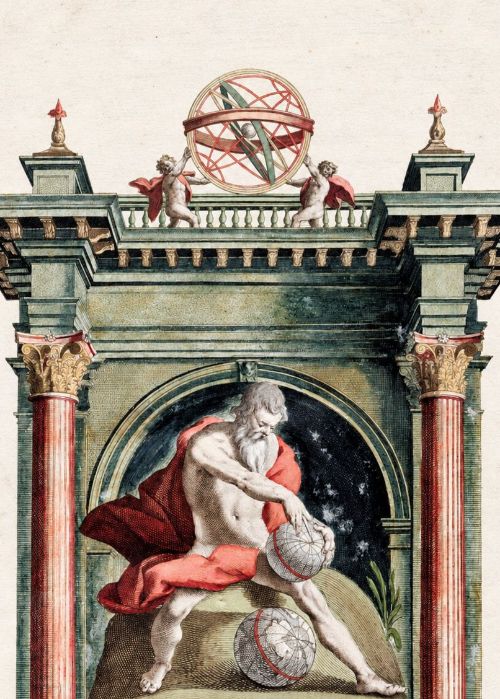
“Habent sua fata libelli”—Books have their destinies. Some begin to exert their influence before they have assumed the form envisaged by their authors; others reach their readers only after a long succession of promises, interruptions and renewed beginnings. One reader will find him long-winded, another will see little that is new, and a third will find the argument obscure.
The very word atlas owes its fortune to a posthumous book. When Gerard Mercator died in 1594, he left maps already in print, others still in his workshop, and a manuscript on the Creation. His son Rumold brought them together at Duisburg the following year as the Atlas sive cosmographicae meditationes de fabrica mundi et fabricati figura. On the engraved title page Atlas, the legendary astronomer-king of Mauretania, sits with a celestial globe in his hands and a terrestrial globe at his feet. Readers were already accustomed to turning the pages of a book of maps. A quarter of a century earlier, in Antwerp, Abraham Ortelius had brought maps by different hands to a common format in his Theatrum orbis terrarum. Mercator’s king gave that familiar book its name.
Warburg chose another name from antiquity for his picture atlas. The name of Mnemosyne, goddess of memory, already stood in Greek letters over the entrance to his library. Atlas himself appears on Panel 2. In a photograph of the Farnese marble the Titan bends beneath a celestial sphere. An etching on the same panel, taken from an eighteenth-century edition of Manilius, spreads the surface of that sphere out on a sheet. The eye can follow Perseus among the constellations, then travel back to the bowed shoulders of the figure who carries them. Across the small interval between the two images, it is possible to see how the ancients gave the heavens a measure and their weight a human form.
On Panel 4 of Mnemosyne we can see the reader of one atlas at work on another. Warburg took pages from Carl Robert’s Die antiken Sarkophagreliefs, which brought reliefs from distant collections together for comparison, and pinned them to the black cloth. A page whose composition Robert had settled in print could now change neighbours in a book Warburg was still making. This was the freedom he had in mind when he wrote to his brother Max in 1927 that a large typological atlas would give his research on the afterlife of antiquity in Europe a form at once firm and flexible. In Rome, inviting Eugénie Strong to see them after his lecture at the Bibliotheca Hertziana, he called them Aushängebögen, advance sheets. To Julius von Schlosser he explained that he had drawn on a chapter of the projected book for his lecture. Early in February, nine frames were carried from the Hertziana to his rooms at the Hotel Palace on Via Veneto, where he could study the images with his visitors at closer quarters. There he could stand beside a visitor and trace an argument from one photograph to the next. On the printed page, the reader would have to make that passage with only the arrangement of the images and Warburg’s words for company.
Nearly thirty years before the Roman lecture, Ghirlandaio’s workshop had prompted Warburg to ask a gardener’s question. In the Birth of St John the Baptist in the Tornabuoni Chapel, a young woman strides into the lying-in chamber, a basket of fruit on her head, her drapery streaming behind her. In Ninfa fiorentina, the epistolary dialogue he began with André Jolles around 1900, the two friends follow her with their eyes. Jolles would gladly go wherever she might lead. Warburg looks to the ground from which she sprang. “Is this strangely delicate plant really rooted in the arid Florentine earth?” He wonders whether some ingenious gardener had persuaded the Tornabuoni to find room for such a flower. The conceit gives the painter and his patrons a share in the cultivation of an ancient gesture. Here, in a Florentine merchant’s family chapel, the Nymph has found employment bringing fruit to a woman in childbed. In August 1929 it was the gardener’s turn to ask the Nymph for help. Warburg hoped that a reading of her panel, now Panel 46, would persuade the Library’s governing board (Kuratorium) that the Atlas was worth the expense.
On 6 October Warburg set down a plan for some two hundred printed plates in two portfolios, accompanied by two volumes of text. The first was to explain the plates and give the sources. The second was to offer interpretations. How the material on the sixty-three panels of the last photographic series would have found its way onto those two hundred plates remains an open question. At four in the morning on 26 October, Warburg was still thinking about a panel on Perseus and its bearing on his reading of Giordano Bruno. He died of an heart attack later that day. A month afterwards Gertrud Bing wrote to Ulrich Middeldorf that she and Fritz Saxl knew the plan well enough to undertake an edition. From the wealth of notes Warburg had left, she hoped to compose the commentary as “a mosaic of his own words”. The work he had done with photographs would fall to his editors to do with sentences.
In 1933, reviewing Warburg’s posthumous collected writings, Gesammelte Schriten, Johan Huizinga found a botanical image for the library and the community of scholars it sustained. He hoped that “this beautiful plant” would weather “the storms of our difficult times” and “continue to bloom and bear fruit” (Huizinga’s text is published in Italian translation in Engramma 151). That December, as the Library sought refuge from National Socialism, two steamers carried its books, photographs and furniture down the Elbe, bound for London. The Atlas had a more uncertain passage. B.G. Teubner, the Leipzig firm that had published Warburg’s collected writings after his death, was also the first publisher he had approached about Mnemosyne. Negotiations were already under way in 1928. Bing and Saxl carried them on after Warburg’s death, but in 1935 they came to an end. In February 1940 Bing wrote to Ernst Gombrich that when she pictured the work complete and the volume in print, she could, for a moment, forget the war.
This issue of Engramma is, in that sense, a botanical garden. Here the successive editions of Mnemosyne stand side by side, and their introductions preserve something of the soil in which each took root. A reader can still discern on the printed page the habits of the archive or the experience of looking at images together on a gallery wall. Elsewhere, a few lines of commentary hold the memory of years of discussion around a seminar table. These practices often meet in the work of a translator, for whom the search for a word in another language may begin with a fresh look at the panel itself.
For this issue we have translated most of the texts into English and brought them up to date, correcting minor errors in the course of revision. At the end of each contribution, readers will find a bibliography that allows them to follow the author’s argument back to its sources and to pursue an enquiry of their own.
Through the publishing history of this one work, Engramma has tried to write a chapter in the cultural history of the twentieth and twenty-first centuries. For those who had worked beside Warburg, the Atlas was still a book they hoped to finish. Later readers came to it with questions of their own, and what one generation could recover of Mnemosyne became the ground on which another began its work. The introductions let us follow that passage closely enough to see how, over the course of a century, the very meaning of having seen the Atlas has changed. According to the reader’s comprehension—“Pro captu lectoris”.
Introductions to Mnemosyne
How could one read a panel of Mnemosyne before the full sequence of sixty-three was available in print? In the late 1970s Dorothée Bauerle worked from the panel photographs at the Warburg Institute in London, identifying the images and reading their changing arrangements alongside Warburg’s notes. Her 1980 dissertation, published in Münster in 1988, offered a commentary on all sixty-three panels. In her Introduction, the changing arrangement of the images bears on a question that runs through the notebooks. How can an image in which a conflict finds expression also give the beholder the distance to reflect on it? It is this precarious space for thought that Warburg calls Denkraum.
Bauerle’s identifications helped the Daedalus group reconstruct the Atlas for exhibition in Vienna in 1993. For Hamburg in 1994, the group made a concertina booklet for each panel. Unfolding it, a reader could compare the historical photograph with a numbered reconstruction and consult the accompanying texts. In Bipolar disorder, détournement and inversion in Aby Warburg’s Mnemosyne project, Werner Rappl returns to Panel 71. At the centre of a study for Carl Larsson’s Midvinterblot stands King Domalde, about to be sacrificed to avert a famine. Identifying the study allows Rappl to read the surrounding images of royal power in the light of that sacrifice. The revised German text of Rappl’s lecture appears here with an English translation.
When the Daedalus reconstruction travelled to Siena, Florence and Rome in 1998–99, the accompanying volume, edited by Italo Spinelli and Roberto Venuti, included Martin Warnke’s Aby Warburg (1866–1929). First published in German in 1990 and presented here for the first time in English, the essay asks what became of Warburg’s historical psychology of expression when he came to be read chiefly as a founder of iconography. Warnke faced a related question as editor. In 2000 the Atlas appeared in the Gesammelte Schriften, in the first edition independent of an exhibition. Warnke’s Editorial Note explains a choice he made in preparing the volume with Claudia Brink. The panel photographs are reproduced uncropped, down to the bolt on the reading-room door visible at the right of the frame. On the facing page, a numbered diagram gives readers the editors’ proposed route through the same images.
Maurizio Ghelardi took the Berlin volume as the basis for the Italian edition published by Aragno in 2002. In Mnemosyne: ‘From Word to Image’, Nicholas Mann returns to a letter Warburg wrote to his brother Max in 1928. Warburg’s account of his passage from word to image leads Mann back to the work of the linguist Hermann Osthoff and to Warburg’s own search for a syntax of gesture. For this issue Mann translated and revised his Italian preface, returning to the German sources. Readers of Fernando Checa’s Madrid edition of 2010 encounter the sixty-three panels before they reach his essay, The Idea of the Artistic Image in Aby Warburg: The Mnemosyne Atlas (1924–1929). Checa follows two routes by which antiquity reached the Renaissance. The ancient gods take on astrological guises in the frescoes of Palazzo Schifanoia, while the heroes of antiquity wear the dress of the Burgundian court in fifteenth-century tapestries.
Three editions appeared in 2012, each giving the reader a different way into the panels. In Mexico City, Linda Báez Rubí devoted one volume to the images and a second to their interpretation. A Journey to the Sources opens the latter by asking how a gesture can preserve a memory even as its form changes. Richard Semon’s theory of the engram and Goethe’s studies of organic form give her two ways of approaching that question. Her essay and Checa’s both appear here in English for the first time. In Tokyo, Hiroaki Ito, Tetsuhiro Kato and Jun Tanaka wrote commentaries on all sixty-three panels. Ito’s Aby Warburg and the Mnemosyne Atlas explains how they compared the Hamburg and Berlin identifications, devised their own numbering and drew provisional headings from Gertrud Bing’s notes.
In Paris, Roland Recht opened the large-format French edition with The Bilderatlas Mnemosyne by Aby Warburg. Reading the diary of the Hamburg library, he follows Warburg’s images from the lecture room to the projected book. Stéphane Mallarmé’s Livre, whose loose sheets could change places, suggests what it might mean to bind Warburg’s movable images into a volume. Engramma republishes the full essay that appeared in 2012. For the Polish edition of 2015, Paweł Brożyński and Małgorzata Jędrzejczyk collated Warburg’s introduction and Fritz Saxl’s letter to his publisher with the surviving typescripts. Their glossary records the choices facing a translator of Warburg. Brożyński’s Introduction to the Polish Edition asks what is at stake in the work’s two names, Mnemosyne and Atlas, reading them through Hölderlin’s hymn and the image of the astronomer-king on Mercator’s frontispiece.
The Forschungsgruppe Mnemosyne at Hamburg’s 8. Salon returned to the scale of the exhibition wall. With the Daedalus print files at their disposal, its members could keep the panels assembled and study them together for four years. In By Way of Introduction, written for Baustelle 1.4, Roberto Ohrt explains how a detail scarcely legible on the printed page could alter the reading of a whole panel. The thirteen Baustelle booklets were revised for the Karlsruhe exhibition of 2016 and issued as a boxed set in 2016–17. For the Berlin exhibition of 2020, Ohrt and Axel Heil sought out the prints Warburg had handled, by then dispersed through the Warburg Institute’s Photographic Collection. In The Mnemosyne and its Afterlife, republished in Meredith Dale’s translation, they draw attention to what the black-and-white photographs had obscured. Reassembled in colour, materials from quite different sources lose the uniform appearance they had acquired in the photographs of 1929.
The Chinese edition, translated by Dong Lü and Hongkai Qiao and published in Chongqing in 2024, takes Warnke and Brink’s volume as its starting point. In his Introduction to the Chinese Translation, Qiao arranges his reading in nine groups of panels. He follows the Florentine Nymph into a HAPAG shipping advertisement on Panel 77 and reads the press photographs of the Lateran Treaty among the final images of the Atlas. The commentary in L’Atlante delle immagini, edited by Ghelardi and Monica Centanni for Carocci in 2026, takes thirteen routes through the panels, drawing on Warburg’s notes of 19 October 1929. In A Note on the Method and Materials of the Mnemosyne Panels, Centanni and the Seminario Mnemosyne return to the kind of question with which Bauerle began. Which Entombment of Christ appears on Panel 42? The caption inherited from earlier editions points to a drawing by Giovanni Bandini in the Uffizi. The reproduction itself leads the editors to Baccio Bandinelli’s Entombment of Christ in the Louvre. The note appears here for the first time in English.
Beyond Mnemosyne
Adrian Rifkin also made panels, fifty-one of them, for an exhibition of satirical prints and political images from the last years of the Second Empire and the Paris Commune. In Telling with Pictures he recalls how he learnt to put one image beside another. As a child he made a scrapbook of Elizabeth II’s coronation. Later he heard Charles Parker’s Radio Ballads bring recorded voices into counterpoint with song. These are the precedents Rifkin recalls for his own way of putting images into conversation.
Giovanna Targia’s Trascrizioni della memoria e forme mediali nell’Atlante Mnemosyne begins with a dated slip in Warburg’s card index. On 17 May 1901 he saw in Florence the Meleager sarcophagus now in the Brenta-Torno collection. Targia follows gestures of mourning from his work on the Sassetti tomb to Panels 5, 42 and 44. For an earlier display, Warburg had used a drawing from the Codex Coburgensis of a different Meleager sarcophagus, the one at Villa Albani. The draughtsman’s choices thus enter into the history of a gesture that reappears in the Atlas.
In Pontifices minimi. Aby Warburg nel ricordo di Eduard Fraenkel (1929), Giulia Zanon publishes the German text of Fraenkel’s obituary for Warburg in Gnomon alongside an Italian translation. Their correspondence and Fraenkel’s 1925 lecture on Lucan as a mediator of ancient pathos give substance to a phrase the philologist preserves at the close of the obituary. Warburg called himself and his fellow scholars a Collegium der pontifices minimi. Fraenkel’s reading of Lucan gives their work as bridge-builders a particular meaning.
Presentations
Three presentations edited by the Redazione di Engramma take up the relation between the Atlas as a book and as an exhibition. From Word to Image introduces the 2026 Carocci edition of L’Atlante delle immagini, edited by Maurizio Ghelardi and Monica Centanni. Its commentaries allow readers to test an interpretation against the images on each of the sixty-three panels and against Warburg’s writings. An Unfinished Project offers an English excerpt from Giulia Zanon’s Una storia dell’Atlante Mnemosyne di Aby Warburg (Ronzani, 2025). The correspondence follows Bing and Saxl from Warburg’s death in 1929 to the end of negotiations with Teubner in 1935, as they tried to find a publishable form for the photographs and notes. Aby Warburg’s Mnemosyne Atlas: An Exhibition History presents Zanon’s Exhibit Mnemosyne | Display Mnemosyne (Antiga, 2025). Surveying more than thirty exhibitions and thirteen editions, the book asks what entered public view each time an exhibition set out to show Mnemosyne.
In Face au Bilderatlas Mnemosyne. Présentation d’un projet collectif de recherche et de créations, Matteo Vallorani documents a collaboration between the Cehta at the École des hautes études en sciences sociales, the Mucem and the Beaux-Arts de Marseille from 2023 to 2025. A workshop returned to the image sequences for Warburg’s Kreuzlingen lecture of 1923 and his tribute to Franz Boll in 1925. By projecting and rearranging the images, artists, students and scholars could try out for themselves the relation between a spoken argument and the sequence on the screen.
Abstract
Engramma 239, Bilderatlas. An Object, a Project, reconstructs the posthumous history of Aby Warburg’s Mnemosyne through a mosaic of introductions to its successive editions. In Introductions to Mnemosyne, Dorothée Bauerle’s Introduction reads the panel photographs alongside Warburg’s notes. Werner Rappl’s Bipolar disorder, détournement and inversion in Aby Warburg’s Mnemosyne project revisits the Daedalus reconstruction through a study for Carl Larsson’s Midvinterblot. Martin Warnke examines the reception of Warburg’s historical psychology in Aby Warburg (1866–1929) and explains his treatment of the photographic record in the Editorial Note. Nicholas Mann traces a syntax of gesture in Mnemosyne: ‘From Word to Image’. Fernando Checa traces the afterlife of antiquity in frescoes and tapestries in The Idea of the Artistic Image in Aby Warburg: The Mnemosyne Atlas (1924–1929). Linda Báez Rubí reads Warburg alongside Semon and Goethe in A Journey to the Sources. Hiroaki Ito explains the Japanese editors’ numbering in Aby Warburg and the Mnemosyne Atlas, and Roland Recht follows the passage from lecture to book in The Bilderatlas Mnemosyne by Aby Warburg. Paweł Brożyński considers the two names of the Atlas in his Introduction to the Polish Edition. Roberto Ohrt recounts the collective reading of the reassembled panels in By Way of Introduction and, with Axel Heil, the recovery of original prints in The Mnemosyne and its Afterlife. Hongkai Qiao follows the Nymph into modern advertising in his Introduction to the Chinese Translation. Monica Centanni and the Seminario Mnemosyne explain how they revised identifications and organised the Carocci commentary in A Note on the Method and Materials of the Mnemosyne Panels. In Beyond Mnemosyne, Adrian Rifkin recalls mounting an exhibition on the Paris Commune in Telling with Pictures. Giovanna Targia traces gestures of mourning across drawings and photographs in Trascrizioni della memoria e forme mediali nell’Atlante Mnemosyne. Giulia Zanon presents Fraenkel’s obituary and his exchanges with Warburg over Lucan in Pontifices minimi. Aby Warburg nel ricordo di Eduard Fraenkel (1929). In Presentations, From Word to Image introduces the Carocci commentary on all sixty-three panels. Two presentations of books by Giulia Zanon follow. An Unfinished Project retraces Bing and Saxl’s negotiations with Teubner. Aby Warburg’s Mnemosyne Atlas: An Exhibition History surveys more than thirty exhibitions and thirteen editions. Matteo Vallorani documents experiments in projection and montage in Face au Bilderatlas Mnemosyne. Présentation d’un projet collectif de recherche et de créations.
keywords | Terentianus; André Jolles; Johan Huizinga; Giorgio Pasquali; Gertrud Bing; Fritz Saxl; B. G. Teubner; LIT Verlag; Dölling und Galitz Verlag; Artemide Edizioni; Akademie Verlag; Nino Aragno Editore; Ediciones Akal; Instituto de Investigaciones Estéticas, Universidad Nacional Autónoma de México; Arina Shobō; L’écarquillé; Narodowe Centrum Kultury; Fundacja Splot; Kartoffelverlag; Universal-futur-Bitch-press; ZKM – Zentrum für Kunst und Medien Karlsruhe; Hatje Cantz; Chongqing University Press; Carocci editore; Ronzani Editore; Antiga Edizioni.