From Word to Image
A Presentation of: Maurizio Ghelardi, Monica Centanni (a cura di), L’Atlante delle immagini (Carocci, Roma 2026)
edited by Redazione di Engramma
Abstract
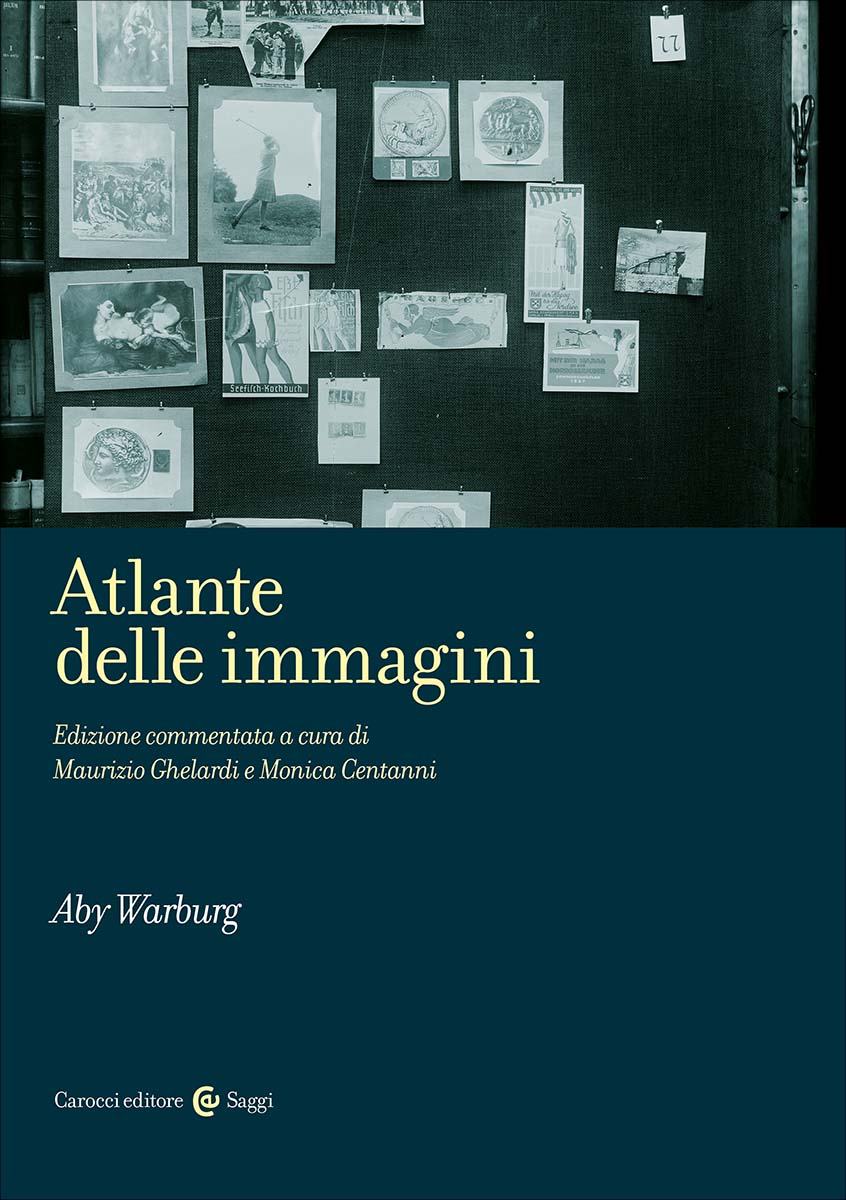
A. Warburg, L’Atlante delle immagini, a cura di M. Ghelardi, M. Centanni (Carocci, Roma 2026).
Indice
Prolegomeni
Presentazione, di Monica Centanni e Maurizio Ghelardi
Aby Warburg: dalla parola all’immagine, di Maurizio Ghelardi
Atlante Mnemosyne: il tema e i contenuti, di Monica Centanni
Testi sull’Atlante
Introduzione a Mnemosyne: l’Atlante delle immagini, Aby Warburg, traduzione di Maurizio Ghelardi
Lettera alla casa editrice Teubner (1930), di Fritz Saxl, traduzione di Maurizio Ghelardi
Atlante Mnemosyne
Nota sul metodo e sui materiali delle Tavole di Mnemosyne, a cura di Monica Centanni e del Seminario Mnemosyne
Percorso α (Tavole A, B, C)
Coordinate della memoria
Percorso I (Tavole 1-3)
Astrologia e mitologia. Proiezioni del cosmo: Babilonia, Atene, Alessandria, Roma
Percorso II (Tavole 4-8)
Preconiazioni dell’Antico. Estasi e malinconia; Madre della vita e della morte;
Pathos del sacrificio; Pathos della Vittoria; Pathos dell’ascesa e della caduta
Percorso III (Tavole 20-27)
Migrazione degli antichi dèi. Peregrinazioni e mascheramenti delle antiche divinità
tra Oriente e Occidente (Baghdad, Toledo, Padova, Rimini, Ferrara, XIII-XV secolo)
Percorso IV (Tavole 28/29-35)
Veicoli della tradizione. Tornei, feste, arazzi, fiabe mitologiche. Scambi tra Nord e Sud
(primo Rinascimento, Firenze, le Fiandre, XV-XVI secolo)
Percorso V (Tavole 36-41a)
Irruzione dell’Antico. Feste, vita di corte, giochi popolari, mitiche allegorie, pathos
dionisiaco (XV-XVI secolo)
Percorso VI (Tavole 42-48)
Reincarnazioni dell’Antico. Figure del compianto, Mercanti e Fortuna,
Angeli e Vittoria, Ninfe e Cacciatrici di teste (Firenze, XV secolo)
Percorso VII (Tavole 49-52)
Mantegna e l’Antico. Controllo, distanza e inversione del pathos
Percorso VIII (Tavole 53-56)
Dalle Muse a Manet. Ascesa e caduta degli dèi (Roma-Parigi, XVI-XIX secolo)
Percorso IX (Tavole 57-59)
Dürer e l’Antico. Migrazioni al Nord
Percorso X (Tavole 60, 61/64)
L’era di Nettuno. Mito e celebrazione del potere tra corti italiane
e monarchie europee (XVI-XVII secolo)
Percorso XI (Tavole 70-76)
Arte ufficiale e pathos barocco. Drammatizzazione del mito: dalla scena del ratto
al teatro anatomico (Rembrandt, Rubens)
Percorso XII (Tavole 77-79)
Attualità della Memoria. Sublimazione del pathos dell’Antico: sport, Chiesa,
Stato e potere
Bibliografia
The new edition of Aby Warburg’s L’Atlante delle immagini, edited by Maurizio Ghelardi and Monica Centanni and published by Carocci in Rome in 2026, brings the surviving panels of Mnemosyne into dialogue with a critical commentary. At its centre is the relationship between images and words that underlies Warburg’s unfinished project. By extending the commentary to all sixty-three panels, the edition offers a way into their visual arguments, tracing the historical sources, conceptual connections and movements of thought that inform their arrangement. It renews the ambition of a book in which the Atlas and its accompanying texts illuminate one another.
Mnemosyne occupied much of Warburg’s intellectual energy between 1926 and his death in 1929. The final surviving arrangement comprises sixty-three panels and, according to the inventory adopted in this edition, 1,174 images. On the dark cloth of the panels, photographs of altarpieces and paintings appear alongside illustrated broadsheets, astronomical charts, diagrams, coins, postage stamps, playing cards, coats of arms, advertisements and newspaper cuttings. Works by Botticelli, Ghirlandaio and Rembrandt share this space with objects drawn from everyday life and the immediate present. Their coexistence gives material form to an enquiry capable of following the migration of images across differences of medium, status and historical context.
The heterogeneity of these materials is integral to the Atlas’s method. Each image acquires significance through its relationship with the others: through juxtaposition and recurrence, through variations in scale and format, and through its position within the panel. Seeing entails recognising connections and reconstructing the argument they make possible. A panel therefore invites the reader to move between the identification of its individual elements and the interpretation of their configuration. Carlo Ginzburg’s characterisation of Mnemosyne as a machine for thinking captures this active dimension: the montage is itself a means of enquiry, through which relations become visible and available for further investigation.
The central concern of this enquiry is the afterlife of antiquity: the transmission of expressive forms, their periods of latency and their reactivation in new circumstances. Gestures inherited from the ancient world retain their force while acquiring different meanings and functions. They pass through reinterpretations, misunderstandings and exchanges between cultures, carrying the representation of life in motion and the bodily expression of passion into later visual languages. The classical tradition emerges as a history of such transformations. Its continuity includes interruption and oblivion; its forms persist through the changes that make them newly intelligible. The concept of Nachleben allows this process to be understood beyond the limits of a straightforward return or rebirth of the past.
These movements also transform the geographical coordinates of cultural history. Following images from South to North and from East to West reveals the exchanges through which European civilisation took shape. What comes into view is a syncretic culture, constituted through the transmission and reworking of materials from different traditions. Warburg’s enquiry into human orientation consequently moves across philology, history, experimental psychology, anthropology, linguistics, the study of religion and philosophy. His own retrospective account of his intellectual development gives philosophy a guiding role in the turn towards images. The method he called psychohistorical seeks to understand how inherited forms mediate experience, and how cultural memory oscillates between contemplative distance and orgiastic abandon.
The unfinished Atlas was recognised early as an intellectual legacy whose significance depended on its future use. Writing in 1930, shortly after Warburg’s death, Giorgio Pasquali identified Mnemosyne as the work through which its author wished to live on for posterity. His appeal to younger scholars joined recognition with responsibility: the Atlas was to become a touchstone for their own thinking, and its legacy would bear fruit through transformation. Pasquali thus understood that the culmination of Warburg’s research remained an open undertaking, requiring others to test its possibilities and pursue its questions.
The history of the project’s reception was nevertheless marked by long interruptions. The rise of National Socialism, the displacement of Warburg’s circle and the transfer of the Library from Hamburg to London in 1933 complicated the prospects for publication. Gertrud Bing, who had worked closely with Warburg on Mnemosyne, remained deeply committed to the project. In 1958, when the Institute moved to Woburn Square, she had the name ΜΝΗΜΟΣΥΝΗ inscribed in the entrance area, recalling its place in the Hamburg library. The name preserved the connection between the institution and the enquiry into memory from which the Atlas had emerged.
In the 1970s, Giorgio Agamben helped redirect attention to the epistemological significance of Mnemosyne, challenging its reduction to a private repertory or an eccentric by-product of its author’s illness. From the 1990s onwards, the Atlas became the focus of increasingly extensive research, editorial work and exhibitions. Italian initiatives, including the Associazione Warburg-Italia and the Seminario Mnemosyne in Venice, contributed to this renewed engagement alongside Georges Didi-Huberman’s studies and the editorial scholarship of Martin Warnke and Maurizio Ghelardi. The reconstruction exhibited in Berlin in 2020, curated by Roberto Ohrt and Axel Heil, drew on research in the Warburg Institute’s collections and on an institutional collaboration supported by Bill Sherman. Together, these undertakings made the Atlas available to new forms of historical and theoretical investigation.
The Carocci edition continues this line of research. Its commentary draws on more than twenty-five years of collaborative work by the Seminario Mnemosyne, whose findings have appeared in La Rivista di Engramma. Warburg left an introduction, notes and a substantial body of related writings, but he did not complete the systematic commentary he had planned for the Atlas. The editors set out to interpret the full sequence of surviving panels and to explain the basis for their reading. The new edition approaches this unfinished relationship between visual montage and verbal exposition through close attention both to the panels and to the wider corpus of his work.
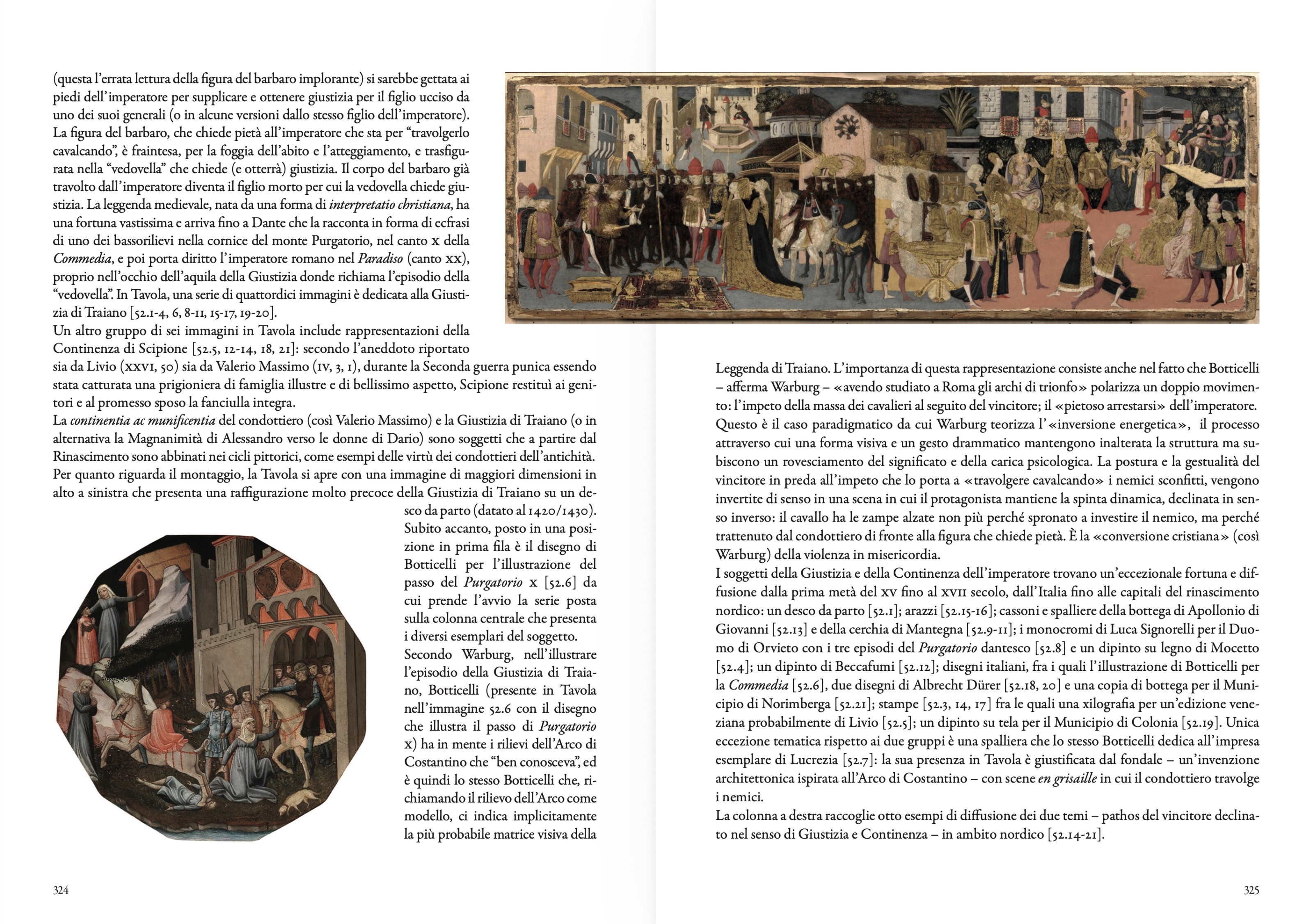
Panel 52. Page reproduced from M. Ghelardi and M. Centanni, Aby Warburg, L’Atlante delle immagini (Carocci, Roma 2026).
Each image is treated as an argumentative unit within the syntax of its panel. The commentary identifies its sources and historical circumstances, follows its connections with neighbouring images and relates these findings to Warburg’s research. This movement between the individual element and the larger configuration allows the thematic architecture of the Atlas to emerge. The readings proceed from the introductory panels A, B and C, which establish the coordinates of memory, through the investigations of antiquity and the Renaissance, to the panels concerned with contemporary life. The sequence offers routes through the material while preserving the connections that cross from one panel to another.
The bibliographical apparatus follows the same principle of orientation. Each commentary is accompanied by a selective bibliography identifying passages from Warburg’s writings and correspondence that bear directly on the panel, together with critical studies devoted to its interpretation. These references direct readers to the sources and critical discussions most immediately relevant to each panel without attempting to reproduce the full range of scholarship consulted in preparing the commentary. The aim is an apparatus sufficiently precise to support further research and sufficiently clear to remain usable. Scholarly rigour and accessibility are brought together in the effort to make a demanding work available to a wider readership.
Warburg’s comparison of the Atlas to an extendable set of coat racks on which to hang the garments woven by time conveys the provisional and generative character of its construction. The images remain open to new relations, and their interpretation requires repeated movement between the panel, the written sources and the historical worlds they bring into contact. The new edition gives readers the means to undertake that movement. Its commentary returns to the invitation recognised by Pasquali: to engage with Mnemosyne as a work whose intellectual life continues through the questions brought to it.
Abstract
This contribution presents the new edition of Aby Warburg’s Mnemosyne Atlas, edited by Maurizio Ghelardi and Monica Centanni and published by Carocci in 2026. It examines the Atlas as an unfinished enquiry into cultural memory and the afterlife of antiquity, in which meaning emerges through the montage of heterogeneous images. The discussion connects Warburg’s psychohistorical approach and his understanding of cultural transmission with the history of the project’s reception, from Giorgio Pasquali and Gertrud Bing to Giorgio Agamben and subsequent scholarship. It then outlines the edition’s commentary on all sixty-three surviving panels, developed through the collective research of the Seminario Mnemosyne. By relating individual images and their configurations to Warburg’s writings, and providing selective bibliographies, the edition renews the dialogue between visual argument and verbal interpretation while preserving the openness of the project.
keywords | Giorgio Pasquali; Gertrud Bing; Giorgio Agamben; Carlo Ginzburg; Georges Didi-Huberman; Martin Warnke; Roberto Ohrt; Axel Heil; Bill Sherman; Seminario Mnemosyne; Warburg Institute; Nachleben.
Per citare questo articolo / To cite this article: Redazione di Engramma (edited by), From Word to Image. A Presentation of: Maurizio Ghelardi, Monica Centanni (a cura di), L’Atlante delle immagini (Carocci, Roma 2026), “La Rivista di Engramma” n. 239, settembre 2026.