Introduction
On: Dorothée Bauerle, Gespenstergeschichten für ganz Erwachsene. Ein Kommentar zu Aby Warburgs Bilderatlas Mnemosyne (Lit Verlag, Münster 1988)
Dorothée Bauerle
Abstract | Deutsche Originalfassung
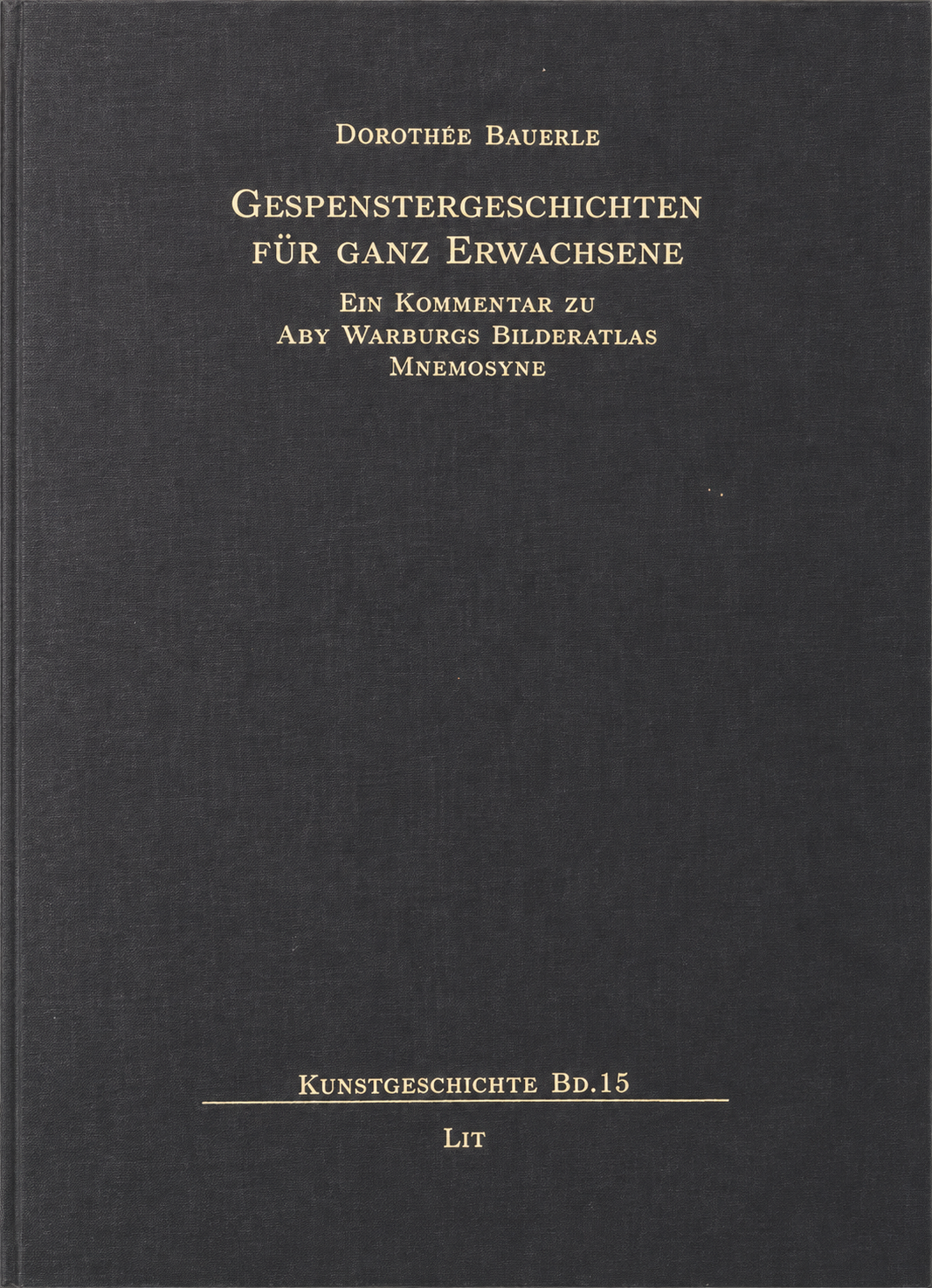
D. Bauerle, Gespenstergeschichten für ganz Erwachsene. Ein Kommentar zu Aby Warburgs Bilderatlas Mnemosyne (Lit Verlag, Münster 1988).
Inhalt
Einführung
I Warburgs historische Psychologie des Ausdrucks ein Kommentar zur Mnemosyne
Denkraum und Orientierung
Symbolbegriff und Kunsttheorie
Brüche zwischen den Polen
Besinnung und Ausdruck
Kunst und Erinnerung
Geschichte
Grenzüberschreitung und Zwischenstufen
Form und Intention
II Interpretation der Bildertafeln des Atlas' Mnemosyne
Vorbemerkung
Die Tafeln
Verzeichnis der Literaturabkürzungen
Literaturverzeichnis
Abbildungsverzeichnis
When Dorothée Bauerle began working on the panel photographs in London in 1978, readers knew the Atlas chiefly through scattered illustrations. Encouraged by Martin Warnke, she set out to identify the individual images and to read their arrangements alongside Warburg’s notebooks. Her Marburg dissertation of 1980 appeared in Münster in 1988 as Gespenstergeschichten für ganz Erwachsene. The book moves from an account of Warburg’s thought to a commentary on all sixty-three panels. Its opening pages, published here in German and in English translation, ask what it means to read a work whose author kept moving the images and recasting his terms. Bauerle’s identifications would later assist the Daedalus group in its reconstruction.
Introduction
The Mnemosyne Atlas has remained a fragment. Warburg planned an atlas containing some 2,000 illustrations and two volumes of text (“Mnemosyne – an attempt at a science of culture grounded in the study of art (2 volumes of text and an atlas with some 2,000 illustrations”). As it now stands, it consists of 63 panels displaying approximately 1,000 individual images in all.
The panels were produced roughly as follows: Warburg grouped the visual material on ‘pinboards’, which were then photographed. These photographs survive in various versions and are held among Warburg’s papers at the Warburg Institute in London. There are, however, no identifications of the individual images or interpretations of the panels. Directly associated with the Atlas are a seventeen-page introduction, the notes for the lecture Mnemosyne, delivered at the Bibliotheca Hertziana in Rome on 17 January 1929, and a notebook entitled Mnemosyne Überschriften, dating from 1928. To these may be added the notebooks Allgemeine Ideen of 1927 and Grundbegriffe I und II of 1929. Together, these provide something like a framework of thought in aphorisms.
The three opening panels are designated by letters, which set them apart from the remaining panels as a kind of introduction. They are followed by a consecutively numbered sequence of eight panels; after a gap, a further continuously numbered group runs from Panel 20 to Panel 64. Panels 50 and 51, and Panels 60–64, are each combined on a single panel; Panels 23 and 41 have the supplementary Panels 23a and 41a respectively. After Panel 64 there is another break. Panels 70–79 bring the Atlas to its conclusion. The missing panels were undoubtedly intended to be completed. Professor Gombrich identified the version presented here as the last to have been assembled by Warburg himself (information provided by Professor Gombrich in a conversation in London in October 1978).
A characteristic feature of Warburg’s work on the Atlas is that the panels were produced in numerous versions, often differing only slightly from one another. This principle of constant variation also runs through the written records: individual thoughts recur in altered forms in almost all the notes. It reveals Warburg’s scholarly ethos, his effort to approach his subject through ever-new formulations, including visual ones, and to unfold what he meant in the multiplicity of its meanings, rather than confining it to a single sense. No formulation settles the matter once and for all; thought does not congeal in the statement. The fragmentary—and thus also open—character of the Atlas is therefore no mere accident, but is inherent in the structure of Warburg’s thought itself.
The commentary on the Mnemosyne Atlas presented here is therefore conceived as an approach to an inexhaustible subject. It can in no way claim actually to reconstruct the Atlas as Warburg intended, or even to exhaust the depth and originality of his thoughts, including those formulated in images. It seeks, instead, to propose one possible reading of the Atlas.
My study is divided into two parts. The first seeks to provide an insight into the structure of Warburg’s thought and to present his conception of art in relation to the conceptual figures of the “struggle for a space for thought” and “orientation”. Against this background, the second part undertakes the identification of individual images and an interpretation of the panels. Warburg did not, however, reduce images to mere exemplifications of concepts. Rather, as expressions of those conflicts and means of overcoming them, they also retain their original visual power and dignity.
In both parts I have drawn on all the writings and notes by Warburg available to me, without following their chronology (Ernst Gombrich’s biography of Warburg offers a more chronological account of his notes and writings, attentive to his intellectual development; see Gombrich 1970). This seemed justified because the Atlas represents the culmination and sum of all that Warburg thought (“In the Atlas, Warburg wishes to present the full range of his scholarly work and its results to the scholarly community” Saxl to Teubner). Mnemosyne is also a major work in this sense: all the subjects that ever occupied Warburg are woven into the Atlas, bringing a lifetime of scholarship into the present once again through recollection. It is in his work that Warburg comes alive as a person and his thought becomes intelligible, rather than in a setting of anecdotes. Warburg himself suffered the inner conflict of orientation through thought; the theme of the Atlas, the creation and destruction of a space for thought, is also “A problem of his own self, as a fundamental problem of every human soul” (Saxl 1929, 12). And his work achieves the utmost objectivity precisely through the commitment of his whole person. Saxl emphasised Warburg’s passionate devotion to his work in his commemorative address. Warburg, he recalled, had regarded Zarathustra’s words as applicable to his own life: “‘O Zarathustra’, they said, ‘are you looking for your happiness?’—‘What does happiness matter?’ he replied. ‘I have long ceased to strive for happiness; I strive for my work’” (Nietzsche [1883-1885] 1960, II, 477; see also Saxl 1929, 1).
Warburg allowed no boundary to be drawn between his person and his work, nor did he acknowledge in his work the boundaries that art history might take for granted. He moves across the borderlands of several disciplines, repeatedly venturing beyond them—even into what Hegel once defiantly called “houses of ill repute”. “It is thought that, when thinking moves beyond the ordinary circle of representations, it visits houses of ill repute; that one entrusts oneself to a sea on which the waves of thought toss one this way and that, only to end up once more on the sandbank of this temporal existence, which one had left for no purpose whatsoever” (Hegel [1817] 1977, 69).
The many stimuli and influences that Warburg absorbed and worked through as a “crosser of boundaries” have been noted only in passing in this study (for his engagement with “modern art scholarship”, see Warburg’s letter to Goldschmidt, cited in Gombrich 1970, 141). This is due in part to the nature of the notes themselves, which often allow the traces of his engagement with other thinkers to be discerned only through allusions and wordplay. Thus Warburg’s note “An atlas of images towards a critique of pure unreason” refers to Kant (Warburg, Grundbegriffe II, 21 June 1929), and the note “A preparatory school of well-tempered passion of antiquity” refers to Jean Paul (Warburg, Grundbegriffe II, 3 May 1929). Warburg writes that his successes in researching astrology were due to the “Boll-wark at my back” thereby emphasising the importance of Franz Boll’s Sphaera (Warburg 1925; Boll 1903).
Bringing Warburg into conversation with theorists who have no direct connection with him is intended as a form of imaginary dialogue or “elective affinities”, and should not be mistaken for philological research on Warburg. This approach is grounded, once again, in the open form of his thought. The wealth of suggestions cannot be exhausted; the perspectives on problems that Warburg opens up often evoke associations, and memories of reading emerge. One’s own thinking is thus kept in motion; almost involuntarily, one joins in weaving the tapestry of Warburg’s thought, entwining related ideas and establishing sometimes surprising correspondences.
Warburg’s language, often rich in imagery, also achieves something else: it does not simply reproduce its object, but unfolds its open horizons, allowing the world to emerge as a universal network of relations. The images of the Atlas, too, are grouped according to relations and configurations. This form and Warburg’s intention are mutually implicated: through signification, language and image reach beyond themselves; as acts of expression, they enact the self’s conscious distancing from the world, rather than simply duplicating reality. In expression, the subject invests phenomena with meaning.
Here lies his essential significance, alongside the many, in some cases revolutionary, advances he introduced into art history: Warburg identifies the function and place of the image in the process of orientation through thought. For him, images and works of art are also Leid-Bilder, images of suffering that human beings create out of their urgent need for orientation.
To gain a space for thought within one’s own thinking, amid the conflict between peril and redemption: this might characterise the innermost impulse of Warburg’s research. Research as “Seeking and finding, or the adventures of one who delights in thinking” (Allgemeine Ideen, 5 June 1927).
Einführung
Der Bildatlas Mnemosyne ist Fragment geblieben. Von Warburg geplant war ein Atlas mit etwa 2000 Abbildungen und zwei Bänden Text (“Mnemosyne – ein Versuch kunstwissenschaftlicher Kulturwissenschaft (2 Bände Text und ein Atlas mit etwa 2000 Abbildungen)”). So wie er jetzt vorliegt, besteht er aus 63 Bildertafeln, die insgesamt ungefähr 1000 Einzelabbildungen zeigen.
Die Tafeln sind etwa so entstanden: Das Bildmaterial wurde von Warburg auf ‘Pinnwänden’ gruppiert und dann abphotographiert. Diese Photographien sind in verschiedenen Ausführungen erhalten und befinden sich in Warburgs Nachlaß im Warburg Institute in London. Allerdings gibt es keine Identifikationen der Einzelbilder und auch keine Interpretationen der Tafeln. Direkt zugeordnet sind dem Bilderatlas eine Einleitung von 17 Seiten, die Notizen zum Vortrag Mnemosyne, gehalten in Rom in der Bibliothek Hertziana am 17. Januar 1929, und ein Notizbuch mit dem Titel Mnemosyne Überschriften von 1928. Hinzuzählen kann man noch die Notizbücher Allgemeine Ideen von 1927 und Grundbegriffe I und II von 1929. Diese bilden gewissermaßen ein Denkgerüst in Aphorismen.
Die drei Eingangstafeln sind mit Buchstaben gekennzeichnet, sie setzen sich so – gleichsam als Einleitung – von den übrigen Bildertafeln ab. Dann folgt eine durchnumerierte Sequenz von acht Tafeln; nach einer Lücke schließt sich ab Tafel 20 bis zur Tafel 64 wieder ein durchlaufend numerierter Komplex an. Die Tafeln 50 und 51 sowie 60 bis 64 sind auf je einer Tafel zusammengefaßt; Tafel 23 und Tafel 41 haben den Anhang 23a bzw. 41a. Nach Tafel 64 erfolgt ein neuerlicher Bruch. Mit den Tafeln 70 bis 79 wird der Bilderatlas bis zu seinem Schluß fortgesetzt. Zweifellos sollten die fehlenden Tafeln noch ausgeführt werden. Diese hier vorliegende Version wurde von Professor Gombrich als die letzte von Warburgs Hand angefertigte bezeichnet (Hinweis Professor Gombrichs in einem Gespräch in London im Oktober 1978).
Kennzeichnend für Warburgs Arbeit am Bilderatlas ist, daß die Bildertafeln in vielfachen – oft nur geringfügig voneinander abweichenden – Versionen angefertigt wurden. Dieses Prinzip der ständigen Variation durchzieht aber gleichermaßen auch die Aufzeichnungen: einzelne Gedanken tauchen in Abwandlungen in fast allen Notizen auf. Deutlich wird so Warburgs Arbeitsethos, seine Anstrengung, sich in immer neuen (Bild-)Formulierungen seinem Thema anzunähern und das von ihm Gemeinte nicht einsinnig, sondern in der Vielfalt seiner Bedeutungen zu entfalten. Nichts ist in der einmal gefaßten Formulierung erledigt, der Gedanke erstarrt nicht in der Aussage. Der fragmentarische – und das meint zugleich auch der offene – Charakter des Bilderatlas ist also nicht nur zufällig, sondern im Gefüge des Warburg’schen Denkens selbst angelegt.
Der hier vorgelegte Kommentar zum Bilderatlas Mnemosyne versteht sich deshalb als Annäherung an ein unendliches Thema. Er kann keinesfalls für sich beanspruchen, den Bilderatlas im Warburg’schen Sinne tatsächlich zu rekonstruieren oder auch nur die Tiefe und Originalität seiner – auch der in Bilder gefaßten – Gedanken auszuschöpfen. Statt dessen wird hier versucht, eine mögliche Lesart zum Bilderatlas vorzuschlagen.
Meine Arbeit gliedert sich in zwei Teile. Der erste Teil versucht, einen Einblick in Warburgs Gedankengefüge zu geben und seinen Kunstbegriff im Zusammenhang mit den Denkfiguren des “Kampfes um den Denkraum” und der “Orientierung” darzustellen. Der zweite Teil unternimmt die Identifikation der Einzelbilder und eine Interpretation der Bildertafeln vor diesem Hintergrund. Aber nicht zur bloßen Exemplifikation der Begriffe hat Warburg die Bilder herabgewürdigt, vielmehr sind sie von ihm als Ausdruck jener Konflikte und Mittel ihrer Bewältigung zugleich in ihrer ursprünglichen Bilderkraft und Würde bewahrt.
Beidesmal habe ich alle mir verfügbaren Schriften und Aufzeichnungen Warburgs hinzugezogen, ohne eine Chronologie dieser Arbeiten einzuhalten (eine eher chronologische, dem Entwicklungsgang Warburgs verpflichtete Aufarbeitung seiner Aufzeichnungen und Schriften gibt Ernst Gombrich in seiner Warburg-Biographie; vgl. Gombrich 1970). Dies erschien mir gerechtfertigt, weil der Bilderatlas die Kulmination und Summe alles von Warburg Gedachten vorstellt (“Im Atlas will Warburg die Fülle seiner wissenschaftlichen Arbeit und ihre Resultate der Forschung vorlegen”, Fritz Saxl, Outline to the Atlas, Manuskript, Warburg Institute, London, vgl. Saxl an Teubner). Die Mnemosyne ist auch ein Hauptwerk in diesem Sinn; alle Sujets, die Warburg je beschäftigten, sind in den Bilderatlas hineingewoben – ein Forscherleben wird so noch einmal erinnernd vergegenwärtigt. Nicht im anekdotischen Ambiente wird die Person Warburgs lebendig und sein Denken begreifbar, sondern in seinem Werk. Warburg selbst hat leidend den Zwiespalt der denkenden Orientierung erlebt; das Thema des Atlas, Denkraumschöpfung und Denkraumzerstörung, ist auch “[…] ein Problem seines eigenen Ichs, als ein Grundproblem jeder Menschenseele” (Saxl 1929, 12). Und sein Werk erreicht das Äußerste an Sachlichkeit gerade in der Investition der ganzen Person. Diese leidenschaftliche Hingabe Warburgs an sein Werk hat Saxl in seiner Gedächtnisrede betont. Warburg habe das Wort Zarathustras für sein Leben als gültig erachtet: “‘O Zarathustra, sagten sie, schaust du wohl aus nach deinem Glücke?’ – ‘Was liegt am Glücke: antwortete er. Ich trachte lange nicht mehr nach Glücke, ich trachte nach meinem Werke.’” (Nietzsche [1883-1885] 1960, II, 477; vgl. auch Saxl 1929, 1).
Weder zwischen Person und Werk hat Warburg eine Grenzziehung zugelassen, noch hat er in seinem Werk die Grenzen anerkannt, die der Kunstgeschichte selbstverständlich sein mögen. Warburg bewegt sich in den Grenzbereichen mehrerer Wissenschaften; er schweift immer wieder aus – selbst dorthin, wo, wie Hegel einmal aufbegehrend es nannte, “böse Häuser” sind. “Man meint, wenn das Denken über den gewöhnlichen Kreis der Vorstellungen hinausgehe, so gehe es zu bösen Häusern; man vertraue sich da einem Meere an, auf dem man von den Wellen des Gedankens da- und dorthin geschlagen werde und am Ende doch wieder auf der Sandbank dieser Zeitlichkeit anlange, die man für nichts und wieder nichts verlassen habe” (Hegel [1817] 1977, 69).
Die vielen Anregungen und Einflüsse, die der “Grenzüberschreiter” Warburg aufgenommen und verarbeitet hat, sind in dieser Arbeit nur am Rande vermerkt worden (zur Auseinandersetzung mit der “modernen Kunstwissenschaft” siehe Warburgs Brief an Goldschmidt, zit. in Gombrich 1970, 141). Dies liegt zum einen an dem Charakter der Aufzeichnungen selbst, die oft nur in Andeutungen und Wortspielen die Spuren der Auseinandersetzung mit anderen Denkern erahnen lassen. So verweist Warburgs Notiz “Bilderatlas zur Kritik der reinen Unvernunft” auf Kant (Warburg, Grundbegriffe II, 21. Juni 1929), die Notiz “Vorschule der wohltemperierten antikischen Leidenschaft” bezieht sich auf Jean Paul (Warburg, Grundbegriffe II, 3. Mai 1929). Erfolge bei der Erforschung der Astrologie habe er durch das “Boll-Werk im Rücken” gehabt, schreibt Warburg und hebt so die Bedeutung von Franz Bolls Sphaera hervor (Warburg 1925; Boll 1903). Zum andern sei hier auf Gombrichs Biographie verwiesen, die diesen Einflüssen ausführlich nachgegangen ist (Gombrich 1970).
Die Konfrontierung Warburgs mit Theoretikern, die nicht unmittelbar mit ihm in Zusammenhang stehen, geschieht im Sinne eines fiktiven Dialogs oder von “Wahlverwandtschaften”, und ist nicht als Warburg-Philologie mißzuverstehen. Diese Herangehensweise hat ihren Grund wiederum in der offenen Form des Warburg’schen Denkens. Die Fülle der Anregungen läßt sich nicht erschöpfen; die Problemperspektiven, die Warburg anrührt, evozieren oft Assoziationen – Leseerinnerungen tauchen auf. Das eigene Denken wird somit in Fluß gehalten; fast unwillkürlich webt man an dem Gedankenteppich Warburgs mit, indem man Ähnliches anrankt und – mitunter überraschende – Korrespondenzen knüpft.
Warburgs – oft sehr bilderreiche – Sprache leistet aber auch dieses: Sie bildet ihren Gegenstand nicht einfach ab, sondern entfaltet seine offenen Horizonte und läßt so die Welt als universelles Beziehungsgefüge entstehen. Nach dem Modus der Beziehung und der Konfiguration sind auch die Bilder des Atlas gruppiert. Diese Form und Warburgs Intention sind aufeinander verwiesen: Sprache und Bild reichen, indem sie bedeuten, über sich hinaus; als Ausdrucksleistungen sind sie Akt der bewußten Distanzierung des Ichs von der Welt, nicht einfach verdoppelte Realität. Im Ausdruck unterlegt das Subjekt den Phänomenen Sinn.
Und hier liegt – neben den vielen, zum Teil revolutionierenden Errungenschaften, die Warburg in die Kunstgeschichte einführte – seine wesentliche Bedeutung: Warburg markiert Funktion und Stelle des Bildes im Prozeß der denkenden Orientierung; Bilder und Kunstwerke sind für ihn zugleich Leid-Bilder, die der Mensch aus seiner Orientierungsnot heraus schafft.
Im eigenen Denken – im Widerstreit von Gefährdung und Erlösung – Denkraum zu erringen, so ließe sich das innerste Moment der Forschungen Warburgs charakterisieren. Forschung als “Suchen und Finden oder die Abenteuer eines Denklustigen” (Allgemeine Ideen, 5. Juni 1927).
Bibliography
Abbreviations and Editions Used
- Allgemeine Ideen
WIA III.102.1.4. - Grundbegriffe
WIA III.102.3. - Überschriften
WIA III.108.1.
Writings by Aby Warburg
- Warburg 1925
A. Warburg, Die Einwirkung der Sphaera Barbarica auf die kosmischen Orientierungsversuche: Franz Boll zum Gedächtnis, Vortrag in Gedenken an Franz Boll, April 1925, WIA III.94.2.1.
Bibliographical References
- Boll 1903
F. Boll, Sphaera. Neue griechische Texte und Untersuchungen zur Geschichte der Sternbilder, Leipzig 1903. - Gombrich 1970
E.H. Gombrich, Aby Warburg. An Intellectual Biography, London 1970. - Hegel [1817] 1977
G.W.F. Hegel, Enzyklopädie der philosophischen Wissenschaften I [Encyklopädie der philosophischen Wissenschaften im Grundrisse. Zum Gebrauch seiner Vorlesungen, Heidelberg 1817], in Id., Werke, VIII, Frankfurt am Main 1977. - Nietzsche [1883-1885] 1960
F. Nietzsche, Also sprach Zarathustra [Also sprach Zarathustra. Ein Buch für Alle und Keinen. Teile I und II, Chemnitz 1883; Teil III, Chemnitz 1884; Teil IV, Leipzig 1885], in Id., Werke in drei Bänden, hrsg. von K. Schlechta, II, München 1960. - Saxl 1929
F. Saxl, Rede gehalten bei der Gedächtnis-Feier für Professor Warburg am 5. Dezember 1929, London, WIA.
Abstract
This contribution presents, in English translation alongside the German original, the introduction to Dorothée Bauerle’s Gespenstergeschichten für ganz Erwachsene: Ein Kommentar zu Aby Warburgs Bilderatlas Mnemosyne (1988)—a landmark study originating from her 1980 doctoral dissertation, which provided the first systematic, panel-by-panel commentary on all 63 display boards of Warburg’s Bilderatlas. Bauerle examines both the 1929 photographic documentation of the panels and a complex constellation of primary materials from the Warburg Institute Archive, including Warburg’s draft introduction (Einleitung), Hertziana lecture fragments, the Überschriften (panel titles), and his aphoristic notes in Allgemeine Ideen and Grundbegriffe I & II. She argues that the Atlas’s fragmentary and open form is inherent to Warburg’s epistemological framework, directly connecting the visual montages to his conception of art, the struggle for a space for thought (Denkraum), and the problem of cognitive orientation.
keywords | Fritz Saxl; Ernst H. Gombrich; Denkraum; Lit Verlag; Warburg Institute Archive; Überschriften; Allgemeine Ideen; Grundbegriffe.
Per citare questo articolo / To cite this article: D. Bauerle, Introduction. On: Dorothée Bauerle, Gespenstergeschichten für ganz Erwachsene. Ein Kommentar zu Aby Warburgs Bilderatlas Mnemosyne (Lit Verlag, Münster 1988), “La Rivista di Engramma” n. 239, settembre 2026.