Right-Wing Communication Guerilla
Nationalist Détournements of Feminist Protest Performances
Kathrin Fahlenbrach
Abstract
Introduction
For some time now, appropriating left-wing protest symbols has been one of the key strategies of far-right movements, especially when it comes to representing their goals and ideologies to the outside world. Initially, this tactic was mainly used to circumvent censorship of right-wing extremist symbols in public (cf. Miller-Idriss 2018). At the same time, their communication guerrilla warfare has been marked by an open cultural battle against a supposedly left-wing mainstream (see, for example, Terizakis, Knopp 2025; Meiering 2022). Situational forms of protest such as sit-ins, flash mobs, or occupations of symbolic locations, which have been invented by emancipatory social movements, were prominently hijacked by European Identitarian activists and used for their own purposes. With the possibilities offered by online platforms, the potential for communication guerrilla warfare by the right wing has increased exponentially (Terizakis, Knopp 2025; Steinwender 2025; Fielitz, Thurston 2019).
This article uses the example of femonationalist activists in Germany to examine memetic reversal of left-wing emancipatory forms of protest on the streets and online. Exploring online videos of the German activist group Lukreta, it will be shown how nationalists appropriate fundamental claims of the women’s movement and their forms of protest and how they combine them with right-wing narratives and rhetoric. The paper will analyse different strategies of such semiological détournement, which are intended not only to symbolically incapacitate their opponents, but also to disguise and normalize right-wing narratives under the mask of liberal activist forms.
The analysis will place particular emphasis on visual and pictorial tactics of assimilation, alienation, and the reversal of aesthetic codes, tracing their lineage to Situationism, the anti-authoritarian movements of the 1960s, and anti-corporate adbusting activism, among other traditions. The aim of this paper is to show how femonationalist activists use the cultural grammar of left-wing movements – especially feminism – for supporting the right-wing project of cultural warfare against the left-wing mainstream, and promoting a broader cultural backlash.
Femonationalism
Right-wing populist parties in Europe and in the US have been benefiting for quite some time from having women at their helm. Figures such as Marine Le Pen in France, Sarah Palin in the US, Alice Weidel in Germany, and Georgia Meloni in Italy (Marcora 2024) have established themselves as powerful political leaders who have gained unprecedented support for their parties, even beyond radical minorities. In doing so, they exploit traditional gender stereotypes, according to which women tend to be perceived as both more altruistic and less radical than men. The added value of women as mediators of right-wing politics to the bourgeois middle class is apparently so highly regarded by these parties that they are even willing to accept ideological contradictions for this purpose. This is the case, for example, with Alice Weidel, who is a homosexual woman in a relationship with a migrant partner, living with her in a foreign country (Switzerland). Her own lifestyle thus stands in stark contrast to the anti-liberal and patriotic values she herself propagates (see Jacopo Galimberti’s contribution in this issue).
However, the Weidel case reveals another current trend among right-wing parties and movements: They deliberately appropriate left-wing emancipatory habitus, and related forms of expression, imbuing them with their own worldviews and ideologemes. This fits in with a general strategy among right-wing politicians, which Sasse describes as a “reversal into the opposite” (Sasse 2023). The gesture of subversion is used here as a technique of power, as “subversion from above”, analyzed by Sasse in the context of authoritarian, anti-democratic politicians. They spread their anti-liberal and authoritarian agendas by presenting themselves as true advocates of freedom of expression and liberalism. Democratic opponents, on the other hand, are branded as censors and fascists.
This broader tendency towards détournement and subversion as a power technique (Sasse 2023) is supported by another recent agenda of right-wing actors, conveyed as “subversion from below” (Steinwender 2025). As is well-known, key figures of the so-called New Right, as Alain de Benoist in France and Thor von Waldstein in Germany have appropriated the idea of “Meta-Politics” from the Marxist philosopher Antonio Gramsci (Flügel 2022). It is above all Gramsci’s idea of meta-politics, the spreading of revolutionary worldviews, values, and ideologies throughout society that has now become the ‘Holy Grail’ of right-wing movements in Europe (Lindemann 2022, 255; Meiering 2022). As Terizakis and Knopp put it: the New Right “pursues a ‘metapolitical’ strategy, i.e., one aimed at the pre-political sphere, in order to achieve ‘cultural hegemony’” (Terizakis, Knopp 2025, 126, translation by the author).
The appropriation of left-wing theories for their meta-political agenda is symptomatic of the widespread adoption of left-wing concepts and symbolic forms. Benoist, von Waldstein, but also Identitarian activists such as Martin Sellner or the German publisher Götz Kubitschek propagate the imitation of left-wing ideas and ideological reversal (Meiering 2022). On their now banned website, the German Identitarians describe their tactics as follows:
We believe that political change is not only possible in parliaments and party politics, but also takes place in the cultural sector, public debates, the media, and on the streets. We therefore operate in a kind of ‘pre-political space’ that shapes discourse and thus serves as the basis for direct and concrete political decisions (Identitarians Germany, cited in Flügel 2022, 92, translation by the author).
This strategy seeks to dismantle what is portrayed as the entrenched liberal “cultural hegemony” and “opinion dominance” of left-leaning media, while simultaneously appropriating and exploiting their cultural capital.
Accordingly, they have extended their culture battle to values and forms of expression that originally emerged in left-wing alternative circles since the 1960s, but which have long since spread throughout Western societies. It is primarily the values associated with individual autonomy and self-realisation that have been promoted by social movements since then and now represent a basic social consensus (Kasimov 2025).
This battle is first of all taking place in the pre-political space, in online-spheres: In right-wing activism, among influencers and other online actors in interconnected online spheres (Terizakis, Knopp 2025). In this pre-political arena, women have long since become “cultural entrepreneurs” of right-wing meta-politics (Krug 2025b, 3). In her study on right-wing nano-influencers, de Haan et al. (2025) identify as two of their main strategies: “dog whistling” and “red pilling”. Dog whistling refers to packaging controversial political messages in an innocuous and entertaining form, for example by mixing them with popular music, video snippets from films and series on TikTok, or framing them with commonly used emojis and filters. These common signs imply specific codes that address in-group meanings which only right-wing users can decode (e.g. the juice-emoji for ‘jews’). “Red pilling”, on the other hand, picks up on a topos that goes back to the film The Matrix and has become popular mainly in conspiracy online-discourses. “Red pilling” strategies used by right-wing actors on the web who aim to make the white population of Europe and the US aware of the dangers of their own alleged annihilation by migrant cultures and of the manipulation of public opinion operated by left-wing media.
Femonationalist activism significantly feeds into this overall cultural battle. Calderaro defines femonationalism as “a novel form of anti-feminism characterised by the appropriation of selective aspects of feminism, which are adapted to far-right political agendas and primarily rely on the racialisation of sexism” (Calderaro 2025, 93). In terms of Meta-Politics, they are exploiting feminism as an influential emancipatory discourse. Throughout all its ramifications and historical variations, feminism has essentially advocated gender equality and the self-realisation of women since the nineteenth century. Right-wing activists, do not reject these principles outright; rather, they present themselves as their genuine defenders, albeit advancing divergent interpretations of what those principles concretely entail. They paint a dramatic picture of a threat to white (heterosexual) women in European countries, whose autonomy, freedom, and self-realisation are allegedly threatened by the increasing presence of migrant men in public spaces. Propagating ‘remigration’ as the only solution to this indicted problem, they convey their nationalist messages in a feminist guise.
Calderaro (2025) has examined the feminist framing strategies in femonationalist activism that accompany this concealment tactic. In doing so, she has identified three key collective action frames that lie behind their messages and actions. The first is “opposition to intersectional feminism” (Calderaro 2025, 948) which extends its demand for gender justice to non-binary people and other minorities. Femonationalists denounce this expansion not only as a betrayal of women’s needs and interests, but also as a manifest threat to them. They argue that by advocating diversity, intersectional feminism has become blind to the dangers that patriarchal norms within certain migrant communities pose to women. The second frame is “the use of post-feminist frames”, and, according to Calderaro (2025, 933) this concerns the aforementioned claim in femonationalism that, thanks to earlier women’s movements, gender equality has already been established and constitutionally enshrined in the Western world. However, they argue that there is a fundamental threat to these achievements by migrants, which left-wing feminists were unwilling to see. The third key frame, which underlies the other two, is “racialisation of sexism” (Calderaro 2025, 933). This frame attributes sexualised violence against women primarily to migrant men, while sexual abuse by white and ‘native’ men is downplayed or concealed. The third frame serves primarily to stir up collective feelings of fear and aggression against ‘foreigners’ and to mobilize political support and protest. It manifests the actual and key message of femonationalist activists, namely the demand for the deportation of people with a migrant background. The other two supposedly feminist frames, in turn, serve strategically only to package this message in terms of dog whistling and red pilling.
In the current and still nascent research on femonationalism, two dominant types of activists are being observed: On the one hand, there are combative activists who mobilize through protests on the streets and online. They belong to activist groups and networks that can be found in several European countries (e.g. Némésis in France, Lukreta in Germany. On the other hand, there are influencers who convey traditional female roles such as housewife and mother in an internet-savvy lifestyle aesthetic, making use of the affordances and codes of online platforms such as Instagram and TikTok (de Haan et al. 2025). Also in the broader public, they are often referred to as “tradwives” (Krug 2025a).
Both right-wing protesters and influencers essentially convey a nationalistic image of women, according to which women are seen as the ‘natural’ origin of family and race and must be protected in this role. Seeing this as their true destiny, both types of activists see themselves as liberators of women from the constraints of left-wing, misguided emancipation and heteronomy.
Communication Guerilla Warfare as an Emancipatory Project
In their meta-political battle, right-wing and femonationalist online activism focuses on communicative tactics and strategies that have their roots in the communication guerrilla of left-wing emancipatory movements. To illustrate the implications of this strategic appropriation and political inversion by femonationalists, I will offer a brief overview of some main goals and tactics in the context of left-wing movements.
Umberto Eco was one of the first to introduce the term “semiological guerrilla” (Eco [1968] 1986). In 1967, he recognised the enormously increased importance of public communication as a powerful arena in the then emerging age of electronic mass media. Similar to other critical thinkers of the time (e.g. Marshall McLuhan or Theodor W. Adorno), he recognised the risk of individuals being deprived of their autonomy by the standardised conventions, signs and codes of mass media. To counter this, Eco called for the self-empowerment of recipients through their active appropriation of media messages and their codes in the form of an ongoing “semiological guerrilla warfare”. While power over the technical channels and infrastructures in the mass media is hierarchically organised, according to Eco, the power of the audience lies in the individual, even resistant, appropriation of media codes and messages. Hence, he envisioned semiological guerilla as a continuous practice of critically decoding and appropriating media messages and their underlying codes. As he put it, semiological guerilla warfare could be:
A constant correction of perspectives, the checking of codes, the ever-renewed interpretations of mass messages. The universe of Technological Communication would then be patrolled by groups of communications guerrillas, who would restore a critical dimension to passive reception (Eco [1968] 1986, 132).
Before Eco, it was Guy Debord and the artists around the Situationists International who paved the way for communication guerilla concepts and practices since the late 1950s. In his work The Society of the Spectacle, Debord identified a strong standardisation of everyday life routines, culture and society at large (Debord [1967] 1995). Debord uses the metaphor of spectacle to characterize a culture and society shaped by capitalist rules, which is based on principles of distraction and entertaining performances, thereby turning people into seduced but passive consumers. Significantly, Debord saw subversive action as the only way out of this alienation and created the idea of the Situationist International. The target audience of the Situationist approach is citizens, who are to free themselves from passivity and ideological control through spontaneous actions (as the Situationist International in 1960). Subversive resistance is intended to create interventionist situations, such as happenings on the street, which temporarily suspend public order and enable new, self-empowering experiences. A typical example of this was dériver (aimless rambling) in urban areas, which disrupted the functional processes of traffic, consumption and everyday working life of ‘conformist’ citizens in order to wake them up from their embeddedness in capitalist logics (this concept was realised more specifically in the 1960s by the anti-authoritarian movement in Germany, notably by the ‘rambling hash rebels’: see Kraushaar 2007).
Through the artistic movement of the Situationist International and its various national manifestations, Debord’s ideas triggered a veritable paradigm shift in protest culture in the 1960s. Of crucial importance here was the extension of resistance against state institutions to the cultural field of lifestyles, values, and social roles – the original leftist account of Gramsci’s Meta-Politics (cf. Kraushaar 2007; Fahlenbrach 2007). For instance, the anti-authoritarian group of the “Subversive Action” in Germany, several of whose members subsequently founded ‘Kommune 1’, aimed more at a ‘revolutionary way of life’ than at gaining political power. Similar to Gramsci’s approach, anti-authoritarian groups and activists were concerned with a cultural change encompassing the whole of society, from which a broad spectrum of left-wing emancipatory movements emerged in the following decades. Significantly, visual protest performances and images took on an unprecedented importance in guerilla practices (Fahlenbrach 2007). Through subversive practices, mass media images became both the target and the means of protest: whether in the form of staged media events, such as the alleged ‘pudding attack’ on the US Vice president Hubert Humphrey visiting Germany in 1967, or through ‘happening’-like street protests that explored the limits of civil disobedience and made them publicly visible – also by the media, covering these events.
Since these beginnings of communication guerrilla warfare, a continuous standardisation of its goals and tactics in liberal activism can be observed to this day (Steinwender 2025). The spectrum ranges from its use in emancipatory new social movements (e.g. ecology movements or human rights movements) and in extreme left-wing groups (e.g. Antifa) to consumer-critical cultural jamming and adbusting activism (see Kalle Lasn 2000; Völlinger 2010). Since the 1970s, subversive forms of protest have been increasingly used to draw the attention of the media and the broader public to their goals in a powerful symbolic way. This has been particularly evident with the development of professional PR strategies by movement organisations and NGOs like Greenpeace or ATTAC, who regularly are featuring symbolic happenings and actions as staged media, and image events (Delicath, de Luca 2003) to attract the attention of a broad audience (Baringhorst et al. 2009). The German handbook on communication guerrilla warfare (Blisset, Brünzels 2001) is characteristic of its standardisation in left-wing protest culture.
In the age of digital image and online media, the activist significance of subversive actions has once again increased (Steinwender 2025). Since then, it has been important not only to attract the attention of journalistic gatekeepers in the mass media, but also to take into account the algorithmic dynamics of global image flows on social online platforms (Fahlenbrach 2025). The anti-globalisation movement around 2000 and the North African movements (the Arab Spring) were the first to powerfully demonstrate how the newly emerging infrastructures of online platforms can be used in a resistant and subversive manner to overcome censorship, but also to mobilize international public support.
To conclude, the project of communication guerrilla warfare which, in the spirit of Eco, still continues to critically examine power relations and hegemonic media discourses, focuses primarily on the socio-cultural dimension of worldviews, values, lifestyles, and discursive hegemonies in its practices of resistance. The basic understanding within liberal, emancipatory activism could be characterised as follows: Communication guerrilla warfare opposes dominant power structures primarily through the cultural understanding associated with them and the related forms of communication. To this end, the everyday routines, rules, signs, and media of dominant cultural practices and discourses are appropriated on their surface and subversively inverted (détournement), exposing the underlying cultural grammar for critical reflection. Communication guerrilla tactics always aim to link familiar signs and practices with implicit critical messages or new meanings in the process of revealing them, which ideally are evoked in the minds of the addressees themselves. In this context, key principles of communication guerrilla warfare are: faking, alienation, disruption, and, over-identification (Völlinger 2010; Blisset, Brünzels 2001).
In faking, the desired change is presented as already accomplished by feigning an alternative normality or facts that are generally considered desirable against the backdrop of commonly shared values and worldviews – for example, from a humanistic perspective. On the part of emancipatory activists, faking typically offers an ideal vision of a world in which civil society values are better preserved. Fake, then, often quickly provokes contradictions among actors who see their (political, economic, etc.) interests threatened by such an alternative, idealistic scenario. The adbusters group The Yes Men in particular ha
ve repeatedly applied this principle effectively by launching desired news items in established news media, such as the payment of damages to victims of the Dow Chemical accident in Bhopal (see Razorfoundation, Bhopal Disaster – BBC – The Yes Men). Dow Chemical’s denial of this news blatantly demonstrated to the public its lack of any sense of guilt. The example demonstrates that producing fakes in a subversive and alienating sense can aim at a critical process of enlightenment that uncovers hidden truths. Accordingly, as emphasised in the Handbook of Communication Guerrilla, the evocation of denials is firmly planned. The exposure of fakes is a central component of subversive action; as the authors put it: “Fake = forgery & exposure/denial/confession” (Blisset, Brünzels 2001, 69). Without subsequent exposure, fakes become lies (see Paolucci 2023).
Furthermore, the principle of alienation aims to give new meanings to established places, routines and practices of everyday life. Such activist alienation occurs time and again, for example at award ceremonies at sporting events. A prominent example is the kneeling protest of the NFL-player Colin Kaepernick during the opening ceremony of a football game in 2016, while the national anthem was played. His boycott of the ritual of standing straight, with his right hand on his breast, created an influential symbol of protest against racism for the Black Lives Matter-movement. Also, the change of advertising billboards in adbusting is a common practice of subversive alienation, in which the aesthetics and message of advertising are parasitically exploited and reversed to convey a consumer-critical attitude.
Closely related to alienation is the principle of disruption, in which familiar processes and public places are temporarily blocked and rendered ineffective. This includes the aforementioned happening-like forms of action such as sit-ins, teach-ins, or critical mass demonstrations. Another example comes most recently from Germany, in the blockade of urban traffic by climate activists who glued their hands to the street, triggering massive and striking counter-reactions among the population, revealing their narrow acceptance to adapt to the circumstances of climate change. Finally, the principle of over-identification is characterised by an overly affirmative confirmation of well-established signs, rules, and routines, which, by their very exaggeration, make the underlying patterns of thought and behaviour tangible. A recent example is a prominent campaign by the German ‘Centre for Political Beauty’ an actionist art group that uses guerrilla communication tactics to raise public awareness for human rights. In their latest prominent campaign, they erected a monument to CDU politician Walter Lübcke in front of the CDU party headquarters in Berlin (see Zentrum für Politische Schönheit, Bau das Walter Lübcke Memorial direkt vor die Parteizentrale der CDU). During his lifetime, Lübcke was a staunch opponent of right-wing extremism and was murdered for it in 2019 by an AfD supporter. While the conservative CDU party regularly struggles with its position in relation to the AfD party, the memorial is intended to remind its representatives of the fatal consequences of an alliance with the far-right. In an overly affirmative manner, CDU member Lübcke is being honoured here by a civil-rights group by answering in detail the aesthetic codes related to memorial culture. As a result, many passersby take it as an official memorial. The elaborately produced bronze statue of Lübcke, next to which an information stele explains Lübcke’s commitment to fighting right-wing extremism and his murder, has quickly become a serious memorial site where people pause and lay flowers and candles. In stark contrast to this sympathy, the CDU has distanced itself from this action, criticizing it as unworthy and disrespectful. Accordingly, in terms of guerrilla communication warfare, the group has triggered revealing reactions from the party, ones which draw public attention towards its problem of distancing itself from the AfD.
Communication Guerilla Warfare as a Default Mode in Net-Cultures
Beyond political activism and art, such subversive techniques of communication guerilla warfare have long been used in commercial contexts as well. This can be exemplified by guerrilla marketing, which has recognised the attention-grabbing potential of disrupting traditional advertising codes and semiotic surprises (Völlinger 2010). Even more, internet culture, with its memetic image practices, has long been permeated by these techniques and aesthetic strategies. Digital technologies, with their affordance structures, already promote the ongoing de- and recontextualisation of images, videos, and texts (e.g. by offering corporate meme-generators on platforms). The formerly subversive techniques of communication guerrilla have thus not only become inflationary, but have even solidified into standardised forms of expression in online communication within platforms such as TikTok or Instagram as image editing tools. Accordingly, Steinwender recognizes “a problematic state of coexistence” (Steinwender 2025, 18) “between subverted norms on the one hand and, on the other hand, subversion that has become the norm” (Gerber, Hausladen 2017, 12, translation by the author).
The very principle of subversive détournement and alienation of commonly known semiotic material and codes has broadly become a gesture in its own right, largely emptied of activist intention and incorporated into profit-oriented platform economies. As Paolucci observes, semiological guerrilla warfare has become a default mode of social media – albeit in a way that Eco did not intend. It has promoted the spread of fake news and a primacy of subjective interpretation and experience over knowledge in social-media-communication. In his words:
We now live in a world where a deviant version of the semiological guerrilla has won and has become, paradoxically, the default mechanism of many contemporary forms of communication, presenting aberrant decoding, misleading interpretations, and contents aimed at deconstructing knowledge, since everyone now knows that knowledge is always connected to some form of power (Paolucci 2023, 103).
Communication Guerilla Warfare Shifting to the Far-Right
The standardization of guerilla techniques in the realm of platform-economics and online-communication significantly paved the way for their appropriation by right-wing actors in their meta-political battles for cultural hegemony. As such, two trends can be observed: On the one hand, a New Right-oriented form of communication guerrilla warfare has emerged in many Western countries (Meiering 2022a), appropriating the ideas and strategies of the anti-authoritarian New Left of the 1960s and 1970s, and redirecting them against their original authors.
In explicitly using the concepts of alienation and reverse mimesis against its initial creators, communication guerilla tactics are used in order to reverse emancipatory achievements in Western societies (Flügel 2022). The French author of the nouvelle droite in France, Alain de Benoist, or the German publisher Götz Kubitschek, for example, openly propagate the exploitation of leftist ideas and their symbolic arsenal (Meiering 2022b). It was Benoist who was the first to exploit Gramsci’s concept of a battle for cultural hegemony and meta-politics, inspiring other right-wing movements throughout Europe. For example, Götz Kubitschek sees the project of a New Right directly in the tradition of the leftist anti-authoritarian movement, whose forms of protest, concepts, and symbols he exploits: for example, by calling his own network Conservative Subversive Action, a direct allusion to the situationist group Subversive Aktion of the New Left in Germany in the 1960s (Speit 2018; Lindemann 2022). In fact, this development was also supported by former members of the New Left who had joined the right wing, such as Frank Bökelmann, who was even a member of Kommune 1.
The activist realisation of subversive guerilla actions happens most prominently by the Identitarian Movements in Europe (Gensing 2018). In a campaign video (“When are you joining us?”, YouTube, 4 June 2018) on their now-banned YouTube channel from January 2018, they openly formulate their guerrilla tactical program, including: Media work, building identitarian counter-public spheres, and influencing. The occupation of symbolic locations such as the Brandenburg Gate in Berlin (2016), a memorial vigil for ‘Merkel’s dead’ – referring to the ‘victims’ of ‘mass migration’ to Germany since 2015 – or the Defend Europe campaign taking place in several locations across Europe make use of the familiar symbolic arsenal of civil society protest. In the context of the Defend Europe actions in 2017, for example, a ship carrying Identitarians circulated in the Mediterranean. At once over-identifying and alienating, these actions imitated refugee rescue ships in the Mediterranean, but under the opposite motto. The action was performed for the online-distribution of videos and photos, also adapting the principles of well-known PR-strategies by civil-rights movements (e.g. Greenpeace).
On the other hand of the right-wing cultural battle, there is a broader digital media guerrilla warfare on the net that aggressively exploits popular and memetic net structures and practices, while rather implicitly referring to the leftist heritage. The focus here is on massive memetic warfare that exploits the algorithmic dynamics of online platforms such as X or TikTok (Rafael 2018). The social web is programmatically instrumentalised as a key arena for the right-wing culture war (Bogert, Fielitz 2019; Gerbaudo 2015). Authoritarian, anti-emancipatory, and nationalist views are disseminated en masse, but at the same time target specific user profiles.
A notable example of this is the prominent German online manifesto entitled Handbuch für Medienguerillas (“Handbook for Media Guerrillas”). It somehow imitates the idea of the aforementioned handbook for left-wing activists – albeit significantly differing in its form and content. In an openly aggressive tone, it is rather a militant manifesto. It suggests a multi-stage strategy for the far-right conquest of online public spheres, propagating four interlocking tactics: ‘shitposting’, ‘open-source memetic warfare’, ‘social networking’, and ‘attacking of filter bubbles’. On the one hand, the focus is on aggressive attacks on leftist and liberal ‘enemies’ through shitposts, fake slander, trolling, etc. This involves the use of the formerly subversive principles of faking, alienation, and reversal, but also over-identification. For example, accounts and posts are faked in the form of ‘reverse mimesis’ (Casarino, Nardelli 2021) and provided with discrediting content. In contrast to emancipatory communication guerrilla, these tactics are to be used in a decidedly manipulative and denunciatory manner. There is no intention of subsequently unmasking and exposing the fakes – on the contrary, the aim is to anchor the wrong impression in the minds of internet users. In addition, guerrilla tactics aim to enforce a right-wing climate on online platforms, as such increasing acceptance of fundamental systemic upheavals under the ‘netizens’. The target audience here is not so much the ‘enemies’ but the average users who are to be won over to right-wing ideas and attitudes (cf. Gerbaudo 2015). For example, the manifesto mentions the dissemination of alternative scientific papers and information, or the systematic generation of digital ‘swarm intelligence’, this also via fake accounts, which suggest right-wing majorities on the web.
Casarino and Nardelli (2021), and Kasimov (2025) argue that the social web, with its decentralised structures, effectively conceals the authoritarian and anti-emancipatory goals of right-wing extremist actors on the internet. This is because the interactive and personalizing mechanisms of the internet still offer users an impression of agency and self-efficiency. The framing of right-wing posts in a personal, but also collectively shared, platform context can thus contribute significantly to the normalisation of right-wing discourses. As Karimov (2025) also demonstrates, actionist forms of propaganda which call for quick reaction from many individual users on the net, e.g. shitposting and trolling, but also happening-like actions on the street, should allow sympathizers to experience their commitment as fully self-controlled and autonomous. Accordingly, it is the combination of decentralised web-infrastructures, the corporate idea of egalitarian, autonomous user-communities on the web (Gerbaudo 2015), and the use of standardized tool kits of communication guerilla, which offer right-wing activists an ideal milieu for their propaganda. Together, they evoke an ambience of individual freedom and creativity, while at the same time fighting against such libertarian values and struggling for the reinstatement of authoritarian ones.
Femonationalist Communication Guerilla Warfare: The Case of the German Group Lukreta
As mentioned above, women are playing an increasingly important role as cultural entrepreneurs (Krug 2025a) in the cultural struggle of the far-right. Of particular significance here are activist groups and networks associated with femonationalism. In France, Germany, and other European countries, they are closely linked to the far-right Identitarian Movement. Both the French group Collectif Némésis and the German group Lukreta directly emerged from the Identitarian networks. In 2019, the German Federal Office for the Protection of the Constitution classified the Identitarians as an extremist, anti-constitutional group, female activists have played an increasingly important role in spreading right-wing opinions throughout society.
Lukreta has its origins in an activist project by the Identitarian movement, which operated under the name #120 db. It refers to the decibel level of emergency whistles that women can use on the street if they feel threatened by sexual violence. In a video entitled #120 db – Der wahre Aufschrei (The Real Outcry), and in a testimonial style of protest rhetoric, activists look directly into the camera and identify themselves as victims of sexual violence by migrant men (The video is no longer online; the description is based on an analysis of an archived version in Drüecke, Klaus 2019). Hence, the video campaign imitated both the labelling, the rhetoric and aesthetics of the #MeToo movement, which at the time (2017) publicly denounced sexual harassment of women and structural gender inequality. In the form of subversive alienation, the Identitarians conveyed a completely different message, which targeted exclusively migrant men as perpetrators. This racist framing of sexism (Calderado 2025) was already evident in a much-noticed earlier action by the group, when they interrupted a #MeToo plenary session at the 2018 Berlinale film festival with their posters in a disruptive action. With a large protest banner bearing the slogan “The voice of forgotten women #120db”, they obstructed the view of the discussion panel on the podium for the audience gathered there and stole the full attention of the local press cameras. At the same time, in a gesture of communication guerrilla warfare, they denounced the supposed blind spots of the #MeToo event, which they claimed neglected the female ‘victims of migration’.
Since 2019, the group has been appearing in public under the name Lukreta, both on the streets and on relevant online platforms. Its key founding member is Reinhild Boßdorf, a member of the Identitarian movement and of the Junge Alternative (now renamed Generation Deutschland). As is common with other activist networks, Lukreta’s street and online appearances are closely linked. Happenings, demonstrations, and other street actions are documented on video with smartphones and shared on their online feeds.
The following section examines five activist videos by Lukreta that the group distributed on its official Instagram account in 2025. Furthermore another video by a Lukreta activist is included, who first appeared on Instagram under the username @sia_lukreta and currently goes by the name @siavonriva. While the Lukreta account mainly presents collective actions, @siavonriva’s posts are characterised by a more individualistic style coined by influencer aesthetics. An Instagram reel from 27 February 2025 documents the disruption of a rally, that is annually organised by feminist activists under the slogan “One Billion Rising”, campaigning against sexual violence.
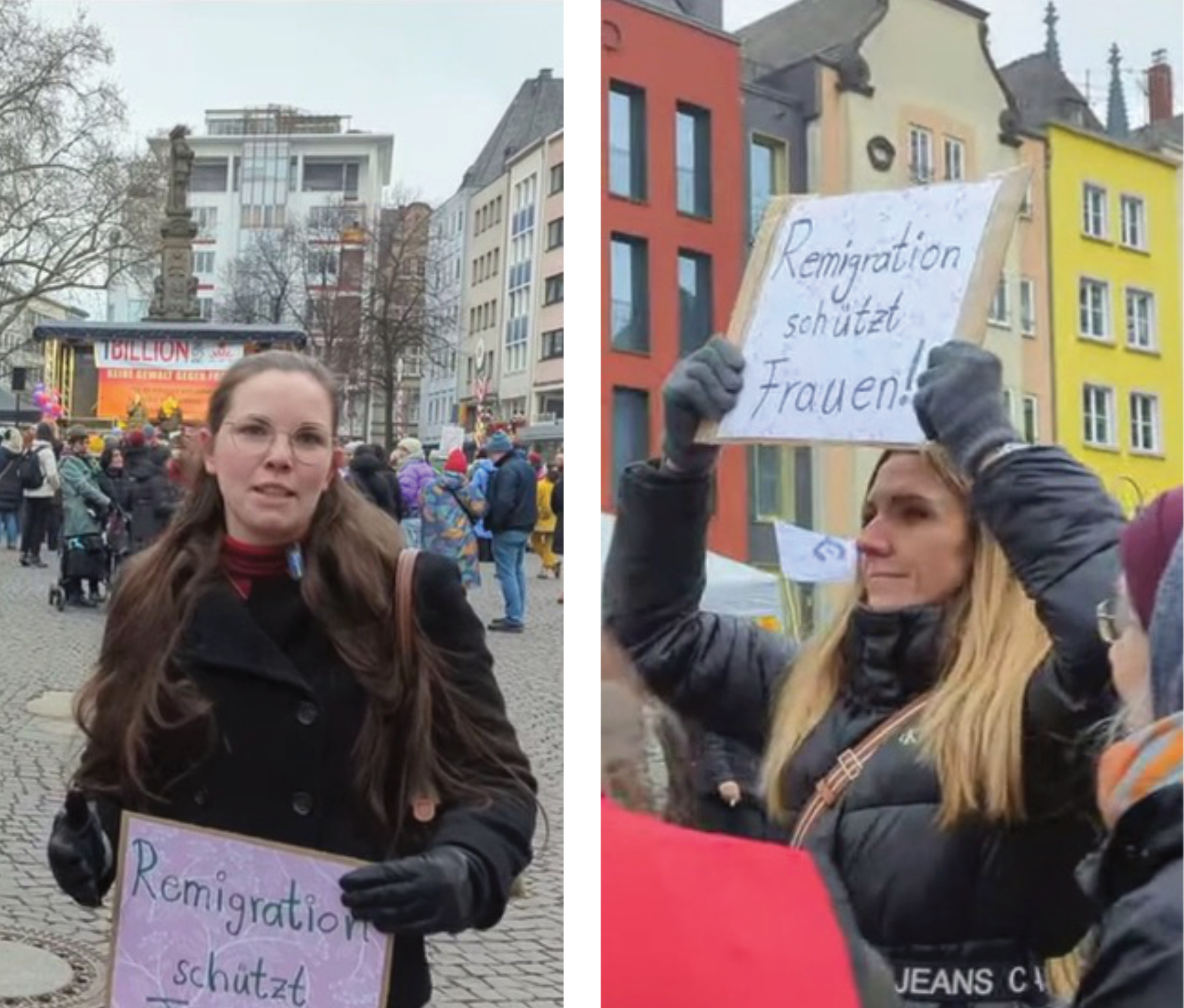
1 | Lukreta, “One Billion Rising”, Instagram Reel, 27 February 2025.
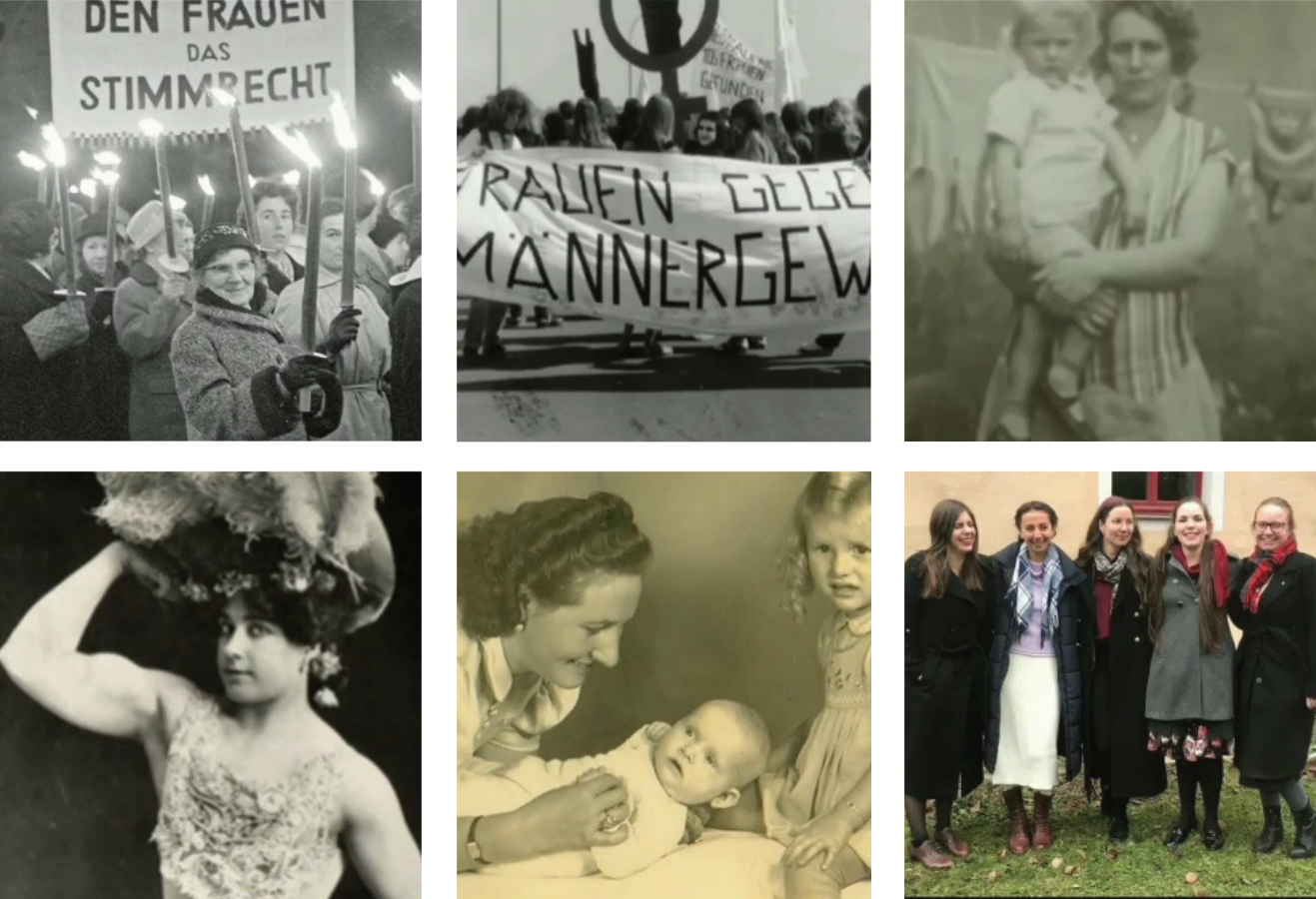
2 | Selected Captions from Lukreta, Instagram Reel on International Woman’s Day, 8 March 2025.
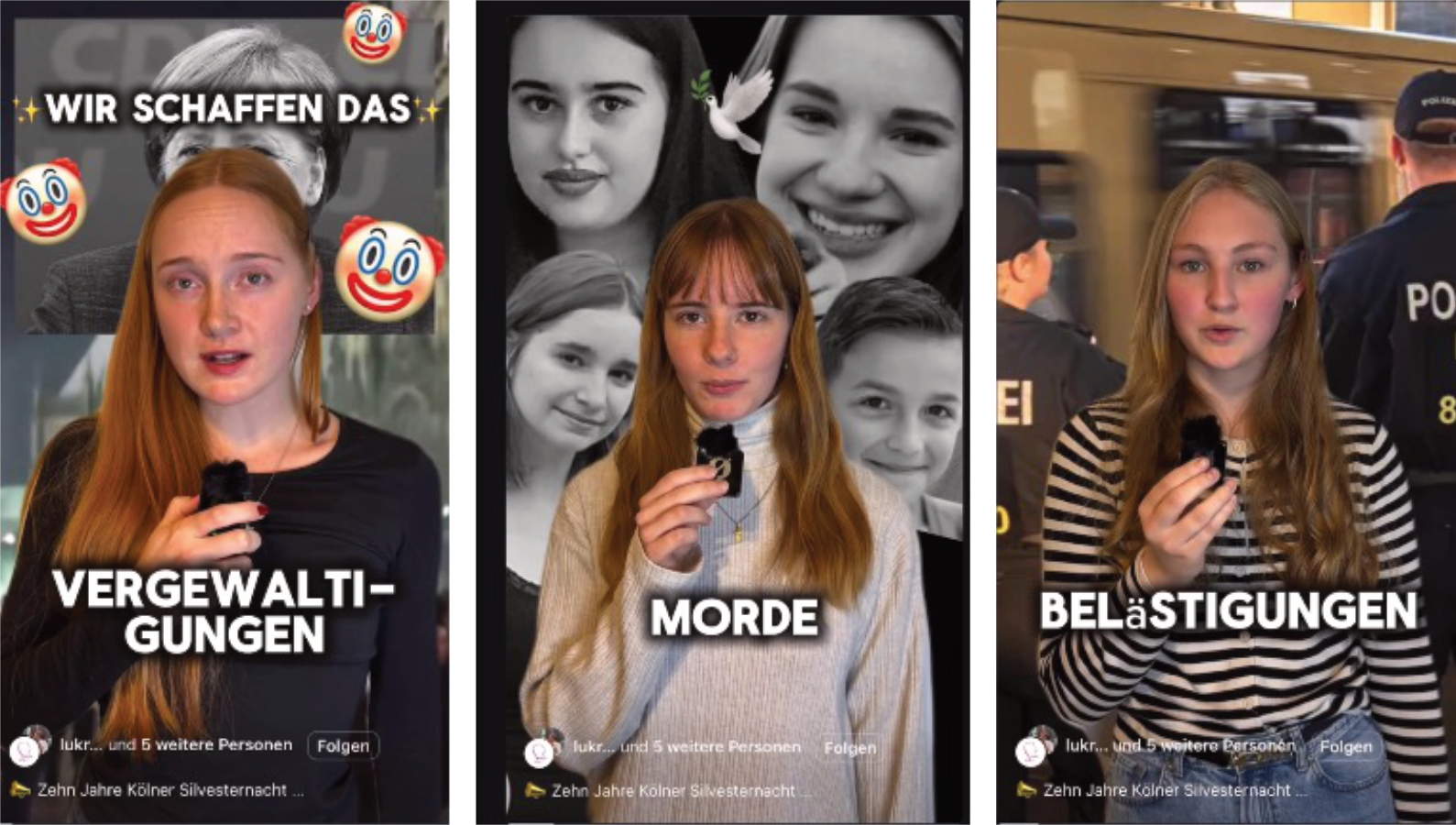
3 | Lukreta, Instagram Reel on International Day for the Elimination of Violence against Women, 25 November 2025.
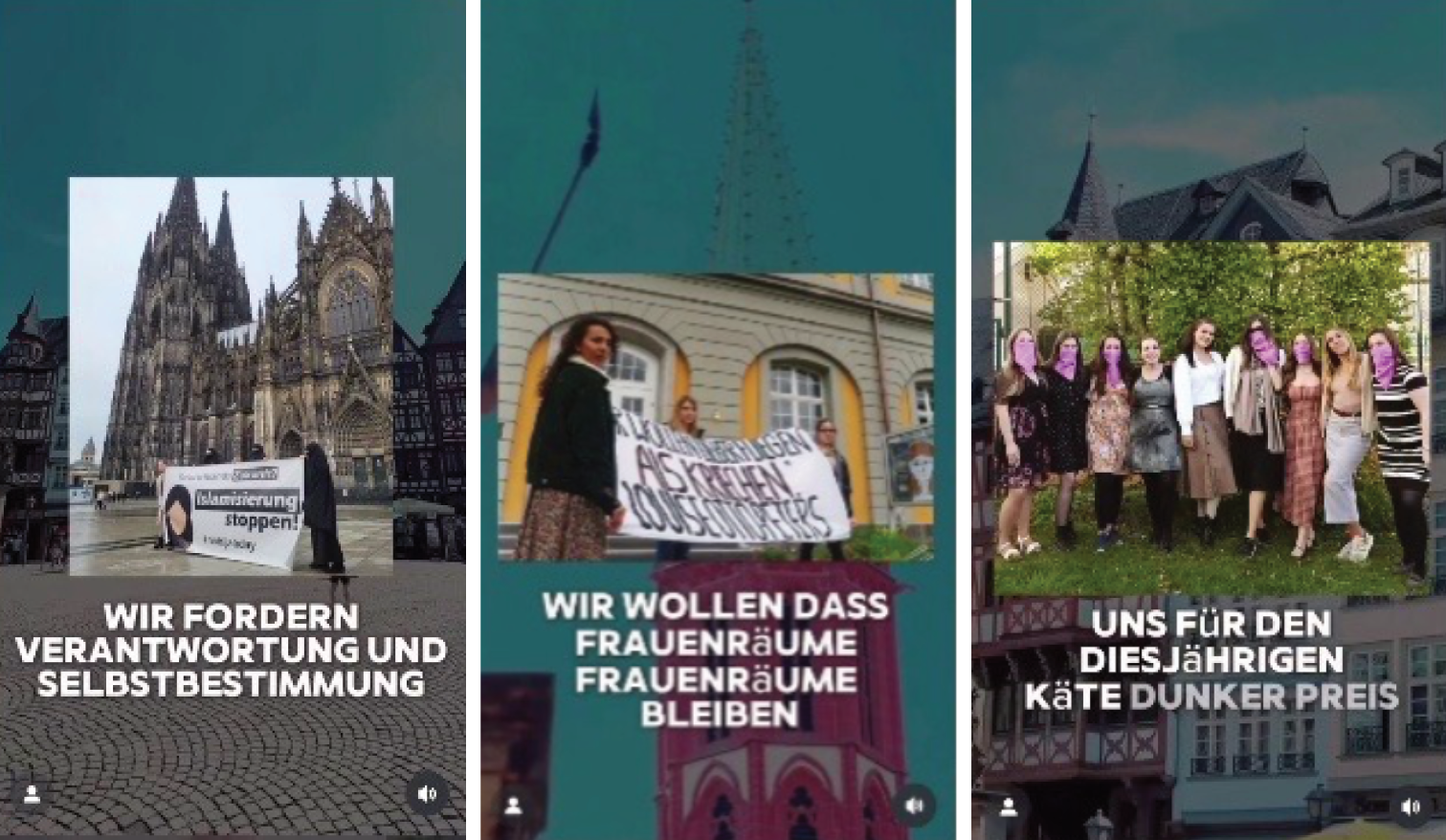
4 | Lukreta, Application for the Käte-Dunker Award, Instagram Reel, 8 May 2025.
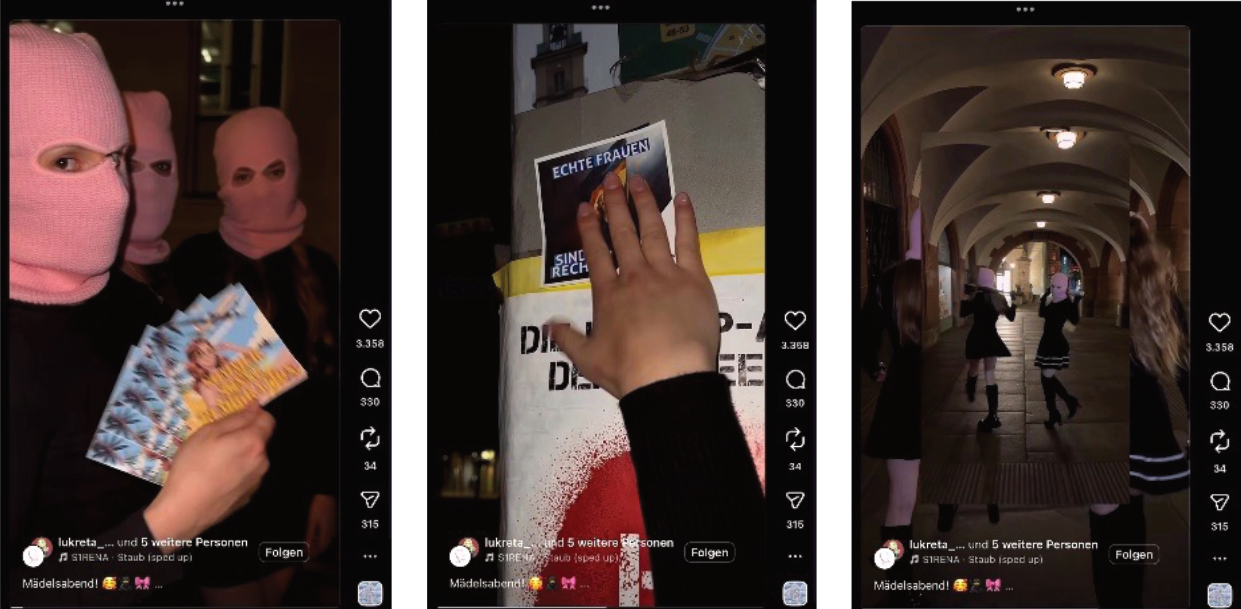
5 | Lukreta, “Mädelsabend” (Girl’s Night), Instagram Reel, 6 August 2025.
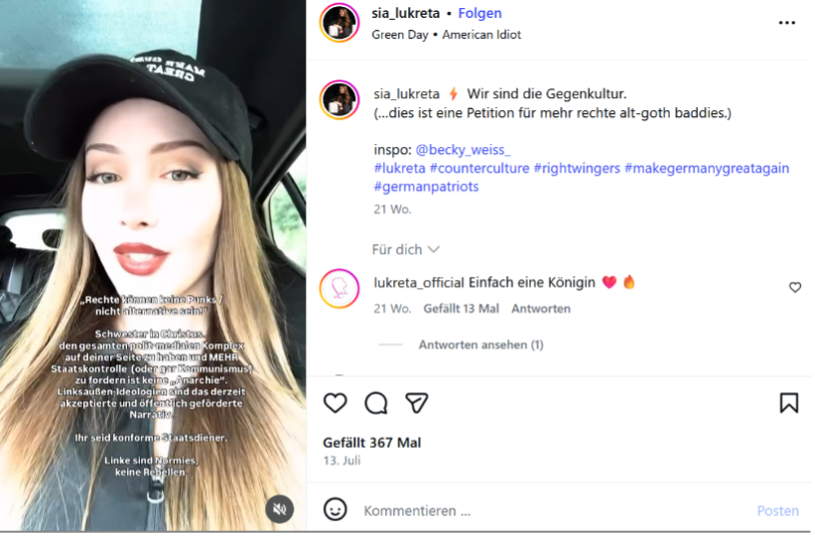
6 | @siavonriva, “We are Counterculture”, Instagram Reel, 7 July 2025.
Shot on vertical smartphone format, the video first shows spokesperson Reinhild Boßdorf holding a poster with the slogan “Remigration protects women”. While the registered rally is taking place in the background, Boßdorf speaks in the foreground in a tone of moral blaming, claiming (without evidence) that there were two gang rapes of women by migrant men every day in Germany and demanding remigration as the only adequate solution. The message of the original feminist event is at the same time exploited and disrupted. This equally applies to the continuation of the video action. It shows how the Lukreta activists approach the participants of the rally and deliberately provoke them with their posters and calls for remigration. The outraged reactions of the local participants are obviously desired and captured on camera. From off-camera a male Lukreta activist can be heard, supposedly trying to engage in dialogue with the feminist demonstrators by offering to talk to them about statistics on violence against women by migrant men. The refusal by the other side in front of the running camera is recorded as evidence of the ideological blindness and moral inconsistency of left-wing feminists. The situationist principle of disrupting public proceedings through provocation is taken up here only in a superficial manner. The main goal is the video-activist documentation of the refusal by their opponents to engage in dialogue. The target audience are the sympathetic platform users, not the feminists demonstrating on site.
Other video campaigns also demonstrate Lukreta’s strategy of superficially confirming processes and forms of recurring events ritualised in civil society, but semantically inverting them through their xenophobic messages. For example, in 2025, the group symbolically appropriated International Women’s Day (8 March) and the UN-established International Day for the Elimination of Violence against Women (24 November).
A video from 8 March 8 2025 (that has been removed from the Instagram-account), shows a collage of historical black-and-white images from the first women’s movement in the nineteenth century, images of self-confident female workers and mothers, charismatic female artists and athletes of the 1920s, and women demonstrating for the acceptance of the miniskirt in the 1960s. Hence it is a heterogeneous mixture that only partially takes into account the actual feminist movements, omitting the influential anti-authoritarian and later ones. Overall, the rather apolitical topos of the ‘self-confident woman’, as well as of proud motherhood, dominates. Parallel to this series of images, a voice-over narrator places the Lukreta group in direct succession of such historical pioneers of female emancipation and self-empowerment. In an appealing gesture, the narrator calls on female viewers to continue this legacy together. After the words “Now it is our turn, of the women of the 21st century, to solve our problems”, white text panels display statements such as: “Germany: Wave of rapes by migrants”, “Islam expert warns of ‘imported’ propensity for violence: What the numbers say” (although no numbers or specific sources are cited), or “It doesn’t get any more patriarchal than the women’s quota” (all translations by the author). In between, supposedly apolitical problems are mentioned, such as TikTok addiction among young women, which is intended to relativize the far-right diagnosis of the times. Clearly the history of female emancipation is completely disconnected from its historical left-wing roots, with the allusive collage of images mixing poses and topoi of female self-confidence with traditional images of women. The associations evoked by these images are semantically anchored in the nationalist discourse by the voice-over commentary. This creates an alternative, distorted vision of feminist emancipation movements, which recontextualizes the early women’s movement politically in right-wing discourse. In terms of camouflage, the right-wing extremist statements on the text panels, which are suggested as factual information, are framed by familiar, historic pictures and are also attributed with a heroic attitude.
On the International Day for the Elimination of Violence against Women (25 November 2025), Lukreta posted an Instagram reel (this video has been removed from the Instagram account but can still be viewed on the YouTube account of Lukreta) that explicitly uses internet-savvy codes to address a young audience on the net.
Presented in vertical format, it shows a collage of several layers of images, with the foreground almost entirely filled with quickly changing portraits of single activists speaking directly into the camera. In the form of a chain of sentences, which the speakers add to alternately, the impression of a collective speaker-subject is created. At the same time, the speakers address their demands to the state and society individually and by showing their faces. In a rhetoric of moral accusation and in adapting to the occasion of the ritualised day of remembrance, they deplore a decade of sexual violence against women by migrant men and crime on German streets as an expression of failed migration policy. Their statements are supplemented by textual tags that frame their faces at the top and bottom, alluding the form of emblems, as they are widely known from net memes. Their verbal statements are thus concisely reinforced by written words such as “rape”, “murder”, or “harassment” and aim for viral memetic effects in the further online circulation of the video. While the political message is thus doubly coded linguistically (verbally and in writing), the layered image collages in the background serve to quickly evoke affective connotations and reactions. The chosen motifs suggest a drastically charged conflict scenario between ‘the state and politics’, ‘female victims’, ‘criminal conditions on German streets’ and – as a reaction to this – ‘activist resistance’ against these grievances at the end. They show the heads of German politicians, black-and-white portraits of women (anonymous ‘victims’), court hearings, police operations on dark streets, and, towards the end, the protesting activists. The fast-paced sequence of shots of the speakers, the use of jerky zooms on their faces, the rapid flow of image collages in the background, as well as the fading in of text tags and stickers create a mash-up aesthetic adapted to the platform. It packages the radical messages in a pop aesthetic. This camouflage not only contributes to the platform’s algorithmically programmed attention principles. At the same time, it promotes the relativisation and normalisation of its racist messages. It is by using the appeal of moral blaming, familiar from civil rights activism and by merging it with popular meme-, and mash-up-styles in online-spheres, the video fundamentally reverses liberal and feminist values in terms of communication guerilla.
In another video action, the group addresses feminists on the left in an even more provocative manner: In an Instagram-Reel from 8 May 2025, it applies for the Käte Dunker Award, which the Left Party awards annually to honour outstanding female personalities and feminist initiatives and associations.
In the style of a civil rights movement, the application video shows images of the activists in front of churches, traditional German house facades, or in summery outdoor shots, intended to evoke connotations of Christian and patriotic ‘engaged citizens’ from the mid of society. This impression merges with the evocation of more combative associations by photos of their symbolic street happenings. With their protest posters at public events such as participating in a demonstration for ‘remigration’, posing in full Muslim veils in front of a swimming pool or in front of Cologne Cathedral (at New Year Eve in 2015, many women have been sexually harassed by men around the Cologne Cathedral, many of them migrants. Since it occurred, this event has been excessively instrumentalised by far-right actors to support their pseudo-feminist and racist claims), they emphasize their combative commitment to women’s rights. Here the guerilla tactics of over-identification is invoked: The publicly proclaimed demand for recognition by the left-wing jury feigns their full identification with core values of feminism, whose liberal emancipatory worldviews are again ignored and replaced within the video by authoritarian and xenophobic claims.
Even more distinctively than the previous examples, the next two videos explore the aesthetics, practices, and codes popular and familiar on online platforms, in a way that is typical for online guerilla warfare. However, these examples also adopt emancipatory forms of protest in an openly provocative way.
In an Instagram reel by Lukreta, framed by the tag “Mädelsabend” (“Girl’s night”) a nocturnal street action is shown in which activists cover anti-fascist stickers in urban spaces with right-wing stickers. These display slogans such as: “Real women are right-wing!” or “Summer, sun, remigration”. Under the slogan “Keep your streets clean!”, they make the anti-fascist claims and images invisible and ‘clean’ the urban space of left-wing slogans against the right (e.g. “No Cops”, “No Nazis”, or “No soccer for fascists”). In this case, the guerrilla practice of street art is appropriated to pepper the infrastructure of public space with short messages that passersby notice even as they go rushing by. This traditionally left-wing practice of street art is not only used here to spread right-wing slogans on the streets. Using the call to ‘clean up the streets’ the activists radically invert the expressive gesture of street art in terms of a right-wing ideology prompting for authoritarian control and censorship in public spaces. This also applies to other forms of protest in the video action, especially its punk underground aesthetic. The activists, who are accompanied by a shaky handheld mobile camera, mostly from behind and in close-up, often blurred shots, wear short skirts and pink Pussy Riot masks.
In some shots, they swing baseball bats over their shoulders, highlighted in slow motion. The left-wing feminist punk group Pussy Riot who are being alluded to had declared war on authoritarian and patriarchal images of women in Russia through situationist disruptive actions in churches and on political stages, but also through their music videos, conveying radical feminist attitudes. Through their presence in international media, especially during their arrests and court proceedings in Russia, they have also made the global public aware of the narrow limits of civil disobedience in their country. By appropriating the iconic Pussy Riot masks and the gesture of symbolically disrupting public space, the Lukreta activists evoke the codes of autonomous, spontaneous, and subversive resistance mentioned above with Kasimov (2025). While the masks originally served to protect against police persecution, when worn on the heads of the Lukreta activists they also suggest the risk of their action being criminalised by the state – which is obviously counter-factual and contrasts with the harmlessness of their sticker campaign. The baseball bats, however, break with left-wing punk aesthetics. They are a symbol of an openly violent neo-Nazi scene in eastern Germany after reunification. On the one hand, then, the video action evokes individualistic and emancipatory connotations in the form of Pussy Riot aesthetics, but also of Slut Walks, known from intersectional feminisms against sexual violence. On the other hand, these are ideologically counteracted by the symbolism of right-wing extremist Nazi violence and the racist slogans on their stickers. This obvious reversal is explicitly relativised in a disclaimer by the group in the comments section. Here, emphasis is placed on the satirical nature of the video, which is claimed not to be a call to violence or to property damage, while also pointing out that the stickers were removed afterwards to ensure the visibility of the left-wing stickers. This is a typical example of online guerrilla warfare by the far right, in which obvious racist and violence-glorifying messages are framed as satire and thus trivialised in the comments section of the posting. This effect is further enhanced by another internet-savvy practice: The video is accompanied by the atmospheric voice of singer S1RENA, who is currently popular on the internet. The fast, synthetic electro-pop rhythmically reinforces the quick cuts and the movements of the activists in the images. In the tradition of music videos and adapted to current video aesthetic trends on online platforms, a vivid mix of images and music is created here, which makes the political messages particularly easy to consume and also corresponds to the algorithmic principles of attention control on the online-platforms.
The combination of internet guerrilla warfare and the alienating appropriation of left-wing protest aesthetics also characterizes a video posted by on the Instagram account of @siavonriva under the tag “We are the counterculture. This is a petition for more right-wing alt-goth baddies”.
The caption already formulates the claim to provoke the general understanding of left-wing counterculture, also by ironically alluding to the activist form of petitions. In addition, the pop-cultural ‘goth baddie’-trend is cited, in which young women confidently present their white-painted faces with dark eye makeup and black hair in gothic style on their online platforms. It seems obvious that the overemphasis on white skin is particularly suitable for the exploitation by right-wing users in order to expressively convey their racist worldview. The short video consists of a loop lasting only a few seconds and shows the creator in selfie format with gothic-style white-lit skin and a black cap. The video selfie is overlaid with a static text that responds to a supposedly left-wing quote at the beginning: “Right-wingers can't be punks/alternative”. This is followed by a response: “Having the entire political-media complex on your side and demanding MORE state control […] is not ‘anarchy’. Far-left ideologies are the currently accepted and publicly promoted narrative. You are conformist servants of the state. Leftists are normies, not rebels” (translation by the author).
The claiming of a hegemony of left-liberal views in the media and the state is provocatively exaggerated here by imitating the terms and linguistic jargon of the anti-fascist left and turning them against themselves. The provocation of a supposedly left-wing self-image is further intensified by the soundtrack. It uses the famous song American Idiot by the punk band Green Day and the line repeated in the video loop: “In television dreams of tomorrow, we’re not the ones who’re meant to follow”. Through this selective appropriation of the song and its audiovisual blending with their nationalist performance, the video completely reverses the originally decisive anti-fascist message of the punk song into its opposite. The lyrics, which are omitted from the video, continue with “I’m not part of a redneck agenda. Now everybody do the propaganda”. In the form of a semiotic appropriation, the rebellious punk attitude of the band is decontextualised and drastically alienated for the performance of its own subversive rebelliousness. This guerilla tactic characterizes the entire video, which copies the language, habitual gestures, and even the music of left-wing counterculture and instrumentalizes it for the propagandistic performance of a supposedly subversive minority counterculture on the far right.
Conclusion
It can be said that the guerrilla tactic of alienating imitation dominates in all of the videos which have been examined. On the one hand, and corresponding to right-wing online guerrilla warfare, the videos exploit popular codes and practices for their own purposes. On the other hand, they mimic and semantically reverse a relatively broad spectrum of left-wing protest symbols, rituals, and attitudes. In terms of femonationalism, the selected videos by Lukreta focus primarily on feminist forms of expression and practices: post-feminist attitudes such as gender equality or women's rights; public practices and rituals of feminist institutions and actors (such as commemorations and ritualized rallies, and award ceremonies), symbolic forms and practices of left-wing protest and subcultures (such as situationist happenings on the street), selfie testimonials with moral appeals (such as the #MeToo movement), left-wing street art, and punk underground styles.
Apart from the mimetic alienation of this arsenal of left-wing protest- and countercultures, the only other frequently used principle that stands out is faking. However, as has already been emphasised above, this is not faking in the sense of emancipatory communication guerrilla warfare according to Eco. Instead, the group regularly spreads defamatory claims against migrants, which only superficially appear to be objective. None of the videos that speak of mass rapes by migrant men provide precise sources. Rather, Lukreta embraces the general tendency in social media described by Paolucci (2023), whereby subjectivity and personal feelings replace objectifiable knowledge. Therefore, the testimonial aesthetic plays an important rhetorical role in performing evidence: References to subjective fears and anecdotal experiences are affectively authenticated in the video selfie format. At the same time, these practices of self-authentication, borrowed from internet culture, represent a downplaying of the more serious act of lying and inflammatory insinuations. This is because in all of these videos the subjective testimonials are linked to generalizing racist insinuations against entire population groups.
While the implementation of principles of left-wing communication guerrilla in the videos of Lukreta is thus limited, the variance of the superficially imitated symbolic forms of left-wing subversion suggests creativity and variety. Accordingly, the redundantly conveyed, simplistic nationalist messages are not only trivialised and normalised by the appropriation of left-wing forms of protest, but also culturally enhanced. However, this effect is likely to wear off in the foreseeable future. The codes of subversion and anti-authoritarian self-empowerment associated with the symbolic arsenal of left-wing counterculture are being emptied of meaning through continuous reversal and re-semantisation with authoritarian and reactionary ideas – especially when they are standardised by the algorithmic dynamics of online platforms.
Bibliographical references
- Baringhorst et al. 2009
S. Baringhorst, V. Kneip, J. Niesyto (eds.), Political Campaigning on the Web, Bielefeld 2009. - Blisset, Brünzels 2001
L. Blisset, S. Brünzels, autonome a.f.r.i.k.a. gruppe (Hrsg.), Handbuch der Kommunikationsguerilla, Berlin-Hamburg/Göttingen 2001. - Bogert, Fielitz 2019
L. Bogert, M. Fielitz (eds.), “Do You Want Meme War?”: Understanding the Visual Memes of the German Far Right, in: Maik Fielitz, Nick Thurston (Hg.), Post-Digital Cultures of the Far Right: Online Actions and Offline Consequences in Europe and the US., Bielefeld 2019. - Calderaro 2025
C. Calderaro, Beyond Instrumentalization: Far-Right Women’s Appropriation of Feminism in France, “Politics & Gender” 21, 4 (March 2025), 931-959. - Cesarino, Nardelli 2021
L. Cesarino, P.H.J. Nardelli, The hidden hierarchy of far‑right digital guerrilla warfare, “Digital War” 2 (2021), 16-20. - De Haan et al. 2025
S. De Haan, P. Henke, K. Kramer, K. Morochnyk, J. Recktenwald, L. Selbmann, C. Welzel, Digitale Praktiken politischer Bekennung und Positionierung: Affordanzanalyse rechter Nanoinfluencerinnen auf Instagram und TikTok, in M. Krug (Hrsg.), Zwischen Hausfrau und Hetze: Rechte Influencerinnen im digitalen Raum, Essen 2025, 59-84. - Debord [1967] 1995
G. Debord, The Society of the Spectacle [La Société du Spectacle, Paris 1967], trans. Donald Nicholson-Smith, New York 1995. - Delicath, DeLuca 2003
J.W. Delicath, K.M. DeLuca, Image Events, the Public Sphere, and Argumentative Practice: The Case of Radical Environmental Groups, “Argumentation” 17 (2003), 315-333. - Drüeke, Klaus 2019
R. Drüeke, E. Klaus, Die Instrumentalisierung von Frauen*rechten in rechten Diskursen am Beispiel der Kampagne #120db, “GENDER – Zeitschrift für Geschlecht, Kultur und Gesellschaft” 3 (2019), 84-99. - Eco [1968] 1986
U. Eco, Towards a Semiological Guerilla Warfare [Per una guerriglia semiologica, in Id., La struttura assente. Introduzione alla ricerca semiologica, Milano 1968], in Id., Travels in Hyperreality, trans. William Weaver, San Diego 1986, 125-132. - Fahlenbrach 2007
K. Fahlenbrach, Protestinszenierungen. Die Studentenbewegung im Spannungsfeld von Kulturrevolution und Medienevolution, in M. Klimke, J. Scharloth (Hrsg.), 1968 Handbuch zur Kultur- und Mediengeschichte der Studentenbewegung, Stuttgart 2007, 11-21. - Fahlenbrach 2025
K. Fahlenbrach, Net icons and memetic imagery of protest in online activism, “Visual Communication” 0,0 (2025). - Fielitz, Thurston 2019
M. Fielitz, N. Thurston (eds.), Post-Digital Cultures of the Far Right. Online Actions and Offline Consequences in Europe and the US, Bielefeld 2019. - Flügel 2022
D. Flügel, Thor von Waldstein: Metapolitik. Theorie – Lage – Aktion, in D. Meiering (Hrsg.), Schlüsseltexte der ›Neuen Rechten‹. Kritische Analysen antidemokratischen Denkens, Wiesbaden 2022, 91-99. - Gensing 2018
P. Gensing, Zwischen PR und Realität. Die Wahrnehmung der Identitären Bewegung durch die Medien, in A. Speit (Hrsg.), Das Netzwerk der Identitären. Ideologie und Aktionen der Neuen Rechten, Berlin 2018, 189-201. - Gerber, Hausladen 2017
T. Gerber, K. Hausladen, Compared to What?: Pop zwischen Normativität und Subversion, Wien-Berlin 2017. - Gerbaudo 2015
P. Gerbaudo, Populism 2.0. Social media activism, the generic internet user, and interactive, direct democracy, in D. Trottier, C. Fuchs (eds.), Social Media, Politics, and the State: Protest, Revolutions, Riots, Crime, and Policing in the Age of Facebook, Twitter, and YouTube, New York 2015, 67-87. - Kasimov 2025
A. Kasimov, Decentralized hate: sustained connective action in online far-right community, “Social Movement Studies” 24,2 (2025), 199-217. - Kero 2023
S. Kero, Jung, weiblich und extrem rechts: Die narrative Kommunikation weiblicher Akteurinnen auf Instagram, “easy_social_sciences” 69 (2023), 28-36. - Kraushaar 2007
W. Kraushaar, Berliner Subkultur Blues, Haschrebellen, Tupamaros und Bewegung 2. Juni, in M. Klimke, J. Scharloth, Joachim (Hrsg.) 1968 Handbuch zur Kultur- und Mediengeschichte der Studentenbewegung, Stuttgart 2007, 261-275. - Krug 2025a
M. Krug (Hrsg.), Zwischen Hausfrau und Hetze. Rechte Influencerinnen im digitalen Raum, Berlin 2025. - Krug 2025b
M. Krug, Rechte Influencerinnen im digitalen Raum, in: Id. (Hrsg.), Zwischen Hausfrau und Hetze. Rechte Influencerinnen im digitalen Raum, Berlin 2025, 1-6. - Lasn 2000
K. Lasn, Culture Jam: How to Reverse America’s Suicidal Consumer Binge – And Why We Must, New York 2000. - Lindemann 2022
M.J. Lindemann, Benedikt Kaiser, Alain de Benoist und Diego Fusaro: Marx von rechts, in Meiering 2022a, 252-263. - Marcora 2024
M. Marcora, “I am a Woman, I am a Mother, I am an Italian, I am a Christian”: A Multimodal Critical Discourse Analysis of Giorgia Meloni’s Femonationalist Communication on Instagram, Uppsala University, 2024 - Meiering 2022a
D. Meiering, (Hrsg.), Schlüsseltexte der ›Neuen Rechten‹. Kritische Analysen antidemokratischen Denkens, Wiesbaden 2022. - Meiering 2022b
D. Meiering, Überblick: ‚Die Linke‘ als Bezugspunkt rechter Identitätspolitik, in Meiering 2022a, 277-281. - Miller-Idriss 2019
C. Miller-Idriss, What makes a Symbol Far-Right? Co-opted and Missed Meanings in Far-Right Iconography, in M. Fielitz, N. Thurston (eds.), Post-Digital Cultures of the Far Right. Online Actions and Offline Consequences in Europe and the US, Bielefeld 2019, 123-136. - Paolucci 2023
C. Paolucci, Pre‐Truth: Fake News, Semiological Guerrilla Warfare, and Some Other Media and Communication “Revolutions”, “Media and Communication” 11/2 (2023), 101-108. - Rafael 2018
S. Rafael, Identitäre im Internet. Von Crowdfunding bis Meme Wars, in A. Speit (Hrsg.), Das Netzwerk der Identitären. Ideologie und Aktionen der Neuen Rechten, Berlin 2018, 127-141. - Sasse 2023
S. Sasse, Verkehrungen ins Gegenteil: Über Subversion als Machttechnik, Berlin 2023. - Speit 2018
A. Speit, APO von rechts? Vorwort, in Id. (Hrsg.), Das Netzwerk der Identitären. Ideologie und Aktionen der Neuen Rechten, Berlin 2018, 9-16. - Steinwender 2025
H. Steinwender, Subversion – ein (unvollständiger) Überblick, in I. Ritzer, H. Steinwender (Hrsg.), Subversion. Was von Medienkritik, Kommunikationsguerilla und dem Aufstand der Zeichen übrigblieb, Wiesbaden 2025, 3-27. - Terizakis, Knopp 2025
G. Terizakis, V. Knopp, Meme als Mittel neurechter Metapolitik. Konzeptuelle Überlegungen zu kommunikativen Mechanismen in der extremen Rechten aus interpretativer Sicht, in K. Denker, N. Nestler (Hrsg.), Digitale Bilderkämpfe: Zur politisch-strategischen Kommunikation mit Memen, Bielefeld 2025, 121-146. - Völlinger 2010
A. Völlinger, Im Zeichen des Marktes: Culture Jamming, Kommunikationsguerilla und subkultureller Protest gegen die Logo-Welt der Konsumgesellschaft, Marburg 2010.
Abstract
Fahlenbrach’s article examines how femonationalist activists in Germany – specifically the group Lukreta – appropriate and reverse left-wing emancipatory forms of protest through communication guerrilla tactics. Drawing on the theoretical frameworks of semiological détournement and femonationalism, the analysis of six Instagram reels published in 2025 reveals how Lukreta mimics feminist protest aesthetics, rituals, and symbols while semantically inverting their emancipatory content with xenophobic and nationalist messages. The paper argues that the standardisation of guerrilla communication techniques within platform economies has facilitated their appropriation by the far right, enabling the normalisation and trivialisation of racist discourse under the guise of feminist activism.
keywords | Femonationalism; Communication guerrilla warfare; Lukreta; Umberto Eco; Guy Debord.
questo numero di Engramma è a invito: la revisione dei saggi è stata affidata al comitato editoriale e all'international advisory board della rivista
Per citare questo articolo / To cite this article: K. Fahlenbrach, Right-Wing Communication Guerilla: Nationalist Détournements of Feminist Protest Performances, “La Rivista di Engramma” n. 233 (aprile 2026).