The Political Iconology of Right-Wing Culture
Editorial of Engramma 233
Jacopo Galimberti, Margherita Picciché, Ivan Pintor Iranzo and Giulia Zanon
Abstract
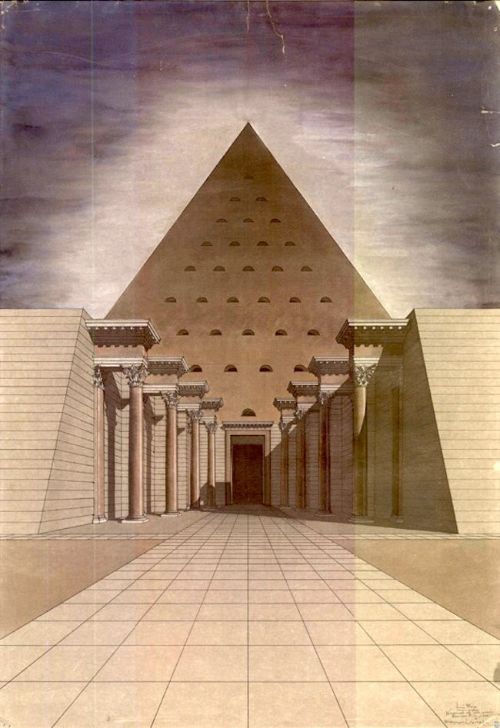
“Dos personas se encuentran en un momento de caos. Son un escultor y un arquitecto. [Después] se agrega un militar. Sienten la necesidad de combatir de un modo espiritual por un orden” [“Two people meet at a moment of chaos. They are a sculptor and an architect. [Later] a military officer joins them. They feel the need to fight, in a spiritual way, for order”]. In December 1936, as Madrid burned under the siege of Franco’s troops and the bombing by the German Junkers 52, the architect Luis Moya, together with the sculptor Manuel Laviada and the Viscount of Uzqueta, designed a monumental funerary complex to be built at the heart of the city: a citadel, a triumphal arch, and a crypt intended to house the tomb of a “Unique Hero”—the sepulcher of victorious power. Moya gave the project the name Sueño arquitectónico para una exaltación nacional. It was 1937, and Francoism was beginning to articulate its aesthetic ideal, embracing evocative forms structured around the conjunction of death, sacrifice, and antiquity as foundational to the legitimation of power. Moya’s pyramid was never built, yet the mystical impulse that informed it endured in the Valle de los Caídos, in the fasces adorning public façades, and in the stone eagles crowning rationalist buildings. These visual elements constitute the aesthetic fabric of Far Right culture that traverse the centuries, periodically resurfacing at the threshold of what Aby Warburg termed the “selective will of time”.
This issue of Engramma confronts this aesthetic-political nexus through the framework of political iconology. The volume reconstructs a line of inquiry that appears in embryonic form in Warburg’s work and was subsequently systematised by Martin Warnke and the Hamburg School, while maintaining a sustained focus on the political imagery of the Far Right, from historical fascism to its contemporary rearticulations.
In so doing, the issue emphasises the intellectual legacy of Martin Warnke, who cultivated a longstanding relationship with Engramma and the Seminario Mnemosyne beginning in 2004 (see Engramma 34, Giornata di studi sull’Atlante. Diario del 19 marzo 2004). His work has been honored by the journal through a commemorative issue (Engramma 171) as well as through the republication of significant essays, including those dedicated to the Warburg Library (see Engramma 198, Die Bibliothek Warburg und ihr Forschungsprogramm) and to Warburg as a scholar of cultural politics (see Engramma 171, Aby Warburg als Wissenschaftspolitiker).
The genesis of the volume was also shaped through two moments of scholarly exchange: the “International Seminar on Political Iconography”, held at Universitat Pompeu Fabra in Barcelona on April 24, 2025, and the conference “Myths of Nation, Economy and the Iconology of the Far Right”, which took place on December 8, 2025, at the Warburg-Haus in Hamburg.
*
“What does right-wing culture mean?”. In the summer of 1979, the Italian weekly “L’Espresso” posed this question to the Germanist Furio Jesi. His answer was unequivocal:
The culture [of the Right is] a culture in which the past is a kind of homogenized mash that can be shaped and maintained in whatever form proves most useful. A culture in which a religion of death—or of exemplary dead—prevails. A culture that declares the existence of incontestable values, designated by words with an initial capital: above all Tradition and Culture, but also Justice, Freedom, Revolution. A culture built, in short, on authority, on mythological certainty about the norms of knowledge, teaching, commanding, and obeying (Furio Jesi, “L’Espresso” 25, June 24, 1979).
Jesi further contended that much of the broader cultural heritage—including that of those who did not identify with the political right—was in fact a residue of right-wing culture, within that logic of reappropriation that led Franco to claim ownership of the thousands of Republican corpses used to fill the Valle de los Caídos. Nearly fifty years after that inquiry, and only a few years after the death of its author, whose intellectual legacy was long neglected but is today attracting renewed scholarly attention, this issue of Engramma takes up, in its own way, the challenge Jesi had posed with uncomfortable clarity concerning the nature of right-wing imagery.
The analytical framework developed throughout this issue draws on political iconology as a Warburgian Nachleben, an inquiry into the afterlife of images across their historical reactivations, while locating its disciplinary articulation in the tradition of the Hamburg School and, most specifically, in the research program defined by Martin Warnke. That program’s reception has, however, been an uneven one, shaped by misreadings and political discontinuities. It was not until 1970, at the Twelfth German Congress of Art Historians in Cologne, that a younger generation of art historians from the Ulmer Verein undertook an initial recuperation of Warburg, in the context of a broader revolt against the established canons of the discipline. A provocative session chaired by Warnke, titled Das Kunstwerk zwischen Wissenschaft und Weltanschauung, offered a critical assessment of the tendency within art history to subordinate the individual artworks to overarching ideological or collective frameworks.
It was nonetheless from this crucible of ideas and conflicts that two of the most consequential figures for both Warburg studies and Political Iconology would emerge: Warnke, appointed professor at the University of Marburg that same year, and his student Horst Bredekamp. Over the following decade, art historians returned to Warburg with renewed intensity, a process that culminated in definitive institutional recognition at the 1990 International Conference on Aby Warburg. That same year, Warnke was awarded the Leibniz Prize, which enabled him to establish the “Forschungsstelle Politische Ikonographie” at the Warburg-Haus in Hamburg. This initiative was designed both to reestablish a physical connection with the sites of Warburg's original research and to develop his legacy in its most explicitly political dimension. It was within this context that Politische Ikonographie took shape as a formal disciplinary field, producing foundational research instruments such as the Image Index to Political Iconography and, later, the Handbuch der Politischen Ikonographie, edited by Warnke together with Uwe Fleckner and Hendrik Ziegler—works that mark a turning point in the systematic study of the field.
By way of methodological introduction, the issue presents the first translation into Italian, English and Spanish of Martin Warnke’s 1993 text Politische Ikonographie. The text—one of the (unfortunately) few sustained contributions Warnke devoted specifically to the subject—examines the concepts of Schlagbild and the public sphere, both of which are necessarily central to any rigorous analysis of political imagery. This is followed by Notes on the Concept of Schlagbild, by Margherita Picciché, reconstructing the genealogy of political iconography in twentieth-century German art history, with particular attention to the theoretical and methodological legacy of the Hamburg School, of which Martin Warnke was one of the leading scholars.
The issue is then divided into three sections: Myths and (Un)truths, Crowded Masses, Far Right Bodies.
Myths and (Un)truths
The first section traces the ideological roots of myth in the visual politics of the contemporary Right, drawing on intellectual history and image theory. In Not True, but Right. Falsity and Inaccuracy as Political Visual Strategy, Emanuele Arielli addresses a problem that runs through the entire section: the strategic function of falsity in right-wing visual political communication. By introducing the concepts of “emblematic evidence” and “synthetic indexicality”, Arielli shows how manipulated, decontextualized, or AI-generated images do not fail for lack of veracity but function precisely as pseudo-proofs confirming pre-established ideological narratives. In Mito, simbolo, antichità. Bozza per uno studio sulla personalità nella storia a partire dagli scritti di Julius Evola, Irene Galuppo reconstructs the figure of Julius Evola—“a figure with whom no one has yet properly settled accounts”, in Furio Jesi’s own words—showing how his thought operates as an iconographic reservoir for the global Far Right, from Steve Bannon to Alessandro Giuli. In Le anime nere. Il mito dell’eroe e le radici di un’egemonia, Nicolas Martino shifts the focus to an apparently distant terrain—the Japanese anime that reached Italian screens in the late 1970s—arguing that the myth of the solitary anti-modern hero embodied by Captain Harlock shares the same Romantic matrix as bourgeois individualism, and that the anti-liberal Right and economic liberalism grow from the same cultural substrate. In La blanquitud de Apolo. La supervivencia de la Antigüedad clásica en la cultura visual de la Alt-Right, Luis Vives-Ferrándiz Sánchez examines how specific models of classical statuary—above all the Apollo del Belvedere—have been mobilized from the eighteenth century onward as ideological instruments for theorizing racial categories of masculine beauty and bodily perfection, tracing their appropriation as visual and ideological supports for the legitimation of Alt-right racial doctrine. In The Aesthetics of Technofascism. From Apocalypse to Milk and Mar-a-Lago-Makeovers, Kathrin Rottmann and Friederike Sigler extend this logic to the aesthetics of contemporary American technofascism: from incarnations of apocalyptic masculinity to the trad wife as a hyper-digitized performance of a völkisch nature that never existed. Thomas Helbig closes the section with A Magical Aid to Experience. Warburg’s Use of Film as an Object of Political Iconology, tracing an arc from Warburg’s analysis of the LUCE documentary on the 1929 Lateran Conciliation to the contemporary mechanisms of AI-slop and social media, and showing how Warburg had intuited in the cinematic apparatus a “magical aid to experience” capable—through critical analysis—of subverting the very propagandistic intentions it served to convey.
Crowded Masses
The second section shifts attention from the individual image to the collective body—the masses that structure the visual politics of the right. In Downloading Martyrs. Turkey’s Commemoration Campaign for the Failed Coup Attempt of July 15, 2016, Elif Akyüz documents how the Turkish government transformed the failed coup of July 2016 into an inexhaustible iconographic reservoir, reversing its political sign to affirm and consolidate preexisting power. In A Neoliberal Caspar David Friedrich. The AfD’s Ethnoscape, Jacopo Galimberti analyzes AfD communication through a close reading of an Alice Weidel campaign video, showing how the German Romantic landscape—Waldeinsamkeit, the forest as locus of völkisch identity—is reactivated as the illegitimate and incoherent inheritance of a national bourgeoisie incapable of producing its own aesthetics and compelled to appropriate those of others. In False Flags? Semiotic Operations and Assemblages of (Neo) Fascist Propaganda and Protest, Tom Holert examines the semiotic operations of flags in the contemporary Far Right, showing how the legal prohibition of the swastika has generated a substitute creativity that navigates the boundaries of the unconstitutional with a tactical agility that regulations struggle to keep pace with. In The Visual Politics of ‘Danishness’ and the Mainstreaming of Xenophobia in Danish Party Politics, Mikkel Bolt Rasmussen reconstructs the mainstreaming of xenophobia in Danish party politics—rooted in Islamophobia and sustained by images expressing a ‘Danishness’ that is fundamentally agrarian and kitsch.
Far Right Bodies
The third section approaches the question from the perspective of the body as a surface of ideological inscription. In Surface Derangement. Preliminary Notes for an Inquiry into Trumpian Imagery Luka Arsenjuk and Mauro Resmini analyze Trumpism as a politically disarticulated spectacle. Drawing on Walter Benjamin, Furio Jesi, and Gérard Wajcman, they argue that Trumpian "iconorrhea"—the deluge of AI- and social-media-generated images to which we are constantly exposed—is not the aestheticization of a recognizable politics but rather a seriality stripped of myth: a “continuous crisis” that replaces the dialectical temporality of historical fascism with the logic of capitalist discontinuity. In Far Right Virilities in Digital Spaces. Analysing The Masculine Aesthetics of Matteo Salvini and Jair Bolsonaro, Erica Capecchi analyzes the digital masculinity of Matteo Salvini and Jair Bolsonaro as a deliberate aesthetic construction—specifically, the figure of the Capitano as a dispositif that fuses the image of the man of the people with that of the virile authoritarian leader. In Right-Wing Communication Guerilla. Nationalist Détournements of Feminist Protest Performances, Kathrin Fahlenbrach examines the femonationalist détournement of feminist protest forms by the German group Lukreta, showing how the tactics of communication guerrilla are appropriated and semantically reversed—transforming the vocabulary of emancipation into a vehicle for xenophobic and racist messages normalized by the aesthetics of digital platforms. In Soldiers of Lights. Food, Self-optimization, and the Contemporary Far Right, Clio Nicastro extends the analysis to the terrain of food and wellness, showing through the documentary Soldiers of Light (2025) how practices of diet, fasting, and bodily self-optimization become a symbolic system of belonging and exclusion.
The issue closes with Nicole Coffineau’s Hillbilly Split. A critical viewing of Hillbilly Elegy (Netflix, 2020) which reads the film on the life of J.D. Vance as a narrative apparatus and argues that its lack of psychological and social depth is precisely the condition of its political efficacy—its cinematic failures helping to account for its broader political utility.
Abstract
Engramma 233 examines how the contemporary Far Right, lacking a genuinely new political imaginary, consistently reactivates a repertoire of visual survivals. The issue presents the first translation into Italian, English, and Spanish of Martin Warnke's Politische Ikonographie (1993), with some Notes on the Concept of Schlagbild by Margherita Picciché, examining the concepts of Schlagbild and the public sphere. The issue is organized into three sections: Myths and (Un)truths, Crowded Masses, Far Right Bodies. Myths and (Un)truths traces the ideological roots of myth in the visual politics of the contemporary right, through contributions by Emanuele Arielli (Not True, but Right), on the strategic function of falsity in right-wing visual communication; Irene Galuppo (Mito, simbolo, antichità), on Julius Evola as iconographic reservoir for the global Far Right; Nicolas Martino (Le anime nere), on the shared Romantic matrix of anti-liberal right and economic liberalism; Luis Vives-Ferrándiz Sánchez (La blanquitud de Apolo), on classical statuary as ideological support for Alt-right racial doctrine; Kathrin Rottmann and Friederike Sigler (The Aesthetics of Technofascism), on contemporary American technofascism from apocalyptic masculinity to the trad wife; Thomas Helbig (A Magical Aid to Experience), on Warburg’s analysis of LUCE video on La conciliazione and its relevance to AI-generated media. Crowded Masses shifts attention to the collective body, through contributions by Elif Akyüz (Downloading Martyrs), on Turkey’s iconographic exploitation of the failed 2016 coup; Jacopo Galimberti (A Neoliberal Caspar David Friedrich), on the AfD’s reactivation of German Romantic landscape imagery; Tom Holert (False Flags?), on the semiotic creativity generated by the legal prohibition of the swastika; Mikkel Bolt Rasmussen (The Visual Politics of ‘Danishness’), on the mainstreaming of xenophobia in Danish party politics. Far Right Bodies approaches the body as a surface of ideological inscription, through contributions by Luka Arsenjuk and Mauro Resmini (Surface Derangement), on Trumpian ‘iconorrhea’ as a seriality stripped of myth; Erica Capecchi (Far Right Virilities in Digital Spaces), on the digital masculinity of Matteo Salvini and Jair Bolsonaro; Kathrin Fahlenbrach (Right-Wing Communication Guerilla), on the femonationalist détournement of feminist protest forms; Clio Nicastro (Soldiers of Lights), on diet and bodily self-optimization as a symbolic system of Far Right belonging. The issue closes with Nicole Coffineau’s Hillbilly Split, reading the series Hillbilly Elegy (Netflix, 2020) as a narrative apparatus whose cinematic failures are the very condition of its political efficacy.
keywords | Political Iconology; Martin Warnke; Donald Trump; Caspar David Friedrich; AfD; J.D. Vance; Julius Evola; Peter Thiel; Jair Bolsonaro; Dansk Folkeparti; Captain Harlock.
Per citare questo articolo / To cite this article: J. Galimberti, M. Picciché, I. Pintor Iranzo, G. Zanon, The Political Iconology of Right-Wing Culture. Editorial of Engramma 233, “La Rivista di Engramma” 233 (aprile 2026).